
Engineering comparison · Pressure testing · RFQ
API 598 and ISO 5208 both govern aspects of industrial valve pressure testing, but their test schedules and acceptance requirements cannot be assumed equivalent. A shell test assesses the pressure boundary; a closure test evaluates sealing across the closed valve under defined conditions. For an RFQ, engineers and buyers should identify the applicable product standard, test edition, medium, pressure, duration, seat design, leakage limit, test direction and required evidence before accepting a supplier quotation or test certificate.
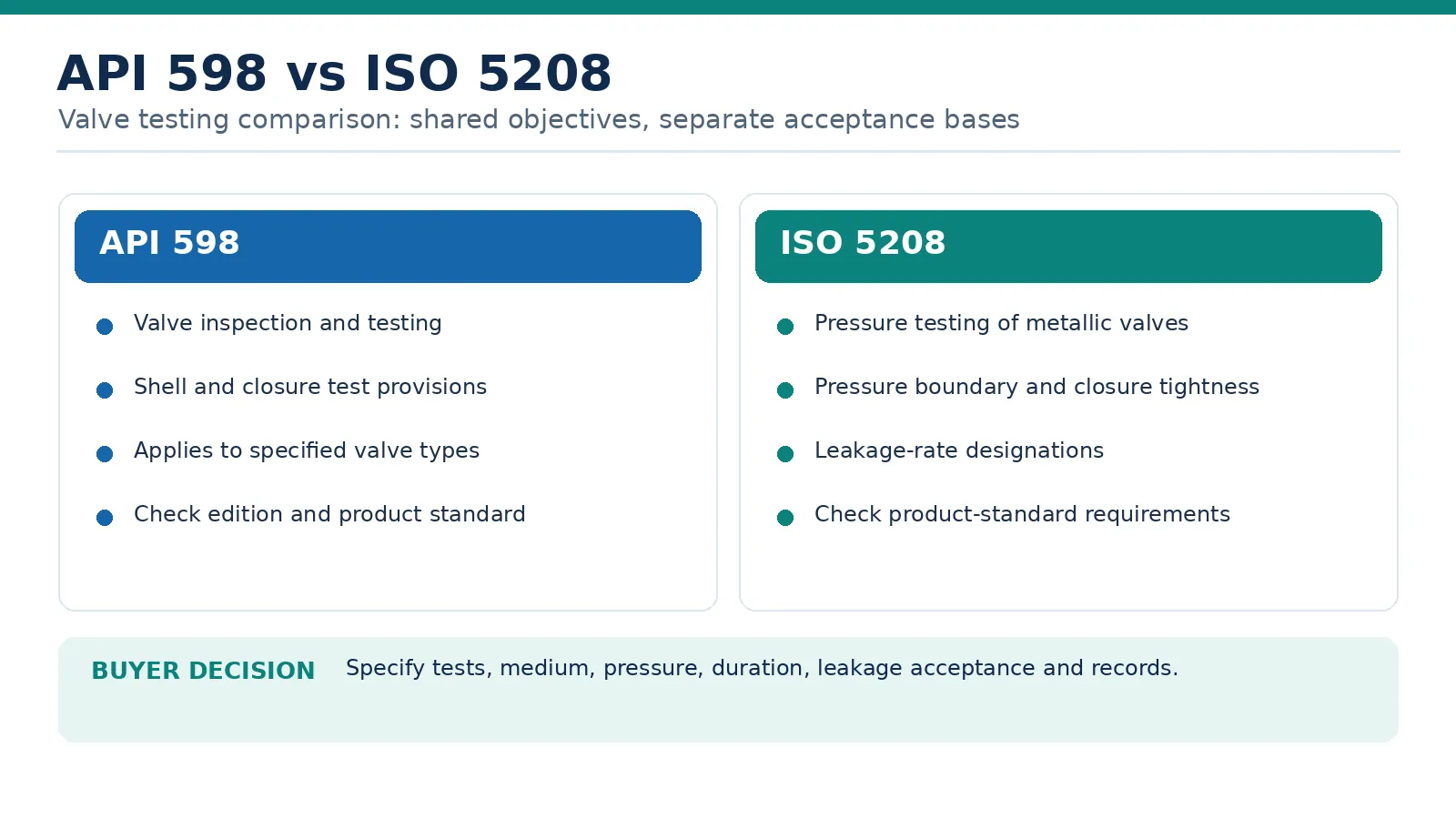
1. API 598 vs ISO 5208: Key Differences at a Glance
API 598, Valve Inspection and Testing, addresses inspection, examinations and pressure tests for valve types within its scope. ISO 5208, Industrial valves — Pressure testing of metallic valves, provides a pressure-testing framework for metallic industrial valves, including pressure-boundary integrity and closure tightness. Both must be applied with attention to the relevant valve design and governing requirements.
| بند المراجعة | API 598 | ISO 5208 |
|---|---|---|
| Document | Valve Inspection and Testing | Industrial valves — Pressure testing of metallic valves |
| Edition used for this overview | 11th edition (2023) | ISO 5208:2015 |
| حدود الضغط | Applicable shell testing provisions | Pressure-boundary testing provisions |
| Closure tightness | Closure testing and acceptance as applicable | Closure testing and designated leakage acceptance as applicable |
| Valve applicability | Specified industrial valve types and constructions | Metallic industrial valves within scope |
| Product standard | Check which product standard and project requirements invoke the test | Use together with applicable valve product standards; verify differences |
| Procurement implication | Specify edition, applicable tests and acceptance | Specify edition, applicable leakage designation and acceptance |
The presence of a similar test name does not prove equivalent test conditions. This is why technical bid comparison must examine the supplied procedure and test records, not only the standard number on a datasheet. For a wider overview, see Raymon Valve’s industrial valve standards guide.
2. What Do API 598 and ISO 5208 Actually Cover?
API 598: Valve Inspection and Testing
API 598 covers inspection and testing requirements for applicable gate, globe, plug, ball, check and butterfly valve constructions, including relevant resilient-, nonmetallic- and metal-seated designs. Test obligations depend on the particular valve type and the governing product and purchase requirements. Shell testing, closure testing, and backseat testing where relevant should be identified separately.
ISO 5208: Pressure Testing of Metallic Valves
ISO 5208 addresses the integrity of the pressure boundary, degree of closure tightness and structural adequacy of the closure mechanism. It is intended to operate in conjunction with the relevant valve product standard. The applicable product standard may impose requirements that differ from the general testing framework, so engineers need both documents rather than treating the testing standard as a complete valve specification.
Product Standards and Contractual Requirements
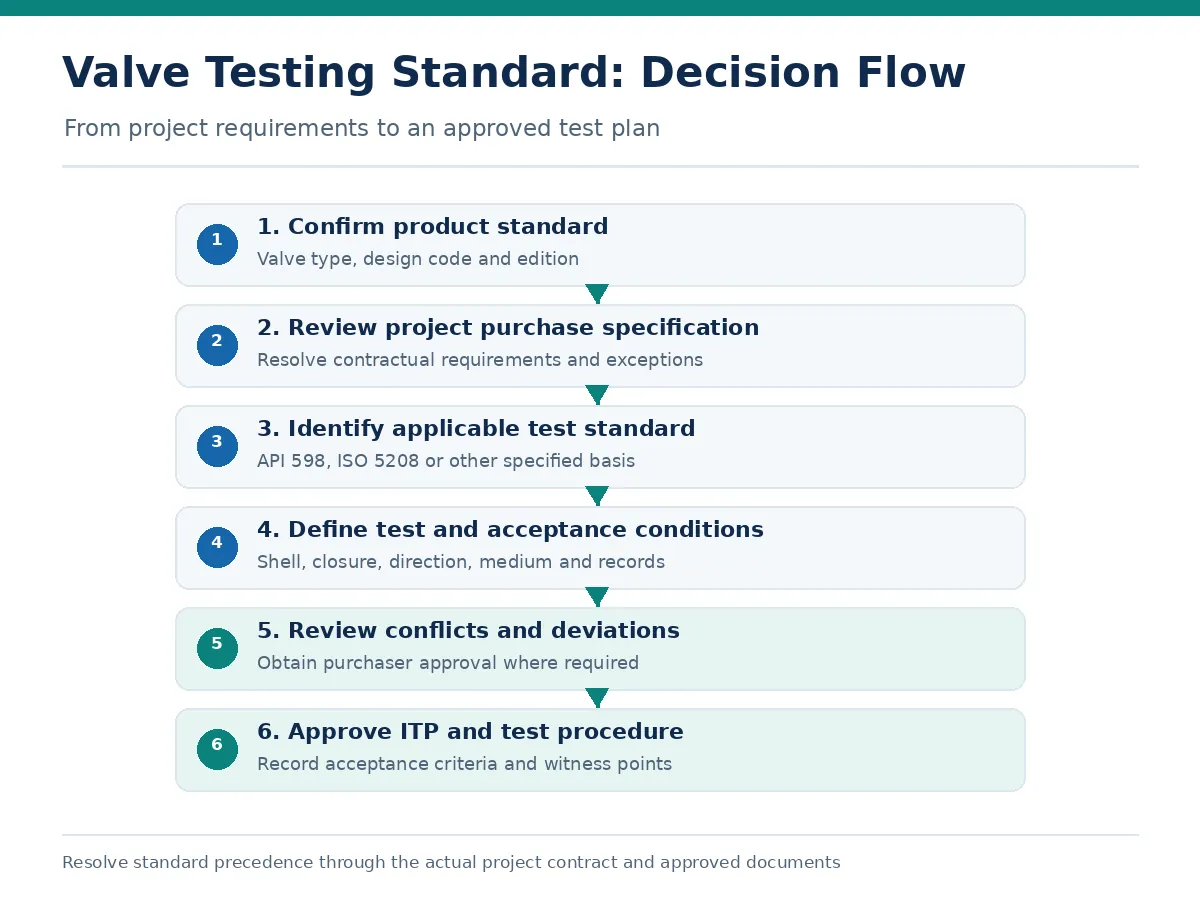
Standards such as API 600, API 602, API 608, API 609 or API 6D—and applicable ISO valve product standards—may be relevant depending on the purchase. They do not all establish identical test requirements. The buyer should record the specified editions, determine which requirements are invoked and resolve document conflicts under the project’s contractual precedence rules. Do not assume that referring to API 598 or ISO 5208 overrides the product standard.
For applicable industrial gate valves, review the proposed valve construction alongside the governing product standard and its inspection requirements; the product category alone does not establish the test acceptance basis.
Source boundary: The ISO 5208:2015 official abstract states that the document is applied with valve product standards to the extent normatively referenced and that differing product-standard requirements apply. Any separate contract document-precedence rule must be confirmed in the project purchase specification; it should not be inferred from this general ISO statement.
3. Shell Test Requirements: Pressure-Boundary Integrity
A shell test evaluates the pressure-containing boundary under specified conditions. The test may include the body, bonnet or cover and pressure-retaining connections, as applicable to the valve construction. It assesses unacceptable external leakage under the prescribed test procedure; it is not an acceptance test for leakage past the valve’s closed seat.
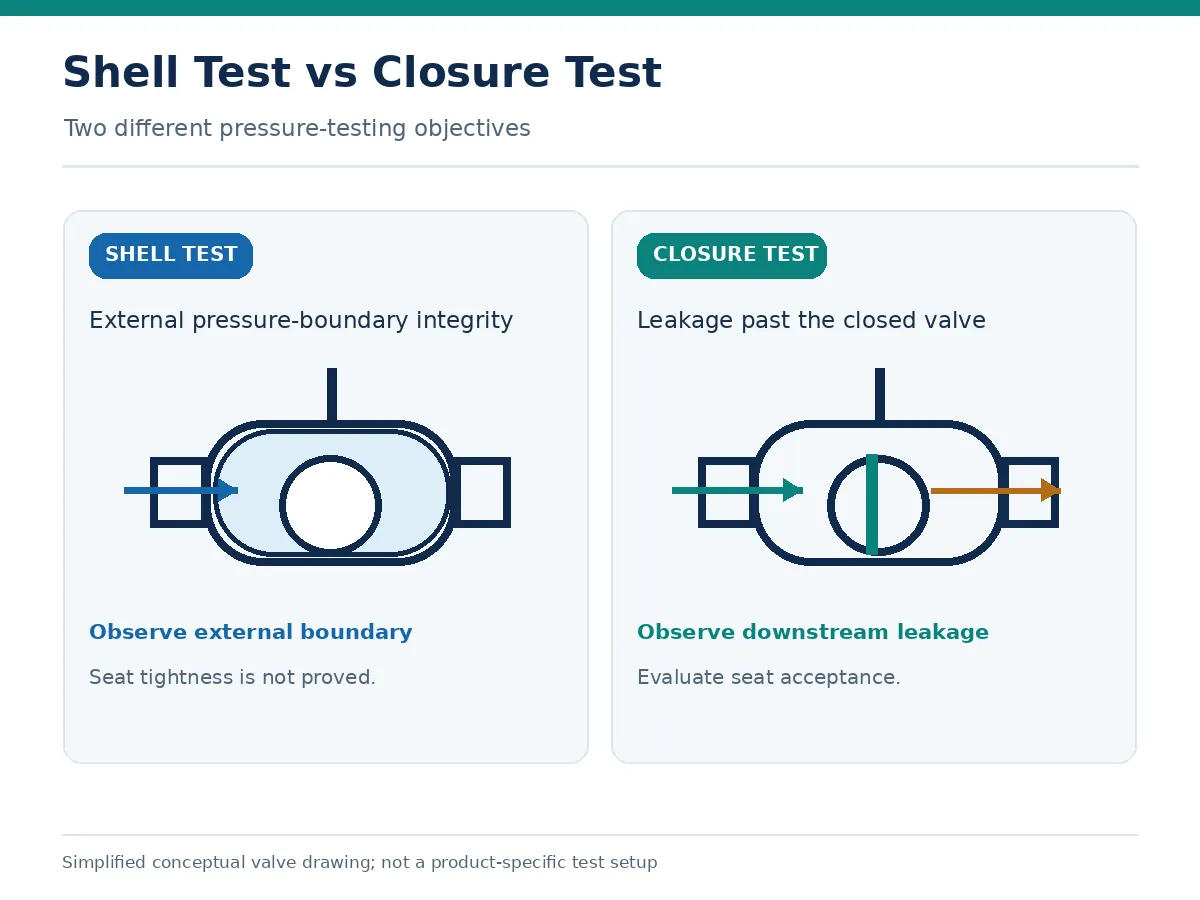
To evaluate a test report, confirm the required test medium, pressure and rating basis, temperature where relevant, minimum holding time, valve configuration, venting and instrumentation. Any test pressure multiplier must be justified against the applicable standard and specified valve rating rather than copied into every RFQ without review.
Example — shell test report gap: A vendor submits a signed “hydrostatic test passed” certificate, but the document does not identify the tested unit or actual holding time. The problem is not necessarily a failed test; it is insufficient evidence for the specified acceptance. Match the valve identification to the purchase documentation, request the recorded test conditions and do not release the inspection hold point until the ITP requirements have been met.
Shell Test Report: What to Verify Before Acceptance
| الدليل | سؤال المراجعة | Potential hold-up |
|---|---|---|
| تحديد الصمام | Does the report uniquely match the ordered valve and pressure boundary? | Untraceable batch-only record where unit traceability was required. |
| Pressure basis | Is the stated test pressure based on the correct governing standard and rating? | Unexplained pressure multiple or unit conversion. |
| Actual results | Are medium, applied pressure, duration and leakage observation recorded? | Only a generic “hydro passed” statement. |
| Instrumentation | Is calibration evidence available as specified by the ITP? | Expired or untraceable instrument details. |
4. Closure Leakage Testing: Seat Tightness and Test Direction
Closure testing evaluates leakage past the closed valve. Depending on the applicable standard and product specification, the method may involve lower-pressure gas testing, higher-pressure liquid testing, or other prescribed conditions. These methods are not freely interchangeable. Their acceptance criteria must be associated with the specific medium, pressure, time and observation or measurement method.
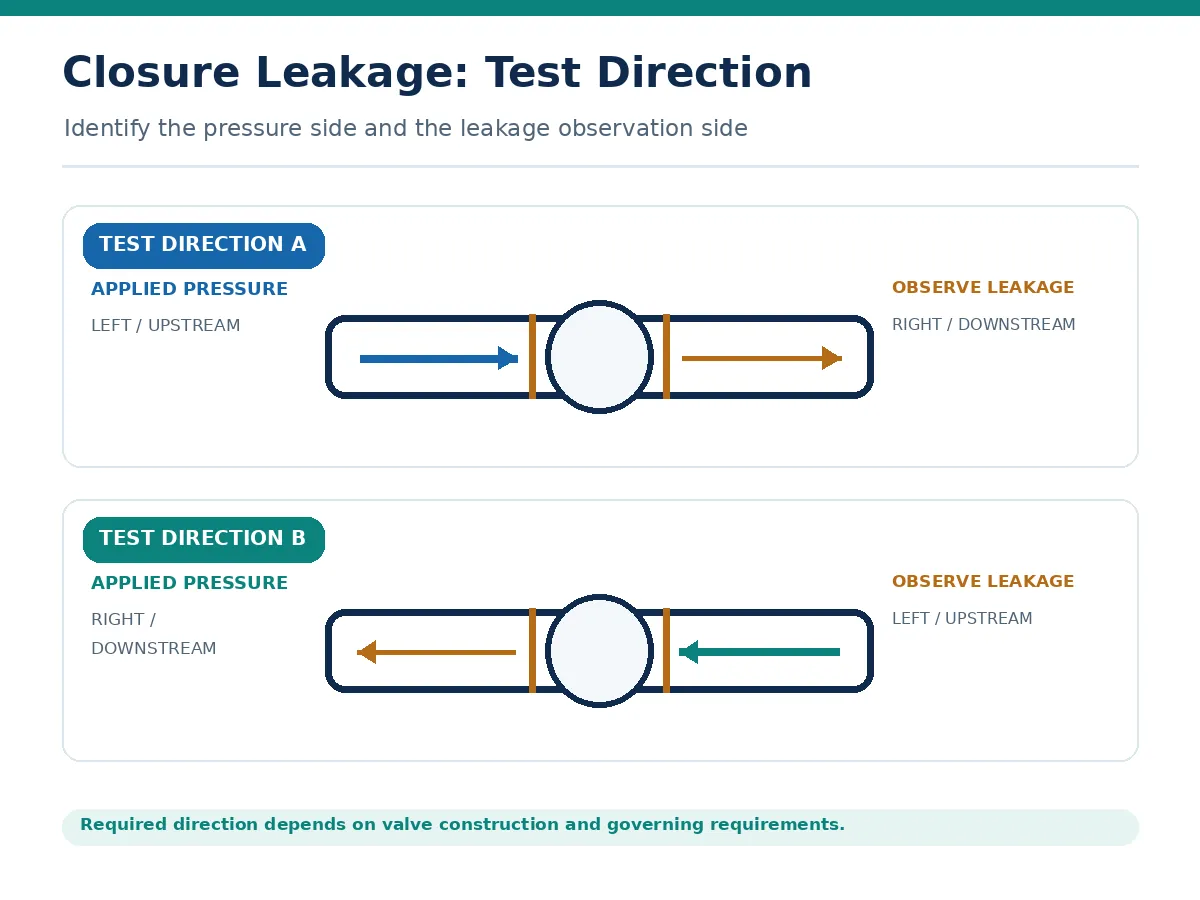
Example — directional seat assumption: A bid describes an isolation valve as bidirectional, yet the supplied closure report shows only one pressurization direction. This is a documentation gap if the project specifies testing from both sides. Confirm the valve seat configuration, the required directions and the actual report results instead of inferring acceptance from the product description alone.
Test Direction and Seat Construction
Some valves have direction-dependent sealing behavior; other designs may require documented performance from more than one direction. Test direction must reflect the actual construction and purchase requirements. A description such as “bidirectional” does not, on its own, establish that both pressure directions were tested. For pressure-assisted seat systems, cavity-pressure management and test setup require particular attention.
What the Closure Test Report Should Record
Useful records identify the valve tag or serial number; product and test standards and their editions; seat construction; medium, applied pressure and duration; test direction; required leakage acceptance; actual leakage or prescribed observation; and the result and witness identity where relevant. Quantitative limits should be supported by recorded measurement data when required.
5. API 598 vs ISO 5208 Leakage Acceptance Criteria
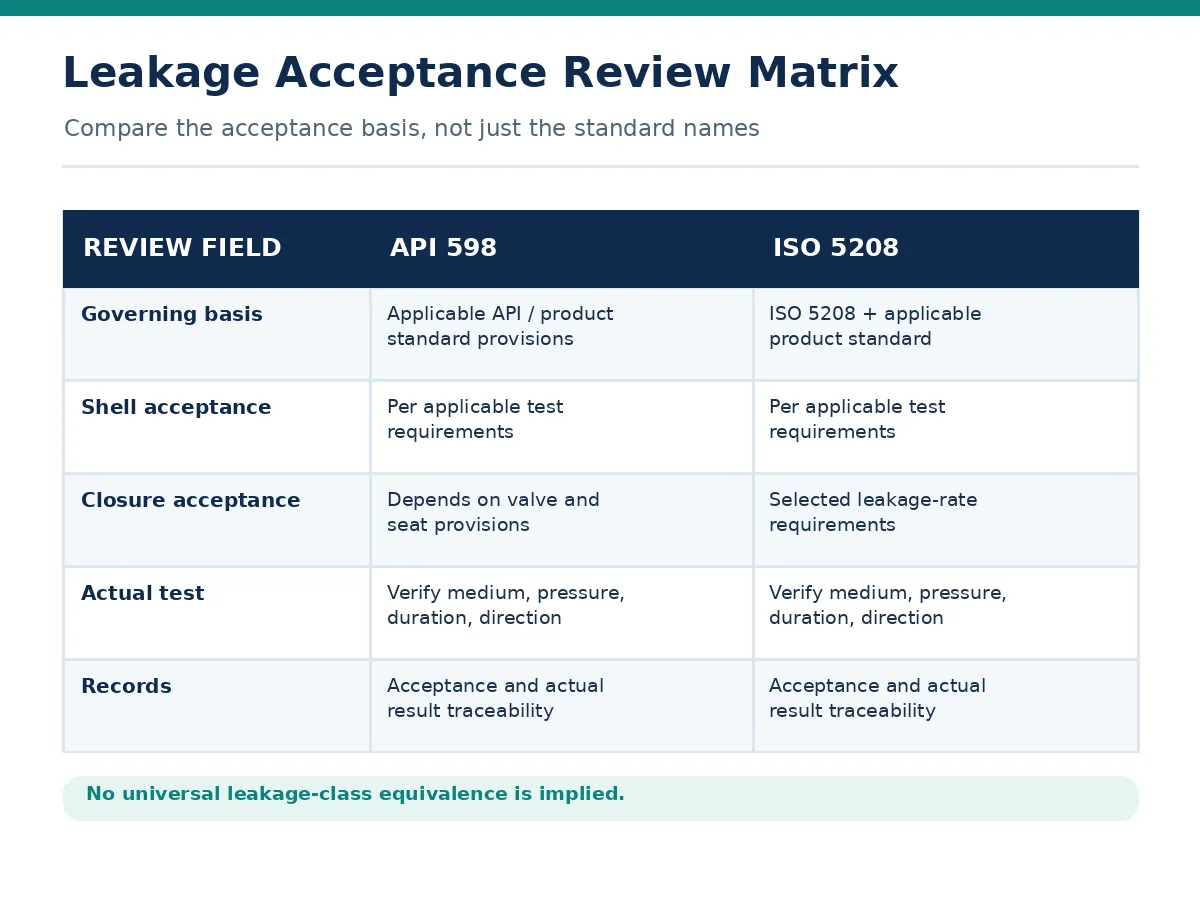
Closure leakage acceptance must be evaluated under the applicable product standard, test standard edition and purchase specification. API 598 establishes relevant acceptance requirements for the applicable valve and seat construction. ISO 5208:2015 provides closure leakage-rate designations, but the designation alone does not establish a contractual requirement for a particular valve. The rate selected, observation method, test medium, pressure, duration and test direction must all be consistent with the governing specifications.
Do Not Convert Leakage Classes Automatically
Descriptions such as “tight shutoff,” “bubble-tight” or “zero leakage” cannot replace a properly specified test method and acceptance criterion. Differences in test medium, pressure, observation method, nominal size basis and time can make numerical results incomparable. A supplier’s statement that an ISO 5208 test passed does not by itself show that the originally specified API 598 acceptance basis was met, and vice versa.
If a project asks for more restrictive seat tightness, the buyer should specify how it will be measured and require manufacturer confirmation of feasibility for the proposed valve construction. Do not infer a universal leakage limit solely from the phrase “metal seated” or “soft seated.”
Acceptance boundary: A statement of “Rate A” or “bubble-tight” is meaningful only with the edition, test method and applicable valve/product requirements. It should not be expanded into a guarantee of no leakage at every operating temperature, process pressure or direction. If the submitted record lacks the measuring or observation basis specified by the purchase specification, request clarification before approval.
Worked RFQ Review Scenario: Metal-Seated Isolation Valve
Illustrative procurement scenario—not a Raymon Valve project or product test: The EPC purchase specification requires an ISO 5208 closure test with a defined leakage acceptance designation and test direction for a metal-seated isolation valve. Supplier A quotes a different test basis under API 598, while Supplier B explicitly references the specified ISO 5208 edition but omits the leakage-rate designation and actual report fields. Neither quotation should be approved on the basis of a generic “passed” statement alone.
| دليل المورد | Buyer finding | Disposition |
|---|---|---|
| Supplier A: API 598 stated, ISO 5208 required | Test-method and acceptance equivalence not established | Clarification required: obtain an itemized compliance matrix and actual test conditions |
| Supplier B: ISO 5208 edition stated, leakage rate absent | Specified closure acceptance cannot yet be checked | Clarification required: obtain governing rate designation, test direction, measurement method and recorded results |
| Revised offer: complete evidence aligns with all specified requirements | Engineer and ITP reviewer confirm the required scope | Accept: subject to contractual approval and document checks |
| Alternative offered with demonstrated, justified differences | Requirements differ but change is technically evaluated | Deviation approval: only if authorized in writing before implementation |
| Unresolved noncompliance or missing mandatory test | Mandatory acceptance cannot be demonstrated | Reject / technical hold: do not treat as an equivalent compliant offer |
6. Can API 598 and ISO 5208 Be Used Interchangeably?
Sometimes a single approved test program may demonstrate requirements associated with more than one specification. However, that outcome must be demonstrated by a requirements-based comparison—not assumed because the tests have similar names. Where the supplier offers a different standard from that required by the purchase specification, request a formal technical deviation and a matrix identifying any gaps or additional tests.
| Supplier proposal | Purchaser review |
|---|---|
| API 598 offered; ISO 5208 specified | Compare required tests, acceptance, conditions and documentation; approve deviation only if justified. |
| ISO 5208 offered; API 598 specified | Verify that all applicable API 598 obligations are satisfied or define additional tests. |
| Dual-standard compliance claimed | Request compliance matrix and test evidence mapped to each applicable requirement. |
| Only a shell test reported | Confirm and obtain any required closure/backseat test evidence. |
| Only one seat-test direction reported | Review design, required direction and approved ITP. |
7. How to Specify API 598 or ISO 5208 in a Valve RFQ
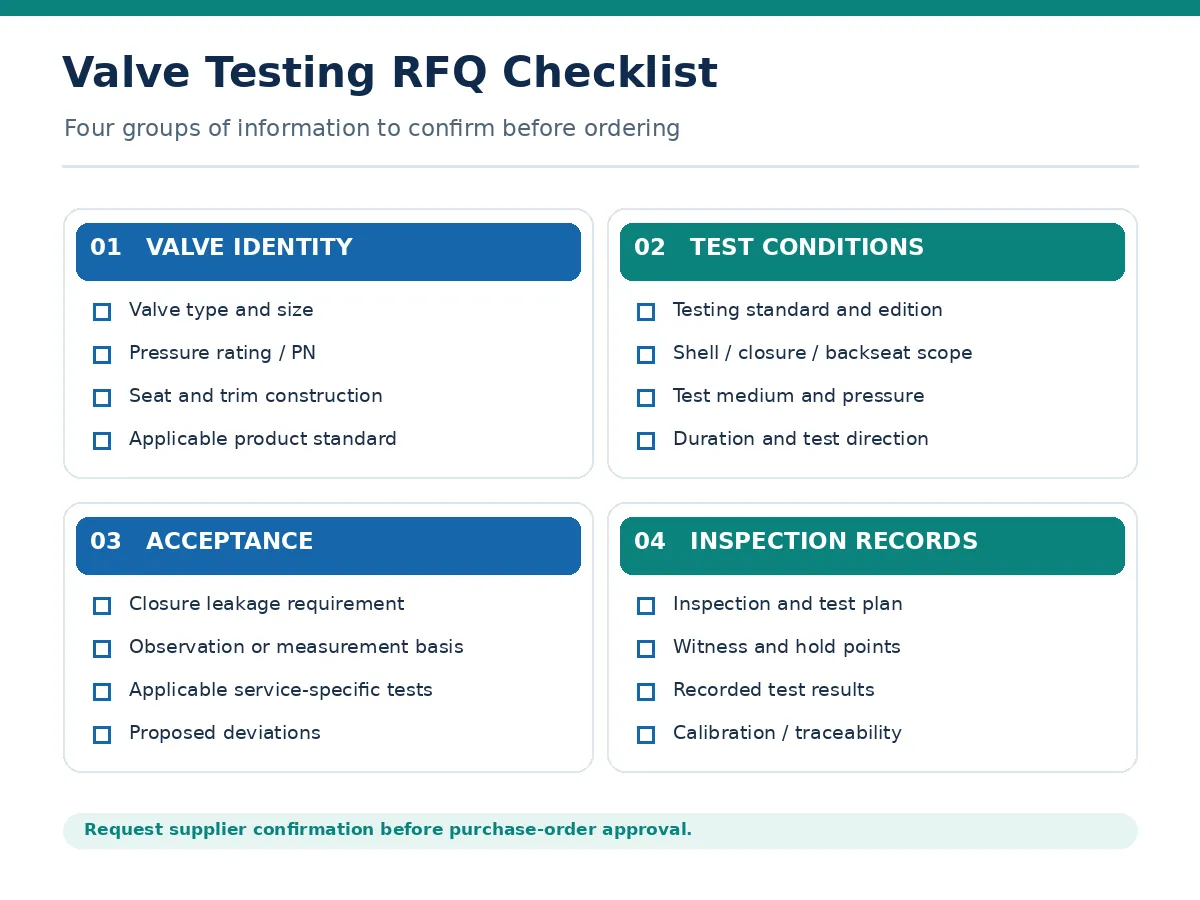
To compare technical quotations, provide a controlled test scope. The minimum useful RFQ fields are the valve type, size, pressure class/PN, product standard and edition, test standard and edition, seat construction, required shell/closure/backseat tests, medium, pressure, duration, closure direction, leakage acceptance and inspection documentation. The supplier should declare deviations before procurement approval.
Inspection and Test Plan (ITP)
An ITP should identify document-review stages, witness points, hold points and record requirements as applicable to the project. Third-party inspection participation, notification periods and release authorization must be specified rather than inferred from the testing standard number.
Test Report and Documentation Package
| Record | الغرض |
|---|---|
| Approved test procedure | Defines test configuration, methods and acceptance. |
| ITP | Sets inspection steps and witness/hold points. |
| Pressure test report | Records applied conditions, actual observation or leakage and results. |
| Calibration evidence | Supports the measurement traceability required by the project. |
| تحديد الصمام | Links the results to the relevant valve. |
| Deviation / NCR record | Documents departures from and dispositions against requirements. |
For additional context on supplier processes, see the valve manufacturing and inspection process. Project-specific test results, traceability and compliance must still be demonstrated by the documents required in the purchase specification.
Test Evidence Gap Review: What to Request
| Missing evidence | لماذا هو مهم | Supplier clarification |
|---|---|---|
| No test pressure or holding time | Cannot verify required conditions | Provide recorded values and approved test procedure reference |
| No closure direction or valve configuration | Cannot verify prescribed seat-loading direction | Identify pressurized side, valve position and observation side |
| Only “pass” recorded; no stated acceptance basis | Cannot determine which limit was applied | Identify standard edition, applicable acceptance criterion and recorded observation |
| No tag/serial traceability | Report cannot be linked reliably to supplied item | Supply cross-referenced valve and report identification |
| Witness requirement omitted | ITP contractual obligation may be unmet | Clarify witness notice, attendance, waiver or retest disposition |
Procurement consequence: Do not release a mandatory documentation hold point simply because a supplier provides a certificate heading. Obtain the missing records or a properly approved nonconformity disposition.
Example — incomplete supplier substitution: An offer states “ISO 5208 accepted in lieu of API 598” without listing the selected leakage-rate designation or the required backseat and closure tests. Classify this as clarification required, not an equivalent bid. Request a requirement-by-requirement comparison; if a difference remains, seek written deviation approval from the authorized project party before issuing the PO.
Example RFQ Testing Clause
For broader testing terminology, consult the valve pressure testing resource. For product categories that may need testing-scope review, explore the مجموعة منتجات الصمامات الصناعية. These pages provide context; actual requirements still depend on the relevant datasheet.
Normalize Supplier Bids Before Technical Approval
| Bid comparison item | Offer A | Offer B | Approval rule |
|---|---|---|---|
| Governing test standard / edition | Record exact proposal | Record exact proposal | Match RFQ or document approved deviation. |
| Applicable closure test and direction | Record proposed tests | Record proposed tests | Cover all specified directions and conditions. |
| Acceptance criterion | State actual limit | State actual limit | Compare against the same contractual requirement, not just “pass”. |
| ITP witness / records | List inclusions | List inclusions | Confirm agreed witness, traceability and report deliverables. |
Pricing should not be compared as technically equivalent until missing tests, witness services, retesting obligations and document deliverables have been normalized. Any resulting cost difference should be made visible in the commercial comparison rather than concealed under a generic testing allowance.
8. Common Valve Testing Specification Mistakes
- Edition unspecified: buyers and suppliers may refer to different revisions.
- Leakage acceptance undefined: “tested to ISO 5208” may not state the applicable closure acceptance designation.
- Shell/closure conflated: external integrity does not demonstrate tight shutoff.
- Test direction assumed: the test report may not cover both specified directions.
- Records incomplete: a pass statement without pressure, duration or criterion may be insufficient.
- Other qualifications inferred: routine pressure tests do not replace fire-safe, fugitive-emission, NDT, PMI or specialized service testing.
9. Frequently Asked Questions
What is the main difference between API 598 and ISO 5208?
API 598 addresses inspection and testing for applicable valve types; ISO 5208 establishes pressure-testing requirements for metallic industrial valves. The actual obligations depend on the valve product standard, valve construction, applicable editions and purchase specification.
Does API 598 allow seat leakage?
Acceptance depends on the applicable valve type, seat construction and standard provisions. Do not assume either a universal zero-leakage requirement or a universal allowable rate without checking the governing criteria.
What are ISO 5208 leakage rate designations?
ISO 5208 defines closure leakage-rate designations, including Rate A, for specified test conditions. Rate A should not be restated as an unconditional in-service zero-leakage promise. The governing product standard and project specification must establish which rate, test direction and method apply.
Can an ISO 5208 test be accepted instead of API 598?
Only after confirming the required tests, conditions, acceptance criteria and documentation satisfy the purchase requirements, and obtaining any necessary deviation approval.
What should a valve testing RFQ specify?
List the product and test standards and editions; required shell, closure and backseat tests; medium, pressure, duration, test direction and leakage acceptance; and ITP, witness and test-report deliverables.
10. Final Considerations for Valve Testing Specifications
A pressure test records performance under defined factory test conditions; it does not, by itself, validate suitability for the process fluid, corrosion exposure, operating temperature, repeated cycling, fugitive emissions or fire-safe service. The accepted technical bid must therefore keep pressure-test evidence separate from other project qualification requirements.
API 598 and ISO 5208 are useful testing frameworks, but neither replaces a complete valve product specification. Establish the governing requirements, acceptance criteria and supporting evidence before testing begins. This makes supplier quotations easier to normalize, inspection results easier to review and technical deviations easier to resolve.
Request Testing and Documentation Scope
Share your valve datasheet, product and testing standards, size and pressure rating, seat design, required leakage acceptance, ITP and documentation requirements for a project-specific quotation and technical scope discussion.
Submit Your Valve Datasheet / RFQPrepared as technical educational content by Raymon Valve. Supplier-specific testing scope and supporting documentation must be confirmed for each RFQ.
 Arabic
 English
 German
 French
 Spanish
 Italian
 Portuguese
 Russian