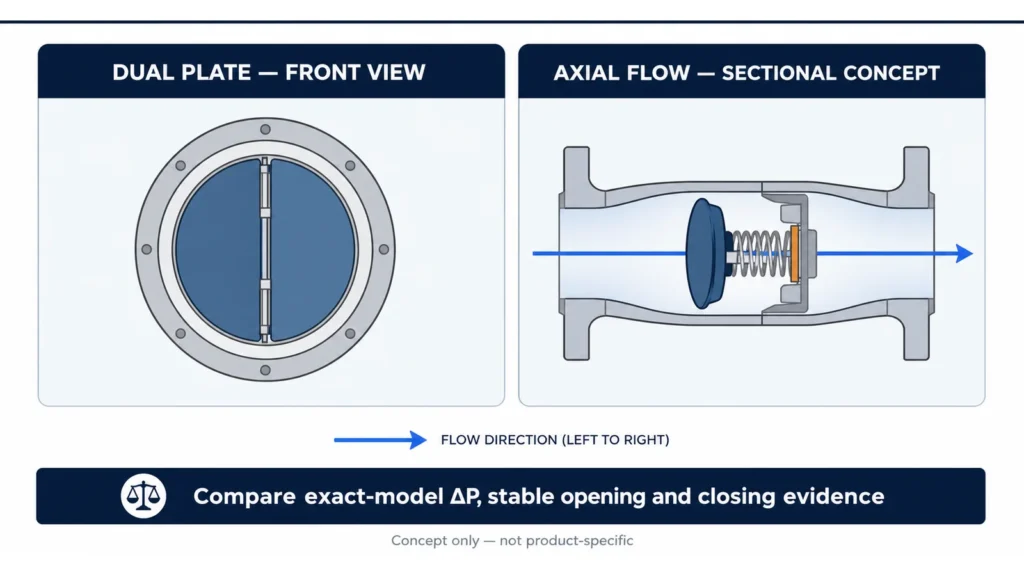
Neither design is universally better. A dual-plate check valve is often shortlisted where compact face-to-face dimensions and installed mass matter; an axial-flow design is often shortlisted where guided short-travel closure and tightly controlled reverse-flow exposure justify closer dynamic review. The final choice cannot be made from the family name. Compare exact-model pressure-loss and opening behavior, spring and travel data, approved orientation, reverse-velocity evidence, and the pump-system transient at minimum, normal, maximum and trip conditions.
This distinction matters because steady-state efficiency and pump-trip protection are related but separate decisions. A valve with an acceptable pressure drop can still be unstable at low flow. A fast-moving closing element does not, by itself, prove that surge pressure will remain within the project limit. Selection therefore requires both valve data and system data.
Featured illustration: Concept comparison of typical dual-plate and axial-flow construction directions. Exact internal geometry and performance vary by manufacturer and model; this image is not product evidence.
Quick Decision: Dual Plate or Axial Flow?
Use the valve type as a screening direction, then approve the exact offered model against the complete duty.
- Shortlist a dual-plate design when compact installation, lower installed mass, and a short face-to-face pattern are important—provided the offered model demonstrates acceptable pressure loss, stable opening, closing response, orientation, and materials.
- Shortlist an axial-flow design when guided short-travel closure and limited reverse-flow exposure are important—provided the supplier supplies model-tied pressure-loss and dynamic evidence for the stated operating and trip conditions.
- Approve neither design from the name alone. “Spring-assisted,” “axial,” “silent,” or “non-slam” does not establish the actual reverse velocity, surge pressure, minimum stable flow, or pump protection for a particular system.
The broader válvulas de retención industriales remains the commercial family route. This article addresses only the engineering comparison between dual-plate and axial-flow constructions.
What Construction Difference Actually Changes the Decision?
Typical Dual-Plate Mechanism
A typical dual-plate check valve uses two rotating plate halves mounted around a central hinge or pin. Springs may assist the plates toward the closed position as forward flow decays. Compared with a long-travel swing disc, the plate movement can be short, but the exact closing behavior still depends on plate mass, travel, spring characteristics, hinge friction, stops, fluid conditions, and flow deceleration.
The open flow path must also be reviewed. Plates, springs, pins, and supports can remain within the flow stream. Their geometry and the plate opening position influence loss and stability. A compact body does not automatically mean low pressure loss, and a nominally full-open plate position does not prove stable behavior at minimum flow.
Buyers evaluating a dual-plate check valve should request the exact sectional drawing and model data rather than transfer a generic family description into the project specification.
Typical Axial-Flow Mechanism
A typical axial-flow check valve uses a guided closing element that travels substantially along the pipe axis. Flow passes around the disc or poppet through an annular or shaped passage. A spring commonly acts on the moving element, while internal guides control its travel.
Guide arrangement, spring design, seat geometry, diffuser or nozzle profile, and travel vary between models. Those differences affect pressure loss, opening position, friction, wear, and closing response. Commercial terms such as axial flow, nozzle, silent, and non-slam may overlap, but they do not prove identical internal construction or equal performance.
El axial-flow check valve product route can help identify the requested construction. Final approval still requires controlled information for the exact model offered.
What the Drawing Must Confirm
Before comparing performance, confirm that both bids describe the construction the project intends to evaluate:
- exact valve type and model;
- body pattern and end connection;
- internal flow path;
- plate, disc, or poppet travel;
- hinge, pin, guide, stop, and spring arrangement;
- seat geometry and replacement method;
- flow arrow and permitted installation orientation;
- access required for inspection and maintenance.
Without this identity check, two quotations may use the same family name for materially different internal designs.
Side-by-Side Engineering Decision Matrix
| Factor de decisión | Dual-plate screening direction | Axial-flow screening direction | Evidence required before approval |
|---|---|---|---|
| Dimensiones de instalación | Often considered where short face-to-face and lower installed mass matter | Body pattern may be longer or heavier depending on design | Approved GA drawing, face-to-face, mass, envelope, and support/load data |
| Flow path and pressure loss | Pins, plates, springs, and opening position influence the flow path | Annular passage, diffuser geometry, and disc position influence the flow path | Exact-model Cv/Kv or pressure-drop curve with stated conditions |
| Estabilidad a bajo flujo | Plates can move away from the intended open position if the valve is not sufficiently loaded by flow | A guided disc can also operate below its intended stable position | Minimum stable flow/velocity or opening-position evidence for the model |
| Respuesta de cierre | Depends on plate travel, inertia, spring, friction, and flow deceleration | Depends on disc travel, moving mass, spring, guide friction, and flow deceleration | Model-tied dynamic or reverse-velocity evidence |
| Reverse-flow exposure | Cannot be inferred from “spring-assisted” alone | Cannot be inferred from “axial” or “non-slam” naming alone | Reverse-velocity characteristic at stated deceleration conditions |
| Orientación | Model-specific | Model-specific | Approved installation instructions and flow direction |
| Mantenimiento | Review plates, pin/hinge, springs, stops, and seats | Review disc/poppet, guides, spring, and seat | Sectional drawing, IOM, inspection access, and spare-parts list |
| Comparación de ofertas | Compactness may reduce installation scope, but price is not universal | Specialized construction or evidence scope may affect the quotation | Normalized inclusions, exclusions, deviations, and document list |
The matrix does not select a winner. Its purpose is to expose which evidence is missing before a technical bid comparison proceeds.
Pressure Loss: Compare Curves, Not Valve Names
Why a Single Cv or Kv Value Is Incomplete
Pressure loss depends on flow rate, fluid properties, valve geometry, and the position of the moving element. A catalogue Cv or Kv can be useful only when its basis is known. Ask whether it represents a fully open valve, a particular spring, a defined flow direction, and the exact offered size and construction.
A valve may show acceptable loss at maximum flow while operating at an unstable partial-open position at minimum flow. Conversely, a design with a higher catalogue coefficient is not automatically the better choice if its opening behavior or dynamic evidence is insufficient for the duty.
For a broader explanation of why check valves should be evaluated beyond line size, see the check valve sizing and flow-stability guide.
Three-Flow-Case Evidence Table
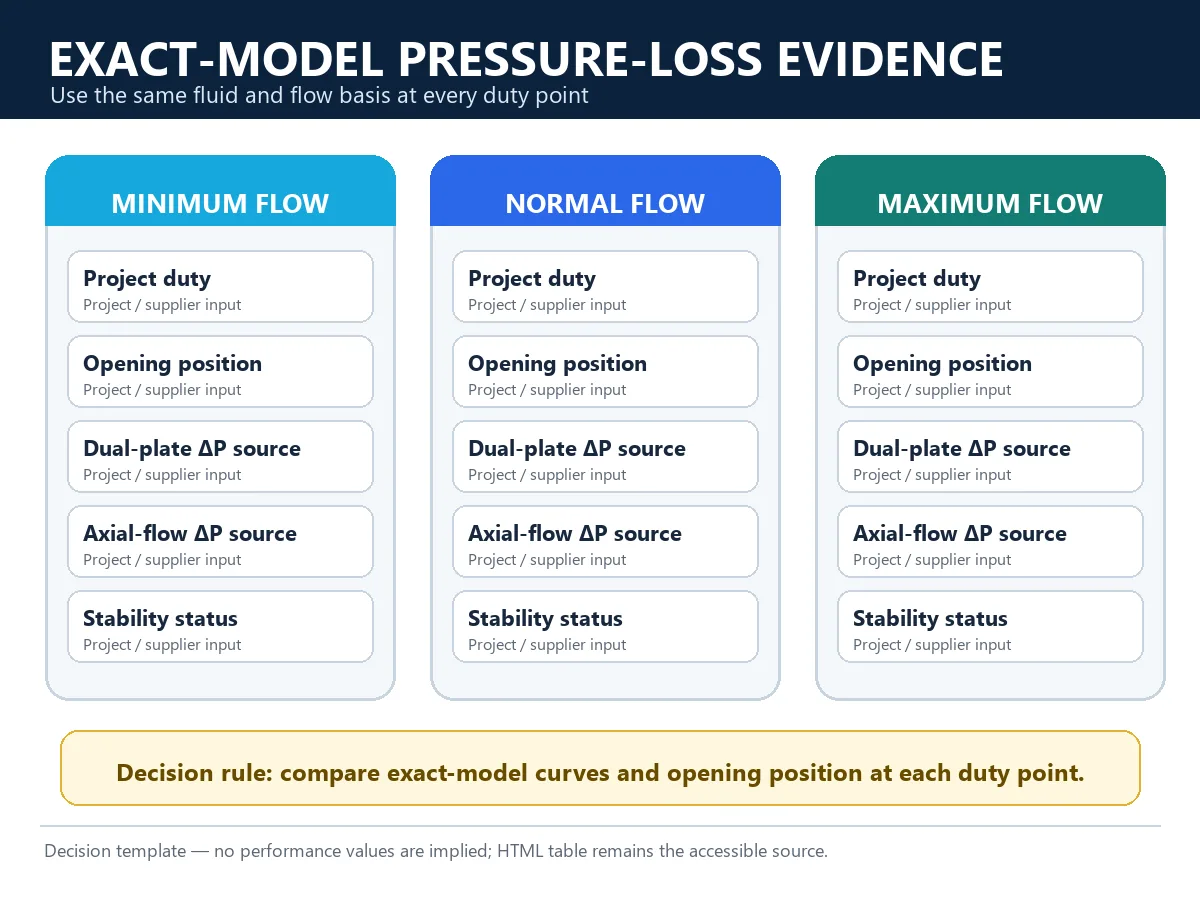
Use the same cases and fluid basis for every bidder. Complete this table with supplier-controlled data; do not substitute a generic family brochure.
| Flow case | Project flow or velocity | Supplier opening-position evidence | Cv/Kv or ΔP source | Stability status | Elemento pendiente |
|---|---|---|---|---|---|
| Mínimo | Project input required | Exact-model evidence required | Curve/test/calculation reference required | Confirmed / Partial / Open | Record risk of unstable motion or incomplete opening |
| Normal | Project input required | Exact-model evidence required | Curve/test/calculation reference required | Confirmed / Partial / Open | Confirm normal operating margin |
| Máximo | Project input required | Exact-model evidence required | Curve/test/calculation reference required | Confirmed / Partial / Open | Confirm acceptable loss and mechanical position |
The final pressure-loss comparison should state the fluid, temperature, density where relevant, flow basis, valve size, and exact model. A graph without those conditions is not sufficient evidence for project approval.
Low-Flow Instability Is a Separate Check
If flow is too low to hold the moving element in its intended stable position, the plates or disc may move repeatedly. The field symptom may be noise, vibration, fluctuating pressure, or accelerated wear, but these symptoms are not unique to one valve family. Valve oversizing, pump operation, local flow disturbance, spring selection, and installation can all contribute.
Do not publish or accept a universal minimum velocity. Request the basis for the exact offered model and compare it with the project’s minimum continuous, intermittent, startup, and shutdown conditions. Detailed symptom separation is covered in the check valve chatter versus slamming guide.
Failure Modes: Symptom, Possible Cause and Verification
Treat a field symptom as a trigger for investigation, not as a diagnosis of one valve family. The same noise, pressure fluctuation, or seat impact can arise from the valve, its sizing, the pump operating point, the local piping, or the wider transient.
| Observed risk or symptom | Possible contributors to investigate | Evidence or check required | Implicación en la selección |
|---|---|---|---|
| Repeated plate or disc motion, noise, or vibration | Flow below the stable-opening range; oversized valve; local flow disturbance; spring or opening-position mismatch | Exact-model opening-position evidence across operating cases; pump operating range; nearby piping review; supplier IOM | Keep minimum-flow suitability OPEN until the offered model and installed arrangement are checked |
| Hard seating impact or reported slam | Reverse velocity before seating; travel, inertia, spring, friction, or system deceleration | Model-tied reverse-velocity or dynamic evidence; shutdown sequence; high-consequence transient review | Do not accept a spring-assisted or non-slam label as the acceptance basis |
| Higher-than-expected steady pressure loss | Partial opening; restrictive internal passage; spring basis; fluid-property or curve-basis mismatch | Exact-size pressure-drop curve at minimum, normal, and maximum flow with stated fluid and opening basis | Compare lifecycle energy impact and stable opening together; a family name does not rank the bids |
| Closure leakage or loss of isolation | Seat damage; debris; misalignment; wear; wrong leakage acceptance basis | Seat construction; fluid cleanliness/solids; inspection findings; stated seat-test procedure and acceptance criteria | Define the required closure function and test scope instead of assuming an undefined leakage outcome |
| Hinge, pin, guide, or spring wear | Cycling; unstable motion; solids; friction; alignment; component material pairing | Sectional drawing; component material schedule; expected cycles; inspection access; IOM and spare-parts scope | Compare maintainability and wear evidence for the exact construction |
| Instability after installation | Unapproved orientation; nearby elbows/reducers/branches; pipe strain; support or alignment issue | Approved orientation instructions; GA drawing; piping layout; support and alignment review | Approve the installed configuration, not only the valve datasheet |
This matrix does not attribute root cause from symptoms alone. Inspection, operating data, and system review remain necessary.
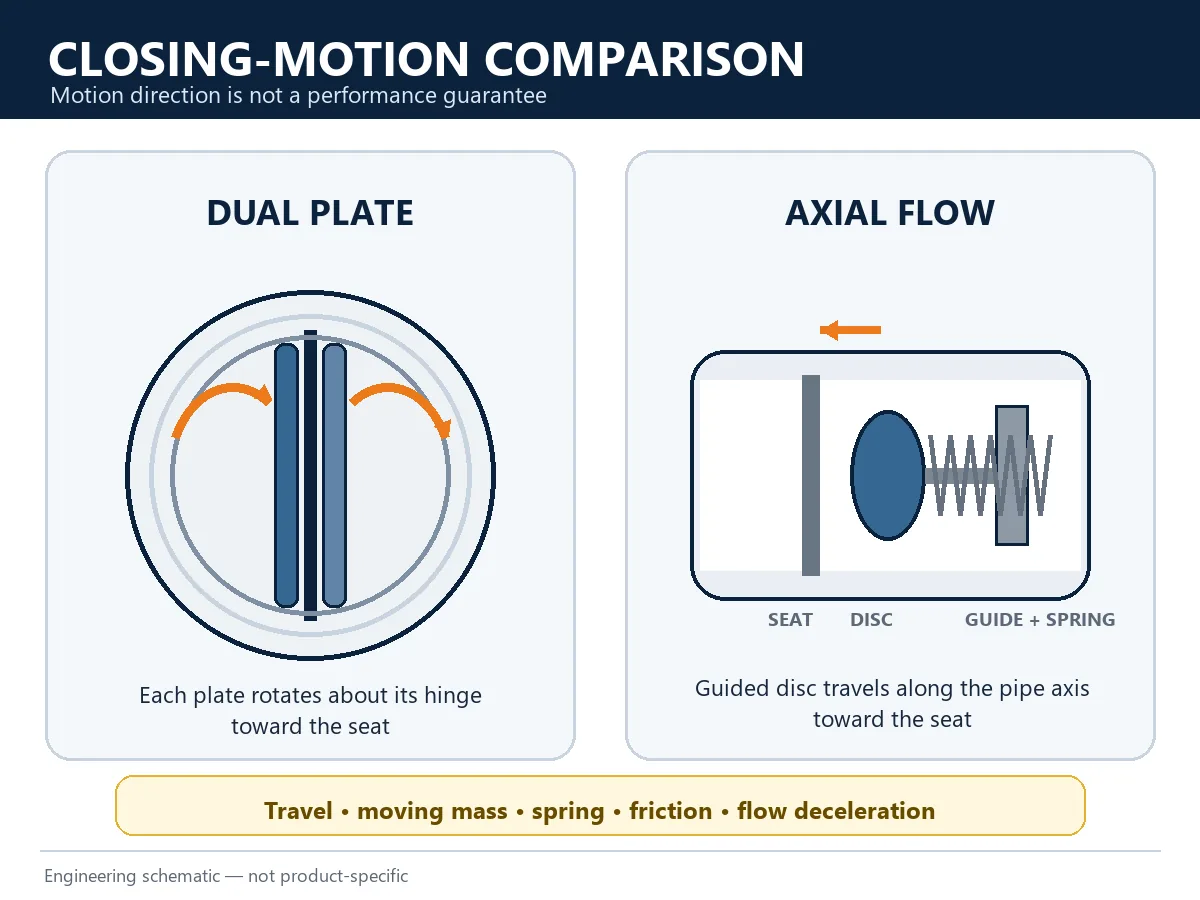
Closing Response: Travel, Spring, and Deceleration Matter
The Closing Sequence
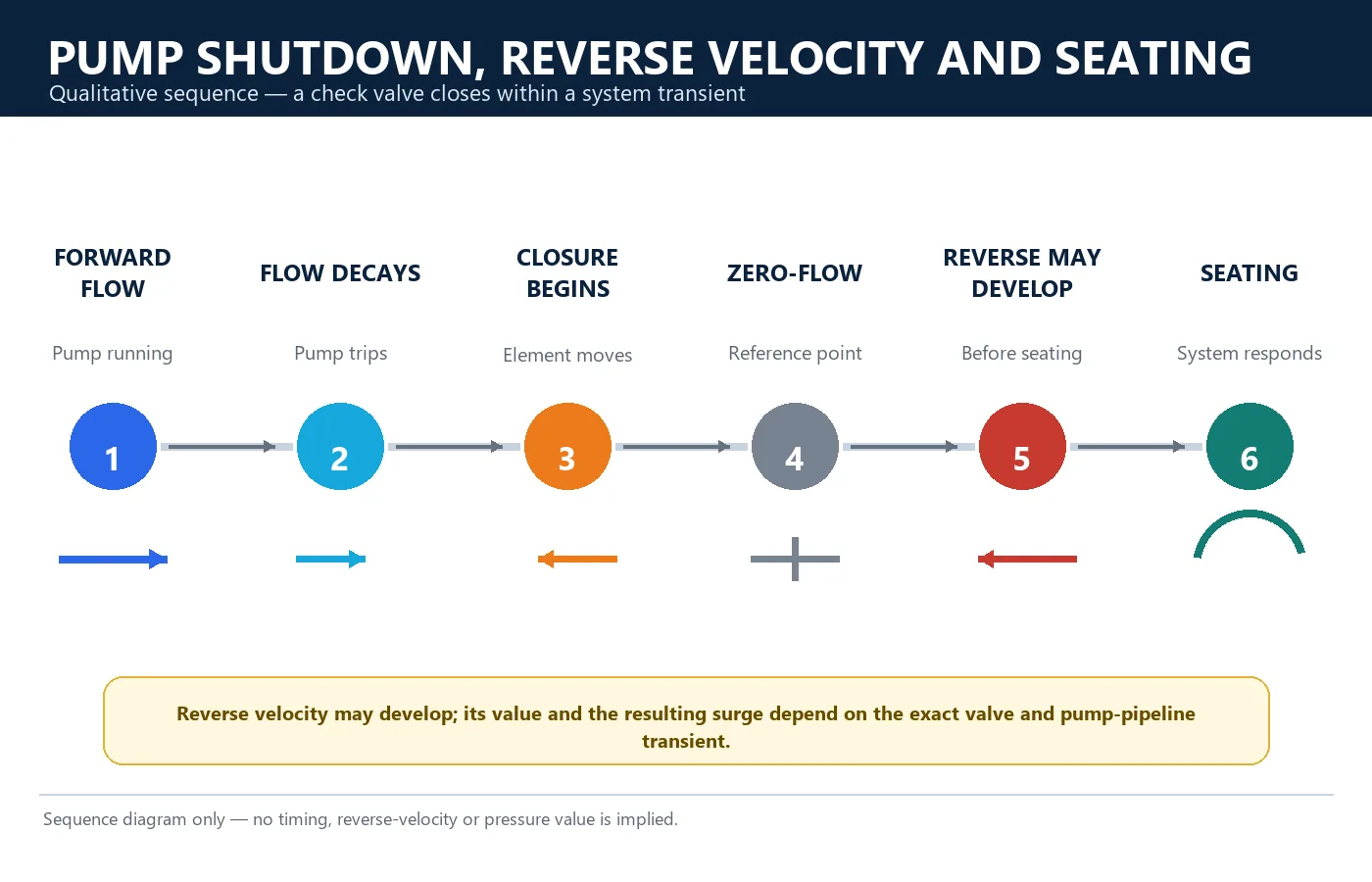
During a pump shutdown, forward flow decays. The valve’s moving element begins to return toward the seat. Depending on the system and valve response, the element may seat before, at, or after the flow reaches zero. If reverse velocity develops before seating, the moving fluid and the closure event can influence the pressure transient.
The relevant engineering question is therefore not simply “Which valve closes faster?” It is: how does the exact model respond under the deceleration conditions that the system will impose?
Parameters That Affect Response
Review at least:
- moving-element mass and inertia;
- travel distance;
- spring force, rate, and preload;
- hinge or guide friction;
- seat-contact behavior;
- fluid density and phase;
- forward-flow decay and reverse acceleration;
- installation orientation;
- upstream and downstream system arrangement;
- expected cycling frequency.
Both dual-plate and axial-flow designs can use short travel and spring assistance. Those features can support responsive closure, but they do not establish an actual closing time or reverse velocity without model-specific evidence.
Evidence Ladder for Closing Performance
Use evidence appropriate to the consequence of the duty:
- Generic construction information supports early screening only.
- Exact-model static data—drawing, travel, spring basis, cracking pressure, and flow curve—supports a preliminary comparison.
- Exact-model dynamic data tied to stated deceleration or test conditions supports a more consequential closing-response review.
- System transient analysis or relevant system testing may be required where surge, reverse rotation, or equipment damage has a high consequence.
An unrelated model’s test, an animation, or a generic “non-slam” label should not be treated as project evidence.
Pump Protection: Where Valve Selection Ends and System Analysis Begins
A check valve can influence when closure occurs relative to flow reversal, how much reverse flow develops before seating, and how much steady-state pressure loss is added to the system. It cannot, by its name alone, prove that the complete pump and pipeline system is protected.
El Hydraulic Institute’s waterhammer resources describe surge as a system response to changes in liquid velocity, including pump shutdown and valve operation. This is why pump protection cannot be reduced to a valve-family comparison.
What the Valve Name Cannot Prove
Neither “dual plate” nor “axial flow” proves:
- elimination of water hammer;
- an acceptable maximum or minimum system pressure;
- prevention of pump reverse rotation or mechanical damage;
- acceptable response for every trip sequence;
- suitability for all parallel-pump headers;
- a universal safe closure time;
- a universal permitted reverse velocity.
Pump-Trip Escalation Path
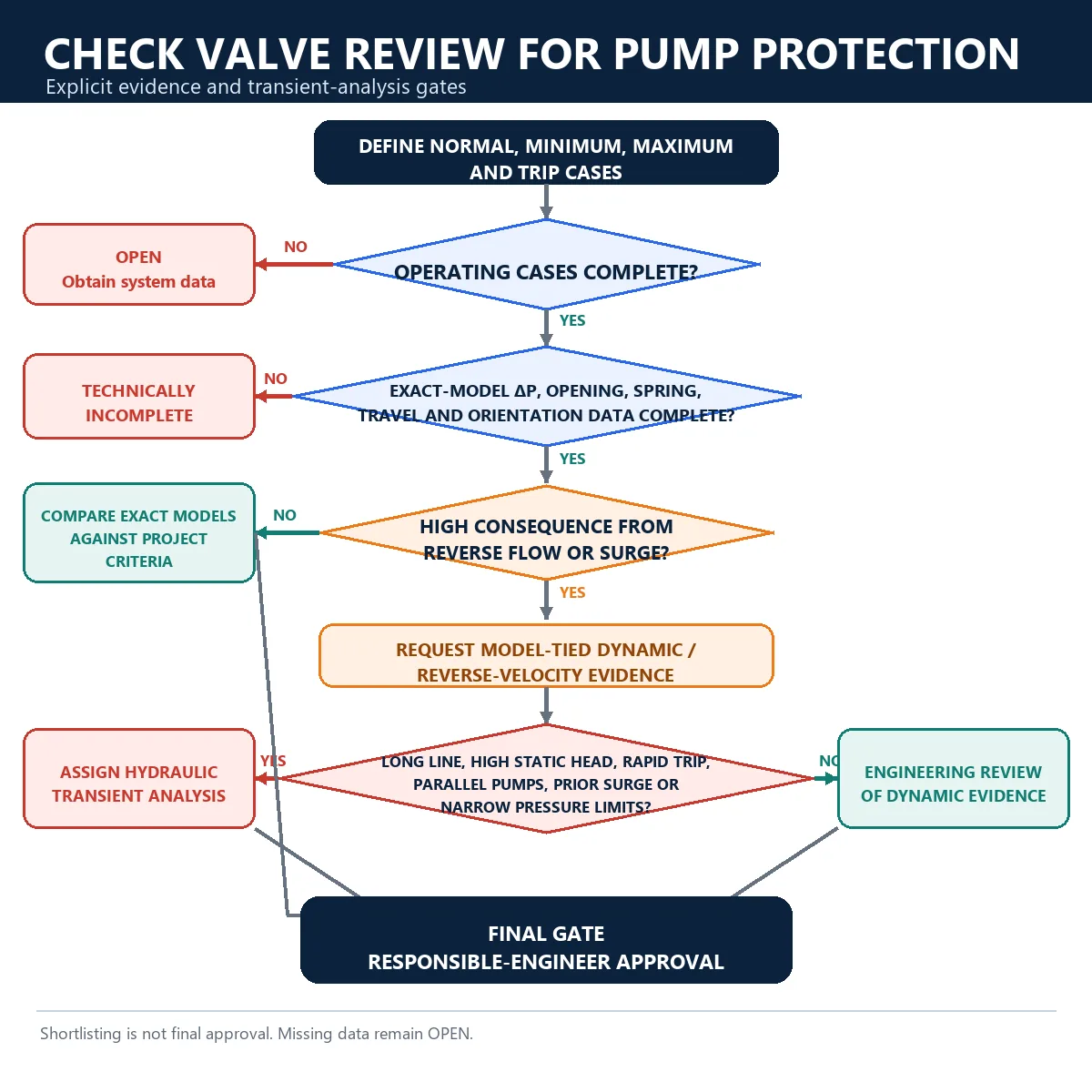
Use the following decision path:
- Are minimum, normal, maximum, startup, shutdown, and trip conditions defined? If no, keep selection OPEN and obtain the missing operating cases.
- Does each bidder provide exact-model pressure-loss, opening, spring, travel, orientation, and material data? If no, keep the bid technically incomplete.
- Could reverse flow or surge cause significant equipment, piping, or process consequences? If yes, request model-tied dynamic or reverse-velocity evidence.
- Does the system include a long line, high static head, rapid trip, parallel pumps, a narrow pressure envelope, prior surge, or strict reverse-flow limits? If yes, assign a responsible owner for hydraulic transient analysis.
- Are the valve and system evidence consistent with the project acceptance criteria? Only then can the responsible engineer make the final selection.
This flowchart identifies when additional analysis is required. It does not calculate surge pressure or approve a valve.
Installation, Orientation, and Maintenance Envelope
Dimensions and Installed Load
Compare face-to-face, overall envelope, mass, end connection, support requirements, and removal space. A short-pattern dual-plate body may be attractive where space and support load are constrained, but the exact drawing governs. An axial-flow body may have a different length and mass depending on its pattern and internal flow passage.
ASME B16.10 addresses face-to-face and end-to-end dimensional interchangeability within its scope. It does not prove pressure loss, closing response, material suitability, or pump-trip performance. The project should confirm the applicable dimensional basis on the approved drawing.
Orientation and Local Piping
Do not state that every spring-assisted check valve can be installed in any position. Approved orientation depends on the exact spring, moving-element weight, guide or hinge arrangement, and manufacturer instructions. Confirm the flow arrow, horizontal or vertical limitations, and any upward- or downward-flow restrictions for the offered model.
Record nearby pumps, reducers, elbows, branches, and other flow disturbances for review. Avoid imposing a universal straight-run rule without an applicable product instruction or project specification.
Maintenance and Spares
For dual-plate designs, review access to plates, hinge or pin, springs, stops, and seats. For axial-flow designs, review access to the guided disc or poppet, guide surfaces, spring, and seat. In both cases, request:
- installation, operation, and maintenance instructions;
- inspection intervals or condition-based guidance where available;
- replaceable-parts identification;
- recommended spare-parts list;
- disassembly envelope and lifting requirements;
- permissible repair and acceptance criteria.
Maintainability should be compared using the exact construction, not a generic statement that one family has fewer parts.
Materials, Seats, Testing, and Documentation
Compare materials by component: body, plates or disc, hinge/pin or guide, spring, seat/seal, fasteners, and any hardfacing. A material grade alone is not a service guarantee. Final suitability depends on medium composition, concentration, temperature, pressure, velocity, solids, corrosion/erosion mechanisms, cleaning conditions, fabrication route, and project requirements.
The technical bid should separate:
- shell pressure testing of the pressure boundary;
- seat or closure testing against stated acceptance criteria;
- functional checks of movement and assembly;
- dynamic evidence for opening and closing behavior;
- NDT and PMI where the project specifies them;
- material traceability and MTC scope;
- witness, hold, and document-review points in the ITP.
ISO 5208:2015 covers pressure testing of metallic valves within its published scope. A pressure or seat test does not prove stable opening, reverse velocity, waterhammer performance, or pump protection.
API 594 may be referenced for check-valve construction within its applicable scope, but the current edition and project applicability must be verified through API’s official publication and update information. A standards reference does not prove that a Raymon product or an offered model is designed, tested, certified, or documented to that standard.
When Each Design Belongs on the Shortlist
Shortlist a Dual-Plate Design When
- compact face-to-face and installed mass are important;
- the exact offered model has acceptable pressure loss at the required flow cases;
- minimum-flow opening and stability are demonstrated;
- closing-response evidence is adequate for the trip consequence;
- orientation and local installation conditions are approved;
- material, seat, testing, maintenance, and document requirements are satisfied.
Shortlist an Axial-Flow Design When
- guided short-travel closure is a priority for dynamic review;
- permitted reverse-flow exposure is tightly controlled and the supplier provides model-tied evidence;
- the pressure-loss curve is acceptable at minimum, normal, and maximum flow;
- spring, travel, guide, orientation, and maintenance details are confirmed;
- material, testing, inspection, and documentation requirements are satisfied.
Do Not Choose Either Until
- all operating and trip cases are defined;
- quotations use the same process and hydraulic basis;
- exact models and internal constructions are identified;
- missing data, deviations, exclusions, and optional scope are visible;
- critical transient risk has a named engineering owner;
- the responsible engineer has reviewed the complete datasheet and project criteria.
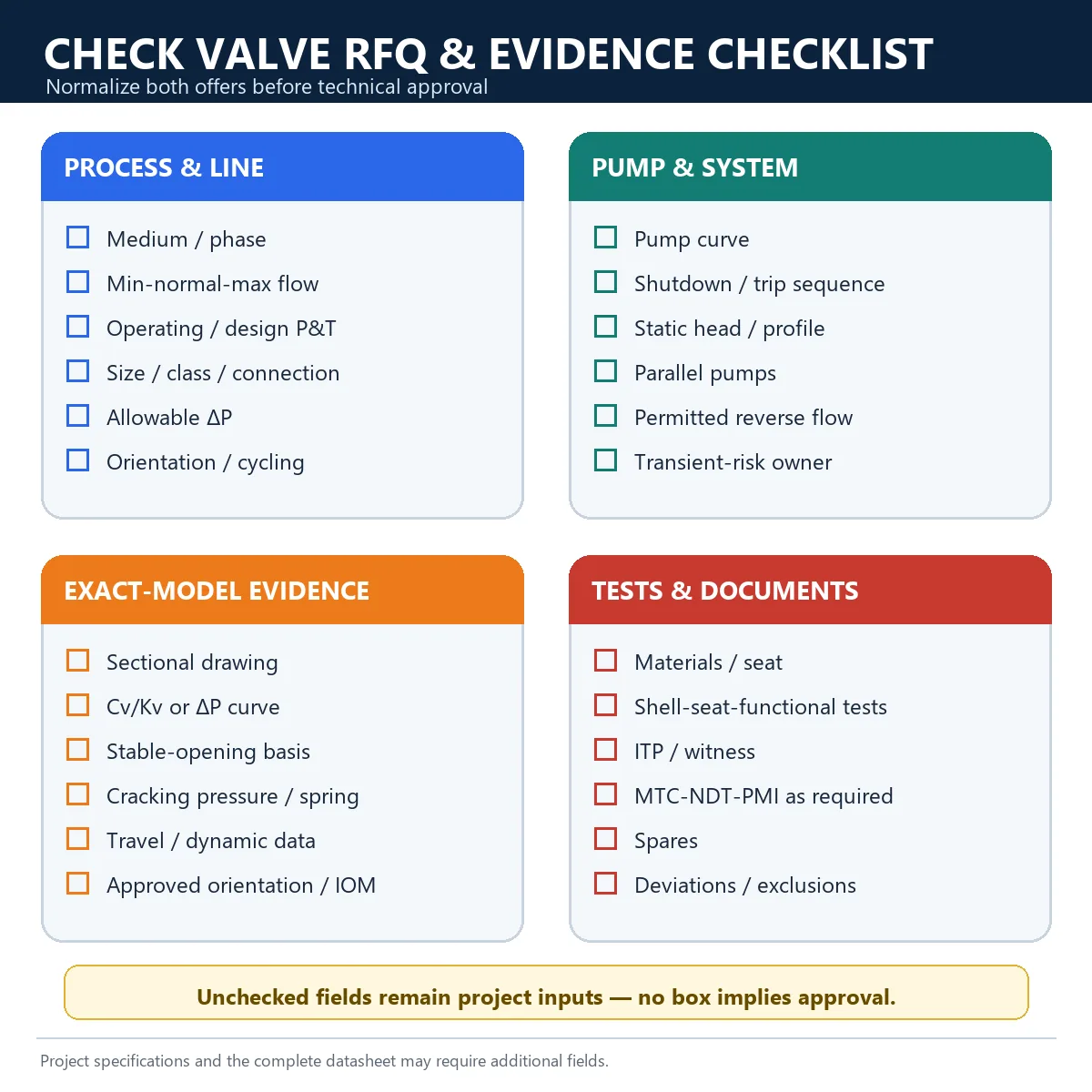
RFQ Normalization Checklist
Process and System Data
- valve function and location;
- medium, composition, solids, and phase;
- density and viscosity where relevant;
- minimum, normal, and maximum flow or velocity;
- startup, shutdown, and trip conditions;
- operating and design pressure;
- operating and design temperature;
- nominal size, pressure class/PN, and end connection;
- curva de bomba y secuencia de parada;
- perfil de carga y de tubería estática;
- parallel-pump or common-header arrangement;
- allowable steady-state pressure loss;
- permitted reverse-flow or reverse-rotation objective;
- installation orientation and nearby piping geometry;
- expected cycling.
Valve and Supplier Evidence
- exact valve type, model, and sectional drawing;
- face-to-face, mass, envelope, and connection data;
- body, plates/disc, hinge/guide, spring, seat, and hardfacing materials;
- Cv/Kv or pressure-drop curve with stated basis;
- minimum stable flow or opening-position evidence;
- cracking pressure and spring basis where relevant;
- moving-element travel;
- dynamic or reverse-velocity evidence where required;
- approved orientation and IOM;
- shell, seat, functional, and any special test scope;
- ITP, MTC, NDT/PMI, witness, and documentation requirements;
- spare-parts scope;
- technical deviations, exclusions, and optional items.
Use the checklist to make both offers comparable. A lower quoted price is not meaningful if one bid omits dynamic evidence, tests, materials, documents, or spares required by the other.
Tabla de Normalización Técnica de Ofertas
Use one status vocabulary for both offers: Confirmed, Partial, Open, o Not Applicable. A commercial comparison should not proceed as though an OPEN technical field were an equivalent inclusion.
| Comparison package | Offer A status / reference | Offer B status / reference | Acceptance owner and action |
|---|---|---|---|
| Exact model, revision, sectional drawing, size, class/PN, connection | Confirmed / Partial / Open / N/A | Confirmed / Partial / Open / N/A | Buyer or responsible engineer confirms identical comparison scope |
| Minimum, normal, and maximum flow; opening position; Cv/Kv or pressure-drop curve | Confirmed / Partial / Open / N/A | Confirmed / Partial / Open / N/A | Hydraulic reviewer checks common fluid and duty-point basis |
| Travel, moving mass, spring basis, cracking pressure, and dynamic/reverse-velocity evidence | Confirmed / Partial / Open / N/A | Confirmed / Partial / Open / N/A | Responsible engineer defines evidence level from trip consequence |
| Face-to-face, mass, envelope, orientation, support, removal and maintenance space | Confirmed / Partial / Open / N/A | Confirmed / Partial / Open / N/A | Piping/layout owner verifies the installed configuration |
| Body, plates/disc, hinge/guide, spring, seat, fasteners and hardfacing | Confirmed / Partial / Open / N/A | Confirmed / Partial / Open / N/A | Materials owner reviews each component against project service data |
| Shell, seat, functional and special tests; ITP, MTC, NDT/PMI and witness points | Confirmed / Partial / Open / N/A | Confirmed / Partial / Open / N/A | QA/project team confirms procedure, acceptance criteria and document timing |
| Spares, IOM, exclusions, deviations and optional scope | Confirmed / Partial / Open / N/A | Confirmed / Partial / Open / N/A | Procurement keeps cost and scope differences visible |
Record the document number, revision, and responsible reviewer behind every Confirmed status. A statement in an email or generic brochure should not silently replace controlled exact-model evidence.
Supplier Evidence Hierarchy and Technical Approval Gate
For consequential duties, rank evidence in this order:
- Approved project and system data with responsible-engineer acceptance criteria.
- Controlled information for the exact offered model, including drawings and datasheets.
- Model-tied pressure-loss, opening, and dynamic evidence with stated test or calculation conditions.
- Order-specific acceptance evidence, including ITP, procedures, reports, traceability, deviations, and document register.
- Generic family brochures or marketing descriptions, suitable for screening only.
Do not approve either design for pump protection from a family name, a generic animation, an unspecified non-slam label, or test results from an unrelated size or model. Where controlled performance data are missing, record an OPEN item rather than filling the gap with inference.
Resumen de Selección Final
A dual-plate design often deserves consideration where compactness and installed mass matter. An axial-flow design often deserves consideration where guided short-travel closure and reverse-flow control justify stronger dynamic scrutiny. Neither direction is a final selection.
Compare exact models at minimum, normal, maximum, and trip conditions. Require pressure-loss and opening data, spring and travel information, approved orientation, materials, testing, documentation, and dynamic evidence proportional to the consequence. For critical pump systems, complete the valve comparison within a system-level transient review.
Solicitar revisión de selección de válvula de retención
To compare dual-plate and axial-flow offers on the same basis, submit:
- medio y fase;
- minimum, normal, and maximum flow;
- presión y temperatura de operación/diseño;
- size, pressure class/PN, and end connection;
- curva de bomba y secuencia de parada;
- perfil de carga y de tubería estática;
- parallel-pump arrangement;
- allowable pressure loss and permitted reverse flow;
- installation orientation;
- material, testing, inspection, and document requirements.
Submit project data for a check valve selection review
The review can identify missing inputs, unsupported supplier statements, and conditions requiring dynamic or transient analysis. It does not replace project-specific calculations or the responsible engineer’s final approval.
Preguntas frecuentes
Which Has Lower Pressure Loss: a Dual-Plate or Axial-Flow Check Valve?
The family name does not decide the result. Compare exact-model Cv/Kv or pressure-drop curves, fluid basis, and opening position at minimum, normal, and maximum flow. Either design can perform differently as geometry, spring, size, and operating point change.
Which Check Valve Closes Faster?
Closing response depends on moving mass, travel, spring characteristics, friction, fluid conditions, and flow deceleration. Both families can use short travel and spring assistance. Request model-tied dynamic or reverse-velocity evidence when closing performance has a high consequence.
Can an Axial-Flow Check Valve Eliminate Water Hammer?
No valve-family name can guarantee that. An exact axial-flow design may limit reverse velocity under stated conditions, but waterhammer is a system transient involving the pump, pipeline, fluid, operating sequence, and valve response.
Is a Dual-Plate Check Valve Suitable for Pump Discharge?
It may be suitable when the exact model demonstrates acceptable pressure loss, stable opening, closing response, orientation, materials, and testing for the duty. Critical pump trips may require dynamic evidence and system transient analysis.
Is an Axial-Flow Check Valve the Same as a Nozzle Check Valve?
The terms can overlap commercially, but they do not guarantee identical internals. Confirm the disc or poppet, guide, spring, seat, flow path, and travel on the controlled drawing for the offered model.
Can a Dual-Plate Check Valve Be Installed Vertically?
Some models may permit vertical installation, but the approved direction depends on the plate weight, spring, hinge arrangement, flow direction, and manufacturer instructions. Do not apply one model’s orientation approval to the whole family.
What Exact Data Should Be Requested from the Supplier?
Request the exact drawing, material schedule, pressure-loss curve, opening/stability basis, cracking pressure and spring information, travel, orientation, test scope, IOM, spares, deviations, and dynamic evidence where the consequence requires it.
When Is a Hydraulic Transient Study Needed?
Escalate the review for long pipelines, high static head, rapid pump trips, parallel pumps, strict reverse-flow limits, prior surge, narrow pressure limits, or high-consequence equipment. Catalogue-only evidence is also a reason to assign a system-level engineering review.
Nota de ingeniería
This article is an engineering screening and RFQ-preparation tool. It does not calculate pressure loss or surge for a project and does not approve a valve. It is issued as organizational technical content by Raymon Valve; no individual professional credential or order-specific review is asserted. Final selection remains with the project’s responsible engineer using confirmed process data, exact-model controlled documents, applicable specifications, and the required system analysis.