
For a triple-offset butterfly valve, neither a laminated nor a solid metal seal ring is automatically better. A laminated ring may use alternating metal and graphite or another specified filler, while a solid ring is a one-piece metallic element; the practical choice depends on the exact seal-pair geometry, medium compatibility, temperature profile, differential pressure, required leakage acceptance and manufacturer-approved maintenance limits. Buyers should compare the complete valve configuration and equivalent shutoff-test evidence—not assume that the ring label predicts temperature capability, lower torque, repairability or leakage performance.
1. Laminated vs Solid Metal Seal Rings: How Are They Different?
The sealing ring works with the disc sealing surface to establish the required shutoff condition when a triple-offset butterfly valve reaches its closed position. The three-offset geometry is intended to reduce unnecessary rubbing during travel, with the sealing surfaces engaging primarily near the final closing position. The actual mechanism, however, varies by manufacturer and design. For the valve configuration and project data review, see the Triple-Offset Butterfly Valve product page.
1.1 Laminated Metal Seal Ring Construction
A laminated metal seal ring is a layered sealing element. Some triple-offset butterfly valve designs use alternating metal and graphite layers; other designs may use different filler materials or layer arrangements. “Laminated” therefore describes a construction approach, not a complete material specification. Confirm the exact layer stack, filler grade, ring location, retention method and mating sealing surface from the manufacturer’s drawing and bill of materials.
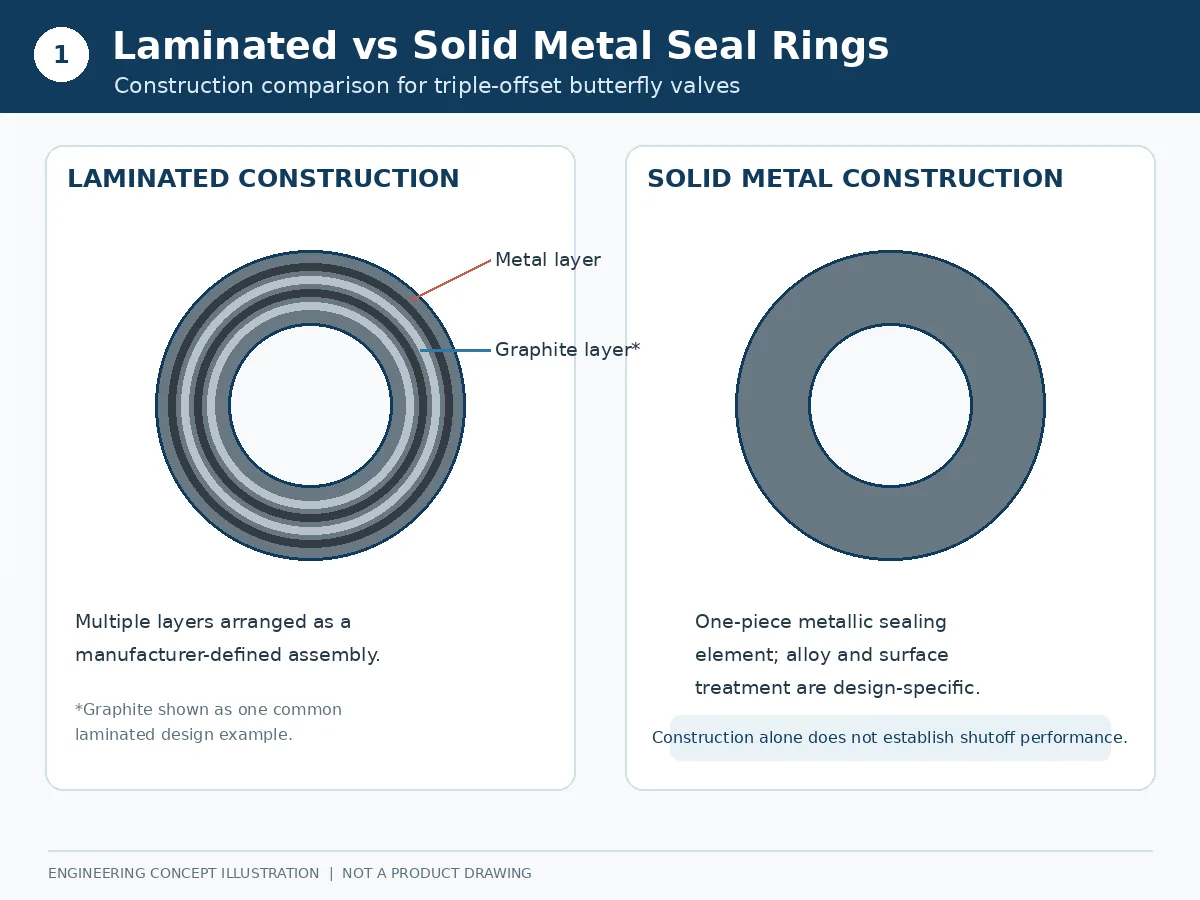
In a metal-and-graphite design, the metal layers and filler work as an assembled sealing element; their individual roles and load sharing depend on the design. Other laminated constructions may use different fillers. Do not infer the material stack, chemical compatibility, temperature limit or repair method from the word “laminated” alone. Require the layer schedule, material grades, thicknesses, retention details and applicable service limitations.
Some manufacturer literature describes alternating metal and graphite layers and offers different alloy options for particular applications. These product-specific examples should not be generalized to every laminated ring. Buyers should request the proposed ring’s material specification and construction drawing.
1.2 Solid Metal Seal Ring Construction
A solid metal seal ring generally refers to a metallic sealing element without the layered filler construction used in a laminated design. Confirm whether the offered component is genuinely one-piece, how it is retained, whether it has a coating or hardfacing, and which disc surface it contacts. Its suitability depends on the complete material pairing, geometry, surface condition, dimensional accuracy and process compatibility.
Some solid metal sealing systems may also use hardfacing, coatings or specialized surface finishes. Therefore, “solid metal” does not mean that every design has the same surface construction or material properties.
1.3 How Triple-Offset Sealing Geometry Works
The three offsets establish the relationship between the shaft axis, disc and conical sealing surfaces. The resulting camming action is designed to minimize contact during much of the opening and closing stroke and bring the sealing surfaces into engagement near the closed position. Exact offset definitions and geometry should be confirmed from the valve manufacturer’s drawing.
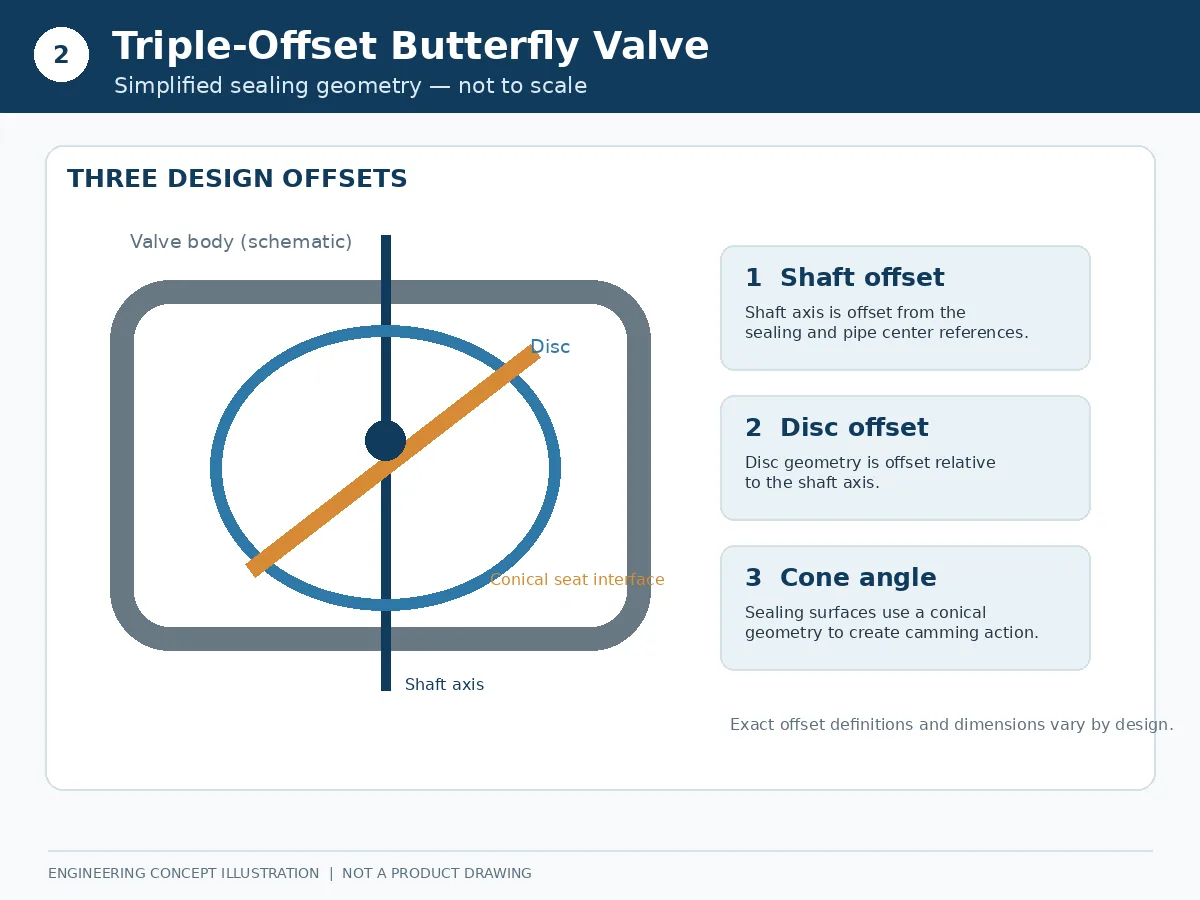
Seal ring selection cannot be separated from the complete valve geometry. Differences in cone geometry, contact pattern, machining accuracy and closing torque can produce different sealing behavior even when two valves use similar alloy families.
1.4 Key Construction Differences
| Característica | Laminated Metal | Solid Metal |
|---|---|---|
| Basic construction | Multiple metal and filler layers in applicable designs | One-piece metallic element |
| Structural behavior | Influenced by layer arrangement and filler properties | Influenced by material properties and geometry |
| Contact accommodation | Depends on designed layer compliance | Depends on geometry and material response |
| Graphite content | Present in graphite-laminated designs | Not required |
| Revisión de materiales | Metal and filler must both be compatible | Metal and any surface treatment must be compatible |
| Mantenimiento | Depends on layer condition and approved repair procedure | Depends on damage depth and machining allowance |
The practical difference is not simply “flexible versus rigid.” It is how the complete sealing system maintains the required contact condition under the specified operating environment.
2. Temperature Response and Thermal Cycling
Temperature suitability is a property of the complete valve configuration, not the seal ring alone. The body pressure-temperature rating, disc and shaft materials, seal ring and mating surface, stem packing, gaskets, bearings, bolting and any actuator-mounted components may impose different limits. The review must cover minimum, normal, maximum, startup, shutdown and upset metal temperatures, plus the relevant pressure and cycling cases. A seal ring material that appears suitable in isolation does not establish the temperature capability of the assembled valve.
2.1 Thermal Expansion and Differential Movement
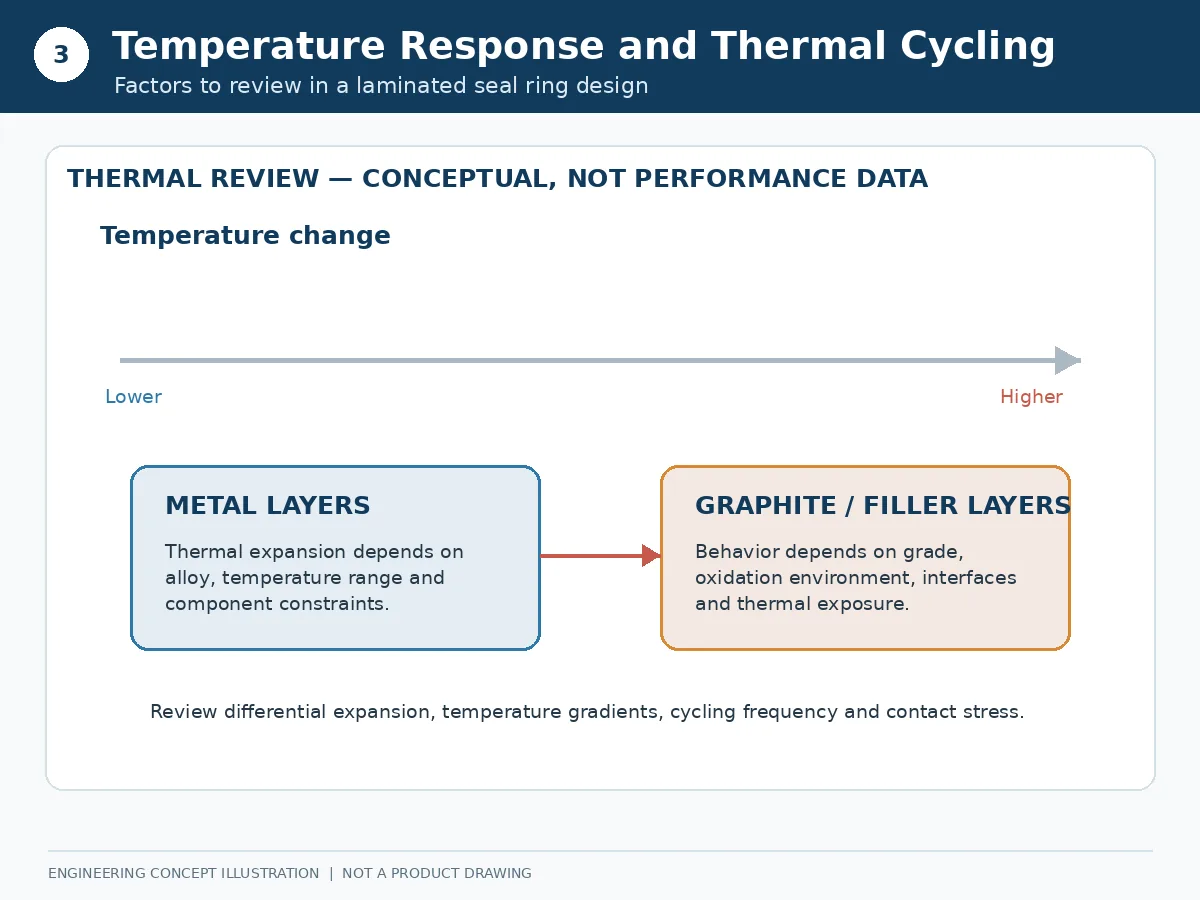
Metal components expand when heated and contract when cooled. The amount of dimensional change depends on the material coefficient of thermal expansion, temperature range, component geometry, temperature distribution and mechanical constraints. If the disc and sealing ring experience different thermal movements, their relative contact geometry can change.
- Changes in contact stress.
- Changes in seating torque.
- Uneven sealing contact or localized loading.
- Increased sensitivity to manufacturing and assembly tolerances.
For this reason, evaluating the seal ring independently from the disc and valve body is insufficient.
2.2 Graphite Layers and High-Temperature Behavior
Graphite is used in certain laminated metal seal rings because its mechanical and sealing characteristics can complement the metal layers. Its behavior depends on grade, density, oxidation environment, temperature exposure and construction.
- Oxidation environment: Graphite behavior in oxidizing atmospheres may differ from behavior in inert or reducing environments.
- Thermal cycling: Repeated heating and cooling can influence filler condition and interfaces.
- Layer arrangement: Metal and graphite thicknesses and the overall configuration influence mechanical response.
- Process compatibility: The medium must be reviewed for compatibility with every material in the sealing assembly.
A 2019 peer-reviewed case study examined a specific laminated seal design for a triple-offset butterfly valve in a combined-cycle power plant application. The authors modelled a stainless-steel/graphite layered configuration and reported prototype performance testing for their particular design at a stated 350°C operating condition. The study is useful because it illustrates how layer count, filler thickness, contact stress and geometry were evaluated together. It is not a generic 350°C rating, a qualification for other manufacturers’ rings, or proof that all graphite-laminated designs are suitable for that temperature. See the full study, Design of Laminated Seal for Triple Offset Butterfly Valve (350 °C) Used in Combined Cycle Power Plants.
2.3 Solid Metal Ring: Material and Thermal Stability
A solid metal ring may avoid a graphite-containing layer stack where that filler is unsuitable, but it does not establish a higher temperature rating by itself. Engineers must assess the selected alloy and surface treatment together with the disc, body, shaft, packing, gaskets, bearings and bolting. Confirm pressure-temperature limits for the exact valve construction and obtain evidence for the required operating and transient temperature profile.
A solid metal ring may be considered where graphite compatibility is a concern, but the selected alloy and sealing geometry still require verification.
2.4 Thermal Cycling: What Should Buyers Check?
| Elemento de revisión | Engineering Question |
|---|---|
| Temperatura de diseño | What are the maximum and minimum design temperatures? |
| Temperatura de operación | Is the temperature stable or subject to frequent changes? |
| Temperature gradient | Do the disc and ring experience different thermal conditions? |
| Medio | Is the environment oxidizing, reducing, corrosive or contaminated? |
| Material | Are all sealing materials compatible with the medium and temperature? |
| Ciclos térmicos | Has the design been evaluated for repeated heating and cooling? |
| Cierre | What leakage acceptance criteria apply at the required operating conditions? |
A typical RFQ gap appears when a buyer specifies only the maximum process temperature. The valve may also experience cold start-up, rapid heat-up, shutdown cooling or repeated bypass cycles. Those transitions can create different temperatures and expansion rates across the disc, ring, retainer and body. Record the full operating cycle and ask the manufacturer which configuration-specific qualification or analysis supports the proposed seal system.
Nota de ingeniería: A pressure test performed at ambient temperature does not, by itself, establish sealing performance during high-temperature operation.
3. Friction, Contact Stress and Operating Torque
Operating torque is frequently misunderstood when comparing laminated and solid metal seal rings. A laminated ring is not automatically a low-torque design, and a solid metal ring is not automatically a high-torque design. Torque depends on the complete valve construction and operating conditions.
3.1 Non-Rubbing Sealing Principle
The triple-offset configuration is designed to reduce unnecessary contact between the disc and seat during the operating stroke. In a properly engineered design, the sealing surfaces engage near the final closing position. This can reduce rubbing and the associated risk of galling or surface damage compared with designs that maintain sliding contact throughout the stroke.
3.2 Laminated Construction and Contact Variation
The layered construction of a laminated seal ring can provide a degree of structural compliance, depending on the metal and filler arrangement. This may help the sealing element accommodate certain contact variations. The actual result depends on layer thickness and configuration, material properties, ring installation and retention, contact geometry, surface condition and assembly tolerances. More compliance does not automatically mean lower operating torque or better sealing.
3.3 Solid Metal Contact and Surface Finish
A solid metal seal ring relies on its designed sealing geometry, material properties and surface condition. Machining accuracy is particularly important. Poorly controlled sealing surfaces may cause uneven contact, localized loading, increased operating torque, premature surface deterioration or inconsistent shutoff results. The disc and seat should be evaluated as a matched sealing pair.
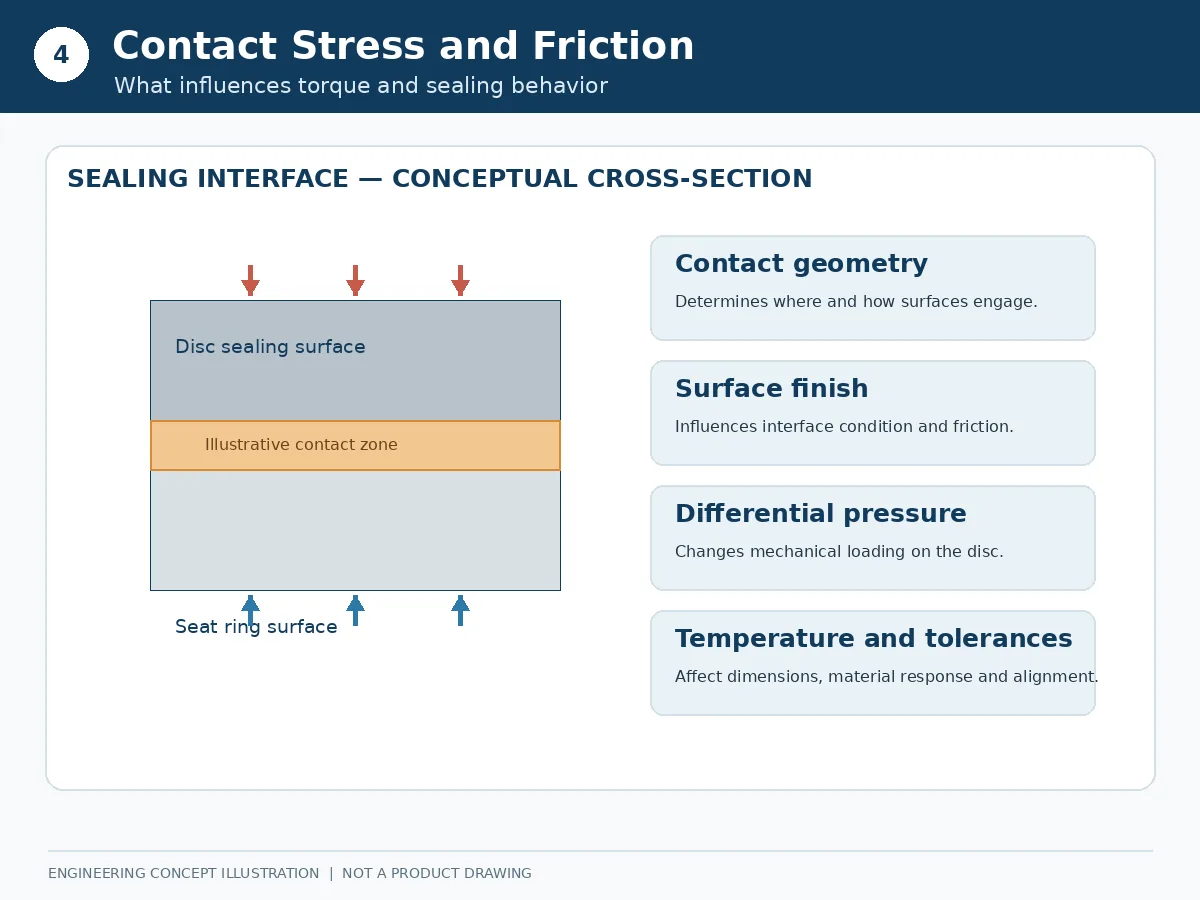
3.4 What Determines Operating Torque?
| Factor | Potential Influence |
|---|---|
| Presión diferencial | Changes mechanical loading on the disc. |
| Seal geometry | Determines contact and seating behavior. |
| Surface finish | Influences interface condition and friction. |
| Material hardness | Affects deformation and surface interaction. |
| Temperatura | Changes material properties and dimensions. |
| Assembly tolerances | Influence alignment and contact distribution. |
| Actuator configuration | Determines available operating torque and margin. |
A common commissioning discrepancy occurs when an actuator is selected from nominal valve size or a single catalogue torque value. If the specified differential pressure, seating direction, temperature or packing load differs from the assumed basis, the available margin may be inadequate. Request the manufacturer’s torque profile and its stated assumptions for break-to-open, running and seating duties; do not infer torque from laminated or solid construction alone.
For actuator selection, buyers should request manufacturer-supplied torque data across the required operating conditions. A generic torque figure based only on valve size is insufficient. Final actuator selection must consider seating and unseating torque, differential pressure, operating temperature, actuation time, safety margin and operating requirements.
4. Repairability, Replacement and Lifecycle Cost
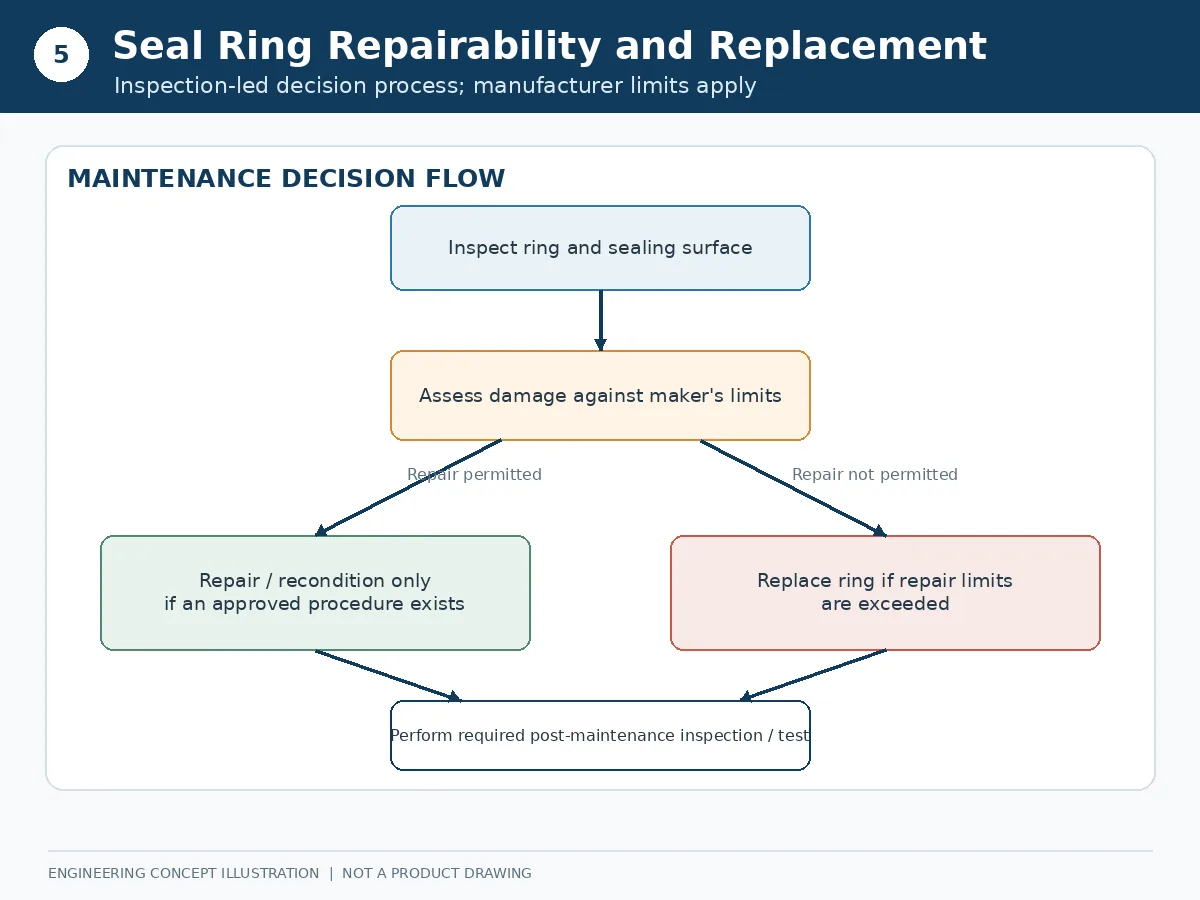
“Repairable” can refer to different activities: replacing a seal ring, reconditioning a removed component in a qualified workshop, or repairing a damaged sealing element. These activities are not interchangeable. The permitted method depends on the valve design, damage condition, manufacturer instructions, dimensional limits and the purchaser’s maintenance requirements.
4.1 Field Replacement Is Not the Same as In-Line Repair
Some butterfly valve product configurations allow the seal ring to be replaced after the valve has been isolated, removed or positioned according to the manufacturer’s procedure. Whether the seat must also be removed, whether the valve must be taken out of the pipeline, and whether the procedure is suitable for a particular size are model-specific questions. Do not assume that a replaceable seal ring can be changed safely in-line or under pressure.
As one product-specific example, Bray’s TRI LOK-Cx IOM describes seal-ring replacement procedures and states limitations for particular removal methods, including cases where the valve is installed in the pipeline or where handling larger valves is difficult. This illustrates why the exact IOM must govern; it is not a universal procedure for other manufacturers’ valves. See the Bray TRI LOK-Cx Installation, Operation and Maintenance Manual.
4.2 Laminated Ring: What Must Be Inspected?
For a laminated construction, inspection should establish whether the layer stack remains intact and whether the sealing profile is within the manufacturer’s acceptance limits. Depending on the design, relevant findings may include layer separation, filler deterioration, distortion, corrosion, scoring or damage to the retaining arrangement. The presence of layers does not mean individual layers are field-replaceable or that the ring can be rebuilt by an unapproved method.
Before deciding on disposition, request the approved inspection method, dimensional limits, layer-integrity criteria, repair prohibition or permission, and post-maintenance verification requirements from the valve manufacturer.
4.3 Solid Metal Ring: Reconditioning Requires Approval
A solid metal ring may be considered for workshop assessment if the manufacturer provides an approved reconditioning route. Machining can alter the sealing profile, dimensions, surface finish or relationship between the disc and seat. A coating or hardfacing may also be affected. Do not describe re-machining as an available repair unless the manufacturer confirms the material, remaining allowance, geometry restoration method and acceptance criteria for the exact ring.
4.4 Damage Findings and Verification
| Observed Finding | Potential Concern | Verification Before Disposition |
|---|---|---|
| Layer separation or distortion | Loss of intended layer arrangement or sealing profile. | Inspect the complete assembly and obtain manufacturer acceptance limits. |
| Filler cracking, erosion or deterioration | Filler damage or loss of intended contact behavior. | Identify filler grade and exposure history; use the approved inspection method. |
| Scoring or localized wear | Uneven contact or damage to the mating surface. | Record location and depth; inspect the disc sealing surface and contact pattern. |
| Corrosión u oxidación | Material loss, roughness or reduced section. | Review medium chemistry, temperature history and all exposed materials. |
| Permanent deformation | Changed sealing geometry or dimensional interference. | Measure critical dimensions against the controlled drawing and repair limits. |
| High or inconsistent operating torque | Possible misalignment, deposits, interference or actuator issue. | Review torque trend, valve position, differential pressure and mechanical condition; do not attribute the cause to the ring without inspection. |
During receiving inspection after a maintenance return, a ring may appear visually intact while its critical conical profile, flatness or thickness has changed. Photograph and measure the ring and mating disc against the controlled drawing before disposition. A visual check alone is not authorization to reuse, re-machine or reinstall the component.
Record the valve tag, serial number, service history, operating conditions, photographs, measurements and maintenance actions. Inspection findings alone do not establish root cause.
4.5 Compare Lifecycle Cost on a Like-for-Like Basis
Compare the cost of the complete maintenance strategy, not only the initial seal-ring price.
Lifecycle cost model: Clife = Cpurchase + Cinspección + Creplacement + Capproved reconditioning + Cdowntime
Ask suppliers to identify the spare ring part number, replacement scope, whether seat and gasket replacement is also required, special tools, workshop requirements, recommended inspection intervals if documented, and the availability/lead-time basis. Do not assign a service-life or maintenance-cost advantage without comparable operating data.
5. Shutoff Performance: What Test Evidence Should Buyers Request?
A seal ring’s construction does not independently prove that a complete valve will meet its required shutoff performance. The final result depends on the complete sealing system, including the disc, seat, contact geometry, manufacturing accuracy, assembly and operating conditions. Buyers should evaluate actual valve-level test evidence rather than relying solely on descriptions such as laminated metal seat or solid metal seat.
5.1 Metal-to-Metal Sealing and Allowable Leakage
Metal-seated butterfly valves should be evaluated against a clearly defined leakage acceptance requirement. The purchase specification should identify the applicable test standard and edition, test pressure, test medium, test duration, permissible leakage, test direction and acceptance criteria. Terms such as “tight shutoff,” “bubble-tight” or “zero leakage” should not replace an explicit test requirement.
5.2 Shell Test vs Seat Leakage Test
| Prueba | Main Purpose | What It Does Not Establish |
|---|---|---|
| Shell pressure test | Checks pressure-boundary integrity. | Does not independently prove seat tightness. |
| Prueba de estanqueidad del asiento | Evaluates closure tightness under specified test conditions. | Does not automatically prove performance at operating temperature. |
| Prueba funcional | Checks valve operation and mechanical function. | Does not replace pressure or seat testing. |
| High-temperature qualification test | Evaluates performance under specified elevated-temperature conditions. | Does not automatically qualify every valve configuration. |
A successful shell test should never be presented as proof of successful seat leakage testing.
5.3 Pressure Direction and Bidirectional Shutoff
For bidirectional applications, buyers should confirm whether the valve is designed and tested for the required flow and pressure directions. The RFQ should identify preferred flow direction, maximum differential pressure, whether bidirectional shutoff is required, leakage acceptance in each direction and any pressure-dependent limitations. A manufacturer’s statement of bidirectional capability should be supported by product-specific documentation and applicable test requirements.
5.4 Test Pressure, Medium and Temperature
Testing conditions must be comparable when evaluating different suppliers. Two valves cannot be fairly compared if one supplier reports a seat test at one pressure and medium while another uses different conditions. Standardize test pressure, medium, duration, flow direction, leakage acceptance, test temperature and report traceability.
ISO 5208:2015 specifies examinations and tests used to establish metallic valve pressure-boundary integrity, closure tightness and structural adequacy of the closure mechanism. The official ISO catalogue states that the 2015 fourth edition was reviewed and confirmed in September 2025 and remains current; an Amendment 1 is separately shown as under development in 2026. ISO also states that the standard is applied with the relevant valve product standard where cited, and that differing product-standard requirements take precedence. API 609 is the API butterfly-valve product standard. API’s current update listing shows an API 609 10th Edition update dated May 2026; verify the purchased edition, addenda and contractual applicability for each project. Neither standard reference replaces the actual test report or project acceptance criteria.
For the related testing framework, see pruebas de presión de válvulas y en la valve standards resource.
5.5 Match Each Standard to the Evidence It Can Support
| Referencia | Role in the Specification | Evidence to Request | Important Boundary |
|---|---|---|---|
| ISO 5208:2015 | Metallic valve examination and pressure testing, where invoked by the product standard or contract. | Applicable test procedure and completed test record with actual conditions and result. | Does not by itself prove a valve’s suitability for every service condition or high-temperature shutoff. |
| API 609 | Butterfly valve product-standard framework, where specified. | Supplier’s declared product-standard basis and applicable edition; related inspection and test documents. | Do not infer product conformity or a specific test outcome from a general standards reference. |
| Project purchase specification | Defines the contractual test scope and acceptance criteria. | Approved datasheet, ITP, test procedure, witness points and acceptance record. | Project requirements may add to or specify requirements beyond a general reference. |
| Manufacturer design qualification | Supports application-specific claims such as elevated-temperature or bidirectional performance. | Configuration-specific qualification report and stated limitations. | Evidence for one size, material or configuration does not automatically qualify every variant. |
Source note: The ISO scope and status are based on the official ISO 5208:2015 catalogue entry. API identifies API 609 as Butterfly Valves: Double-Flanged, Lug- and Wafer-Type in its official standards update listing. Check the currently applicable edition and addenda when the RFQ is issued.
5.6 Normalize the Shutoff Test Before Comparing Suppliers
A supplier comparison is meaningful only when the test basis is equivalent. A pass/fail statement without the test direction, pressure, medium, duration and leakage acceptance does not allow a purchaser to judge whether two offers meet the same requirement.
| Comparison Field | Proveedor A | Proveedor B | Purchaser Check |
|---|---|---|---|
| Valve tag / size / class | Same tag duty and configuration? | ||
| Seal ring construction and materials | Exact layer stack or solid material identified? | ||
| Test standard and edition | Contractually applicable edition? | ||
| Test type and pressure | Seat test distinguished from shell test? | ||
| Test medium and temperature | Conditions match the specification? | ||
| Pressure direction | Required direction(s) demonstrated? | ||
| Duration and leakage criterion | Same acceptance basis and units? | ||
| Observed leakage and result | Measured result or documented acceptance? | ||
| Traceability and witness | Report linked to tag/serial number? |
Where high-temperature shutoff is a critical requirement, request configuration-specific qualification or test evidence at the relevant temperature. An ambient-temperature production test should not be presented as proof of hot operating performance.
5.7 How to Review a Manufacturer’s Test Report
| Evidence Field | Information to Request |
|---|---|
| Identificación de la válvula | Tag number, model and serial number. |
| Construcción | Laminated or solid metal seal ring. |
| Material | Seal ring and disc sealing surface materials. |
| Norma de ensayo | Standard number and edition. |
| Test type | Shell, seat or functional test. |
| Presión de prueba | Actual applied pressure. |
| Medio de prueba | Water, air, nitrogen or other specified medium. |
| Dirección de prueba | Direction or directions tested. |
| Duración de la prueba | Actual holding period. |
| Leakage result | Measured result or acceptance outcome. |
| Criterios de aceptación | Specified allowable leakage. |
| Inspection record | Date, inspector and applicable witness details. |
A frequent supplier-comparison error is to treat a shell-test pass as evidence of seat shutoff. The shell test addresses the pressure boundary; the closure test addresses leakage across the closed valve under its recorded test conditions. Keep the reports separate in the inspection dossier and match each result to the valve tag, serial number, test direction and acceptance criterion.
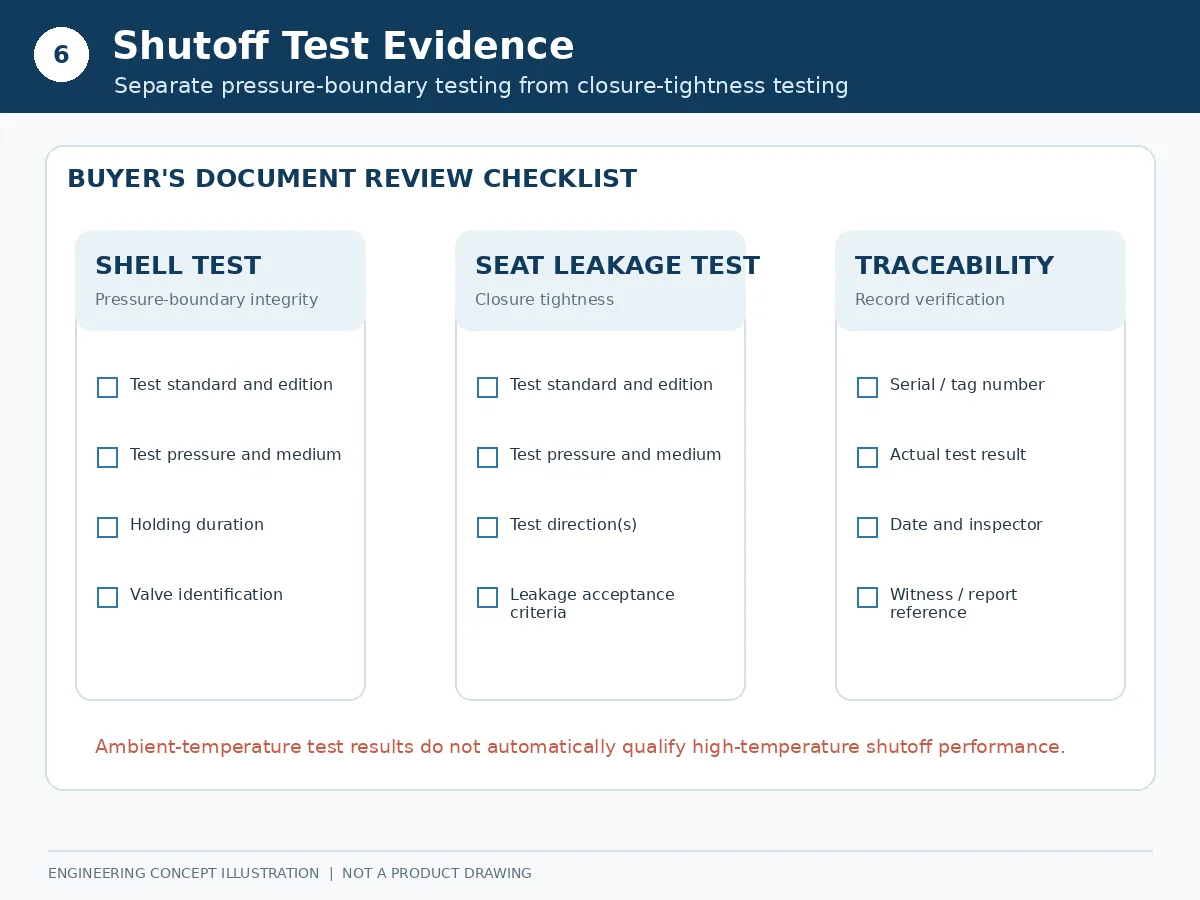
Importante: An ambient-temperature seat test establishes performance under the recorded test conditions. It should not be interpreted as automatic proof of high-temperature shutoff performance unless the required temperature condition has also been qualified and documented.
6. Laminated vs Solid Metal Seal Rings: Engineering Selection Matrix
Selection should begin with the operating environment and required shutoff duty, not with a general preference for one construction.
| Application Consideration | Laminated Metal | Solid Metal |
|---|---|---|
| Graphite-compatible service | May be considered. | May also be considered. |
| Service incompatible with graphite | Requires alternative design review. | May be suitable with compatible materials. |
| Servicio a alta temperatura | Requires layer and graphite assessment. | Requires alloy and thermal assessment. |
| Cryogenic service | Requires specific design qualification. | May be suitable with appropriate materials. |
| Particulate-containing medium | Depends on layer construction and process conditions. | Certain designs may be preferred. |
| Ciclos térmicos frecuentes | Evaluate layer integrity and differential expansion. | Evaluate thermal stress and contact stability. |
| Repair requirements | Confirm layer repair options. | Confirm machining and reconditioning allowance. |
| Tight shutoff duty | Require documented valve-level testing. | Require documented valve-level testing. |
6.1 A Practical Selection Path for Engineers and Buyers
- Screen material compatibility first. Identify every material in the sealing assembly, including metal layers, graphite or other fillers, coatings and the disc sealing surface. Check the process medium, contaminants and atmosphere against each material.
- Define the full temperature profile. Record minimum, normal, maximum and upset temperatures, as well as start-up, shutdown and cycling frequency. Do not substitute a single maximum temperature for the operating profile.
- Define the pressure and shutoff duty. State design pressure, maximum differential pressure, preferred flow direction, bidirectional requirement and the specified leakage acceptance criteria.
- Review the complete seal pair. Ask for the disc/seat geometry, materials, surface treatment, manufacturing tolerances and any relevant design qualification. A seal ring cannot be assessed independently of the disc and valve geometry.
- Normalize supplier evidence. Compare test standards, editions, test medium, pressure, duration, direction, leakage result and valve identification on the same basis.
- Confirm maintenance implications. Obtain written inspection limits, approved repair methods, replacement lead-time information and spare-part identification before final technical approval.
Regla de decisión: If material compatibility, temperature qualification, shutoff acceptance or repair limits remain undocumented, treat the quotation as technically incomplete and request clarification before comparing price.
6.2 Material and Service Compatibility Review
| Service Concern | What to Review for Laminated Construction | What to Review for Solid Metal Construction |
|---|---|---|
| Graphite incompatibility | Confirm whether the selected filler is exposed to the medium and whether an alternative laminated material system is approved. | Confirm that the one-piece alloy and any surface treatment are compatible. |
| Oxidizing atmosphere | Obtain the graphite grade’s applicable oxidation limits and supporting qualification for the actual environment. | Review oxidation resistance of the alloy and surface treatment at the specified temperature. |
| Corrosive medium | Assess both metal layers and filler; do not qualify the assembly by the metal grade alone. | Assess the base alloy, coating or hardfacing, and any galvanic or crevice-related concerns. |
| Particulates / solids | Review particle size, concentration, potential ingress and the manufacturer’s design limitations. | Review erosion, indentation, scoring and the selected sealing surface’s resistance. |
| Ciclos térmicos | Request assessment of differential expansion, layer integrity and contact behavior across the cycle. | Request assessment of thermal stress, dimensional stability and contact behavior across the cycle. |
| Low-temperature service | Confirm filler behavior, layer integrity and qualification at minimum design temperature. | Confirm alloy toughness, dimensional behavior and the complete valve’s low-temperature qualification. |
These are review prompts, not universal compatibility ratings. Final material acceptance requires the exact medium composition, concentration, temperature, pressure, contaminants and applicable project requirements.
6.3 When a Laminated Seal Ring May Be Preferred
- The process medium is compatible with the selected graphite and metal materials.
- The application may benefit from the designed compliance of the layered construction.
- The manufacturer has documented experience with the intended service conditions.
- The required leakage criteria can be demonstrated through applicable testing.
- The maintenance team has access to approved inspection and replacement procedures.
6.4 When a Solid Metal Seal Ring May Be Preferred
- Graphite is incompatible with the process medium.
- Particulates or process contamination create additional design concerns.
- The application requires a specific metallic sealing construction.
- The selected alloy is compatible with the process environment.
- The manufacturer can demonstrate the required shutoff performance.
6.5 Manufacturer Examples Are Product-Specific
For example, Bray’s TRI LOK-Cx technical manual describes an optional solid seal as a direct replacement for its laminated seal and identifies particular material options and applications involving particulates or service incompatible with hydrocarbons or graphite. This is evidence of one manufacturer’s offered configuration, not a universal rule that every solid metal seal is suitable for every particulate or graphite-incompatible service. Review the exact valve model, materials, limits and documentation. See the Bray TRI LOK-Cx technical manual.
6.6 Conditions Requiring Manufacturer Engineering Review
- High differential pressure combined with elevated temperature.
- Severe thermal cycling.
- Highly corrosive or chemically aggressive media.
- Abrasive solids.
- Strict leakage acceptance requirements.
- Specialized fire-safe or fugitive-emission requirements.
- Limited maintenance access.
- Unusual pressure direction or installation constraints.
Neither construction should be selected without further review when these conditions apply. The manufacturer should confirm the proposed construction against the complete valve datasheet and project specification.
7. RFQ Checklist for Triple-Offset Butterfly Valve Seal Rings
To avoid receiving quotations that cannot be technically compared, procurement teams should request consistent information from every supplier.
7.1 Seal Ring Construction and Material
- Laminated or solid metal construction.
- Complete seal ring material specification.
- Graphite grade and construction details, where applicable.
- Disc sealing surface material.
- Surface treatment or hardfacing details.
- Sealing geometry and applicable drawings.
- Material certificates and traceability requirements.
7.2 Operating and Design Conditions
- Medio de proceso y composición.
- Normal and design pressure.
- Normal and design temperature.
- Minimum and maximum temperature.
- Temperature cycling frequency.
- Maximum differential pressure.
- Particulate content and abrasion risk.
- Corrosion and oxidation environment.
- Required operating frequency.
7.3 Shutoff and Testing Requirements
- Required leakage acceptance criteria.
- Applicable valve product standard.
- Applicable pressure testing standard and edition.
- Shell test requirements.
- Seat leakage test requirements.
- Test pressure and medium.
- Unidirectional or bidirectional shutoff.
- Third-party inspection or witness requirements.
- Test documentation and traceability.
7.4 Maintenance and Spare Parts
- Recommended inspection procedure.
- Approved repair and reconditioning methods.
- Maximum allowable repair limits.
- Seal ring replacement availability.
- Spare parts identification.
- Repair documentation.
- Post-maintenance testing requirements.
Supplier Seal Ring Technical Evaluation Scorecard
Use this table to identify missing evidence and technical deviations before comparing commercial price. A blank field means “not yet demonstrated,” not automatic acceptance.
| Evaluation Item | Proveedor A | Proveedor B | Evidencia requerida |
|---|---|---|---|
| Controlled seal construction drawing | Drawing number and revision | ||
| Complete material specification | Material grades for ring, filler and mating surface | ||
| Temperature and pressure suitability | Configuration-specific rating / qualification basis | ||
| Process compatibility | Medium and contaminant review | ||
| Seat leakage test evidence | Test report with conditions and acceptance | ||
| Repair / replacement procedure | Applicable IOM and approved repair limits | ||
| Spare seal ring identification | Part number and supply scope | ||
| Desviaciones técnicas | Deviation list and purchaser disposition |
Supplier Technical Comparison
| Evaluation Category | Proveedor A | Proveedor B |
|---|---|---|
| Seal ring construction | ||
| Material specification | ||
| Temperature suitability | ||
| Pressure suitability | ||
| Leakage acceptance | ||
| Norma de ensayo | ||
| Repair procedure | ||
| Spare parts availability | ||
| Desviaciones técnicas | ||
| Supporting documents |
The lowest initial quotation should not automatically be considered the lowest-cost solution. Missing material information, unclear test acceptance criteria and unsupported maintenance claims can create substantial procurement risks.
8. Frequently Asked Questions
8.1 What is the difference between laminated and solid metal seal rings?
A laminated metal seal ring is a layered sealing element; some designs use alternating metal and graphite layers, while other filler materials or layer arrangements may be manufacturer-specific. A solid metal seal ring generally refers to a metallic sealing element without that layered filler construction. Confirm the exact materials, retention method and mating surface from the valve drawing and bill of materials.
8.2 Which seal ring is better for high-temperature service?
Neither construction is universally better. Temperature suitability depends on the complete valve, including body rating, disc and shaft materials, seal ring, packing, gaskets, bearings and bolting. For laminated designs, also review the exact filler and layer construction. Require qualification or documented limits for the actual pressure and temperature profile.
8.3 Do laminated seal rings require lower operating torque?
Not necessarily. Operating torque depends on sealing geometry, differential pressure, contact conditions, material properties, surface finish and assembly tolerances. A laminated construction may provide designed compliance, but this does not automatically establish a lower torque requirement. Request manufacturer torque data for the actual valve configuration.
8.4 Can a damaged laminated seal ring be repaired?
Do not assume that individual layers can be repaired or replaced. Distinguish seal-ring replacement under the model-specific IOM from workshop reconditioning or repair of the ring itself. Obtain the manufacturer’s written procedure, dimensional limits and post-maintenance acceptance requirements before authorizing work.
8.5 Can solid metal seal rings be re-machined?
Re-machining is not a default repair option. It is permissible only if the manufacturer approves the procedure for the exact ring, confirms remaining dimensional allowance and defines how the sealing profile and surface condition will be accepted. Coatings or hardfacing may impose additional restrictions.
8.6 Which seal ring provides better shutoff performance?
Neither construction automatically provides better shutoff. Actual performance depends on sealing geometry, surface condition, manufacturing accuracy, assembly and operating conditions. Buyers should compare documented seat leakage test results under equivalent pressure, medium, direction and acceptance criteria.
8.7 What test documents should buyers request?
Request the applicable valve testing standard, shell and seat test reports, actual test pressure, medium, duration, leakage result, acceptance criteria and valve identification. For high-temperature service, also request relevant design qualification or performance evidence covering the specified operating conditions.
Request a Triple-Offset Butterfly Valve Technical Review
Need to compare a laminated and solid metal seal option for a project? Send the valve datasheet or RFQ so the proposed sealing construction can be reviewed against the process conditions and specified acceptance criteria. A useful first review needs the following minimum information:
- Tamaño y clase de presión de la válvula.
- Medium and operating conditions.
- Normal and design temperature and pressure.
- Required seal ring construction, if specified.
- Leakage acceptance criteria.
- Testing and inspection requirements.
Review the Triple-Offset Butterfly Valve configuration o submit your valve datasheet for a technical review.
References and Further Reading
- ISO 5208:2015 – Industrial valves: Pressure testing of metallic valves (official catalogue; fourth edition confirmed in 2025; Amendment 1 under development as checked October 2026).
- American Petroleum Institute – API standards update listing (API 609 10th Edition update listed May 2026; confirm purchased edition and addenda).
- Kwak et al. (2019), Design of Laminated Seal for Triple Offset Butterfly Valve (350 °C) Used in Combined Cycle Power Plants – peer-reviewed, configuration-specific research.
- Bray TRI LOK-Cx Technical Manual – manufacturer-specific solid and laminated seal options.
- Válvulas de mariposa – Raymon Valve product category.
- Valve pressure testing – related engineering resource.
- Normas de válvulas – standards resource.
- Acerca de Raymon Valve.
Engineering scope and limitations: This article is an initial comparison of general seal-ring constructions for technical and procurement evaluation. It does not provide a valve rating, material compatibility approval, actuator torque calculation, repair authorization or guaranteed leakage result. The research example and manufacturer manual cited above apply only to their stated designs. Final selection requires confirmation against the complete process data, applicable product standard, valve datasheet, approved drawings and purchase specification. Authoring status: Raymon Valve technical content; no individual engineer reviewer has been identified for this article.
 Spanish
 English
 German
 Arabic
 French
 Italian
 Portuguese
 Russian