
Engineering comparison · Industrial isolation
Choose a ball valve for industrial isolation when quarter-turn operation, repeated switching or an automated package fits the duty. Consider a gate valve for full-open or full-closed isolation where its flow passage, linear operating arrangement and installation envelope meet the specification. A ball valve vs gate valve decision still depends on seat compatibility, pressure-temperature limits, shut-off differential pressure and the required closure time. Compare both proposals against the same leakage acceptance, installation drawing and supplied scope before approving either construction.

In this guide
- Quick comparison
- Operating design and flow path
- When to consider a ball valve
- When to consider a gate valve
- Conditions requiring review
- Replacement checklist
- Compare quotations
- Preguntas frecuentes
- Request selection review
Ball Valve vs Gate Valve: A Quick Comparison for Isolation Duty
A ball valve rotates a bored ball; a gate valve moves a gate across the flow path. Both require a construction suited to the stated isolation duty. Compare the offered designs at the same operating cases rather than ranking their names by tightness, speed or purchase price.
On a small screen, scroll the table horizontally to view all columns.
| Factor de selección | Válvula de bola | Válvula de compuerta | Buyer confirmation |
|---|---|---|---|
| Closure motion | Typically 90° ball rotation | Linear gate movement; operator arrangement varies | Required operating method and position indication |
| Trayectoria del flujo | Full, reduced or purpose-designed bore | Passage depends on gate construction and bore | Actual internal geometry and required flow capacity |
| Cierre | Seat design and materials determine acceptance capability | Gate/seat arrangement and materials determine acceptance capability | Test conditions and allowable leakage |
| Cycling | Candidate for repeated quarter-turn isolation | Review suitability for the required operating frequency | Cycle duty, differential pressure and maintenance requirements |
| Automatización | Quarter-turn actuator package | Multi-turn or linear actuator arrangement, as designed | Torque/thrust, supply, controls and fail action |
| Installed space | Body, lever or actuator clearance | Bonnet, stem and operator clearance | Approved overall dimensions in all positions |
| Mantenimiento | Access depends on body and seat construction | Access depends on bonnet, gate and seat construction | Removal route, isolation provision and service procedure |
| Coste | Depends on configuration and supplied scope | Depends on configuration and supplied scope | Comparable technical, inspection and commercial inclusions |
Start with the function and operating cases below. Shortlist a construction only after identifying the evidence needed to accept it.
Which Requirement Should Drive the Shortlist?
On a small screen, scroll the table horizontally to view all columns.
| If the requirement is… | Initial direction | Condition before selection |
|---|---|---|
| Quarter-turn automated isolation | Evaluate a ball valve package. | Confirm seat suitability, operating torque, supply conditions, cycle duty and closure time. |
| Infrequent isolation in an existing gate-valve installation | Evaluate a matching gate construction and compare alternatives. | Confirm passage, rating, operating load, available space and required shut-off performance. |
| Continuous flow regulation | Start a dedicated control-valve review. | Provide minimum, normal and maximum flow cases, pressures, temperature and the control objective. |
| Solids, deposits or trapped-liquid concerns | Keep the choice conditional for either valve. | Obtain a construction-specific review of sealing, movement, cleanout and cavity-pressure behavior. |
Selection hold point: If the required pressure-temperature envelope, medium compatibility, maximum shut-off differential pressure or leakage acceptance is unknown, request the missing data before technical approval. Record provisional assumptions as quotation conditions.
How the Closure Design Changes Operation and Installation
Quarter-Turn Ball Movement vs Linear Gate Travel
A ball valve typically rotates through 90°, as described in Spirax Sarco’s rotary isolation-valve guidance. The short travel suits quarter-turn actuation, but it does not establish operating torque, closure time or cycle life. Obtain those limits for the proposed seat system, differential pressure and operating conditions.
Gate valves may use rising-stem or non-rising-stem arrangements. The gate still travels linearly, but the external movement and required clearance differ. Review the actual drawing before deciding whether a gate valve fits beneath a platform or within a congested pipe rack.
For either valve, check the installed operator as well as the bare valve. A lever needs swing clearance; a gearbox needs handwheel access; an actuator needs room for accessories, wiring or tubing and maintenance.
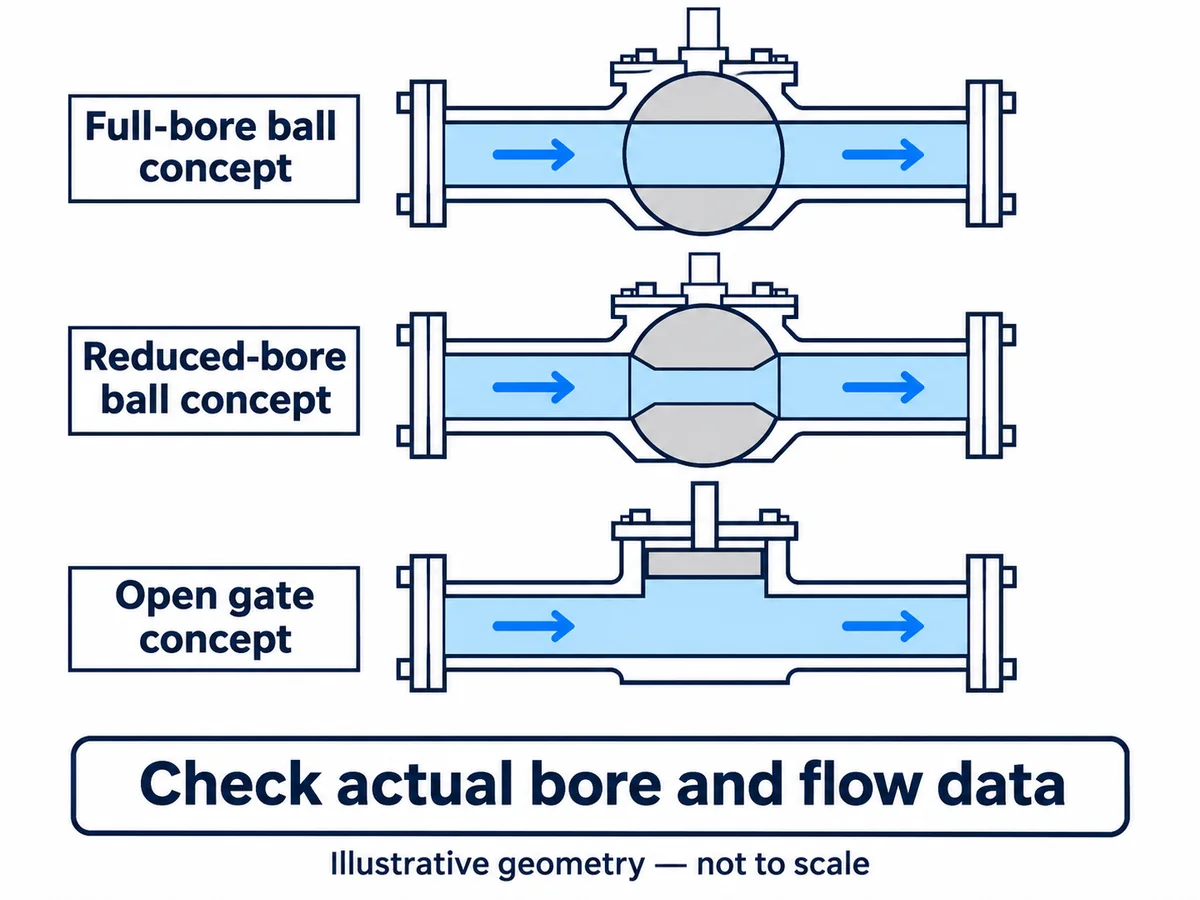
Full Bore, Reduced Bore and the Actual Flow Path
Ball valves are available with full and reduced bores, as explained in the rotary-valve reference above. Compare their actual passages with the proposed gate valve rather than treating nominal size as flow capacity. The full port vs reduced port ball valve comparison explains the separate bore, flow-data and pigging checks.
Ask for model-specific Cv/Kv or pressure-loss data, including the stated bore, test or calculation basis and valve position. A fully open published coefficient does not describe every intermediate position or prove the system’s transient response. Hypothetical flow review: Two offers have the same nominal size, but one has a smaller passage. If the pressure-loss budget cannot be checked, keep that offer conditional. Obtain the actual flow cases, fluid properties and offered-model coefficient before accepting the bore.
For a piggable line, add the required internal clearances and pig compatibility to the specification. A full-bore label alone does not establish compatibility with the selected pig or the complete installed pipeline.
When Should a Ball Valve Be Shortlisted?
Quarter-Turn Automation and Repeated Isolation
Consider a ball valve where the project calls for quarter-turn isolation, repeated operation or integration with a pneumatic, electric or hydraulic actuator. Confirm the actual operating load before selecting the package.
Give the supplier the maximum differential pressure during opening and closing, temperature extremes, prolonged closed periods, cycle frequency and deposit risks. Ask for breakaway, running and end-of-travel torque as applicable to the selected design. Compare the complete operating-load envelope with actuator output at the minimum specified supply, then check the selected margin and maximum allowable valve input torque.
Gate valves can also be automated; compare complete packages at the same supply and fail-action requirements. Hypothetical actuator review: A quarter-turn package is quoted for normal operation, while the required shutdown differential pressure is unspecified. Its operating capability remains unconfirmed because the governing load case is missing. Obtain the shutdown case, valve torque envelope, minimum available supply, required travel time and fail action. Verify the selected margin and allowable valve input load before approving the package.
Seat Choice and Shut-Off Requirements
Specify the body, trim, stem, seats, packing and gaskets separately. Body-material compatibility does not establish the suitability of every wetted part or seal. Seats govern closure contact and wear; packing influences stem sealing and friction; gaskets seal static joints. Review the complete assembly’s chemical compatibility, temperature limits and operating loads. Soft and metal seats require different design-specific assessments, and neither material label establishes leakage acceptance, fire qualification or external-emissions performance.
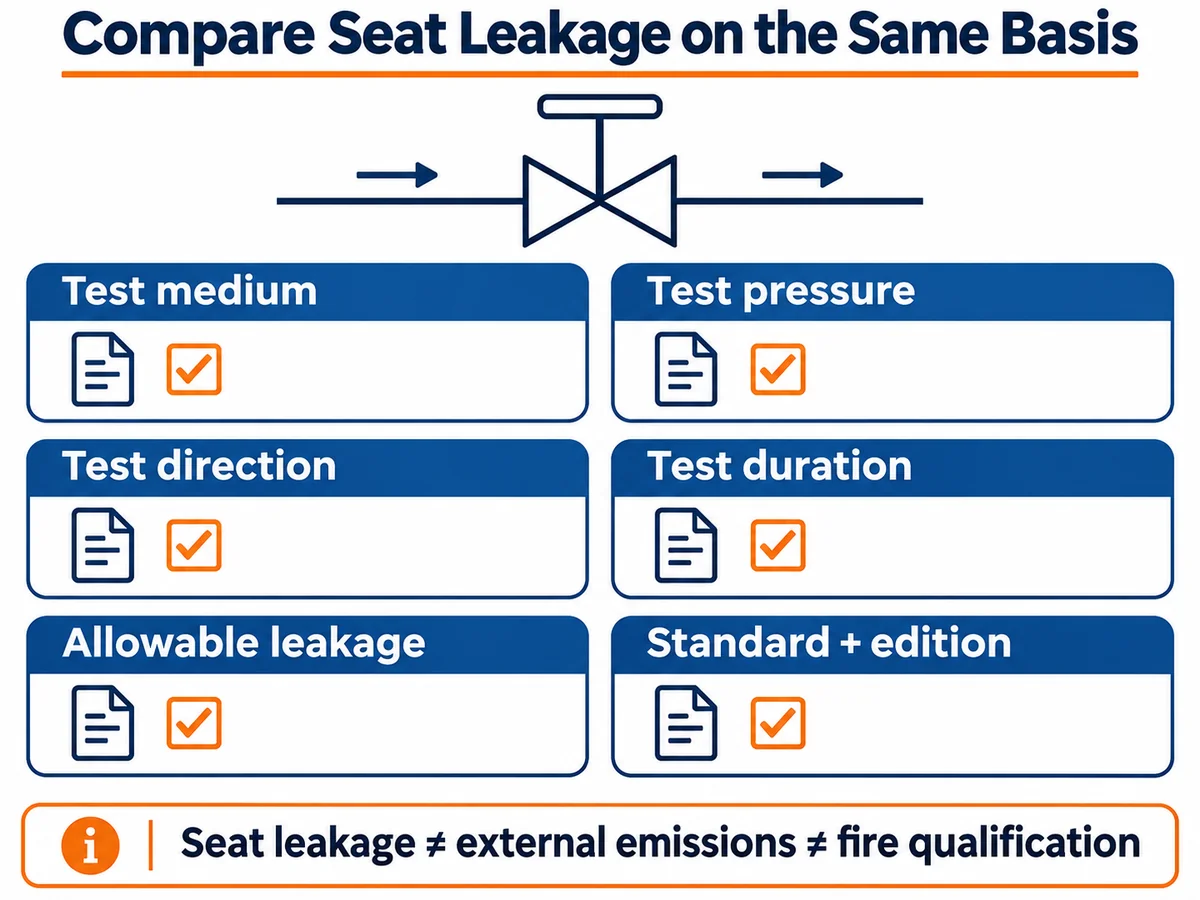
Specify what “tight shut-off” means. Record the test medium, pressure, direction, duration, allowable leakage and applicable standard and edition. A factory acceptance result describes performance under the agreed test conditions; it does not establish identical leakage throughout every future operating condition.
Review industrial ball valve configurations to identify possible constructions, then request confirmation against the tag datasheet. Use the floating vs trunnion ball valve comparison for the separate ball-support decision; diameter alone does not establish the selected construction.
When Should a Gate Valve Be Shortlisted?
Full-Open or Full-Closed Isolation and Installation Fit
Shortlist a gate valve for full-open or full-closed isolation where the offered passage and linear operating arrangement suit the installation. Spirax Sarco’s linear isolation-valve guidance describes the general mechanism. Compare the actual gate construction, required cycling, travel time, stem clearance and shut-off conditions before deciding whether it is the better fit.
The commercial comparison should use the actual size, pressure class, materials and supplied operator. There is no useful universal diameter at which every project should switch from a ball valve to a gate valve.
For an actuated gate valve, request the opening, running and seating thrust/torque requirements applicable to the design, including starting against the specified differential pressure. Obtain the proposed actuator capability and limit/torque settings. Confirm that available output meets operating loads without exceeding the valve’s allowable input loads; use the approved manufacturer instructions for settings.
Match the Gate Construction to the Service
Wedge, parallel/slab and knife gate constructions should be evaluated separately. A proposal for one does not establish the suitability of the others. Identify the construction in the quotation and ask how its sealing arrangement, materials and passage address the specified service.
For steam or elevated-temperature duty, compare constructions against both the highest and lowest specified temperatures, including startup, shutdown and thermal cycling. Confirm the pressure boundary, bonnet joint, bolting, trim, packing and gaskets as well as the seats. A gate-valve name does not establish the required rating, and a metal-seated ball valve should be assessed on its own documented envelope.
For a steel gate-valve product example, review the API 600 gate valve product page. This is one construction route; assess other gate designs separately and record the accepted configuration in the purchase documents. The product-page designation does not establish compliance for a future order.
Which Service Conditions Prevent a Simple Either-Or Decision?
High Temperature, Solids, Fouling and Trapped Liquid
Record medium composition, concentration, phase, solids and relevant cleaning or shutdown conditions. Where the service requires it, include pH, chlorides or H₂S exposure in the material review. Identify particle size and abrasiveness, deposition or crystallization risks, and the likely degradation mechanism. Corrosion of metal parts, erosion of sealing surfaces and swelling or permeation of nonmetallic seals require different checks. Ask for the selected construction’s compatibility evidence and maintenance limitations.
Class 150, Class 300 and other class designations are not fixed operating pressures. Verify the applicable material group and temperature-dependent rating, then confirm any lower limit imposed by the actual seat, packing, gasket or design. The official ASME B16.34 scope and edition listing identifies the 2025 edition and includes ratings and materials within its construction scope; it does not approve every valve for every medium. Hypothetical temperature review: An isolation valve meets normal duty, but the specified cleaning cycle has not been checked. Obtain that pressure-temperature case and seal limits; hold approval while compatibility remains unresolved.
Identify potentially trapped liquid volumes and obtain the selected design’s cavity-pressure review. Confirm relief direction and any specified vents or drains, including whether the arrangement affects the intended isolation boundary. Require a drawing or written design statement for double-isolation claims; the number of seats alone does not establish the function.
Closure Time, Pressure Transients and Fail Position
Define the required closing time through the system review. A quarter-turn valve can be configured for different operating speeds, and a gate valve’s longer travel does not prove that a damaging transient is impossible.
Where closing behavior matters, provide the piping or process team with the proposed travel time and operating profile. Evaluate the hydraulic or process consequences before fixing actuator speed. The fastest available closure is not automatically the correct setting.
Specify the required response to loss of power, instrument air or control signal. Distinguish fail closed, fail open and remain-in-position requirements, and identify the energy source and accessories needed to achieve the agreed behavior.
Throttling, Emergency Isolation and Special Qualification
Treat standard isolation designs as full-open/full-closed candidates. If continuous flow regulation is needed, review a purpose-designed control valve or characterized rotary design using the required flow cases and control objective. Partial opening alone does not establish suitable throttling performance.
Emergency isolation also needs a defined package duty. Record response time, fail action, controls and any required functional-safety evidence. Valve type alone does not establish the performance of the complete safety function.
Where fire testing, fugitive emissions, cryogenic qualification or sour-service requirements apply, request evidence covering the offered construction and specified scope. Keep these requirements separate from routine pressure and seat tests.
Can a Ball Valve Replace an Existing Gate Valve?
A replacement can be considered after an engineering comparison of the existing duty and proposed valve. Equal nominal size and pressure class do not establish interchangeability.
On a small screen, scroll the table horizontally to view all columns.
| Replacement check | What to verify |
|---|---|
| Duty | Required isolation function, operating cases and reason for replacement |
| Pressure-temperature envelope | Proposed model’s rating across all specified cases |
| Trayectoria del flujo | Actual bore, required flow capacity and pigging requirements, if applicable |
| Installed connection | Face-to-face length, end standard, flange facing, gasket and bolting compatibility |
| Materiales | Body, trim, seat, packing and gasket compatibility with the service |
| Shut-off conditions | Maximum differential pressure, isolation direction and leakage acceptance |
| Accionamiento | Manual effort or actuator loads, closing time, fail position and feedback |
| Space and loads | Operator clearance, orientation, supports, weight and piping-load requirements |
| Mantenimiento | Access, removal route, spares and approved service procedure |
| Aceptación | Approved drawing, deviations, tests and responsible project approval |

Hypothetical replacement review: Assume the duty remains on/off isolation and a proposed ball valve has the same nominal size and pressure class as the existing gate valve. The supplier has not yet provided the face-to-face drawing or operating-load data for the required shut-off differential pressure. Mark the offer conditional. Request the installation drawing, applicable torque data and closing-time proposal; compare them with the available space, actuator supply and required operating cases. Close the open items before technical approval, or reject the configuration if it cannot meet the confirmed requirements.
Plan replacement work under the site’s approved isolation, depressurization, draining and maintenance procedures. Neither valve’s closed position should be treated by itself as proof that equipment is safe to open.
How to Compare Ball and Gate Valve Quotations on the Same Basis
Normalize the Technical and Inspection Scope
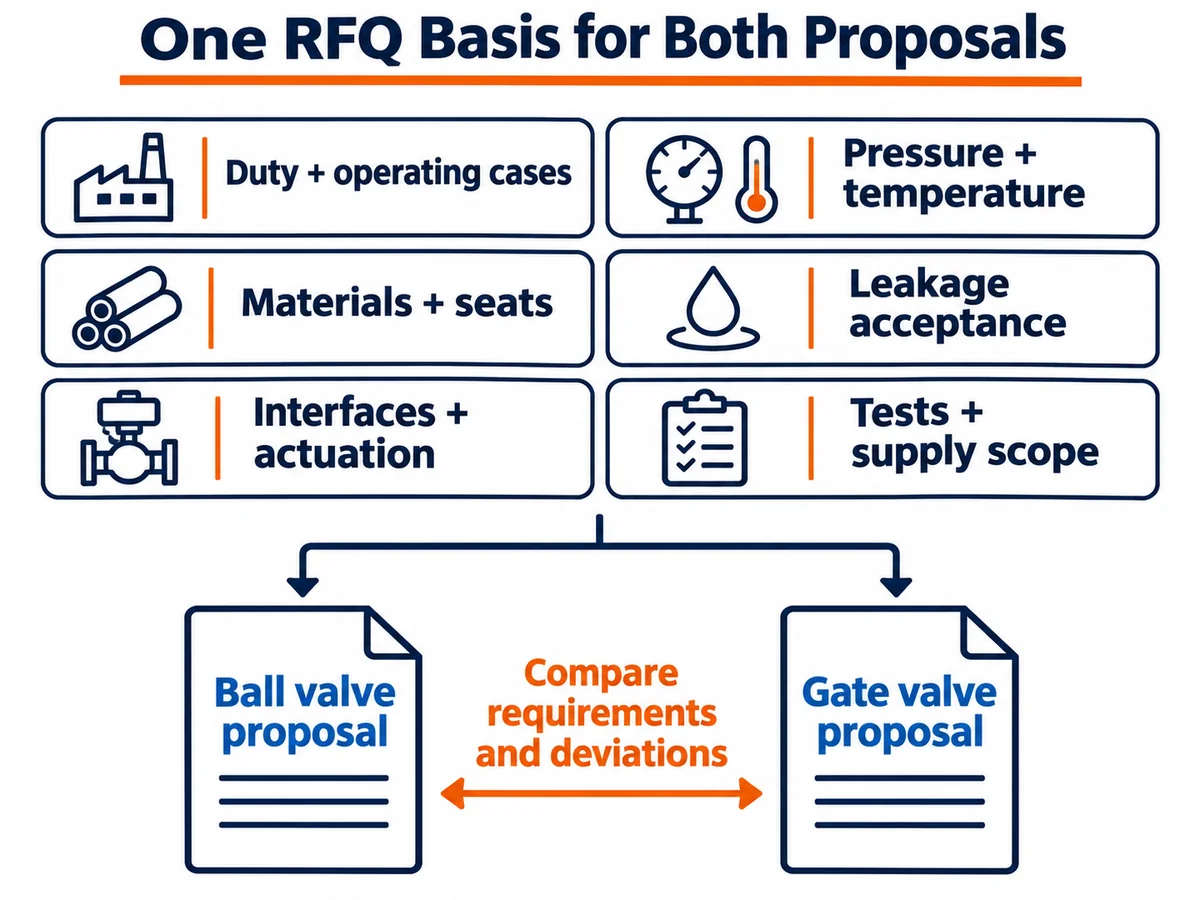
Give both suppliers the same operating cases and acceptance requirements. Ask them to identify deviations explicitly rather than leaving assumptions inside a general product description.
On a small screen, scroll the table horizontally to view all columns.
| RFQ field | Common comparison basis | Evidencia a solicitar |
|---|---|---|
| Función | Isolation duty, cycles, closure time and fail position | Tag datasheet and operating cases |
| Presión y temperatura | Operating/design envelope and maximum shut-off differential pressure | Model rating data and accepted datasheet |
| Flow passage | Actual bore and allowable pressure loss | Drawing and flow data where required |
| Materiales | Body, closure member, seats, packing and gaskets | Material and seat specification |
| Leakage | Standard/edition, medium, pressure, direction, duration and allowable rate | Agreed test procedure and report |
| Installed fit | Ends, face-to-face length and operator envelope | Approved general arrangement drawing |
| Accionamiento | Loads, supply, margins, settings and accessories | Torque/thrust data and actuator selection record |
| Supply scope | Inspection, documents, spares and deviations | Itemized quotation and deviation schedule |
Use the project’s named standards and approved editions to define construction, dimensions, testing and documentation separately. A compliant pressure-boundary design and an acceptable closure test answer different questions. Resolve conflicts and purchaser options in the approved specification rather than treating a standard number in the quotation as complete acceptance.
ISO 5208:2015, confirmed in 2025 according to ISO’s official page, addresses metallic-valve pressure-boundary and closure testing in conjunction with the applicable product standard. It is not a general application-selection approval. Confirm the project-required edition and the controlling product-standard requirements before agreeing acceptance.
Shell testing assesses the pressure boundary under specified conditions; seat testing checks closure leakage under its defined conditions. Functional checks confirm specified movement and package behavior. A pressure test does not establish that all internal material defects are absent. NDT, positive material identification (PMI), material test certificates and heat-treatment records provide different evidence; PMI alone does not establish full material history. Agree any fire, external-emissions or cryogenic qualification separately, and retain the required tag-linked records. Use the valve pressure testing guide to organize the inspection scope.
Request the Missing Evidence Before Purchase Approval
Classify each offer as acceptable, conditional or excluded for the stated duty. Use “conditional” when a missing record or declared deviation still needs resolution; a low price does not close that item. The following checks turn the comparison into purchase-review actions.
On a small screen, scroll the table horizontally to view all columns.
| Requirement | Supplier record | Hold point |
|---|---|---|
| Installed fit | Approved drawing: ends, face-to-face, operator envelope and access. | Resolve incompatible interfaces or clearance conflicts before approving the replacement. |
| Rating and sealing | Model-specific pressure-temperature limits, material/seat details and agreed leakage procedure. | Exclude a configuration outside the required envelope; hold acceptance while relevant data are missing. |
| Actuated duty | Torque/thrust selection record, minimum supply, allowable loads, travel time and fail action. | Resolve load, speed and fail-action deviations before approving the package. |
| Inspection and traceability | Required inspection plan, material records and tag-linked test/document list. | Agree record scope, witness points where specified, and delivery timing in the order. |
Compare installed cost using the same supply boundary: valve, operator and accessories, inspection, documents, installation changes and spares. Separate excluded items and unresolved deviations from the quoted total. Evaluate maintenance access and required service tasks against the site plan; establish any lifecycle saving from documented assumptions.
Supplier background can support the evaluation—see Acerca de Raymon Valve—while the offered valve’s technical acceptance should remain tied to the agreed order documents.
Alcance de ingeniería: This guide supports initial screening and RFQ preparation for industrial isolation. It does not select a final valve or actuator. Confirm the exact model against the complete service envelope, approved datasheet, applicable standards and required tests. The cited references explain general mechanisms and standard scopes; they do not verify an offered model. No model-specific test reports or qualification records have been supplied for this comparison. No product performance, certification or service life is asserted.
Preguntas frecuentes
What is the main difference between a ball valve and a gate valve?
A ball valve rotates a bored ball, typically through 90°, while a gate valve moves a gate linearly across the flow path. This affects the operating arrangement and installation envelope. Selection also requires the actual materials, rating, leakage requirement and service conditions. Which valve provides tighter shut-off?
Compare the actual seat designs under the same test medium, pressure, direction, duration and allowable leakage rate. Neither valve family guarantees a leakage result by name. An accepted factory test applies to its specified conditions and does not establish identical leakage throughout service life. Which valve has lower pressure drop?
Compare actual bore and model-specific flow data at the same operating conditions. Both can offer low restriction when the selected passage is suitable and the valve is fully open. Equal nominal size alone does not establish equivalent pressure loss. Can either valve be used for throttling?
Treat standard isolation designs as full-open/full-closed valves. Dedicated control ball valves or other regulating designs require a separate flow and control review. A partly open isolation valve is not thereby qualified for continuous throttling. Can a ball valve replace a gate valve without piping changes?
Possibly, if the proposed dimensions, ends, rating, materials, operating behavior and installed clearances meet the existing requirement. Verify these against drawings and the approved replacement specification before purchase. Is a gate valve always cheaper at larger sizes?
No universal price relationship applies. Compare equivalent pressure class, materials, bore, operator, tests and documentation. Installation modifications and maintenance requirements can also affect the project cost.
Solicitar revisión de selección de válvula
Send one tag datasheet per duty, including the medium and phase; operating and design pressure and temperature; size, class and end connections; maximum shut-off differential pressure; cycle frequency; required closure time; and leakage acceptance criteria. For actuation, include supply conditions and fail position. Identify any solids, special qualification or inspection requirements. For replacement, attach the existing datasheet and installation drawing.
If a required field is unknown, mark it “to be confirmed” and identify the operating case that needs review. Ask the proposal to state its construction, acceptance basis, supplied documents and deviations.
Solicitar revisión de selección de válvula with the project inputs so the proposed construction, supplied scope and deviations can be reviewed against a common specification.
 Spanish
 English
 German
 Arabic
 French
 Italian
 Portuguese
 Russian