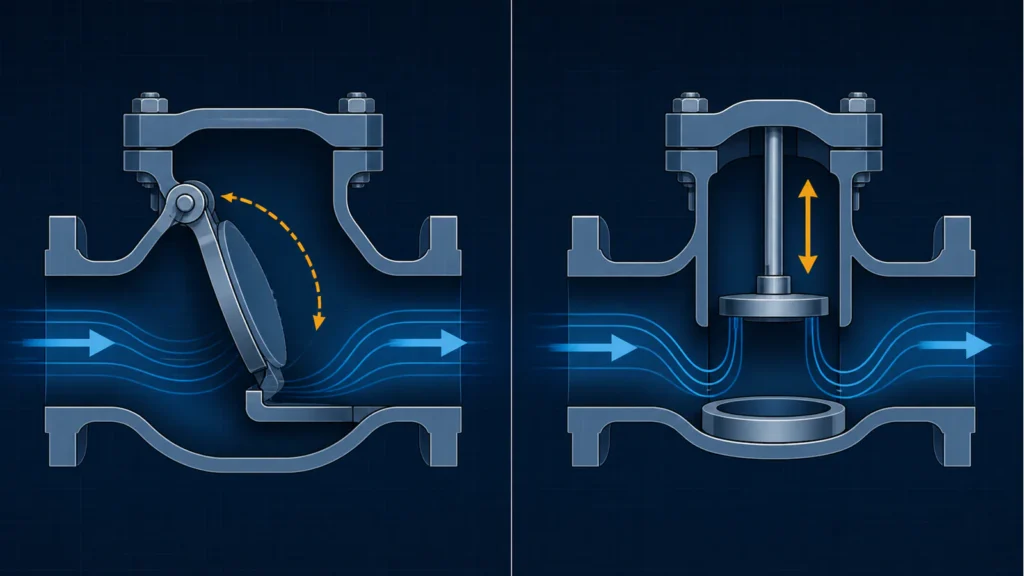
Engineering concept comparing a hinged swing disc with a vertically guided conventional lift element

Clapet anti-retour à battant vs Clapet anti-retour à levée : perte de charge, installation, réponse à la fermeture et sélection

A swing check valve uses a hinged disc and usually offers a more direct flow path; a conventional lift check valve uses a guided closure element and commonly creates a more restrictive passage. That difference can affect pressure loss, opening behavior, installation and closing response, but neither construction is universally better. Select between them using the actual flow range, allowable pressure drop, approved orientation, opening and stable-flow data, closure behavior, medium condition and pump or compressor shutdown case—not the valve type name alone.

Technical approval boundary: This comparison supports preliminary screening and RFQ normalization. Final approval requires the complete project datasheet, exact-model performance evidence and, where transient consequences are significant, a system-level hydraulic review.

Featured illustration: Concept comparison of hinged swing-disc motion and guided conventional lift motion. It is not an exact product drawing, test record, or project evidence.

Clapet anti-retour à battant ou à levée : La décision en une minute

A swing check valve is often the first construction to screen when low steady pressure loss is important and the operating flow can hold the disc in a stable open position. A conventional lift check may be worth screening for smaller-bore, clean service where guided movement is preferred and sufficient differential pressure is available to lift and hold the closure element open.

Those are screening directions, not specifications. Vertical piping, fluctuating flow, pulsation, rapid trips, solids or previous slam can invalidate a type-based decision.

Project priority or conditionOrientation préliminaireEvidence required before approvalStop condition
Low allowable steady pressure dropScreen swing constructions firstExact-model Cv/Kv or pressure-flow curve at minimum, normal and maximum flowDo not approve from “low resistance” or type name alone
Small-bore, clean service with guided closure preferenceScreen conventional lift constructionsBody pattern, opening differential, stable-open basis and approved orientationHigh pressure alone does not prove suitability
Minimum flow far below normal flowScreen both for stable openingOpening-position or minimum-stable-flow evidenceHold if the offered model has no low-flow basis
Vertical pipingVérifier la construction exacteControlled drawing, flow direction and IOMNo generic vertical approval
Rapid trip, pulsation or previous slamNeither type wins by nameClosing data and possible transient reviewNo non-slam or pump-protection promise
Solids, deposits or viscous mediumExaminer les deux avec prudenceInternal geometry, clearances, materials and cleaning/maintenance planNo universal “dirty-service” conclusion

The broader clapets anti-retour industriels may include spring-assisted, dual-plate, axial-flow, nozzle and other designs. Expanding the candidate list is appropriate when neither conventional swing nor conventional lift construction can be supported for the duty.
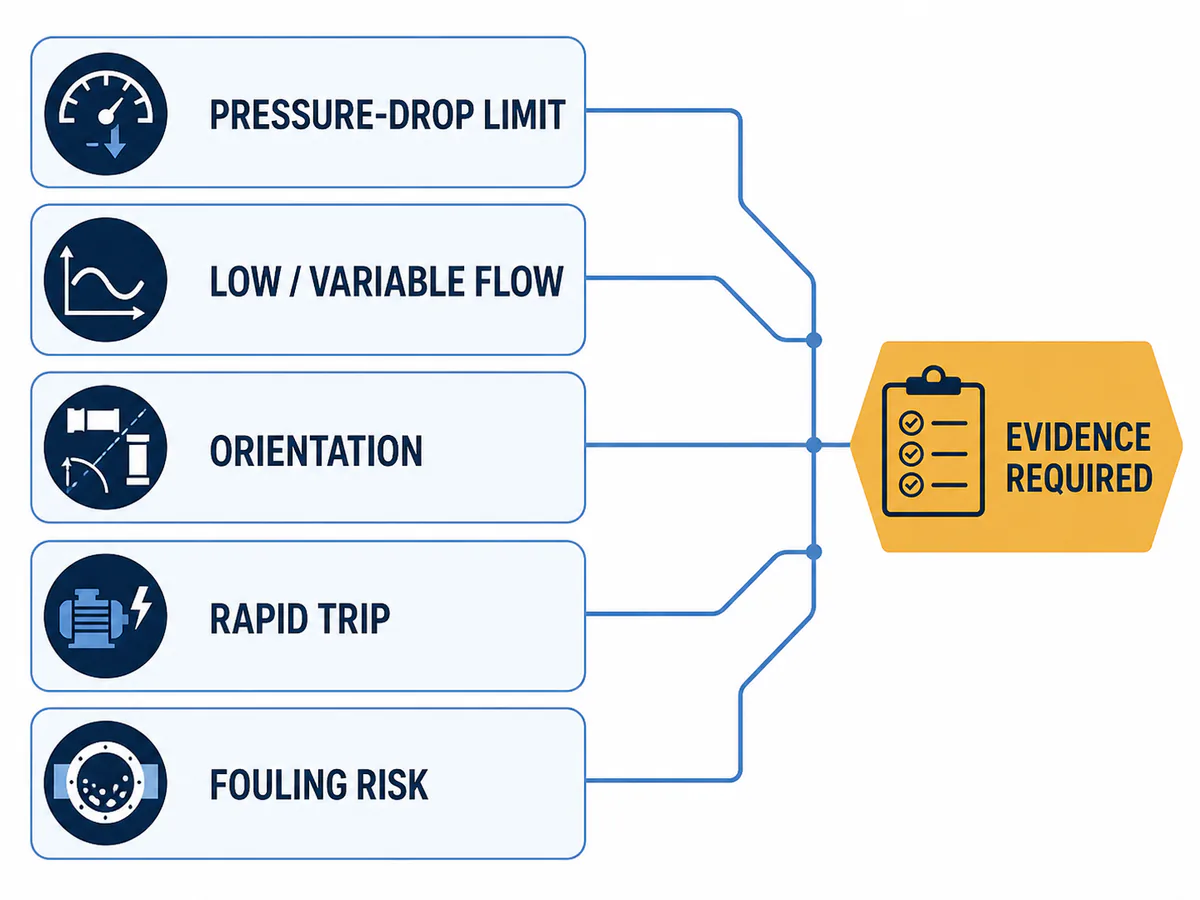
Screening matrix for pressure drop, low flow, orientation, rapid trips and fouling when comparing check valves
Example screening matrix. A preliminary direction is not a final valve selection.

Swing and Lift Describe Different Closure Motions

How a Conventional Swing Check Valve Moves

A swing check valve uses a disc connected to a hinge, shaft or pivot. Forward flow rotates the disc through an arc away from the seat. When the opening force decreases, gravity, reverse flow and any model-specific spring, lever or counterweight move the disc back toward the seat.

Important variables are disc travel and mass, hinge friction, opening position, gravity direction, any spring/lever/counterweight force, and the available maintenance space.

A plain swing check, spring-assisted swing check and lever-and-weight swing check should not be treated as dynamically identical merely because all use a hinged disc.

Comment un clapet anti-retour à levée conventionnel se déplace

A conventional lift check uses a disc, piston, plug or ball that moves along a guide. Forward differential pressure raises the closure element. When the opening force falls below the combined closing forces, it returns toward the seat.

Important variables are guided travel and mass, guide clearance and friction, gravity or spring force, seat and body geometry, deposits or viscosity, and the approved guide direction.

“Lift check valve” is not a complete dynamic description. A gravity-operated globe-pattern lift check is not automatically equivalent to a spring-assisted silent, nozzle, axial-flow or ball-lift design. Use the offered sectional drawing and controlled product documents to establish what is being compared.
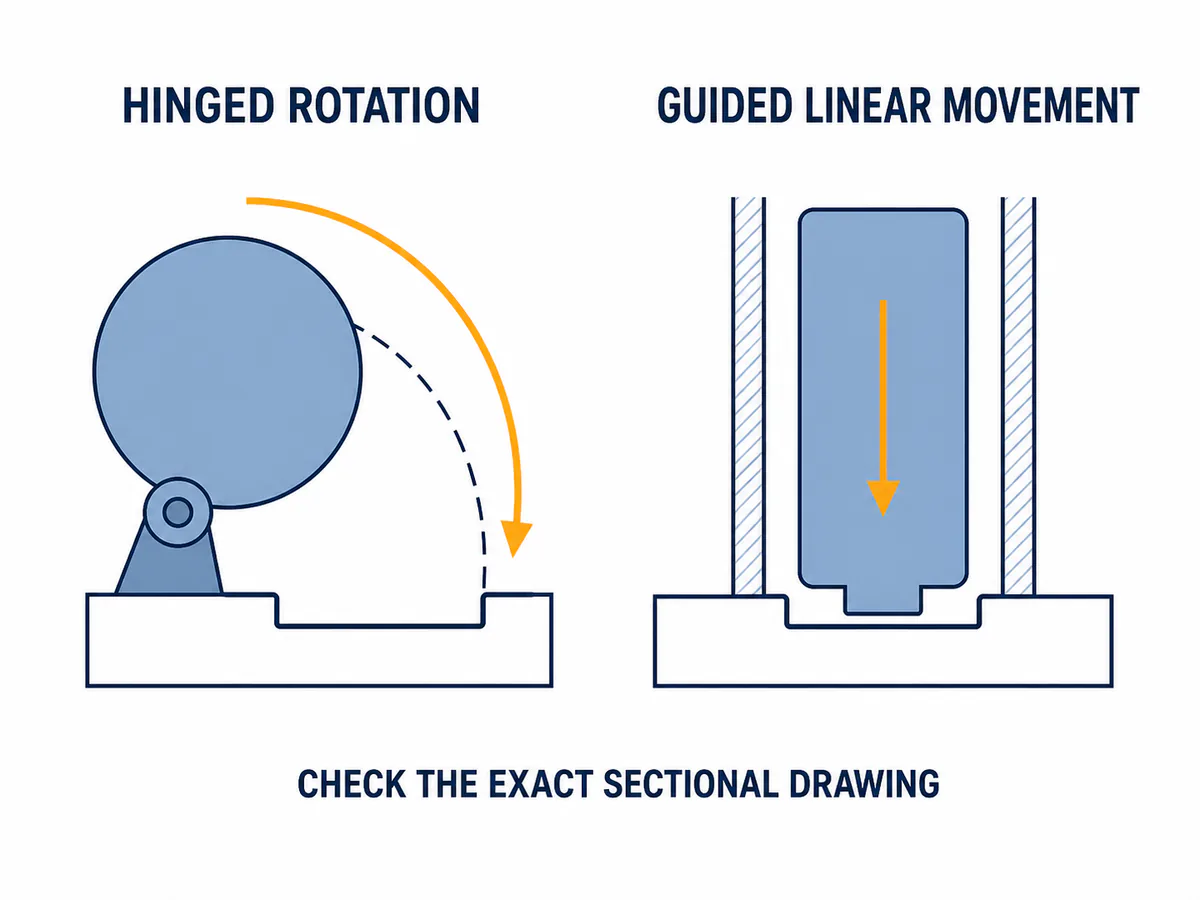
Simplified schematic showing a swing disc rotating on a hinge and a lift element moving along a guide
Engineering schematic, not an exact product drawing. Type names describe closure motion but do not establish the offered internal construction.

Compare the Same Operating Basis

Compare both offers against the same project data and calculation basis.

Entrée projetSupplier returnAcceptance owner
Medium, phase, density, viscosity and solidsStated fluid basis for curves or calculationsProcess/project engineering
Débit minimum, normal et maximumPressure drop and expected opening position at each pointHydraulic/process engineering
Operating and design pressure/temperatureApplicable pressure-temperature and material basisPiping/materials engineering
Line size, valve size, class/PN and endsOffered bore/body pattern and reducer assumptionsPiping engineering
Orientation and flow directionApproved drawing and IOMMechanical/project engineering
Pump/compressor operation and trip caseClosing or dynamic evidence where requiredRotating/system engineering
Leakage, testing and documentsProcedure, acceptance criteria, ITP and dossier indexQuality/procurement

The supplier must state whether pressure-loss data are tested, calculated or published, together with the Cv/Kv convention, fluid properties, opening position and reducer assumptions. Do not compare a fully open valve with another at an unstated position.

Pressure Drop: Tendency Is Not a Guarantee

Why Swing Often Screens Lower

After the disc rotates clear of the passage, a swing check can provide a comparatively direct path. The Manuel des vannes de régulation Emerson describes the same general fully open tendency. It is not an exact-model result: partial or unstable opening and body contour can change the loss.

Why Conventional Lift Often Screens Higher

A conventional globe-pattern lift check commonly routes flow through a seat opening and direction change, increasing loss according to body pattern, lift, guide geometry and opening position. A streamlined spring-assisted or axial design must be identified and evaluated as that different construction.

La pression d'amorçage n'est pas la perte de charge en fonctionnement

TermeCe qu'il décritSource de preuveCe que cela ne prouve pas
Cracking or opening pressureDifferential pressure at initial movement from the seatExact-model data with orientation and test basisFull opening, stable operation or operating loss
Caractéristique d'ouvertureClosure-member position as flow or differential changesModel curve, test or calculationInstalled shutdown response
Fully openA defined maximum or stable travel positionManufacturer definition and model dataThat every project flow reaches that position
Cv/KvFlow-capacity coefficient under a defined conventionExact-model test or calculationMinimum stable flow or transient suitability
Perte de charge en fonctionnementLoss at a stated medium and flow conditionPressure-flow curve or supported calculationClosure behavior after a trip

Request results at minimum, normal and maximum flow. A single full-open catalogue coefficient can conceal low-flow instability, and a low cracking pressure can coexist with higher operating loss.
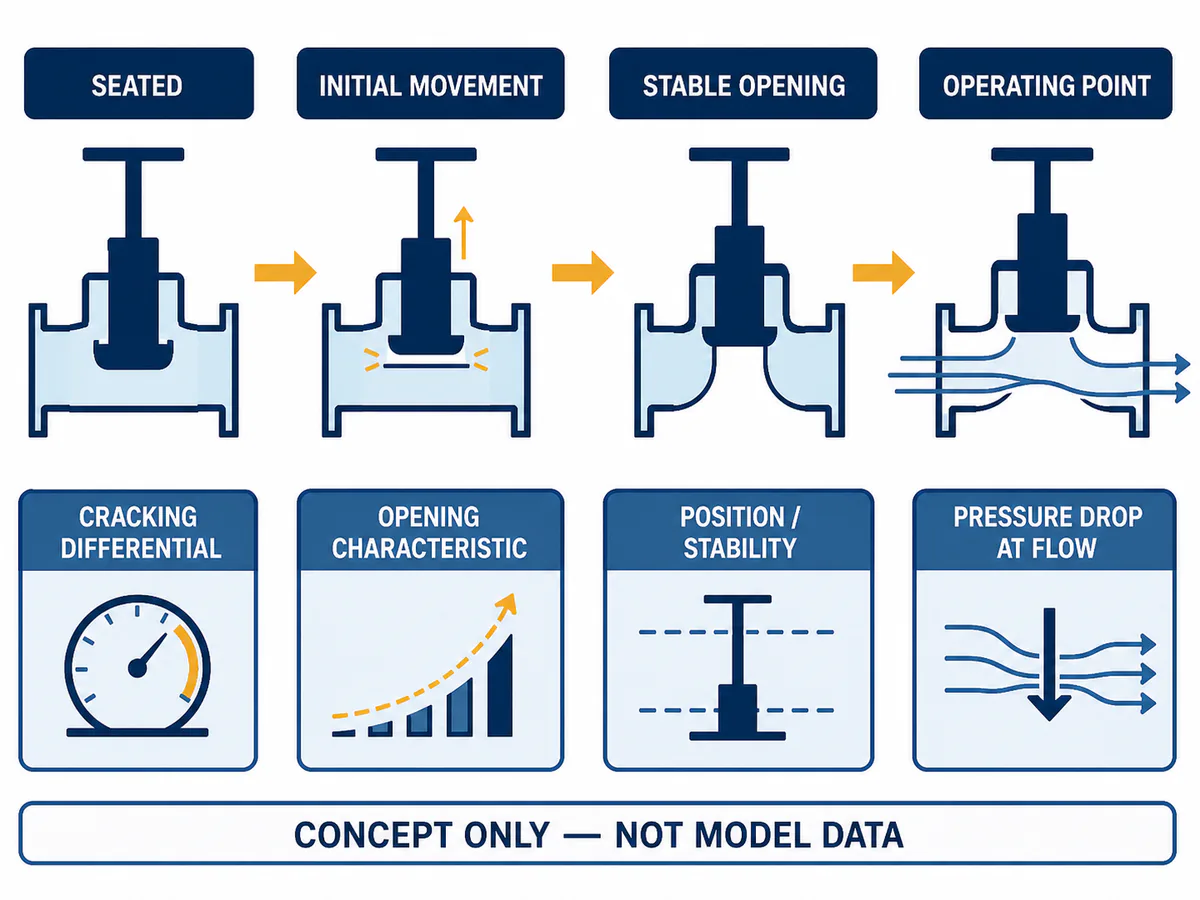
Diagram separating cracking pressure, opening position, stable opening and operating pressure drop
Engineering concept. Initial movement, stable opening and pressure loss at operating flow are different evidence questions.

Installation Orientation Requires Exact-Model Approval

Swing check valves are commonly installed in horizontal piping. Some exact designs may also be approved for vertical upward flow when the closure arrangement and gravity direction support positive return. Vertical downward flow, hinge orientation and angled installation must not be assumed acceptable.

Lift checks are equally construction-specific. A conventional gravity-return body may require a particular guide direction, while a dedicated vertical-lift or spring-assisted in-line model may allow a different orientation. The generic name does not establish the answer.

Approval requires the exact sectional construction, proposed direction, flow arrow, gravity/spring action, maintenance clearance and manufacturer-controlled drawing/IOM. Keep orientation OPEN when that evidence is unavailable.
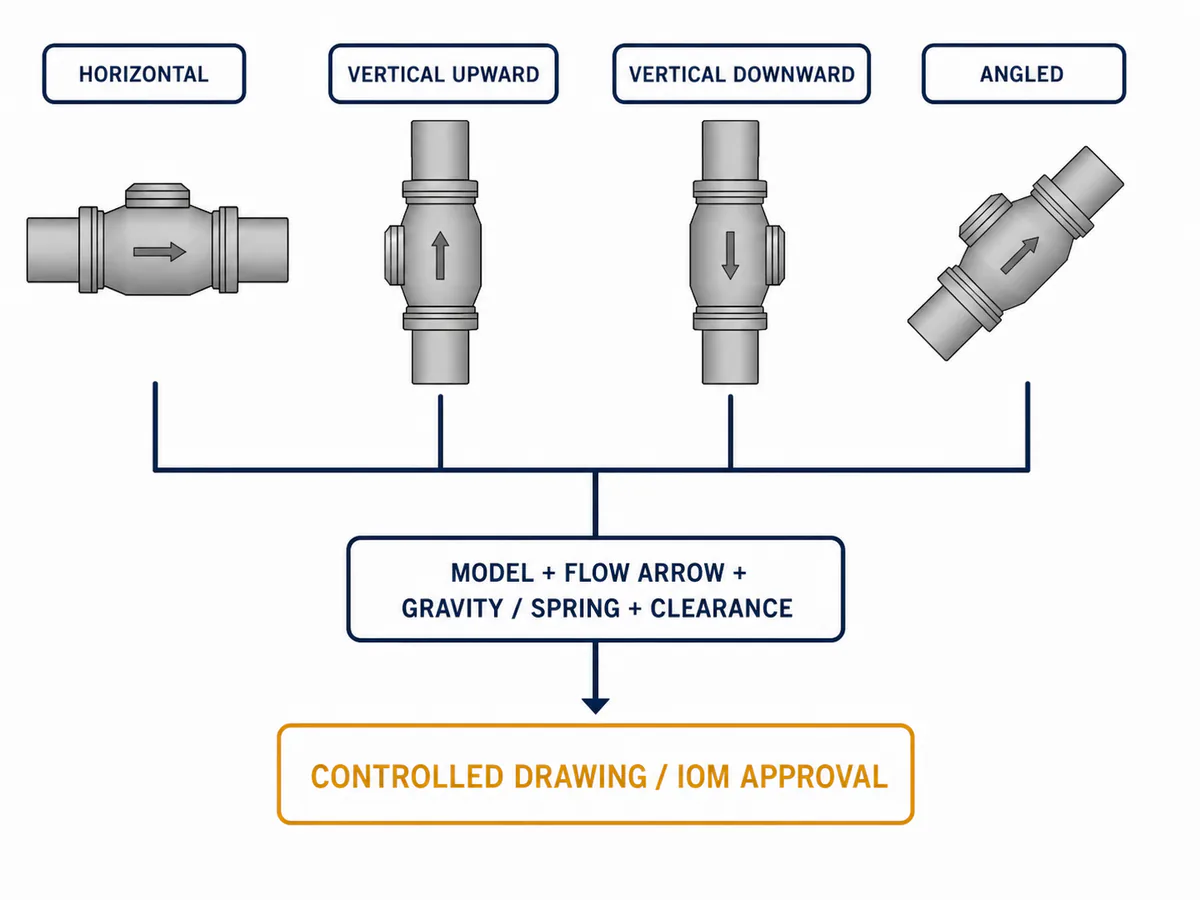
Flowchart routing four piping orientations to exact-model drawing and IOM approval
Engineering approval map. Permitted orientation and flow direction must follow the exact model drawing and IOM.

Opening and Low-Flow Stability

Both constructions need enough flow force or differential pressure to reach and maintain an acceptable position. A swing disc may hover or oscillate; a guided lift element may repeatedly rise and fall or stick when friction, deposits, pulsation or changing differential pressure dominates.

Line size alone does not establish the valve size. Matching the pipe can leave the closure member unstable at minimum flow; reducing the valve without checking pressure loss, interfaces and closing behavior can create a different problem.

NASA's bounded check-valve chatter example is for oxygen service, not a universal process-valve rule, but it illustrates an important principle: valve geometry, system geometry, flow, pressure, temperature and spring forces can interact dynamically.

For each duty point, request the following chain of evidence:

flow and fluid condition → expected opening position → stable-operation basis → unresolved dynamic risk → responsible approval owner

The separate guide de dimensionnement et de dynamique de fermeture des clapets anti-retour explains why nominal line size is only a mechanical starting point.

Closing Response, Reverse Velocity and Surge

A swing disc often follows a relatively long rotational path and carries rotational inertia. Some lift constructions may use shorter guided travel. Neither observation proves which offered valve will close acceptably in the installed line.

Closing response also depends on opening position, moving mass, friction, gravity, spring or counterweight force, equipment deceleration and when reverse flow develops. The same valve can respond differently from partial and full travel.

The relevant sequence is equipment-state change → forward-flow decay → closure-member movement → possible reverse velocity → seating and system pressure response.

Hydraulic Institute material, including its field evaluation of check-valve designs and surge pressure, reinforces the need to treat check-valve response and waterhammer as an installed-system issue.

Do not promise faster lift-check closure, inevitable swing-check slam or automatic pump protection. Rapid trips, long lines, high static head, parallel equipment or serious consequences may require model-specific dynamics and transient analysis. The check valve chatter and slamming guide owns detailed diagnosis.
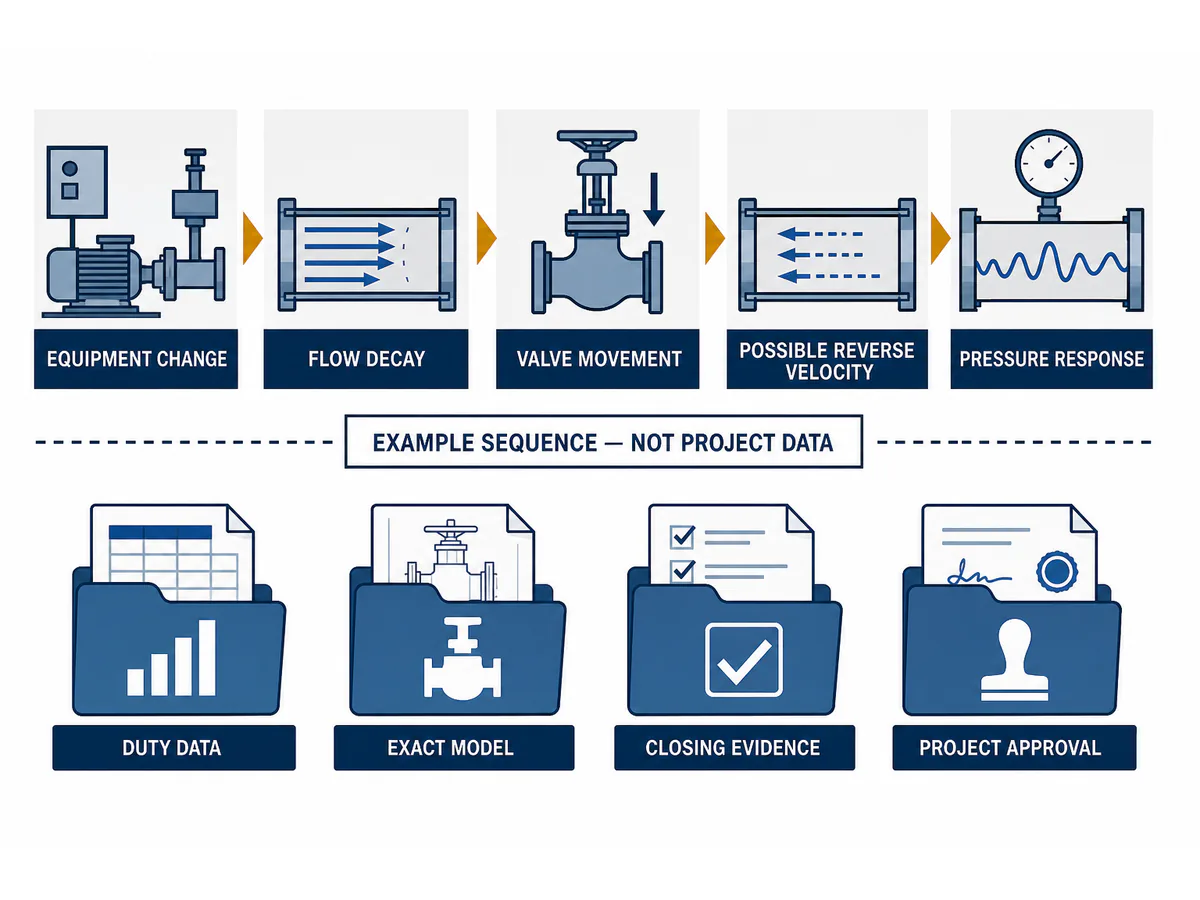
Illustrative sequence from equipment change and flow decay to valve movement, pressure response and project evidence
Example sequence, not project data. Closing response and surge require exact-model and installed-system evidence.

Medium, Fouling and Maintenance Access

Claims such as “swing for dirty service” or “lift for steam” are incomplete. Solids, deposits, viscosity, multiphase flow, condensate and corrosion products can affect hinges, guides, seats and clearances. Review the body/cover access, moving-element geometry, hinge or guide, spring and stop details, cleaning route, spare parts and post-maintenance checks.

Materials must be reviewed by component. A body, disc, hinge, guide, spring, seat, gasket or bolting material name does not by itself prove temperature capability, corrosion resistance, wear life or suitability for steam, sour, abrasive or cryogenic service.

Exact-Model Evidence Matrix

Question d'approbationPreferred evidenceWhat it may supportCe que cela ne prouve pas
What construction is offered?Revised GA and sectional drawingClosure motion, body pattern and internal identityOperating suitability
Is the orientation allowed?Approved drawing and IOMInstallation direction and accessStability in the actual system
Will pressure loss fit?Exact-model Cv/Kv or pressure-flow curveHydraulic comparison at stated conditionsStable opening unless position is included
Will it open and remain stable?Opening characteristic or stable-flow basisFiltrage de la plage de fonctionnementShutdown transient response
How does it close?Travel, mass, spring/counterweight and dynamic dataComparison of offered modelsSystem surge without system inputs
Are materials suitable?Component schedule plus compatibility reviewPreliminary materials decisionUniversal compatibility or service life
Does testing meet the order?Approved procedure, ITP, report and dossier indexStated order acceptanceInstalled dynamic performance

If a supplier cannot identify the exact model, orientation, data basis or technical deviations, the proposal is not ready for final technical approval.

Standards and Tests: Scope Is Not Dynamic Proof

Applicable standards depend on the construction and project specification. API 594 may be relevant to specified check-valve constructions; ASME B16.34 addresses applicable new-construction rating, material, examination, testing and marking scope; and ISO 5208 covers specified pressure-boundary and closure testing. None establishes installed flow stability or transient response.

A reference to any of these documents does not prove that a particular Raymon Valve product is designed, tested, certified or order-documented to it. The exact standard, edition, purchaser options, approved procedure and order evidence must be confirmed.

Swing vs Lift Check Valve RFQ Checklist

Buyer Inputs

  • valve function and installation location;
  • medium, composition, phase, density, viscosity and solids;
  • débit minimum, normal et maximum ;
  • operating and design pressure and temperature;
  • line size, pressure class/PN and end connection standard;
  • line orientation, flow direction, available envelope and maintenance access;
  • allowable pressure drop and leakage requirement;
  • pump/compressor relationship, cycling and shutdown case;
  • materials, testing, inspection, documentation and witness requirements;
  • quantity, destination and project schedule.

Supplier Returns

  • proposed model and exact construction;
  • GA/sectional drawing and approved orientation;
  • exact-model Cv/Kv or pressure-flow curve;
  • pressure drop at each stated flow point;
  • cracking/opening differential and stable-open basis where relevant;
  • closure travel, moving-element details and spring/counterweight information;
  • component material schedule;
  • test, inspection and document inclusions;
  • assumptions, exclusions and technical deviations.

Normalize Technical Bids Before Selecting a Construction

A comparison is only defensible when suppliers return the same fields on the same operating basis. Mark each field as Confirmed, Partial, Open ou Not Applicable. A critical field marked Open is a hold point; it is not permission to infer performance from the words “swing” or “lift.”

Normalization fieldRequired supplier returnComparison ruleHold point
Offered identityManufacturer, model, exact construction, size, Class/PN, ends and drawing revisionCompare the actual offered valves, not family labelsModel or internal construction is not identified
Hydraulic basisMedium properties, flow points, valve opening position, Cv/Kv convention, reducer assumptions and test/calculation sourceRecalculate or compare every offer at the same stated duty pointsPressure loss is quoted only as “low” or as an unsupported full-open value
Opening and stabilityCracking/opening differential, opening characteristic and minimum stable-flow basis where relevantSeparate initial movement from stable operating positionNo basis exists for minimum or variable flow
Orientation and accessApproved flow direction, drawing/IOM statement, gravity or spring direction and maintenance envelopeUse the exact proposed installation, not a generic horizontal/vertical claimExact orientation is absent or conflicts with controlled documents
Réponse à la fermetureTravel, moving mass, spring/counterweight details and model-specific dynamic evidence where consequence requires itCompare the same trip or flow-decay caseA non-slam, surge-control or pump-protection result is claimed from type name alone
Materials and internalsComponent-level body, closure member, hinge/guide, spring, seat, gasket and bolting scheduleReview compatibility and temperature/pressure boundaries by componentA material trade name is used as a universal service guarantee
Tests and documentsApplicable procedure, acceptance criteria, ITP, certificates/reports to be supplied and technical deviationsSeparate order acceptance from installed dynamic performanceStandard references, document inclusions or deviations are ambiguous

Record the source document, revision, date and reviewer for every Confirmed field. Procurement can then compare commercial offers without silently changing the engineering basis.

Approval Hold Points: When the Type Comparison Must Stop

Pause type approval and escalate the missing evidence when any of the following applies:

  • the minimum, normal or maximum flow case is missing, or the offered valve position at those cases is unknown;
  • exact model, internal construction, orientation or flow direction is not controlled;
  • pressure-loss values use different fluids, coefficients, opening positions or reducer assumptions;
  • rapid trips, long lines, high static head, parallel equipment or previous slam create an unresolved transient consequence;
  • solids, viscosity, deposits or corrosion products may affect hinge/guide motion but internal clearances and maintenance access are unknown;
  • the proposal claims certification, material suitability, non-slam behavior or pump protection without scope-specific evidence;
  • testing, inspection, documentation or technical deviations are not stated against the purchase specification.

An Open hold point can be closed only by the responsible project party using controlled product data, calculation/test evidence or an approved system review. It cannot be closed by repeating a general tendency from this article.

Logique de sélection finale

  1. Confirm the medium, flow range, pressure, temperature and equipment relationship.
  2. Confirm valve identity, line/valve size, ends, orientation and available space.
  3. Eliminate constructions that fail material, connection, maintenance or controlled-orientation requirements.
  4. Compare exact-model pressure drop at the same duty points and basis.
  5. Confirm opening and stable-flow margin at minimum and normal flow.
  6. Examiner la réponse à la fermeture et les conséquences de la vitesse inverse.
  7. Normalize inspection, testing, documentation and technical deviations.
  8. Obtenir l'approbation technique spécifique au projet.

Swing and lift check valves perform the same non-return function through different closure movements and flow paths. The acceptable construction is the exact valve that remains stable across the required operating range, stays within the pressure-drop allowance, is approved for the installation and closes acceptably within the connected piping system.

Demander une analyse comparative des clapets anti-retour à battant et à levage

Send the medium and phase, density or viscosity where relevant, solids, minimum/normal/maximum flow, operating/design pressure and temperature, line and valve size, pressure class/PN, end connection, orientation, allowable pressure drop, leakage requirement, equipment shutdown behavior and required tests.

Attach the datasheet, piping layout or P&ID, pump/compressor operating information, purchase specification and any previous chatter, slam or leakage observations. Ask suppliers to return exact-model curves, approved orientation, opening and closing evidence, materials, document inclusions and technical deviations on the same basis.

Ask for the returned comparison to identify the exact model, data basis, assumptions, exclusions, Open fields and technical deviations.

Request a check valve project review

Foire aux questions

Quel clapet anti-retour présente une perte de charge plus faible, un clapet à battant ou un clapet à levée ?

A fully and stably open swing check often has lower loss because its disc can leave a more direct passage. Compare exact-model data at the specified flow conditions before approval.

What is the difference between cracking pressure and operating pressure drop?

Cracking pressure starts movement from the seat; operating pressure drop is the loss at a stated flow and opening position. Low cracking pressure does not prove full or stable opening.

Un clapet anti-retour à battant peut-il être installé verticalement ?

Some models may allow vertical upward flow; others are horizontal only. Confirm the model, flow direction, drawing and IOM. Do not assume downward installation is acceptable.

Un clapet de retenue à passage direct peut-il être installé sur une conduite verticale ?

A gravity-return body, dedicated vertical-lift valve and spring-assisted in-line valve can have different limits. Obtain model-specific approval.

Does a lift check valve always close faster than a swing check valve?

No. Travel may be shorter, but mass, friction, spring/gravity forces, opening position and system deceleration also matter. Require model and system evidence.

Is a conventional lift check the same as a silent or nozzle check valve?

No. Many silent, nozzle or axial-flow designs use a spring and a different flow path, travel and closure characteristic. Confirm the internal construction rather than grouping them under the word “lift.”

Which construction is better for low-flow service?

Neither is automatically better. Each offered model must remain acceptably open at minimum flow while meeting the pressure-drop limit.

Can either type prevent water hammer or protect a pump automatically?

No type name proves that result. Equipment shutdown, line profile, flow deceleration, valve travel and reverse velocity interact; significant consequences may require transient analysis.

What data belongs in a swing-versus-lift RFQ?

Include the medium, flow range, pressure, temperature, size, class/PN, ends, orientation, allowable pressure drop, solids or fouling risk, equipment shutdown behavior, leakage requirement, materials, testing and documentation scope. Require exact-model evidence and a technical-deviation list in return.

Engineering Assumptions / Limits

  • The comparison is between conventional swing and conventional lift/piston constructions unless a different model is explicitly identified.
  • No Raymon product-specific size, rating, material, temperature, pressure-loss, cracking-pressure, minimum-flow, leakage or dynamic claim is made.
  • General pressure-loss tendencies do not replace exact-model curves.
  • Orientation remains model-specific and must follow controlled drawings/IOM documents.
  • No non-slam, waterhammer-elimination or pump-protection guarantee is made.
  • Material labels do not establish service suitability.
  • Standard references are scope references only and do not prove Raymon product conformity, testing, certification or order documentation.
  • Final approval belongs to the responsible project parties using the complete datasheet and order evidence.

Laisser un commentaire

Votre adresse e-mail ne sera pas publiée. Les champs obligatoires sont indiqués avec *

fr_FRFrench
Retour en haut