
Quick Answer: How to Choose Between Wafer and Lug Butterfly Valves
The correct choice between wafer and lug butterfly valves depends on more than the valve body connection style. Engineers and procurement teams should evaluate flange connection requirements, piping arrangement, maintenance planning, dead-end service conditions and confirmed operating data before selecting a valve design.
A wafer butterfly valve is often considered where a compact installation arrangement is preferred, while a lug butterfly valve may provide different connection and maintenance considerations. However, the valve body style alone does not determine application suitability. Final selection requires review of the complete service conditions, including medium, pressure, temperature, flange standard, installation arrangement and project documentation requirements.
Connection style is only one part of butterfly valve selection. Actual suitability depends on the complete piping system, valve design data, service conditions and applicable project requirements.
Wafer and Lug Butterfly Valve Construction Differences
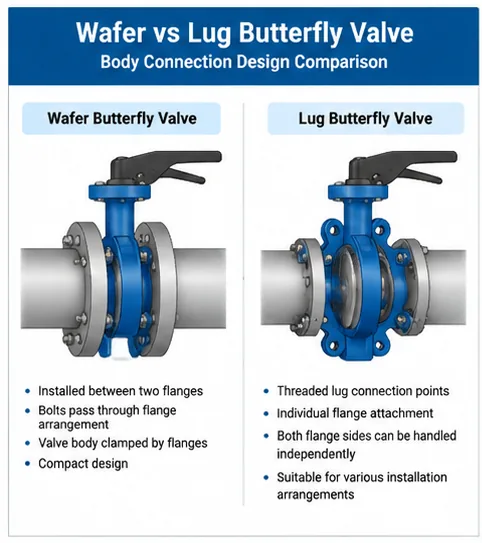
The primary difference between wafer and lug butterfly valves is the way the valve body connects to the piping flange system.
Both designs use a rotating disc and shaft mechanism for flow isolation. The main engineering difference is the connection arrangement and how installation forces are transferred through the valve and piping system.
Wafer Butterfly Valve Design
A wafer butterfly valve is installed between two pipe flanges. The valve body is positioned inside the flange assembly, and the connection depends on the complete flange bolting arrangement to secure the valve in the piping system.
Typical review considerations include:
- available installation space;
- flange alignment;
- bolt arrangement;
- sealing interface condition;
- pressure and temperature requirements.
A common RFQ issue occurs when buyers specify only valve size and pressure class but do not define flange standard, medium, temperature or installation arrangement. These missing inputs can affect technical comparison between suppliers.
Lug Butterfly Valve Design
A lug butterfly valve uses individual lug connection points around the valve body. Each lug provides a separate attachment location for flange connection.
Compared with wafer designs, lug valves may provide different maintenance and isolation considerations because the connection arrangement can influence equipment removal procedures and system isolation planning.
Важные факторы для рассмотрения включают:
- piping arrangement;
- pressure direction;
- equipment isolation requirements;
- maintenance access;
- manufacturer-confirmed application limits.
A lug design should not automatically be considered suitable for every application. Dead-end service, pressure conditions and installation requirements require confirmation against the specific valve design.
Flange Loading: Why Connection Design Matters
Flange loading is an important engineering consideration when comparing wafer and lug butterfly valves. The connection arrangement influences how forces are transferred between the valve body, flange faces, bolts and sealing interfaces.
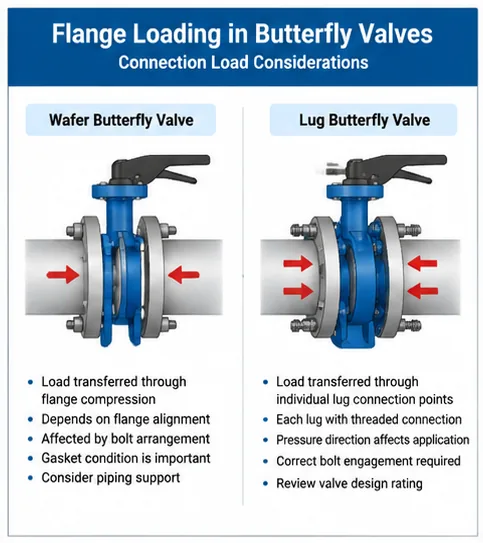
Wafer Butterfly Valve Flange Loading Considerations
| Пункт рассмотрения | Почему это важно |
|---|---|
| Flange alignment | Supports proper installation and helps maintain the intended sealing interface condition. |
| Bolt arrangement | Influences the connection loading applied during installation. |
| Стандарт фланца | Ensures dimensional compatibility between valve and piping system. |
| Gasket condition | Affects sealing interface evaluation. |
| Piping support | May influence external loads acting on the valve connection. |
Lug Butterfly Valve Flange Loading Considerations
| Пункт рассмотрения | Почему это важно |
|---|---|
| Pressure direction | Important for reviewing the specific application condition. |
| Individual flange connection | Influences isolation and maintenance planning. |
| Bolt engagement | Requires correct installation practice. |
| Valve design documentation | Required to confirm application suitability. |
Dead-End Service: Why Connection Style Requires Careful Review
Dead-end service is one of the key application conditions considered when comparing wafer and lug butterfly valves. This condition may occur when a valve is installed at the end of a pipeline or when one side of the valve may experience pressure while the opposite side is not connected to a continuation of the piping system.
However, dead-end service suitability depends on the specific valve design, pressure condition, installation arrangement and manufacturer documentation. The connection style alone should not be used as the only selection criterion.
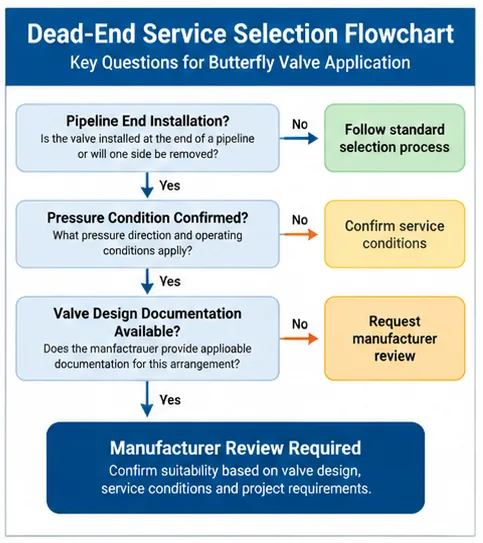
Questions to Confirm Before Selection
| Вопрос для рассмотрения | Почему это важно |
|---|---|
| Is the valve installed at the pipeline end? | Defines the installation arrangement and pressure boundary condition. |
| Will one flange side be removed during maintenance? | Influences isolation planning and removal procedures. |
| What pressure direction applies? | Required for technical application evaluation. |
| Does the manufacturer provide applicable documentation? | Required before final specification approval. |
A lug butterfly valve is not automatically suitable for every dead-end service application. The selected valve construction should be confirmed against the complete service data, project specification and manufacturer documentation.
Maintenance and Replacement Considerations
Maintenance planning can influence butterfly valve selection, especially in systems where equipment isolation, valve removal sequence and available working space are important considerations.
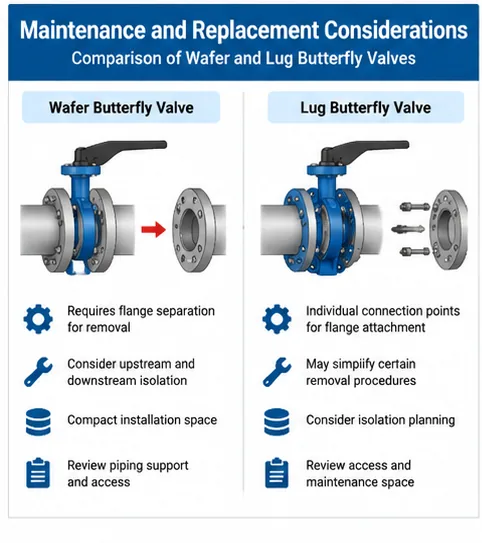
Wafer Butterfly Valve Maintenance Considerations
For wafer butterfly valves, maintenance planning may require review of:
- available installation clearance;
- flange separation procedure;
- upstream and downstream isolation method;
- piping support condition during maintenance.
The compact installation arrangement may be beneficial in some systems, but the actual maintenance procedure depends on the surrounding piping design and operating practice.
Lug Butterfly Valve Maintenance Considerations
For lug butterfly valves, maintenance planning may include:
- individual lug connection arrangement;
- equipment removal sequence;
- system isolation planning;
- maintenance access requirements.
A lug design should not automatically be considered easier to maintain. Maintenance suitability depends on the complete piping system, isolation procedure and equipment arrangement.
Wafer vs Lug Butterfly Valve Selection Matrix
The following comparison provides a preliminary selection framework. Final valve selection requires confirmation against project-specific requirements.
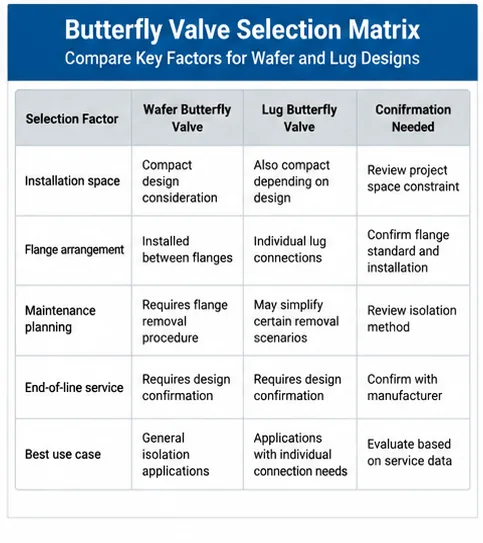
| Фактор выбора | Дисковый затвор типа wafer | Дисковый затвор с проушинами (lug) |
|---|---|---|
| Installation space | Often considered where a compact installation arrangement is required. | May also be suitable depending on piping and project requirements. |
| Метод присоединения | Installed between two pipe flanges. | Uses individual lug connection points. |
| Maintenance planning | Review flange separation and isolation procedures. | Review connection arrangement and removal sequence. |
| Dead-end service | Requires manufacturer and project confirmation. | Requires manufacturer and project confirmation. |
| Final selection basis | Confirmed service data and piping requirements. | Confirmed service data and piping requirements. |
RFQ Checklist for Wafer or Lug Butterfly Valve Selection
Complete RFQ information helps suppliers evaluate the correct valve construction and provide a more accurate technical quotation.
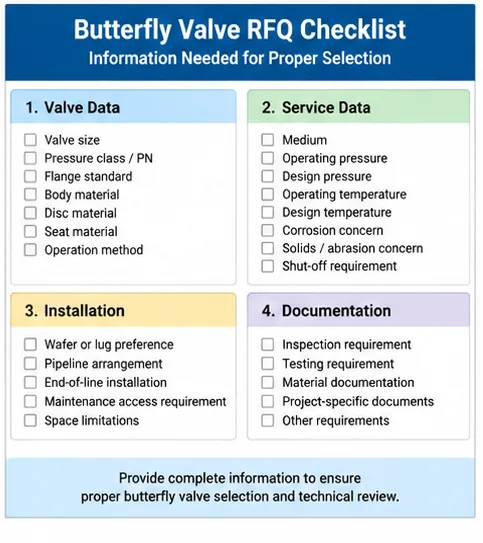
Valve Information
- Valve size;
- Pressure class or PN rating;
- Flange standard;
- Body material;
- Disc material;
- Seat material;
- Operation method.
Service Information
- Medium;
- Operating pressure;
- Design pressure;
- Operating temperature;
- Design temperature;
- Corrosion or abrasion concerns;
- Shut-off requirements.
Installation and Documentation Requirements
- Wafer or lug preference;
- Pipeline arrangement;
- End-of-line installation requirement;
- Maintenance access requirement;
- Inspection requirements;
- Testing requirements;
- Material documentation requirements.
Supplier Technical Review Checklist for Butterfly Valve Selection
When comparing butterfly valve quotations, buyers should review not only the valve type but also the completeness of the supplier’s technical response.
| Пункт рассмотрения | Buyer Check |
|---|---|
| Datasheet completeness | Confirm required valve information is provided. |
| Информация о материалах | Confirm body, disc and seat material details. |
| Testing scope | Confirm inspection and testing requirements. |
| Documentation package | Confirm project documentation requirements. |
| Технические отклонения | Review differences between quotation and specification. |
Standards and Documentation Considerations
Butterfly valve selection may involve different standards depending on valve design, pressure rating, flange connection and project requirements.
Buyers should confirm:
- applicable valve standard;
- flange dimensional requirements;
- testing requirements;
- documentation expectations.
For additional review, see our resources on valve standards and documentation requirements и butterfly valve testing requirements .
For broader technical guidance, explore our industrial valve technical resources .
Conclusion: Selecting Between Wafer and Lug Butterfly Valves
The selection between wafer and lug butterfly valves should be based on confirmed service conditions, flange connection requirements, installation arrangement and maintenance considerations.
Wafer butterfly valves may be considered where a compact installation arrangement is preferred, while lug butterfly valves may provide different connection and isolation planning considerations. However, neither design should be selected only by valve body style.
A complete technical review should consider valve size, pressure, temperature, medium, flange standard, installation arrangement, shut-off requirements, testing scope and documentation expectations before final selection.
For more information about butterfly valve solutions, visit our решения для дисковых затворов страницу.
FAQ
What is the main difference between wafer and lug butterfly valves?
The main difference is the valve body connection arrangement. Wafer butterfly valves are installed between two flanges, while lug butterfly valves use individual lug connection points for flange attachment. Final selection depends on piping arrangement and project requirements.
Are lug butterfly valves always required for dead-end service?
No. Dead-end service suitability depends on the specific valve design, pressure condition, installation arrangement and manufacturer documentation. The connection style alone should not be used as the only selection criterion.
Which butterfly valve is easier to maintain?
Maintenance suitability depends on the complete piping system, isolation procedure, available access and equipment arrangement. Neither wafer nor lug design should be considered universally easier without reviewing the application.
What information is needed for a wafer or lug butterfly valve RFQ?
A technical RFQ should include valve size, pressure, temperature, medium, flange standard, body and seat materials, installation arrangement, shut-off requirements, testing requirements and documentation scope.
What should buyers review when comparing butterfly valve suppliers?
Buyers should review datasheet completeness, material information, testing scope, documentation package, technical deviations and the supplier’s ability to confirm project-specific requirements.
Request Butterfly Valve Selection Review
Submit your butterfly valve application data for a project-specific technical review. Complete application information helps establish the appropriate valve construction, documentation requirements and evaluation scope.
Please include:
- Valve size;
- Medium;
- Рабочее и расчетное давление;
- Рабочая и расчетная температура;
- Flange standard;
- Installation arrangement;
- Dead-end service requirement;
- Testing and documentation requirements.
 Russian
  English
  German
  Arabic
  French
  Spanish
  Italian
  Portuguese