
Valve testing · Qualification evidence · RFQ engineering
Fire-safe and fugitive-emission valve requirements address different risks and cannot substitute for one another. Fire-safe qualification evaluates specified leakage and operability during and after a controlled fire test; fugitive-emission qualification evaluates external leakage through stem or shaft seals and relevant body joints under defined pressure, temperature and cycling conditions. For a valve RFQ, the decisive question is whether each test report covers the exact valve being offered. This guide compares test scope, explains qualification coverage, and shows buyers how to verify evidence and avoid costly specification gaps.
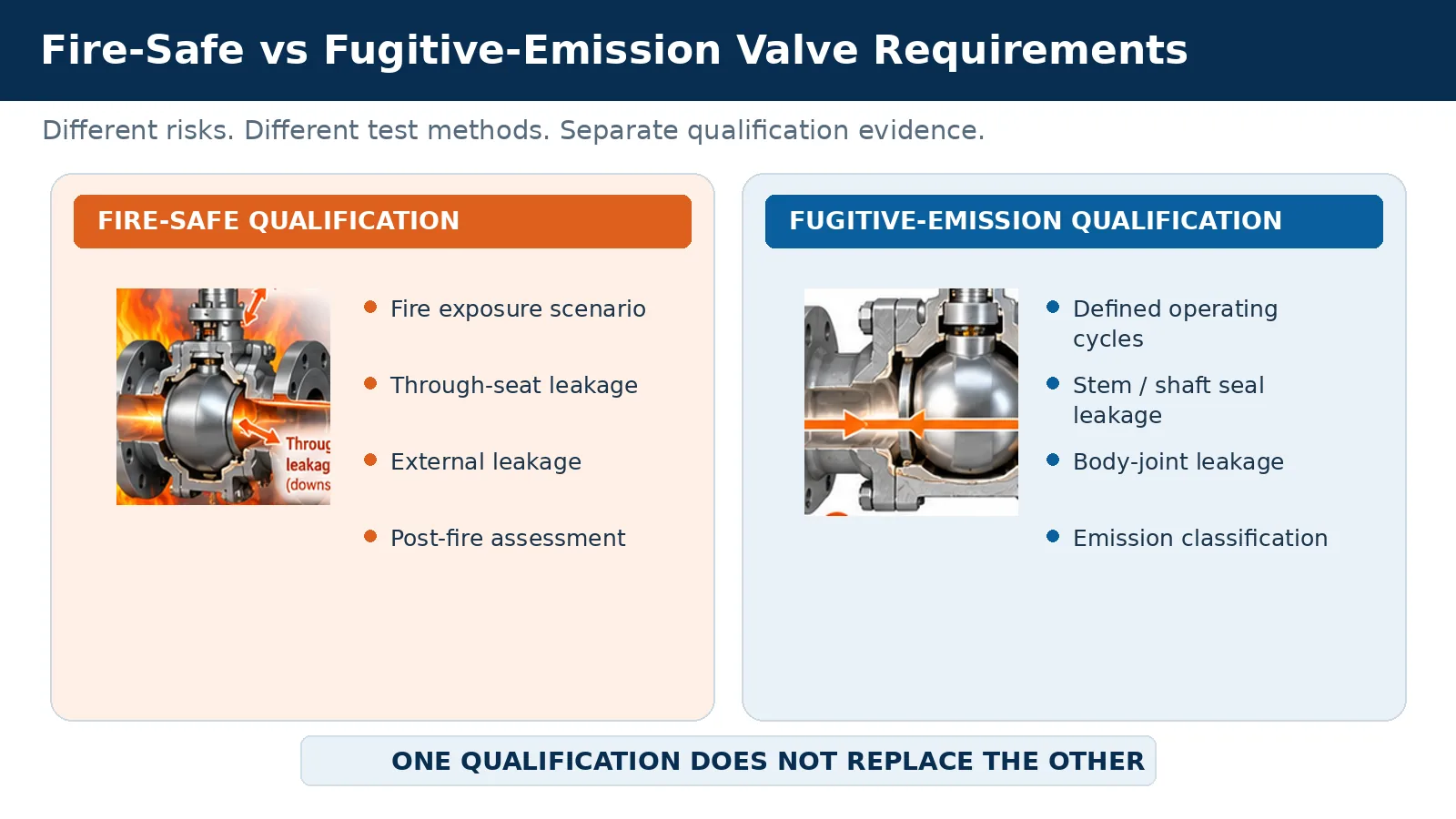
1. Fire-Safe vs Fugitive-Emission: What Is the Difference?
Both requirements concern leakage control, but they address different operating scenarios. A valve may have a qualified fire-resistant sealing design without the separate type-test evidence required for controlled external emissions during routine operation. Conversely, a low-emission design is not thereby qualified for a fire event.
| Evaluation area | Fire-safe | Fugitive-emission |
|---|---|---|
| Primary concern | Leakage and integrity under prescribed fire exposure | External emissions during specified operating tests |
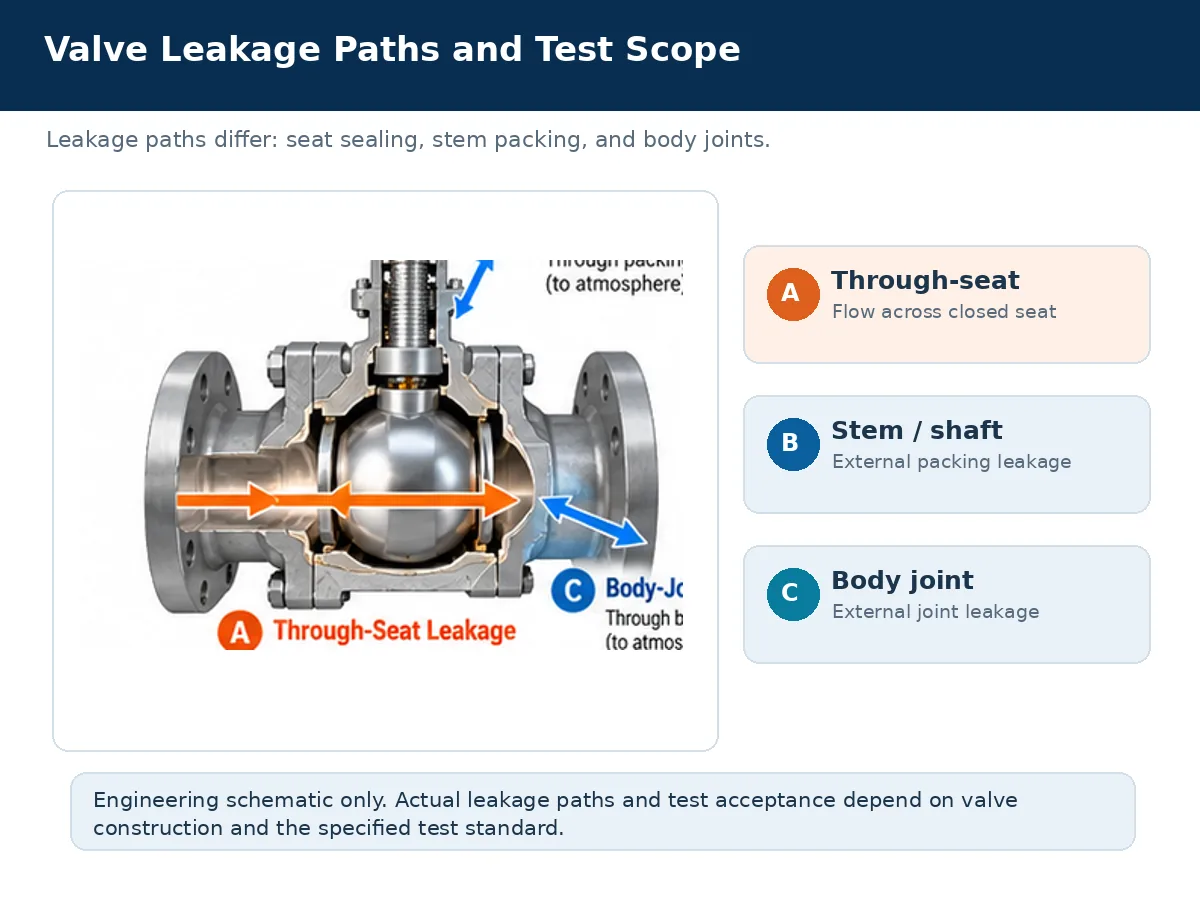
| Leakage paths | Through-seat and external leakage, as applicable | Stem/shaft seals and applicable body joints |
| Typical routes | API 607, API 6FA, ISO 10497 | API 624, API 641, ISO 15848-1 |
| الدليل | Applicable fire type-test report and qualification scope | Emission type-test report, classification and scope |
| دليل الإنتاج | Separately specified routine inspections/tests | Separately specified production acceptance tests |
| Interchangeable? | No | No |
Different leakage paths
Through-seat leakage occurs across the closure member. Stem or shaft leakage occurs at the dynamic sealing assembly. Body-joint leakage occurs at relevant static pressure-boundary joints. Routine seat tightness alone does not demonstrate external emission performance.
2. What Do Fire-Safe Valve Tests Actually Prove?
Fire-safe qualification evaluates defined performance during and after a prescribed fire test. It is not a promise of unlimited fire resistance or guaranteed tightness in every real-world fire. API 607 addresses the specified scope of quarter-turn valves and valves with nonmetallic seats; API 6FA (Sixth Edition, dated May 5, 2026, in the API Standards Plan) provides a separate valve fire-test route. Its applicability and qualification coverage must be checked against the valve design and the project specification; API 6FA, API 607 and ISO 10497 are not automatically interchangeable. ISO 10497 covers fire type-testing within its stated valve scope. Select the standard by valve design and the applicable owner specification, not by label alone.
Seat leakage, external leakage and operability
Depending on the governing procedure, fire testing addresses through-seat leakage, external leakage, post-fire operation and, for relevant double-seated designs, cavity overpressure relief. The test report and permitted design-family qualification rules must establish the scope of any claimed coverage.
Fire type testing vs routine production testing
A type-test report supports a defined design qualification. It does not mean every valve was subjected to a destructive fire test. Separately required production shell, seat, functional and inspection records must be specified and supplied on their own terms. For further explanation, consult Raymon Valve’s industrial valve fire-testing resource.
Illustrative engineering scenario: A supplier quotes a fire-tested isolation valve but supplies a standard pneumatic actuator without fire-survivability evidence. The valve fire-test report addresses the qualified valve configuration; it does not prove the actuator, tubing or emergency-shutdown assembly will function after a fire. The purchaser should define the required package-level function and request separate evidence or an approved exception.
Engineering boundary: the valve is not the whole actuated assembly
For ISO 10497:2022, fire type-testing covers specified soft- and metal-seated isolation valves. The standard excludes the fire-testing requirements for electric, pneumatic and hydraulic actuators. A fire-test report for the pressure-containing valve therefore does not establish that the installed actuator package, instrument tubing or shutdown function will survive a fire. Where these functions are required, specify and verify them separately.
Reports issued under an earlier ISO 10497 edition also require careful review against that edition’s reporting provisions and the purchaser’s acceptance requirements. Do not automatically reject or accept an earlier-edition report solely because its cover page shows an older date.
3. What Do Fugitive-Emission Valve Tests Actually Prove?
Fugitive-emission requirements concern external leakage from applicable stem or shaft seals and body joints during defined tests involving pressure, temperature and operating cycles. Packing design, stem finish, gland loading and valve construction can affect the result. A packing certificate alone does not qualify every complete valve fitted with that packing.
API 622 vs API 624 vs API 641
API 622 addresses packing type testing. API 624 addresses type testing of valves with rising or rising-rotating stems and graphite packing within its scope. API 641 addresses fugitive-emission type testing for applicable quarter-turn valves. The ISO publisher lists ISO 15848-1:2015 as the current published edition, together with Amendment 1:2017; any later draft work should not be cited as an already published replacement. Packing evidence and whole-valve evidence are different documentation categories, and scope matching remains necessary.
ISO 15848-1 vs ISO 15848-2
ISO 15848-1 concerns type testing and classification for applicable isolation and control valves. The specified leakage classification, temperature and endurance qualification should be checked against the project requirements. ISO 15848-2 addresses production acceptance testing. A type-test report cannot be substituted for a project-required production acceptance result, and vice versa.
When specifying ISO 15848-1, state the required classification rather than requesting unspecified “ISO low-emission compliance.”
Illustrative procurement scenario: Two suppliers offer graphite-packed rising-stem gate valves. One attaches a packing type-test summary; the other references a complete-valve emission type-test report. These are not interchangeable proof. Check whether the project calls for packing qualification, complete-valve qualification, or both, and record the actual tested configuration and acceptance class before evaluating price.
For service-level specification rather than the evidence comparison alone, consult the low-emission valves engineering framework; the qualification report still must match the offered valve.
Emission class is not the same as an unrestricted service guarantee
Under ISO 15848-1, the relevant classification and qualification conditions must be identified in the supplier’s documents. Buyers should compare the specified leakage class, endurance/cycling qualification, temperature class and tested configuration with the project’s acceptance criteria rather than asking only for “ISO 15848 compliant.” The publicly stated ISO 15848-1 scope excludes end-connection joints, vacuum applications, corrosion effects and radiation effects; these are separate engineering considerations.
When ISO 15848-2 production acceptance is required, define the production population or inspection extent, test procedure, acceptance criteria, witnessing and deliverable records in the ITP. A revision project for ISO 15848-2 edition 3 is under development; that draft should not be cited as an already published edition.
4. Which Standards Apply to Different Valve Types?
Begin with the actual valve design. Quarter-turn ball, butterfly and plug valves may be reviewed against applicable quarter-turn qualification routes. Rising-stem gate and globe constructions require their own scope review. Control-valve emission testing may be relevant, but fire-testing applicability must be considered independently.
For a broader overview of the governing product, testing and qualification documents, see the industrial valve standards guide.
Application boundary: Select the standard only after confirming quarter-turn versus rising-stem construction, closure or control duty, seat and packing design, and the project-specified edition. The valve name alone does not establish test applicability. An API 6FA, API 607 or ISO 10497 document should not be treated as automatically interchangeable; verify the exact scope and purchaser acceptance route.
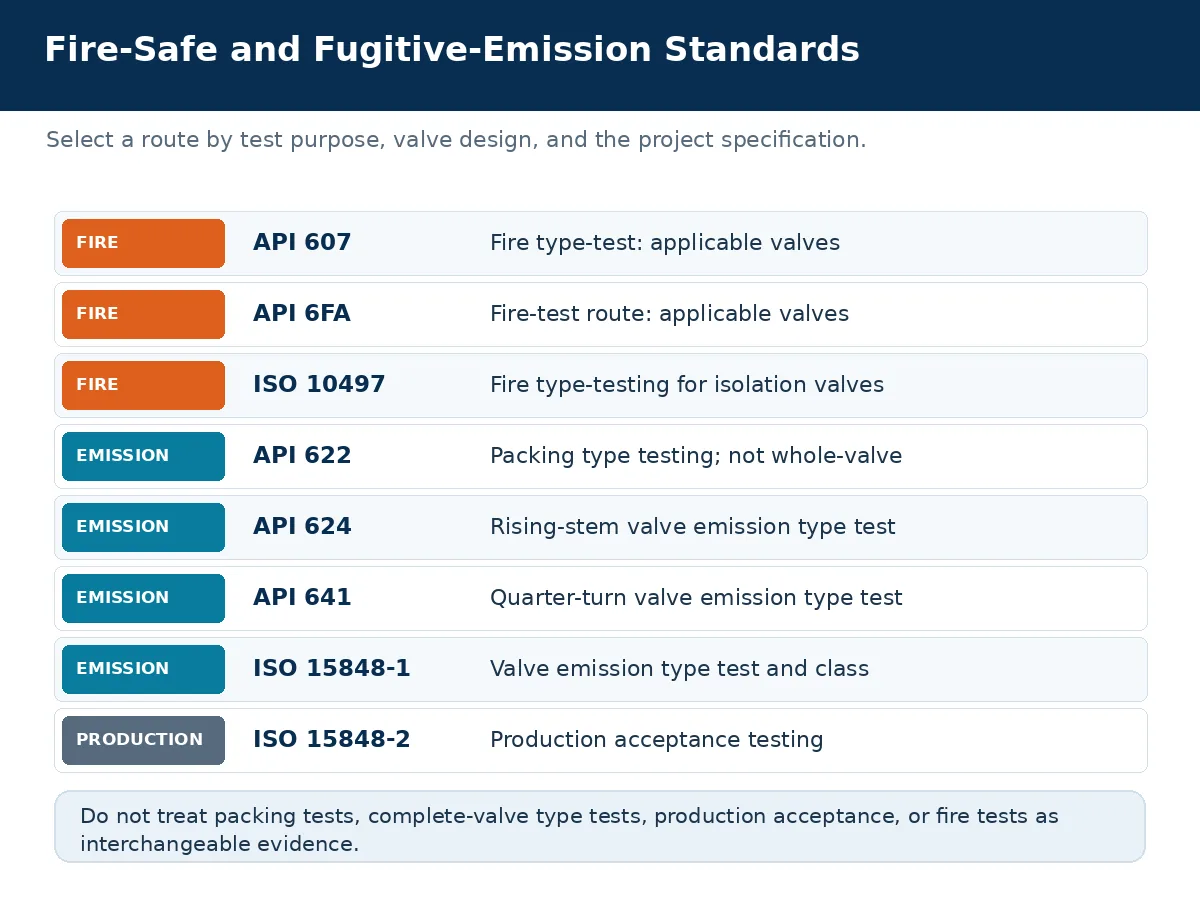
Editorial scope note: Verify standard names, editions and applicability against the official publications; this illustration is not a qualification certificate or a substitute for the governing standards.
| نوع الصمام | Potential fire-test route | Potential emission-test route | Critical check |
|---|---|---|---|
| Quarter-turn ball | API 607 / API 6FA / ISO 10497, as applicable | API 641 / ISO 15848-1 | Seat and stem seals; qualification coverage |
| Butterfly / plug | Applicable fire-test standard | API 641 / ISO 15848-1, where applicable | Shaft/plug sealing and tested construction |
| Rising-stem gate / globe | Applicable fire-test standard | API 624 / ISO 15848-1, where applicable | Stem motion, packing and bonnet joint |
| صمام تحكم | Design-specific review | ISO 15848-1 or applicable project route | Dynamic sealing and package boundaries |
5. How Should Buyers Verify Valve Qualification Evidence?
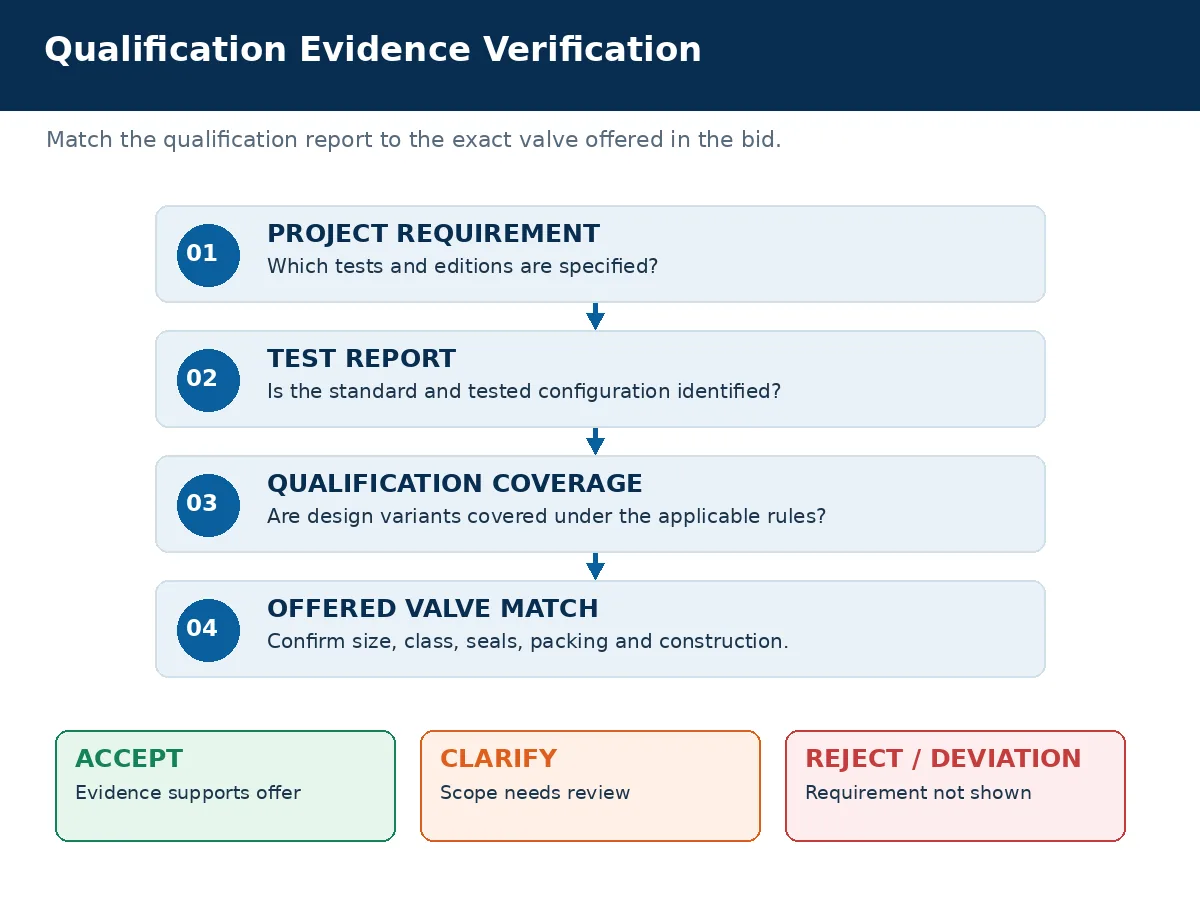
The important question is not whether the supplier can show a certificate cover page. It is whether the tested configuration and its permitted qualification coverage support the valve in the commercial offer. Use the traceability path: Required standard → Test report → Tested configuration → Qualification extension → Offered valve → Accepted document set.
Report scope and the offered design
Review test report identification, applicable edition, tested construction and sealing configuration. Confirm whether the quoted size, pressure rating, body and seal materials, packing system and applicable operating envelope are supported. Any qualification-relevant design changes require evaluation under the applicable standard and project acceptance rules.
Evidence-to-offer matching: Request a report-to-tag matrix linking each quotation line to the qualification report identifier, tested model, relevant seat and stem/shaft sealing arrangement, applicable size/rating/material extension basis, operating envelope and declared deviations. A report for one product family is useful only when the permitted qualification rules demonstrably include the offered construction.
| عدم رجوع | الإثبات المطلوب | Risk if missing |
|---|---|---|
| Standard and edition | Qualified test reference | Wrong or unacceptable test basis |
| Report identity | Traceable complete report or approved extracts | Generic / unrelated certificate |
| الإنشاءات | Tested configuration and relevant drawing | Offered design differs from test specimen |
| Design-family coverage | Permitted extension and supporting rationale | Unsupported size or rating claim |
| نظام الإحكام | Seat, packing, stem and joint details as relevant | Unreviewed material or configuration change |
| Emission class | Reported class and associated test conditions | Insufficient performance for the project |
| Production tests | ITP, production test records and acceptance criteria | Type test mistaken for unit inspection |
| الانحرافات | Supplier deviation schedule | Undisclosed qualification gap |
Evidence Gate: Match the Qualified Design to Each Quoted Tag
A useful supplier response is a short qualification coverage statement tied to each valve tag or a clearly defined set of identical tags. It should identify the test report, standard/edition, tested valve, permitted design-family extension and each offered design feature that could affect sealing or test performance.
Example, not a qualification claim: An RFQ specifies a fire-safe, low-emission quarter-turn valve. Supplier A provides a fire-test report for a different seat construction and an emission report with a different packing arrangement. Supplier B provides separate reports and a documented coverage basis matching the offered construction. Both may quote the same broad standard numbers, but Supplier A requires a formal qualification clarification before technical acceptance. Neither supplier is deemed approved without review of the complete project requirements and evidence.
Do not assume: identical nominal size, material grade or valve family name alone establishes that a certificate covers the supplied valve. Changes in seat material, packing architecture, bonnet joint, stem geometry or operating envelope should be checked against the governing qualification rules.
Illustrative document-review scenario: The tested ball valve uses a particular stem seal, but the quotation lists an alternative packing system. The difference does not automatically invalidate qualification, yet it is an open technical question. Ask for the controlled drawing revision, component comparison, standard-based extension justification and purchaser disposition before releasing the order.
6. Seven Common Fire-Safe and Fugitive-Emission RFQ Mistakes
Incomplete qualification language can produce bids that appear equivalent but contain different test and documentation obligations. Seven recurring errors are listed below.
Illustrative bid evaluation: An RFQ says only “fire safe and low emission”; Supplier A includes qualification reports, while Supplier B quotes a standard valve and marks both requirements “compliant.” A price comparison at this point is misleading. Issue a common clarification requiring the two standards/editions, tested-to-offered coverage, production inspection scope and priced document deliverables from both bidders.
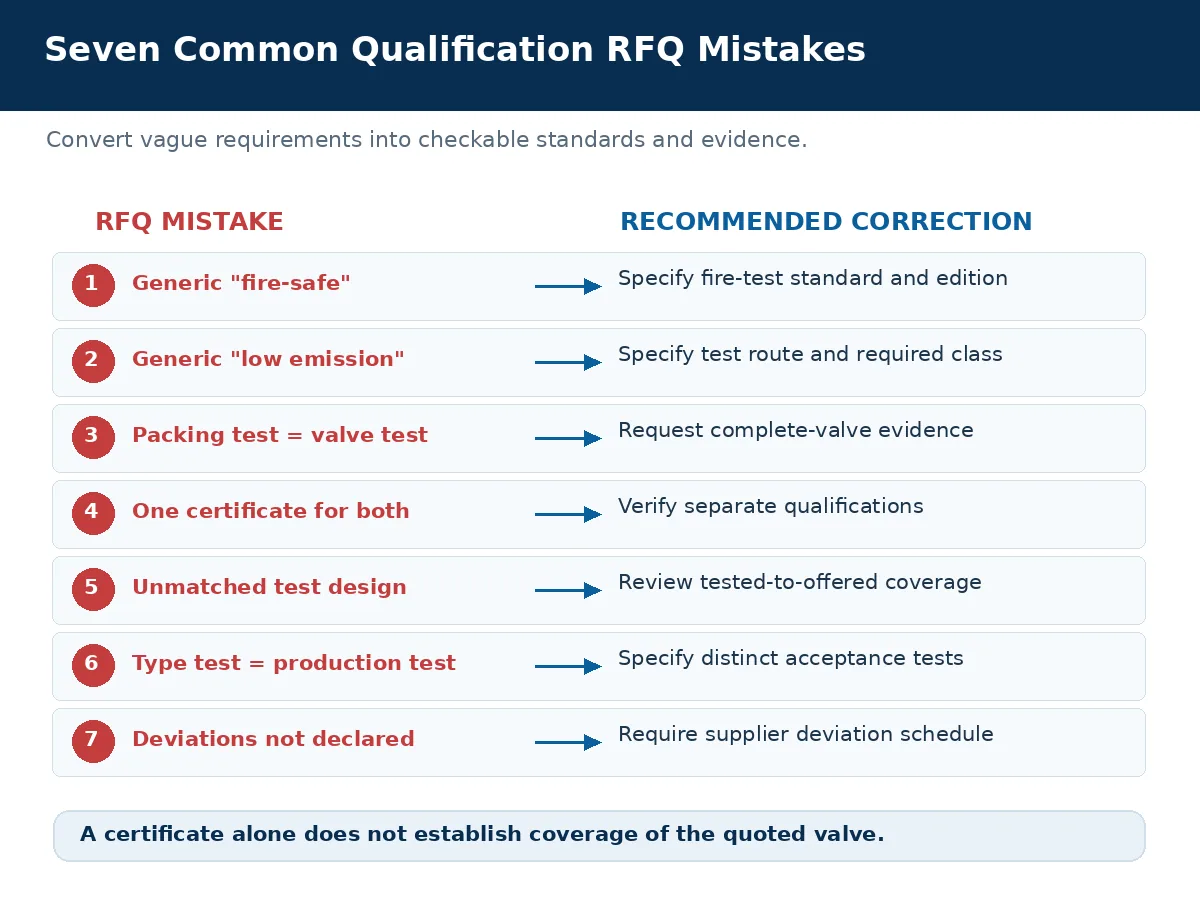
| Mistake | لماذا هو مهم | Correction |
|---|---|---|
| “Fire-safe required” only | Standard and edition omitted | State standard, edition, evidence |
| “Low-emission valve” only | No class or test route | Specify standard and classification |
| API 622 treated as valve test | Packing is not complete-valve qualification | Request relevant whole-valve evidence |
| One report assumed to cover both | Different test objectives | Review two qualifications separately |
| Configuration not checked | Quoted design may differ | Require tested-to-offered mapping |
| Type test treated as production test | Routine acceptance unproven | Separate production requirements |
| Deviations not declared | Bid may exclude required evidence | Use formal deviation schedule |
7. How to Specify Both Requirements in a Valve RFQ
A useful RFQ identifies the applicable requirement for each tag, names the standard and edition, describes the acceptance criteria and requests qualification coverage for the exact offered configuration. It separately defines production testing, witnessing, inspection and deliverables.
Example fire-safe clause
The proposed valve shall be supported by fire-safe type-test qualification evidence in accordance with the project-specified applicable standard and edition. The supplier shall identify the tested configuration, report and documented basis for coverage of the offered design. All limitations and deviations shall be declared for purchaser review.
Example fugitive-emission clause
Where required by the datasheet, the offered valve shall be supported by fugitive-emission qualification evidence to the specified standard, edition and classification. The supplier shall identify the sealing configuration, qualification envelope and documented coverage of the proposed valve.
Production testing and documents
Production tests, routine shell/seat tests, inspection witness points, ITP and report submissions shall be stated separately. Type qualification shall not be represented as evidence that every production valve underwent the same test.
Commercial and inspection boundary: The RFQ should explicitly identify whether qualification reports are required at bid stage or before manufacture, who approves the test coverage, whether additional production emission testing is included, the acceptance basis for any witness/hold points, and whether a third party must attend. State which items are included in the offered price and which trigger a priced deviation.
Define the Document Submission Milestones
RFQ documentation should distinguish bid-stage evidence (qualification list, report references, preliminary coverage mapping and deviations), pre-manufacture approval (approved datasheet, ITP and any required full test-report review), and final turnover records (production test results, inspection release documents and the agreed qualification evidence package). Identify which submissions are for information, approval or witness review. Do not assume every certificate is included without being listed in the document register.
For routine shell and seat tests and their documentation boundaries, see the مرجع اختبار ضغط الصمام; these tests do not replace fire-safe or fugitive-emission type qualifications.
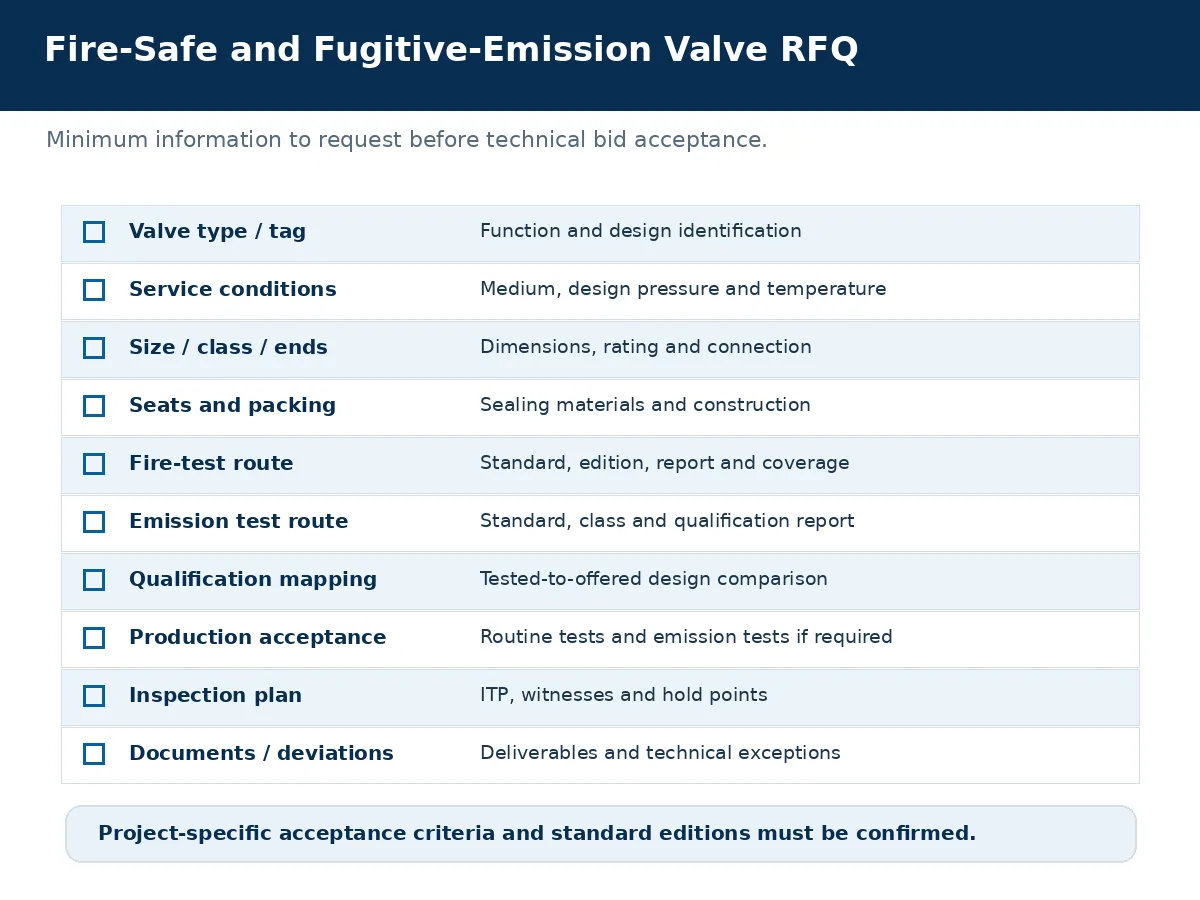
Technical Bid Normalization: Record More Than “Comply”
For each requirement, ask suppliers to complete one line with required standard and class, offered test route, report ID, tested-to-offered coverage, production inspection included, documents included و deviation/clarification. This separates a test claim from an auditable deliverable.
| Bid check | Supplier response required | Acceptance gate |
|---|---|---|
| Fire-safe | Standard/edition, test report, coverage statement | Applies to quoted tag and construction |
| الانبعاثات المتسربة | Standard/edition, class or test basis, report and coverage | Specified emission requirement demonstrated |
| Production inspection | ITP, test extent, criteria, hold/witness points | Included in quotation and deliverables |
| Exceptions | Numbered deviation register with resolution status | All critical exceptions closed before PO |
8. What Should Be Confirmed Before Purchase Order Approval?
- Confirm the requirement by valve tag: fire-safe, fugitive-emission, or both.
- Confirm applicability: selected standards, editions, valve types and classes.
- Match qualification evidence: tested design and permitted coverage against the offer.
- Separate production acceptance: ITP, inspection, testing, witness and records.
- Close deviations: outstanding technical and commercial exceptions before approval.
Qualification and inspection requirements may change design choice, supporting documentation, cost and schedule. Reviewing the evidence before order placement is preferable to discovering a qualification gap at final inspection. A broader overview of valve types is available in the industrial valve products guide.
Release decision: Where the evidence does not establish required coverage, mark the technical evaluation Clarification Required rather than silently accepting a certificate. A formally approved deviation, different qualified design or further testing may be necessary. The responsible project engineer and purchaser determine acceptance under the applicable specification.
9. Frequently Asked Questions
Is a fire-safe valve automatically qualified for fugitive emissions?
No. The qualifications address different operating scenarios and leakage risks. Request separate evidence whenever both requirements are specified.
What is the difference between API 607 and API 641 testing?
API 607 addresses fire testing within its stated valve scope. API 641 addresses fugitive-emission type testing of applicable quarter-turn valves. One does not establish the other qualification.
Does an API 622 packing test qualify the complete valve?
No. API 622 concerns packing type testing. A whole-valve fugitive-emission requirement needs evidence appropriate to the applicable valve testing standard.
What is the difference between ISO 15848-1 and ISO 15848-2?
ISO 15848-1 concerns type qualification and classification. ISO 15848-2 concerns production acceptance testing. They serve different evidence functions.
Can one fire-safe report cover different valve sizes and classes?
Only where the applicable standard permits qualification extension and supporting documents establish the specific coverage. Do not assume all models in a supplier’s range are covered.
What should buyers request when both requirements apply?
Request each applicable qualification report, standard and edition, tested and offered configurations, coverage basis, applicable emission class, required production tests and declared deviations.
Conclusion: Treat Each Requirement as an Independent Qualification Decision
Fire-safe and fugitive-emission requirements should be specified and verified independently. A meaningful technical bid review matches qualification reports to the offered valve, identifies what a standard does and does not cover and separates design type testing from production acceptance. The final decision depends on the approved project datasheet, applicable standards and documented supplier evidence.
Request Testing and Qualification Evidence Review
Send the valve type and tag, medium, design pressure and temperature, size/class, sealing construction, specified fire-safe and fugitive-emission standard and edition, required emission class, production test scope and documentation expectations. Product-specific qualification and testing availability require confirmation from the actual supplier records.
Submit Your Valve Datasheet / RFQ → Arabic
  English
  German
  French
  Spanish
  Italian
  Portuguese
  Russian