
PFA is not automatically better than PTFE for lined valves. Both offer broad chemical resistance, but choosing between them requires the complete valve design, not a resin name. PFA’s melt-processability can enable particular liner geometries, while a qualified PTFE-lined construction may meet the same duty. The decisive checks are finished-valve temperature and pressure limits, permeation risk, liner support under vacuum, complete wetted-material compatibility and manufacturer evidence.
Use the comparison and RFQ checks below to determine when PTFE is sufficient, when a documented PFA construction offers a relevant benefit, and when a bid must remain on technical hold.
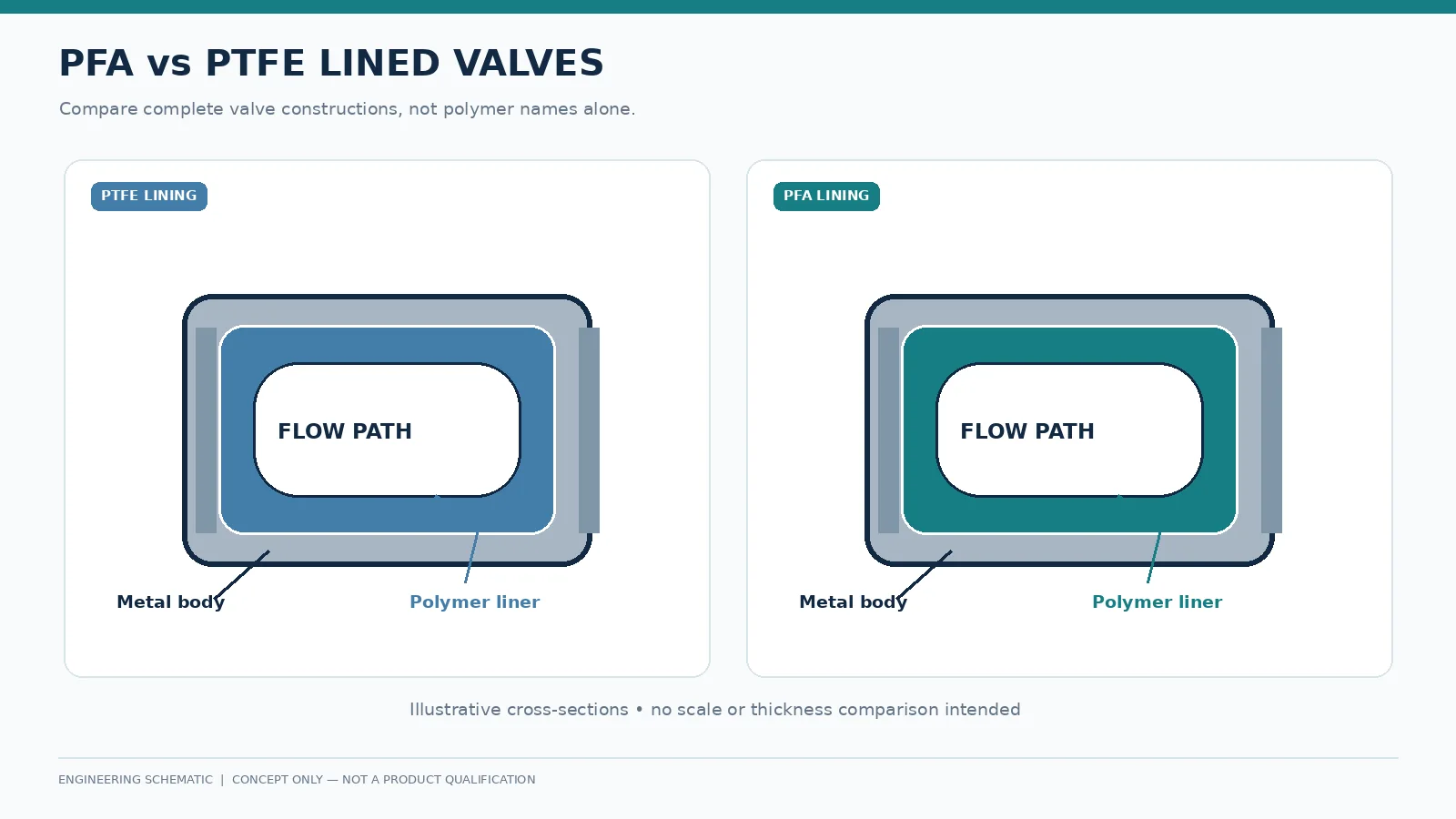
1. PFA vs PTFE Lined Valves: Key Differences at a Glance
The useful comparison is between qualified, complete lined-valve configurations, not two generic polymer datasheets. Both are fluoropolymers with broad chemical resistance, but the suitability of an assembled valve also depends on its body, seals, lining process and operating envelope.
| العامل | PTFE-lined valve | PFA-lined valve | تحقق المشتري |
|---|---|---|---|
| Chemical resistance | Broad; service-specific exceptions | Broad; service-specific exceptions | Medium, concentration, temperature |
| درجة الحرارة | Finished-valve limit must be confirmed | Finished-valve limit must be confirmed | Model-specific pressure–temperature envelope |
| Permeation | Possible; grade and conditions matter | Possible; grade and conditions matter | Permeant-specific evidence |
| فراغ | Construction-dependent | Construction-dependent | Liner support and qualification |
| Processing | Often formed/molded and sintered | Melt-processable manufacturing options | Sectional drawing and lining details |
| الدورة الحرارية | Requires dimensional and sealing review | Requires dimensional and sealing review | Duty cycles and manufacturer limits |
| Commercial comparison | Scope-dependent | Scope-dependent | Normalized quotation and deviations |
Quick selection rule: Do not select PFA simply because a process operates at elevated temperature or vacuum. Do not accept PTFE solely because a compatibility chart names the chemical. Validate the complete service envelope.
2. How Do PFA and PTFE Valve Linings Differ?
PTFE material properties and liner manufacturing
Polytetrafluoroethylene (PTFE) is recognized for broad resistance to many corrosive chemicals and low-friction behavior. Due to its exceptionally high melt viscosity, PTFE manufacturing commonly uses powder processing, molding, sintering, machining or forming. In valves, the exact arrangement varies by design. A PTFE lined butterfly valve configuration and a lined plug valve may use different support and sealing geometry even if both are specified as PTFE-lined.
PFA melt processability and liner construction
Perfluoroalkoxy polymer (PFA) is a melt-processable fluoropolymer. Depending on grade and process, it can be processed by methods including extrusion, injection molding or transfer techniques. These characteristics may enable different liner shapes or manufacturing routes. Melt processability itself does not establish superior permeation, temperature or vacuum performance.
Material evidence: AGC’s PFA resin information describes the melt-processable polymer family. It does not demonstrate the allowable pressure, temperature or vacuum rating of a particular lined valve.
Why thickness, geometry and retention matter
A fluoropolymer liner is one element of a mechanically loaded assembly. Review specified minimum lining thickness, tolerances, coverage at ports and stem passages, body support, flange-face sealing and retention details. Differential expansion, pressure loading, operation and maintenance access all interact with these features. Two valves with the same nominal polymer may have different approved operating limits.
3. Temperature Limits: Resin Data vs Finished Valve Ratings
Pressure–temperature interaction: A lining’s dimensional behavior and the assembled valve’s sealing performance can change under simultaneous differential pressure and heat. Request allowable conditions for the exact valve size and design; a pressure class or nominal PN marking alone is not evidence of the liner’s qualified temperature limit.
Example — hot-service quotation: An RFQ lists the design temperature but omits how long the valve remains at that temperature and whether peak differential pressure occurs simultaneously. A resin datasheet cannot close this gap. Ask both suppliers for the allowable valve-size-specific pressure–temperature envelope and identify the simultaneous worst-case operating scenario before approving either lining.
One of the most consequential specification errors is to assign the maximum temperature published for a bulk resin directly to a finished lined valve. Resin-level properties support initial screening, but the completed valve also includes metallic pressure-retaining parts, joints, packing, seats and geometrically constrained polymer components.
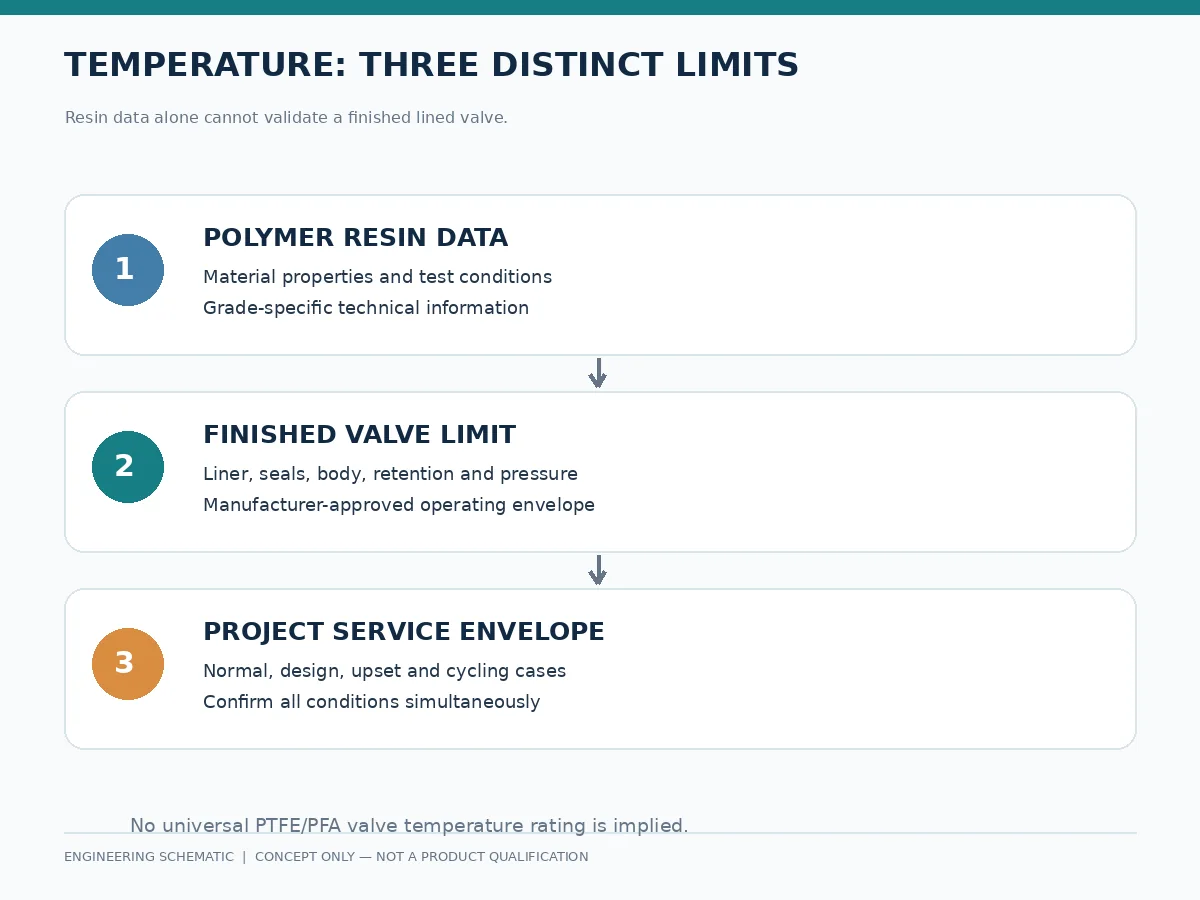
| Temperature information | What it means | Documentation needed |
|---|---|---|
| Resin data | Characteristics of a polymer under stated material test conditions | Resin technical datasheet |
| Finished-valve rating | Allowable envelope for the specific assembled valve | Manufacturer-issued rating/datasheet |
| Project service envelope | Normal, design, minimum and upset conditions | Approved project datasheet |
Creep, sealing and temperature
Polymer deformation is dependent on time, temperature and mechanical stress. Sustained loading can affect liner shape, support contact, local sealing stresses and component clearances. Valve pressure and cycling conditions can become controlling before a bulk resin temperature characteristic is reached.
Thermal cycling and upset cases
Repeated startup and shutdown expose the polymer and the surrounding metal to differential thermal expansion. The buyer should report thermal cycles, process upsets, cleaning temperatures and the duration of extreme conditions. A steady-state allowable temperature does not necessarily qualify a transient scenario.
الحد الهندسي: This guide deliberately gives no universal finished-valve temperature limit for PFA or PTFE. Confirm the proposed model and service conditions with the valve manufacturer.
4. Permeation: Does PFA Perform Better Than PTFE?
Corrosion resistance and molecular permeability are different properties. A polymer can resist rapid chemical attack yet still allow certain molecules to move through it. Permeation involves sorption into the polymer, diffusion across it and desorption on the other side. This is different from a gross leak through a crack, hole or failed joint.
Example — persistent odor outside a lined assembly: Odor near a valve is not proof that PTFE or PFA has failed by permeation; joint leakage, packing leakage and process deposits are alternative causes. First apply the plant’s safe isolation and exposure-control procedures, then review leak location, inspection records, medium identity and the liner design before specifying a replacement material.
حد الإثبات: Chemours’ Teflon PFA fluoropolymer-film properties bulletin (PDF) reports permeability-related material properties. Such film results cannot be applied directly to a finished valve liner, nor do they establish that PFA outperforms PTFE for the specified chemical. Comparable testing requires the same permeant, conditions, grade and thickness, with the reporting units and test method stated.
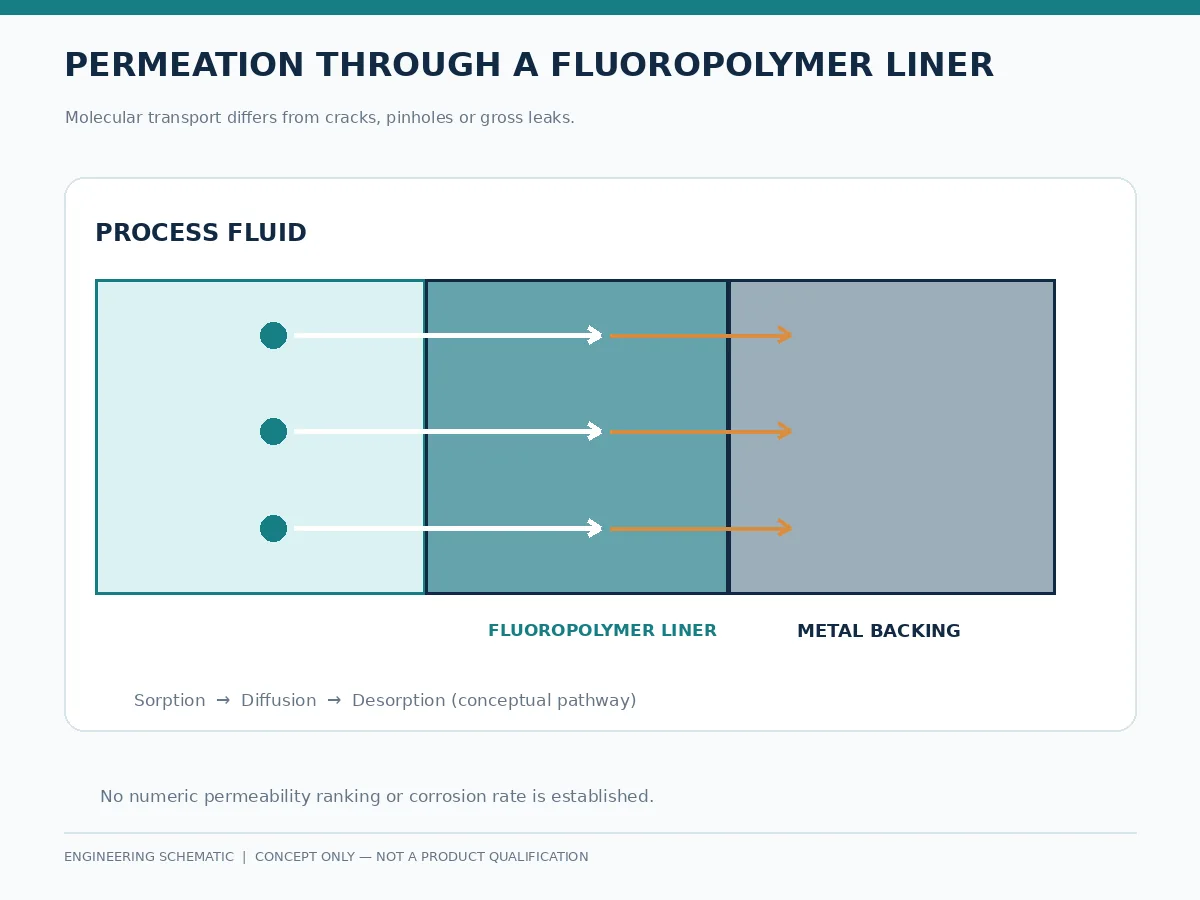
| Influencing variable | لماذا هو مهم |
|---|---|
| Chemical species | Different permeants interact with and diffuse through each material differently |
| Concentration and pressure difference | Change the driving conditions for permeation |
| درجة الحرارة | Can strongly affect transport |
| Liner thickness | Affects the transport path |
| Resin grade and processing | May alter relevant material properties |
| Exposure duration | Affects cumulative exposure and consequences |
Permeation and behind-liner consequences
In some constructions, permeating species may reach metallic surfaces or spaces behind the lining. Whether this results in corrosion or another integrity concern depends on the chemical, backing material and construction. Request evidence related to the relevant permeant and the specified temperature, not an unexplained blanket claim that one fluoropolymer is impermeable.
Inspection for lining discontinuities may detect some defects, but an integrity or holiday test does not by itself prove long-term molecular permeation resistance. A defensible material comparison uses relevant grades, equal test conditions and a clearly defined acceptance criterion.
Permeation comparison rule: If a supplier claims lower permeation for a proposed PFA or PTFE lining, request the permeant identity, test method, resin grade, temperature, liner thickness, measured units and conditions. Without matched conditions, numeric values or simple ‘better/worse’ rankings are not technically comparable.
5. Vacuum Service and Liner Stability
Vacuum service may reverse the direction of the pressure differential acting on the lining. When fluid pressure inside the valve is lower than pressure behind the liner, inward deformation or loss of support may become a concern. Whether those mechanisms occur depends on liner geometry, support and retention, external pressure, minimum absolute pressure, temperature and exposure duration.
Example — intermittent hot vacuum: A valve may experience vacuum only during shutdown while its lining is still hot. An ambient-temperature vacuum claim does not necessarily cover this combined case. Specify the minimum absolute internal pressure, possible pressure behind the liner, corresponding temperature and hold time; request construction-specific qualification rather than choosing PFA by material name.
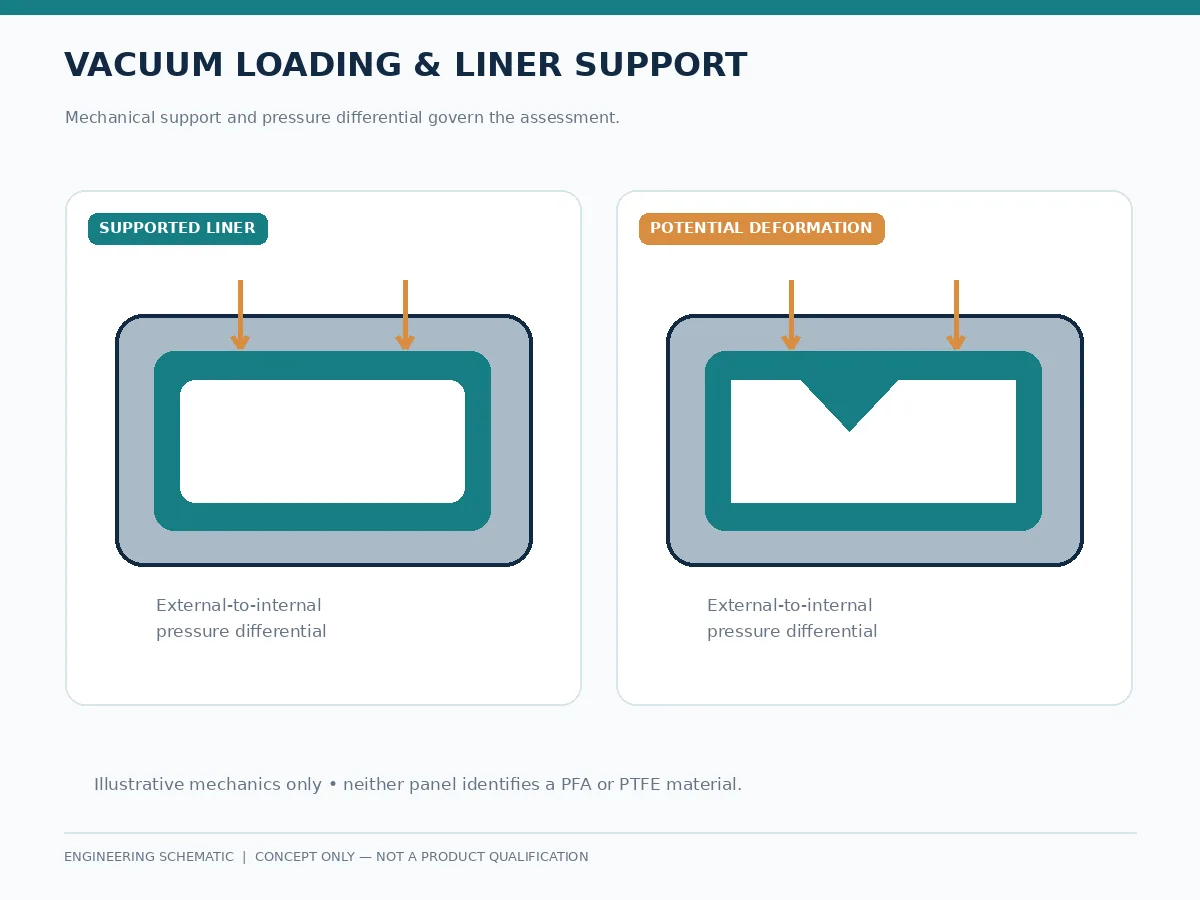
Potential deformation mechanisms
Unsupported liner spans can be susceptible to movement or buckling under differential pressure. This is a possible failure mechanism rather than an inevitable outcome. The molding method alone does not determine which of two actual lined valves is qualified for vacuum. A PFA-lined design must not be called full-vacuum capable unless the manufacturer supports that claim for the specific configuration.
| Vacuum-review field | Data to request |
|---|---|
| Minimum pressure | Absolute pressure, not only “vacuum” |
| External pressure | Pressure acting on the opposite side of the liner |
| درجة الحرارة | Actual temperature during the vacuum event |
| Exposure | Continuous, intermittent and upset duration |
| الإنشاءات | Liner support, retention, drawing and valve size |
| الدليل | Model-specific calculations, qualification or applicable test records |
6. Chemical Compatibility: Review the Complete Wetted System
Both PTFE and PFA are resistant to many acids, bases and solvents, but no universal compatibility statement is valid for all media and operating conditions. Engineers need the actual chemical identity, concentration ranges, contaminants and exposure temperature. A mixed process stream may include minor components, dissolved gases, solvents or cleaning agents that introduce different risks.
Screening source: Daikin’s fluoropolymer chemical-resistance resource supports preliminary material screening; it is not a model-specific valve qualification or an approval for an unlisted mixture.
Combined chemical and thermal exposure
Temperature can change diffusion behavior, the chemistry of the process and polymer mechanical response. Assess normal service, credible upsets, phase changes and duration together rather than isolating compatibility from temperature and pressure.
Cleaning and other wetted components
Include CIP or flushing fluids and maintenance chemicals, where relevant. Depending on design, seats, packing, stem seals, gaskets and other components may be exposed. Even a compatible lining does not establish compatibility for every component of a valve. For a broader review of chemistry, contaminants, exposed components and corrosion mechanisms, consult Raymon Valve’s corrosion-resistant valve material selection المورد.
See also Raymon Valve’s PTFE / PFA lined valve configurations for the associated product scope.
Failure Modes and Verification Before Material Approval
Visible symptoms do not uniquely identify a PFA or PTFE material problem. Use the table below to frame supplier questions and inspection requirements, rather than diagnosing a valve without examination. If loss of containment or unsafe operation is suspected, follow the plant’s isolation and maintenance procedures and obtain a competent inspection.
| Observed concern | Possible contributing conditions | Evidence or verification to request |
|---|---|---|
| Discoloration or corrosion behind lining | Permeation, damage, defects, incompatible backing environment | Service chemistry, liner inspection, backing-metal condition and relevant permeation data |
| Inward liner distortion during vacuum | Pressure differential, unsupported spans, elevated temperature or retention issue | Minimum absolute pressure, temperature, sectional drawing and model-specific vacuum qualification |
| Leakage after repeated temperature cycles | Joint or sealing-interface movement, creep or assembly effects | Cycle history, approved sealing design, torque/assembly procedure and leak-test record |
| Unexpected operating force or impaired closure | Liner deformation, interference, deposit buildup or another mechanical cause | Operation history, dimensional inspection and manufacturer functional checks |
حد الإثبات: A positive shell or seat test at one specified condition does not establish long-term permeation resistance, thermal-cycle durability or vacuum performance. Specify each acceptance criterion separately.
7. PFA vs PTFE Lined Valve Selection Matrix
Use this matrix to decide what to evaluate and what evidence remains necessary. It is a preliminary screening tool, not an automatic material approval.
Shortlist decision: Retain PTFE as a compliant option when the exact configuration meets chemistry, temperature, pressure/vacuum, sealing and documentation requirements. Evaluate PFA when a supplier can demonstrate a design-specific advantage against an identified risk. Hold both options when essential service cases or supporting evidence remain open.
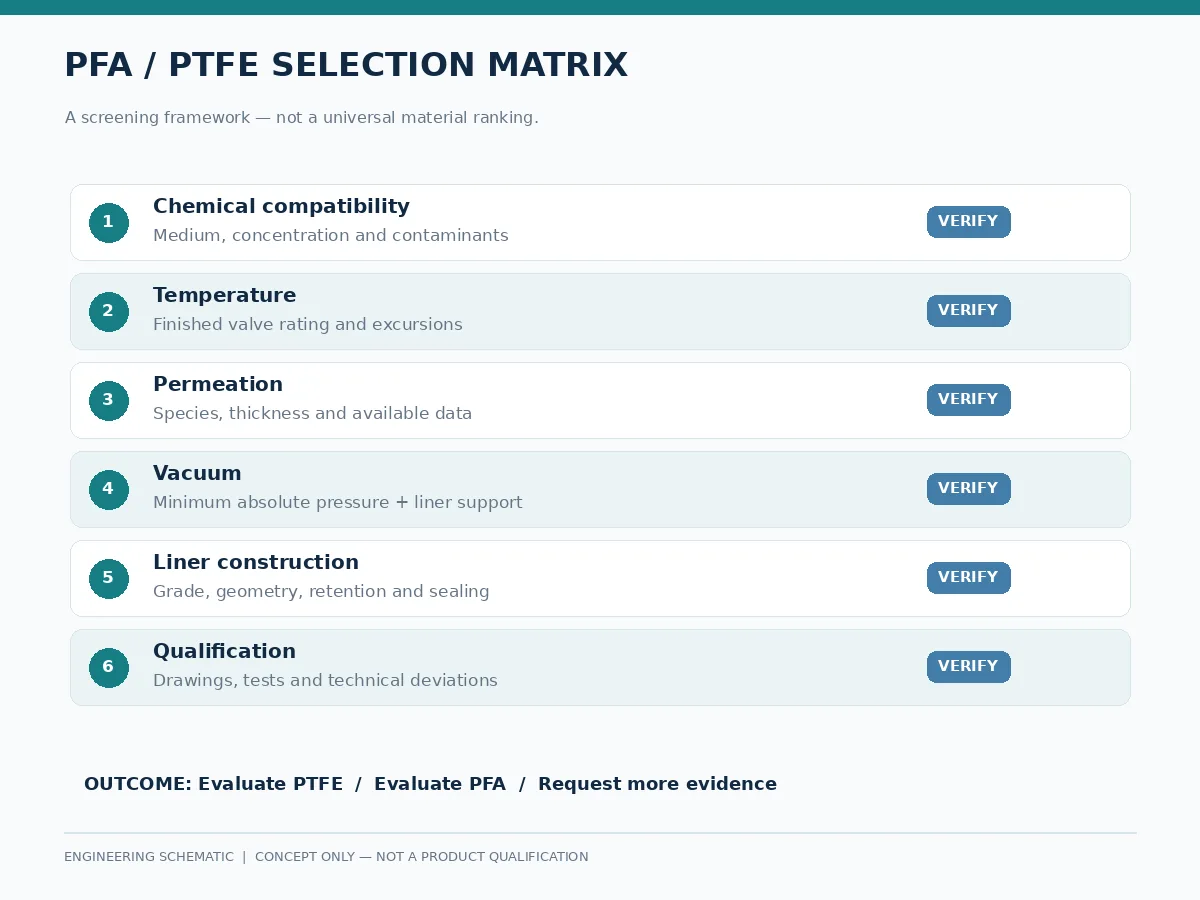
| Service or specification scenario | التوجيه الأولي | Approval evidence |
|---|---|---|
| Documented PTFE valve envelope meets service | PTFE may be appropriate | Compatibility, rating and lining drawings |
| Melt-processed liner geometry is a design requirement | Evaluate available PFA constructions | Actual manufacturing method and drawings |
| Elevated operating temperature | Compare qualified assemblies | Model-specific pressure–temperature envelope |
| Permeation controls selection | Evaluate both with matched data | Relevant permeant, grade, thickness and temperature |
| Continuous/intermittent vacuum | Compare qualified constructions | Vacuum envelope at specified temperature |
| Frequent thermal cycles | Review both options | Cycling conditions and design qualification |
| Unresolved chemical or construction data | Do not finalize selection | Close technical deviations and missing inputs |
When PTFE may be suitable
PTFE is a defensible choice when the specific lined-valve configuration satisfies the documented service envelope and the supplier provides the necessary technical evidence. Selecting PFA for reputation alone may add cost without solving a demonstrated engineering problem.
When PFA deserves evaluation
PFA may be useful when a melt-processed liner configuration meets the design intent or when supplier evidence demonstrates a relevant application-specific advantage. No performance improvement should be assumed merely from the material designation.
When neither selection is ready
Defer approval when chemical contaminants, upset temperatures, minimum absolute pressure or valve-specific limits are not known. Request a revised datasheet, qualified construction or further material review before issuing a purchase approval.
8. What to Include in a PFA/PTFE Lined Valve RFQ
A request such as “DN100, PN16, PFA-lined valve” does not by itself provide enough information to approve a corrosive-service valve. Procurement should ensure competing suppliers quote against the same operating conditions, technical scope, documentation and acceptance criteria.
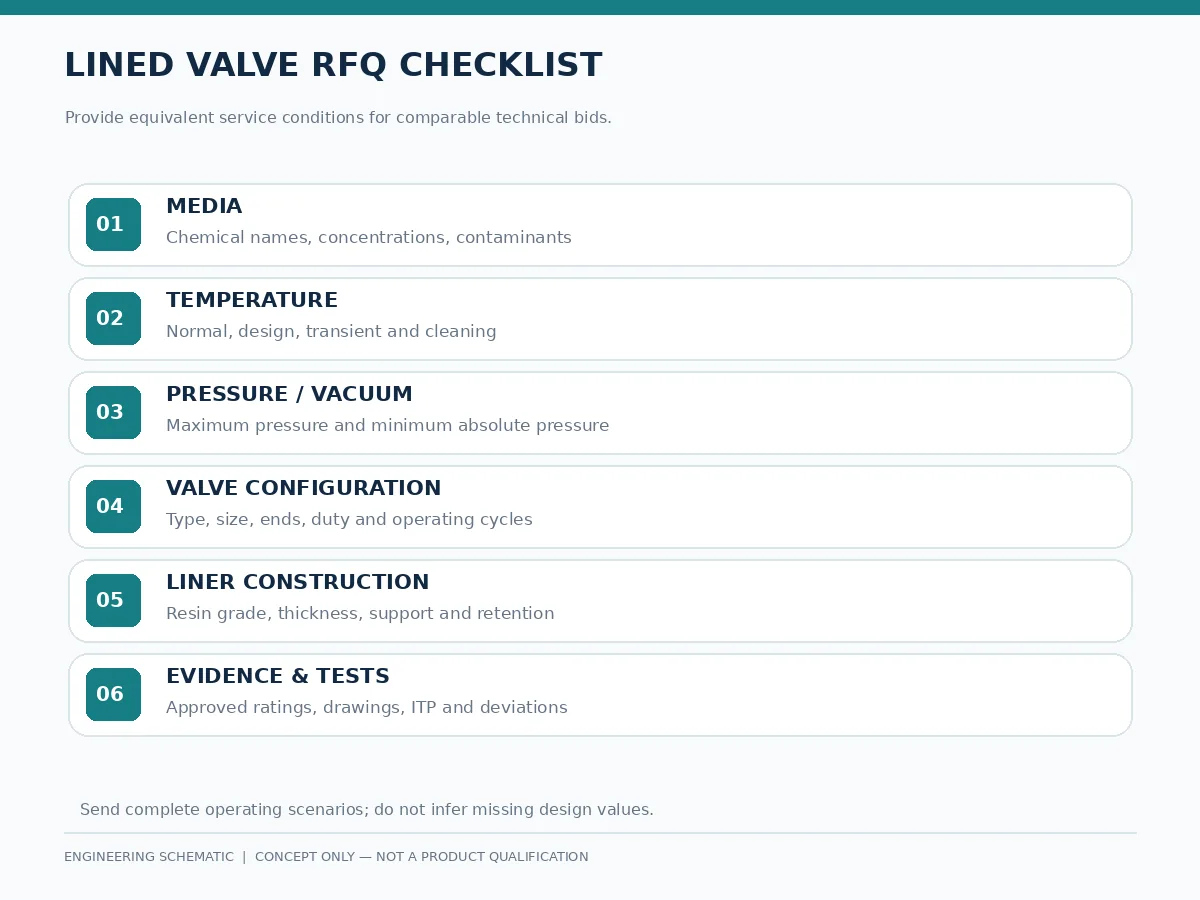
| RFQ group | المدخلات المطلوبة |
|---|---|
| الخدمة | Tag, valve function, process medium, concentrations, contaminants, solids |
| Thermal | Normal/minimum/maximum/design and upset temperatures; duration and cycles |
| Pressure and vacuum | Normal/design pressure, minimum absolute pressure, external pressure, duration |
| التكوين | Type, size, rating, connections, operation/actuation, duty |
| Lining | PFA/PTFE grade, construction, minimum thickness, coverage, support and retention |
| الفحص | Approved tests, acceptance criteria, records, witness points |
| Commercial normalization | Technical deviations, inclusions, delivery scope and documents |
Construction and inspection documents
Request the approved valve datasheet and sectional drawing, lining identification, relevant materials documents and an inspection-and-test plan appropriate to the selected valve. Where specified, inspection may include lining continuity/holiday testing, pressure-boundary tests, closure leakage tests and operational testing. These are distinct activities: a shell test does not prove molecular permeation resistance, while a lining continuity test cannot establish full-vacuum or elevated-temperature suitability.
Where a particular design is being evaluated, consult the PFA lined valve information و lined and plug valve product family as product-level references.
Supplier Technical Bid Normalization: What Must Match?
Quotations for a PTFE-lined valve and a PFA-lined valve should be compared only after the proposed duty and deliverables have been normalized. Ask each supplier to provide a compliance statement with explicit exceptions, rather than using an unspecified ‘equivalent’ material description.
| Bid comparison item | استجابة المورد المطلوبة | If missing or different |
|---|---|---|
| Resin and liner construction | Polymer grade, lining process, minimum thickness and support details | Record technical deviation; request sectional drawing |
| Pressure, temperature and vacuum | Model/size-specific approved envelope including applicable transients | Do not infer qualification from generic polymer data |
| Wetted materials and chemistry | All wetted components identified and compatibility basis stated | Request full material list and chemistry review |
| Testing and acceptance | Individual tests, criteria, witness points and records offered | Normalize test scope before price comparison |
| Documentation and exceptions | Drawings, records, ITP and itemized deviations | Resolve open points before technical approval |
Example: An Incomplete Chemical-Service RFQ
Incomplete request: “DN100 lined valve for hot acid, occasional vacuum.” This does not identify the chemical and concentration, the maximum temperature, the vacuum absolute pressure or whether the vacuum coincides with the temperature peak.
Improved request: Include the exact chemistry and concentration range; normal/design/upset temperatures and their durations; normal/design pressure; the minimum absolute pressure and corresponding temperature; valve function, connections and cycles; and the required supporting documents. Ask suppliers to quote both suitable constructions where available, explicitly noting any departure from the requested service envelope. This is an illustrative field checklist, not an approved specification for any particular chemical.
Technical Approval Gate: When Can a Bid Proceed?
| Approval item | Proceed only when | If missing |
|---|---|---|
| نطاق الخدمة | Media, concentration, temperature, pressure/vacuum and transients are defined | Hold technical approval and clarify process data |
| Materials and lining | Grade, wetted components, liner geometry and construction are documented | Request sectional drawing and material review |
| Operating qualification | Selected valve model/size has adequate documented pressure–temperature and vacuum limits, as applicable | Request specific evidence or alternative proposal |
| Inspection and deviations | Test scope, criteria, records and deviations are agreed | Resolve exclusions before PO approval |
Approval gate is a purchasing-screening aid, not a substitute for approval by the responsible project engineer.
9. Frequently Asked Questions
Is PFA better than PTFE for lined valves?
Not universally. Both can provide broad chemical resistance. Selection depends on the medium, temperature, pressure or vacuum conditions, liner construction and evidence supporting the finished valve.
Can PFA and PTFE lined valves operate at the same temperature?
Their ranges can overlap, but allowable temperature is model- and pressure-dependent. Compare manufacturer-approved finished-valve operating envelopes rather than generic resin characteristics.
Which lining offers better resistance to chemical permeation?
There is no universal ranking for every permeant. Compare relevant resin grades and test evidence at comparable concentration, temperature, pressure differential and thickness.
Are PFA lined valves suitable for full vacuum service?
Some qualified valve constructions may be. PFA alone does not establish full-vacuum capability; confirm minimum absolute pressure, temperature, liner support and qualification for the proposed model.
What information is required to select a PFA or PTFE lining?
Provide chemical identity and concentration, contaminants, operating and design temperature, pressure and vacuum data, valve configuration, cycles, cleaning exposure and testing or documentation requirements.
10. Final Selection: Match the Lining to the Complete Service
Material differences matter, but neither PFA nor PTFE should be chosen from a resin-property list alone. A defensible selection combines chemical compatibility, operating and upset temperatures, pressure or vacuum, potential permeation, liner support, sealing interfaces and model-specific evidence. PTFE may be fully appropriate when its qualified valve configuration meets these requirements. PFA may offer useful process or construction alternatives where that benefit is demonstrated.
Ask for Material and Lining Review
Send chemical identity and concentration (including impurities and cleaning fluids), normal/design/upset temperatures, operating pressure, minimum absolute pressure if vacuum applies, valve size and duty, operating cycles, and inspection/documentation requirements. Ask for qualified construction options, a clear technical deviation list, and the remaining data needed for approval.
Submit Your Valve Datasheetالمراجع الفنية والنطاق
Material-level sources explain general polymer properties but do not certify any Raymon Valve product or finished valve operating limit.
- AGC — Fluon PFA resins (general material characteristics)
- Daikin — Chemical resistance information (material-level screening)
- Chemours — Teflon PFA fluoropolymer film properties bulletin (PDF) (material-level permeability context; not valve-specific comparative data)
Engineering note: This article is a preliminary technical screening resource, not a valve approval, test report or an assertion of Raymon Valve product certification. Final suitability, pressure–temperature limitations, vacuum performance, permeation criteria and inspection scope require approved project data and manufacturer documentation for the selected model. Named polymer grades and verified model-specific performance figures were not supplied for this article.
 Arabic
  English
  German
  French
  Spanish
  Italian
  Portuguese
  Russian