By Raymon Valve Technical Content Team · Engineering Decision Support
Concentric, double-offset and triple-offset butterfly valves should not be ranked as universally basic, better and best. A concentric valve may fit when its complete resilient-seat system covers the medium, pressure, temperature, cycling and shutoff duty. Double offset can reduce seat interference, but its limit still depends on the selected seat and valve rating. Triple offset can support metal-seated isolation, yet geometry alone proves neither high-temperature suitability nor fire performance or zero leakage. Final selection requires model-specific ratings, torque data and test evidence.
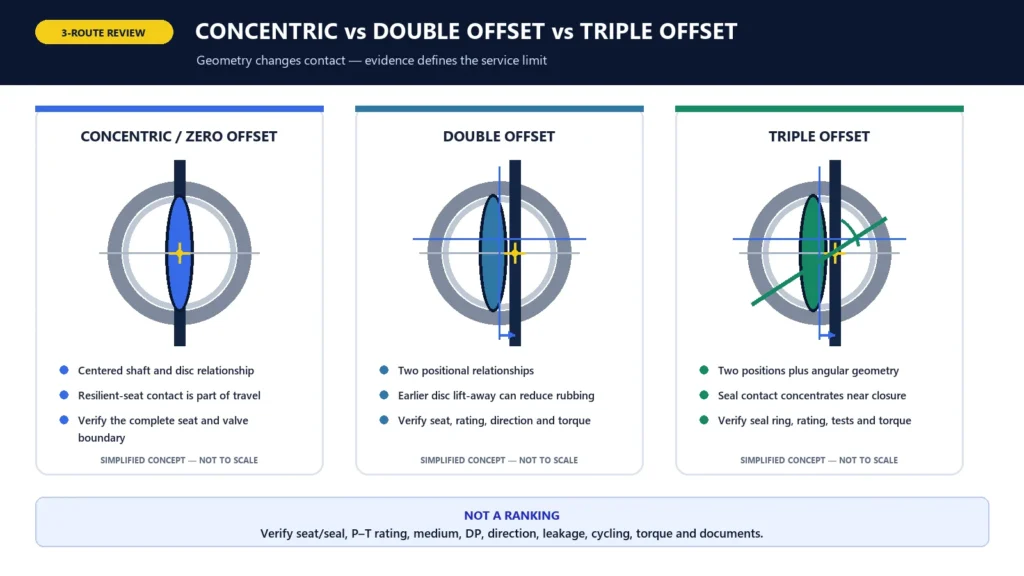
Featured illustration: Conceptual concentric, double-offset and triple-offset geometry. The final choice depends on the documented seat system, pressure-temperature duty, shutoff requirement, torque basis and project evidence. Engineering concept only; not product evidence.
Quick Comparison: Which Offset Design Fits the Service?
The first screening question is not “Which valve has more offsets?” It is “Can the proposed construction and evidence satisfy the complete service and acceptance basis?”
Use the table below to establish a review route. It is not a substitute for the selected manufacturer's pressure-temperature data, drawings, torque information or test records.
| Construction route | What the geometry suggests | Preliminary review direction | Do not infer | Minimum evidence before approval |
|---|---|---|---|---|
| Concentric / zero offset | Disc movement and resilient-seat deformation are closely linked through the operating stroke | Keep in review when the documented resilient seat, valve rating and operating duty align | A universal pressure or temperature limit, media compatibility, leakage class or maintenance life | Exact model and size, seat identity, pressure-temperature rating, compatibility review, closing differential pressure, cycle duty and shutoff basis |
| إزاحة مزدوجة | The shaft/disc relationship can move the disc away from the seat earlier after opening | Keep in review when reduced seat interference is useful and the specified seat system covers the duty | That “high performance” proves a particular seat, rating, direction or leakage level | Geometry, seat construction, rating, directionality, torque data and test evidence |
| إزاحة ثلاثية | An additional angular sealing relationship can keep sealing surfaces separated through most of travel | Keep in review when a documented metal-seated or reduced-rubbing isolation design matches the duty | Inherent fire safety, zero leakage, bidirectional shutoff, cryogenic suitability or a universal high-temperature rating | Seal-ring construction, materials, rating, leakage basis, pressure direction, qualification scope and model-specific torque |
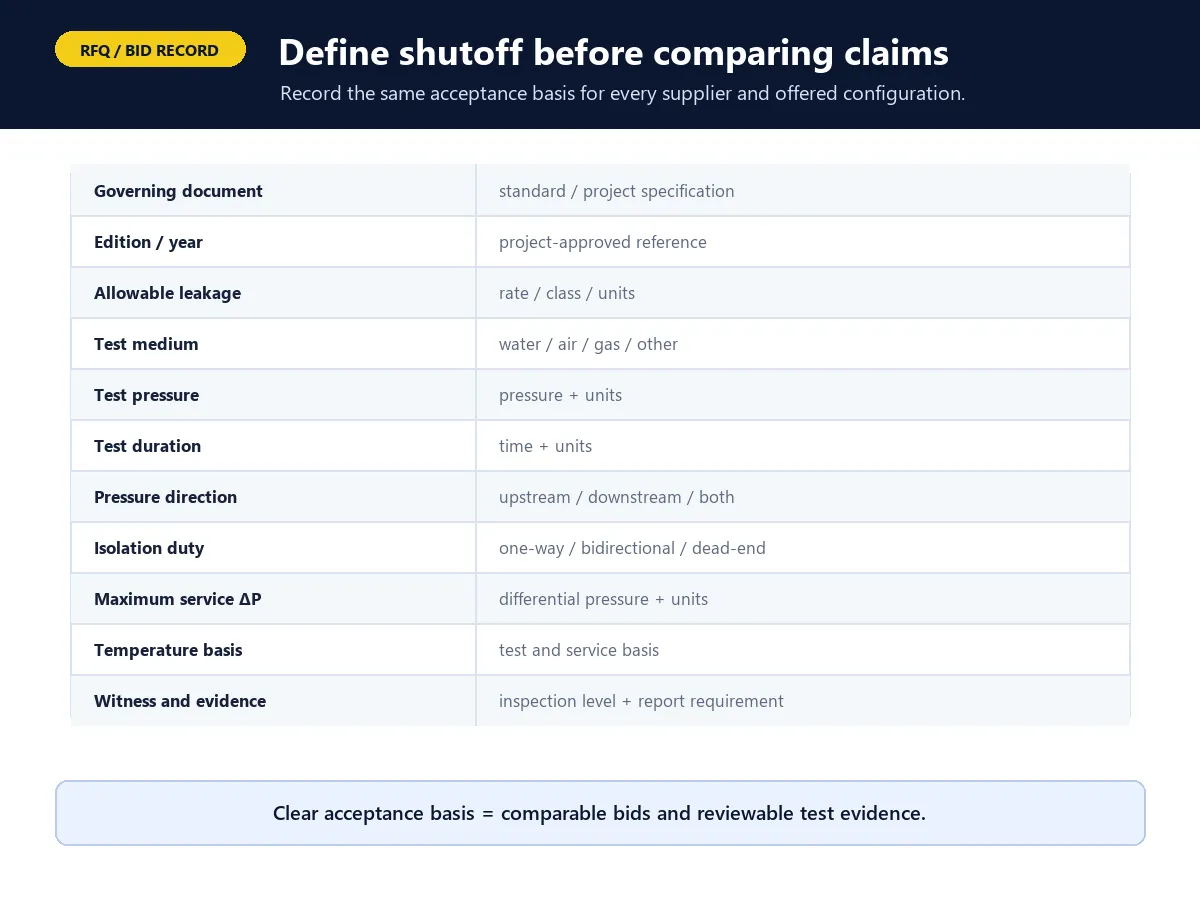
This distinction matters during both specification and bid comparison. Two suppliers may use the same offset label while proposing different seat systems, body styles, directionality, ratings and acceptance criteria. If those fields are not normalized, the quoted valves are not technically equivalent.
Define the Valve Function Before Choosing the Offset
Offset geometry should be screened only after the valve function and operating cases are clear. An isolation valve, a frequently cycled on-off valve, a modulating valve and an emergency or fail-action valve can place different demands on the seat, torque profile, actuator and acceptance evidence.
| الوظيفة المطلوبة | Operating data that changes the review | Evidence or calculation to request | Hold point |
|---|---|---|---|
| Isolation / on-off | Maximum closing differential pressure, pressure direction, leakage criterion and cycling | Configuration rating, shutoff basis, torque data and test scope | “Tight shutoff” is not defined by rate, conditions and evidence |
| Defined throttling duty | Normal/minimum/maximum flow, differential pressure, operating angle, velocity, solids and process risks | Exact-model performance data and the applicable sizing, cavitation, noise or velocity review | Suitability is inferred from line size or valve type alone |
| الدوران المتكرر | Cycles, travel profile, dwell, temperature changes and maintenance target | Documented cycle basis, torque cases and maintenance assumptions | Service life is assumed from offset count |
| Emergency or fail action | Required fail position, available supply, closing time and transient consequence | Valve torque basis, actuator calculation and system/transient review where applicable | Fail action, minimum supply or transient acceptance is open |
This article does not perform control-valve sizing or a transient analysis. Where the duty requires those calculations, keep the construction decision preliminary until the responsible process, piping and controls reviews are complete.
What the Three Butterfly Valve Geometries Actually Change
All three designs use a rotating disc, but the relationship between the shaft axis, disc and sealing surface changes how contact develops during movement. Geometry affects the sealing mechanism and torque profile; it does not independently establish the service envelope.
Concentric or zero-offset geometry
In a concentric construction, the shaft and disc are arranged around the valve centerline, and closure commonly depends on deformation of a resilient liner or seat. The disc remains in contact with, or interferes substantially with, the seat during rotation. That contact is part of how the valve seals, but it can also make seat behavior, friction and operating torque sensitive to the actual compound, interference, temperature, differential pressure and cycling history.
The practical limitation is therefore not a universal number attached to the word “concentric.” It is the boundary of the complete selected valve. A buyer needs the seat designation and construction, the valve pressure-temperature rating, medium compatibility review, shutoff test basis and operating data. A service name such as water, HVAC or utility air is not enough by itself because concentration, treatment chemicals, solids, temperature excursions, vacuum conditions and cycle frequency can change the review.
Double-offset geometry
A double-offset valve changes the shaft position relative to the disc and sealing arrangement. The resulting disc path can lift the disc away from the seat earlier after opening than a conventional concentric design, reducing unnecessary sliding contact through much of the stroke.
That mechanism can be valuable where seat wear or operating characteristics are important, but “double offset” is still incomplete as a purchase description. A double-offset valve may be offered with different polymer, resilient or metallic sealing arrangements, and those configurations can have materially different pressure-temperature, leakage, directionality and maintenance boundaries. The terms “double offset,” “high performance,” “soft seated” and “metal seated” should not be treated as interchangeable.
Triple-offset geometry
A triple-offset valve adds an angular or conical relationship to the first two offsets. The sealing surfaces can remain separated during most of the operating stroke and engage closer to final closure. This geometry is one reason triple-offset constructions are considered for metal-seated isolation and duties where sliding contact between sealing surfaces must be controlled.
However, the third offset does not identify the seal-ring layers, material pairing, pressure-temperature rating, allowed leakage, pressure direction or qualification status. A metal-seated triple-offset valve is not automatically fire tested, bidirectional, cryogenic qualified or “zero leakage.” Each of those statements requires its own acceptance basis and evidence.
Normalize the terminology before comparing quotations
An RFQ or technical bid table should identify:
- concentric, double-offset or triple-offset geometry;
- seat, liner or seal-ring construction;
- body style and end connection;
- body, disc, shaft and sealing-component materials;
- pressure-temperature rating for the exact configuration;
- unidirectional or bidirectional shutoff basis;
- leakage criterion and test conditions;
- operating torque and actuator basis;
- required qualifications, inspection and documents.
If a proposal says only “high-performance butterfly valve” or “metal-seated butterfly valve,” record a clarification instead of assuming the missing construction.
Service Limits Come From Eight Approval Gates
The service limit of a butterfly valve is the combined boundary of the valve assembly, process conditions, operating method and acceptance requirements. A useful review treats each of the following as a gate. If a critical input or supporting document is absent, the status remains open.
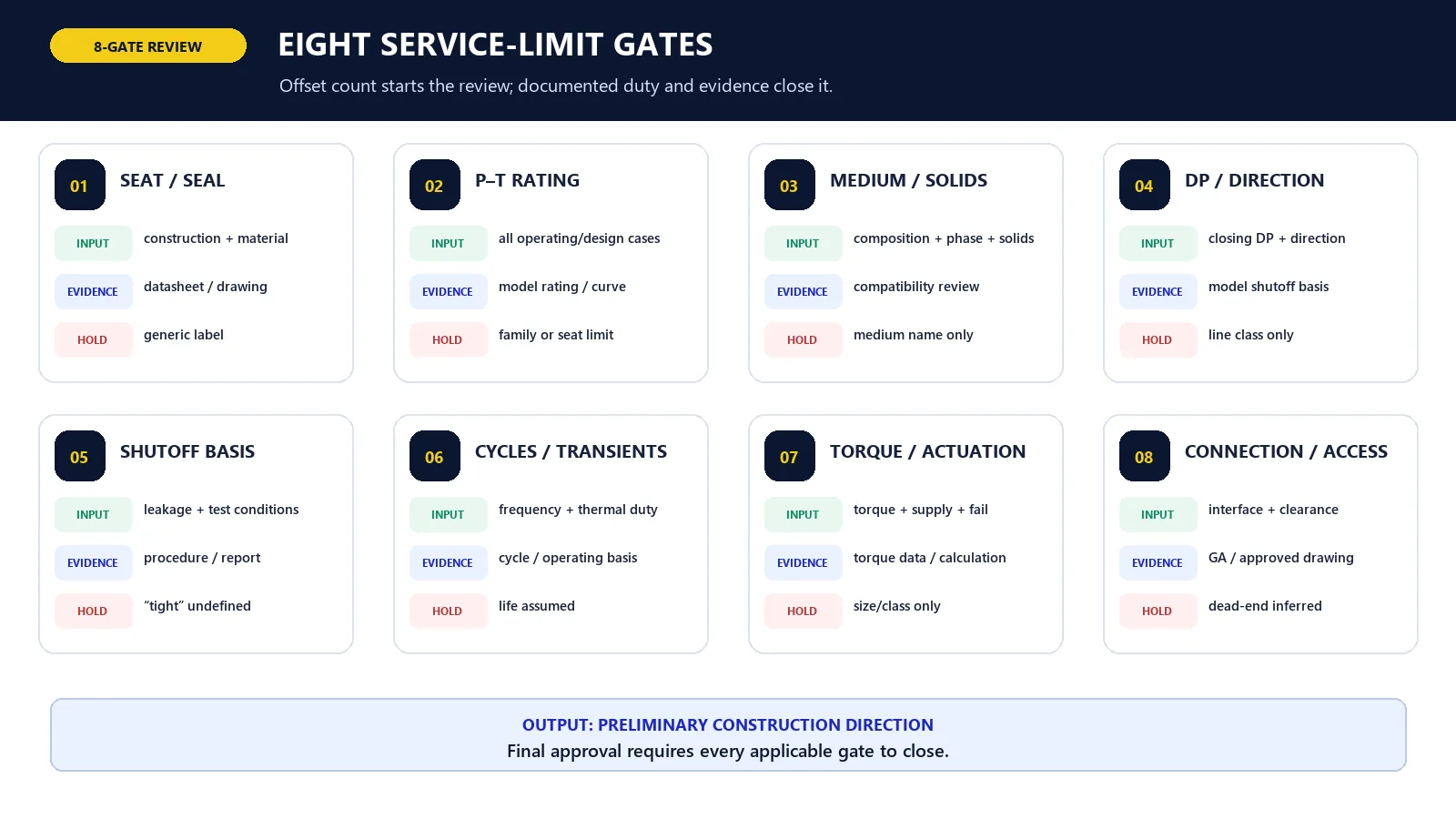
| بوابة | المدخلات المطلوبة | دليل المورد | Hold condition | Decision owner |
|---|---|---|---|---|
| Seat and seal construction | Exact component, grade/compound, arrangement and replaceability | Controlled datasheet, drawing or BOM description | Generic label only | Engineering / materials |
| تصنيف الضغط ودرجة الحرارة | Model, size, pressure designation, body and seat configuration | Applicable rating table or controlled datasheet | Family range or seat-only limit | الهندسة |
| Medium and solids | Composition, concentration, phase, contaminants, solids and velocity where relevant | Compatibility review and defined material system | Medium named without composition or risk review | Process / materials |
| Differential pressure and direction | Maximum closing differential pressure and required directionality | Model-specific shutoff direction and rating | Line class used as a substitute for closing duty | Piping / mechanical |
| Shutoff acceptance | Leakage criterion, test medium, pressure, direction and duration | Approved procedure and test record | “Tight shutoff” without an acceptance basis | Engineering / quality |
| Cycling and transients | Frequency, expected cycles, dwell and thermal changes | Cycle basis, operating limitations and maintenance plan | Life assumed from valve type | Reliability / operations |
| عزم الدوران والتشغيل | Valve torque cases, supply, fail action, time and accessories | Torque data and actuator calculation | Actuator selected from size alone | Mechanical / controls |
| Connection and installation | Wafer/lug/flanged interface, mating flange, face-to-face, clearance and access | Approved general arrangement and interface data | Disc clearance, dead-end rating or access unresolved | Piping / layout |
Seat and seal construction
Resilient, PTFE-based, laminated-metal and solid-metal routes behave differently, but the category name is only the start. Record the actual component, material designation, construction, backing or retainer, hardfacing or coating, and replacement method where relevant. The sealing system then has to be reviewed against pressure, temperature, medium, solids, cycling and leakage requirements.
Complete pressure-temperature rating
Do not combine the body pressure class with a temperature value from a separate seat-material chart and call it the valve rating. The approved boundary must apply to the exact model, size, pressure designation, material construction and seat/seal configuration. A lower-rated seat or directional sealing arrangement may control the usable boundary even when the body has a broader rating.
This article intentionally gives no universal numerical limits for the three offset families. Product-specific values may be published only when they are traceable to controlled data for the exact entity and configuration.
Medium, phase, composition and solids
A material name is not a compatibility guarantee. The review may need to consider corrosion, swelling, permeation, erosion, deposition, galling, contamination or cleaning exposure. These are possible mechanisms to evaluate—not predicted failures. The responsible reviewer needs composition, concentration, phase, temperature, pressure and solids information before approving the material and seat system.
Differential pressure and flow direction
Pipeline pressure designation and closing differential pressure are different inputs. The valve and actuator must be assessed for the actual differential pressure at the relevant operating cases. If bidirectional shutoff is required, the buyer should state the pressure direction and acceptance basis explicitly. Do not infer bidirectional capability from offset count or body style.
Shutoff and leakage acceptance
Terms such as “tight shutoff,” “bubble tight” and “zero leakage” are not complete specifications. A review needs the governing standard or project criterion, test medium, test pressure, pressure direction, duration, allowable leakage and required record or witness point. Soft seating does not prove one leakage rate, and metal seating does not prove another.
Cycle duty and thermal transients
Operating frequency, expected cycle count, dwell time and the rate and magnitude of temperature change can affect the seat system, bearing loads, packing, sealing contact and actuator requirement. Without a defined duty and supporting evidence, neither longer seat life nor a maintenance interval should be promised.
Torque, actuation and fail action
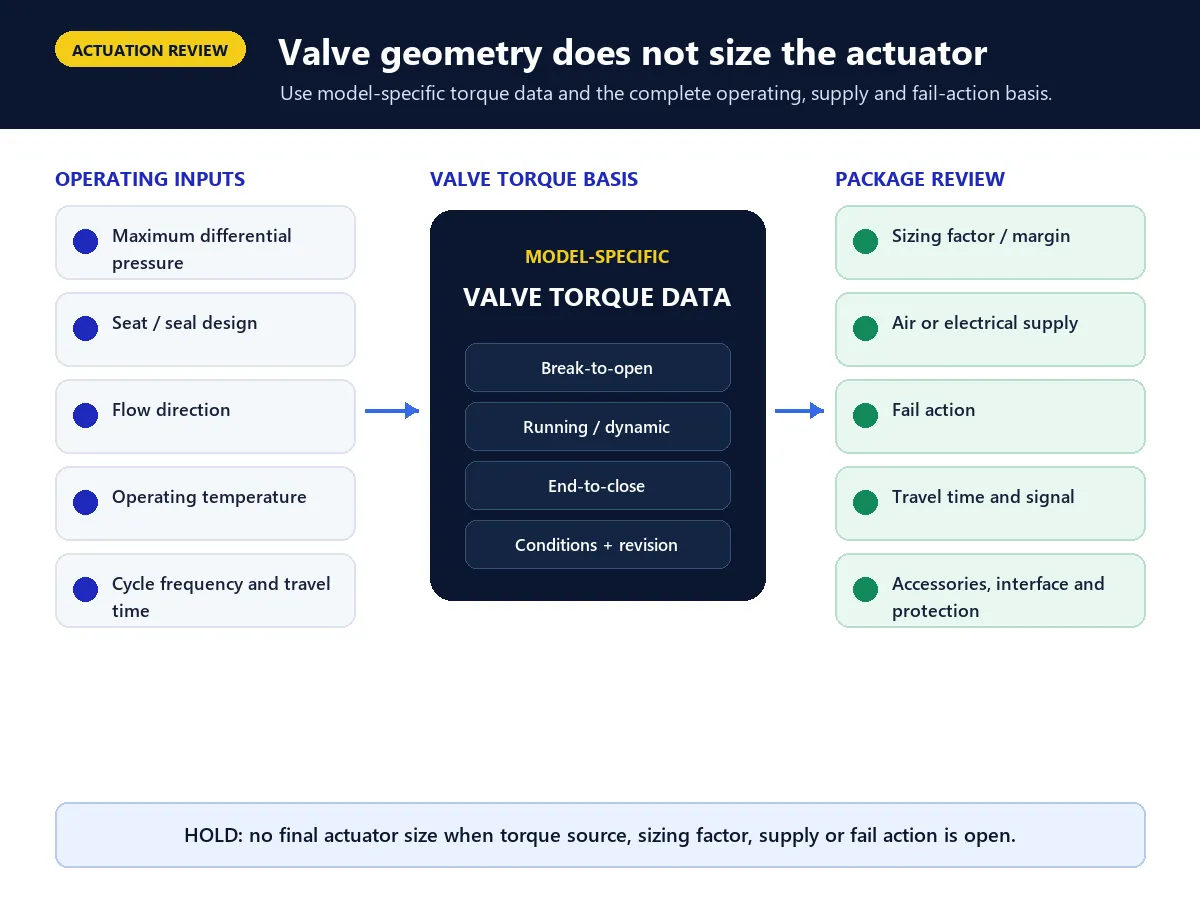
The actuator review may require breakaway, running, dynamic, seating and unseating torque under defined pressure and temperature cases. It also needs the actuator type, available air pressure or electrical supply, sizing factor, fail action, travel time, control signal, duty cycle, enclosure requirement, accessories and mounting interface. If torque or fail action remains open, the package is not ready for approval.
Connection, installation and maintenance
Confirm the wafer, lug or flanged interface; mating flange and bore; face-to-face requirement; disc clearance; orientation; actuator envelope; and access for removal or seat service. A lug body does not by itself establish a dead-end-service rating. That capability needs an exact pressure, direction and product-evidence basis.
Failure Risks to Close Before Approval
The table below identifies review mechanisms, not predicted failures. Use it to turn a broad service description into specific supplier questions and project hold points.
| Risk mechanism | Inputs that can change the risk | Verification needed | Keep the decision open when |
|---|---|---|---|
| Seat damage or leakage drift | Seat interference, medium compatibility, solids, temperature, cycling and closing load | Exact seat construction, complete rating, duty basis and leakage acceptance | The seat is identified only by a generic material name |
| Unexpected operating torque or actuator stall | Differential pressure, direction, packing friction, deposits, temperature, supply and fail action | Model-specific torque cases plus actuator sizing calculation and minimum supply | Only nominal size, class or one unexplained torque value is available |
| Metal sealing-surface damage, galling or erosion | Material pairing, surface treatment, alignment, solids, velocity, deposits and thermal distortion | Drawing/material definition and the applicable design, cycle or service review | “Metal seated” is the only construction evidence |
| Disc, gasket or mating-flange interference | Body style, flange bore, gasket inside diameter, disc envelope and installation orientation | Approved GA/section drawing and mating-interface check | Disc clearance or face-to-face data are missing |
| Directional shutoff or dead-end overload | Pressure direction, one-sided loading, support condition and required leakage result | Exact directional/dead-end rating and matching test basis | Capability is inferred from lug construction or offset count |
| Stem/packing external-leakage risk | Pressure, temperature, cycles, stem loads and any emissions requirement | Packing construction, operating boundary and applicable test/qualification evidence | A special emissions requirement is stated without its acceptance scope |
Side-by-Side Engineering Comparison
The following table compares review logic, not guaranteed performance.
| عامل المراجعة | Concentric | إزاحة مزدوجة | إزاحة ثلاثية |
|---|---|---|---|
| الهندسة | Shaft/disc arranged around the valve centerline | Two positional offsets modify the disc path | Two positional offsets plus angular/conical sealing geometry |
| Seat contact during travel | Resilient-seat interference is normally integral to operation | Disc can lift away from the seat earlier | Sealing surfaces can remain separated until near closure |
| Common sealing routes | Resilient liner or seat | Resilient, PTFE-based or other engineered seat; some metallic routes | Laminated or other metallic sealing arrangements are common |
| التوجيه الأولي | Review when the documented resilient-seat system covers the full duty | Review when reduced rubbing and the selected seat system match the duty | Review when documented metal-seated/reduced-contact isolation matches the duty |
| Pressure-temperature approval | Exact valve and seat configuration required | Exact valve and seat configuration required | Exact valve, seal ring and material system required |
| Directionality | Must be documented | Must be documented | Must be documented |
| Shutoff evidence | Test criterion and conditions required | Test criterion and conditions required | Test criterion and conditions required |
| Cycling/transients | Check seat deformation, friction and duty | Check seat behavior, interference and torque across the duty | Check sealing contact, thermal effects and torque across the duty |
| Actuator evidence | Model-specific torque and operating cases | Model-specific torque and operating cases | Model-specific torque and operating cases |
| Common specification error | Selecting by service name or seat material alone | Treating “high performance” as a complete specification | Treating geometry or metal seating as proof of qualification |
| Minimum approval document | Configuration-specific datasheet and test basis | Configuration-specific datasheet, torque and test basis | Configuration-specific datasheet/drawing, torque, test and any required qualification scope |
For a broader review of body styles, end connections, materials and operation, use the دليل اختيار صمام الفراشة. The present comparison intentionally stays focused on offset geometry and service-boundary evidence.
When Each Design Can Remain in Review
Concentric butterfly valve: preliminary fit and hold points
A concentric valve can remain in review when the exact resilient seat or liner and the complete valve rating cover the confirmed process duty. The medium and solids risk, closing differential pressure, shutoff basis, cycle duty, connection and torque requirement must all be addressed.
Place the proposal on hold when the seat identity is vague; pressure-temperature data are not configuration-specific; compatibility is assumed from EPDM, NBR or another material name; abrasion, deposition, vacuum or thermal cycling remains unresolved; or the required directionality and leakage result are unsupported. Special requirements such as fire qualification, cryogenic service or fugitive-emission performance require separate evidence.
Double-offset butterfly valve: preliminary fit and hold points
A double-offset valve can remain in review when reduced seat interference is useful for the operating profile and the exact seat construction, complete rating, shutoff direction and cycle basis are documented. This route may bridge duties for which a concentric configuration is not supported without automatically requiring a triple-offset design.
Place the proposal on hold when “high performance” replaces a construction description; a polymer or metal label is treated as a universal limit; bidirectional shutoff, dead-end duty, fire performance or leakage acceptance is not tied to the model; or actuator selection relies only on nominal size and pressure class.
Triple-offset butterfly valve: preliminary fit and hold points
A triple-offset valve can remain in review when the project needs a documented metal-seated or reduced-rubbing isolation route and the proposed seal-ring construction, materials, rating, leakage basis, directionality, cycling and torque data support the duty. The added geometry is useful only when the complete design and evidence close the requirement.
Place the proposal on hold when triple offset is presented as automatic proof of high-temperature suitability, zero leakage, fire safety, bidirectional performance, severe service or cryogenic qualification. Also hold the selection if thermal expansion, galling, erosion, deposition, solids or actuator margin have not been reviewed.
Seat-System Evidence Matters More Than the Valve Label
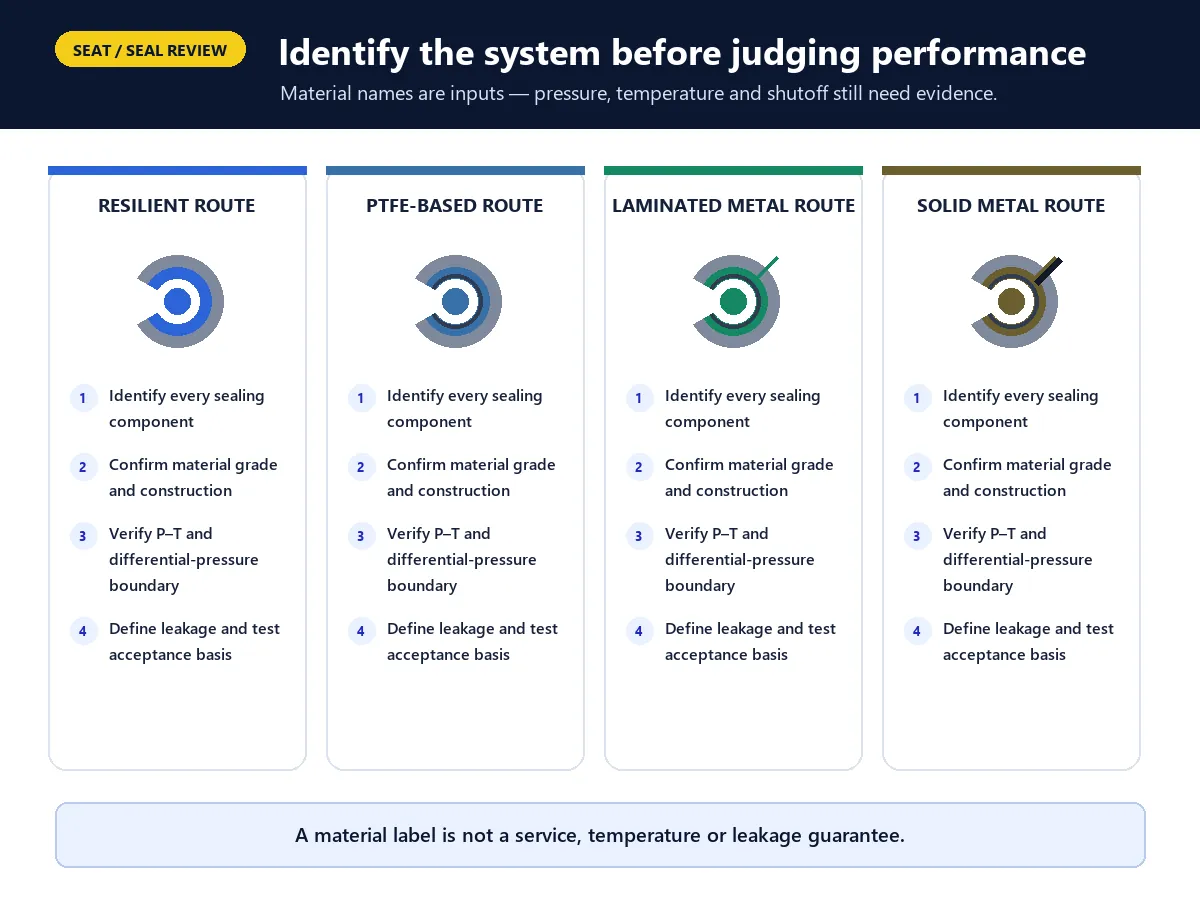
| Seat/seal route | Identity to record | Risks to review | الأدلة المطلوبة | Do not infer |
|---|---|---|---|---|
| Resilient | Component, compound/designation, construction and replacement method | Swelling, compression behavior, temperature, solids and cycling | Controlled configuration data, compatibility review, valve rating and test basis | Media suitability or leakage class from EPDM/NBR alone |
| PTFE-based | Exact grade or reinforcement, geometry, backing and retainer | Creep, cold flow, thermal expansion, chemical conditions and cycling | Configuration data and complete pressure-temperature boundary | Universal chemical or temperature suitability |
| Laminated metal | Layer materials, insert/filler, retainer and interfaces | Thermal cycling, erosion, replacement and directional behavior | Drawing/BOM, rating, test and qualification scope | Fire safety or zero leakage from “laminated metal” |
| Solid metal | Material pairing, hardfacing/coating, finish and contact geometry | Galling, corrosion, erosion, distortion and seating load | Controlled material/drawing data and leakage evidence | Tight shutoff from “metal seated” alone |
هو industrial butterfly valve range may show available design routes. It does not replace the tag-specific datasheet, material review or acceptance documents for the valve being purchased.
Standards and Tests: Keep the Scopes Separate
A standards list does not prove service suitability. Map every reference to the requirement it actually governs and confirm the project-approved edition.
| Requirement type | Potential reference | What it may support | ما لا تثبته | Required product/order evidence |
|---|---|---|---|---|
| Butterfly-valve product/design requirements | API 609 where specified and applicable | Product/design, material, dimensional, rating, examination and test requirements within its scope | That every Raymon butterfly valve conforms, is monogrammed or suits the process | Controlled design basis, exact configuration, applicable edition and any required certification scope |
| Pressure-boundary/design rating | ASME B16.34 where applicable | Pressure-temperature and construction requirements within its defined valve/material scope | Seat suitability, process compatibility or complete project acceptance | Applicable design/rating basis and configuration-specific data |
| Pressure and closure testing | ISO 5208 or the project-selected test basis | Pressure-boundary integrity and closure-tightness test requirements within scope | Product design suitability, fire qualification, emissions qualification or field service life | Approved procedure, acceptance criteria and product/order test record |
| Fire, emissions or special service | Applicable qualification or project document | A defined test or material/environment scope | Blanket family suitability | Valid report/certificate tied to the relevant design and project requirement |
هو API Standards Plan lists the 10th edition of API Standard 609, Butterfly Valves: Double-flanged, Lug- and Wafer-type, and Butt-welding Ends, dated May 18, 2026. That publication record is useful for edition control, but it is not evidence that a particular product complies. Confirm the edition named by the project and the exact applicable scope before purchasing.
The official ISO 5208 record identifies ISO 5208:2015, Industrial valves — Pressure testing of metallic valves, as current after confirmation in 2025. ISO explains that it addresses pressure-boundary integrity, closure tightness and structural adequacy of the closure mechanism, and that product-standard requirements can take precedence where they differ. It does not establish process compatibility or replace the valve product standard.
The official ASME B16.34 page lists B16.34-2025, Valves—Flanged, Threaded, and Welding End and describes pressure-temperature ratings, materials, dimensions, examination, testing and marking within its scope. Its applicability must still be confirmed for the selected valve and material construction.
Edition-status check: The linked issuer records were checked on September 6, 2026. They are reference sources only, not proof that a Raymon product complies, is certified or suits a particular service.
For more on keeping design, testing and qualification scopes separate, see the Valve Standards resource و Valve Pressure Testing guide.
Torque and Actuator Selection Cannot Be Derived from Offset Count
An offset design can change the torque profile, but it does not select the actuator. Ask the valve supplier for torque data tied to the exact model, size, seat construction, differential pressure, temperature, flow direction and operating case. The review may need breakaway, running, dynamic, seating and unseating values rather than one unlabeled number.
Then define the package inputs:
- actuator type and mounting/interface;
- available air pressure or electrical supply;
- sizing factor or margin required by the project;
- fail-open, fail-close, fail-in-place or other approved action;
- travel time and cycle frequency;
- on-off or modulating duty and control signal;
- solenoid, positioner, limit switches and other accessories;
- enclosure and environmental protection requirement.
An actuator shown in a photo or listed as available is not necessarily included or correctly sized. If valve torque, supply or fail action is open, the package decision must remain open.
إثبات المورد وتطبيع العطاء الفني
A technically responsive quotation should identify the evidence behind the proposed service boundary. Request at least:
- an approved datasheet for the exact configuration;
- a general arrangement drawing and applicable face-to-face/interface data;
- seat, liner or seal-ring construction details;
- the applicable pressure-temperature rating basis;
- material requirements and traceability scope;
- model-specific torque data and actuator calculation where applicable;
- pressure and closure test procedure and acceptance criteria;
- qualification reports where the purchase specification requires them;
- a document schedule and technical deviation register.
Normalize competing bids with one table instead of comparing catalog names.
| Requirement | Buyer basis | المورد أ | المورد ب | Deviation | Evidence reference | Status / owner |
|---|---|---|---|---|---|---|
| Offset geometry | Defined or supplier to propose | |||||
| Seat/seal construction | Component-level requirement | |||||
| Pressure-temperature boundary | Exact operating and design cases | |||||
| Differential pressure/direction | Maximum closing case and direction | |||||
| Leakage acceptance | Criterion and test conditions | |||||
| Torque/actuation | Operating cases, supply and fail action | |||||
| Tests/qualifications | Project scope and edition | |||||
| المستندات | Drawing, datasheet, records and certificates |
RFQ Checklist for Concentric, Double-Offset and Triple-Offset Valves
Before requesting a final selection, provide:
- valve function: isolation or a defined throttling duty;
- preferred geometry, or
supplier to propose with evidence; - DN/NPS and pressure designation;
- operating and design pressure;
- maximum closing differential pressure;
- medium, composition, concentration, phase and solids;
- operating and design temperature, including thermal cycling or transients;
- body, disc, shaft and seat/seal requirements;
- wafer, lug or flanged connection and mating interface;
- flow direction and any bidirectional shutoff requirement;
- leakage criterion, test medium, pressure and direction;
- operating frequency, expected cycles and fail action;
- manual, gear, pneumatic or electric operation;
- actuator supply, control signal, travel time and accessories;
- applicable design, test, inspection and qualification requirements;
- quantity, destination, project reference, documents and witness points.
If these fields are incomplete, record assumptions and open items rather than forcing a valve-type conclusion.
ملخص القرار
Concentric, double-offset and triple-offset butterfly valves are different construction routes, not three universal service ratings. Start with the seat or seal-ring system and complete pressure-temperature boundary. Then confirm the medium, differential pressure, flow direction, leakage acceptance, cycling, installation and torque cases. Finally, map each standard, test and qualification to the evidence it actually provides.
Choose the least complex construction that meets the documented duty—but do not approve any route until the datasheet, drawings, ratings, torque data, tests and deviations agree.
Request Butterfly Valve Service-Limit Review
Send enough information to compare the complete construction and evidence package—not only the offset label.
Minimum submission:
- medium/composition, phase and solids;
- operating/design pressure and temperature plus maximum closing differential pressure;
- DN/NPS, pressure designation, connection and mating interface;
- seat/seal preference or
supplier to propose with evidence; - leakage requirement, pressure direction, cycle duty and fail action;
- actuator type/supply and required test, inspection and document scope.
The review can identify missing inputs, compare proposed construction routes and establish a quotation basis. Final tag approval remains subject to the responsible project engineering and quality authorities and the exact product/order evidence.
أسئلة متكررة
Use these answers for preliminary screening; the exact offered construction and project requirements remain controlling.
Is a triple-offset butterfly valve always better than a double-offset or concentric valve?
No. The correct route depends on the complete duty, seat/seal construction, pressure-temperature rating, shutoff requirement, directionality, torque basis and evidence. Additional geometric complexity is useful only when it resolves a documented requirement.
What is the main limitation of a concentric butterfly valve?
There is no safe universal limit based only on the word “concentric.” The practical boundary is whether the exact resilient seat or liner and complete valve rating cover the medium, pressure, temperature, differential pressure, cycling and shutoff duty.
Does double offset automatically mean high performance?
No. “High performance” can be used differently across suppliers. Normalize the proposal to the exact geometry, seat construction, rating, pressure direction, test basis and torque data.
Is every triple-offset butterfly valve fire safe or zero leakage?
No. Fire performance and leakage acceptance are separate evidence-dependent claims. They cannot be inferred from triple-offset geometry or metal seating.
Can pressure class and temperature select the offset design?
Not by themselves. The decision also depends on the exact seat/seal system, medium, closing differential pressure, directionality, cycling, torque, connection, installation and documentation requirements.
What data are required to size a butterfly valve actuator?
Use model-specific valve torque for the relevant operating cases together with differential pressure, seat construction, temperature, cycle duty, supply, required margin, fail action, travel time, control mode, accessories and mounting details.
Can a lug butterfly valve be used for dead-end service?
Only when the exact configuration has a documented dead-end rating with the applicable pressure and direction basis. Lug geometry alone does not prove the capability.
Which standard defines a butterfly valve's service limit?
No single standard designation should be treated as complete approval. Product/design, pressure-rating, testing, connection, qualification and project-specification scopes must be mapped separately to the selected valve and order.
ملاحظة هندسية
This comparison is a preliminary screening framework, not a tag-specific sizing or approval calculation. Final valve selection depends on confirmed process data, the exact valve construction and rating, material compatibility, shutoff acceptance, actuator basis, applicable project documents and responsible engineering review. Prepared by the Raymon Valve Technical Content Team as an engineering decision aid; it does not replace the responsible project engineer's approval.
Engineering Assumptions / Limits
- No controlled family-wide numerical pressure, temperature, leakage or cycle-life limit was available for all three designs.
- Raymon product-registry data remain F2 public/configurable records and are not generalized into family performance claims.
- API 609, ASME B16.34 and ISO 5208 are cited at S0 reference level only; no Raymon product compliance or certification claim is made.
- Material and seat labels remain subject to medium, concentration, pressure, temperature, solids, cycling and project review.
- Fire, fugitive-emission, sour-service, cryogenic, severe-service, dead-end and directionality claims require configuration-specific evidence.
- No actuator size is proposed because model-specific torque, supply and fail-action data are not part of this editorial task.
