
Ball Valve Selection Guide: Types, Materials, End Connections, Seat Designs, and Industrial Applications
Ball valves are widely used in industrial piping systems because they provide reliable shut-off, fast quarter-turn operation, compact structure, and relatively low pressure drop when fully open. However, selecting a ball valve is not simply a matter of matching the nominal pipe size. A correct selection must consider pressure rating, temperature, fluid properties, sealing requirement, end connection, operation method, material compatibility, installation space, maintenance access, and applicable project standards.
In real projects, many ball valve failures are caused by incorrect selection rather than poor manufacturing. A soft seated floating ball valve may work reliably in clean water, compressed air, natural gas, or light oil service, but the same valve may fail quickly in high-temperature steam, abrasive slurry, catalyst fines, ash handling, or high-pressure large-diameter pipeline service. In those conditions, a trunnion mounted design, metal seated sealing system, special coating, or different body material may be required.
This engineering guide explains the main ball valve types, body materials, end connections, seat designs, operating methods, industrial applications, and selection mistakes that buyers should avoid. It is written for project engineers, maintenance teams, EPC contractors, distributors, and industrial buyers who need a practical method for selecting ball valves for real service conditions.
For Raymon Valve’s complete product range, you can also visit our industrial ball valves product category page.
1. What Is a Ball Valve?
A ball valve is a quarter-turn valve that uses a spherical closure element to start, stop, or isolate fluid flow. The ball has a bore through its center. When the bore is aligned with the pipeline, the valve is open. When the ball is rotated 90 degrees, the bore becomes perpendicular to the flow path, and the valve is closed.
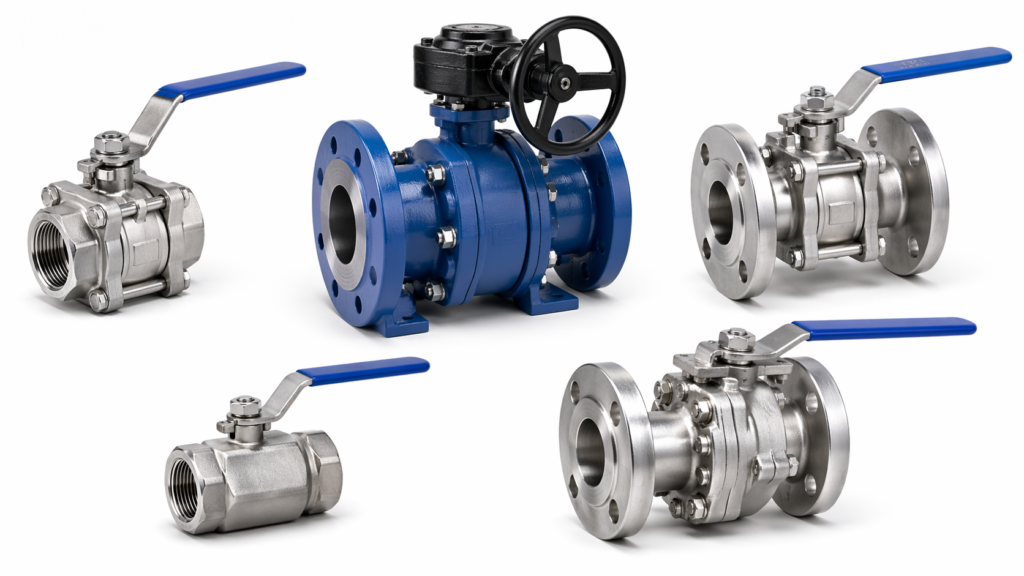
The main components of a ball valve usually include the valve body, ball, stem, seats, body seals, end connections, packing system, and operating device. Depending on the construction, the valve may be one-piece, two-piece, three-piece, floating ball, trunnion mounted, soft seated, or metal seated.
From an engineering point of view, the most important function of a ball valve is reliable isolation. A full port ball valve can provide a flow path close to the pipe bore, which helps reduce pressure drop. A reduced port ball valve is more compact and economical, but it creates a smaller flow area and may not be suitable where low pressure loss or pipeline pigging is required.
Ball valves are primarily used for on-off service. They can be used for limited throttling in some low-risk applications, but they are generally not recommended for continuous flow control. Long-term throttling can expose the seat edge to high-velocity flow, causing seat erosion, noise, vibration, and leakage. If accurate flow regulation is required, a control valve, globe valve, or characterized ball valve should be evaluated instead.
Engineering note: In maintenance practice, one common misunderstanding is treating every quarter-turn valve as suitable for throttling. A standard soft seated ball valve left half-open in a high differential pressure water line may develop seat wear and leakage within a short service period. The problem is not always the valve quality; it is often a mismatch between valve design and operating duty.
2. Why Ball Valve Selection Matters
Ball valves may look similar from the outside, but their internal design can be very different. A small threaded ball valve used for compressed air is not designed for the same duty as a large trunnion mounted ball valve used in a high-pressure pipeline. A PTFE soft seated valve for clean water is not equivalent to a metal seated valve for high-temperature abrasive media.
Proper ball valve selection affects:
- Shut-off performance
- Operating torque
- Seat life
- Pressure and temperature safety
- Corrosion resistance
- Maintenance cost
- Actuator sizing
- Pipeline reliability
- Total lifecycle cost
In engineering practice, the valve should be selected according to real service conditions, not only according to price or nominal pipe size. The most important selection factors include medium type, pressure rating, temperature range, pipe size, connection standard, leakage requirement, operation frequency, and whether the medium is clean, corrosive, viscous, abrasive, toxic, flammable, or high temperature.
Several international standards are often used to define ball valve requirements. For example, ISO 17292 specifies requirements for metal ball valves used in petroleum, petrochemical, natural gas plants, and related industrial applications. ASME B16.34 covers pressure-temperature ratings, dimensions, materials, testing, and marking requirements for flanged, threaded, and welding end valves, according to ASME-related standard records. API 608 is commonly referenced for metal ball valves with flanged, threaded, socket-welding, and butt-welding ends in petroleum, petrochemical, and industrial service.
Engineering example 1 — seat leakage after short service: A soft seated floating ball valve was installed in a line carrying liquid with fine solid particles. The valve passed the initial pressure test, but leakage appeared after repeated operation. Inspection showed scoring on the soft seat and ball surface. The cause was abrasive particles trapped between the ball and seat during closing. The prevention method is to review solid content, velocity, pressure drop, and operating frequency before selection. For abrasive service, a metal seated ball valve or hardened surface treatment should be considered.
3. Main Types of Ball Valves
Ball valves can be classified by structure, connection type, seat design, body construction, port design, and operating method. For industrial selection, the most important categories are floating ball valves, trunnion mounted ball valves, flanged ball valves, threaded ball valves, and metal seated ball valves.
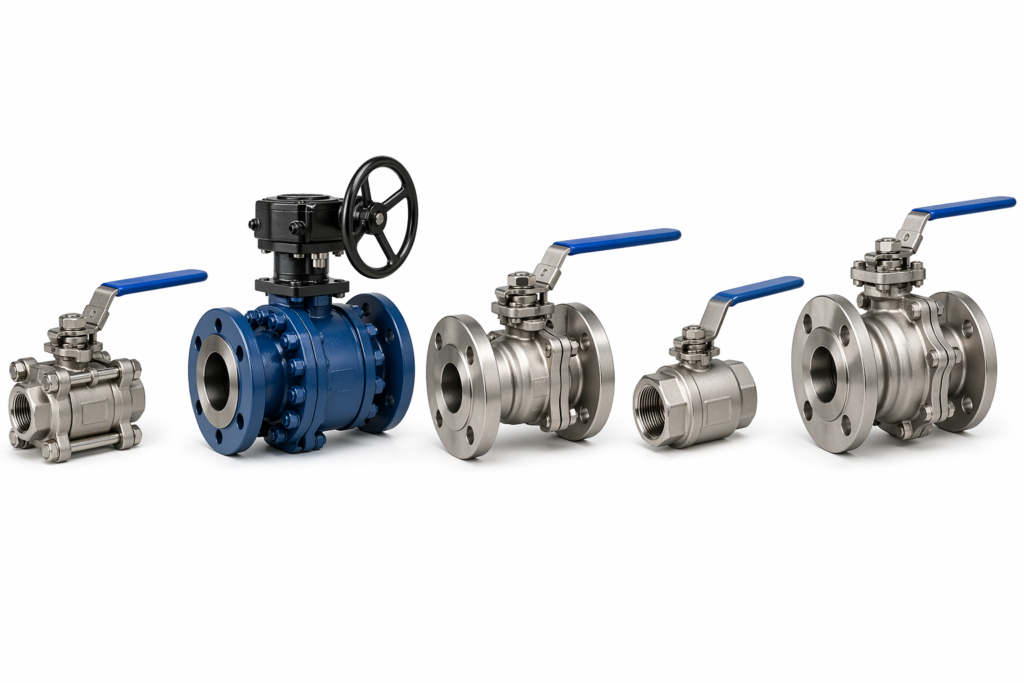
3.1 Floating Ball Valve
A floating ball valve uses a ball that is not fixed by a lower trunnion support. The ball is held in position by the valve seats. Under line pressure, the ball moves slightly downstream and presses against the downstream seat, creating tight sealing.
Floating ball valves are commonly used for small to medium sizes and low to medium pressure applications. They have a relatively simple structure, compact body, and good sealing performance for clean media. Typical services include water, air, gas, light oil, chemical utility lines, general industrial pipelines, and equipment-mounted systems.
The main advantages of floating ball valves include simple construction, reliable shut-off, economical cost, easy operation, and wide material availability. However, as valve size and pressure increase, the force acting on the ball also increases. This can increase seat load and operating torque. For large-diameter or high-pressure service, a trunnion mounted design is usually more suitable.
Floating ball valves are suitable when the application requires compact structure, reliable sealing, and moderate operating conditions. They are not usually the first choice for very large sizes, very high pressure, severe abrasive media, or frequent operation under high differential pressure.
Typical engineering range: Floating ball valves are commonly selected for small to medium bore sizes and clean on-off service. The actual pressure-temperature limit depends on body material, seat material, valve class, and applicable design standard. The seat rating may be lower than the shell rating, so both must be checked before ordering.
For product details, visit our Floating Ball Valve page.
3.2 Trunnion Mounted Ball Valve
A trunnion mounted ball valve uses additional mechanical support at the top and bottom of the ball. The ball is fixed by trunnions and does not float freely under pressure. The seats move toward the ball to provide sealing. This design reduces the load on the seats and lowers the operating torque, especially in large-diameter and high-pressure applications.
Trunnion mounted ball valves are commonly used in oil and gas pipelines, long-distance transmission lines, petrochemical plants, power plants, gas processing systems, and other heavy-duty industrial services. They are often selected for high-pressure classes, large bore sizes, and applications where stable operation and reliable sealing are required.
The main advantages of trunnion mounted ball valves include lower operating torque, better suitability for high-pressure service, improved stability in large sizes, and compatibility with gearboxes or actuators. Depending on project requirements, trunnion ball valves may also be designed with double block and bleed function, emergency sealant injection, anti-static design, fire-safe construction, and stem blowout prevention.
Compared with floating ball valves, trunnion mounted ball valves are generally more complex and more expensive. However, for large-size or high-pressure pipelines, the improved mechanical support and lower torque often make them the more reliable and practical choice.
Engineering example 2 — excessive operating torque: In one pipeline replacement case, a large-size floating ball valve was selected because it had a lower purchase cost than a trunnion mounted valve. During commissioning, the manual operation was difficult and the actuator sizing became larger than expected. The root cause was high seat load caused by line pressure acting on the floating ball. A trunnion mounted valve would have reduced seat load and operating torque. For high-pressure or large-bore service, torque calculation should be reviewed before final valve selection.
For large-diameter or high-pressure service, visit our Trunnion Mounted Ball Valve page.
3.3 Flanged Ball Valve
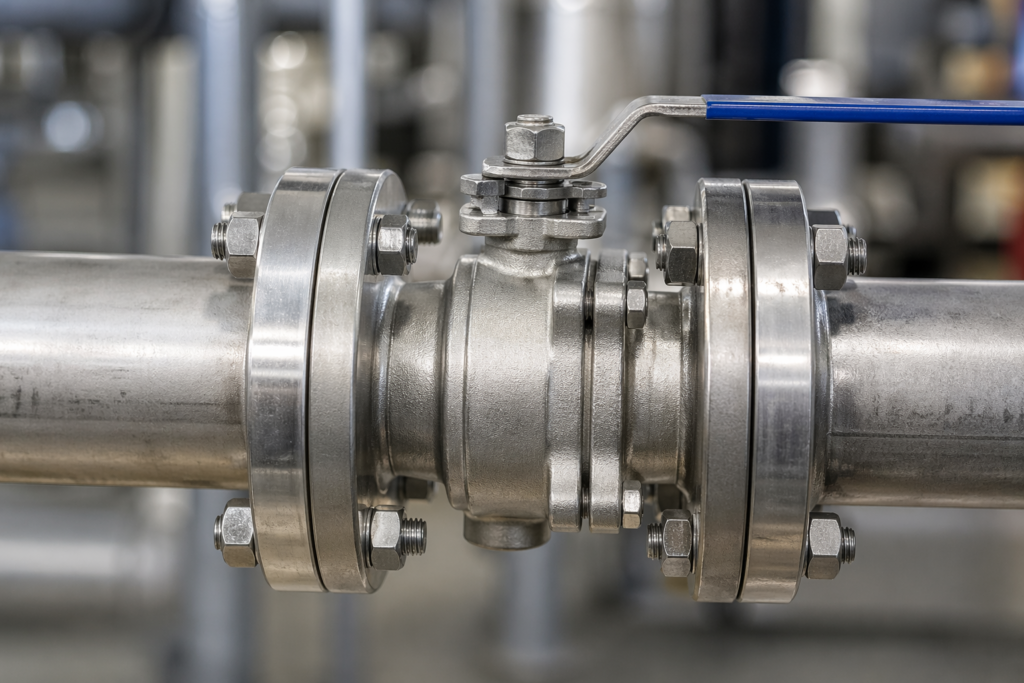
A flanged ball valve uses flanged ends to connect with pipeline flanges. The flange connection provides strong mechanical support, easy installation, and convenient removal for maintenance. Flanged ball valves are widely used in industrial piping systems where reliability, alignment, and serviceability are important.
Flanged ball valves are commonly used in water treatment, chemical processing, oil and gas, power generation, general industrial plants, and process pipelines. They are available in different pressure ratings and flange standards such as ASME, EN, DIN, JIS, and other project-specific requirements.
The main advantage of a flanged ball valve is that it can be installed and removed without cutting the pipeline. This is important for systems that require periodic inspection, repair, or replacement. Flanged connections are also preferred in larger sizes and higher-pressure systems compared with threaded connections.
When selecting a flanged ball valve, engineers should confirm flange standard, pressure class, face type, bolt hole pattern, gasket compatibility, valve face-to-face dimension, and body material. Incorrect flange matching can cause installation problems, leakage, or mechanical stress on the pipeline.
Installation check: Before tightening flange bolts, confirm that the pipe flanges are aligned and parallel. Do not use flange bolts to pull misaligned piping into position. This can introduce bending stress into the valve body and cause gasket leakage, seat distortion, or premature stem packing leakage.
For applications requiring stable pipeline connection and easy maintenance, visit our Flanged Ball Valve page.
3.4 Threaded Ball Valve
A threaded ball valve uses internal or external threads to connect with pipes or fittings. Threaded ball valves are usually used in small-size piping systems, equipment connections, compressed air systems, water lines, oil lines, gas service, and general utility applications.
Common thread standards include NPT, BSP, BSPT, and other regional or project-specific thread forms. The correct thread type must be confirmed before purchasing because different thread standards are not always interchangeable. Incorrect thread matching may cause leakage, poor engagement, thread damage, or unsafe installation.
Threaded ball valves are compact, easy to install, and cost-effective for small-size applications. They are especially suitable for equipment packages, skid systems, instrumentation lines, and maintenance-friendly utility pipelines.
However, threaded connections are generally not recommended for large pipe sizes, severe vibration, high mechanical load, or applications requiring frequent disassembly. For larger systems, flanged or welded connections may provide better mechanical strength and long-term reliability.
Engineering example 3 — thread leakage after installation: A threaded ball valve was installed on a utility line, but leakage occurred at the connection during the pressure test. The valve itself was not leaking through the seat. The problem was a mismatch between the pipe thread and the valve thread form, combined with excessive seal tape. The correction was to confirm the thread standard, clean the threads, apply the correct sealing compound, and retighten within proper limits. Threaded valves should never be forced if the thread engagement feels abnormal.
For compact small-bore applications, visit our Threaded Ball Valve page.
3.5 Metal Seated Ball Valve
A metal seated ball valve uses metal-to-metal sealing surfaces instead of soft polymer seats. The ball and seat surfaces are often hardened, coated, or specially treated to improve wear resistance, high-temperature performance, and service life under demanding conditions.
Metal seated ball valves are used where soft seated valves may fail due to high temperature, abrasive particles, erosion, thermal cycling, or severe media conditions. Typical applications include high-temperature service, steam, ash handling, slurry, catalyst service, mining, power plants, petrochemical processes, and other severe service applications.
The key advantage of a metal seated ball valve is its ability to withstand harsher conditions than conventional soft seated designs. It can provide better resistance to wear, deformation, and temperature damage. However, metal seated valves usually require higher operating torque and may have different leakage performance compared with soft seated valves, depending on design and sealing class.
When selecting a metal seated ball valve, engineers should confirm temperature range, hardness of sealing surfaces, coating method, media abrasiveness, pressure drop, operating frequency, leakage requirement, and actuator torque margin.
Engineering example 4 — soft seat deformation in high-temperature service: A soft seated ball valve was installed in a line where actual operating temperature exceeded the seat material limit during periodic thermal cycling. After several cycles, the valve showed increased operating torque and leakage. Inspection found seat deformation. The prevention method is to check both continuous operating temperature and possible upset temperature. For high-temperature or thermal cycling service, metal seated construction or a higher-temperature seat material should be evaluated.
For high-temperature, abrasive, or severe service conditions, visit our Metal Seated Ball Valve page.
4. Ball Valve End Connection Types
The end connection determines how the valve is installed into the piping system. It also affects maintenance, pressure capability, vibration resistance, leakage risk, installation cost, and replacement method.
4.1 Flanged End
Flanged ball valves are suitable for industrial pipelines that require strong connection and easy removal. They are widely used in medium and large pipe sizes. Flanged ends are preferred when the valve may need to be inspected, repaired, or replaced during the service life of the system.
Important flange selection factors include pressure class, flange standard, sealing face, gasket type, bolt material, bolt tightening sequence, and face-to-face dimension. In international projects, flange standard confirmation is especially important because ASME, EN, DIN, and JIS systems may have different dimensions and drilling patterns.
Common flange face types include raised face, flat face, and ring type joint. Raised face flanges are widely used in many industrial systems. Flat face flanges are often used with certain cast iron or ductile iron components to reduce bending stress. Ring type joint flanges are used in higher-pressure or more critical applications where a metal ring gasket is required.
4.2 Threaded End
Threaded end ball valves are mainly used for small-size pipelines and equipment connections. They are easy to install and do not require flanges or welding. They are commonly found in compressed air, water, oil, gas, and general industrial systems.
However, threaded connections have limitations. They are less suitable for large sizes, heavy pipe loads, strong vibration, or systems where repeated disassembly may damage the threads. For demanding industrial service, threaded connections should be selected carefully.
For small-bore threaded valves, the installation quality is as important as the valve itself. Incorrect sealing tape application, over-tightening, poor thread engagement, or mixed thread standards can all cause leakage.
4.3 Welded End
Welded ball valves provide a permanent and leak-resistant connection. They are often used in high-pressure, high-temperature, underground, or critical pipeline systems where external leakage must be minimized. Welded ends can include socket weld or butt weld designs.
The main disadvantage of welded valves is that removal and replacement are more difficult compared with flanged valves. Welding procedures, material compatibility, heat treatment, and inspection requirements must also be considered.
When welded end valves are used, the buyer should confirm whether the valve can tolerate welding heat during installation or whether special installation procedures are required to protect seats and seals.
4.4 Clamp or Special Connections
Some industries may require clamp, sanitary, union, or special connection designs. These are usually selected according to the process system, cleaning requirement, installation space, or industry standard. For example, sanitary ball valves are used in food, beverage, pharmaceutical, and clean process systems.
Special connections should always be checked against the mating pipework or equipment connection. Even small dimensional differences can create installation problems, gasket compression issues, or leakage paths.
5. Ball Valve Body Materials
Body material selection depends on pressure, temperature, corrosion resistance, media compatibility, and project standard. The valve body must have sufficient mechanical strength and chemical resistance for the service environment.
5.1 Carbon Steel
Carbon steel ball valves are commonly used in oil, gas, steam, water, and general industrial service where corrosion is not severe. Carbon steel provides good mechanical strength and is suitable for many pressure and temperature conditions.
However, carbon steel may require coating, painting, or corrosion allowance when used in humid, outdoor, or mildly corrosive environments. It is not suitable for many aggressive chemical services unless properly protected or specified according to the application.
Typical carbon steel valve materials may include ASTM A216 WCB for cast valves or ASTM A105 for forged components, depending on the valve design and standard. The final material selection should match the project specification, pressure-temperature rating, and corrosion condition.
5.2 Stainless Steel
Stainless steel ball valves provide better corrosion resistance than carbon steel and are widely used in chemical processing, water treatment, marine environments, food processing, and corrosive media. Common stainless steel grades include CF8, CF8M, SS304, and SS316 depending on casting or forging standards.
Stainless steel is often preferred when the medium contains moisture, mild chemicals, or corrosive components. SS316 or CF8M is usually selected where improved resistance to chloride or chemical corrosion is required. However, stainless steel is not automatically suitable for every chemical. Concentration, temperature, chloride content, pH value, and oxygen level can all affect corrosion behavior.
5.3 Ductile Iron
Ductile iron ball valves may be used in water, HVAC, and general utility systems where pressure and temperature conditions are moderate. Ductile iron provides better strength and toughness than gray cast iron and is often used with protective coatings.
For corrosive, high-temperature, or critical industrial service, ductile iron may not be the best choice unless the working conditions are clearly within its limits. In flange systems, flat face requirements and gasket selection should also be checked carefully when ductile iron components are used.
5.4 Alloy Steel
Alloy steel ball valves are used for high-temperature, high-pressure, or special process conditions. They may be required in power plants, refining, petrochemical, or severe thermal service. Material selection should follow the project specification and applicable pressure-temperature rating requirements.
Alloy materials should not be selected only because they appear stronger. The correct alloy depends on temperature, corrosion mechanism, pressure class, welding requirement, and compatibility with the process fluid.
6. Ball Valve Seat Materials and Sealing Designs
The seat is one of the most important parts of a ball valve because it directly affects sealing performance, torque, temperature limit, chemical compatibility, and service life.
6.1 PTFE Seat
PTFE is widely used for soft seated ball valves because it provides good chemical resistance and low friction. It is suitable for many clean fluids, gases, oils, and chemical media within its temperature and pressure limits.
The limitation of PTFE is that it can deform under high load or high temperature. Therefore, the valve pressure-temperature chart should be reviewed before selection. The allowable pressure may decrease as temperature increases.
6.2 RPTFE Seat
Reinforced PTFE provides better mechanical strength and improved resistance to deformation compared with virgin PTFE. It is often used where slightly higher pressure or better seat stability is required.
RPTFE is still a soft seat material, so it should not be treated as a replacement for metal seats in abrasive or very high-temperature applications.
6.3 PEEK Seat
PEEK is used in more demanding applications where higher temperature resistance and mechanical strength are required. It is more expensive than PTFE but can provide better performance under certain high-pressure or high-temperature conditions.
PEEK may be selected for special chemical, high-pressure gas, or higher-temperature applications, but compatibility should still be checked against the actual medium.
6.4 Metal Seat
Metal seats are used for severe service applications involving high temperature, abrasive particles, erosion, or thermal cycling. Metal seated valves require precise machining, surface hardening, and careful torque evaluation.
The correct seat material should be selected according to media type, temperature, pressure, leakage requirement, and operating frequency. A soft seat may provide excellent tight shut-off in clean service, but it can be damaged quickly by abrasive solids or excessive temperature.
For metal seated valves, the sealing surfaces may use hardfacing, coating, or surface treatment. Common considerations include hardness difference between ball and seat, coating thickness, thermal expansion, and resistance to galling.
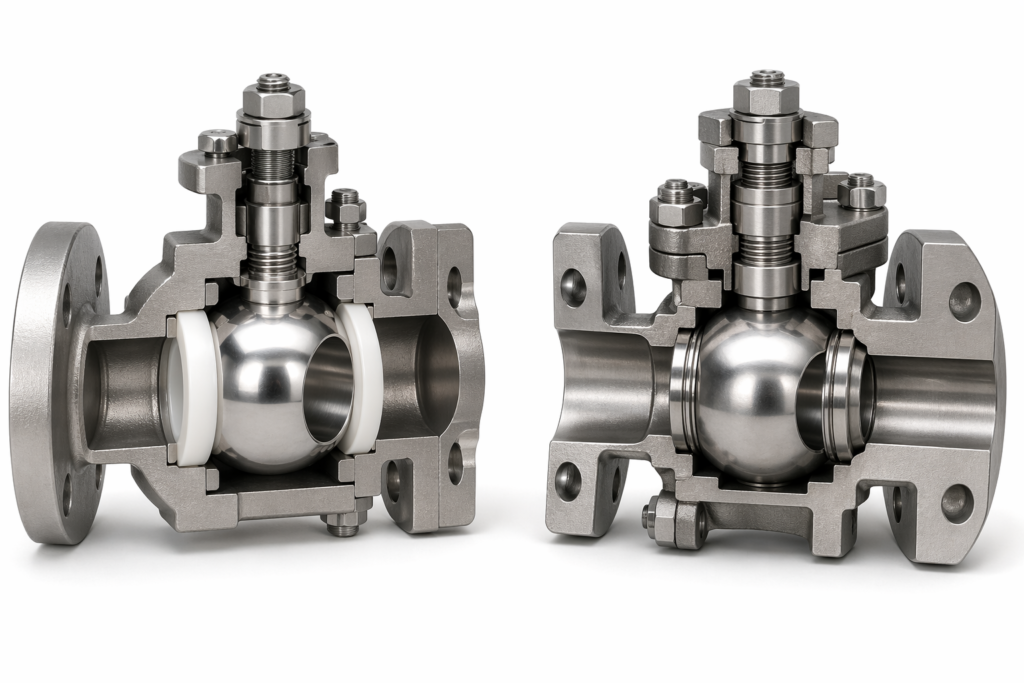
7. Soft Seated vs Metal Seated Ball Valves
| Selection Factor | Soft Seated Ball Valve | Metal Seated Ball Valve |
|---|---|---|
| Sealing Material | PTFE, RPTFE, PEEK, elastomer, or polymer seat | Metal-to-metal sealing surface |
| Best For | Clean liquid, gas, oil, water, and general service | High temperature, abrasive media, slurry, severe service |
| Temperature Resistance | Limited by soft seat material | Better for high-temperature conditions |
| Operating Torque | Usually lower | Usually higher |
| Shut-off Performance | Excellent tight shut-off for clean media | Depends on sealing class and surface treatment |
| Wear Resistance | Limited in abrasive service | Better resistance to wear and erosion |
| Cost | Generally more economical | Higher initial cost, but better for severe service |
The choice between soft seated and metal seated ball valves should be based on the real working conditions. For clean water, gas, and general industrial fluids, a soft seated ball valve is often the most practical solution. For high temperature, particles, abrasion, or severe service, a metal seated ball valve is usually more appropriate.
Practical selection rule: If the medium is clean and the temperature is within the seat material limit, soft seated design is usually preferred for tight shut-off and lower torque. If the medium contains hard particles, the temperature exceeds the safe range of polymer seats, or the valve sees frequent cycling under severe conditions, metal seated construction should be reviewed.
8. Full Port vs Reduced Port Ball Valves
Ball valves can also be classified by port design. A full port ball valve has a bore size close to the pipeline internal diameter. This design provides lower flow resistance and is suitable for applications where pressure drop must be minimized or where pigging may be required.
A reduced port ball valve has a smaller bore than the pipeline. It is usually more compact and economical, but it creates higher pressure drop. Reduced port valves may be acceptable for utility systems or applications where flow loss is not critical.
When selecting between full port and reduced port, engineers should consider flow rate, pressure drop, cleaning requirements, pigging requirements, and cost. For main process lines, full port is often preferred. For auxiliary systems, reduced port may be acceptable.
| Port Type | Engineering Advantage | Limitation | Typical Use |
|---|---|---|---|
| Full Port | Lower pressure drop and easier pigging | Larger size and higher cost | Main process lines, pipelines, high-flow systems |
| Reduced Port | Compact and economical | Higher flow resistance | Utility lines, auxiliary systems, non-critical service |
9. Ball Valve Operation Methods
The operation method affects usability, safety, automation, and maintenance. Ball valves can be operated manually or with actuators.
9.1 Lever Operated Ball Valve
Lever operation is common for small-size ball valves. It provides quick manual operation and simple position indication. However, as valve size and pressure increase, operating torque may become too high for direct lever operation.
Lever valves should be installed where operators have enough clearance to open and close the valve safely. The lever should not interfere with adjacent pipes, insulation, walls, or equipment.
9.2 Gear Operated Ball Valve
Gear operation is used for larger valves or valves with higher torque. A gearbox reduces manual operating effort and allows smoother opening and closing. Gear operation is common for large flanged and trunnion mounted ball valves.
Gear operators are also useful where sudden opening or closing should be avoided. In larger pipelines, controlled operation can help reduce mechanical shock and water hammer risk.
9.3 Pneumatic Actuated Ball Valve
Pneumatic actuators are used for automated on-off control where compressed air is available. They are common in process plants, chemical systems, water treatment, and industrial automation.
When selecting a pneumatic actuator, the available air supply pressure, fail-safe position, solenoid valve, limit switch, position feedback, and site hazardous area requirements should be reviewed.
9.4 Electric Actuated Ball Valve
Electric actuators are used where electrical control is preferred or compressed air is not available. They are suitable for remote operation, process automation, and systems requiring controlled opening and closing.
When selecting an actuator, the valve torque must be calculated with sufficient safety margin. Media condition, pressure differential, seat type, frequency of operation, and temperature can all affect torque requirements.
Actuator sizing note: Metal seated valves, high-pressure valves, dirty service valves, and valves that remain in one position for a long time may require a higher torque safety factor than clean-service soft seated valves. Always confirm breakaway torque, running torque, and maximum differential pressure before actuator selection.
10. Key Standards and Specifications to Confirm
Industrial ball valves are often manufactured and tested according to international standards. The applicable standard depends on valve type, industry, pressure class, material, and project requirement.
Commonly referenced standards may include:
- API 608 for metal ball valves in petroleum, petrochemical, and industrial applications
- ISO 17292 for metal ball valves used in petroleum, petrochemical, natural gas plants, and related industrial applications
- ASME B16.34 for pressure-temperature ratings, dimensions, materials, testing, and marking of flanged, threaded, and welding end valves
- ASME B16.5 for pipe flanges and flanged fittings
- ASME B16.10 for face-to-face and end-to-end dimensions
- API 607 or ISO 10497 for fire-safe testing where required
- ISO 5211 for actuator mounting interface
Before purchasing, the buyer should confirm the required design standard, pressure class, inspection standard, material certificate, test requirement, flange standard, and any special project documentation.
Specification checklist: A complete ball valve inquiry should include valve size, pressure class, body material, trim material, seat material, end connection, bore type, operation method, design standard, test standard, medium, operating pressure, operating temperature, and any special requirements such as fire-safe design, anti-static device, NACE compliance, or fugitive emission control.
11. Industrial Applications of Ball Valves
Ball valves are used across many industries because they provide reliable shut-off and simple operation. However, the correct valve type varies by application.
11.1 Oil and Gas
Oil and gas systems often require high-pressure performance, reliable shut-off, fire-safe design, and compatibility with hydrocarbons. Trunnion mounted ball valves are commonly used for pipelines and high-pressure systems, while floating ball valves may be used for smaller process lines.
For flammable media, fire-safe requirements, anti-static construction, stem sealing, and emergency sealing options should be reviewed according to the project specification.
11.2 Chemical Processing
Chemical applications require careful material and seat selection. Stainless steel, alloy materials, PTFE seats, or special sealing materials may be required depending on the chemical composition, concentration, and temperature.
The same chemical name can behave differently at different concentrations and temperatures. A material that performs well at ambient temperature may not be suitable at elevated temperature. Chemical compatibility should therefore be checked against the exact process condition.
11.3 Water Treatment
Water treatment systems commonly use floating ball valves, flanged ball valves, and threaded ball valves depending on size and installation requirement. Corrosion protection and seat compatibility should be considered, especially in treated water or chemical dosing systems.
For larger water systems, flange alignment, gasket selection, and maintenance access are important because valves may remain in service for long periods before operation.
11.4 Power Generation
Power plants may require valves for steam, cooling water, fuel systems, ash handling, and auxiliary services. High-temperature and abrasive conditions may require metal seated ball valves or special materials.
In steam or high-temperature service, seat material limits, body material rating, thermal expansion, and packing performance should be checked carefully.
11.5 Mining and Abrasive Service
Mining and slurry systems may expose valves to particles, abrasion, erosion, and severe operating conditions. Standard soft seated valves may have limited service life in these conditions. Metal seated or specially coated valves are often required.
Velocity, particle hardness, solid concentration, and operating frequency all affect service life. In abrasive service, a valve that performs well in static pressure testing may still fail early if the sealing surfaces are not designed for particle exposure.
11.6 General Industrial Pipelines
For general industrial systems such as compressed air, water, oil, gas, and utility lines, floating ball valves, threaded ball valves, and flanged ball valves are commonly selected according to pipe size and pressure rating.
General service does not mean selection can be careless. Even for utility lines, the buyer should confirm pressure, temperature, thread type, flange standard, seal material, and operation frequency.
12. How to Choose the Right Ball Valve
A practical ball valve selection process should follow engineering logic. The following steps can help reduce selection errors.
Step 1: Confirm the Medium
Identify whether the medium is water, air, gas, oil, steam, chemical, slurry, powder, or another fluid. Also confirm whether the medium is clean, corrosive, viscous, crystallizing, abrasive, toxic, flammable, or high temperature.
Step 2: Confirm Pressure and Temperature
Check the maximum operating pressure and temperature, not only the normal working condition. The selected valve must meet the pressure-temperature rating with suitable body and seat materials.
Step 3: Confirm Valve Size and Port Requirement
Confirm nominal pipe size, required flow capacity, and whether full port or reduced port design is acceptable. Full port design is preferred where low pressure drop or pipeline pigging is required.
Step 4: Select the Correct Ball Valve Type
For small to medium clean service, a floating ball valve may be suitable. For high-pressure or large-diameter service, a trunnion mounted ball valve is often better. For severe high-temperature or abrasive service, a metal seated ball valve may be required.
Step 5: Select the End Connection
Choose flanged, threaded, welded, or special connections according to pipeline design, pressure rating, size, maintenance requirement, and project standard.
Step 6: Select Body and Seat Materials
Confirm corrosion resistance, mechanical strength, temperature resistance, and chemical compatibility. Body and seat materials must be suitable for both normal and upset conditions.
Step 7: Confirm Operation Method
Select lever, gearbox, pneumatic actuator, or electric actuator according to valve size, torque, location, automation requirement, and safety considerations.
Step 8: Confirm Standards and Testing
Confirm the required valve design standard, pressure test, leakage test, fire-safe requirement, material certificate, and inspection documentation before placing an order.
| Service Condition | Recommended Valve Direction | Key Checks Before Ordering |
|---|---|---|
| Clean water, air, light oil, general service | Soft seated floating ball valve | Seat material, pressure class, connection type |
| Large-diameter or high-pressure pipeline | Trunnion mounted ball valve | Torque, bore type, double block and bleed requirement |
| Small-bore equipment connection | Threaded ball valve | NPT/BSP thread type, sealing method, installation torque |
| Industrial pipeline requiring maintenance access | Flanged ball valve | Flange standard, gasket, bolt pattern, face-to-face dimension |
| High temperature or abrasive media | Metal seated ball valve | Seat hardening, leakage class, actuator torque margin |
13. Common Ball Valve Selection Mistakes
Many valve problems are caused by incorrect selection rather than manufacturing defects. Common mistakes include:
- Selecting only by pipe size without checking pressure and temperature
- Using soft seated valves in abrasive or high-temperature service
- Using floating ball valves for large-size high-pressure applications where trunnion design is more suitable
- Ignoring thread standard differences such as NPT and BSP
- Selecting the wrong flange standard or pressure class
- Forgetting to check actuator torque requirements
- Using reduced port valves where full port flow is required
- Ignoring corrosion compatibility between valve material and medium
- Not confirming fire-safe or anti-static requirements for flammable service
- Choosing based only on initial price instead of lifecycle cost
A well-selected ball valve should match the real working condition, not only the purchase specification. When the service is severe, it is better to review the application carefully before ordering.
Field inspection tip: If a ball valve leaks after installation, do not immediately assume internal seat failure. First identify whether the leakage is through the bore, from the stem packing, from the body joint, or from the pipe connection. The troubleshooting direction is different for each leakage location.
14. Ball Valve Selection Summary
Ball valves are reliable and versatile shut-off valves, but different designs serve different working conditions. A floating ball valve is suitable for compact, economical, small to medium clean service. A trunnion mounted ball valve is better for large-diameter, high-pressure, and heavy-duty pipeline applications. A flanged ball valve provides strong pipeline connection and easy maintenance. A threaded ball valve is practical for small-size equipment and utility systems. A metal seated ball valve is designed for high-temperature, abrasive, and severe service conditions.
The correct selection should consider valve structure, material, seat design, pressure rating, temperature range, end connection, operation method, and industry standard. For project engineers and buyers, the goal is not only to purchase a valve that fits the pipeline, but to select a valve that can operate safely and reliably throughout its service life.
If you are selecting ball valves for an industrial project, Raymon Valve can provide product options for floating ball valves, trunnion mounted ball valves, flanged ball valves, threaded ball valves, and metal seated ball valves according to your pressure, temperature, material, and application requirements.
FAQ: Ball Valve Selection
1. What is the difference between a floating ball valve and a trunnion mounted ball valve?
A floating ball valve uses line pressure to push the ball against the downstream seat for sealing. It is commonly used for small to medium sizes and moderate pressure. A trunnion mounted ball valve has mechanical support at the top and bottom of the ball, which reduces seat load and operating torque. It is more suitable for large-size and high-pressure applications.
2. When should I use a metal seated ball valve?
A metal seated ball valve should be considered when the service involves high temperature, abrasive particles, erosion, slurry, thermal cycling, or severe media conditions where soft seats may fail prematurely. The buyer should confirm temperature range, particle content, leakage requirement, surface hardening method, and actuator torque before ordering.
3. Are flanged ball valves better than threaded ball valves?
Flanged ball valves are generally better for larger sizes, higher pressure, and industrial pipelines requiring easy maintenance. Threaded ball valves are more suitable for small-size equipment connections, utility lines, and compact piping systems. The better choice depends on pipe size, pressure class, maintenance method, vibration level, and installation standard.
4. What materials are commonly used for ball valves?
Common ball valve body materials include carbon steel, stainless steel, ductile iron, and alloy steel. Seat materials may include PTFE, RPTFE, PEEK, elastomers, or metal seats depending on the application. Material selection should consider pressure, temperature, corrosion resistance, and compatibility with the process medium.
5. Can ball valves be used for high-temperature service?
Yes, but the valve design and seat material must be suitable for the temperature. Standard soft seated ball valves have temperature limitations. For high-temperature service, metal seated ball valves, suitable packing materials, and proper body materials should be reviewed according to the pressure-temperature rating and actual operating condition.
6. Which ball valve is suitable for abrasive media?
For abrasive media, a metal seated ball valve with hardened or coated sealing surfaces is usually more suitable than a standard soft seated valve. The final selection should consider particle hardness, solid concentration, velocity, pressure drop, and operating frequency.
7. How do I choose the right ball valve for my pipeline?
Start by confirming the medium, pressure, temperature, pipe size, end connection, sealing requirement, material compatibility, and operation method. Then select the valve type according to the actual working condition. For clean moderate service, a floating ball valve may be enough. For high-pressure large-size service, consider a trunnion mounted ball valve. For severe service, consider a metal seated ball valve.
8. What should be checked before ordering a ball valve?
Before ordering, check valve size, pressure class, body material, seat material, bore type, end connection, flange or thread standard, operation method, medium, operating temperature, operating pressure, testing requirement, and any special requirements such as fire-safe design, anti-static device, or actuator mounting interface.
 English
  German
  Arabic
  French
  Spanish
  Italian
  Portuguese
  Russian