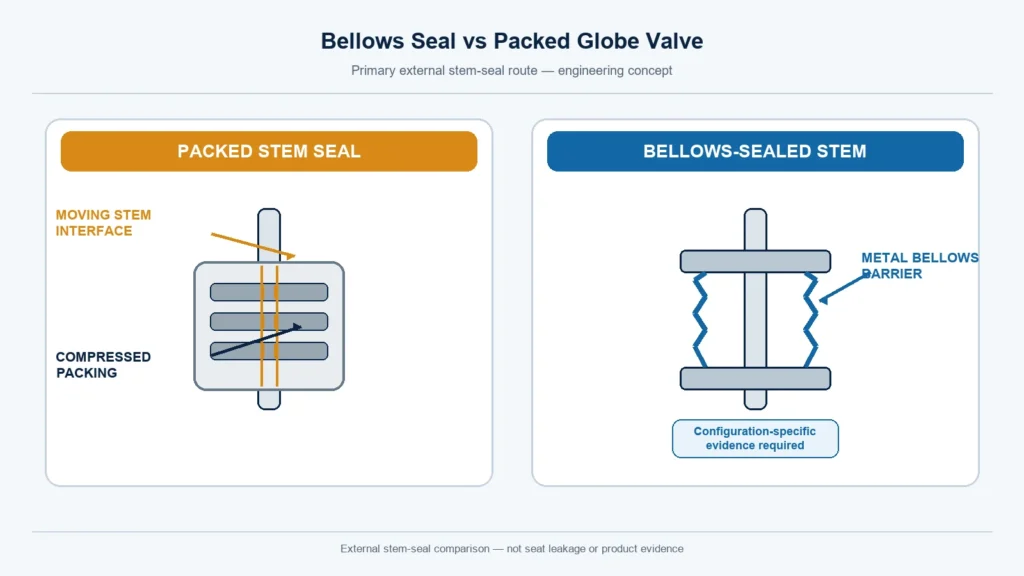
Vergleich der Dichtungen von Regelventilen mit Faltenbalg und Stopfbuchspackung zur Steuerung unterschiedlicher Leckagestrategien

Faltenbalg- vs. Stopfbuchsen-Durchgangsventil: Auswahlrahmen für Spindel und Dichtung

A bellows-sealed globe valve uses a metal bellows assembly as the primary barrier around the rising stem, while a packed globe valve relies on compressed packing at a dynamic stem interface. A bellows design may be considered when the consequence or permitted level of external stem leakage justifies additional design and qualification controls. A packed design may remain appropriate when its packing system, test basis and maintenance plan satisfy the project requirement. Neither option is universally better: selection depends on medium, pressure, temperature, cycling, vibration, corrosion, leakage acceptance, maintenance access and product-specific evidence.

This comparison concerns the stem-sealing arrangement. It does not establish seat leakage, shutoff performance, control-valve sizing or the overall suitability of a valve for a process. Buyers reviewing industrial globe valves should keep those decisions separate.

Technischer Umfang: This article provides a preliminary selection and RFQ framework. It does not establish a Raymon Valve product pressure-temperature range, bellows cycle life, emission class, certification or suitability for a named medium. Those claims require evidence for the exact offered valve configuration.

Featured illustration: Bellows and packing arrangements manage stem leakage through different primary-seal, backup-seal, maintenance and verification strategies. Engineering illustration only; not product evidence.

Bellows Seal vs Packed Globe Valve: Quick Selection Matrix

The most useful starting point is not “Which design is better?” It is “What external stem-leakage requirement must the offered valve satisfy, under what operating conditions, and what evidence will prove it?”

Entscheidungsfeld Packed globe valve — review direction Bellows-sealed globe valve — review direction Evidence needed before approval
Primary stem barrier Compressed packing seals around a moving stem A metal bellows assembly isolates the primary moving-stem leakage path Sectional drawing and seal description
External-leakage acceptance Packing design, installation, test and monitoring must satisfy the specified criterion Bellows design and qualification scope must satisfy the specified criterion; the backup-packing role must be defined Project criterion, test method and configuration-specific evidence
Failure behavior Performance can change with packing wear, relaxation, stem condition, cycling and adjustment Integrity can be affected by fatigue, attachment or weld defects, vibration, corrosion, deposits and off-design movement Design basis, IOM, inspection and qualification evidence
Maintenance route Packing may be adjustable or replaceable under approved isolation and maintenance procedures Bellows inspection or replacement can require bonnet or valve disassembly; field repairability is design-specific Maintenance procedure, parts strategy and access plan
Cycling and stem travel Packing friction, wear and gland-load strategy require review Bellows movement and cycle basis must be checked against actual travel and frequency Operating profile and controlled qualification basis
Space and layout Bonnet and yoke envelope are product-specific The bellows bonnet arrangement may affect overall height and removal space Approved general arrangement drawing
Cost basis Initial and maintenance costs depend on the offered arrangement and site plan Initial cost, evidence, spares and replacement strategy all require comparison Normalized technical and commercial offer
Low-emission claim Not inherent in the word “packed” or in a packing material name Not inherent in the word “bellows” Valid qualification or test scope tied to the offered configuration

If the external-leakage acceptance, service data, operating profile or supplier evidence is incomplete, keep both constructions open. A higher initial price or a more elaborate seal arrangement is not a substitute for a defined requirement.

What Actually Changes at the Stem Seal?

How a packed stem seal works

A packed globe valve normally has a stuffing box around the stem. Packing rings are installed in that space, and a gland arrangement applies compression so the packing contacts the stem and stuffing-box wall. Because the stem moves through the packing as the valve opens and closes, the sealing interface is dynamic.

The result depends on the complete arrangement, not only the packing material. Relevant variables include packing construction and ring arrangement, stem surface condition, stuffing-box geometry and clearances, gland load, pressure, temperature, thermal cycling, operating frequency, installation quality and maintenance practice. A supplier that states only “graphite packing” or “PTFE packing” has not provided enough information to confirm a pressure-temperature boundary, external-leakage performance or media compatibility.

Packing should also not be treated as one outdated design. Different packing systems, loading arrangements and qualification scopes can produce materially different results. The buyer must evaluate the exact offered configuration against the project requirement.

How a metal bellows assembly works

In a bellows-sealed arrangement, a flexible metal bellows accommodates axial stem movement while forming the primary pressure barrier in the stem-seal route. Depending on the design, the bellows may be formed or welded and attached within the bonnet assembly. The exact attachment, construction and movement path are product-specific.

The word “bellows” is therefore only the beginning of the technical review. The supplier should identify:

  • bellows type and construction;
  • component material specification or grade;
  • attachment arrangement;
  • applicable welding and examination scope;
  • rated movement or stroke basis;
  • cycle or qualification basis;
  • pressure and temperature basis;
  • relationship between the bellows, stem and bonnet;
  • inspection, monitoring and replacement route.

These fields should be traceable to the offered valve, not copied from a family brochure or an unrelated qualification report.

What backup packing does—and does not prove

A bellows-sealed valve may also include a packing arrangement as a secondary or backup seal. Its presence does not make every bellows design identical. The drawing and IOM should show where the packing is located, whether it is normally exposed to process pressure, how potential bellows integrity loss is detected, and what operating or maintenance response is required.

Backup packing must not be treated as automatic proof that the valve can continue operating without restriction after suspected bellows degradation. The owner, responsible engineer and manufacturer need an approved detection, isolation and response plan. The plan should define who decides whether the valve remains in service and what evidence is required before return to operation.
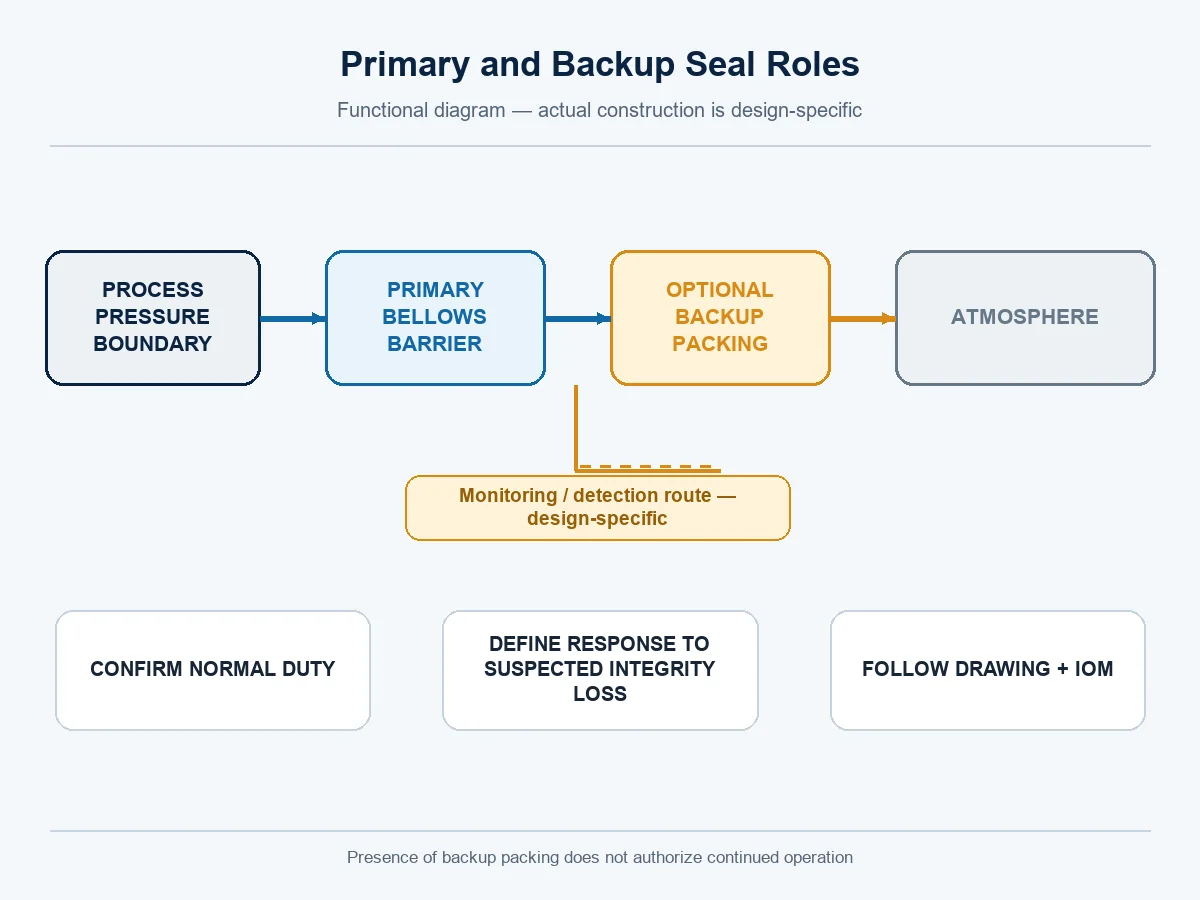
Primary and backup stem seal roles in packed and bellows seal globe valves
The packing is the primary dynamic stem seal in a packed valve; in a bellows-seal design, the bellows is the primary boundary and the packing is generally retained as a backup. Functional concept only; confirm the supplied drawing and IOM. Not product evidence.

External stem leakage is not seat leakage

External stem leakage is a release from the pressure boundary around the stem or related bonnet sealing route. Seat leakage is internal flow across the closed disc and seat. The two have different acceptance criteria and test evidence.

A bellows assembly does not by itself establish tight shutoff, a seat-leakage class, flow characteristic, Cv/Kv, noise performance or resistance to cavitation. If a globe valve will throttle rather than provide simple isolation, the review must also include expected pressure drop, flow range, duty frequency and the risks of erosion, flashing or cavitation. A globe-body shape alone does not replace a control-valve sizing and performance review.

Pre-Shortlist Data Gate

Before favoring either construction, confirm the following project data:

  • valve function: isolation, intermittent throttling, frequent regulation or another duty;
  • straight/T-pattern, angle, Y-pattern or other controlled body route where relevant;
  • DN/NPS, PN/Class, end connection and governing connection standard;
  • normal and design pressure, plus maximum operating differential pressure;
  • normal, design and upset temperature, including the thermal-cycle profile;
  • medium, composition, concentration, phase, contaminants, solids and cleaning conditions;
  • permitted external stem leakage, measurement method, test conditions and consequence of release;
  • seat or shutoff acceptance stated separately;
  • operating frequency, full or partial stem travel, dwell time and expected lifecycle;
  • vibration, piping loads, alignment, corrosion/environment and deposit risks;
  • manual, gear or actuated operation and, if automated, the fail action and supply conditions;
  • maintenance access, isolation philosophy, monitoring method, spares and repair strategy;
  • applicable standards, editions, inspection, witness and documentation requirements.

If one of these inputs controls safety, environmental acceptance or maintainability and remains unknown, the correct result is HOLD — DATA. It is not safe to default to a bellows design merely because the service sounds critical, or to a packed design merely because the valve size and pressure class appear conventional.
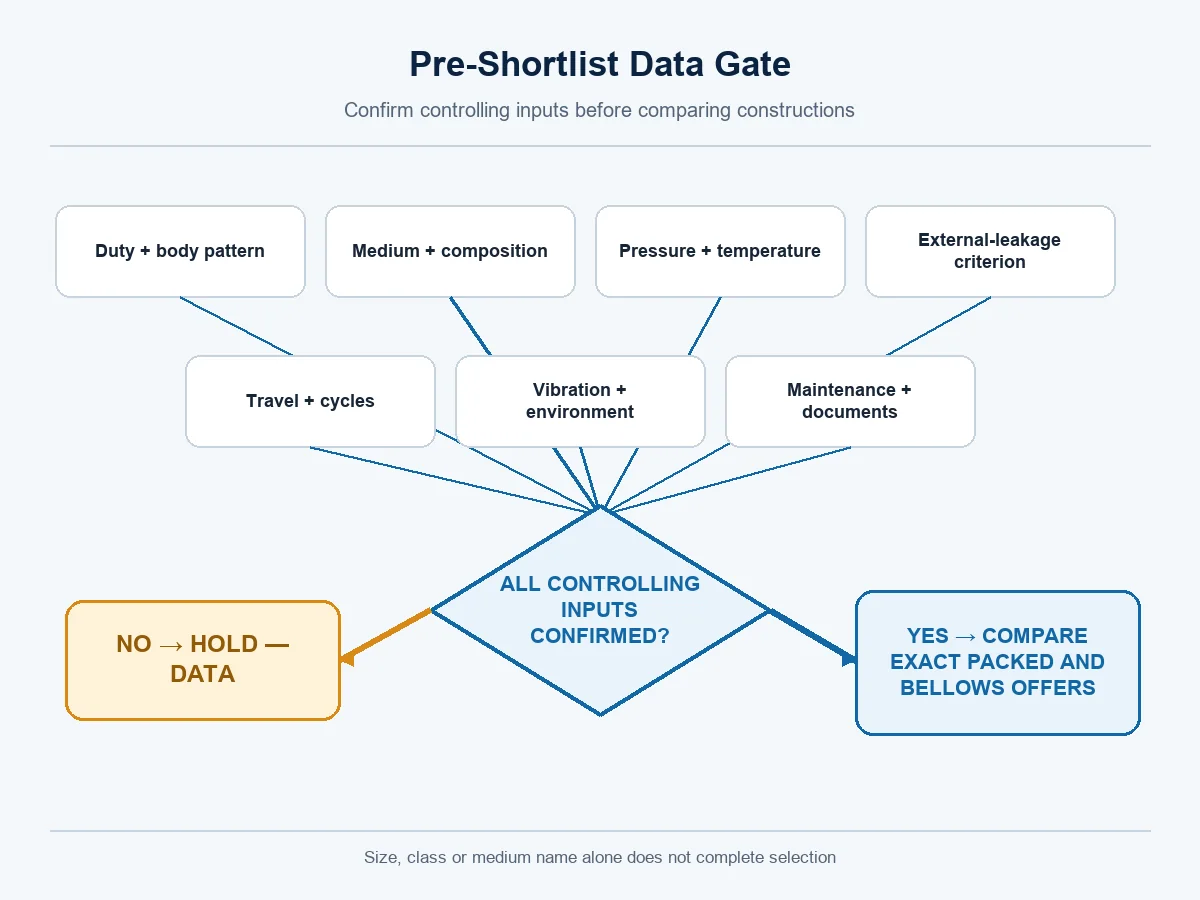
Process and project data required before shortlisting a globe valve stem sealing arrangement
Stem-seal selection starts with verified process conditions, operating pattern, installation constraints and project requirements—not the valve label alone. Engineering decision aid only; not product evidence.

Failure Modes and What the Buyer Should Verify

Both constructions require a realistic degradation and response plan. The table below identifies possible concerns; it does not predict that a particular valve will fail by one of these mechanisms.

Risk or degradation mechanism Packed design — possible concern Bellows design — possible concern Verification direction
Cycling and stem movement Packing wear, friction, consolidation or loss of gland load Bellows fatigue or off-design movement Operating profile, actual stem travel and controlled cycle basis
Thermische Zyklen Packing relaxation or load change; stem and stuffing-box dimensional effects Thermal stress and material or attachment design boundary Temperature history and configuration-specific design evidence
Vibration or misalignment Uneven stem/packing wear or gland behavior Fatigue or imposed lateral/off-axis load Piping support, valve-actuator alignment and manufacturer limits
Corrosion or environment Compatibility of packing, stem and stuffing-box components Compatibility of bellows, attachments and weld area Component-level materials and environment review
Deposits or solids Stem scoring, packing abrasion or movement interference Deposit accumulation or interference around moving convolutions, depending on geometry Medium cleanliness, flushing plan and sectional-geometry review
Assembly or installation Incorrect ring cutting, arrangement, compression or adjustment Attachment, weld, examination or assembly-integrity concern Procedures, manufacturing records, inspection and IOM
Monitoring A trend may require adjustment, replacement or investigation Loss of bellows integrity requires a defined detection and response route Site monitoring procedure, leak-detection provision and response plan
Maintenance intervention Adjustment or repacking requires approved isolation and site procedures Bellows cartridge, bonnet assembly or complete valve replacement may be required IOM, spares, access, isolation and turnaround plan

Cycling and stem travel need actual numbers

The phrase “frequent operation” is too vague for technical comparison. The RFQ should state expected operations per time period, full versus partial travel, stroke, dwell time, temperature transitions and the expected project lifecycle. The supplier must then show how the offered packing or bellows evidence relates to that operating profile.

A bellows qualification value from a different stroke, temperature, pressure or valve configuration may not demonstrate the offered valve. Likewise, a general packing test does not establish the performance of every valve using that packing material.

Vibration, piping load and actuator alignment matter

The stem-seal decision cannot be isolated from installation. Pipe strain, inadequate support, actuator misalignment or vibration can impose conditions that were not represented in a qualification test. The purchaser should define known vibration or loading concerns, while the valve and actuator suppliers should state installation limits and interface requirements.

For an automated globe valve, visible actuation or a catalog actuator size is not a complete package definition. Final selection requires valve thrust or torque data, maximum operating differential pressure, sizing factor, supply pressure or electrical supply, fail action, travel time, signal, accessories, enclosure requirement and mounting/interface details.

Materials are component-specific decisions

The bellows, stem, packing, gland, bonnet, disc or plug, seat, guides, gaskets and attachment regions do not perform the same function. Each relevant component requires its own material specification and service review. A single label such as stainless steel, graphite, PTFE, Inconel or Hastelloy cannot establish corrosion resistance, temperature capability, sour-service suitability, chemical compatibility or lifecycle.

The service review should include medium composition and concentration, contaminants, phase, temperature, pressure, velocity where relevant, solids, cleaning chemicals, external atmosphere and project restrictions.
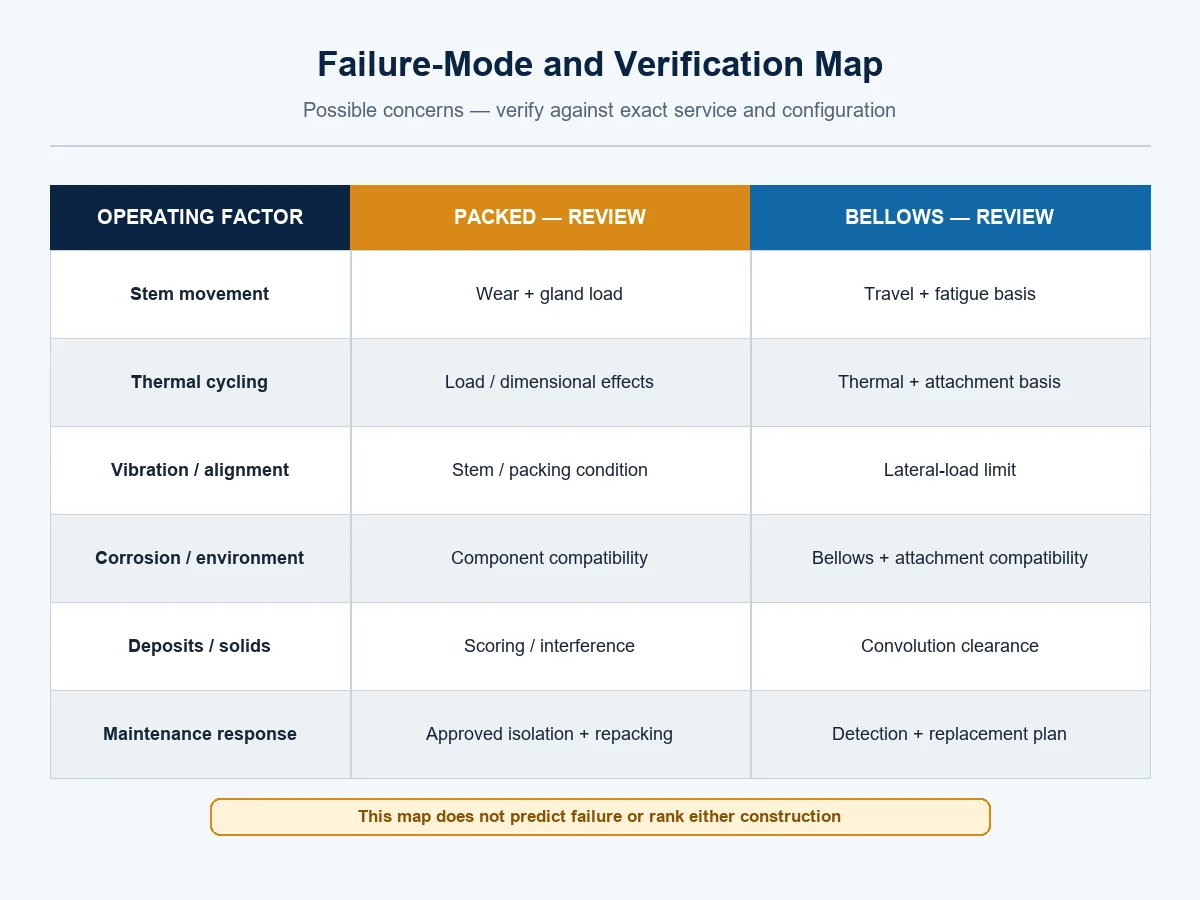
Failure modes and verification needs for bellows seal and packed globe valve stem sealing systems
Bellows and packed arrangements have different degradation mechanisms, inspection access and evidence requirements that must be considered in lifecycle planning. Possible concerns are not failure predictions. Engineering decision aid only; not product evidence.

Maintenance and Lifecycle Planning

Packed-valve maintenance questions

Before accepting a packed valve, ask:

  • What packing construction and arrangement is supplied?
  • What stem and stuffing-box surface or dimensional requirements apply?
  • How is gland loading established and checked?
  • What inspection or leakage-monitoring method does the IOM require?
  • Under what isolation and depressurization conditions may adjustment or replacement occur?
  • Which replacement packing and tools are approved?
  • What symptoms require removal from service or manufacturer review?

Do not assume the packing can be safely adjusted while the valve is pressurized. The exact manufacturer instructions, plant procedures and responsible-person approval govern maintenance.

Bellows-valve maintenance questions

Before accepting a bellows-sealed valve, ask:

  • How is suspected loss of bellows integrity detected?
  • What is the function and normal condition of the backup packing?
  • What operational response is required after an alarm or observed leakage?
  • Is the bellows part of a replaceable bonnet/cartridge assembly, or does replacement require a different scope?
  • What vertical and lateral removal space is required?
  • Which spare assemblies and traceability records are needed?
  • What inspection or examination applies to a replacement assembly?
  • Does replacement affect qualification, warranty, test or documentation status?

A bellows-sealed valve still needs an inspection, spares and replacement strategy. Reduced routine packing adjustment in one design does not justify calling the entire valve maintenance-free.

Installation and Handover Risk Gate

The stem-seal choice must survive installation and maintenance review, not only datasheet comparison. Use the following gate before technical acceptance or release for manufacture.

Installation or handover risk Why it can change the preliminary choice Verification to request Status if unresolved
Bonnet, yoke and removal envelope A bellows bonnet or replaceable assembly may need different vertical or lateral removal space; packed-valve repacking access is also product-specific Approved GA drawing, maintenance envelope and site-access check HOLD — LAYOUT
Orientation, piping load and alignment Pipe strain, off-axis loading or actuator misalignment may impose stem/seal conditions outside the reviewed basis Installation limits, support/alignment plan and valve-actuator interface drawing HOLD — INSTALLATION
Isolation and depressurization route Packing work, bonnet disassembly or seal replacement requires a safe site-owned isolation method Approved IOM plus owner isolation, depressurization and permit procedure HOLD — MAINTENANCE
Monitoring and suspected-integrity response A backup seal or monitoring point is useful only when its normal condition, alarm route and response ownership are defined Drawing, IOM, monitoring method, decision authority and response plan HOLD — RESPONSE
Spares, identity and traceability A generic packing set or bellows assembly may not match the supplied configuration or preserve its evidence scope Model-linked parts list, material/identity records, storage requirements and replacement-test scope OPEN — SPARES
Actuator and accessory interface Mounting, travel, thrust/torque, fail action or supply mismatch can invalidate the package even when the valve body is acceptable Controlled load basis, sizing factor, mounting/interface details, supply, fail action, travel time and accessories HOLD — ACTUATION

These statuses are review gates, not predictions of failure. The purchaser or owner controls site access and safe-work procedures; the valve and actuator suppliers control their product limits and interface information; the responsible project team decides whether the combined package is acceptable.

Normalize lifecycle cost instead of assuming a winner

Lifecycle comparison should use project-specific inputs:

  • purchase price for the exact valve configuration;
  • qualification, inspection and documentation cost;
  • monitoring and routine maintenance labor;
  • isolation, shutdown and access requirements;
  • packing, bellows assembly and other spares;
  • removal, repair or replacement scope;
  • lead time and turnaround impact;
  • product-loss, personnel-exposure, environmental or regulatory consequences defined by the owner.

Without these inputs, claims that one design always has a lower lifecycle cost are not defensible. A bellows candidate can have a strong risk-based justification without requiring an invented payback percentage. A packed candidate can be technically appropriate without being described merely as the cheaper choice.

When Each Construction Can Remain a Candidate

Packed globe valve candidate

A packed construction can remain a candidate when all of the following are addressed:

  • the complete packing arrangement is compatible with the confirmed service;
  • its external-leakage acceptance and test basis satisfy the project requirement;
  • operating pressure, temperature, cycling and stem condition remain within controlled boundaries;
  • inspection, adjustment and replacement can be completed under approved procedures;
  • the site has an appropriate monitoring and maintenance response;
  • the supplier provides configuration-specific technical and document evidence.

This decision should not be reduced to “general service,” “non-hazardous fluid” or “lowest initial price.” A packed arrangement needs the same disciplined mapping from requirement to evidence as any other pressure-boundary solution.

Bellows-sealed globe valve candidate

A bellows-sealed construction can remain a candidate when:

  • the consequence or permitted level of external stem leakage justifies the design route;
  • the exact bellows construction, material, attachment and movement basis match the confirmed conditions;
  • pressure, temperature, cycling, travel, vibration, corrosion/environment and deposit risks are addressed;
  • backup packing, monitoring and response after suspected bellows integrity loss are defined;
  • maintenance access, replacement scope, spares and traceability are acceptable;
  • required qualification, inspection, testing and documentation evidence applies to the offered configuration.

For a current product route, buyers may review the bellows seal globe valve page, but the product page or image is not sufficient evidence of service suitability. The supplier still needs the complete datasheet and project requirements.

Media labels such as toxic, volatile, steam, thermal oil, vacuum, hydrogen or chlorine may identify a high-consequence review. They do not automatically approve a bellows material, pressure-temperature rating, leakage class or Raymon Valve product for that service.

Conditions requiring engineering review or another valve route

Keep the selection open—or evaluate another valve or control solution—when:

  • the external-leakage limit or verification method is not defined;
  • the medium composition, design conditions or operating profile is incomplete;
  • the duty involves frequent modulation or requires a calculated control characteristic;
  • flashing, cavitation, high pressure drop, erosion or noise may govern the design;
  • vibration, deposits, corrosion or stem travel fall outside the supplied evidence;
  • an automated package lacks controlled thrust/torque, fail-action, supply or accessory data;
  • the site cannot safely monitor, isolate, maintain or replace the proposed arrangement.

Standards and Qualification Evidence: Keep the Scopes Separate

Standards should be used to define requirements and evidence scope, not as marketing shorthand.

Reference or scope Safe use in the specification review Was es nicht beweist
MSS SP-117-2023; confirm the project-applicable edition Identifies relevant questions for applicable metal-bellows design, materials, fabrication, installation, qualification, examination and testing It does not prove that the offered valve conforms or is suitable for the process
ISO 15848-1:2015 und Amendment 1:2017; confirm the project-applicable edition and amendments Provides a classification and type-testing framework for external leakage of valve stem/shaft seals and body joints It does not assign every packed or bellows valve a leakage class and does not replace service selection
API Standard 623, where project-applicable Can define a steel globe-valve design/construction requirement after scope and edition verification It does not establish bellows qualification, fugitive-emission performance or Raymon product compliance
Pressure and seat testing Defines shell or seat test conditions and order acceptance when correctly specified It does not by itself prove external stem-emission performance, lifecycle or process suitability

Official source status checked 12 August 2026: MSS identifies SP-117-2023 as its revised bellows-seal standard practice; ISO lists ISO 15848-1:2015 as current and Amendment 1:2017 as published; the API digital catalog lists API Standard 623, edition 2, while the API standards plan shows an edition 3 project in development. The project must confirm the contractually applicable edition, amendments and acceptance criteria. These source links establish standards context only; they do not establish Raymon product conformity, qualification or certification.

For this article, MSS SP-117, ISO 15848-1 and API 623 are reference scopes only. Therefore, stronger wording such as designed to, tested to, qualified, compliant or certified requires exact configuration-specific evidence and the appropriate claim level.

Buyers should also separate qualification evidence from production or order evidence. A type test may support a defined design/configuration scope. A production acceptance test applies to the supplied valve under its specified procedure. An order document shows what was actually required and delivered. One does not automatically replace the others.

For a broader explanation of test-scope differences, see Ventil-Druckprüfung and the site's ISO 15848 low-emission valve guide. The project engineer should still verify the current standard edition, applicable configuration range and acceptance criteria.

Who Owns Each Technical Confirmation?

A technically complete comparison makes ownership visible. “Supplier to confirm” is insufficient when the purchaser has not defined the acceptance criterion, and a purchaser requirement is insufficient when the supplier has not tied evidence to the offered configuration.

Entscheidungsfeld Purchaser / project owner Valve or package supplier Quality / inspection role Unresolved state
Service and consequence Define medium, composition, pressure, temperature, operating profile, release consequence and acceptance basis Identify limits, exclusions and missing inputs for the offered construction Confirm required records and witness points are specified HOLD — DATA
Exact valve and stem-seal construction Define required function, body pattern, size/class, connection and stem-seal intent Identify model/SKU, packing/bellows arrangement, backup-seal role and applicable drawing revision Verify document identity and revision control OPEN — ENTITY
Materials and environment Define composition, contaminants, cleaning, external atmosphere and project material restrictions Provide component-level material specifications/conditions and deviations Verify traceability, certificates and any specified examination scope HOLD — MATERIAL REVIEW
External leakage and qualification Define criterion, method, edition, class and operating/test conditions where applicable Provide configuration-matched qualification or test scope without extending it beyond its limits Check report identity, scope, validity and acceptance requirements HOLD — EVIDENCE
Operation and actuation Define duty, cycles, travel, fail action, supply and response time Provide controlled valve loads, sizing basis, interface and accessory scope Confirm package records and specified functional checks HOLD — ACTUATION
Maintenance and integrity response Define monitoring, isolation, access, turnaround and decision authority Provide IOM, inspection points, backup-seal role, spares and replacement route Confirm required post-maintenance inspection/test records HOLD — RESPONSE
Order documents and deviations Define ITP, MTC, NDT/PMI if applicable, witness, marking, language and data-book requirements Issue a document register and explicit deviation/exclusion schedule Track approval, release and order-specific record completion OPEN — DOCUMENTS

The table does not assign legal or contractual responsibility. The purchase specification and project quality plan remain controlling. Its purpose is to prevent a technical decision from resting on an unowned assumption.
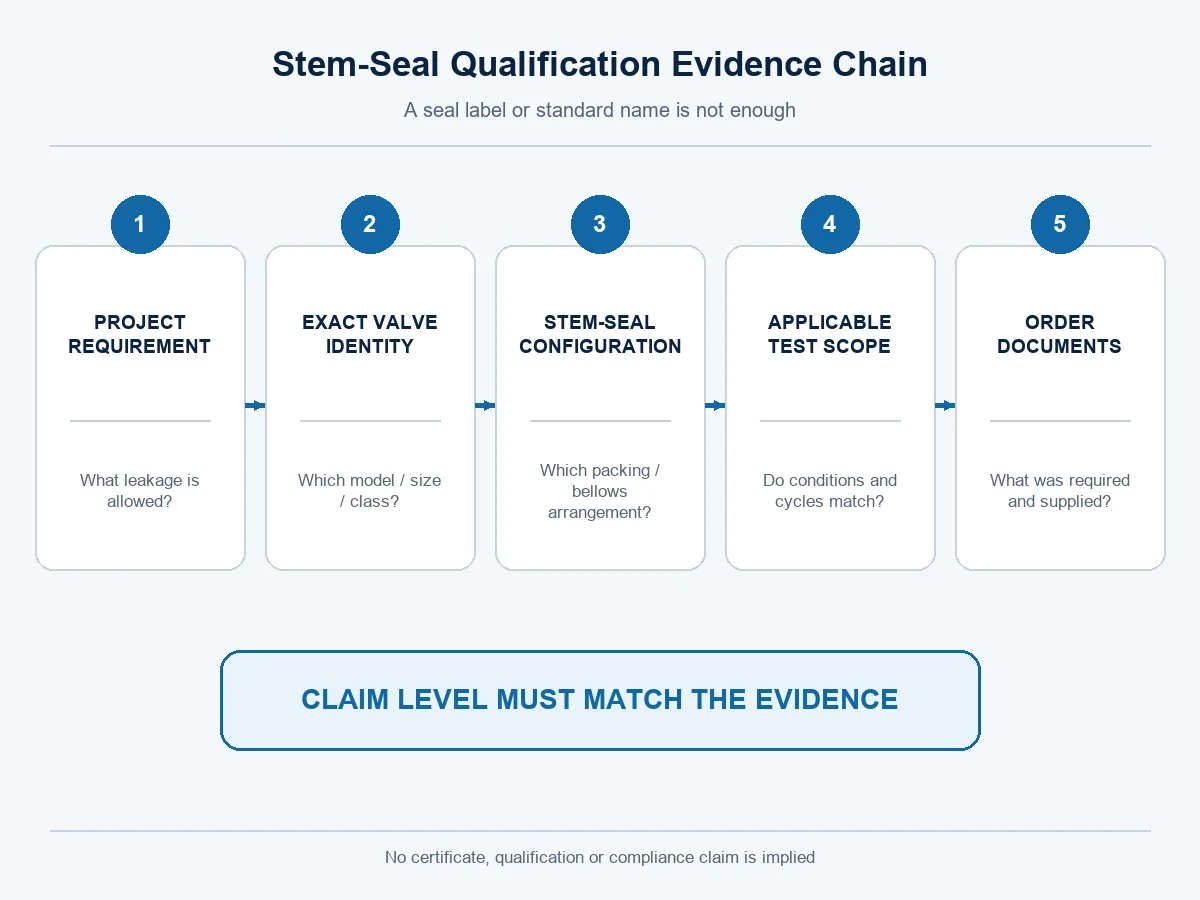
Evidence chain from service data to globe valve stem seal qualification and order documentation
A defensible selection links service data, design scope, qualification evidence, production testing and order-specific documentation. A standard name or seal label alone is not proof. Engineering decision aid only; not product evidence.

Supplier Evidence Matrix for Technical-Bid Comparison

Use the same matrix for every bidder. This prevents one proposal from being evaluated by a detailed test report while another is accepted on a general brochure statement.

Prüfpunkt Buyer or project input Nachweis des Lieferanten Hold condition
Valve identity Family, body pattern, size/class and duty Exact model/SKU, datasheet and sectional drawing Family brochure only
Stem-seal arrangement External-leakage requirement and maintenance route Packing, bellows and backup-packing construction description Seal type named without arrangement
Bellows basis Stroke, cycles, service and environmental risks Type, material/specification, construction, attachment and controlled design/qualification basis Material or cycle claim unsupported
Packing basis Service, leakage acceptance and maintenance plan Packing construction/material, arrangement, stem/box requirements and IOM Generic material name only
Qualification or test Standard, edition, class, temperature, pressure and cycles as applicable Valid report/certificate scope tied to the offered configuration Logo, general certificate or unrelated test
Werkstoffe Medium/composition/environment and component requirements Component-level material schedule, specifications and traceability Material label used as a service guarantee
Failure response Monitoring, isolation and owner response Backup-seal role, detection provision, IOM and replacement procedure Continued operation assumed after suspected failure
Maintenance and spares Access, turnaround and owner strategy GA drawing, removal space, parts list, spares and replacement scope Maintainability claimed without documents
Seat and throttling Shutoff criterion and flow duty Disc/plug, seat and guide details plus sizing/performance evidence where needed Stem-seal design used to imply seat or control performance
Documents and deviations ITP, drawing, MTC, reports, IOM, witness and language Document register and technical-deviation schedule Supplier states only “standard scope”

Any field in the hold column should remain open during technical bid evaluation. Commercial comparison should begin only after the material technical differences and document exclusions are visible.

RFQ Checklist for Globe-Valve Stem-Seal Selection

Include the following fields in the datasheet, requisition or supplier clarification:

Valve and service identity

  • globe-valve type, body pattern and quantity;
  • isolation, intermittent throttling or control duty;
  • DN/NPS, PN/Class, end connection and connection standard;
  • installation orientation and space constraints where relevant;
  • normal/design pressure and maximum operating differential pressure;
  • normal/design/upset temperature and thermal-cycle profile;
  • medium, composition, concentration, phase, contaminants and solids.

Leakage, cycling and sealing requirements

  • permitted external stem leakage;
  • measurement or test standard, edition, conditions and acceptance;
  • seat/shutoff criterion stated separately;
  • operating frequency, full/partial travel, stroke, expected cycles and dwell time;
  • vibration, piping loads, alignment, external environment, cleaning and deposit risks;
  • required packing or bellows route if already mandated;
  • backup-seal, leak-detection, monitoring and failure-response requirements.

Construction, materials and actuation

  • body, bonnet, disc/plug, seat, stem, guide, bellows, packing, gasket and hardfacing requirements by component;
  • manual, gear, pneumatic, electric or hydraulic operation;
  • controlled valve thrust/torque basis and sizing factor for an actuated package;
  • supply pressure or electrical supply, fail action, travel time, signal and accessories;
  • enclosure/protection, interface and mounting requirements.

Standards, inspection and documents

  • applicable design/construction, bellows, fugitive-emission and pressure-test standards with editions;
  • inspection and examination scope;
  • third-party or owner witness points;
  • ITP, approved drawings, material certificates, qualification/test reports and IOM;
  • marking, traceability, recommended spares and preservation/packing requirements;
  • destination/project and technical-deviation schedule.

The RFQ should also state who owns the final materials and service decision. The manufacturer can review the proposed construction, but a preliminary article or quotation cannot replace the purchaser's process data, project specification and responsible-engineer approval.
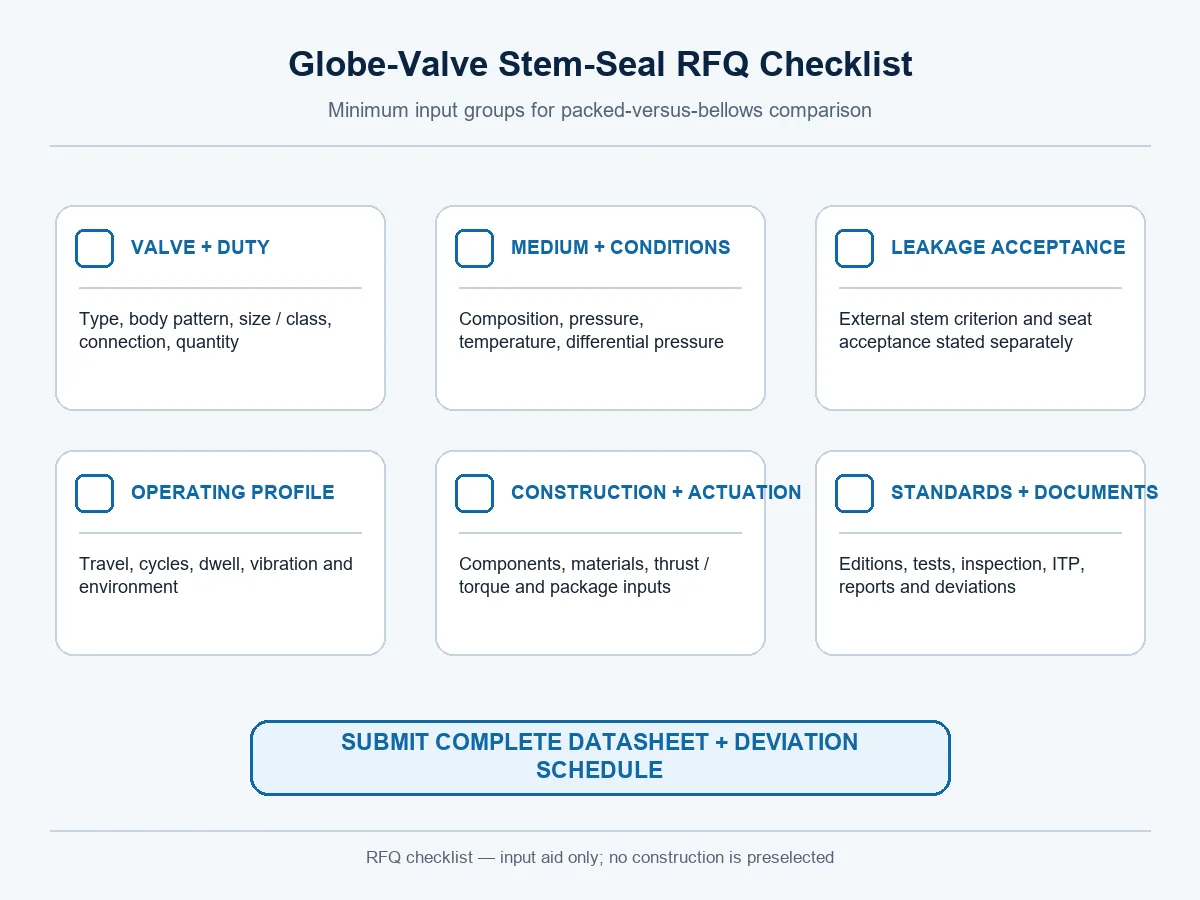
RFQ checklist for comparing bellows seal and packed globe valves
The RFQ should define process conditions, valve duty, materials, connection and pressure basis, stem-seal expectations, testing, documentation and lifecycle constraints. Engineering decision aid only; not product evidence.

Four-Outcome Selection Rule

Use one of four provisional outcomes after reviewing the project inputs and supplier evidence:

Outcome Meaning Required action
PACKED CANDIDATE A specific packed construction remains technically plausible Verify the complete packing arrangement, leakage/test basis, operating boundary and maintenance plan
BELLOWS CANDIDATE A specific bellows-sealed construction remains technically plausible Verify bellows construction, movement/cycle basis, backup seal, qualification and replacement strategy
BOTH OPEN Both constructions may satisfy the requirement Compare exact offers using the supplier-evidence and lifecycle matrices
HOLD — DATA A safe comparison cannot be completed Obtain the missing service, leakage, operating-profile, product or evidence inputs

The result must not be based only on valve size, pressure class, industry, medium name, material label, initial cost or the word “bellows.” Final approval belongs to the project decision process for the exact offered valve.

Illustrative evidence-gap decision path

The following sequence shows how a provisional outcome may change as information becomes controlled. It is an example of decision logic, not a recommendation for a medium, plant or Raymon product.

Review point Information available Provisional outcome Why
Initial inquiry Size/class and medium name only HOLD — DATA External-leakage acceptance, composition, temperature, pressure, travel, cycles and maintenance route are incomplete
Project basis completed Service data, leakage criterion, operating profile and maintenance strategy are defined BOTH OPEN The requirement is now comparable, but neither offered construction has been verified
Technical offers received Exact packed and bellows arrangements plus drawings, limits, IOMs and qualification scopes are supplied BOTH OPEN or one CANDIDATE Compare each offer against the same requirement; a label or price does not close the decision
One offer has an evidence gap A controlling material, travel/cycle, leakage, actuation or replacement field remains unsupported That offer returns to HOLD Missing controlling evidence cannot be offset by unrelated certificates or a general brochure
Technical bid normalized The selected candidate matches the project inputs and its deviations/documents are accepted by the responsible parties CANDIDATE FOR PROJECT APPROVAL Final acceptance still belongs to the order-specific project process

The outcome is therefore reversible. New service information, a changed operating profile, a supplier deviation or an evidence-scope mismatch can move a candidate back to BOTH OPEN oder HOLD — DATA.
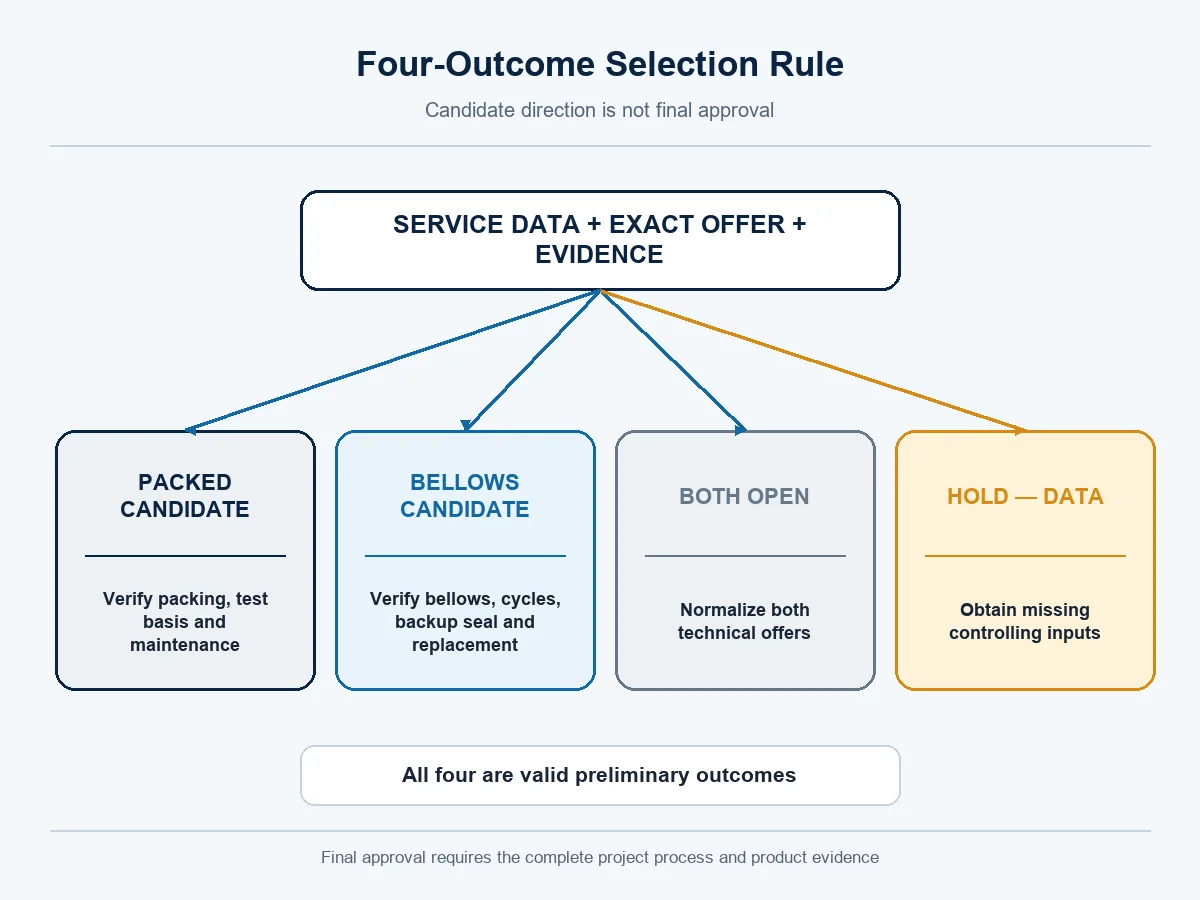
Four possible outcomes when selecting between bellows seal and packed globe valves
A sound comparison may support a packed design, support a bellows-seal design, require specialist review or remain open pending missing data. Candidate direction is not final approval. Engineering decision aid only; not product evidence.

Häufig gestellte Fragen

What is the main difference between a bellows seal and a packed globe valve?

A packed globe valve uses compressed packing around a moving stem as its primary external stem seal. A bellows-sealed globe valve uses a flexible metal bellows assembly as the primary pressure barrier in that route. The difference changes the evidence, failure-mode and maintenance review, but it does not determine seat leakage or overall process suitability.

Does a bellows seal guarantee zero stem leakage?

No universal guarantee should be made from the design name. The purchaser should specify the external-leakage acceptance and require valid evidence for the exact valve configuration, test scope and operating boundary. Bellows integrity, attachments, cycling, temperature, pressure, vibration and environment still require review.

Do bellows-sealed globe valves still use packing?

Some designs include secondary or backup packing. Its exact function, location, monitoring method and response after suspected bellows integrity loss must be confirmed from the drawing and IOM. Its presence does not automatically authorize continued operation after a bellows problem.

Are bellows-sealed globe valves maintenance-free?

No. They still require inspection and monitoring, an integrity-loss response, maintenance access, spare-parts planning and a defined bellows or bonnet replacement route. The frequency and scope must come from the exact design, service conditions and approved IOM.

Can a qualified packed valve meet a low-emission requirement?

A packed configuration may remain a candidate if the complete valve and packing arrangement has evidence that matches the specified test method, class, temperature, pressure, cycles and configuration scope. A packing material certificate alone is not sufficient.

Is a bellows seal always the right choice for hazardous or toxic media?

No automatic selection should be made from a medium label. The consequence and permitted level of release may justify evaluating a bellows design, but material compatibility, pressure-temperature boundary, cycling, vibration, deposits, maintenance and configuration-specific qualification evidence still control approval.

How should operating cycles and stem travel be specified?

State expected operations per time period, full versus partial travel, actual stroke, dwell time, thermal transitions and expected lifecycle. The supplier should map those inputs to the offered packing or bellows design and its controlled qualification basis.

Does a bellows seal improve seat shutoff or control performance?

Not by itself. The bellows concerns the stem pressure boundary. Seat leakage depends on the disc/plug, seat, guiding, load and acceptance criterion. Control performance requires process data and appropriate sizing and performance evidence.

Which documents should be compared before approving a supplier?

Compare the exact datasheet, sectional and GA drawings, component material schedule, stem-seal description, bellows or packing basis, applicable qualification/test evidence, ITP, material certificates, IOM, spares list and technical-deviation schedule. Confirm that document identities and configuration ranges match the offered valve.

What information should accompany the RFQ?

Send the valve function and body pattern; size/class and connection; medium/composition; normal and design pressure/temperature; external stem-leakage and seat acceptance requirements; cycling and travel; vibration/environment; materials; actuation; standards/tests; inspection, documents, maintenance access, quantity and destination/project.

Technische Anmerkung

This article is owned as organization-level technical content by the Raymon Valve Technisches Redaktionsteam. It supports preliminary comparison, risk identification, RFQ preparation and technical-bid normalization. It does not claim review or authorship by a named professional engineer.

No order-specific datasheet, approved drawing, calculation, material record, qualification report, production test record, certificate or deviation approval was used to select a valve in this article. Final construction, pressure-temperature rating, component materials, stem-leakage acceptance, seat performance, actuation, inspection, documentation and service approval require the complete project specification and evidence for the exact offered valve.

Request Stem-Seal Selection Review

For a preliminary comparison, submit your valve datasheet and project requirements in five groups:

  1. Function and consequence: isolation or throttling duty, body pattern, operating frequency, external-release consequence and separately stated seat/shutoff acceptance.
  2. Process conditions: medium and composition, phase, contaminants/solids, normal/design/upset pressure and temperature, maximum operating differential pressure and thermal cycle.
  3. Stem-seal and materials basis: permitted external stem leakage, measurement/test basis, travel/cycles, vibration/environment and component-level material requirements.
  4. Operation and maintenance: manual/gear/actuated route, controlled thrust/torque inputs where automated, fail action, supply, travel time, monitoring, isolation, access, spares and integrity-response strategy.
  5. Quality and project scope: size/class, connection standard, applicable standards/editions, inspection/witness points, drawings, ITP, MTC, qualification/test reports, IOM, quantity, destination and deviation schedule.

Raymon Valve can review whether the submitted information is sufficient to compare packed and bellows-sealed candidates and identify open supplier-evidence fields. The review does not promise final selection, actuator sizing, low-emission qualification, material compatibility, delivery or service suitability before the complete project specification and exact offered-valve evidence are accepted by the responsible parties.

Schreibe einen Kommentar

Deine E-Mail-Adresse wird nicht veröffentlicht. Erforderliche Felder sind mit * markiert

de_DEGerman
Nach oben scrollen