
API 6D and API 608 are both used to specify metal ball valves, but neither standard should be selected from installation location alone. API 6D covers a broader family of valves and project requirements, while API 608 focuses specifically on metal ball valves. For engineering and procurement, the practical decision depends on the governing project specification, valve construction, bore, pressure-temperature basis, testing, qualification requirements and supplier documentation.
Neither designation alone proves that the offered valve is full bore, DBB/DIB, fire-safe, fugitive-emission qualified, suitable for sour or hydrogen service, or acceptable for every project inspection requirement.
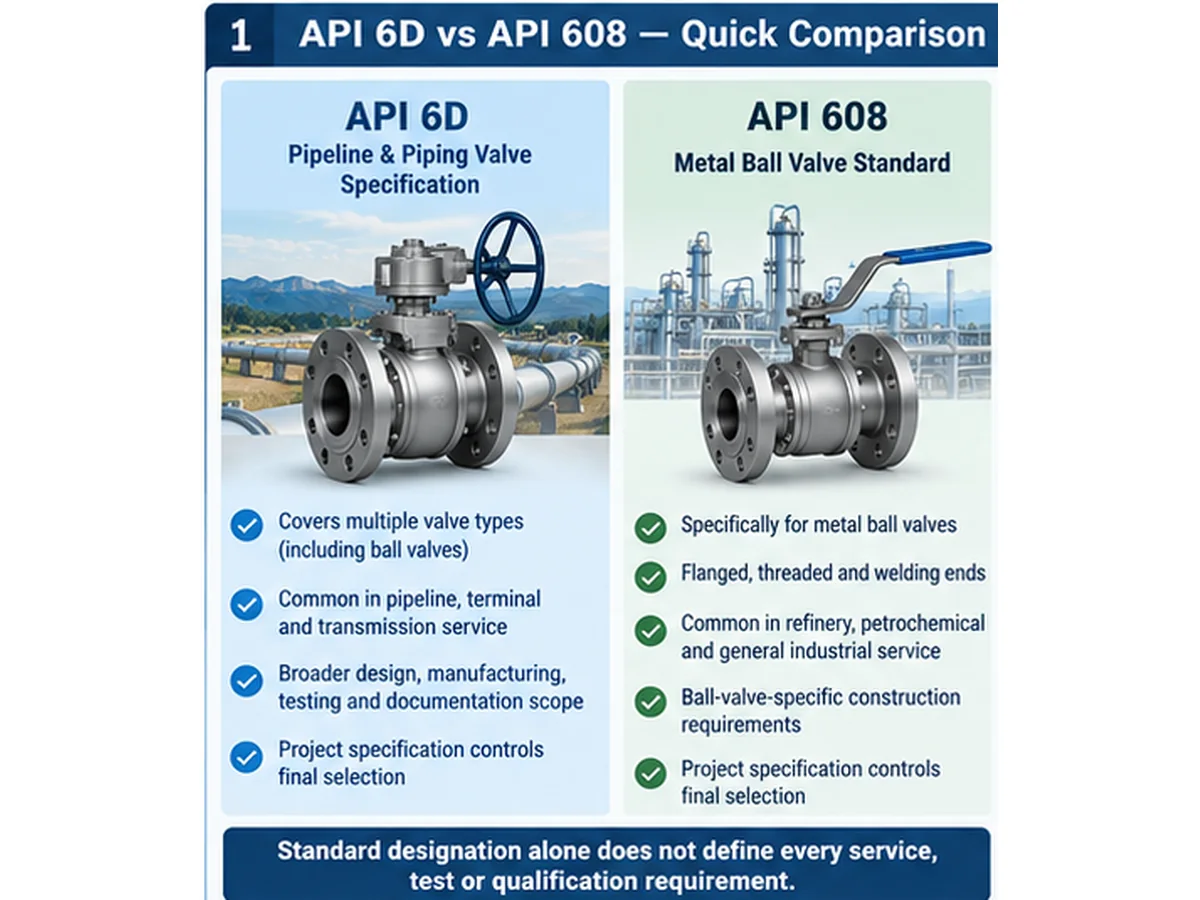
API 6D vs API 608: What Is the Practical Difference?
The difference that matters most to a buyer is scope. API 6D addresses several valve types within a broader product and manufacturing framework, including ball valves. API 608 is specifically focused on metal ball valves.
This does not make API 6D a universally higher-grade version of API 608. The correct standard is the one required by the governing owner, EPC or project documents and applicable to the proposed valve configuration and service.
| Decision Point | API 6D | API 608 | Buyer Check |
|---|---|---|---|
| Primärer Geltungsbereich | Broader valve specification covering several valve types | Metal ball valve product standard | Which standard and edition does the project specification require? |
| Ventiltyp | Includes ball valves and other covered valve types | Kugelhähne | Does the offered valve fall within the adopted standard scope? |
| Typical project context | Common in pipeline, transmission, terminal and related petroleum or natural-gas duties | Common in refinery, petrochemical, process and general industrial ball-valve duties | What piping, pipeline or owner specification governs the valve? |
| Procurement review | Design, manufacturing, testing, marking and documentation requirements must be read with purchaser requirements | Ball-valve-specific requirements must still be combined with project testing and documentation | What supplementary tests, qualification evidence and documents are required? |
| Final suitability | Project-specific | Project-specific | Review the complete datasheet and technical offer before approval. |
What Does API 6D Actually Cover?
API Specification 6D, Specification for Valves, covers a broader valve family than ball valves alone. The current scope addresses requirements for design, manufacturing, materials, welding, quality control, assembly, testing, marking, documentation and process controls for axial, ball, check, gate and plug valves used within its stated petroleum, natural-gas and hydrogen-gas application scope.
For a standards-level explanation separate from this comparison, see the API 6D standard scope guide.
Product and Application Scope
For ball-valve procurement, API 6D is frequently encountered in pipeline isolation, transmission systems, terminal service and trunnion-mounted valve applications. Where a project requires a specific API 6D product configuration, the API 6D ball valve product page can be used as the commercial product reference, while the project datasheet remains the technical basis for approval.
Frequently specified does not mean automatically required. The owner specification, EPC valve specification, pipeline or piping specification, material requisition and purchase order determine the procurement requirement.
API 6D Is More Than a Valve Location Label
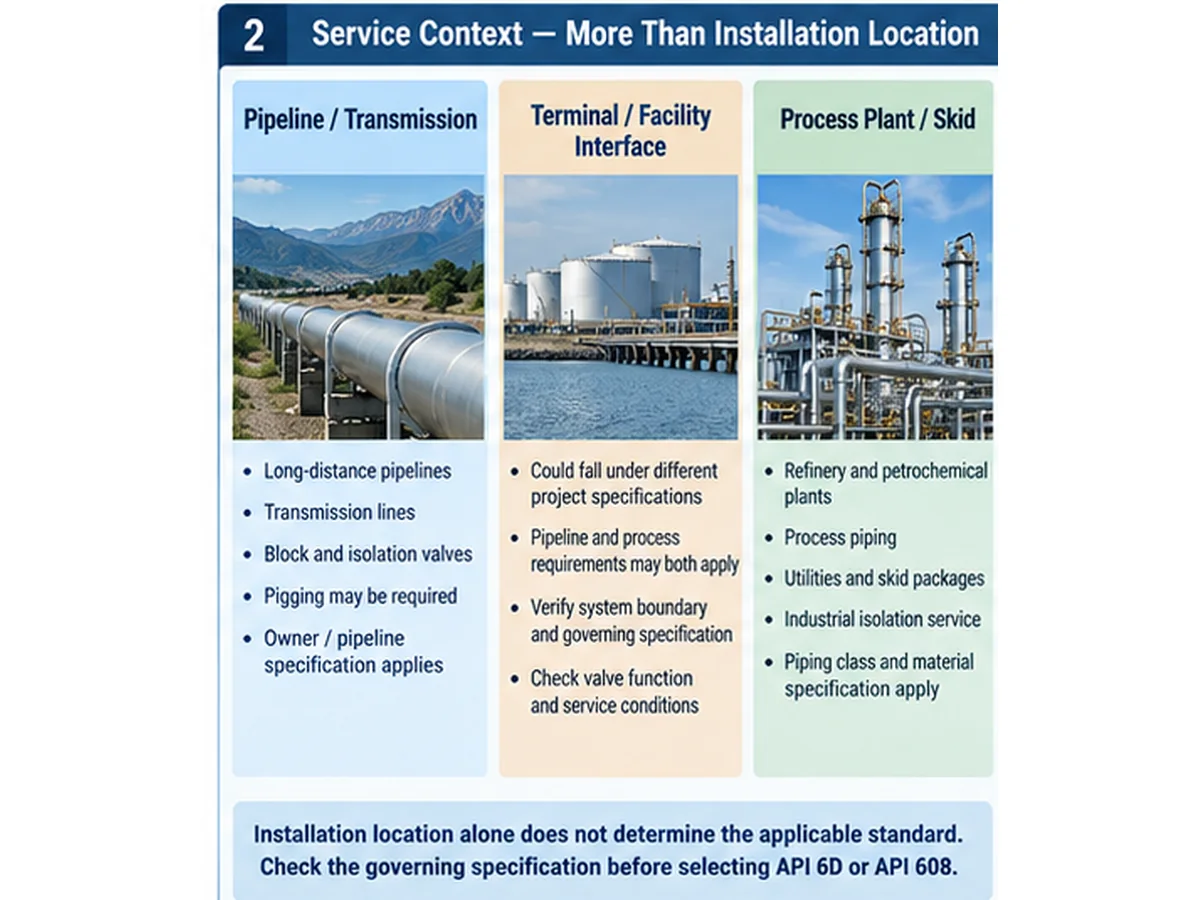
A valve can be installed inside a pipeline-related facility while still being controlled by a process piping specification. Likewise, a terminal or plant interface may contain valves for which the owner specifically requires API 6D.
Before selecting the product standard, verify the system boundary, valve function, end connection, bore requirement, pressure class, pressure-temperature basis, materials, seat arrangement, testing and documentation requirements.
What Does API 608 Actually Cover?
API Standard 608, Metal Ball Valves—Flanged, Threaded and Welding Ends, is specifically a metal ball-valve product standard.
It should not be described as a floating-ball-valve-only standard, a low-pressure-only standard or a lower-grade substitute for API 6D. Those shortcuts turn a scope comparison into an unsupported construction or service claim.
Where API 608 Commonly Fits
API 608 is commonly relevant to refinery, petrochemical, chemical-processing, utility, terminal, skid and general industrial isolation applications. The standard designation still does not replace review of pressure-temperature conditions, medium, valve construction, materials, seat and seal system, end connections, testing and documentation.
How Do Product Standards, Testing and Project Requirements Work Together?
A recurring procurement problem is treating one standard number as proof of every performance or qualification requirement. In practice, product requirements, production pressure testing, special qualification, purchaser inspection and order documentation are different layers.
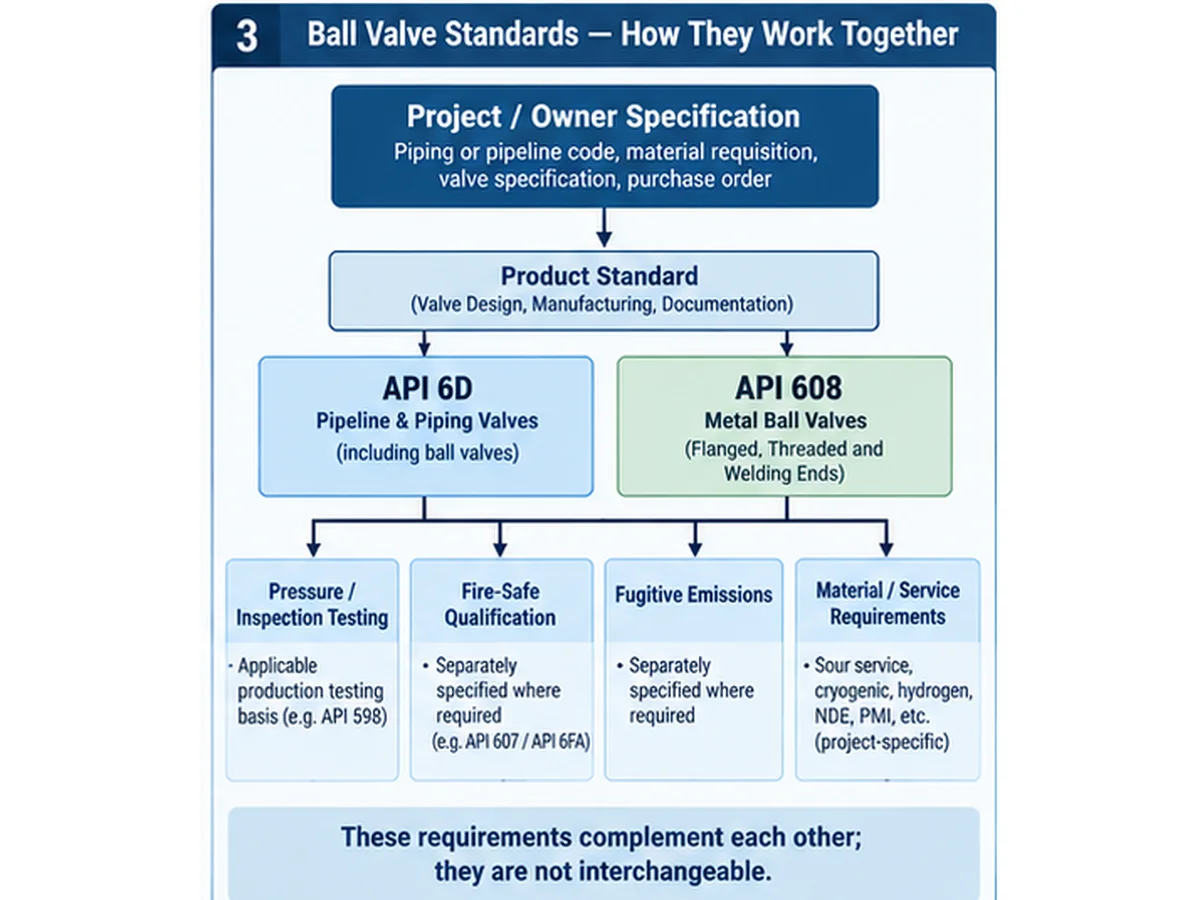
For the separate boundaries between shell, closure and other production tests, use the valve pressure testing requirements guide.
API 6D vs API 608 Design Scope: What Still Has to Be Specified?
The standard designation is one field on the valve datasheet—not the complete valve specification. Construction, bore, pressure-temperature suitability, materials, seats and actuation still require engineering review.
Floating vs Trunnion Construction
Do not infer the ball-support arrangement from the API number alone. The RFQ should identify whether floating or trunnion-mounted construction is required, or whether the supplier may propose a construction subject to technical review.
Ball support affects pressure-load paths, seat behavior, operating torque and actuator inputs. For the dedicated construction comparison, see the floating vs trunnion ball valve guide.
Bore Requirement
Likewise, an API 608 valve should not automatically be treated as reduced bore. Specify the required flow passage independently where the project depends on pig passage, minimum opening or flow capacity.
For bore-specific engineering tradeoffs, see the full port vs reduced port ball valve guide.
Druck-Temperatur-Kennlinie
Pressure class is not a fixed service pressure. Final pressure-temperature suitability depends on the applicable rating basis, material group, temperature and the specific valve construction. Normal operating pressure also does not replace design pressure.
The review should include design pressure, design temperature, minimum temperature where relevant, body and pressure-boundary materials, bolting, seat and seal materials, end connection and any project-specific limitations.
API 6D vs API 608 Testing: What Must the Buyer Verify?
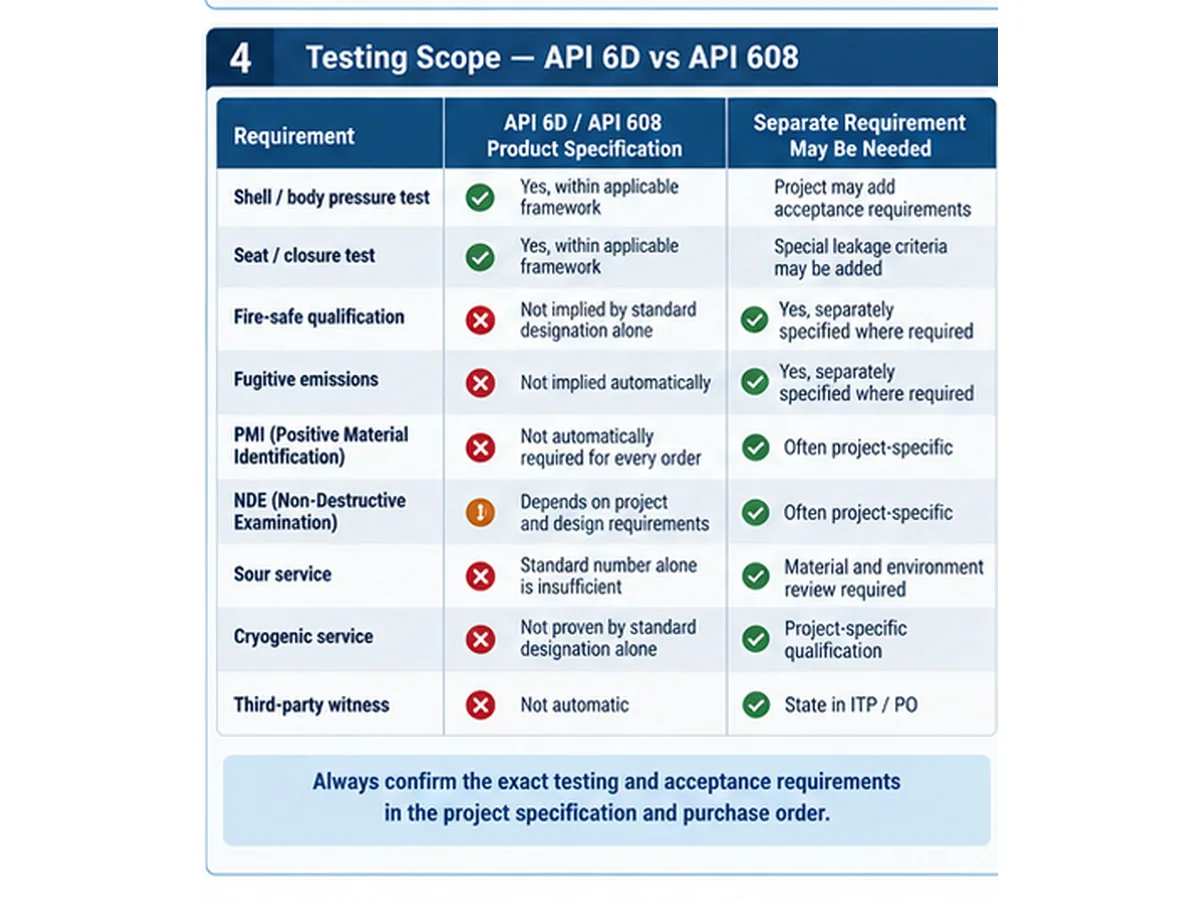
The useful procurement question is not which standard has the “better” test. The buyer should determine which production tests, qualification requirements, witness points and acceptance criteria apply to the actual supplied valve.
Production Pressure Testing
Ball-valve procurement normally requires defined shell/body and seat/closure testing within the applicable specification framework. The RFQ should identify the governing test basis, acceptance requirements and any purchaser witness or hold points.
A shell test primarily addresses the pressure boundary under the specified test conditions. A closure or seat test addresses shut-off performance under its specified conditions. Passing one test does not prove every other performance requirement.
Fire-Safe and Fugitive-Emission Requirements Are Separate Evidence Questions
An API 6D or API 608 designation alone should not be presented as proof that every offered valve configuration has the required fire-safe or fugitive-emission qualification. Where those requirements apply, the purchaser should state the applicable basis and review evidence relevant to the offered design.
Sour, Hydrogen, Cryogenic and Other Special Service
The product-standard designation is not a substitute for a complete service review. Where applicable, the purchaser may still need to confirm medium composition, H2S or hydrogen conditions, temperature, material requirements, hardness or heat-treatment controls, nonmetallic compatibility, NDE, PMI and project-specific qualification requirements.
API 6D vs API 608 Selection Matrix
| Project Condition | API 6D Direction | API 608 Direction | Procurement Check |
|---|---|---|---|
| Transmission / pipeline isolation | Common specification context | Use where permitted by project requirements | Owner / pipeline specification |
| Pigging or minimum passage requirement | Relevant to many projects, but bore still must be specified | Verify the actual offered geometry | Required bore + supplier drawing |
| Process plant isolation | May apply when specified | Common specification context | Piping class / valve specification |
| Large trunnion ball valve | Common procurement context | Verify the applicable scope and offered construction | Construction + seat arrangement |
| Fire-safe duty | Separate applicable evidence required | Separate applicable evidence required | Qualification basis + offered-design evidence |
| Fugitive-emission requirement | Specify separately where required | Specify separately where required | Qualification basis + acceptance criteria |
| Sauersauerstoff-Betrieb | Standard designation alone is insufficient | Standard designation alone is insufficient | Environment + material + hardness review |
| Cryogenic service | Project-specific review required | Project-specific review required | Material + seat/seal + qualification review |
| Hydrogen service | Confirm the applicable API 6D and project requirements | Do not infer suitability from API 608 alone | Material + sealing + project specification |
| Actuated isolation valve | Valve standard does not size the actuator | Valve standard does not size the actuator | Torque data + differential pressure + sizing basis |
Can a Ball Valve Meet Both API 6D and API 608?
A particular valve design may potentially satisfy applicable requirements associated with both standards, but dual compliance should never be assumed from appearance, catalog wording or a quotation line that simply states “API 6D / API 608.”
Five Questions Before Accepting “API 6D / API 608” in a Quotation
- Which edition applies? Confirm the exact edition required by the project and offered by the supplier.
- What valve configuration is actually offered? Confirm floating or trunnion construction, body design, bore, end connection, seat system and materials.
- Which requirements are included in the quoted scope? Separate product-standard requirements from pressure testing, special qualification, NDE, PMI and purchaser inspection.
- What evidence will be supplied? Identify drawings, material records, test reports, qualification records and final inspection documents.
- What deviations exist? Require exceptions, substitutions and exclusions to be listed before technical approval.
The engineering question is whether the specific offered valve satisfies the adopted purchase specification—not whether two standard numbers can be printed on the datasheet.
Common API 6D vs API 608 Specification Mistakes
1. Selecting the Standard Only From Valve Location
“Pipeline” and “process plant” are useful context, but neither label replaces the governing project specification.
2. Assuming API 6D Automatically Means Full Bore
State the bore or minimum flow-passage requirement whenever pigging, inspection tools or flow area matter.
3. Treating API 6D as Automatic Proof of DBB or DIB Function
DBB/DIB functionality, seat directionality and cavity-pressure behavior depend on the actual valve construction and the specified isolation duty. Do not approve an isolation function from the API 6D designation alone.
4. Treating the Product Standard as Fire-Safe Certification
Where fire-safe qualification is required, review the applicable qualification basis and evidence for the offered design.
5. Ignoring the Standard Edition
Record the governing edition in the RFQ or purchase specification where required. A quotation that identifies only the standard number can leave a material technical ambiguity.
6. Comparing Price Before Testing and Documentation Are Normalized
Two suppliers can reference the same product standard while including different NDE, PMI, witness points, qualification evidence and final-document packages. Those differences should be closed before a commercial comparison is treated as equivalent.
What Should Be Included in an API 6D or API 608 Ball Valve RFQ?
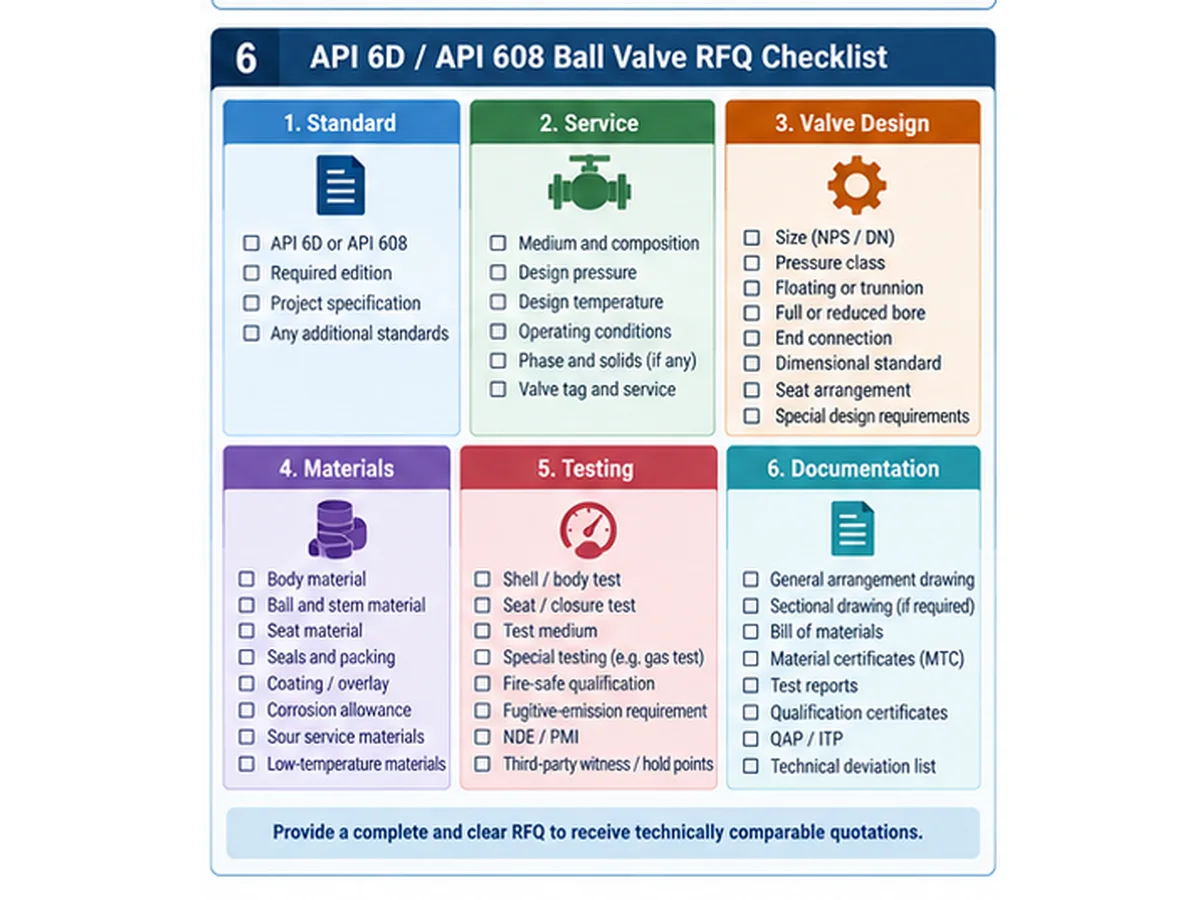
Service and Design Data
- Valve tag, function and governing project specification
- Medium, composition, phase and solids where relevant
- Normal and design pressure
- Normal, design maximum and minimum temperature where applicable
- NPS / DN and required pressure class or PN
- API 6D or API 608 and the required edition
- Floating or trunnion construction
- Required bore or minimum flow passage
- End connection and dimensional requirement
- Body construction and face-to-face / end-to-end requirement where applicable
Materials, Seats and Sealing
- Body, ball, stem and other project-controlled materials
- Seat material and seat arrangement
- Packing, body seals and gaskets
- Coating or overlay where required
- Required isolation function where DBB/DIB is specified
- Closure leakage or shut-off requirement
- Cavity-pressure management requirement where relevant
- Sour-service, low-temperature, cryogenic or other special-service controls
Antrieb
- Manual, gear, pneumatic, hydraulic or electric operation
- Valve torque data for the specified operating condition
- Maximum differential pressure relevant to operation
- Required operating time and operating frequency
- Air or electrical supply
- Required fail position where applicable
- Project actuator sizing margin basis
Testing and Inspection
- Shell/body pressure testing
- Seat/closure testing
- Applicable inspection/test standard and acceptance criteria
- Fire-safe qualification where required
- Fugitive-emission qualification where required
- NDE and PMI scope
- Third-party inspection
- Purchaser witness and hold points
Dokumentation
- Allgemeine Aufstellungszeichnung
- Sectional drawing where required
- Datasheet and bill of materials
- MTC / material records required by the purchase specification
- Pressure-test reports
- Applicable qualification records
- ITP / QAP where required
- Actuator sizing information where applicable
- Technische Abweichungsliste
How Should Suppliers Be Compared?
Normalize the technical scope before comparing commercial price. Two suppliers can quote the same standard number while offering materially different construction, inspection, testing and document packages.
Evidence Should Match the Specific Offered Valve
A generic company certificate, catalog statement or previous test report should not automatically be treated as evidence for every offered valve configuration. Where project approval depends on design qualification, materials or a special test, confirm that the evidence is applicable to the offered design and the stated project requirement.
| Prüfpunkt | Supplier Offer | Evidence to Review | Typical Deviation Risk |
|---|---|---|---|
| Product standard / edition | API 6D or API 608 + edition | Datasheet / technical compliance statement | Edition omitted or different from project requirement |
| Ventilkonstruktion | Floating / trunnion / body construction | GA / sectional drawing | Construction differs from RFQ assumption |
| Bohrung | Actual offered flow passage | Datasheet / approved drawing | Reduced opening quoted where minimum bore is required |
| Werkstoffe | Body / ball / stem / seats / seals | BOM + required material records | Substitution or material scope not clearly declared |
| Sitzanordnung | Offered seat system and sealing direction | Sectional drawing / datasheet | Isolation function inferred rather than demonstrated |
| Druckprüfung | Included test scope | Procedure / test report | Purchaser-specific test omitted |
| Fire-safe / special qualification | Where required by project | Applicable qualification evidence | Generic evidence does not map to offered design |
| NDE / PMI | Project-required scope | Procedure / inspection record | Excluded, limited or priced separately |
| Antrieb | Manual / gear / automated package | Valve torque + actuator sizing basis | Actuator selected without the required operating case |
| Dokumentation | Final document package | Document index / ITP / MDR requirement | Required records excluded from commercial scope |
| Technische Abweichungen | Supplier exceptions | Deviation schedule | Exception hidden in quotation notes |
How to Choose Between API 6D and API 608
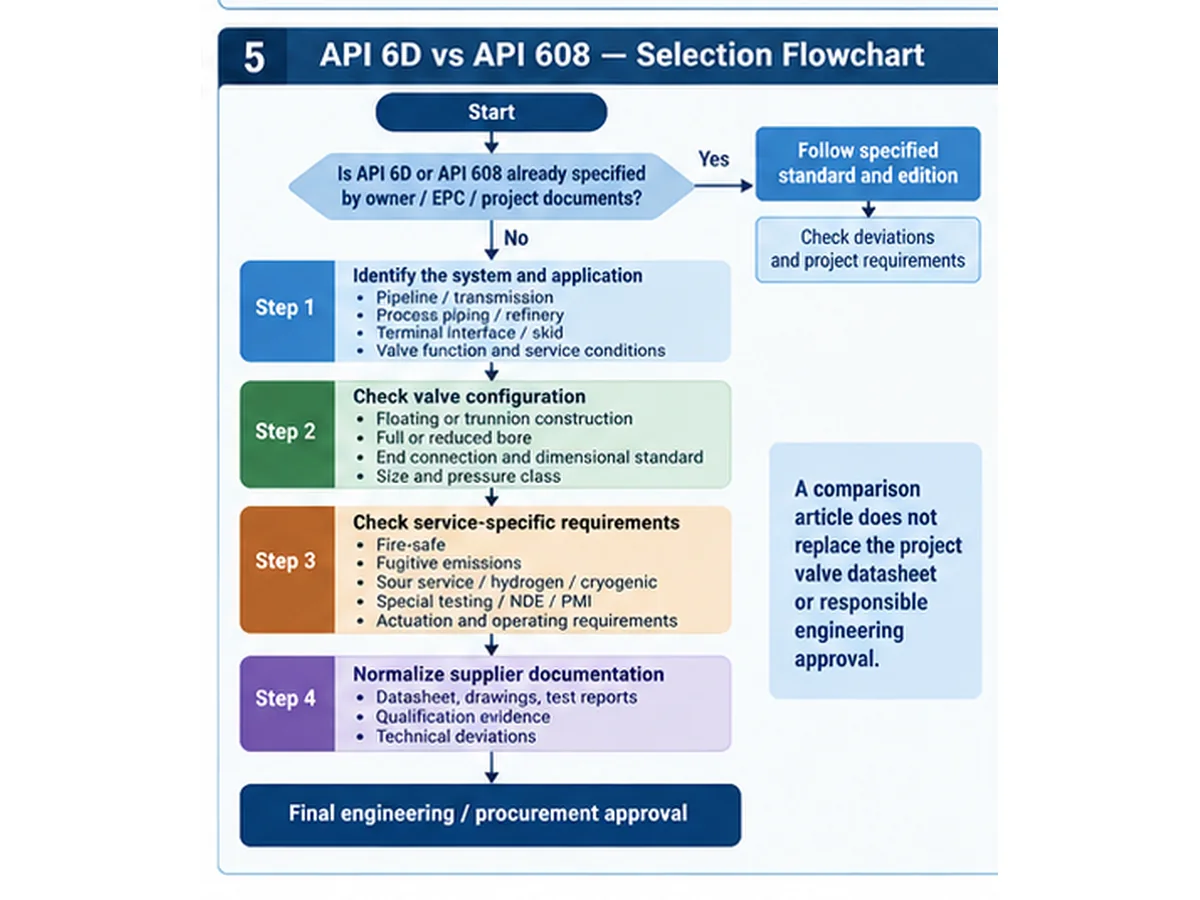
- Identify the governing project requirement.
Start with the owner specification, EPC valve specification, piping or pipeline specification, material requisition and purchase documents. - Check the standard scope against the proposed valve.
Confirm valve type, size, pressure class, construction, bore, end connection and intended service. - Add project-specific requirements.
Define materials, shut-off duty, fire-safe, emissions, sour-service, hydrogen, cryogenic, testing, NDE, PMI and actuation requirements where applicable. - Normalize supplier evidence.
Compare the offered edition, construction, materials, bore, tests, qualification evidence, drawings and deviations before technical approval and price comparison.
Final Selection Takeaway
API 6D and API 608 address related but different ball-valve specification needs. API 6D has the broader multi-valve scope, while API 608 is specifically a metal ball-valve standard. Neither should be selected simply because one is perceived as stricter, more expensive or automatically suitable for a particular installation location.
For an actual project, combine the adopted product standard with the required construction, bore, pressure-temperature rating basis, materials, seats, shut-off requirement, testing, special qualification, actuation, inspection and documentation.
Request an API 6D / API 608 Ball Valve Specification Review
Send the governing valve or piping specification together with the medium, design pressure and temperature, size, pressure class, end connection, bore requirement, valve construction, materials, seat arrangement, shut-off requirement, actuation method and required inspection or qualification scope.
For supplier comparison, also include the required API edition, drawing and document requirements, fire-safe or fugitive-emission requirements, NDE / PMI scope and any third-party witness or hold points.
Submit Your Valve Datasheet / RFQHäufig gestellte Fragen
What is the main difference between API 6D and API 608 ball valves?
API 6D covers a broader family of valve products, including ball valves, while API 608 is specifically a metal ball-valve standard. The correct project requirement still depends on the governing specification, valve configuration, service conditions, testing and documentation.
Is API 6D required for every pipeline ball valve?
No. API 6D is widely used in pipeline valve procurement, but the applicable standard should be established by the owner, EPC, pipeline or piping specification and purchase documents rather than installation location alone.
Is an API 6D ball valve always full bore?
No. Do not infer the required bore from the standard designation alone. Where full opening, pigging or minimum internal diameter matters, state the requirement in the datasheet and verify the offered bore on the supplier drawing.
Can a ball valve meet both API 6D and API 608 requirements?
A particular design may satisfy applicable requirements associated with both standards, but the buyer should verify the editions, product scope, offered construction, testing, qualification evidence and documentation rather than assume dual compliance from a catalog statement.
Does API 6D or API 608 automatically mean a ball valve is fire-safe?
No. Where fire-safe performance is required, the project should identify the applicable qualification basis and the supplier should provide evidence relevant to the offered valve design.
What information should be included in an API 6D or API 608 ball valve RFQ?
Include the governing specification and edition, valve function, medium, design pressure and temperature, size, class, end connection, construction, bore, materials, seat arrangement, shut-off requirement, testing, inspection, actuation and required documentation.
Official Standards References
 German
  English
  Arabic
  French
  Spanish
  Italian
  Portuguese
  Russian