
Engineering comparison · Valve testing and RFQ specification
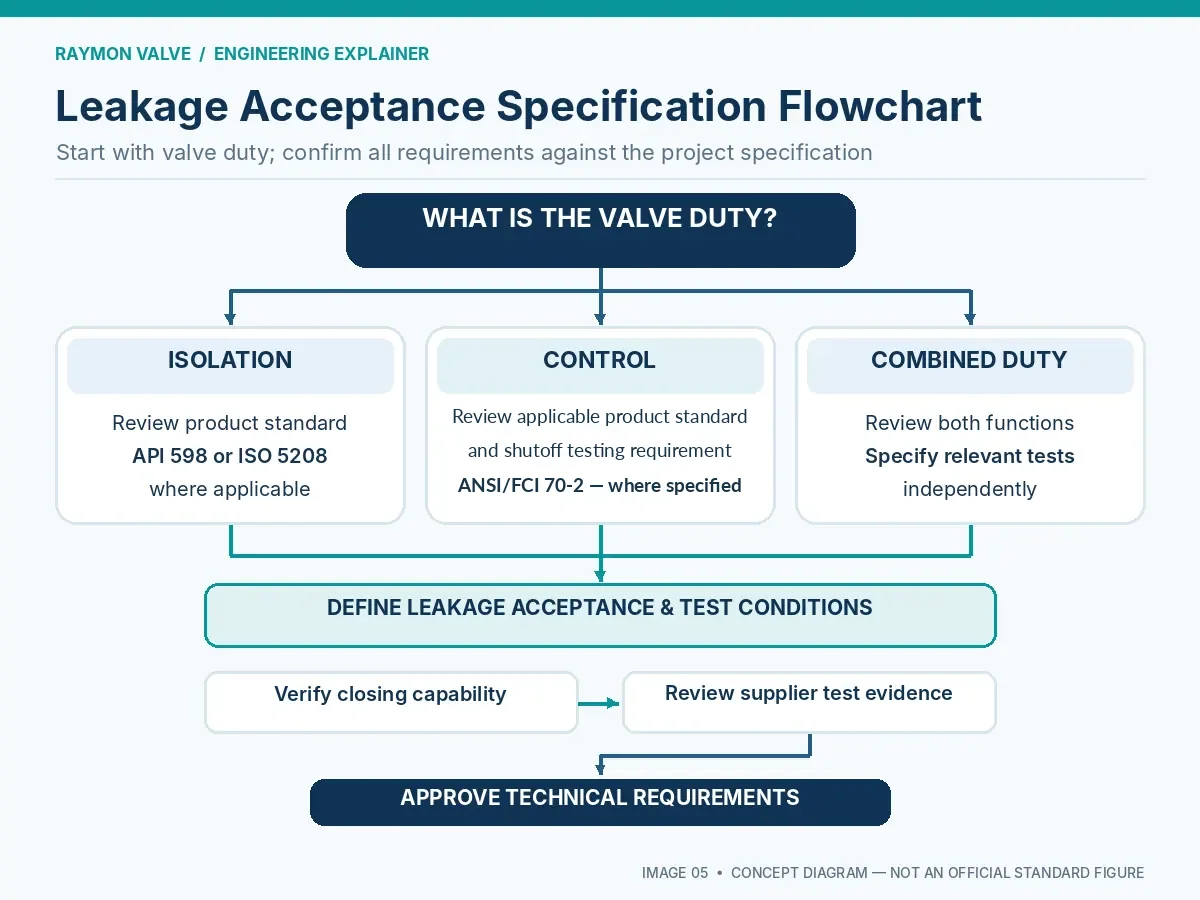
Isolation valve leakage acceptance is not the same as a control valve shutoff class. API 598 and ISO 5208 prescribe industrial valve pressure and closure-testing requirements within their applicable scopes; ANSI/FCI 70-2 addresses control valve seat leakage classes. An ISO 5208 Rate A result cannot automatically be reported as FCI Class VI, or vice versa. The distinction matters when engineers specify an isolation barrier, size the closing actuator, review a supplier test report or compare bids. Start with valve duty, then verify the governing product standard, acceptance criterion, test conditions and documented evidence.
Specification rule: Do not accept “bubble-tight,” “Rate A / Class VI equivalent” or “API 598 tested” without the exact applicable standard, test medium, differential pressure, duration, sealing direction, permissible leakage and measured or observed result. A factory seat test is not by itself a safe-isolation qualification.
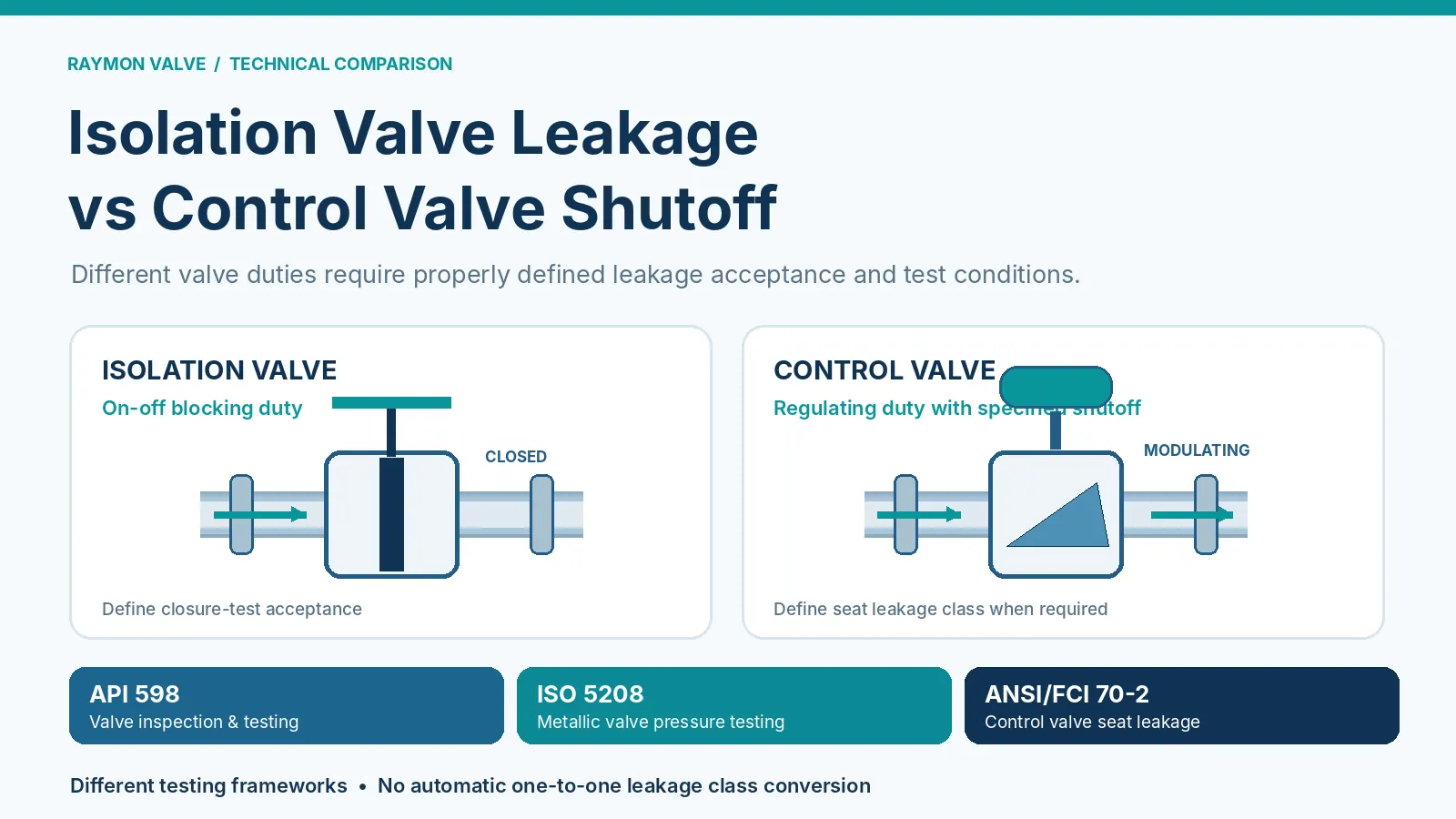
1. API 598 vs ISO 5208 vs ANSI/FCI 70-2: Quick Comparison
All three standards are relevant to leakage evaluation, but they establish different testing and acceptance frameworks. The distinction is not just the amount of leakage permitted: it is also how each standard defines the test, the applicable valve type, the measurement procedure and the acceptance criterion.
| Vergleich | API 598 | ISO 5208 | ANSI/FCI 70-2 |
|---|---|---|---|
| Primary purpose | Inspection and pressure testing of specified industrial valves | Pressure-boundary integrity and closure tightness testing for metallic valves | Control valve seat leakage testing and classification |
| Typical applications | Specified gate, globe, plug, ball, check and butterfly valves | Industrial metallic valves within the applicable product-standard scope | Control valves requiring a defined shutoff leakage class |
| Acceptance basis | Applicable closure-test and seat-construction requirements | Specified closure leakage rate and corresponding test conditions | Specified control valve seat leakage class and test method |
| Buyer should verify | Valve type, seat, test medium, pressure, direction, duration and result | Product standard, rate, fluid, closure conditions and measurement | Class, test procedure, trim and closing-force capability |
| What a pass does not prove | Sealing throughout every operating scenario | Universal service suitability or equivalence to another standard | Suitability for safety or maintenance isolation by class alone |
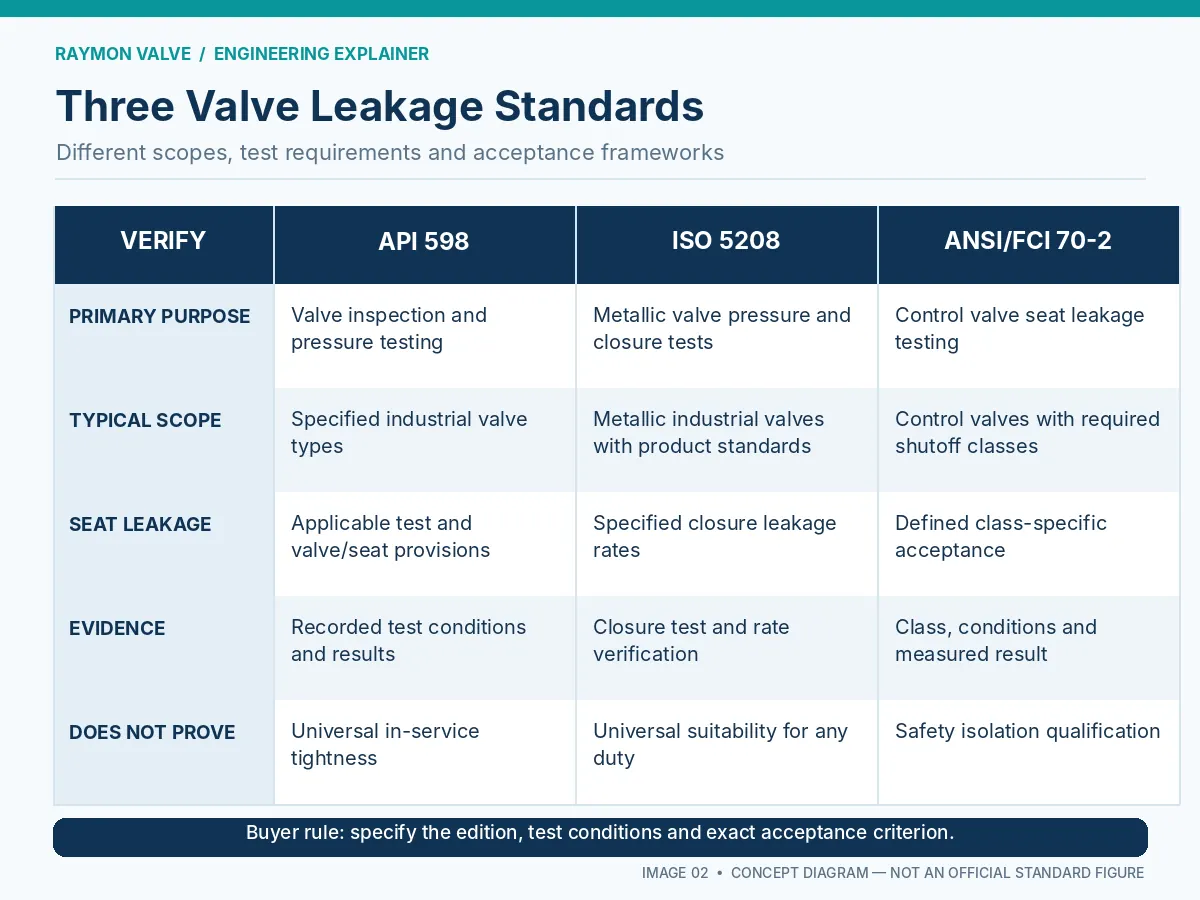
API 598:2023 covers inspection and testing for several industrial valve types. ISO 5208:2015 is a pressure-testing framework for metallic valves, used alongside relevant product standards. ANSI/FCI 70-2-2021 focuses on control valve seat leakage testing. Specify the governing standard and edition in the purchase documents rather than treating a leakage label as a standalone requirement.
2. Isolation Valve Leakage vs Control Valve Shutoff: What Changes?
Isolation duty: blocking flow under specified conditions
An isolation valve primarily establishes or interrupts a flow path. Ball, gate, butterfly, plug and certain globe valves may perform this duty depending on the application. Engineers need to define the closed-valve pressure differential, required sealing direction, media compatibility, temperature and permitted internal leakage. The failure consequences and required isolation philosophy also matter.
Passing a factory seat test demonstrates that a particular valve met a defined acceptance criterion at the recorded test conditions. Ingenieurbeispiel: a line valve accepted during an ambient-temperature seat test may later encounter elevated temperature or abrasive particles. The test result cannot resolve whether the seat retains its sealing capability after thermal exposure or wear; the project must check seat temperature limits, solids, cycling and the isolation consequence before assigning barrier duty.
Control duty: modulating flow with a separately defined shutoff requirement
A control valve regulates flow, pressure, temperature or another process variable by changing its opening. It may also be required to limit leakage when commanded closed. A control valve can meet the specified modulating duty while allowing a defined amount of leakage at the seat; flow capacity and characteristic do not establish the shutoff class.
Requiring tighter shutoff may change trim contact geometry, seat materials, required seating load, actuator thrust and cost. Ingenieurbeispiel: if a control valve is quoted for the required leakage class but the stated actuator air supply or maximum shutoff differential is missing, the purchaser cannot conclude the assembled valve will develop sufficient closing force. Request the verified shutoff case and actuator sizing basis; control valve product and selection information provides additional product context.
Seat leakage, shell leakage and fugitive emissions are different
Sitzleckage is internal flow past the closed valve. Shell leakage is leakage across the pressure boundary. Fugitive Emissionen (Leckage) involve unintended external releases, often through stem packing or other interfaces. Acceptable shell-test or emissions results do not establish seat tightness, and a passing seat test does not prove external sealing performance.
Which shutoff requirement belongs in the procurement specification?
Start with the consequence of leakage, not the most demanding-sounding class. The specified closed-valve duty determines what must be demonstrated by the supplier; a product-standard test and an operational barrier assessment address different questions.
| Duty or concern | First specification decision | Additional evidence needed |
|---|---|---|
| Routine on/off isolation | Identify valve product standard and applicable closure leakage acceptance | Seat design, both required seating directions, test results and service compatibility |
| Modulating control with closed-position leakage limit | State the ANSI/FCI 70-2 class where applicable | Trim, maximum shutoff ΔP, actuator closing capability and class-specific test record |
| Control plus independent block function | Specify each valve’s duty and acceptance test separately | Piping arrangement, isolation philosophy and separate test evidence |
| Maintenance or safety-critical isolation | Establish the system’s approved isolation requirements before selecting an acceptance label | Barrier analysis, applicable site procedures, valve suitability and any additional verification |
The same pressure class or nominal size does not resolve these differences. A low permissible factory leakage value cannot replace confirmation that the specified valve arrangement is appropriate for the system’s isolation objective.
3. API 598: Seat Leakage Acceptance for Industrial Valves
Scope and product-standard relationship
API 598 addresses inspection, examination and pressure testing of the specified gate, globe, plug, ball, check and butterfly valve types. The governing product standard and project purchase specification must also be reviewed. Applicability to a nonstandard configuration should be agreed upon rather than inferred from the valve’s appearance.
Product standard versus test standard: A project may specify a gate, ball, globe or butterfly valve product standard that invokes API 598 for inspection and testing. The purchaser should verify that relationship in the quoted edition rather than citing API 598 as proof of a valve’s pressure-temperature design suitability.
Resilient-seated vs metal-seated valves
Resilient seats use materials and contact geometry that can conform to mating surfaces. Metal seats rely on engineered metallic sealing contact, where surface finish, seat load, temperature and wear can matter. The applicable API 598 closure acceptance depends on the valve and seat construction, rather than one universal leakage allowance for all valves.
Ingenieurbeispiel: a bid for a soft-seated ball valve and a bid for a metal-seated check valve may both state “API 598 compliant,” while applying different closure acceptance provisions. The problem is not the standard citation itself but the missing valve-specific acceptance basis. Compare each offer against its applicable product standard, seat construction, prescribed test and actual leakage observation before treating the bids as technically equivalent.
For further context on seat construction and material selection, review valve seat and sealing-surface materials.
Test scope and evidence
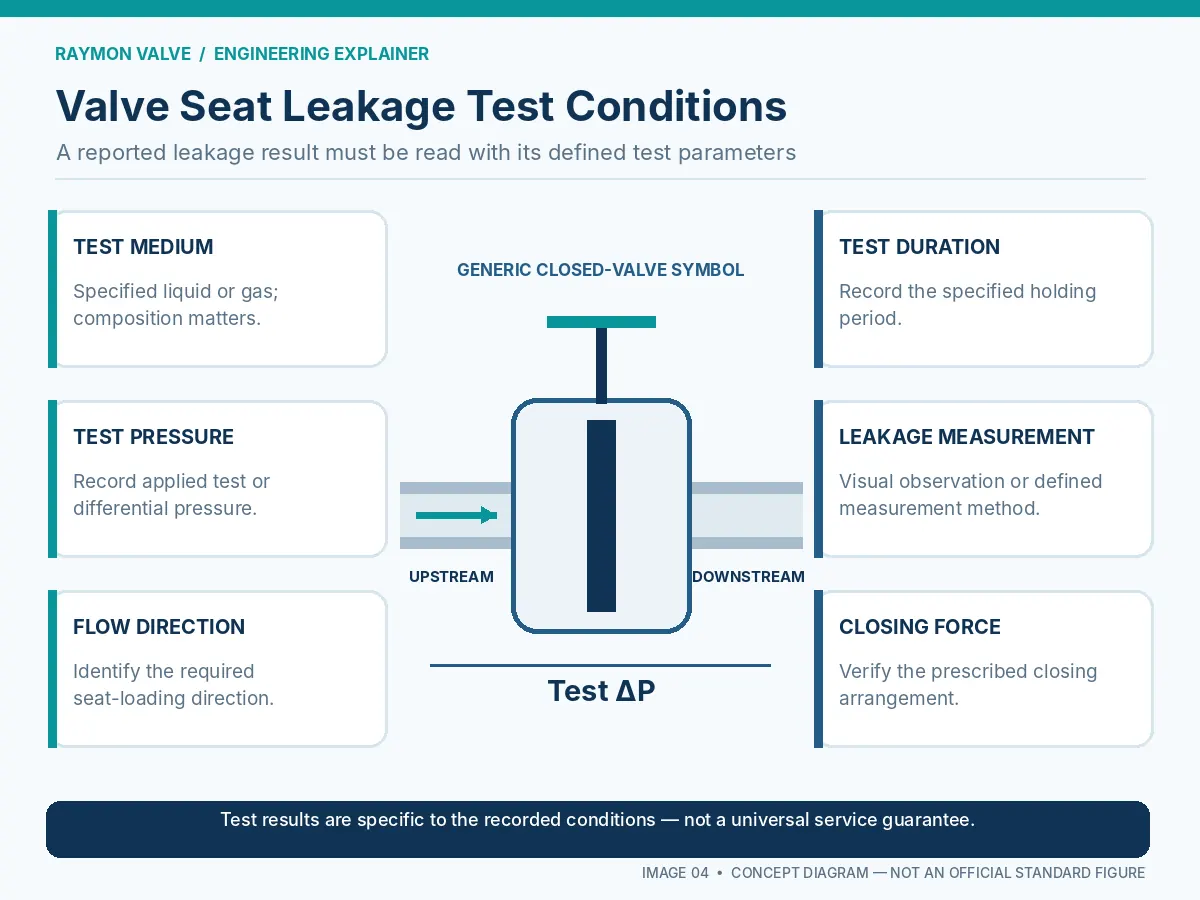
The purchase specification should address applicable shell, backseat and closure tests; test medium; pressure; duration; closure direction; witness points and exceptions. The supplier’s inspection and test plan should show which tests apply to the offered valve, with traceable recorded results.
Technische Anmerkung: “API 598 tested” is not a complete seat-leakage acceptance statement when the buying decision depends on a particular test result. Request the applicable test requirements and report. For broader context, see industrial valve pressure testing.
4. ISO 5208: Closure-Tightness Testing and Leakage Rates
Scope and relationship to product standards
ISO 5208:2015 specifies examinations and tests used to assess pressure-boundary integrity, closure tightness and the structural adequacy of the closing mechanism of industrial metallic valves. It is intended to be used with the applicable product standard where that standard cites it. If product-standard requirements differ, the product-standard requirements govern according to ISO’s published scope statement. ISO also states that the document does not address the safety aspects of pressure testing; an approved safe test procedure is a separate obligation.
How leakage rates should be interpreted
ISO 5208 designates closure leakage rates, including Rate A. The required rate must be linked to the applicable product standard and agreed purchase specification; other rates may involve a defined permissible measured leakage quantity using the relevant test-fluid and valve-size basis. Do not select a rate from the seat material name or pressure class alone. Ask whether the named closure test, acceptance method and permitted rate correspond to the exact valve on the datasheet.
What Rate A actually means
ISO 5208 Rate A is associated with no visually detectable leakage under the prescribed closure-test conditions. This is not a promise of no molecular leakage at every operating pressure, temperature or duration. Sealing performance can change through thermal cycling, corrosion, particulates, wear or reverse pressure direction.
An engineering specification may cross-reference API 598 and ISO 5208, but a cross-reference is not a general acceptance equivalence. Any proposed correspondence must be verified in the controlled editions for the exact valve and seat construction, applicable product standard, test medium, pressure and leakage criterion. The ISO product-standard precedence described above applies only within ISO 5208’s stated scope. See the ISO 5208:2015 official publication and Raymon Valve’s valve standards resource.
5. ANSI/FCI 70-2: Control Valve Seat Leakage Classes I to VI
ANSI/FCI 70-2-2021 establishes control valve seat leakage classes and production test procedures. It is not a predictive calculation of leakage at untested service conditions. Its classification is not a naming alternative for ISO 5208 leakage rates. A credible Class IV, V or VI offer should identify the trim and seat configuration, test procedure, relevant test differential, leakage criterion and closing-force capability of the quoted assembly.
What the classes describe
The standard’s classification system includes Classes I through VI, but an RFQ should refer to the specific class required and its associated procedure rather than using a generic “tight shutoff” label. In practice, Classes IV, V and VI often arise in control valve discussions; their acceptance criteria are not all expressed using the same basis.
| Class group | General acceptance concept | Käuferverifizierung |
|---|---|---|
| Class I | Special classification; the class label alone does not establish whether a production seat-leakage test was performed | Confirm the controlled 2021 edition, purchaser–supplier agreement and any contractual test evidence; do not infer a measured result |
| Classes II, III and IV | Allowable leakage is related to rated valve capacity under a specified test procedure | Confirm rated-capacity basis, exact class, test fluid and conditions |
| Class V | Separate acceptance basis involving seat/port geometry and differential pressure under its prescribed procedure | Confirm relevant port dimension, shutoff pressure and test method |
| Class VI | Defined limited leakage allowance associated with the applicable size and gas-test arrangement | Confirm seat/port dimension, required gas method, acceptance and closing assembly |
The table summarizes different calculation and test foundations, not the exact permissible values. Class I test and agreement provisions must be checked against the controlled ANSI/FCI 70-2-2021 edition; a historical-edition description should not be presumed unchanged. Use the controlled standard to establish limits and procedures for a purchase order; do not substitute an internet conversion chart or an unspecified “bubble-tight” statement.
Source applicability: The Fluid Controls Institute’s public information sheet explains why seat-leakage benchmarks and specified tests matter. It does not provide the full Class I–VI acceptance tables, test details or proof of a particular valve assembly’s conformity. For those requirements, use the licensed ANSI/FCI 70-2-2021 standard and traceable supplier documentation.
Why IV, V and VI cannot be compared from labels alone
Different classes use different acceptance and measurement foundations, which may reference rated flow capacity, differential pressure, seat or port dimensions and prescribed observation or measurement arrangements. Ingenieurbeispiel: one supplier may quote Class V and another Class VI for an otherwise comparable control duty. The higher-looking class number does not settle the procurement decision because the test bases differ. Request both suppliers’ proposed leakage acceptance calculations and test conditions, then obtain purchaser engineering approval for any alternative class. Do not calculate an exact allowed rate without the controlled ANSI/FCI edition and the valve-specific inputs.
Shutoff differential pressure and actuator closing force
Closing forces can include pressure-induced unbalanced loads, required seat contact load, packing friction, guiding friction and mechanical resistance. The relevant closing pressure or torque needs to be verified using manufacturer data, actual shutoff differential pressure, available utilities and failure-action requirements. Leakage class alone cannot establish actuator sizing or field shutoff capability.
The applicable publication is ANSI/FCI 70-2-2021, listed by the Fluid Controls Institute.
6. Is ISO 5208 Rate A Equivalent to ANSI/FCI Class VI?
Nein. ISO 5208 Rate A and ANSI/FCI Class VI are not universally equivalent. Rate A uses a specified no-visually-detectable-leakage criterion; Class VI permits a defined limited quantity under its control-valve test procedure. Different fluids, pressure conditions, measurement methods and seat/port parameters prevent a general one-to-one conversion. Neither label alone proves that the valve will provide an approved isolation barrier or the same leakage performance in service.
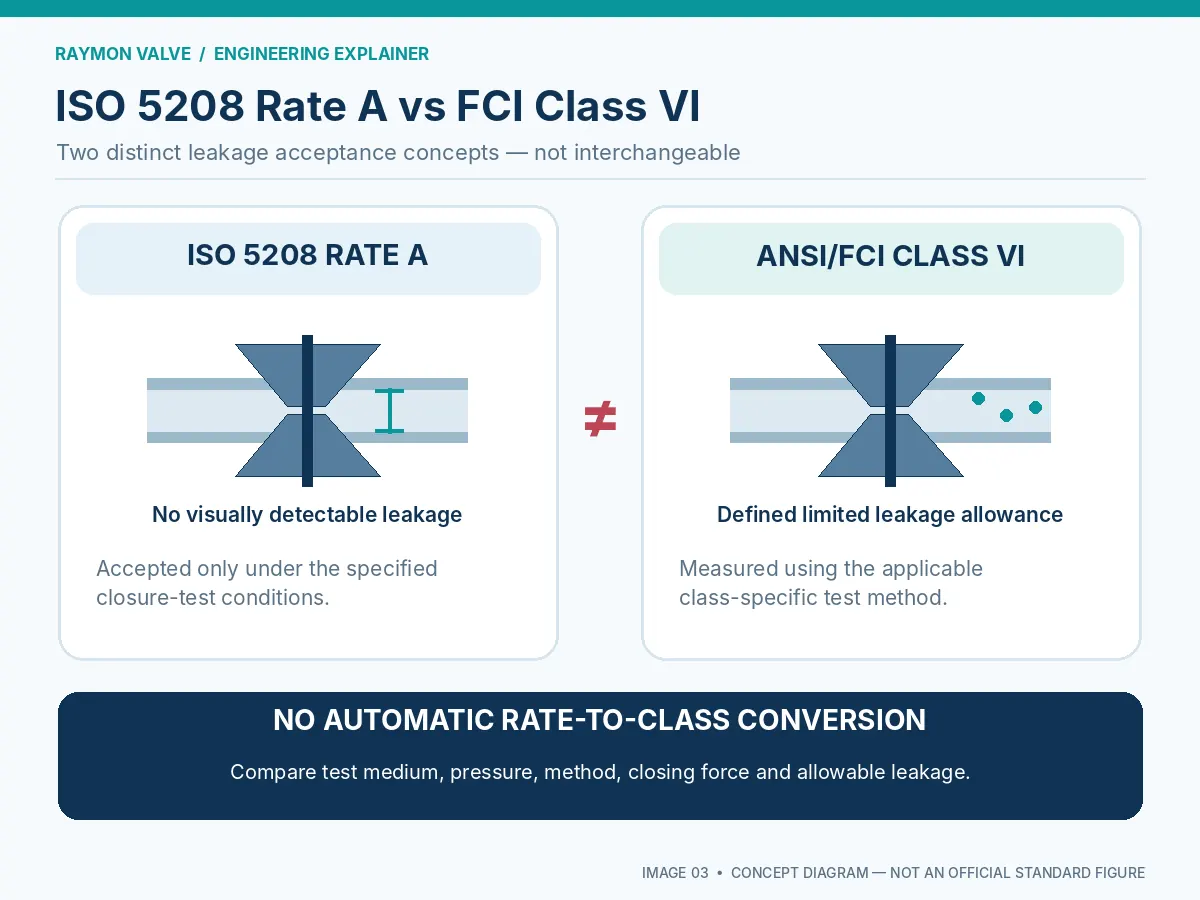
ISO 5208 Rate A is an observation-based closure-tightness acceptance concept: no visually detectable leakage under the prescribed test conditions. ANSI/FCI Class VI permits a defined limited leakage quantity assessed by the applicable control-valve procedure. A visually observed absence of leakage is not the same as a measured numerical zero, and a Class VI test is not a Rate A test. Neither result should be extrapolated to different service temperatures, differential pressures or operating histories without engineering evidence.
| Verification factor | ISO 5208 Rate A | ANSI/FCI Class VI |
|---|---|---|
| Framework | Industrial metallic valve closure testing | Control valve seat leakage testing |
| Acceptance concept | No visually detectable leakage under defined test conditions | Defined limited leakage acceptance under a class-specific method |
| Prüfmedium | As required by the applicable closure-test procedure | As required by the class-specific procedure |
| Prüfdruck | As required by the governing product and test specifications | As required by the ANSI/FCI class-specific conditions |
| Measurement | Defined observation requirements | Defined leakage measurement and acceptance requirements |
| Direct conversion | No universal conversion or relative strictness ranking; any proposed comparison requires a validated shared basis and the controlled standards. | |
If a purchase specification requires both pressure testing and a separate control-valve leakage test, it must explain which tests apply and how they are accepted. A separate seat test does not replace required pressure-boundary tests. Do not write “ISO Rate A / Class VI equivalent” without a justified, approved technical basis.
Review before accepting a claimed cross-standard equivalent: Ask the supplier to identify the exact standard edition, tested valve assembly, seat/port dimensions, acceptance basis, fluid, differential pressure, observation or measurement method, closing method and actual recorded result. Where these cannot be reconciled with the purchase specification, treat the claim as a technical deviation—not as automatic equivalence.
7. How Should Engineers Specify Leakage Acceptance in an RFQ?
The following are hypothetical specification examples, not records of completed Raymon Valve customer projects or claims about specific valve performance.
Example 1 — Soft-Seated Ball Valve for On-Off Isolation
Duty: Block flow in a compatible process service. Test basis: Identify the product standard and the applicable API 598 or ISO 5208 closure test. Verify: Medium, pressure and temperature, seating direction, seat compatibility, permissible leakage and documented results.
Limit: A resilient seat may provide tight shutoff under specified conditions, but service temperature, solids, chemicals and cycling still require review. Explore relevant industrial ball valve constructions.
For a focused comparison of sealing design and application limits, see soft-seated vs metal-seated ball valve selection.
Example 2 — Metal-Seated Gate Valve for High-Temperature Isolation
Duty: Isolate a hot piping system. Test basis: Apply the relevant gate valve product and pressure-test requirements. Verify: Seat and wedge design, thermal cycling, maximum closed differential pressure, required leakage and test evidence.
Limit: Do not import an unrelated control valve class into the requirement by default. High-temperature service behavior is not proven by a room-temperature factory closure test alone.
Example 3 — Globe Control Valve Requiring Class IV or V
Duty: Regulate process flow with a defined leakage allowance when closed. Test basis: Specify the required ANSI/FCI 70-2 class and applicable procedure. Verify: Flow cases, trim, seat construction, shutoff ΔP and actuator closing-force margin.
Limit: Moving from Class IV to Class V may require technical changes to the seat, trim or actuator; it is not just a datasheet wording change.
Example 4 — Control Valve with a Separate Block Valve
Duty: Control flow using one valve and provide isolation using a separate block valve. Test basis: Specify the control valve’s leakage class and the isolation valve’s relevant product and closure-testing requirements independently.
Limit: A separate block valve does not automatically establish an approved safe isolation arrangement. Barrier integrity and maintenance or shutdown philosophy require system-level engineering review.
RFQ specification checklist
| Feld | Erforderliche Eingaben | Grund |
|---|---|---|
| Ventilfunktion | Isolation / control / combined duty | Establishes the service purpose |
| Type and seat | Exact valve and sealing construction | Governs available tests and seat behavior |
| Fluid and service | Composition, phase, contaminants, temperatures, pressure | Determines operating and sealing risks |
| Shutoff ΔP | Maximum required closed differential pressure | Relevant to seat load and actuation |
| Governing standards | Complete design/product/test designations and editions | Prevents ambiguity |
| Acceptance criterion | Exact rate, class or numeric permitted leakage | Defines test acceptance |
| Procedure | Fluid, pressure, direction, duration, measurement | Allows reproducible testing |
| Antrieb | Closing method, available power, fail position | Validates closing capability |
| Inspection and records | ITP, witness point, report, deviation handling | Supports technical acceptance |
Before comparing commercial quotations, resolve any difference that changes the test basis, seat construction or required shutoff capability.
Example purchase-specification wording
The following is an illustrative RFQ template. Values and standards must be filled in using the approved project datasheet; the brackets are not test requirements by themselves.
Valve duty: [isolation/control/combined]. Applicable valve product standard and edition: [ ]. Leakage test standard and edition: [ ]. Required seat leakage class/rate/limit: [ ]. Test medium: [ ]. Test pressure / differential pressure: [ ]. Test direction(s): [ ]. Test duration and measurement method: [ ]. Valve assembly and actuation during test: [ ]. Required report, witness point and deviation approval: [ ].
How to normalize competing technical bids
When offers describe seat tightness differently, create a technical deviation register before comparing price. These are examples of document review actions, not manufacturer test results.
| RFQ requirement | Illustrative supplier response | Engineering action |
|---|---|---|
| ANSI/FCI Class V required | Offers Class IV | Log as deviation; do not approve as equivalent without formal technical review |
| ISO 5208 Rate A required | States “bubble-tight” only | Request exact rate, test standard/edition, medium, conditions and report |
| Maximum shutoff ΔP is specified | Reports leakage class but no available actuator closing-force evidence | Request actuator/trim confirmation for the actual differential-pressure duty |
| Purchaser requires witnessed testing | Provides generic catalogue claim | Confirm ITP hold/witness point and tag-specific record requirements before order approval |
Illustrative clarification: If an RFQ specifies an ISO 5208 Rate A closure test but a supplier quotation states only “tight shutoff,” return the offer for clarification: request the applicable standard and edition, test medium, differential pressure, duration, observation method and the proposed acceptance record. Keep the bid technically open until the purchaser accepts the response or approves a documented deviation.
Bid review principle: A supplier’s proposed alternative test may be acceptable only after the purchaser has evaluated its scope, acceptance basis and deviations. A lower price does not remove a contractual testing requirement.
Practical bid-approval checkpoint: Before issuing a purchase order, record the requested leakage class or rate, the supplier-offered criterion, any departure in test conditions, the associated actuator or seat changes, and the name or role of the party approving the deviation. Where evidence is incomplete, status the item as clarification required, not compliant. This avoids a later factory acceptance dispute over a supposedly equivalent shutoff requirement.
8. What Should a Valve Seat Leakage Test Report Include?
“Leak test passed” is not enough if the report does not establish which valve was tested, the specified limits and actual conditions. The required record depth depends on the project’s inspection and test plan (ITP).
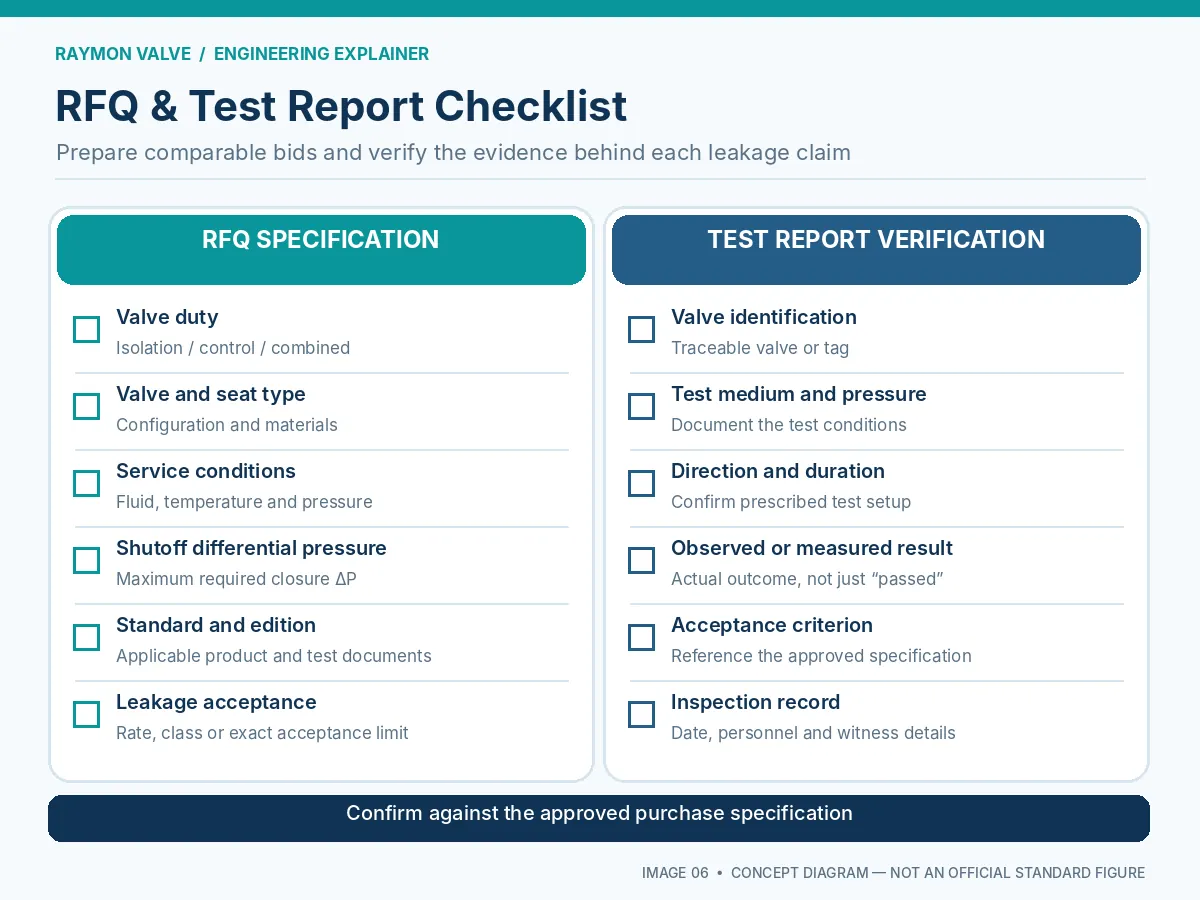
| Report item | Verifizierungsfrage |
|---|---|
| Identification and configuration | Does the result match the valve tag, model, seat and quoted assembly? |
| Standard and edition | Is the governing acceptance procedure unambiguously identified? |
| Leakage acceptance | Is the required class, rate or limit specified? |
| Test medium and pressure | Do they match the approved procedure? |
| Direction and duration | Were the required orientation and time met? |
| Measured/observed result | Is actual evidence recorded rather than a bare “pass” statement? |
| Measurement traceability | Is relevant equipment identified and calibration traceable? |
| Witness and approval | Were the agreed ITP witness/hold points completed? |
| Exceptions and retests | Are deviations and corrective actions recorded and approved? |
Minimum evidence example: For the actual supplied valve or tag, the acceptance record should identify the test standard and edition, medium, applied differential pressure, test duration, seating direction, applicable acceptance limit, observed or measured leakage result, test date, and sign-off or witness evidence when required by the ITP. A classification or “pass” field without the recorded conditions does not allow a buyer to independently compare different test methods.
Inspectors should match the test record to the valve identification, seat construction and offered actuator or closing method. Check that the actual result was recorded in the same units and observation basis as the purchase acceptance criterion, and that relevant equipment identification and calibration status can be traced where required by the ITP. Example: a report bearing only a “PASS” stamp but omitting the test differential or actual leakage result cannot substantiate a cross-supplier comparison. A witnessed test alone does not establish compliance with every project requirement; deviations still need purchaser approval.
What evidence is still missing after a “pass” result?
A test record can demonstrate the result of a particular factory inspection. It does not, on its own, document pressure-temperature rating suitability, fire-safe qualification, material traceability, non-destructive examinations or fugitive-emission performance. If the project requires these, list them as separate datasheet or ITP deliverables and assess their supporting records individually.
For valve assemblies with actuators, confirm whether the tested configuration and available closing force represent the offered assembly. For multi-directional shutoff requirements, ensure every required direction is included in the approved testing scope.
9. Common Mistakes When Comparing Leakage Requirements
- Calling Rate A and Class VI equivalent: The two standards do not share a universal one-to-one acceptance basis.
- Specifying Class VI without assembly review: The valve trim, seating force and actuator capability may be affected.
- Ignoring medium, pressure and direction: Results obtained under different test conditions are not automatically comparable.
- Promising field performance from factory testing: Temperature, solids, wear, cycling and corrosion can change leakage behavior.
- Confusing seat, shell and fugitive leakage: Each requires its own relevant acceptance evidence.
- Comparing bids before normalizing requirements: Suppliers may offer different test bases, seat constructions or deviations.
10. Final Specification Checklist and Engineering Recommendation
Isolation valve leakage and control valve shutoff classifications are separate specification decisions. API 598, ISO 5208 and ANSI/FCI 70-2 each have a defined purpose and should be applied only within their relevant scopes.
- Define isolation, control or combined duty.
- Identify the applicable product and testing standards, including editions.
- State the exact required leakage rate, class or acceptance limit.
- Specify medium, pressure, duration and test direction.
- Verify seat construction and closing-force or actuator capability.
- Request traceable inspection records and explicitly resolve deviations.
A reliable procurement decision depends on the complete datasheet, actual service conditions, project specifications and documented evidence—not a leakage class label alone.
Häufig gestellte Fragen
Is API 598 equivalent to ANSI/FCI 70-2 for valve seat leakage?
No. API 598 covers inspection and pressure testing for specified industrial valves; ANSI/FCI 70-2 defines control valve seat leakage testing requirements. Their acceptance criteria and methods must be evaluated separately.
Is ISO 5208 Rate A the same as ANSI/FCI Class VI?
No. Rate A is a specified no-visually-detectable-leakage acceptance criterion under ISO 5208, whereas Class VI permits a defined quantity under the ANSI/FCI control valve test method. Verify the medium, pressure, measurement basis and exact requirement; do not write them as interchangeable.
Does Class VI mean zero leakage in a control valve?
No. Class VI is a specified seat leakage classification, not an absolute zero-leakage guarantee. Results apply to the defined test and acceptance conditions.
Can a control valve be used as an isolation valve?
Only when its complete design, actuation and system isolation arrangement satisfy the approved service and isolation requirements. An ANSI/FCI leakage class alone is not proof of safe maintenance or emergency isolation.
What should a buyer specify for valve leakage testing?
The RFQ should state valve duty and construction, media, pressure and temperature, maximum shutoff differential pressure, applicable test standard and edition, acceptance criterion, test conditions, inspection points and required documentation.
Request a Leakage Acceptance & Testing Review
Send the valve function, process medium and phase, design/operating pressure and temperature, maximum closed-valve differential pressure, valve and seat construction, required leakage rate or class, applicable product and test-standard editions, and any actuator supply or fail-position constraints. Include drawings, the ITP and proposed test-report or deviation requirements where available. These details allow Raymon Valve to discuss a quotation and documentation scope; final valve suitability and test acceptance require project-specific engineering confirmation.
Submit Your Valve DatasheetTechnical References
- API source-inspector publication effectivity sheet (identifies API Std 598, 11th edition, February 2023; not the acceptance clauses of the standard).
- American Petroleum Institute — Standards (official standards organization).
- ISO 5208:2015 — Industrial valves — Pressure testing of metallic valves.
- Fluid Controls Institute — ANSI/FCI 70-2-2021 standard listing (edition and title).
- Fluid Controls Institute — ANSI/FCI 70-2 informational sheet (background on the purpose of seat-leakage testing; not the licensed acceptance tables).
Technische Einschränkung: This article is preliminary technical and RFQ guidance, not a substitute for the controlled standard, applicable code, approved procurement specification, sizing calculation, manufacturer test evidence or responsible-engineer review. Confirm all leakage limits, formulas and product-specific test provisions in the editions applicable to the project.
Prepared by Raymon Valve Technical Content Team. No individual engineer certification or product-specific conformity is implied.
Nachweisgrenze: Standard publication details and general methods are verified from public sources, but exact tabulated leakage limits, purchase-order acceptance clauses, manufacturing capabilities and valve-specific claims require the controlled edition and actual manufacturer records. Images on this page are technical illustrations, not test certificates or photographs of an approved project.
 German
 English
 Arabic
 French
 Spanish
 Italian
 Portuguese
 Russian