Ball Valve Engineering Guide
Ball Valve Materials Guide: Carbon Steel, Stainless Steel, Alloy Steel, and Seat Materials
Selecting the right ball valve materials is not only a purchasing decision. It is an engineering decision that affects corrosion resistance, pressure-temperature capability, sealing reliability, operating torque, maintenance interval, and the service life of the complete piping system.
Ball Valve Materials Guide: Carbon Steel, Stainless Steel, Alloy Steel, and Seat Materials 7
A ball valve may have the correct size, pressure class, and end connection, but if the body material, ball material, stem material, seat material, packing, or bolting is not compatible with the actual service, the valve can still leak, seize, corrode, or fail early. In many field cases, the problem is not the nominal valve size. The problem is a material package that was never fully reviewed.
This guide explains how to select ball valve materials for industrial service, including carbon steel, stainless steel, alloy steel, duplex stainless steel, soft seat materials, metal seat materials, trim materials, and sealing materials. It is written for engineers, buyers, maintenance teams, and QC personnel who need a practical selection reference before ordering or replacing ball valves.
If you are reviewing a complete valve package, this article should be read together with our pages on industrial ball valves, floating ball valves, trunnion mounted ball valves, flanged ball valves, threaded ball valves, and metal seated ball valves.
Quick Selection Snapshot
The table below gives a practical starting point for selecting ball valve materials. It should not replace the project datasheet, but it helps identify which material issue usually controls the decision.
| Service Condition | Typical Starting Point | What Usually Controls the Decision | What Commonly Goes Wrong |
|---|
| General water, air, oil, and non-corrosive utility service | Carbon steel body with stainless steel ball and PTFE / RPTFE seats | Cost, pressure class, seat compatibility, coating protection | Body material is selected correctly, but seat and seal materials are left generic |
| Clean or mildly corrosive service | Stainless steel 304 / 316 body and trim | Corrosion resistance, cleanliness, chemical compatibility | 304 stainless steel is used where 316 or a higher alloy should be reviewed |
| Chloride-containing water, seawater, or offshore service | 316, duplex, super duplex, or special alloy review | Pitting, crevice corrosion, chloride stress corrosion cracking | “Stainless steel” is specified without checking chloride level, temperature, and standby exposure |
| High pressure gas or oil and gas service | Forged carbon steel or stainless steel with PEEK / Devlon / Nylon seats | Pressure load, seat deformation, fire-safe and anti-static requirements | PTFE seat is used where higher mechanical strength is required |
| High temperature service | Alloy steel or stainless steel body with graphite packing and metal seats | Temperature, thermal cycling, seat stability, packing material | Soft seat is selected beyond its reliable service boundary |
| Abrasive or solid-containing media | Metal seated ball valve with hard-coated ball and seats | Abrasion resistance, coating hardness, leakage class, torque | Soft seated valve is installed in dirty service and leaks after short operation |
| Sour gas or H₂S-containing service | NACE / ISO compliant material package | Material hardness, trim selection, bolting, sour service requirements | Only the body material is checked while trim and bolting are left as standard supply |
| Chemical service | Stainless steel, duplex, alloy, or lined construction | Actual chemical composition, concentration, temperature, cleaning cycle | Compatibility is checked only for normal medium, not cleaning or shutdown condition |
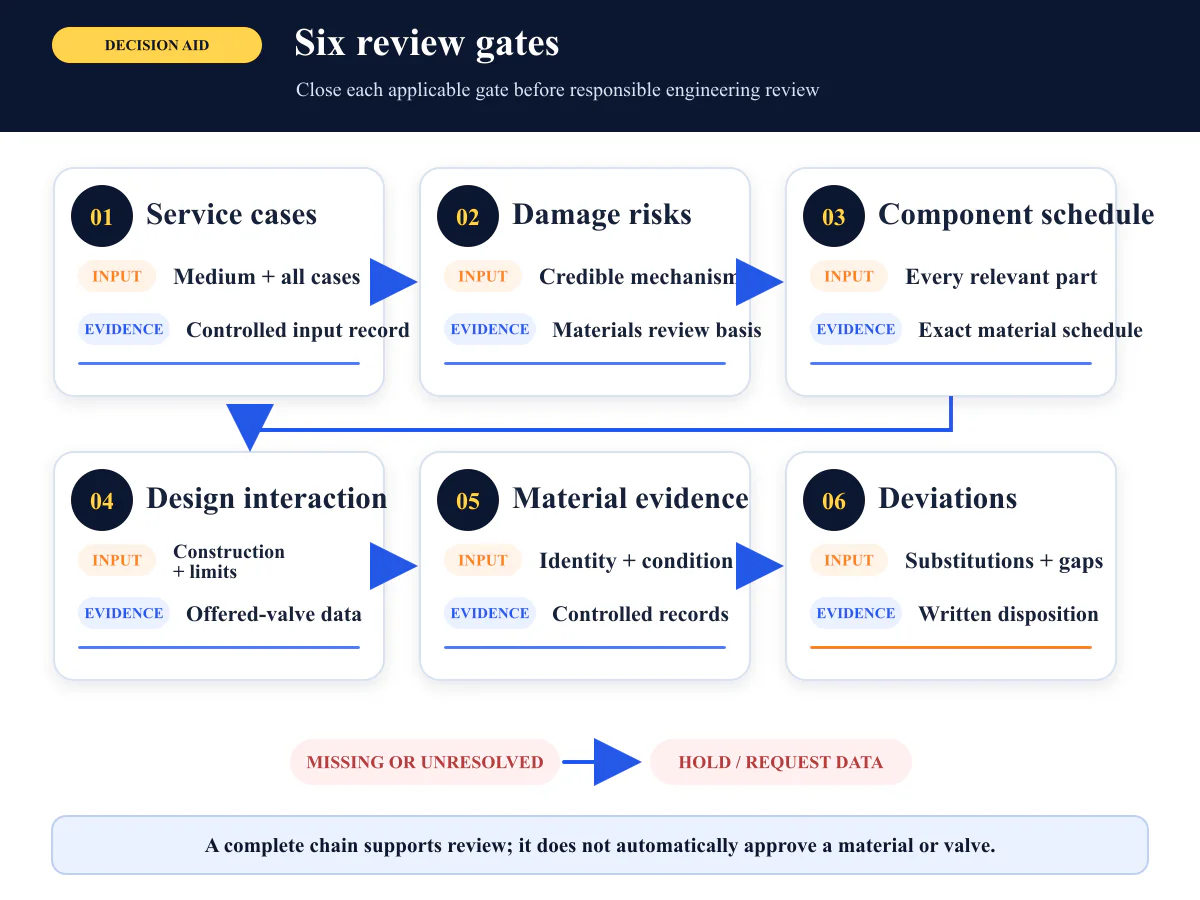
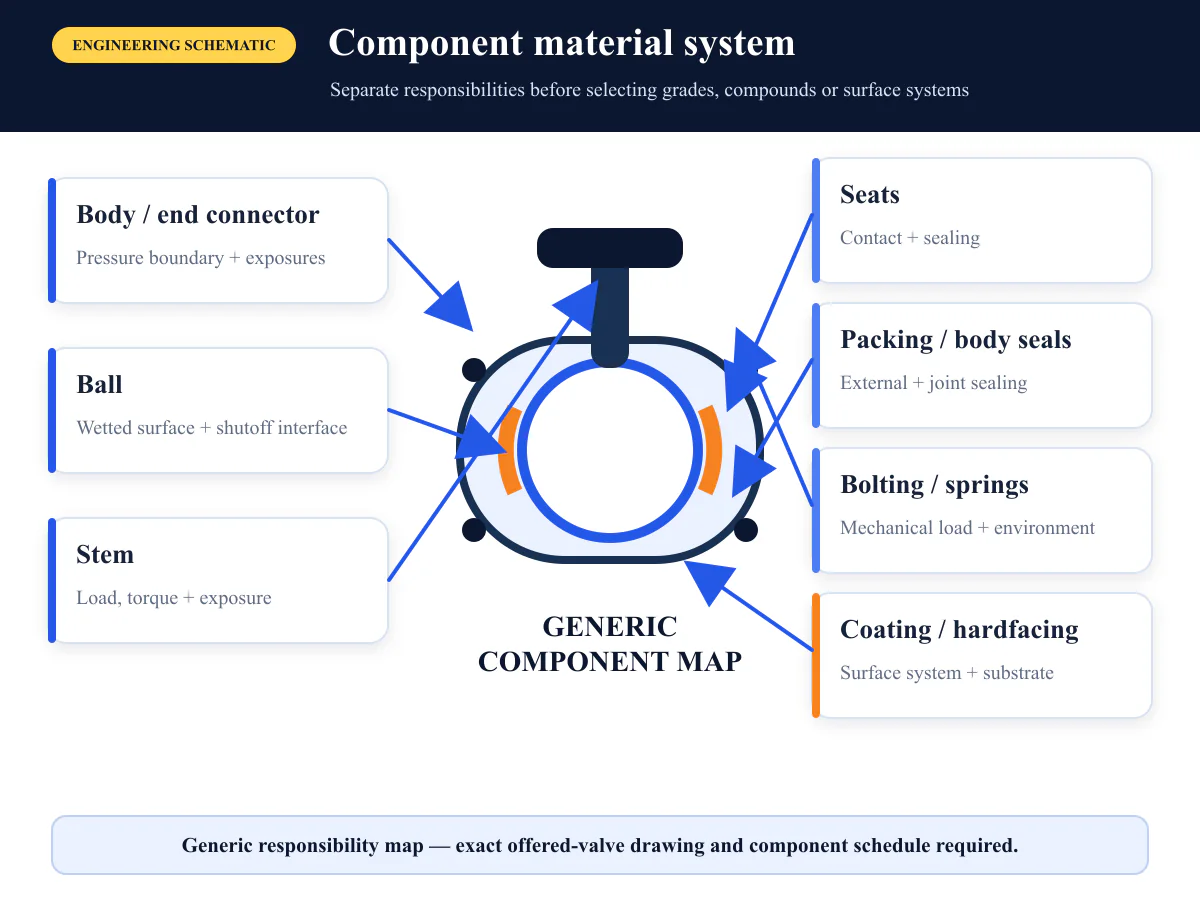
Engineering note: Ball valve material selection is incomplete if only the body material is defined. The ball, stem, seats, seals, packing, body gasket, bolting, and surface treatment must also be reviewed.
What Are Ball Valve Materials?
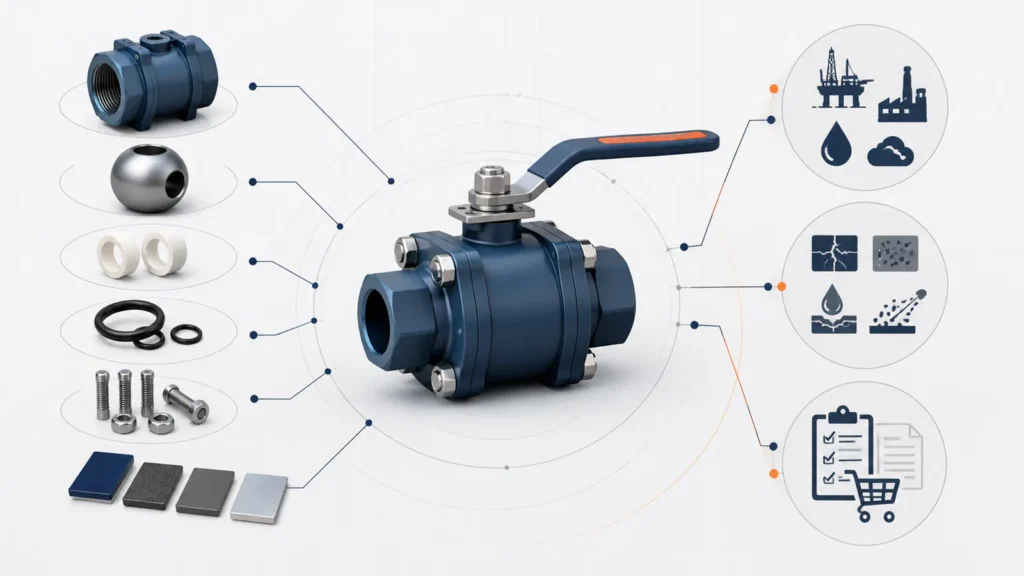
Ball valve materials refer to all materials used in the pressure-retaining, sealing, operating, and connecting parts of the valve. In a real valve datasheet, “material” should never mean only the valve body.
A complete material review normally includes:
- Body material
- End cap or body connector material
- Ball material
- Stem material
- Seat material
- Body seal material
- Stem packing material
- O-ring material
- Bolting material
- Surface coating or plating
- Hard-facing or hard coating
- Anti-corrosion treatment
- Fire-safe sealing arrangement, where required
A common purchasing mistake is to specify “WCB ball valve” or “SS316 ball valve” without defining the trim and seat material. Two valves with the same body material can perform very differently if one uses standard PTFE seats and the other uses PEEK seats, graphite packing, fire-safe sealing, and a hard-coated ball.
Field rule: Treat a ball valve as a material system, not as a single body casting or forging.
Why Ball Valve Material Selection Requires More Attention
Material Failure Usually Starts at the Weakest Component
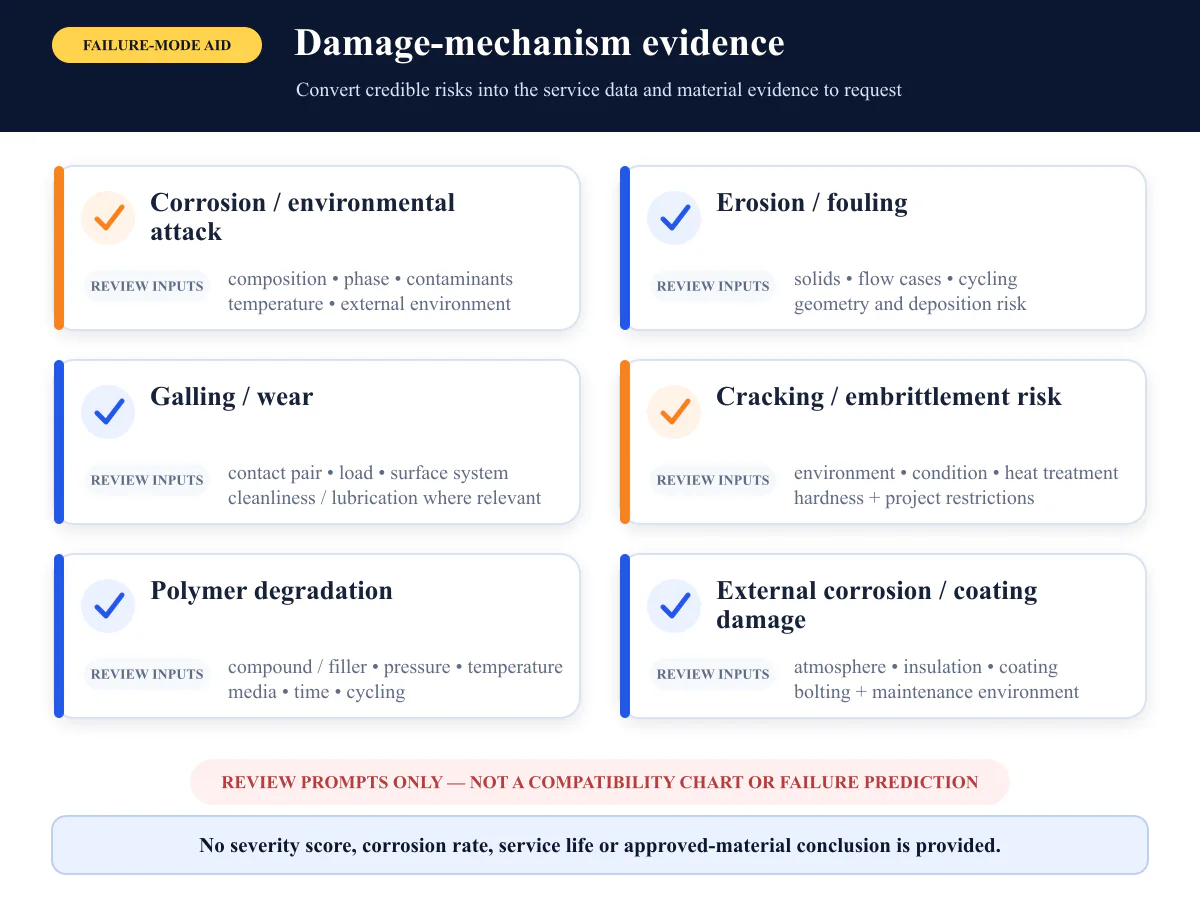
In many failed ball valves, the body is not the first part to fail. The first problem often appears at the seat, stem seal, ball surface, body gasket, or bolting. That is why a valve can pass hydrostatic testing in the workshop but still fail after months of service.
Common field problems include:
- Soft seat deformation under high pressure or high temperature
- Seat swelling caused by chemical incompatibility
- Ball surface scratching from solids or scale
- Stem corrosion due to external atmosphere or washdown chemicals
- Packing leakage after thermal cycling
- Body gasket failure because the gasket material was not checked against temperature
- High operating torque caused by deposits, seat damage, or corrosion products
- External corrosion at bolting, flange area, or valve cavity
The Service Medium Is Often More Complex Than the Line List
A line list may say “water,” but the actual service could be clean water, raw water, seawater, wastewater, hot water, chlorinated water, cooling tower water, or chemically treated water. These services do not require the same material package.
A line list may say “chemical,” but the material decision depends on chemical name, concentration, temperature, pressure, impurities, solids content, cleaning fluid, shutdown exposure, oxygen content, and chloride level.
Typical engineering range: For clean low-temperature utility service, PTFE or RPTFE seats are often reviewed first. For high pressure, elevated temperature, high cycle, abrasive, or dirty service, engineering plastics such as PEEK / Devlon or metal seats may become more suitable. The final limit must follow the seat manufacturer’s pressure-temperature chart and the valve design.
Main Parts of a Ball Valve and Material Responsibilities
Each valve part has a different material responsibility. A reliable datasheet should define the complete material package instead of leaving critical parts as “standard.”
| Ball Valve Part | Main Function | Material Selection Concern |
|---|
| Body | Pressure containment | Strength, corrosion resistance, pressure-temperature rating |
| End cap / body connector | Pressure containment and end connection | Material compatibility with the body and piping system |
| Ball | Flow isolation and sealing surface | Surface finish, corrosion resistance, coating hardness |
| Stem | Torque transmission | Strength, corrosion resistance, anti-blowout design |
| Seats | Main shutoff sealing | Chemical compatibility, temperature limit, deformation resistance |
| Body seals | Prevent external leakage at body joint | Temperature, fire-safe requirement, chemical compatibility |
| Stem packing | Prevent leakage around stem | Emission control, temperature, pressure, cycling |
| Bolting | Mechanical joint integrity | Strength, corrosion resistance, temperature, sour service |
| Coating / plating | Surface protection or wear resistance | Adhesion, hardness, corrosion resistance, abrasion resistance |
Carbon Steel Ball Valve Materials
Carbon steel is one of the most common materials for industrial ball valves. It provides good mechanical strength, wide availability, and relatively economical cost. Carbon steel ball valves are widely used in oil and gas, water, compressed air, fuel systems, utility service, and general industrial isolation.
Ball Valve Materials Guide: Carbon Steel, Stainless Steel, Alloy Steel, and Seat Materials 8
Common carbon steel materials include:
- ASTM A216 WCB for cast carbon steel valve bodies
- ASTM A105 for forged carbon steel valve bodies
- ASTM A350 LF2 for low temperature carbon steel service
- ASTM A352 LCC / LCB for selected low temperature cast steel applications
ASTM A216 covers carbon steel castings for valves, flanges, fittings, and other pressure-containing parts for high-temperature service. ASTM A105 covers forged carbon steel piping components such as flanges, fittings, valves, and similar parts for pressure systems. ASTM A216 material scope and ASTM A105 material scope should be checked when the material grade is part of the purchase requirement.
Where Carbon Steel Ball Valves Are Commonly Used
- General industrial service
- Non-corrosive water lines
- Oil and gas service
- Fuel oil systems
- Compressed air
- Utility lines
- Hydrocarbon service
- High pressure applications using forged construction
Advantages of Carbon Steel
| Advantage | What It Means in Practice |
|---|
| Good mechanical strength | Suitable for many pressure-retaining valve bodies |
| Cost-effective | Usually lower cost than stainless steel or alloy materials |
| Wide availability | Easy to source in cast and forged construction |
| Flexible design range | Available in floating, trunnion, flanged, threaded, and welded designs |
Limitations of Carbon Steel
Carbon steel is not suitable for every fluid. It can corrode in wet, acidic, chloride-containing, marine, or chemically aggressive environments. External corrosion may also be a problem in outdoor, coastal, underground, or chemical plant installations.
Carbon steel may require:
- Painting
- Epoxy coating
- Zinc-rich primer
- Special external coating
- Corrosion allowance
- Internal lining in selected cases
- Replacement with stainless steel or alloy material
Common mistake: Choosing carbon steel because the pressure class is correct while ignoring internal corrosion, external atmosphere, and shutdown exposure.
Stainless Steel Ball Valve Materials
Stainless steel ball valves are selected when corrosion resistance, cleanliness, chemical compatibility, or external environmental resistance is more important than initial cost.
Common stainless steel materials include:
- ASTM A351 CF8
- ASTM A351 CF8M
- ASTM A182 F304
- ASTM A182 F316
- ASTM A182 F316L
- ASTM A479 304 / 316 for stems and trim parts
ASTM A351 covers austenitic steel castings for valves, flanges, fittings, and other pressure-containing parts. This is one of the common references for cast stainless steel valve bodies. ASTM A351 material scope should be checked when CF8 or CF8M cast stainless steel is specified.
304 Stainless Steel Ball Valves
304 stainless steel is a common austenitic stainless steel used in many general industrial and clean service applications. It provides better corrosion resistance than carbon steel and is widely available.
304 stainless steel ball valves are often used for:
- Clean water
- Compressed air
- Mild chemical service
- Food and beverage auxiliary lines
- General industrial utilities
- Indoor or clean environments
- Non-severe corrosion service
304 stainless steel can still fail in chloride-containing service, marine atmosphere, or certain chemical environments. It should not be treated as a universal corrosion-resistant material.
316 Stainless Steel Ball Valves
316 stainless steel is commonly selected where better corrosion resistance is required compared with 304 stainless steel. It is often reviewed for chemical processing, wastewater treatment, marine atmosphere, and selected chloride-containing services.
316 stainless steel ball valves are often reviewed for:
- Chemical process lines
- Wastewater service
- Mildly corrosive fluids
- Marine atmosphere
- Chloride-containing environments
- Cleaner industrial service
- Applications requiring better corrosion resistance than 304
316 stainless steel is not automatically suitable for seawater, high chloride concentration, hot chloride service, or all acids. In more aggressive conditions, duplex stainless steel, super duplex stainless steel, nickel alloy, or lined construction may be required.
Common mistake: Upgrading from carbon steel to 316 stainless steel without checking the actual chloride level, temperature, stagnant condition, and cleaning chemicals.
Alloy Steel and Special Alloy Ball Valve Materials
Alloy steel and special alloy materials are used when carbon steel and standard stainless steel cannot satisfy the pressure, temperature, corrosion, or mechanical requirements.
Common alloy and special materials include:
- ASTM A217 WC6
- ASTM A217 WC9
- ASTM A182 F11
- ASTM A182 F22
- Duplex stainless steel
- Super duplex stainless steel
- Inconel
- Monel
- Hastelloy
- Titanium alloy in selected applications
Alloy Steel for High Temperature Service
Alloy steel ball valves are often used in high temperature or thermal cycling service where carbon steel may not provide sufficient long-term strength or oxidation resistance.
High temperature ball valve applications may require:
- Alloy steel body
- Stainless steel or alloy trim
- Graphite packing
- Metal seated design
- Hard-faced ball and seat
- Fire-safe body sealing
- Extended bonnet or special stem design
- Actuator review for higher torque
In high temperature service, the seat material is often the controlling factor. A valve body may be suitable for the temperature, but the soft seat, packing, or body gasket may not be suitable.
Duplex and Super Duplex Ball Valves
Duplex and super duplex stainless steels are used where higher strength and better resistance to chloride-related corrosion are required. They are common in offshore, seawater, desalination, chemical, and aggressive wet services.
Duplex and super duplex ball valves are often reviewed for:
- Seawater systems
- Offshore platforms
- Desalination plants
- Chloride-containing service
- Aggressive wastewater
- Chemical processing
- Higher strength requirements
Duplex material selection requires manufacturing control. Heat treatment, welding procedure, machining, and inspection must all be controlled properly. A valve cannot be considered suitable simply because the word “duplex” appears on the datasheet.
Ball and Stem Materials
The ball and stem are critical trim components. They affect torque, sealing quality, corrosion resistance, operating reliability, and service life.
Ball Valve Materials Guide: Carbon Steel, Stainless Steel, Alloy Steel, and Seat Materials 9
Common ball materials include:
- SS304
- SS316
- Carbon steel with hard chrome plating
- Duplex stainless steel
- Alloy steel with hard coating
- Tungsten carbide coated ball
- Chromium carbide coated ball
Common stem materials include:
- SS304
- SS316
- 17-4PH stainless steel
- Duplex stainless steel
- Alloy steel
- Sour service compliant materials where required
Why Ball Surface Finish Matters
The ball surface seals directly against the seat. If the ball surface is rough, scratched, corroded, or poorly coated, the seat can be damaged quickly. This is especially important for soft seated ball valves, where PTFE, RPTFE, PEEK, Nylon, or Devlon seats depend on a smooth ball surface.
For abrasive media, the ball may require:
- Hard chrome plating
- Tungsten carbide coating
- Chromium carbide coating
- HVOF coating
- Nitriding
- Other hard-facing methods
Common mistake: Selecting a strong valve body but using a ball surface that is not suitable for abrasive or dirty media.
Seat Materials for Ball Valves
The seat is often the most important material in a ball valve. It determines shutoff performance, operating torque, temperature limit, chemical compatibility, and wear resistance.
Common ball valve seat materials include:
- PTFE
- RPTFE
- PEEK
- POM
- Nylon
- Devlon
- UHMWPE
- EPDM
- NBR
- FKM
- Metal seat with hard-facing or coating
Quick Seat Material Comparison
| Seat Material | Main Strength | Typical Use | Main Limitation |
|---|
| PTFE | Low friction and broad chemical resistance | General service, clean liquids, gases, chemicals | Limited mechanical strength under high load |
| RPTFE | Better strength than PTFE | Industrial ball valves, higher pressure than standard PTFE | Still limited by temperature and chemical compatibility |
| PEEK | High strength and higher temperature capability | High pressure, gas, oil and gas, demanding service | Higher cost |
| Nylon | Good load-bearing ability | High pressure oil and gas applications | Requires careful chemical and temperature review |
| Devlon | Strong mechanical performance | High pressure trunnion ball valves | Not universal for all chemicals |
| UHMWPE | Wear resistance in selected services | Selected slurry or abrasive low-temperature applications | Temperature limitation |
| EPDM | Good for water and selected mild chemicals | Water, HVAC, some utility service | Not suitable for petroleum oil service |
| NBR | Good oil resistance | Oil, fuel, hydrocarbons | Limited for ozone, weathering, and some chemicals |
| FKM | Good chemical and temperature resistance | Oil, chemical, higher temperature sealing | Not suitable for all fluids |
| Metal seat | High temperature and abrasion resistance | Severe service, hot service, dirty media | Higher torque and higher cost |
PTFE Seats
PTFE is one of the most common soft seat materials for ball valves. It offers low friction and good chemical resistance in many clean services.
PTFE seats are commonly used for water, air, clean gas, oil, general industrial service, many chemical media, low torque applications, and bubble-tight shutoff requirements.
PTFE may deform under high pressure, high temperature, high cycling, or high load conditions. It can also be damaged by abrasive particles.
RPTFE Seats
RPTFE means reinforced PTFE. Fillers such as glass fiber, carbon, or other materials are added to improve strength, deformation resistance, and wear behavior.
RPTFE is often selected when standard PTFE is not strong enough for the service. It is common in industrial ball valves, floating ball valves, trunnion mounted ball valves, and chemical service where compatible.
PEEK Seats
PEEK is a high-performance engineering plastic used for more demanding ball valve applications. It has better mechanical strength and higher temperature capability than PTFE.
PEEK seats are commonly reviewed for high pressure gas, high pressure liquid, oil and gas service, trunnion mounted ball valves, elevated temperature service, and applications where PTFE may deform.
Nylon, POM, Devlon, and UHMWPE Seats
Nylon, POM, Devlon, and UHMWPE are engineering plastics used in selected ball valve applications where mechanical strength, pressure load, or wear resistance is important.
They must be checked carefully for temperature, fluid compatibility, swelling, and long-term stability. Do not replace one engineering plastic seat with another without checking the actual media, temperature, pressure, and valve design.
Elastomer Materials Used in Ball Valves
Elastomers are often used for O-rings, secondary seals, or special seat designs. They are not always the main seat material, but they can still control valve reliability.
NBR
NBR is commonly used where oil and hydrocarbon resistance is required. It is often found in oil, fuel, and general hydrocarbon service. It is not suitable for all chemicals and may not perform well in high temperature or outdoor ozone exposure unless properly selected.
EPDM
EPDM is commonly used for water, hot water, HVAC, and selected mild chemical applications. It is not suitable for petroleum oils and many hydrocarbon services.
FKM
FKM is used where better chemical and temperature resistance is needed. It is common in selected oil, chemical, and higher temperature sealing applications.
Common mistake: Selecting the valve body and seat correctly, but leaving O-rings as generic material.
Metal Seat Materials for Ball Valves
Metal seated ball valves are used when soft seats cannot handle the service. They are commonly selected for high temperature, abrasive, erosive, dirty, solid-containing, or severe service applications.
Metal seated ball valves are commonly reviewed for:
- High temperature service
- Steam service
- Hot oil service
- Slurry
- Catalyst service
- Abrasive powder
- Solid-containing fluid
- Severe service isolation
- High cycle applications where soft seat wear is unacceptable
Common coating and hard-facing options include:
- Stellite hard-facing
- Tungsten carbide coating
- Chromium carbide coating
- Hard chrome plating
- Nitriding
- HVOF coating
The correct coating depends on temperature, media, corrosion, abrasion, required hardness, coating adhesion, and leakage expectation.
Soft Seated vs Metal Seated Ball Valves
Ball Valve Materials Guide: Carbon Steel, Stainless Steel, Alloy Steel, and Seat Materials 10
| Item | Soft Seated Ball Valve | Metal Seated Ball Valve |
|---|
| Seat material | PTFE, RPTFE, PEEK, Nylon, Devlon, elastomer-based options | Metal seat with hard-facing or hard coating |
| Shutoff | Excellent tight shutoff in clean service | Good shutoff, but leakage class depends on design and test basis |
| Operating torque | Lower | Higher |
| Temperature capability | Limited by soft seat material | Better for high temperature |
| Abrasion resistance | Limited | Better for abrasive media |
| Media cleanliness | Best for clean media | Better for dirty or solid-containing media |
| Cost | Usually lower | Usually higher |
| Common valve type | Floating or trunnion soft seated ball valve | Metal seated ball valve for severe service |
Selection boundary: Soft seated ball valves are usually preferred for clean media and normal temperature service. Metal seated ball valves should be reviewed when temperature, solids, abrasion, or severe service conditions exceed the limits of soft seats.
Ball Valve Materials Guide: Carbon Steel, Stainless Steel, Alloy Steel, and Seat Materials 11
Material Selection by Service Condition
Water Service
For clean water and general industrial water service, carbon steel or stainless steel ball valves with PTFE or RPTFE seats are commonly used. For small utility valves, brass or bronze may also appear in low-pressure systems, but industrial process lines usually require steel or stainless steel construction.
| Water Type | Typical Material Review |
|---|
| Clean industrial water | Carbon steel or stainless steel body, PTFE / RPTFE seat |
| Treated water | Stainless steel or coated carbon steel depending on chemistry |
| Wastewater | Stainless steel, coated carbon steel, or special seat review |
| Seawater | 316, duplex, super duplex, or special alloy review |
| Hot water | Seat, seal, and packing temperature review required |
Oil and Gas Service
Oil and gas service often requires stronger material control because of pressure, fire safety, anti-static design, sour service, and sealing reliability.
Typical material review includes carbon steel WCB / A105 / LF2 body, stainless steel or 17-4PH stem, stainless steel ball, RPTFE / PEEK / Nylon / Devlon seat, fire-safe design where required, anti-static device, and NACE / ISO material compliance for sour service when applicable.
For large size or high pressure applications, trunnion mounted ball valves are often preferred because the trunnion design helps reduce seat load and operating torque compared with large floating ball valves.
Chemical Service
Chemical service requires detailed compatibility review. The valve material must match actual chemical composition, concentration, temperature, impurities, and cleaning process.
Typical material options include SS316, duplex stainless steel, super duplex stainless steel, Hastelloy, Monel, PTFE seat, RPTFE seat, PEEK seat, and FKM seals where compatible.
Steam and High Temperature Service
Steam and high temperature service can exceed the reliable range of many soft seat materials. The valve body may be strong enough, while the seat and packing are not.
Typical material review includes alloy steel or stainless steel body, metal seated design, graphite packing, spiral wound or graphite body gasket, hard-faced ball and seat, high temperature actuator review, and fire-safe sealing arrangement where required.
Abrasive or Solid-Containing Media
Abrasive service can scratch the ball, cut the seat, increase torque, and create internal leakage. This is one of the main reasons to review metal seated ball valves.
Typical material review includes metal seats, tungsten carbide or chromium carbide coating, hard-faced seat surfaces, full port design where needed, cavity relief review, flushing plan, and higher actuator torque allowance.
Corrosive Media
For corrosive service, the body, ball, stem, seat, seal, and bolting must all be reviewed. A stainless steel body does not solve the problem if the stem, bolts, or seat system are incompatible.
Typical options include SS316, duplex stainless steel, super duplex stainless steel, nickel alloy, PTFE / RPTFE / PEEK seats, FKM or special elastomers where compatible, and corrosion-resistant bolting where required.
Common Ball Valve Material Combinations
| Application | Body Material | Ball / Stem Material | Seat Material | Typical Valve Type |
|---|
| General water | Carbon steel or stainless steel | SS304 / SS316 | PTFE / RPTFE | Floating ball valve |
| Compressed air | Carbon steel or stainless steel | SS304 / SS316 | PTFE / RPTFE | Floating ball valve |
| Chemical service | SS316 or alloy | SS316 or alloy | PTFE / RPTFE / PEEK | Floating or flanged ball valve |
| Oil and gas | WCB / A105 / LF2 | SS316 / 17-4PH | RPTFE / PEEK / Devlon | Floating or trunnion ball valve |
| High pressure pipeline | Forged carbon steel | SS316 / 17-4PH | PEEK / Devlon | Trunnion mounted ball valve |
| High temperature | Alloy steel / stainless steel | Hard-faced alloy | Metal seat | Metal seated ball valve |
| Abrasive media | Alloy steel / stainless steel | Tungsten carbide coated | Metal seat | Metal seated ball valve |
| Seawater | Duplex / super duplex | Duplex / super duplex | PTFE / PEEK | Flanged or trunnion ball valve |
| Sour service | NACE compliant material package | NACE compliant trim | Project-specified seat | Trunnion or forged ball valve |
Standards That Actually Affect Ball Valve Material Selection
Standards should be used to control real engineering decisions, not only to make a datasheet look technical. Each standard below affects a different part of the valve package.
| Standard | What It Affects | Why It Matters |
|---|
| ASME B16.34 | Pressure-temperature rating, materials, valve construction, testing, marking | Helps define allowable material use under pressure and temperature |
| API 608 | Metal ball valves with flanged, threaded, and welding ends | Common basis for industrial and petrochemical metal ball valves |
| API 6D | Pipeline and piping valves | Important for pipeline ball valves and trunnion mounted designs |
| ISO 17292 | Metal ball valves for petroleum, petrochemical, and allied industries | Useful when project specifications follow ISO valve requirements |
| API 598 | Valve inspection and pressure testing | Defines shell and seat test expectations |
| API 607 | Fire testing for quarter-turn valves | Important for hydrocarbon and flammable service |
| NACE MR0175 / ISO 15156 | Metallic materials for H₂S-containing oil and gas production environments | Important where sour service cracking risk is present |
| ASME B16.5 | Flange dimensions, pressure-temperature ratings, materials, marking, testing | Affects flanged ball valve installation and flange compatibility |
Engineering note: A pressure class alone does not define the correct ball valve material. Size, class, material, seat, trim, test standard, and service condition must be locked together.
How to Select Ball Valve Materials Step by Step
Step 1: Define the Real Medium
Do not stop at a generic description. Confirm the real medium in operation, startup, shutdown, and cleaning.
- Is the fluid clean or dirty?
- Does it contain solids?
- Does it contain chlorides?
- Is it acidic or alkaline?
- Is it flammable?
- Is it toxic?
- Does it contain H₂S?
- Does it change during startup or shutdown?
- Are cleaning chemicals used?
Step 2: Confirm Pressure and Temperature
Material selection must consider both design and operating conditions. Check design pressure, operating pressure, differential pressure at closure, design temperature, operating temperature, startup temperature, shutdown temperature, thermal cycling, and the pressure-temperature rating of the selected material.
Step 3: Select Body Material
| Service Requirement | Body Material Direction |
|---|
| General non-corrosive service | Carbon steel |
| Clean or mildly corrosive service | Stainless steel |
| Low temperature carbon steel service | LF2 or other low temperature grade |
| High temperature service | Alloy steel or stainless steel |
| Chloride-rich service | Duplex or super duplex review |
| Aggressive chemical service | Nickel alloy or special alloy review |
Step 4: Select Ball and Stem Materials
Ball and stem materials should match corrosion, strength, and torque requirements. Review ball surface finish, ball coating, stem strength, stem corrosion resistance, anti-blowout design, sour service hardness control, stem seal compatibility, and operating torque.
Step 5: Select Seat Material
The seat material should be selected after pressure, temperature, media, shutoff requirement, and operating frequency are known. Check chemical compatibility, temperature range, pressure load, deformation resistance, wear resistance, required leakage class, media cleanliness, and cycling frequency.
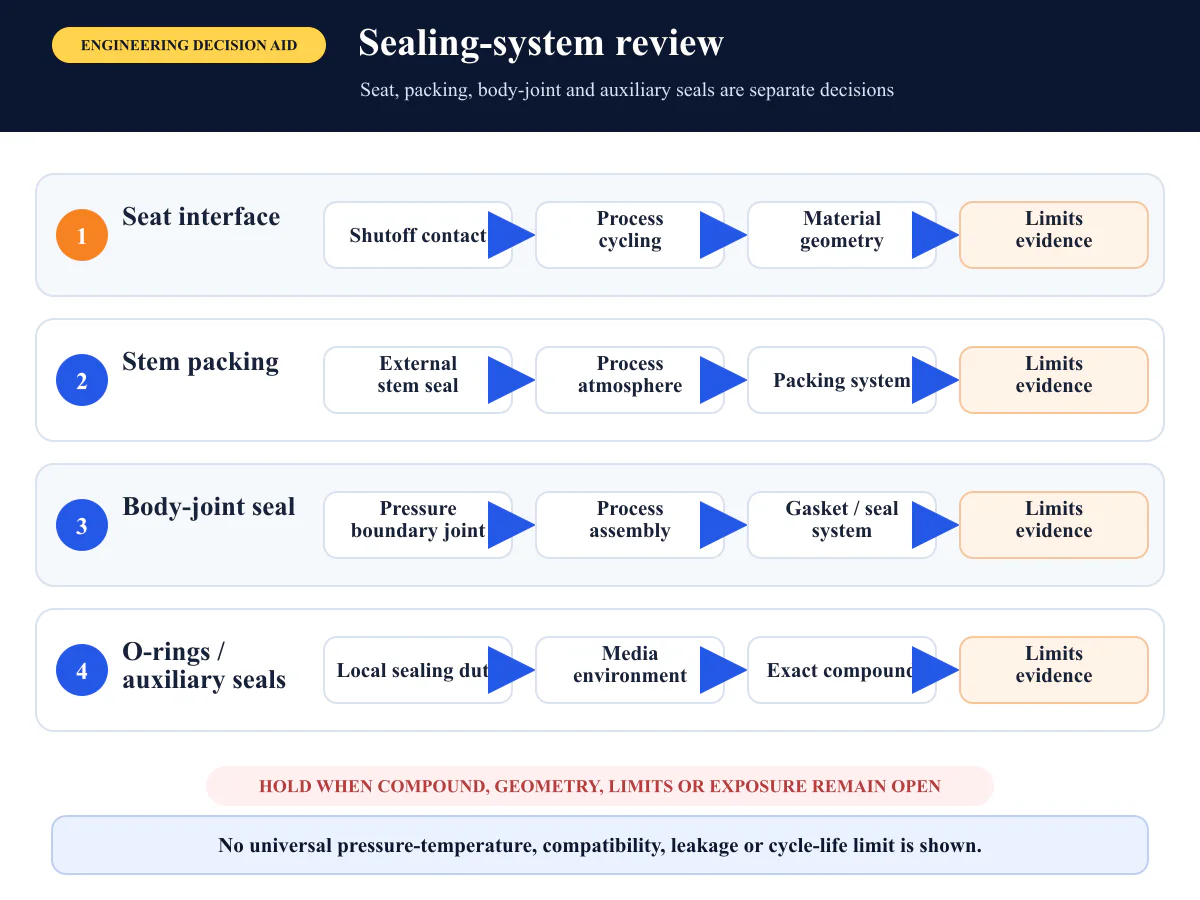
Step 6: Select Seal and Packing Materials
Body seals and stem packing must match the same service condition as the valve body and seat. Common options include PTFE packing, graphite packing, FKM O-rings, NBR O-rings, EPDM O-rings, spiral wound gasket, and graphite body gasket.
Step 7: Confirm Special Requirements
Check whether the project needs fire-safe design, anti-static design, fugitive emission control, sour service compliance, low temperature impact testing, cryogenic service design, oxygen cleaning, coating specification, material traceability, PMI testing, or EN 10204 3.1 / 3.2 certificates.
Procurement Specification Checklist
Ball Valve Materials Guide: Carbon Steel, Stainless Steel, Alloy Steel, and Seat Materials 12
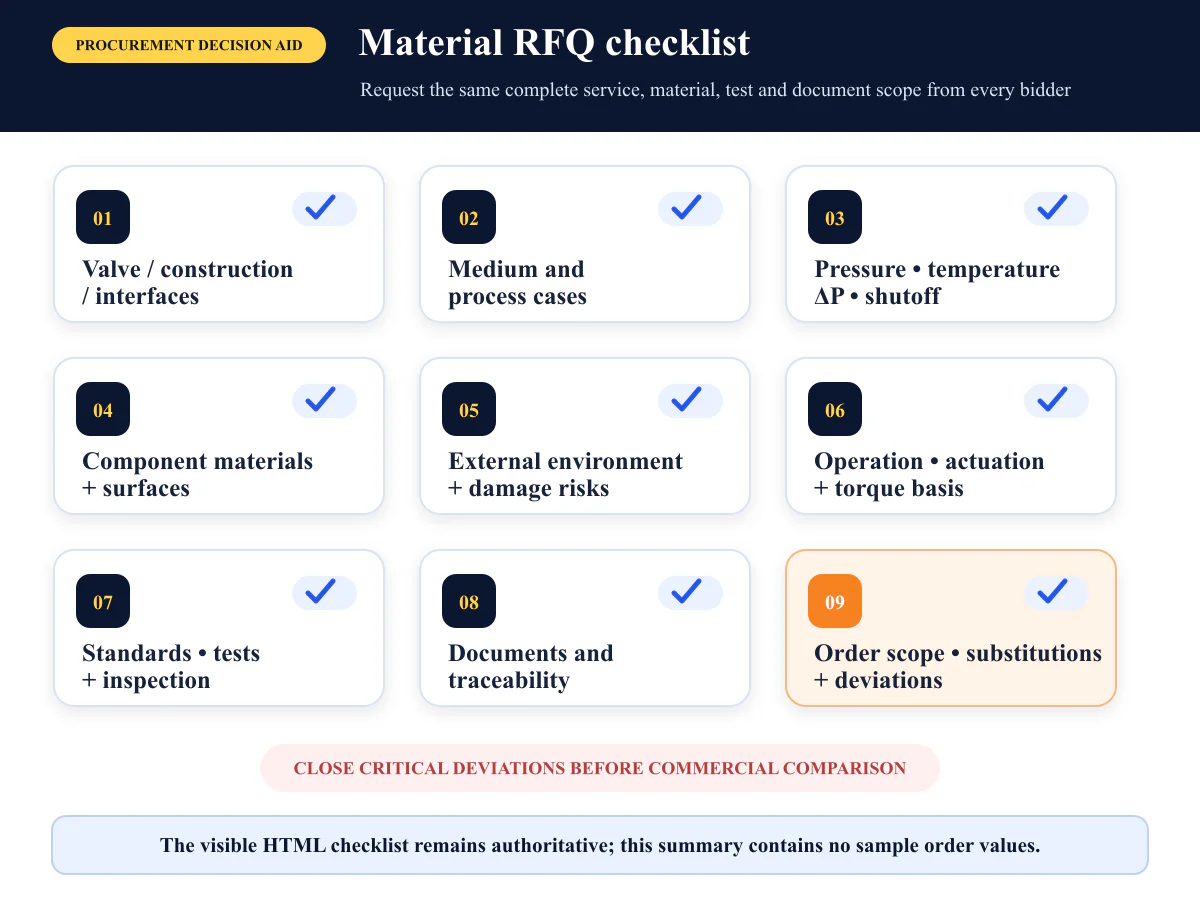
Most ball valve material mistakes begin in the purchase order. If the PO only states “ball valve, Class 150, WCB body,” the supplier has too much room to interpret the construction.
| PO Item | What to State Clearly | Why It Matters |
|---|
| Valve type | Floating, trunnion mounted, soft seated, metal seated | Prevents wrong valve design |
| Body material | Exact ASTM / EN / project grade | Avoids generic material substitution |
| Ball material | Base material and coating if required | Controls corrosion and wear performance |
| Stem material | Exact material and sour service requirement if applicable | Controls strength and corrosion resistance |
| Seat material | PTFE, RPTFE, PEEK, Devlon, metal seat, etc. | Controls shutoff and service boundary |
| Seal / packing material | PTFE, graphite, FKM, EPDM, NBR, etc. | Prevents leakage and temperature mismatch |
| Bolting material | Standard bolting or corrosion-resistant bolting | Prevents external corrosion and joint failure |
| Fire-safe requirement | API 607, API 6FA, or project requirement | Required for many hydrocarbon services |
| Anti-static requirement | Yes / no | Important for flammable service |
| Test standard | API 598, ISO 5208, or project standard | Defines inspection and leakage acceptance |
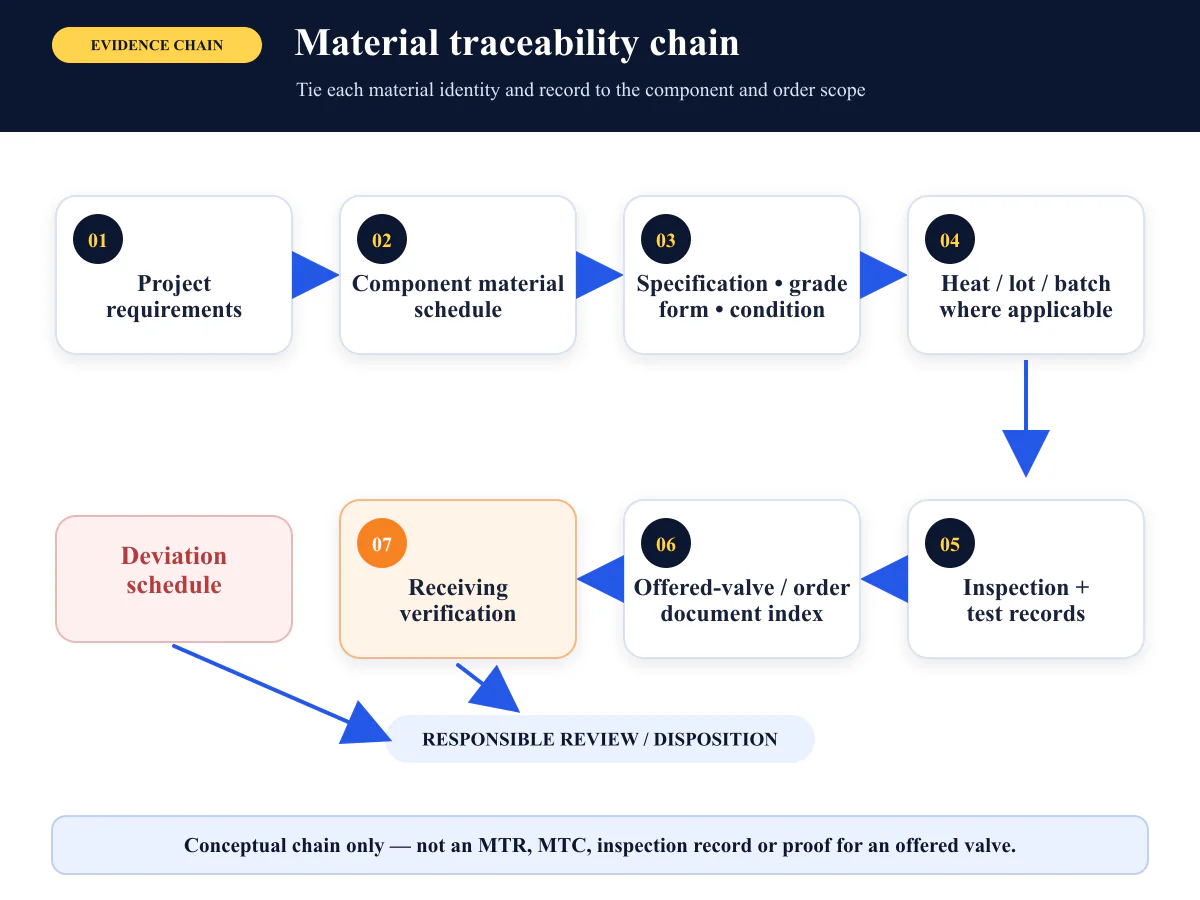
| Material certificates | MTR, PMI, traceability | Supports QA and receiving inspection |
| Coating requirement | Painting, epoxy, special coating | Controls external corrosion protection |
| No substitution rule | Written approval required | Prevents look-alike material replacement |
Example PO wording: Ball valve materials shall be selected according to the approved service condition. Body, ball, stem, seat, seals, packing, bolting, coating, and trim materials shall be stated clearly in the valve datasheet. No material substitution is allowed without written engineering approval. Material certificates, pressure test records, and traceability documents shall be supplied with the valve package.
Incoming Inspection Checklist
| Inspection Item | What QC Should Check | Typical Problem Found |
|---|
| Nameplate | Size, class, body material, manufacturer, standard | Correct size but wrong construction |
| Material certificate | Body, ball, stem, bolting, pressure parts | Missing or incomplete traceability |
| Seat material | Marking, datasheet, supplier confirmation | Generic PTFE supplied instead of specified seat |
| Packing and seals | Packing type, O-ring material, gasket material | Wrong elastomer for temperature or media |
| Ball surface | Scratches, coating defects, plating quality | Leakage risk before installation |
| Stem operation | Smooth movement, excessive torque, damage | Packing over-tightened or internal damage |
| Coating | Surface finish, coating damage, flange protection | Corrosion risk during storage or installation |
| End connection | Flange drilling, thread type, weld end preparation | Installation mismatch |
| Test records | Shell test, seat test, leakage acceptance | Test documentation not aligned with PO |
| Project restrictions | No unauthorized material substitution | Supplier delivers “equivalent” material without approval |
Field rule: Receiving inspection should verify more than valve size and pressure class. It should verify the complete material package.
Common Failure Modes Related to Ball Valve Materials
| Failure Mode | Likely Material Cause | Corrective Action | How to Prevent Repeat |
|---|
| Seat leakage after short service | Wrong seat material, debris, high temperature, seat deformation | Inspect seat and ball, confirm media and temperature | Define seat material by actual service condition |
| High operating torque | Seat swelling, deposits, corrosion, wrong seal material | Inspect seat, stem, packing, and cavity | Check chemical compatibility and cycling condition |
| Body corrosion | Carbon steel used in corrosive media or poor coating | Replace or upgrade material, improve coating | Review internal and external corrosion |
| Stem leakage | Wrong packing or seal material, stem corrosion, thermal cycling | Replace packing, check stem surface | Specify packing and stem material clearly |
| Ball surface damage | Abrasive particles or poor coating selection | Replace or recoat ball, review media solids | Use metal seated or hard-coated design |
| Stainless steel pitting | Chloride exposure or crevice corrosion | Upgrade to duplex or higher alloy if required | Check chloride level and temperature |
| Soft seat extrusion | High pressure or high differential pressure | Use stronger seat material or trunnion design | Review pressure load and seat support |
| Failure in sour service | Non-compliant material hardness or wrong trim | Replace with compliant material package | Specify NACE / ISO requirement clearly |
Composite Field Scenarios for Engineering Training
Scenario 1: Carbon Steel Ball Valve Corroded in a Wet Chemical Area
What happened: A carbon steel flanged ball valve was installed in a plant utility line near a chemical washdown area. The internal medium was not highly corrosive, but the external environment exposed the valve to chemical spray and humidity.
Why it happened: The team reviewed internal fluid compatibility but ignored external corrosion exposure.
The real system cause: The valve body material was acceptable internally, but the coating system and bolting material were not suitable for the external environment.
How it was corrected: The valve was replaced with better external protection, and bolting material was upgraded.
How to prevent recurrence: Review both internal media and external environment before finalizing ball valve materials.
Scenario 2: PTFE Seat Failed in High Temperature Service
What happened: A soft seated ball valve with PTFE seats leaked after several months in a hot process line.
Why it happened: The body material and pressure class were correct, but the seat material was not suitable for the actual temperature and cycling pattern.
The real system cause: The seat material was treated as a secondary detail after the valve body was selected.
How it was corrected: The valve was replaced with a higher temperature seat system or metal seated design.
How to prevent recurrence: Seat material must be reviewed before purchase, especially in high temperature service.
Scenario 3: Stainless Steel Valve Pitted in Chloride Service
What happened: A stainless steel ball valve showed pitting corrosion in a chloride-containing water system.
Why it happened: The specification only said “stainless steel” and did not define chloride concentration, temperature, or material grade.
The real system cause: The selected stainless steel grade was not suitable for the actual chloride condition.
How it was corrected: The material selection was upgraded after reviewing chloride level, operating temperature, and shutdown exposure.
How to prevent recurrence: Do not use “stainless steel” as a complete material specification. Define the exact grade and service boundary.
Scenario 4: Soft Seated Valve Used in Abrasive Media
What happened: A soft seated ball valve installed in a dirty process line developed internal leakage quickly.
Why it happened: The valve was selected as a standard isolation valve, but the line contained hard particles.
The real system cause: The soft seat and polished ball surface were damaged by abrasive solids.
How it was corrected: The valve was replaced with a metal seated ball valve with hard-coated sealing surfaces.
How to prevent recurrence: Any solids, scale, sand, catalyst, or abrasive particles should trigger a seat and coating review.
Related Valve and Material Checks Engineers Usually Review Next
After reading a ball valve materials guide, most engineers and buyers usually continue with one of these decisions:
- Which ball valve type fits the service: floating or trunnion?
- Should the valve use soft seats or metal seats?
- Which end connection is suitable: flanged, threaded, welded, or socket weld?
- Does the service require fire-safe and anti-static design?
- Is the actuator torque affected by the selected seat material?
- Are material certificates and test records required by the project?
A practical internal path is: Ball Valves → Floating Ball Valve / Trunnion Mounted Ball Valve → Metal Seated Ball Valve → material and seat selection articles.
FAQ About Ball Valve Materials
What are the most common ball valve materials?
The most common industrial ball valve materials are carbon steel, stainless steel, alloy steel, duplex stainless steel, and special alloy materials. Carbon steel is widely used for general industrial and non-corrosive service, while stainless steel and alloy materials are selected when corrosion, temperature, pressure, or chemical compatibility requires higher material performance.
Is stainless steel always better than carbon steel for ball valves?
No. Stainless steel has better corrosion resistance in many services, but carbon steel is often more economical and suitable for non-corrosive industrial applications. The correct choice depends on media, pressure, temperature, external environment, corrosion risk, and project requirements.
What is the best seat material for a ball valve?
There is no single best seat material for every ball valve. PTFE is common for clean general service, RPTFE offers better strength than standard PTFE, PEEK is used for more demanding pressure and temperature conditions, and metal seats are used for high temperature or abrasive service.
When should I use a metal seated ball valve?
A metal seated ball valve should be reviewed when the service involves high temperature, abrasive media, solid particles, severe service, or operating conditions that exceed the reliable range of soft seat materials. The ball and seat coating, leakage class, and actuator torque should be checked together.
What ball valve material is suitable for seawater?
Seawater service usually requires careful corrosion review. Depending on chloride level, temperature, oxygen content, flow condition, and project requirements, 316 stainless steel may not be enough. Duplex, super duplex, or special alloy materials may be required.
What material is used for the ball and stem?
Common ball and stem materials include SS304, SS316, 17-4PH stainless steel, duplex stainless steel, alloy steel, and hard-coated materials. For abrasive or severe service, the ball may require tungsten carbide, chromium carbide, hard chrome, or another hard-facing treatment.
Why do ball valve seats fail?
Ball valve seats commonly fail because of wrong material selection, high temperature, chemical attack, seat deformation, abrasive particles, excessive pressure load, or using the valve outside its intended service condition. A seat failure review should check the media, temperature, pressure, ball surface, debris, and operating frequency.
What should be checked before ordering a ball valve?
Before ordering, check the valve type, body material, ball material, stem material, seat material, seal material, pressure class, temperature, media compatibility, fire-safe requirement, anti-static requirement, test standard, coating requirement, and material traceability.
Conclusion
Ball valve material selection should be treated as an engineering decision, not a simple purchasing choice. The correct ball valve materials depend on the complete service condition, including medium, pressure, temperature, corrosion risk, solids content, operating frequency, shutdown environment, and required shutoff performance.
Carbon steel ball valves are practical for many general industrial and non-corrosive services. Stainless steel ball valves provide better corrosion resistance for clean, chemical, and mildly corrosive applications. Alloy steel and special alloy ball valves are used when high temperature, high pressure, chloride exposure, sour service, or aggressive chemicals require stronger material performance.
Seat materials such as PTFE, RPTFE, PEEK, Devlon, Nylon, elastomers, and metal seats must be selected according to sealing requirement, temperature, pressure, and media condition. A reliable ball valve specification should define the complete material package: body, ball, stem, seats, seals, packing, bolting, coating, testing, and documentation. When these details are reviewed together, the valve is much more likely to seal properly, operate smoothly, and provide stable service life in the actual piping system.