
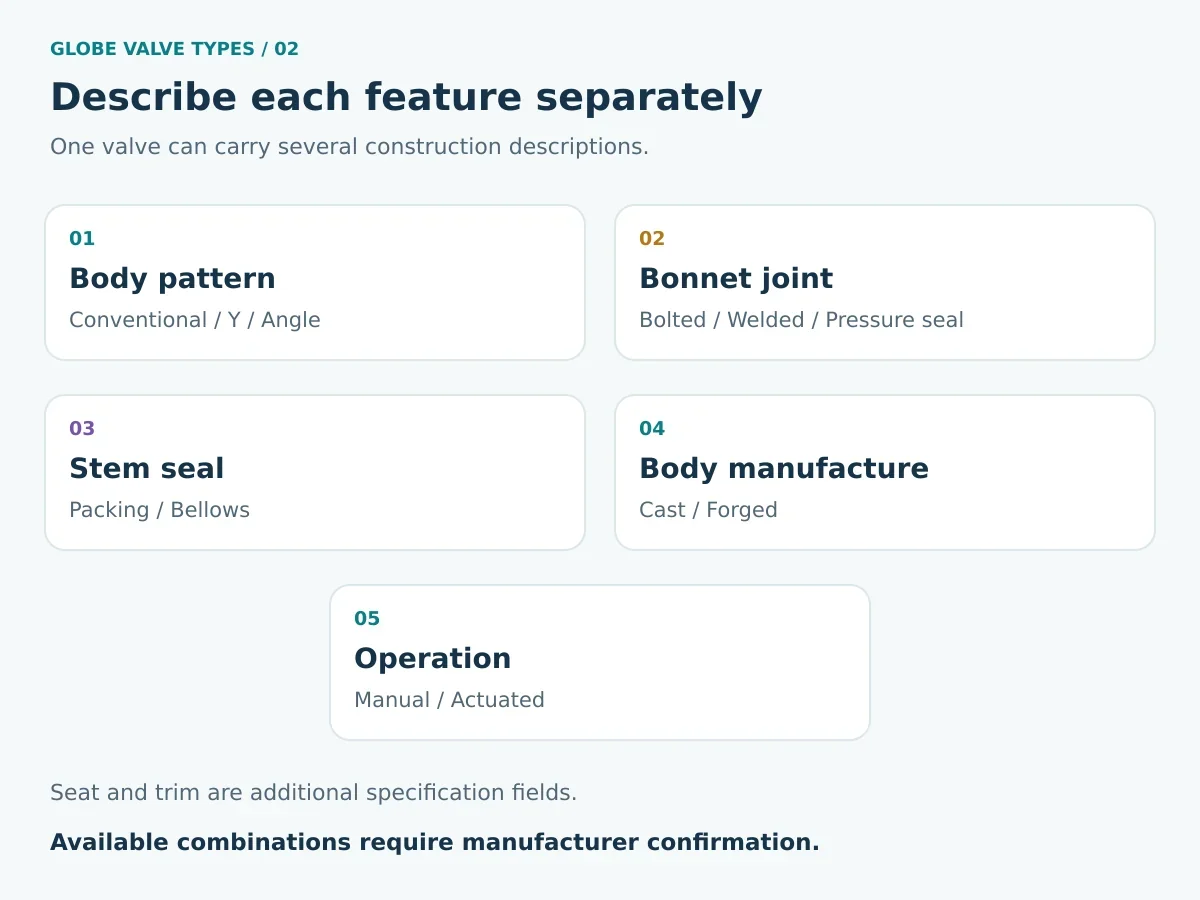
Globe valve types can be classified by body pattern, bonnet joint, stem seal and trim. The main body patterns are conventional T-pattern, Y-pattern and angle-pattern designs; cast or forged bodies and manual or actuated operation describe additional features. These labels can apply to the same valve. This guide explains what each label identifies and how to describe a proposed construction. Confirm its suitability separately against the service data, material compatibility, pressure-temperature rating, flow duty and leakage requirements.Jump to:Body patternsBonnets and stem sealsDisc and trim typesListe de contrôle pour demande de devis
A Quick Route Through Globe Valve Types
- Start with the piping route: shortlist conventional or Y-pattern in-line arrangements, or an angle pattern where the connections must turn. Check the model drawing and available space.
- Specify independent construction features: record the bonnet joint, stem seal, body material, seat/trim and operator separately.
- Confirm the duty before approval: match the proposed design to the operating cases, leakage requirements and supporting documents. Keep an option provisional while those inputs are unresolved.
What Are the Main Globe Valve Types?
Start with the body pattern when the question concerns piping layout and internal geometry. Then specify the other construction features separately. KSB’s valve reference similarly distinguishes globe valves by body arrangement, seat interface and stem sealing.[1]
| Classification | Common descriptions | What the description identifies | What still needs confirmation |
|---|---|---|---|
| Type de corps | Conventional T-pattern, Y-pattern, angle-pattern | Body and seat arrangement relative to the pipe connections | Section drawing, flow direction, capacity and installation space |
| Bonnet joint | Bolted, welded, pressure seal | Connection between the body and bonnet | Joint construction, rating and maintenance requirements |
| Stem seal | Gland packing, bellows seal | Barrier against external leakage around the moving stem | Materials, operating conditions and qualification scope |
| Body manufacturing route | Cast, forged | Method used to produce the body | Material grade, heat treatment, examination and traceability |
| Seat and trim | Metal seat, soft seat, on/off disc, throttling trim | Wetted sealing and flow-regulating components | Compatibility, capacity and leakage acceptance |
| Actionnement | Manual, pneumatic, electric, hydraulic | Method used to move the stem | Required thrust, travel, control duty and fail action |
This table prevents a common RFQ mistake: treating “Y-pattern,” “bellows sealed” and “forged” as mutually exclusive alternatives. Each answers a different specification question. Available combinations depend on the manufacturer’s actual design.
For product options, explore the industrial globe valve range.
Globe Valve Types by Body Pattern
Conventional T-Pattern / Z-Body Globe Valves
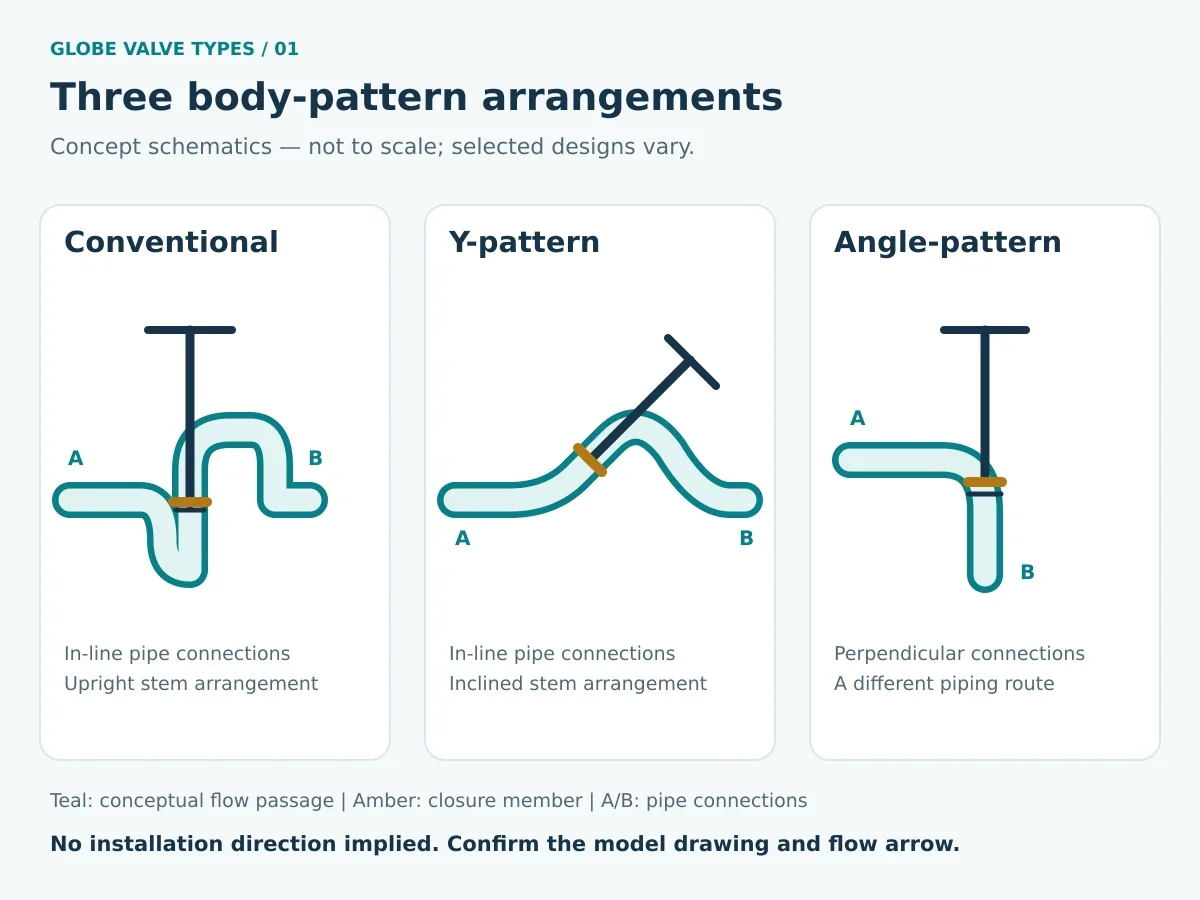
A conventional in-line globe valve has inlet and outlet connections arranged along the pipe axis, with a seat and disc inside the body. The passage changes direction as fluid approaches and leaves the seat. The stem moves the closure element toward or away from that seat.
Suppliers may use T-pattern or Z-pattern terminology for conventional configurations. Treat those labels as a starting point: confirm the cross-section, seat arrangement and dimensions rather than assuming identical construction across catalogues.
The DOE’s January 1993 handbook describes Z-body, Y-body and angle body designs. It provides a useful geometry reference; the supplier drawing remains the basis for identifying the offered construction.[6]
For a preliminary shortlist, check whether the in-line arrangement suits the piping and whether the bonnet, handwheel and stem have enough clearance. Hydraulic acceptance requires the proposed model’s flow data and the actual operating cases; nominal pipe size does not establish pressure loss.
Vannes à soupape en Y
Y-pattern globe valves use an inclined stem and seat arrangement relative to the main pipe axis. This geometry can provide a less restrictive flow passage than a comparable conventional design. Manufacturer literature includes Y-pattern products described as having lower pressure loss, but that comparison applies to the designs concerned.[2]
For technical bids, request Cv or Kv for the offered model and trim, including the test or calculation basis and opening position. Compare capacity at the required operating cases, not simply at the same nominal size. A full-open coefficient does not establish part-load control behavior, transient response or suitability for a damaging pressure drop.
Illustrative RFQ check: two valves have the same size and class, but their quoted capacities differ. The body pattern, port and trim can differ despite matching end connections. Compare the model-specific coefficients and opening positions against the same flow and pressure cases before treating the offers as interchangeable.
The inclined bonnet also changes the installation and maintenance envelope. Check removal space, supports and access before accepting a replacement. See the detailed Y-pattern vs T-pattern globe valve comparison for pressure-drop and installation review.
Angle-Pattern Globe Valves
Angle-pattern globe valves have inlet and outlet connections at right angles. They may suit a piping arrangement that already requires a direction change, subject to the selected valve’s dimensions, orientation and piping-load requirements.
An angle body alone does not demonstrate suitability for flashing, abrasive solids or erosive flow. Those services require review of the pressure profile, fluid phase, velocity, materials and trim. Check the manufacturer’s specified flow direction and installation instructions for the exact construction.
Across all three patterns, distinguish the overall pipe route from the local flow through the seat. Neither the outline of the body nor a generic pattern name is enough to approve installation direction.
Globe Valve Types by Bonnet Joint and Stem Seal
Bolted, Welded and Pressure-Seal Bonnets
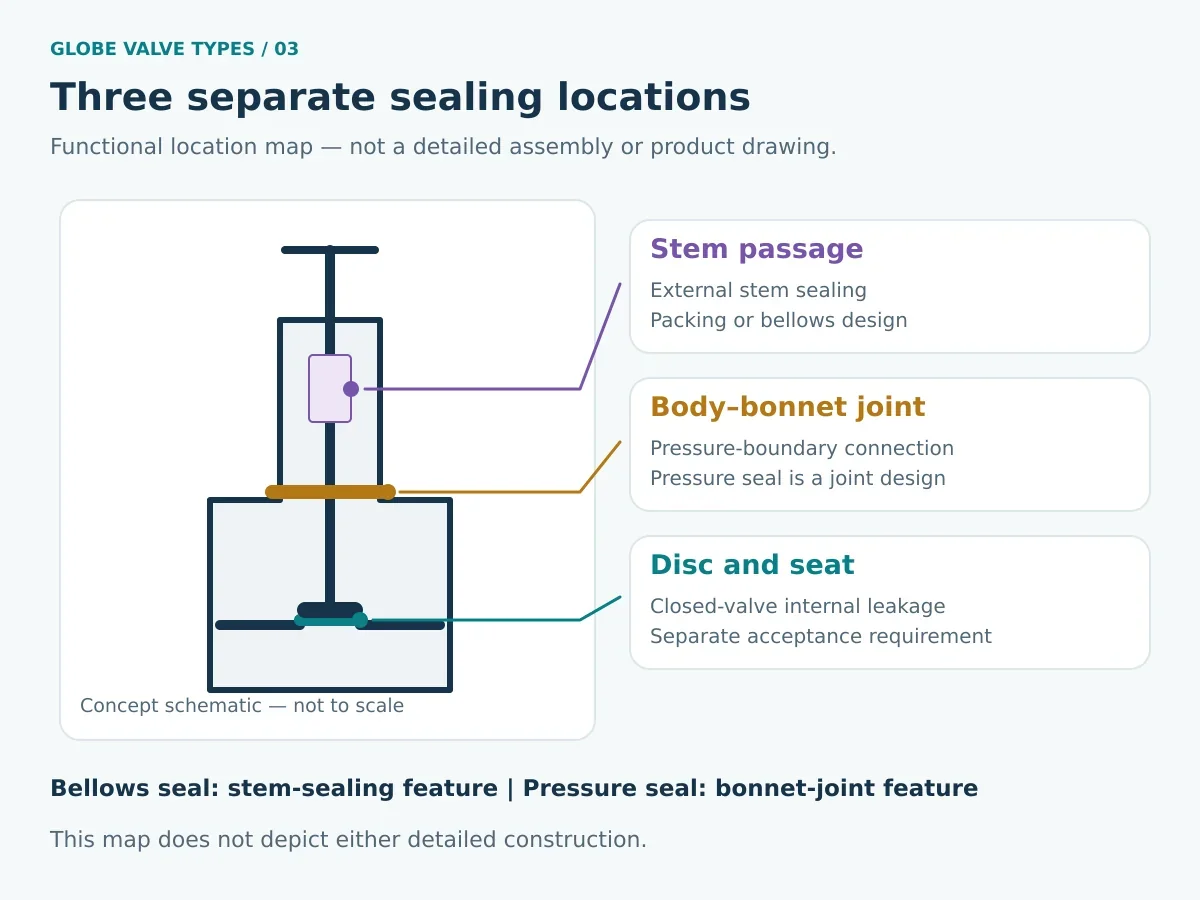
The bonnet closes the upper body opening and supports parts of the stem assembly. Its joint with the body is a pressure-boundary connection.
A bolted bonnet uses bolting and a joint seal between the body and bonnet. Review the gasket, bolting materials and maintenance instructions. A removable joint does not establish how easily the internals can be serviced in the installed position.
A welded bonnet uses a welded body–bonnet connection. Confirm the actual joint design and repair provisions. A welded bonnet and butt-weld pipe ends describe different connections; one does not imply the other.
A pressure-seal bonnet uses a joint arrangement in which internal pressure contributes to the bonnet sealing load. Assembly details and the pressure-seal element remain design specific. The term does not replace verification of the complete pressure-temperature rating, materials or maintenance procedure.
Rating check: an ASME pressure class is a designation, not a fixed allowable pressure. Review the applicable material group and temperature together. Confirm the complete design against its rating basis: body, bonnet and bolting, as well as seat, packing, gasket and trim limits. Normal operating conditions cannot replace the specified design conditions; minimum temperature and thermal cycling may also change the construction review.
The importance of separating these descriptors is visible in manufacturer product names such as “pressure seal Y-pattern” and “bolted bonnet forged globe valve.” They combine several construction attributes rather than describe competing valve families.[2][3]
Packed-Stem and Bellows-Sealed Designs
Stem sealing addresses a different leakage path from the bonnet joint. Gland packing seals around the moving stem. A bellows seal uses a flexible metallic barrier that accommodates stem travel between its attachments.[4]
For packed stems, identify packing materials, arrangement, stem finish requirements and any applicable emissions qualification. For bellows designs, confirm the bellows material, travel and operating limits, connections and relevant qualification evidence. Identify backup packing only where the selected drawing shows it.
Keep external leakage and seat leakage separate. A bellows addresses the stem passage; it does not define leakage past the closed disc and seat. Likewise, selecting a pressure-seal bonnet says nothing by itself about the stem seal.
Illustrative acceptance check: an offer specifies a bellows seal while leaving closed-seat leakage undefined. The stem barrier and seat interface address different leakage paths. Request separate acceptance criteria and supporting test scopes before accepting the sealing description; a bellows label cannot fill the missing seat-test requirement.
For the detailed seal comparison, use the bellows seal vs packed globe valve guide.
Other Globe Valve Descriptors Buyers Will Encounter
Cast and Forged Bodies
Cast and forged describe manufacturing routes. They do not define the flow pattern or provide a complete material specification.
An offer should identify the material grade, product form, heat treatment, examination requirements and traceability. Compare these against the project specification. A manufacturing-route label cannot establish corrosion compatibility or the finished valve’s rating. Review the actual medium and concentration, temperature, solids, cleaning fluids and relevant contaminants. A suitable body material does not establish suitability of the stem, trim, seat, packing or gasket.
Seat and Trim Configurations
Seat materials and disc or plug geometry form another classification dimension. Historical terminology includes the following disc designs:[6]
- Ball disc: a ball-shaped closure member used within a linear-motion globe valve; this is not a rotary ball valve.
- Composition disc: a disc with a nonmetallic sealing insert.
- Plug disc: an elongated, tapered closure member, with the detailed contour depending on the design.
These identify closure designs, not body patterns. Confirm materials, trim geometry, operating limits and leakage acceptance for the actual model.
Also distinguish an on/off disc from trim intended for throttling. Before specifying continuous operation at an intermediate opening, confirm the trim, differential pressure, required capacity and operating range. Cavitation, flashing, gas noise or erosion may require a more detailed review than a general type comparison can provide.
Manual, Actuated and Globe-Style Control Valves
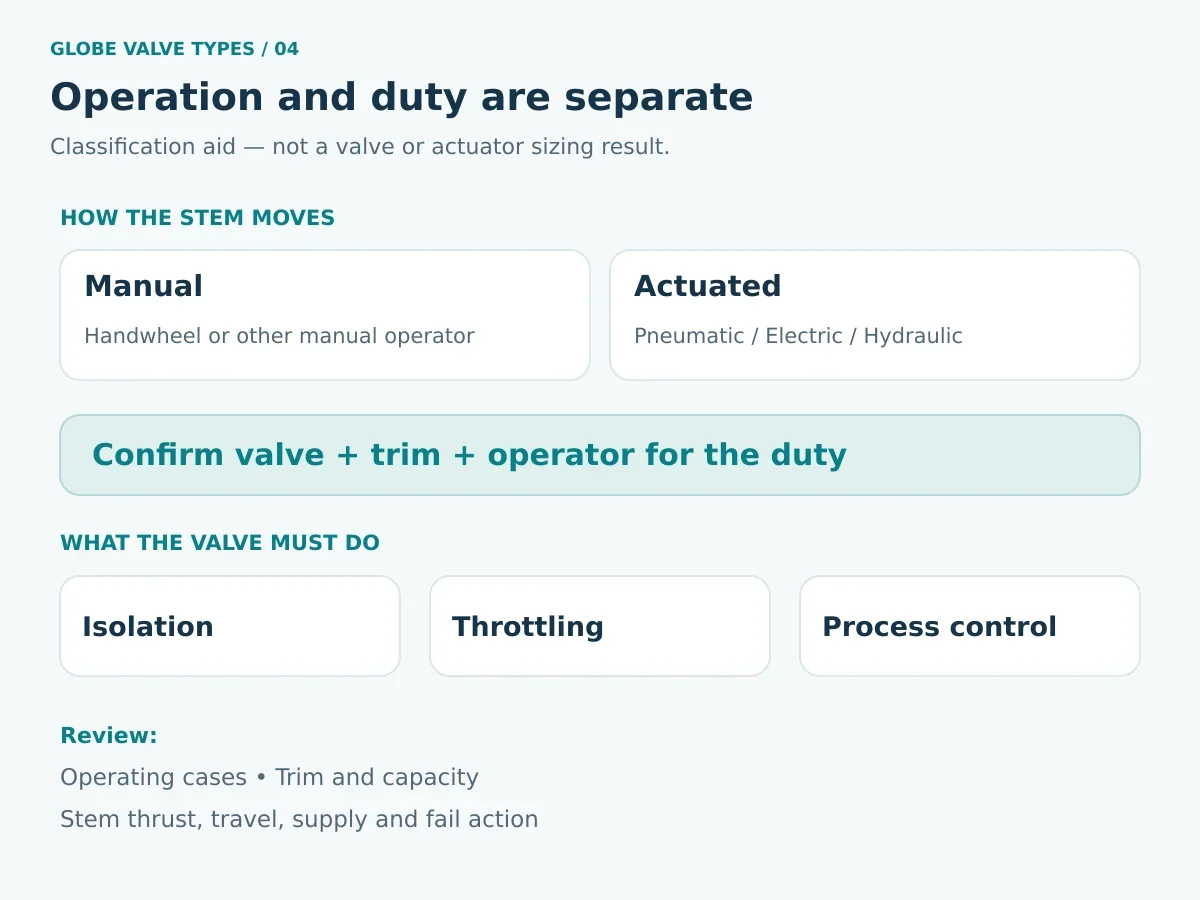
A manual operator and an actuator are ways to move the stem. They do not independently establish the valve’s function or regulating performance.
A globe-style control valve needs a suitable valve-and-trim configuration for the process objective, together with an appropriate actuator and controls. Required information includes minimum, normal and maximum flow, inlet and outlet pressure, fluid properties, temperature and shut-off conditions.
For actuator matching, request required stem thrust and travel for the maximum differential-pressure and seating cases, the margin basis, operating frequency and time, available supply and fail action. Include ambient and accessory requirements where relevant. Valve size alone cannot determine actuator size, and adding an actuator does not by itself establish modulating-control capability.
Terms such as “steam globe valve” and “cryogenic globe valve” describe intended service. They introduce additional construction and qualification questions rather than additional body patterns.
How to Shortlist the Right Globe Valve Construction
Shortlist by the application requirement, then request evidence for the corresponding construction feature. First identify whether the valve is for isolation, occasional manual adjustment or continuous control; that decision changes which capacity, trim and operator information is needed.
Minimum data before recommending a construction: medium and phase, operating and design pressure/temperature, required duty, relevant flow and upstream/downstream pressure cases, pipe interfaces, and separate seat-leakage and external-emissions requirements. Mark missing items as open rather than filling them with catalogue assumptions.
| Screening question | Review first | Evidence before technical approval |
|---|---|---|
| Must the pipe remain in line or turn? | Body pattern and connection geometry | General arrangement and section drawings, orientation and maintenance clearance |
| Is pressure loss constrained? | Body pattern and trim together | Model-specific Cv/Kv and defined operating cases |
| Is continuous throttling or modulation required? | Duty, trim, operator and controls | Capacity data, operating range and relevant service-risk review |
| Is external stem leakage a concern? | Packing or bellows construction | Seal details and qualification relevant to the specified conditions |
| What pressure boundary is required? | Body, bonnet joint and materials | Complete rating basis and applicable project requirements |
| What leakage is acceptable when closed? | Seat, trim and test scope | Test medium, pressure, direction, duration and acceptance criteria |
| How will the valve be maintained? | Access and disassembly provisions | Manufacturer instructions, removal space and spare-parts requirements |
An illustrative description is: Y-pattern body + pressure-seal bonnet + packed stem + butt-weld ends + manual operator. This is a way to organize a specification, not a confirmed Raymon Valve model or a recommendation for a particular service.
Compare Globe Valve Offers on the Same Basis
Ask each supplier to identify the proposed features in the same fields. An unspecified bonnet, trim or leakage test remains an open item. Use the following checks before treating quotations as technically equivalent.
| Point d'examen | Compare on the same basis | Preuves du fournisseur à demander | If unresolved |
|---|---|---|---|
| Construction identity | Body pattern, bonnet joint, stem seal and trim identified on the model drawing | Drawing/model reference and a completed construction schedule | Clarify before comparing offers |
| Duty and capacity | Capacity data and operating cases correspond to the offered size, trim and opening | Model-specific flow data and the required duty review | Keep the shortlist provisional |
| Pressure boundary and materials | Rating basis and material records match the complete proposed construction | Rating information, material specification and required traceability | Hold technical approval for unresolved limits |
| Leakage acceptance | Seat leakage and external stem leakage are specified separately | Agreed test scopes, acceptance criteria and relevant qualification records | Clarify the missing scope; do not infer equivalence |
| Installation and maintenance | Dimensions, orientation and removal access suit the piping | General arrangement, flow-direction instructions and maintenance information | Resolve fit and access before accepting a replacement |
Mark each review item documented, clarification required ou outside the stated requirement. These are bid-review statuses, not a substitute for the project approval process. A source listing a feature or a general company certificate does not establish acceptance of the offered valve.
Example: Classify, Shortlist, Then Confirm
Illustrative screening case: an existing in-line pipe route needs an isolation valve, the available pressure-loss allowance has not been stated, and maintenance space is limited. A conventional or Y-pattern body may remain on the shortlist, subject to the actual dimensions. The labels alone do not resolve hydraulic acceptance. Request the operating cases, allowable pressure loss, capacity data and removal envelope before choosing between them.
If external stem leakage is also a project concern, review the packing or bellows arrangement separately. If continuous control is later required, reopen the duty and trim review. Neither change can be resolved by renaming the body pattern.
When a type comparison is insufficient: identified flashing, cavitation, solids, corrosion, stringent emissions, cryogenic or other special-service requirements call for a separate application and evidence review. Keep the generic type shortlist provisional until the relevant project criteria are addressed.
Use the globe valve engineering guide for the broader technical review.
What to Include in a Globe Valve RFQ
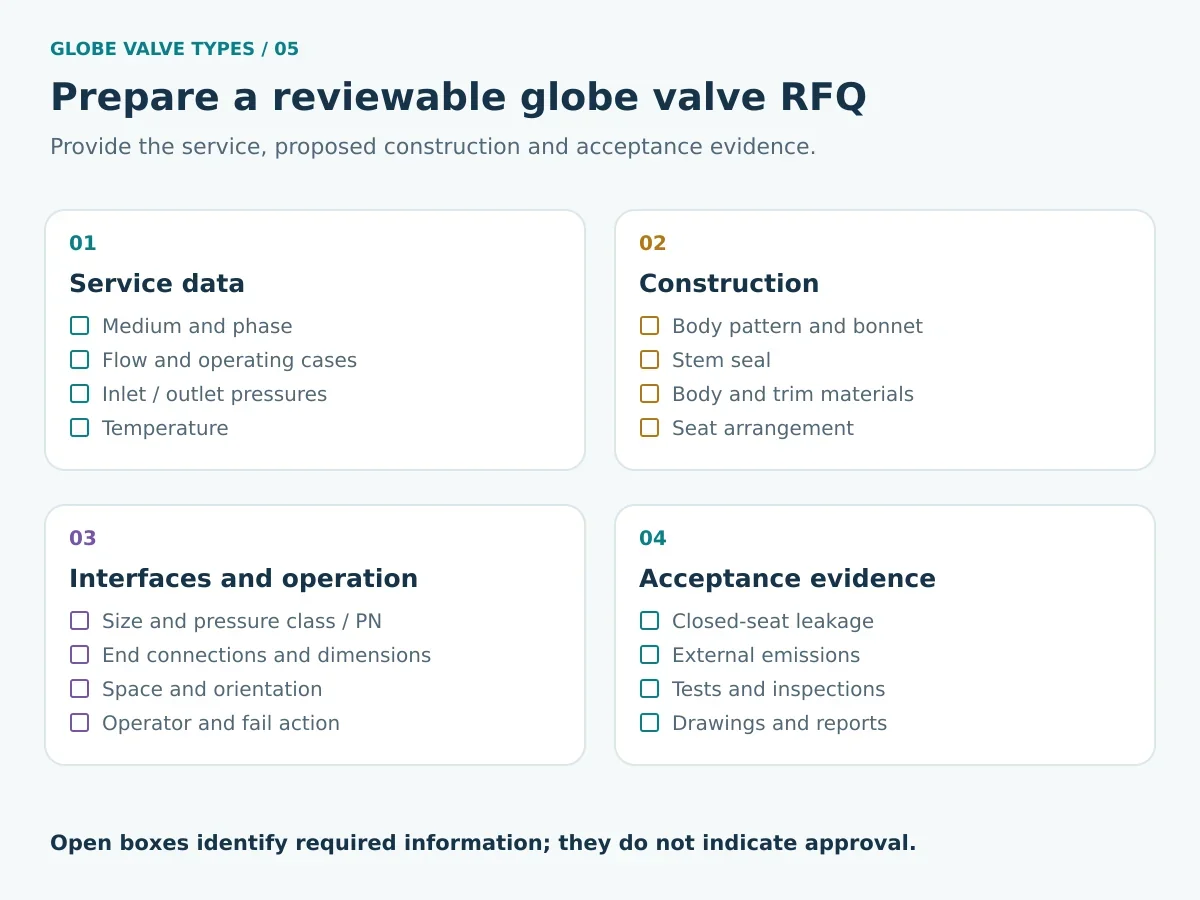
A useful RFQ connects type descriptions to service conditions and acceptance evidence.
- Service and duty: medium, composition, phase, relevant solids, isolation or throttling/control duty and operating frequency.
- Operating cases: normal and design pressure and temperature; required flow with upstream and downstream pressure for relevant cases.
- Piping interfaces: nominal size, class or PN, end connection, dimensional requirements, installation orientation and available space.
- Construction : required or permitted body patterns, bonnet joint, body and trim materials, seat arrangement and stem seal.
- Fonctionnement : manual or actuated, utilities, required travel time, fail action where relevant and interface requirements.
- Leakage acceptance: closed-seat leakage and external stem-emissions requirements recorded separately, with the applicable test basis.
- Inspection and documents: drawings, material records, specified examinations, test reports, witness requirements and a technical-deviation schedule.
Where ASME B16.34 is applicable, agree the project edition and scope. ASME’s publisher page lists the 2025 edition and describes coverage including pressure-temperature ratings, materials, examination, testing and marking for specified valve constructions.[5] A reference to this standard does not establish that a proposed valve is suitable for the process, nor prove a particular product’s compliance.
Ask suppliers to separate shell testing of the pressure boundary, seat testing of closed-valve sealing under specified conditions, functional checks and any external-emissions qualification. A passed shell test does not establish seat acceptance or the absence of every internal defect. Keep specified material traceability, examination methods and witness requirements as separate document items. Manufacturer background can be reviewed through À propos de Raymon Valve, while product approval should rest on the relevant technical submission.
Foire aux questions
What are the three main globe valve body patterns?
The common introductory grouping is conventional T-pattern, Y-pattern and angle-pattern. Confirm the supplier’s drawing because naming and detailed construction vary. Bonnet joints, stem seals and manufacturing routes are additional classification dimensions.Are T-pattern and Z-pattern globe valves the same?
These names may be used for conventional globe-valve arrangements, but terminology alone does not prove identical geometry. Compare the section drawing, seat arrangement, flow route and dimensions of the actual designs.Is a bellows-sealed globe valve a separate body pattern?
Bellows sealed describes the stem seal. Body pattern must be identified separately. Confirm the offered combination, bellows construction and qualification from the manufacturer’s documents.Is a pressure-seal bonnet the same as a bellows seal?
No. A pressure-seal bonnet concerns the body–bonnet joint. A bellows seal concerns the moving stem’s barrier to external leakage. They describe different locations and functions.Can every globe valve be used for continuous throttling?
Continuous throttling requires confirmation of trim, capacity, operating range and service risks. A globe body or an installed actuator alone is insufficient evidence of suitability.What information is needed to select a globe valve type?
Provide duty, medium, flow, upstream/downstream pressure, temperature, piping interfaces, materials, leakage requirements and operation method. Confirm the proposed construction against drawings, ratings and relevant test documentation before approval.
Note technique
This article explains globe valve classifications and supports preliminary screening. The examples are hypothetical; the schematics do not represent a qualified product or a completed selection. Final selection depends on the confirmed datasheet, applicable project requirements, rating, material compatibility, flow duty, leakage acceptance, operation and installation conditions. Confirm the offered construction and documents through the project’s technical approval process.
Request a Globe Valve Construction Review
Send Raymon Valve your datasheet or application requirements with the medium, phase, flow, inlet and outlet pressures, operating/design temperature and pressure, size, connections, duty and separate seat-leakage and external-emissions requirements. Include an existing valve drawing or project specification where available.
Identify required body-pattern, bonnet, stem-seal and material features, plus the inspection documents needed for approval. If a value is unavailable, mark it as an open item. Request a proposed construction, stated assumptions, technical deviations and document scope with the quotation.
References
- KSB — Valve: classification and design features. Supports classification terminology; does not establish Raymon Valve performance.
- Velan — Pressure Seal Y-Pattern Globe Valve. Manufacturer-specific example of combined features and a design-specific hydraulic comparison.
- Velan — Bolted Bonnet Forged Globe Valve. Manufacturer-specific construction example.
- Spirax Sarco — Isolation Valves: Linear Movement. Supports basic stem-seal mechanisms; no universal emissions or maintenance-life claim is adopted.
- ASME — B16.34: Valves—Flanged, Threaded, and Welding End. Official public edition/scope reference; project application requires the applicable standard and specification.
- DOE — Fundamentals Handbook, Mechanical Science, Vol. 2, January 1993. ME-04, printed pp. 15–17: body/disc terminology. Historical educational reference, not a current design code.
 French
 English
 German
 Arabic
 Spanish
 Italian
 Portuguese
 Russian