
Standards & specification review
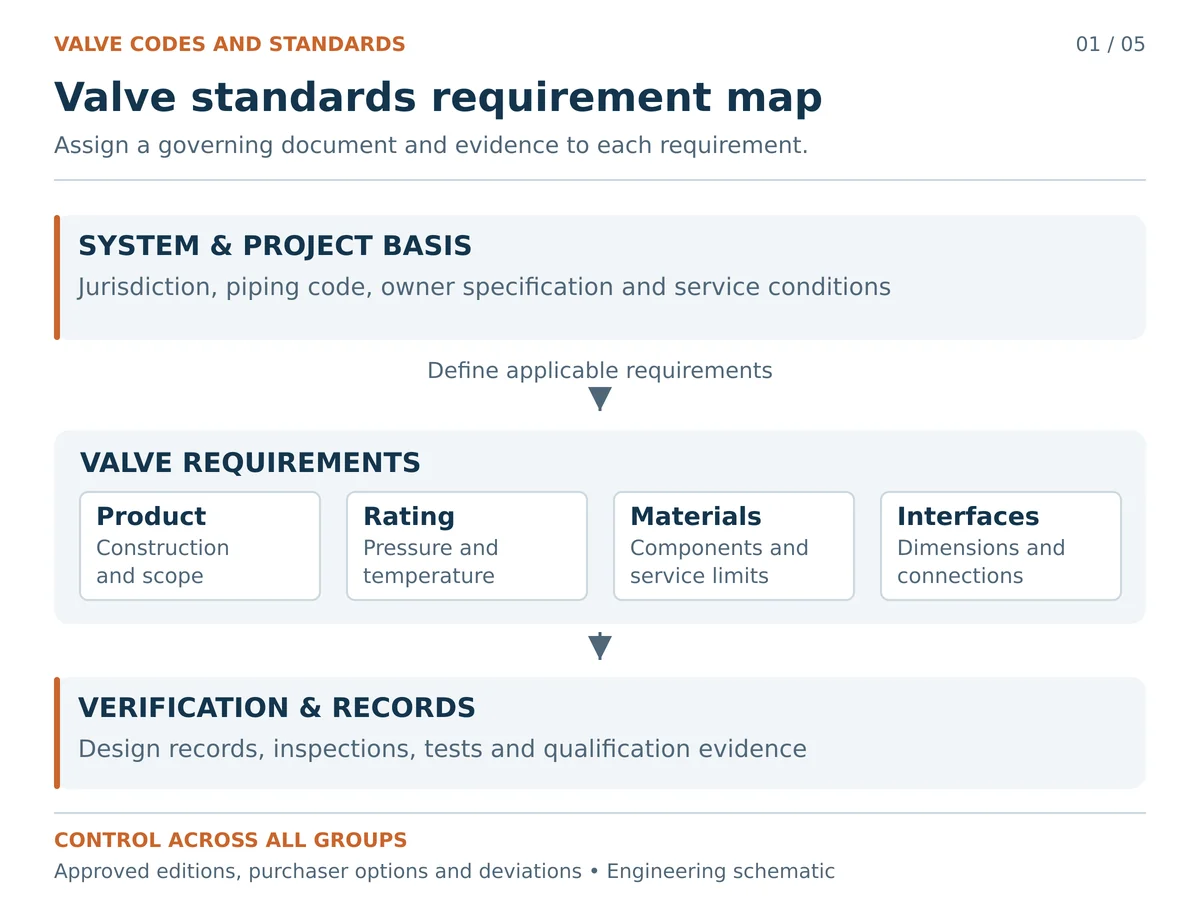
Codes et normes des vannes define the requirements used to specify, manufacture, inspect and accept an industrial valve. A complete specification normally separates the piping-system basis, valve construction, pressure–temperature rating, interfaces, materials and test acceptance. For engineers and buyers, the task is to identify which document governs each requirement and what evidence demonstrates it for the proposed configuration. Use the reference matrix and review checklists below to build an RFQ, compare supplier responses and resolve scope gaps before approving the order.
On this page
- Standards quick reference
- Identify applicable standards
- Piping code and valve standard
- Scope, interface and material checks
- Valve type and service review
- Write standards into an RFQ
- Review supplier evidence
- Resolve a standards conflict
- Avoid specification errors
- Purchase-order checklist
- Foire aux questions
- Request a technical review
Valve Codes and Standards: Quick Reference
Use this index to find the document family for the requirement in question. It is a scope guide, not an equivalence table or a universal list of standards required for every valve. Record the approved edition, amendments and purchaser options separately.
Tables scroll horizontally on smaller screens. Keyboard users can focus a table region and use arrow keys.
| Requirement | Référence | Scope to review | Purchaser check |
|---|---|---|---|
| System basis | ASME B31.3 | Process piping where selected as the governing code | Confirm the system and service basis; it is not a valve product standard. |
| Valve construction and rating | ASME B16.34 | New valve construction within its published scope | Review material, construction and rating at the specified design temperature. |
| Pipeline and related valve products | API 6D | Defined valve products and applications | Review the complete product scope, purchaser options and approved updates. |
| Other product-standard routes | API 600; API 602; API 608; API 609 | Bolted-bonnet steel gate; specified small gate/globe/check; metal ball; butterfly valves, respectively | Select the document for the actual construction. These documents are not interchangeable. |
| Installation length | ASME B16.10 | Face-to-face, end-to-end and applicable angle-valve dimensions | Check valve type, material, size, class and ends against the specified dimensional entry. |
| Interface à brides | ASME B16.5; ASME B16.47 | Flanges within each document’s size, class and material scope | Confirm the applicable standard and full mating interface; nominal size alone is insufficient. |
| Buttwelding ends | ASME B16.25 | Weld-end preparation of piping components | Match the approved end preparation to the mating pipe and project requirements. |
| Inspection and pressure testing | API 598; ISO 5208 | Different inspection/test references, selected as applicable | State the governing document, edition, test conditions and acceptance basis; do not assume equal criteria. |
| Fugitive-emissions type qualification | ISO 15848-1 | External-leakage type qualification within scope | Identify classification, applicable amendments and report coverage for the proposed design. |
| Other special-service qualification | Project-selected fire, low-temperature or other qualification references | Additional requirements triggered by the specified service | Identify the applicable test standard and evidence; a routine pressure test does not establish every qualification. |
| Materials and documentation | Component material specifications and approved project requirements | Material processing, traceability, records and release scope | Define the required records, submission stages and deviation approvals. |
API product titles are identified in the official program-document index; use the API updates register to check published revisions and updates. The summaries here do not replace the controlled standards.
How to Identify the Applicable Valve Codes and Standards
Scroll horizontally if needed.
| Step | Question to answer | Required output |
|---|---|---|
| 1. Establish the system basis | Which jurisdiction, piping code and owner specifications apply? | Approved system and project requirements |
| 2. Define the valve duty | What function, construction and service must the valve provide? | Valve datasheet and service description |
| 3. Identify product requirements | Which product standard covers the proposed construction? | Applicable product standard and scope review |
| 4. Define interfaces | What must match the installed piping and actuator? | Connection, dimensional and mounting requirements |
| 5. Define verification | Which inspections, tests and qualification records are required? | Inspection and test plan with acceptance references |
| 6. Control the documents | Which editions, options and approved deviations apply? | Standards register and deviation schedule |
What Is the Difference Between a Piping Code and a Valve Standard?
System Requirements and Component Requirements
A piping code addresses requirements for a piping system. A valve standard addresses requirements within its defined product or technical scope.
For example, ASME B31.3 covers process piping, including materials and components, design, fabrication, assembly, examination, inspection and testing. ASME’s official product page listed the 2024 edition when checked on 17 November 2026.
ASME B16.34 addresses new valve construction within its scope. Its requirements include pressure–temperature ratings, materials, dimensions, nondestructive examination, testing and marking. The official product page listed the 2025 edition on the same review date.
Project Specifications, Editions and Document Precedence
Prepare a standards register that records:
- Document designation and title.
- Edition or publication year.
- Applicable amendments, addenda and errata.
- Requirement controlled by the document.
- Purchaser-selected options.
- Approved deviations and clarification references.
The latest publication and the contractually applicable edition may differ. Resolve that difference through the project’s approval process before manufacturing release.
Document control: use the approved document-precedence procedure when requirements conflict. Mandatory legal requirements must also be addressed; a contractual precedence rule cannot authorize ignoring them.
Scope, Interface and Material Checks
ASME B16.34’s published scope identifies the requirements it addresses; it does not establish compliance for a particular product.
ISO 5208:2015 addresses metallic-valve pressure-boundary integrity, closure tightness and closure-mechanism structural adequacy. ISO states that it should be applied with the relevant product standard and that differing product-standard requirements take precedence. ISO’s catalogue records confirmation of this edition in 2025.
ISO 15848-1:2015 addresses external leakage from stem or shaft seals and body joints through a type-testing classification and qualification framework. Its published scope excludes end-connection joints, vacuum applications, corrosion effects and radiation. The official catalogue also lists ISO 15848-1:2015/Amd 1:2017. Include the applicable amendment in the project document review; development drafts are not treated here as published requirements.
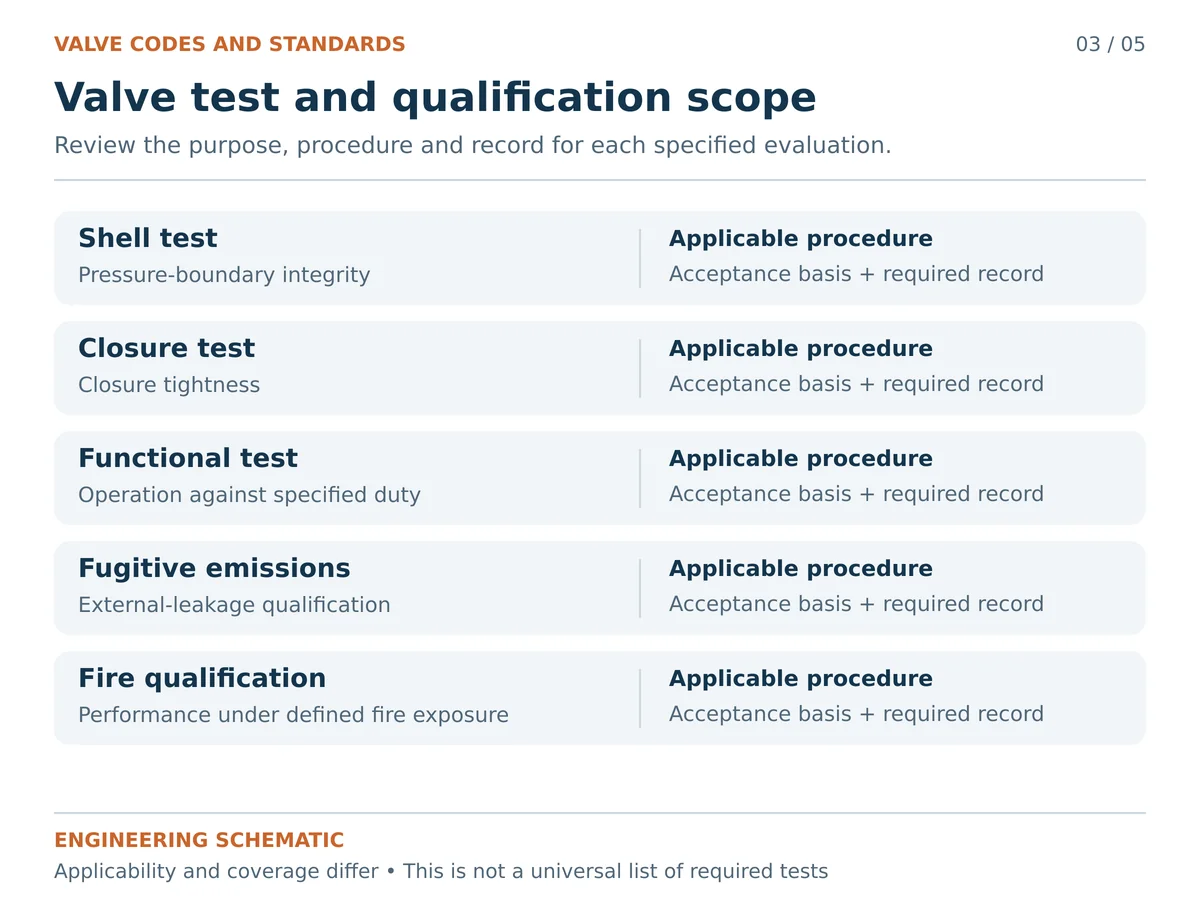
For fire-qualification scope and report review, see the valve fire testing guide; routine pressure-test records do not establish fire qualification.
Dimensions and End Connections
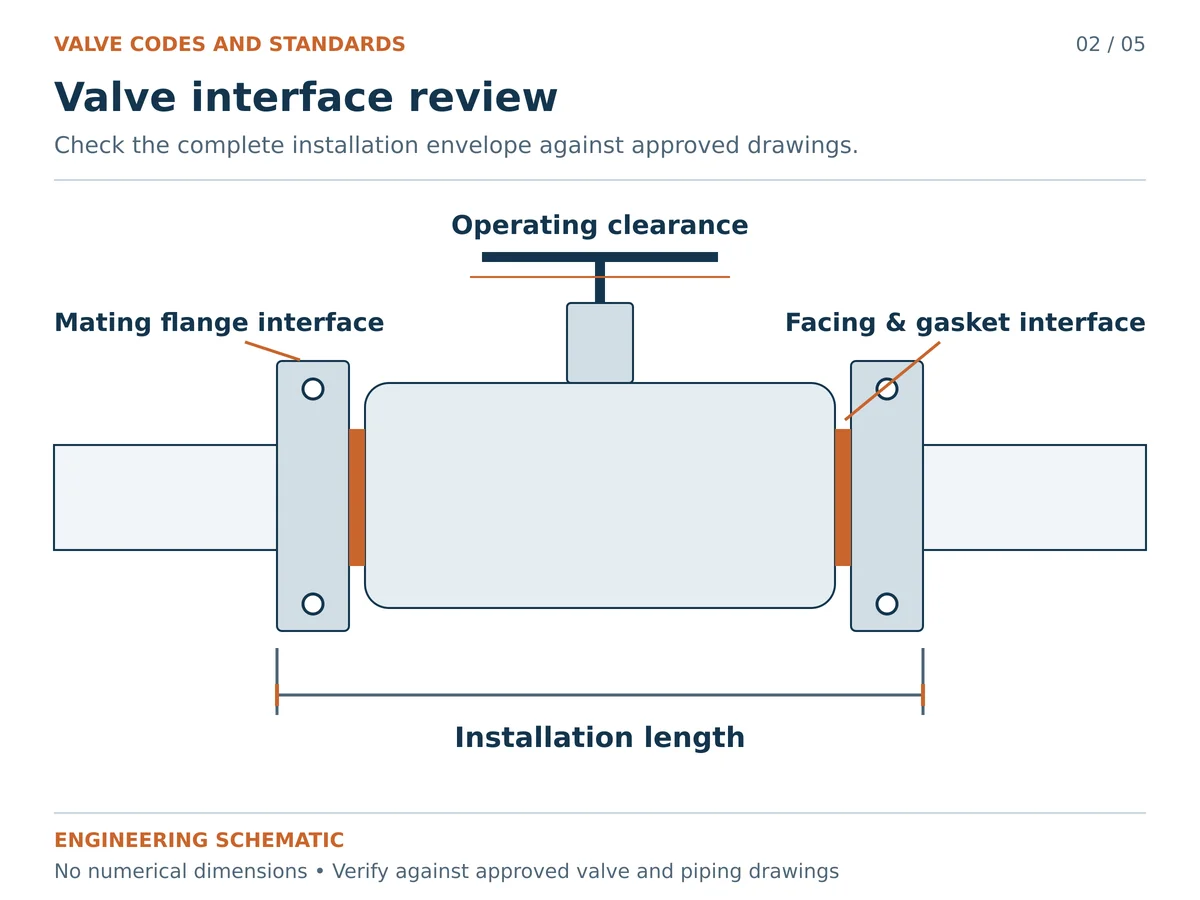
Treat the interface review as a defined engineering task. Ask the supplier to identify the complete proposed interface and compare it with the piping drawings.
Record the installation length, connection designation, facing or end preparation, mating-pipe information and relevant tolerances. For an actuated package, also confirm mounting details, operating envelope and installation access.
Any alternative requires a documented compatibility review before acceptance.
Illustrative replacement review: two valves share nominal size and pressure class, but their approved installation lengths differ. A generic description has hidden the dimensional selection. Compare the controlled drawings, face-to-face dimensions and mating details before acceptance; a shared size and class do not establish interchangeability.
Materials and Special-Service Requirements
Pressure class is not a fixed pressure limit. Class 150, 300 or 600 must be reviewed with the applicable material group, temperature and product design. Check the body and bonnet rating together with the limits of bolting, trim, seats, packing and gaskets. Normal operating pressure does not replace design pressure; minimum temperature, maximum temperature and thermal cycling may introduce additional material or sealing requirements.
For material review, provide medium composition and concentration, phase, solids and velocity, plus chlorides, pH and H₂S where relevant. Include cleaning fluids and shutdown exposure. Identify the relevant degradation mechanism: general corrosion, pitting, crevice corrosion, stress corrosion cracking, erosion-corrosion or hydrogen damage, rather than relying on an alloy name alone.
Request identification of the body, bonnet, closure member, stem, seat, packing and gasket materials. Where the project requires additional environmental qualification, define the supporting records and their applicability to these components.
Body material acceptance does not qualify the stem, trim, seat, packing, gasket or bolting. Review sealing materials for temperature, chemical exposure, wear, friction and required shut-off or external-leakage performance. Swelling or permeation of nonmetallic materials and galling of sliding metal parts require different checks; confirm their relevance to the specified duty.
Illustrative receiving review: an acceptable material test certificate (MTC) accompanies a component whose identification or positive material identification (PMI) result does not match. The gap may be item-to-record linkage or a material mix-up. Verify the item, approved PMI method and reported elements, then resolve the discrepancy through the project quality process. An MTC alone does not establish the identity of the delivered item.
How to Select Standards for the Valve Type and Service
Select the product-standard route after defining the valve duty.
For example, API 6D’s published Addendum 2 describes requirements for axial, ball, check, gate and plug valves in petroleum and natural-gas applications and hydrogen-gas service. Its scope includes design, manufacturing, materials, welding, quality control, assembly, testing, marking, documentation and process controls.
For a product-specific example, review the API 600 gate valve page, then confirm the proposed construction against the complete datasheet and applicable product-standard scope.
Detailed standards-system explanations can be reviewed through the API valve standards guide et ANSI and ASME standards guide.
Continue into the Relevant Standards System
For terminology and project mapping in other systems, see the DIN, EN and ISO valve standards guide, GB and GB/T valve standards guide, et HG and HG/T standards guide. Their inclusion is a navigation aid, not a statement of technical equivalence between systems.
Which Service Inputs Change the Standards Review?
Capture the conditions that change the required construction, qualification or evidence. Use the table below as an RFQ screening aid. It does not determine final suitability.
Scroll horizontally if needed.
| Input to provide | Question de révision | Preuves à demander |
|---|---|---|
| Milieu, phase et composition | Do contaminants, solids or the specified environment introduce additional material or sealing requirements? | Component material schedule and a service-specific compatibility or qualification review |
| Design pressure and temperature; operating cases | Does the proposed construction cover the required combinations and identified transients? | Applicable rating basis, component limits and documented treatment of the stated cases |
| Isolation duty, differential pressure and leakage requirement | Which closure direction, test conditions and acceptance basis must be demonstrated? | Defined shut-off requirement and proposed test procedure linked to the datasheet |
| Operating frequency and actuation | What operating duty, fail position and package interfaces must be reviewed? | Operating-duty statement; valve torque/thrust at the required differential pressure, supply limits, operating time, fail position and matching review where applicable |
| Fire, emissions, low-temperature or other special duty | Which additional requirements are specified, and what evidence covers the proposed configuration? | Required qualification documents and a configuration-to-report applicability statement |
Nominal size does not establish flow capacity. Where flow performance is relevant, identify the operating cases, allowable pressure drop and the basis of any Cv/Kv value, including valve position. Control-valve sizing and check-valve operating stability need their own application data; a standards list or steady-state capacity value does not establish transient system performance.
Record an unresolved service input as an open technical item. Assign it to the purchaser, supplier or responsible project reviewer, and identify the selection or verification decision that depends on its closure.
Check Updates Beyond the Base Edition
Edition control should include relevant addenda and errata. At the 17 November 2026 review, API’s updates page listed API 6D, 25th edition, together with Addendum 3 dated March 2025 and Errata 4 dated October 2026. A register that records only the base edition may miss subsequent changes.
Record the approved document set and review its effect on the proposed supply. Publication dates and certification-program implementation dates should be identified separately where relevant.
Check referenced editions too: distinguish the edition assigned to each referenced document from a general instruction to use current publications. The governing product standard may specify different treatment for dated and undated references. Check its reference rules, approved addenda and the project’s document register before applying a blanket “latest edition” instruction.
How to Write Valve Standards into an RFQ
Include the valve function, medium, operating and design conditions, size, required capacity, connection, material requirements, shut-off duty and operating method. Then identify the documents controlling construction, interfaces, testing and qualification.
For an inspection/test reference specified by the project, the API 598 official preview identifies its published scope. Select the required tests and acceptance basis in the controlled documents; citing the number alone does not complete the RFQ.
An Illustrative Valve Specification Example
The following example demonstrates how to organize an RFQ review. It is an incomplete procurement worksheet for an assumed manual isolation valve, with open items that require resolution before ordering.
Scroll horizontally if needed.
| RFQ field | Example entry or required action |
|---|---|
| Duty | Manual isolation; purchaser to confirm operating frequency and shut-off requirements |
| Service data | Purchaser to provide medium, composition, operating and design conditions |
| Construction de la vanne | Supplier to identify proposed type, body construction and sealing arrangement |
| Product standard | Supplier to propose the applicable document and explain its scope |
| Contrôle de l'édition | Record approved edition, addenda, errata and project-specific modifications |
| Pressure–temperature basis | Supplier to provide rating data for the proposed material and construction |
| Installation interfaces | Confirm against piping specification and approved drawings |
| Tests | Identify required tests, procedures and acceptance references |
| Special qualification | Identify required fire, emissions, low-temperature or other evidence |
| Documents | Agree drawings, material records, reports and final dossier contents |
| Déviations | Submit a separate deviation schedule with the quotation |
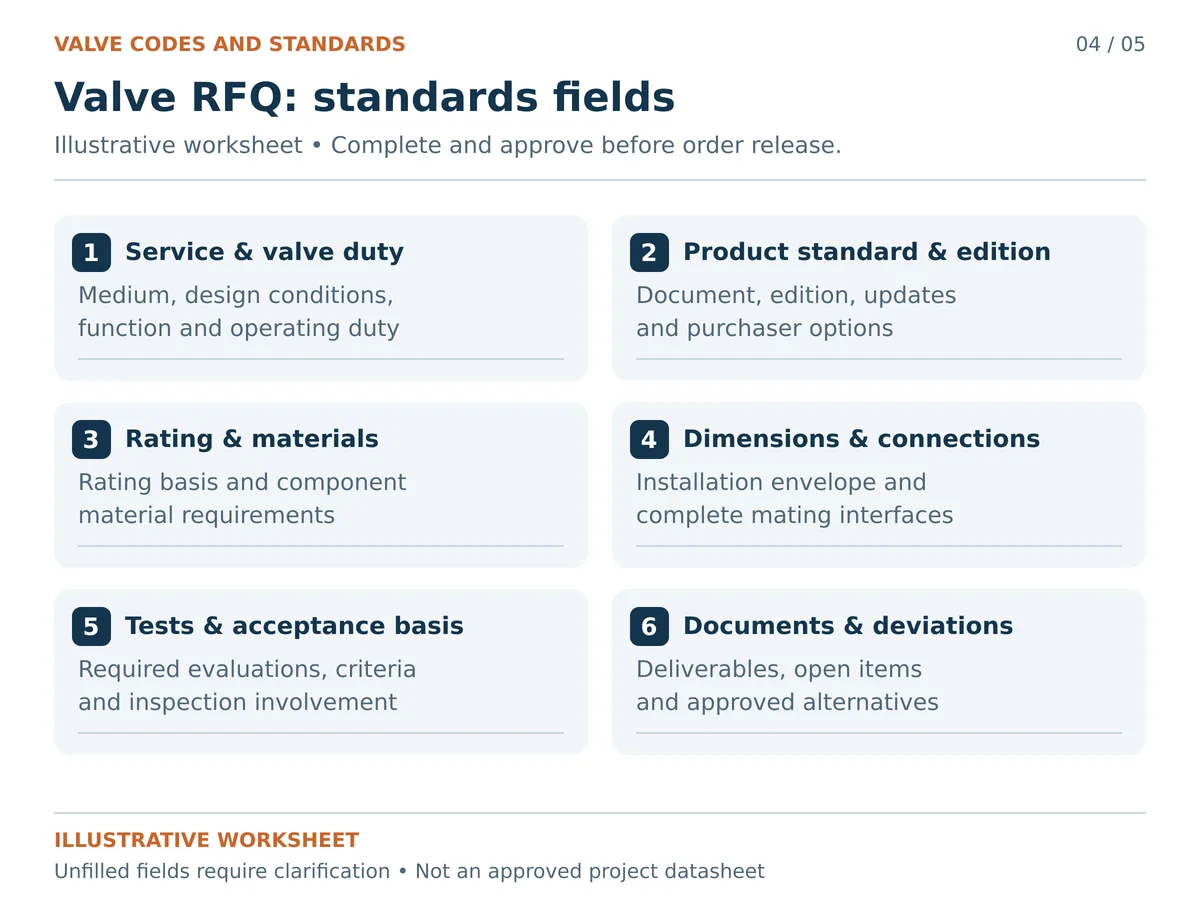
Open fields should be closed through technical clarification and approval. They should not become undocumented supplier assumptions.
Purchaser Options and Technical Deviations
Require the quotation to distinguish:
- Requirements included in the proposed scope.
- Requirements needing purchaser input.
- Proposed alternatives.
- Exclusions and deviations.
- Documents or approvals needed before manufacture.
Each deviation should identify the affected requirement, the proposed alternative, its technical implications and the approval reference. The inspection and test plan (ITP) should also identify required hold or witness points, notification and waiver arrangements, the reviewer and the release record. Agree these arrangements before the affected activity; do not assume every inspection requires the same approval route.
How to Review a Supplier’s Standards Compliance Claim
Convert a general statement such as “complies with applicable standards” into a reviewable response. The review should connect the requirement to the proposed model, supporting documents and acceptance decision.
Scroll horizontally if needed.
| Purchaser requirement | Supplier response to request | Supporting record | Review outcome |
|---|---|---|---|
| Construction du produit | Identify the proposed construction and applicable standard | Drawing and compliance schedule | Accept, clarify or record deviation |
| Rating at design conditions | State the rating basis for the proposed material | Rating data and design documentation | Confirm suitability |
| Installation interfaces | Identify dimensions and connection details | Approved drawing and dimensional report | Confirm fit |
| Test de pression | State procedure, acceptance basis and reporting scope | Procedure and valve-linked test record | Confirm required coverage |
| Special qualification | Identify the report and its applicability | Qualification report and coverage review | Confirm or request additional evidence |
| Traçabilité des matériaux | Explain component-to-record identification | Certificats matière et enregistrements de traçabilité | Confirm required traceability |
| Dossier final | Confirm included documents and submission dates | Approved document register | Confirm release requirements |

Does a Qualification Report Cover the Proposed Valve?
A report for a representative design requires an applicability review before it is accepted for an order. The following is a buyer’s review checklist, not a substitute for the extension or qualification rules in the selected standard.
Scroll horizontally if needed.
| Point d'examen | What to compare | When clarification is needed |
|---|---|---|
| Report identity and test basis | Report number, issuer, standard, edition, procedure and stated result | A certificate summary does not identify the underlying report or acceptance basis |
| Design and sealing configuration | Tested construction, relevant sealing components and offered design | A design or sealing change has no documented coverage assessment |
| Qualified range and classification | Required size/class coverage and the classifications or conditions relevant to the selected qualification | The offered configuration falls outside the demonstrated range, or its coverage is unexplained |
| Order linkage | Quoted model, approved drawing revision and configuration covered by the supplier’s statement | The report cannot be connected to the valve proposed for the tag |
| Changes and required follow-up | Documented basis for coverage and any additional project requirements | Approval relies on an unreviewed equivalence claim or outstanding qualification work |
Illustrative qualification review: an emissions report covers one packing arrangement, while the quoted valve uses another. A certificate title leaves that change unresolved. Compare specimen details, drawing revision and coverage rules; obtain an approved applicability assessment or additional qualification before using the report to accept the offered design.
For example, ISO 15848-1 addresses fugitive-emissions type qualification. Review that evidence for its specified purpose and confirm any separately required production acceptance records. A type-qualification report and the records for the supplied valves serve different review needs.
Where the report does not establish coverage, request a documented applicability assessment or a proposal for the additional verification needed. The responsible project reviewer should resolve the item before the dependent approval.
For test planning, keep the pressure-test requirements linked to the approved procedure and inspection plan. The ressource de test de pression des vannes provides a related review route.
Worked Example: Resolve Conflicting Valve Test References
Illustrative scenario: a datasheet cites one pressure-test standard and edition, while an attached purchase specification cites another. The supplier’s quotation says only “standard pressure test”. No governing acceptance basis has been agreed.
This is a document-control problem to resolve before test approval. Standard names alone do not establish that the requirements or proposed tests are equivalent.
- Identify the affected requirement. Record the documents, revisions and conflicting references. Ask which tests, valve configuration, medium, pressure, duration, direction and leakage criterion are affected. Obtain these details from the controlled documents and supplier procedure.
- Prepare the clarification. Ask the responsible reviewer to confirm the governing basis and any additional requirements using the project’s precedence process. Where the product standard references a test standard, review that relationship as well. Avoid combining selected requirements into an undocumented hybrid procedure.
- Close the record. Update the datasheet or clarification register, supplier compliance schedule, test procedure and inspection plan as necessary. Record the approval reference and the valve tags to which the decision applies.
Example closure entry: “For the identified valve tags, use the approved test basis recorded in the technical clarification. Apply the agreed supplementary requirements. Revise the procedure and inspection plan before the affected test.” The actual documents, acceptance criteria and approval references must be supplied by the project.
ISO 5208’s public scope explicitly addresses its relationship with product-standard requirements. That relationship should be checked when it is invoked; it does not establish a universal precedence order for every project document.
Common Valve Specification Errors to Resolve Before Ordering
Recording a Standard Number Without Its Edition
An incomplete reference can leave the purchaser and supplier working to different requirements. Include the approved edition and relevant updates in the standards register.
Treating a Test Report as Evidence for Every Requirement
Review the purpose and scope of each record. Ask whether it addresses the specific construction, interface, material, test or qualification requirement under evaluation.
Shell testing addresses the pressure boundary; closure testing addresses seat tightness under specified conditions. A backseat test addresses a separate sealing feature, where present. Functional, fire, emissions and low-temperature evaluations address other specified duties. Passing one does not establish all the others, and pressure testing does not demonstrate the absence of every internal discontinuity.
La ASNT overview of NDT methods distinguishes liquid penetrant testing (PT) for surface-opening indications on suitable nonporous materials, magnetic particle testing (MT) for surface and near-surface indications in ferromagnetic materials, and radiographic (RT) and ultrasonic (UT) methods with different internal-examination capabilities. Specify the method, coverage, procedure and acceptance basis for the material and geometry; the methods are not interchangeable.
PMI checks reported composition within the capability of the selected method; it does not replace an MTC, heat-treatment evidence or required mechanical-property records. Conversely, a certificate needs traceability to the physical component. Review chemistry, processing records, examinations and identification as complementary evidence.
Accepting an Alternative Without an Interface Review
When a supplier proposes a different standards route, require a comparison of the affected requirements. Address dimensions, connections, rating basis, materials, testing and documentation as applicable. Record the decision before approving the alternative.
Leaving Acceptance Requirements Until Final Inspection
Agree the acceptance basis and evidence before the work begins. Otherwise, inspection may identify a disagreement that the completed records cannot resolve.
Using a Website Claim as the Complete Approval Basis
Use supplier information to begin the evaluation. Complete the approval using records relevant to the ordered configuration and project requirements.
La About Raymon Valve page provides company context; the requested product and documentation scope should be confirmed during the technical review.
Valve Standards Checklist Before Purchase Order Release
Before releasing the order, confirm that:
- The system basis and applicable project requirements are identified.
- The datasheet contains the information needed for the proposed duty.
- The product standard has been checked against the proposed construction.
- Editions, addenda, errata and purchaser options are recorded.
- The pressure–temperature basis has been reviewed.
- Materials and special-service requirements are defined.
- Installation dimensions and mating interfaces are agreed.
- Tests and acceptance references are specified.
- Required qualification reports have an applicability review.
- Inspection involvement and document submission stages are agreed.
- Deviations have documented decisions.
- Final release responsibilities are assigned.
Close Each Item Before the Activity It Controls
The following is a suggested planning framework. Set the actual approval stages, reviewers, hold points and release authority in the project documents.
Scroll horizontally if needed.
| Activity | Questions to close | Suggested closure record |
|---|---|---|
| Technical bid comparison and award | Are service assumptions, standards, purchaser options, deviations and document scope comparable? | Accepted compliance and deviation schedules, including any conditions attached to award |
| Affected manufacturing or test activity | Are the required drawings, procedures, acceptance references and inspection involvement agreed? | Approved document revisions and closed technical clarifications for that activity |
| Final release | Do the actual records identify the supplied valves and satisfy the agreed release requirements? | Completed dossier, resolved nonconformities and authorized release record as required by the order |
Quotation comparison: ask each supplier to identify included work, optional work, exclusions, additional qualification and document-review dependencies against the same requirements. This exposes scope differences before price and delivery comparisons are accepted.
Foire aux questions
Which codes and standards apply to industrial valves?
The applicable set depends on the piping system, valve construction, service, jurisdiction and project specification. Map the product, rating, dimensional, material, test and qualification requirements separately, then identify the approved document and evidence for each.
What is the difference between a piping code and a valve product standard?
A piping code addresses the system. A valve product standard addresses a defined component scope. Review both against the proposed valve and project requirements; neither the valve name nor one standard number completes the specification.
How do I select the applicable standard edition?
Check the project-approved edition, mandatory requirements, publisher updates and the governing document’s dated or undated reference rules. Resolve differences through technical clarification and record the accepted edition, amendments and deviations before dependent work.
Does a pressure-test report prove all specified requirements?
No. A pressure-test report records results under stated test conditions. It does not establish every material, NDT, functional, fire or fugitive-emissions requirement. Review the separate records required by the order and their applicability to the supplied valves.
Can API, ISO and EN standards be substituted?
Treat substitution as a project engineering review. Compare scope, ratings, materials, interfaces, tests and acceptance requirements, then obtain the required approval. Similar titles or nominal pressure designations do not establish interchangeability.
What should a valve RFQ specify about standards?
State the applicable documents and editions, purchaser options, rating and interface requirements, required tests and leakage acceptance, qualification coverage, document deliverables and deviation procedure. Include the service data needed to review the proposed construction.
How should conflicting requirements be resolved?
Use the approved document-precedence and technical clarification process. Record the governing requirement, affected valve tags, approval and necessary document revisions before proceeding with dependent work. A general “most stringent applies” statement does not resolve an unexplained conflict.
Request a Valve Standards and Documentation Review
Send your valve datasheet, medium, design pressure and temperature, size, connection requirements, project specification and required inspection documents.
Include the unresolved standard reference or specification conflict, the supplier’s proposed response and the supporting records available for review. Identify any special-service requirements and the next approval or activity affected by the open item.Request Standards & Documentation Review
Official References and Technical Scope
Publisher information and public scope statements were checked on 17 November 2026. These references support document identification and scope review; the controlled standards and approved project documents govern detailed requirements.
- ASME: ASME B16.34 — valve scope and rating basis.
- ASME: ASME B31.3 — process-piping system scope.
- ISO: ISO 5208:2015 — metallic-valve pressure-test scope and catalogue status.
- API: API’s updates page — publication updates to review with controlled documents.
- API official preview: API 598 official preview — the official API 598 preview, not the complete standard.
- ISO: ISO 15848-1 — emissions type qualification and amendment information.
- ASNT: ASNT overview of NDT methods — NDT method purposes and capabilities.
Note d'ingénierie: prepared by the Raymon Valve Technical Content Team as a specification-review resource. Illustrative scenarios are decision examples, not reported customer projects. Final applicability, qualification coverage and acceptance require the controlled standards, approved project documents and records for the supplied configuration.
Application boundary: this guide supports specification development and supplier review. Final valve selection depends on the confirmed process data, applicable code, pressure–temperature rating, material compatibility, shut-off requirement, actuation method and project documentation. The RFQ worksheet and engineering diagrams are explanatory examples.
 French
 English
 German
 Arabic
 Spanish
 Italian
 Portuguese
 Russian