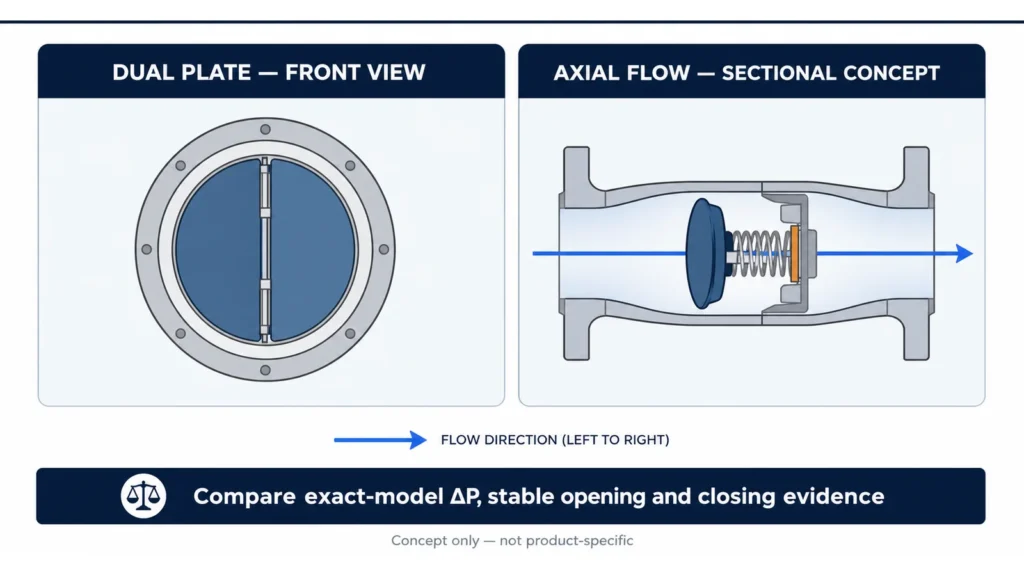
Os diagramas conceituais comparam as orientações típicas de construção de placa dupla e fluxo axial. A geometria interna e o desempenho específicos variam entre fabricantes e modelos.
Este comparativo auxilia no processo de seleção mais amplo de válvulas de retenção industriais. No entanto, ele não substitui o manual de dados completo, a avaliação do sistema de bombeamento ou a aprovação do engenheiro responsável. Para uma descrição mais detalhada das faixas de vazão, estabilidade de abertura e características dinâmicas de fechamento, consulteVálvulas de retenção industriaisProcesso de seleção.Guia de dimensionamento e seleção de válvulas de retenção。
Decisão rápida: Duas placas ou axial?
O tipo de construção pode fornecer uma direção inicial útil, mas não determina a perda de pressão real ou a resposta de fechamento da válvula fornecida. Use a matriz a seguir para determinar qual projeto vale a pena avaliar mais detalhadamente.
Em telas menores, role a tabela horizontalmente para ver todos os campos de comparação.
Decisão rápida: Duas placas ou axial?
| Prioridade do projeto |
Direção inicial |
Ainda a ser confirmado |
| Montagem wafer compacta |
Duas placas podem ser consideradas |
Dimensões de face a face, compatibilidade de flange e direção de aprovação |
| Redução do peso de instalação da válvula |
Duas placas são frequentemente incluídas na comparação. |
Peso preciso, conexão aparafusada, requisitos de suporte e manuseio da tubulação |
| Fechamento de curso curto guiado |
Axial pode ser considerado |
Curso do disco, base da mola, atrito de guia e evidência dinâmica |
| Proteção crítica contra desligamento da bomba |
O axial merece uma análise mais aprofundada. |
Velocidade reversa, análise transiente e consequências do sistema |
| Custo inicial mínimo da válvula |
Placa dupla pode ter vantagens |
Custo total de instalação, perda de pressão operacional e consequências de falha |
| Perda de pressão operacional mínima |
Não há vencedor automático |
Modelo preciso de Cv/Kv, curvas de perda de carga e posição de abertura |
| Baixo fluxo ou fluxo com grandes variações |
Não há vencedor automático |
Manter fluxo mínimo estável e posição da placa/disco em toda a faixa de operação |
| Meios com incrustação ou sólidos |
Não há vencedor automático |
Dobradiças, molas, guias, folgas e sedes expostas |
Limites de seleção:Termos como “silencioso”, “sem golpe de aríete” ou “baixa perda” em folhetos não substituem dados hidráulicos e de desempenho de modelos específicos.
1. FuncionalidadeDefine operação básica de não circulação ou proteção de equipamentos rotativos críticos.
2. Ajuste HidráulicoCompare a perda de pressão do modelo exato e a abertura estável em toda a faixa de fluxo.
3. Ajuste DinâmicoRevise a desaceleração do fluxo, o curso de fechamento, a força da mola e a velocidade reversa na vedação.
4. Adequação para ComprasNormalizar materiais, testes, documentação, desvios, peças sobressalentes e limites de instalação.
O que fisicamente difere entre os dois projetos?
Construção Típica de Válvula de Retenção de Duas Placas
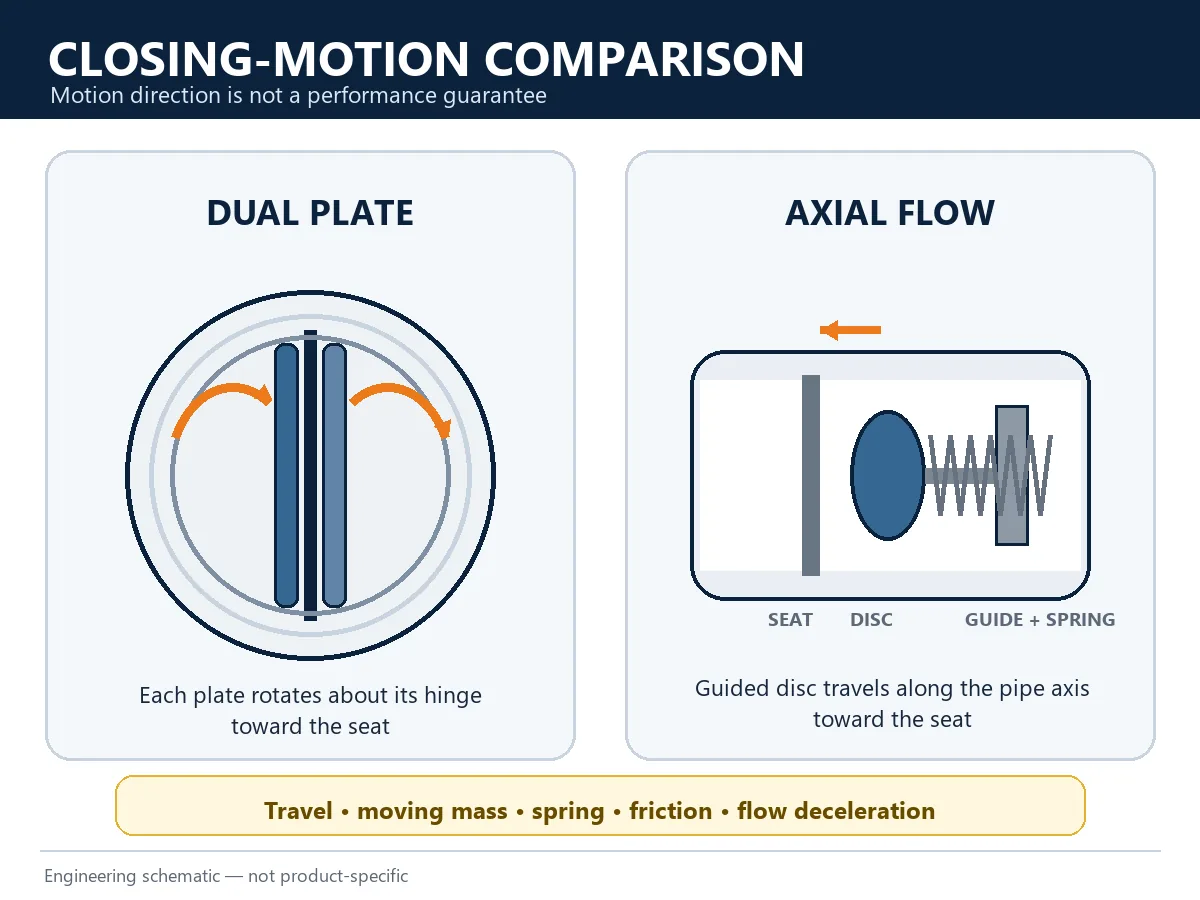
Uma válvula de duas placas típica usa duas placas assistidas por mola girando em torno de pinos de articulação, frequentemente em um corpo wafer compacto. O perfil da placa, a localização da articulação, o torque da mola, os batentes e a geometria da sede variam por modelo, e todos permanecem relevantes para a obstrução do fluxo, resposta estável de abertura e fechamento.
Construção Típica de Válvula de Retenção Axial
Uma válvula de fluxo axial típica usa um disco guiado assistido por mola movendo-se aproximadamente ao longo do eixo do tubo através de um curso linear curto. A área de fluxo anular, a massa do disco, a geometria da guia, a força da mola e a aproximação da sede permanecem específicas do modelo; o nome do projeto por si só não comprova baixo perda ou desempenho sem impacto (non-slam).
Esquema de engenharia mostrando o movimento típico da placa rotacional e o movimento guiado do disco axial. O curso, a massa, as molas e a geometria interna permanecem específicos do modelo.
Duas Placas vs. Fluxo Axial: Comparação de Engenharia Lado a Lado
| Fator de decisão |
Válvula de retenção de duas placas |
Válvula de retenção de fluxo axial |
Verificação do comprador |
| Elemento de fechamento |
Duas placas rotativas, tipicamente com assistência de mola |
Disco guiado movendo-se aproximadamente ao longo do eixo do fluxo |
Desenho seccional aprovado |
| Curso de fechamento |
Movimento rotacional curto |
Movimento linear curto |
Distância exata de curso |
| Inércia de movimento |
Depende do tamanho da placa, massa e arranjo da dobradiça |
Depende da massa do disco e do arranjo de guia |
Dados do modelo oferecido |
| Arranjo de mola |
Molas de disco de torção ou específicas do modelo |
Arranjo de mola central ou guiado |
Base da mola e pressão de abertura |
| Caminho de fluxo |
Placas, dobradiças e suportes ocupam parte da passagem |
Frequentemente anular ou aerodinâmico ao redor de um elemento guiado |
Desenho seccional e coeficiente de fluxo |
| Perda de pressão |
Dependente do modelo e da posição de abertura |
Curva exata de queda de pressão |
| Estabilidade em baixo fluxo |
As placas podem permanecer parcialmente abertas ou mover-se instavelmente se selecionadas incorretamente |
O disco pode permanecer parcialmente aberto abaixo de sua faixa operacional estável |
Dados de fluxo mínimo estável |
| Closing response |
Influenced by plate inertia, springs, friction and deceleration |
Influenced by disc inertia, spring force, guide friction and deceleration |
Evidência dinâmica |
| Installation envelope |
Often compact |
Frequently longer, depending on design |
Certified dimensional drawing |
| Maintenance focus |
Plates, hinges, springs, stops and seats |
Guide, disc, spring and seat |
IOM and spare-parts scope |
| Initial commercial cost |
Often commercially attractive |
May carry a higher initial price |
Normalized total scope |
Pressure Loss: Why the Valve Type Alone Does Not Decide ΔP
Pressure loss through either design depends on the complete internal flow path, not simply on the words “dual plate” or “axial flow.” Relevant variables include internal area, plate or disc obstruction, hinge or guide geometry, spring components, seat profile, valve opening position, fluid density and viscosity, operating flow and compressibility where applicable.
Fully Open Data May Not Represent Normal Operation
A check valve is self-actuated. Its operating position results from the balance between flow force, spring force, moving-element weight, friction and gravity where relevant. At maximum flow, the valve may approach the fully open position used to establish a catalogue coefficient. At normal or minimum flow, it may operate partly open, producing a different loss and potentially unstable movement.
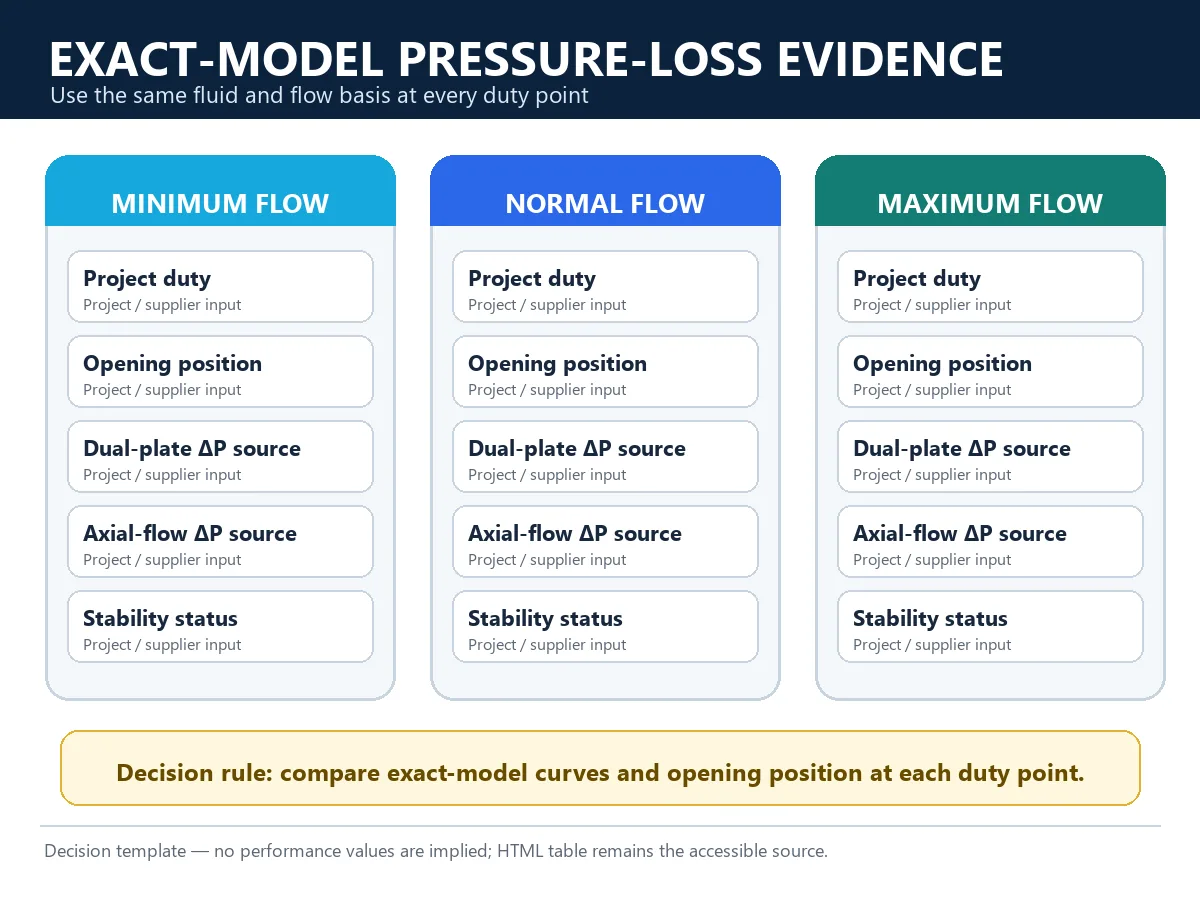
For this reason, buyers should compare exact offered models at the project’s minimum, normal and maximum flow points rather than comparing a single maximum Cv or Kv value.
Example decision matrix for comparing exact-model pressure loss and opening position across the operating flow range. Values must come from project and supplier data.
Engineering comparison table 3
| Operating point |
Required flow |
Dual plate ΔP |
Axial flow ΔP |
Opening position |
Evidence source |
| Minimum |
Project input |
Supplier input |
Supplier input |
Supplier input |
Curve, calculation or test |
| Normal |
Project input |
Supplier input |
Supplier input |
Supplier input |
Curve, calculation or test |
| Maximum |
Project input |
Supplier input |
Supplier input |
Supplier input |
Curve, calculation or test |
Pressure-loss review should also separate purchase cost, installed cost, energy loss over the operating duty, maintenance burden and the consequence of unsuitable closure. A less expensive valve may not be economical if its actual operating loss is materially higher, while a premium design may not be justified where operating hours and risk are limited.
Low-flow approval warning: a valve can satisfy maximum-flow pressure-drop limits yet remain unsuitable at minimum or normal flow. Require the supplier to identify the expected opening position, stable-operating range and any continuous-operation restrictions for the exact offered size and spring configuration.
Closing Response: What Actually Controls Slam Risk?
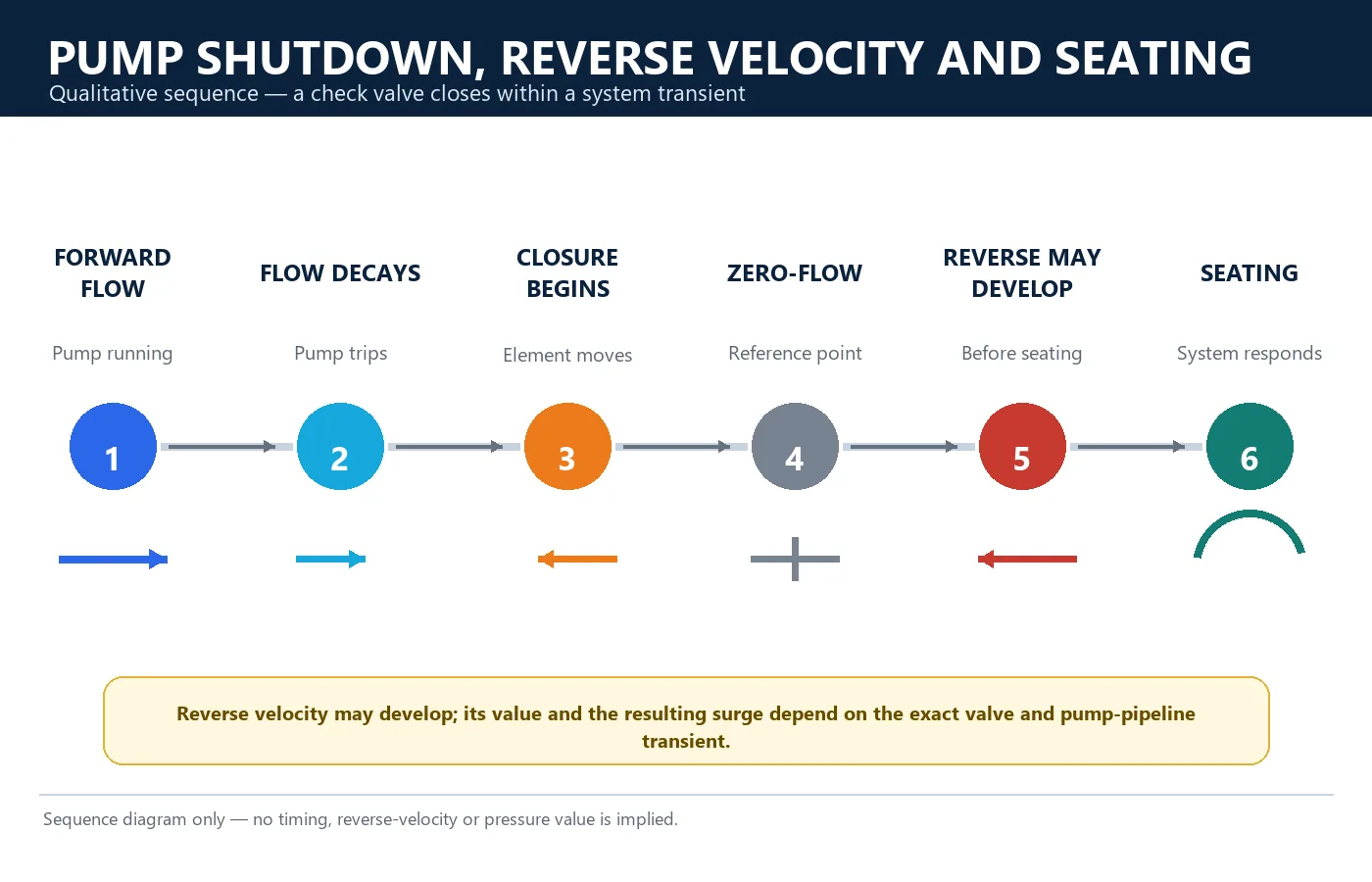
Check valve slam is a system event: the closure element may reach the seat after reverse flow has developed, rapidly changing fluid momentum. Relevant inputs include pump deceleration, shutdown sequence, static head, pipeline profile, moving-element mass, spring force, friction, travel and reverse velocity at seating.
Dual Plate Closing Behaviour
Two plates can shorten individual travel compared with some single-disc swing arrangements, while springs may initiate closure as forward flow falls. Unequal plate movement, hinge friction, spring condition, disturbed inlet flow and low-flow operation can still change the response.
Axial Flow Closing Behaviour
A guided short-stroke disc may follow falling forward flow more closely, but performance still depends on disc mass, spring rate, guide friction, seat approach and the real system deceleration. Fast movement does not by itself guarantee an acceptable pressure transient.
Reverse Velocity at Closure
Reverse velocity at seating is more useful than a marketing label. Static Cv/Kv, cracking pressure and shell-test results do not establish it; a meaningful offer should tie dynamic evidence to the exact valve configuration and stated deceleration conditions.
What a Supplier Dynamic Curve Should State
- exact valve model, nominal size and internal configuration;
- fluid, temperature and installation orientation;
- spring configuration and cracking-pressure basis;
- opening position or forward velocity before deceleration;
- flow-deceleration basis and calculation or test method;
- reverse velocity, closure characteristic or stated response output;
- range of sizes or conditions represented by the data; and
- limits that prevent applying the curve to a different system without review.
For field symptoms after unstable operation has occurred, use the separate check valve chatter and slamming resource.
Engineering sequence illustrating how flow deceleration and reverse velocity can develop before check valve seating. Actual response depends on the valve and complete piping system.
Pump Protection: The Check Valve Is Only One Layer
Normal Shutdown vs Sudden Pump Trip
During controlled shutdown, forward flow may decay gradually; after power loss or emergency trip, speed and flow may change much faster. Pump curve, rotating inertia, control sequence, downstream pressure, system resistance and valve location determine whether the valve follows the decay or allows significant reverse flow before seating.
Parallel Pumps
In a common header, a running pump can drive reverse flow through a stopped unit. Review the operating sequence, header pressure, permissible reverse flow, isolation arrangement and repeated low-flow cycling—not only the selected check-valve family.
Long Pipelines and High Static Head
Long rising mains, high static head and strict pressure limits can make valve closure a system-transient problem. The Hydraulic Institute notes that water-hammer severity depends on velocity change, pipe configuration and material, fluid properties, pump characteristics and valve-closure behavior; complex installations may require mathematical system analysis and modeling. Review the Hydraulic Institute system guidance.
A Hydraulic Institute field evaluation measured pressure after induced pump power loss and compared a swing check valve with a nozzle check valve at one municipal station. It supports the value of field data and transient modeling, but its result is case-specific and must not be converted into a universal performance percentage for dual plate versus axial flow valves. See the case-study scope.
System boundary: a check valve may be one pump-protection measure, but it does not replace review of controlled shutdown, surge vessels, air or vacuum devices, relief arrangements, rotating inertia or other project-specific measures.
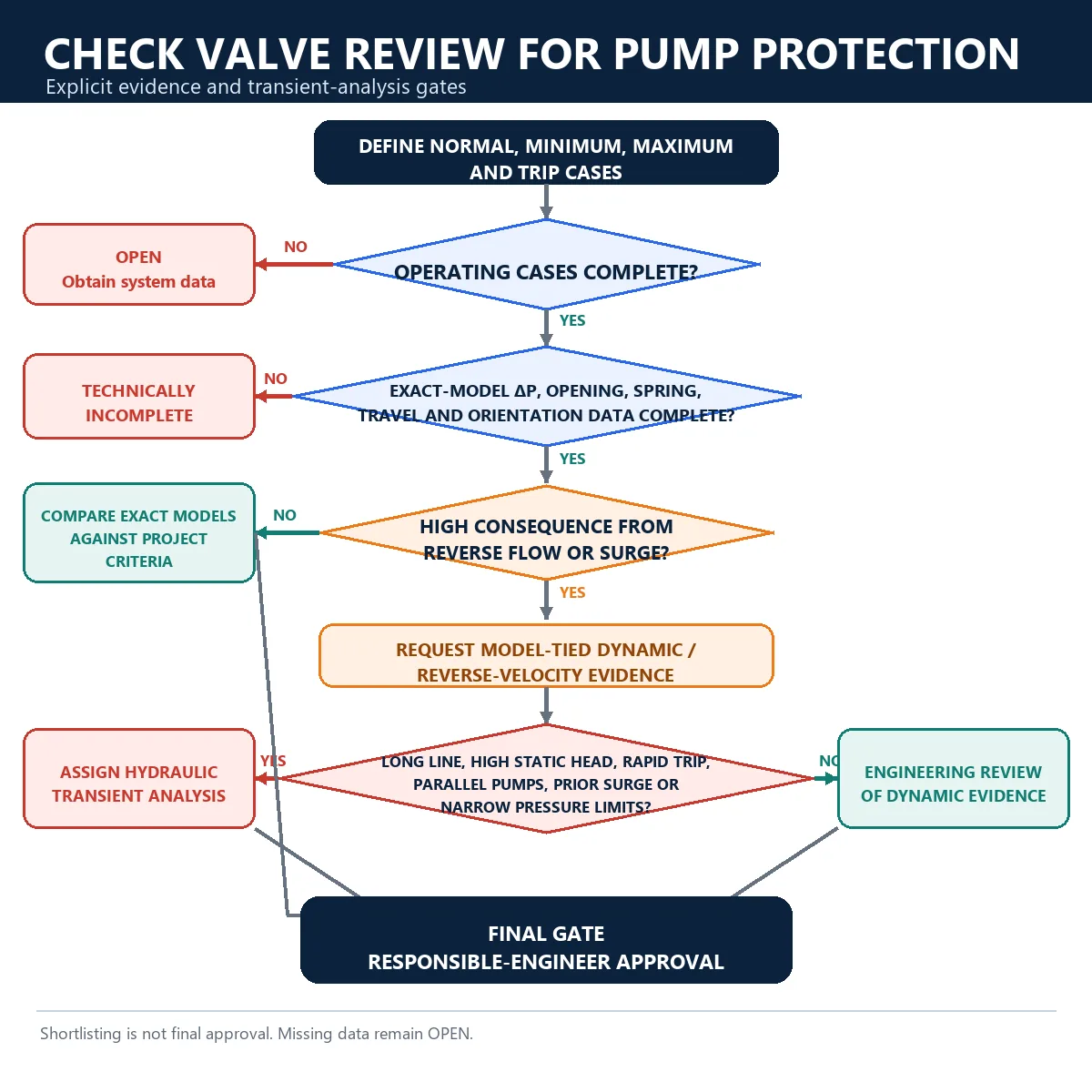
Example engineering decision path for shortlisting check valves and identifying duties that require dynamic or transient review.
When Each Design May Be Preferred
Dual Plate May Be Preferred When
- compact wafer installation or lower support load matters;
- large size makes a short envelope valuable;
- initial commercial economy has high priority; and
- exact-model hydraulic and dynamic evidence supports the duty.
Axial Flow May Be Preferred When
- rotating-equipment protection has high consequence;
- guided short-stroke closure is an important objective;
- permitted reverse flow is low or flow decay is rapid; and
- dynamic evidence supports the offered model and system basis.
Both options still require pressure-loss, stable-opening, orientation, materials, fouling, maintenance and transient review. See the related swing vs lift check valve comparison for a different construction decision.
Installation and Maintenance Factors That Can Change the Decision
The RFQ should state the actual flow direction, orientation, nearby fittings and available maintenance access. Gravity, swirl or an uneven velocity profile can change plate loading or disc position, while deposits and wear can affect hinges, guides, springs and seats.
- Use the offered model’s approved installation orientations rather than a generic rule.
- Review elbows, reducers, pump nozzles and tees against model-specific supplier guidance.
- Confirm replaceable internals, spare assemblies, special tools and removal space.
- Do not invent a universal straight-pipe distance without project or manufacturer support.
Matriz de Indicação de Falha, Causa Provável e Verificação
This matrix is intended for specification review and supplier clarification. It does not replace safe isolation, inspection procedures or system-level failure analysis.
Matriz de Indicação de Falha, Causa Provável e Verificação
| Observed or predicted indication |
Possible engineering cause |
Evidence to request or verify |
Selection implication |
| Repeated plate or disc movement at normal flow |
Valve oversized, unstable opening position, disturbed inlet flow or unsuitable spring |
Minimum stable flow, opening-position data, piping layout and model-specific installation guidance |
Do not approve until stable operation is demonstrated |
| High measured or calculated pressure loss |
Restricted internal path, partial opening, unsuitable nominal size or inaccurate catalogue comparison |
Exact-model ΔP curve, fluid assumptions and opening position at all duty points |
Recompare size and design using normalized data |
| Impact noise or pressure spike after pump trip |
Reverse flow develops before seating, excessive closure travel, low spring force or severe system deceleration |
Trip sequence, deceleration, reverse-velocity curve, transient model and event data |
Escalate to dynamic or transient review |
| Unequal dual-plate movement |
Asymmetric flow, hinge wear, spring variation, debris or installation disturbance |
Sectional drawing, inspection findings, spring/hinge condition and upstream layout |
Correct root cause before return to service or approval |
| Axial disc drag or delayed return |
Guide friction, deposits, galling, corrosion, misalignment or unsuitable clearance |
Guide materials, clearances, medium condition, maintenance evidence and exact IOM |
Review material, fouling and maintenance suitability |
| Leakage after closure |
Seat damage, debris, misalignment, wear or acceptance criterion mismatch |
Seat design, leakage requirement, inspection and pressure-test acceptance |
Separate shut-off acceptance from dynamic suitability |
Required Service Data Before Selecting Either Design
| Data field |
Por que é importante |
| Valve function |
Distinguishes basic non-return duty from critical equipment protection |
| Meio e fase |
Affects density, viscosity, compressibility and compatibility |
| Minimum flow |
Identifies partial-opening and stability risk |
| Normal flow |
Defines normal position and energy loss |
| Maximum flow |
Defines peak velocity and pressure loss |
| Operating/design pressure and temperature |
Supports rating, material, spring and seat review |
| Pump curve and rotating inertia |
Supports operating and shutdown analysis |
| Shutdown sequence |
Influences flow deceleration and reverse-flow development |
| Static head and pipeline profile |
Influence reverse acceleration and transient behaviour |
| Parallel-pump arrangement |
Creates stopped-pump reverse-flow scenarios |
| Allowable valve pressure loss |
Supports hydraulic comparison |
| Permitted reverse flow |
Defines the equipment-protection objective |
| Orientação de instalação |
Affects moving-element behaviour |
| Solids or fouling risk |
Affects hinges, guides, springs and seats |
| Testing and documentation scope |
Defines procurement acceptance and traceability |
Supplier Evidence and Technical Bid Normalization
A purchase decision becomes more reliable when every supplier quotes against the same evidence fields. Pressure-boundary and closure tests must remain separate from hydraulic and dynamic performance. The site’s valve pressure testing resource is included only as a navigational reference; it does not substantiate the offered valve’s pressure loss, stable opening or pump-trip response. The purchase specification and current applicable standards remain controlling.
Supplier Evidence and Technical Bid Normalization
| Evidência exigida |
O que suporta |
O que não comprova |
| Desenho seccional aprovado |
Construction and internal flow path |
Actual system closing response |
| Cv/Kv data |
Hydraulic comparison |
Stable operation at every flow point |
| Pressure-drop curve |
ΔP at stated conditions |
Pump-trip performance |
| Pressão de abertura |
Initial opening requirement |
Fluxo mínimo estável |
| Dados de fluxo mínimo estável |
Low-flow suitability |
Surge protection under every shutdown |
| Plate or disc travel |
Closure distance |
Reverse velocity by itself |
| Spring data |
Closing-force basis |
Complete transient behaviour |
| Dynamic test or analysis |
Behaviour under stated conditions |
Different system conditions |
| Pressure-test report |
Pressure-boundary and closure acceptance |
Hydraulic efficiency or pump protection |
| Certificados de material |
Material traceability |
Resistência universal à corrosão |
| Installation instructions |
Approved orientation and handling |
Suitability for an unreviewed layout |
| Cronograma de desvios técnicos |
Transparent bid comparison |
Compliance unless deviations are accepted |
Technical Bid Normalization Fields
Before comparing price, place each quotation into the same technical format. A lower-priced offer should not appear equivalent when it omits performance data, documentation, inspection, spares or installation restrictions.
Supplier Evidence and Technical Bid Normalization
| Campo da proposta |
Required common basis |
Acceptable evidence |
Deviation treatment |
| Valve construction |
Exact design, size, class/PN, end connection and face-to-face |
Datasheet and approved sectional/dimensional drawing |
List all geometry or connection differences |
| Hydraulic performance |
Same medium properties and minimum/normal/maximum flow |
Cv/Kv and ΔP curve with stated calculation or test basis |
Reject untraceable “low-loss” claims |
| Dynamic performance |
Same pump trip, deceleration and permitted reverse-flow basis |
Dynamic curve, test evidence or project-specific analysis |
Identify static-only offers as incomplete for critical duty |
| Materials and seat |
Same body, closure element, hinge/guide, spring and seat requirements |
Material schedule, MTC scope and compatibility review |
Record every substitution for engineering acceptance |
| Testes e inspeção |
Same shell, seat, functional, NDT/PMI and witness scope where required |
ITP, procedures and report/document list |
Separate included, optional and excluded activities |
| Documentation and spares |
Same drawing, certificate, manual, spare and packing scope |
Document register and commercial inclusion list |
Price omitted scope separately before award |
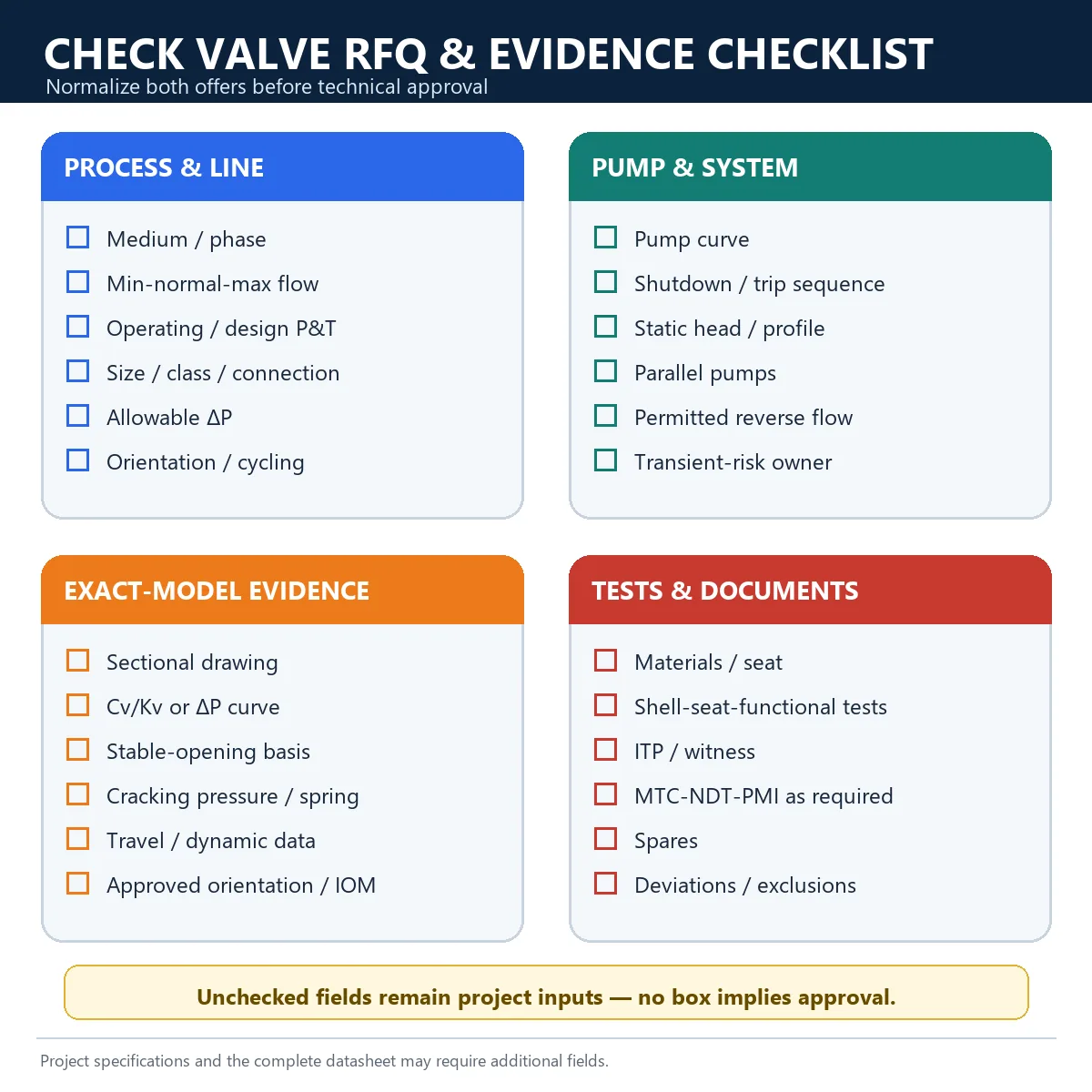
Example RFQ checklist for normalizing dual plate and axial flow check valve quotations. Project specifications may require additional fields.
Engineering Evidence Hierarchy
Use the highest available evidence level for the consequence of the duty. General brochures are suitable for screening, not final approval of critical pump protection.
Project and system dataPump curve, operating range, trip sequence, static head, pipeline profile, permitted reverse flow and transient criteria.
Exact offered-model dataSectional drawing, materials, Cv/Kv or ΔP curve, stable-opening evidence, travel, spring basis and approved orientation.
Dynamic evidence where consequence requires itReverse-velocity characteristic, test evidence or a model tied to the offered valve and the stated deceleration conditions.
Procurement acceptance evidenceITP, pressure-test scope, MTCs, inspection records, deviation schedule, documentation register and spare-parts list.
Aprovação Técnica Válvula Gaveta
Do Not Approve Either Valve Until the Supplier Confirms
- exact valve type, model and internal construction;
- nominal size, pressure class or PN, and end connection;
- applicable pressure-temperature rating;
- body, plate/disc, hinge/guide, spring and seat materials;
- exact-model Cv/Kv or pressure-drop curve;
- minimum stable flow or opening-position basis;
- cracking pressure and spring basis;
- plate or disc travel;
- approved installation orientation;
- shell and seat test scope;
- material traceability, inspection and documentation;
- spare-parts scope and technical deviations.
Escalate to System-Level Engineering Review When
- pump shutdown is rapid;
- reverse flow must be tightly limited;
- parallel pumps share a common header;
- the pipeline is long or static head is high;
- previous slam or surge has occurred;
- rotating-equipment damage has high consequence;
- the offered evidence is limited to static catalogue data;
- pressure excursions must remain within strict project limits.
Final Selection Summary
Shortlist dual plate where compactness, installed mass and commercial economy matter; shortlist axial flow where guided closure and low permitted reverse flow justify closer dynamic review. Approve neither from the family name alone—compare the exact models across the operating and trip conditions, and review the wider piping transient for critical systems.
Solicitar análise de seleção de válvula de retenção
Submit enough project information to compare dual plate and axial flow offers on the same hydraulic, dynamic and procurement basis.
Attach or provide
- medium and phase;
- minimum, normal and maximum flow;
- operating/design pressure and temperature;
- line size, class/PN and end connection;
- pump curve and shutdown sequence;
- static head and pipeline profile;
- parallel-pump arrangement and permitted reverse flow;
- orientation, materials, tests and document requirements.
Use the review to clarify
- which design should remain on the shortlist;
- which exact-model data are still missing;
- whether low-flow stability needs confirmation;
- whether dynamic or transient analysis is required;
- which technical deviations must be resolved before award.
Review boundary: the review can identify missing supplier evidence and conditions that require hydraulic transient analysis; it does not replace the project engineer’s final approval.
Submit Project Data for Review
Perguntas Frequentes
Qual válvula de retenção tem menor perda de carga: uma de placas duplas ou uma axial?
O nome do projeto não decide isso. Compare as curvas exatas de Cv/Kv ou de perda de pressão do modelo e a posição de abertura em fluxo mínimo, normal e máximo.
Qual válvula de retenção fecha mais rápido?
Depende do curso, massa em movimento, características da mola, atrito e desaceleração do fluxo. Discos axiais e placas duplas podem ter curso curto, mas o desempenho permanece específico do modelo e do sistema.
Uma válvula de retenção axial pode eliminar o golpe de aríete?
Não. Pode reduzir a velocidade reversa sob as condições declaradas, mas a bomba, a tubulação, o fluido e a transiente de desligamento ainda requerem revisão.
Uma válvula de retenção de placas duplas é adequada para descarga de bomba?
Pode ser, desde que a perda de carga, a abertura estável, a resposta de fechamento, a orientação e os materiais sejam adequados à aplicação. Desligamentos críticos podem exigir evidências dinâmicas ou análise transiente.
Uma válvula de retenção axial é o mesmo que uma válvula de retenção tipo bico injetor?
Os termos podem se sobrepor comercialmente, mas não garantem internos idênticos. Confirme o disco, guia, mola, caminho do fluxo, sede e curso no desenho aprovado.
Uma válvula de retenção de placas duplas pode ser instalada verticalmente?
Alguns modelos permitem, mas a direção aprovada e a orientação do fluxo dependem do projeto exato da mola e do disco. Siga as instruções do modelo oferecido.
Quais dados devem ser incluídos na solicitação de cotação (RFQ)?
Incluir dados de fluido, faixa de vazão, pressão, temperatura, bomba e tubulação, perda admissível, fluxo reverso permitido, orientação, materiais, testes e documentos.
Quando um estudo de transiente hidráulico é necessário?
Considere-a para linhas longas, alta carga estática, partidas rápidas, bombas paralelas, limites rigorosos de fluxo reverso, surtos anteriores ou equipamentos de alto risco.
Standards and Evidence Scope
At the time of this review, API’s official update record identifies API 594, 9th Edition, February 2022. Confirm the edition and project applicability before procurement. ISO 5208:2015, reviewed and confirmed by ISO in 2025, addresses metallic-valve pressure testing within its scope. ASME B16.10 addresses face-to-face and end-to-end dimensional interchangeability. None of these standards proves the offered valve’s exact pressure loss, stable opening or pump-trip response.
For system-level dynamic context, use the Hydraulic Institute water-hammer guidance. Its municipal pump-station field evaluation is useful case evidence for measurement and modeling, but it compares swing and nozzle check valves in one defined system and is not a universal dual-plate-versus-axial performance result.
Additional site navigation is available through the Raymon Valve Central de Conhecimento. Company context can be reviewed on the about Raymon Valve.
工程说明:本文仅用于初步比较、技术标书标准化和询价准备。文中未计算任何项目特定的压降、关闭时间、反向速度、冲击压力、材料兼容性或最终阀门选型。最终审批取决于已确认的项目数据、适用标准、准确的制造商数据以及负责工程师的审核。内容所有者:Raymon Valve 技术内容团队;本草案未指定任何持证审核人员。