
Fully welded and split body ball valves differ in how their pressure-containing bodies are joined—and in the repair options available after installation. A fully welded shell replaces conventional bolted body-split joints with permanent welds; a split body retains separable joints that may permit internal disassembly. For directly buried pipelines, the first arrangement can reduce inaccessible gasketed body interfaces. For accessible installations expecting internal overhaul, the second may be useful. Neither determines seat tightness, pressure rating or field repairability by itself. Compare the installed access, maintenance and supplier evidence before choosing.
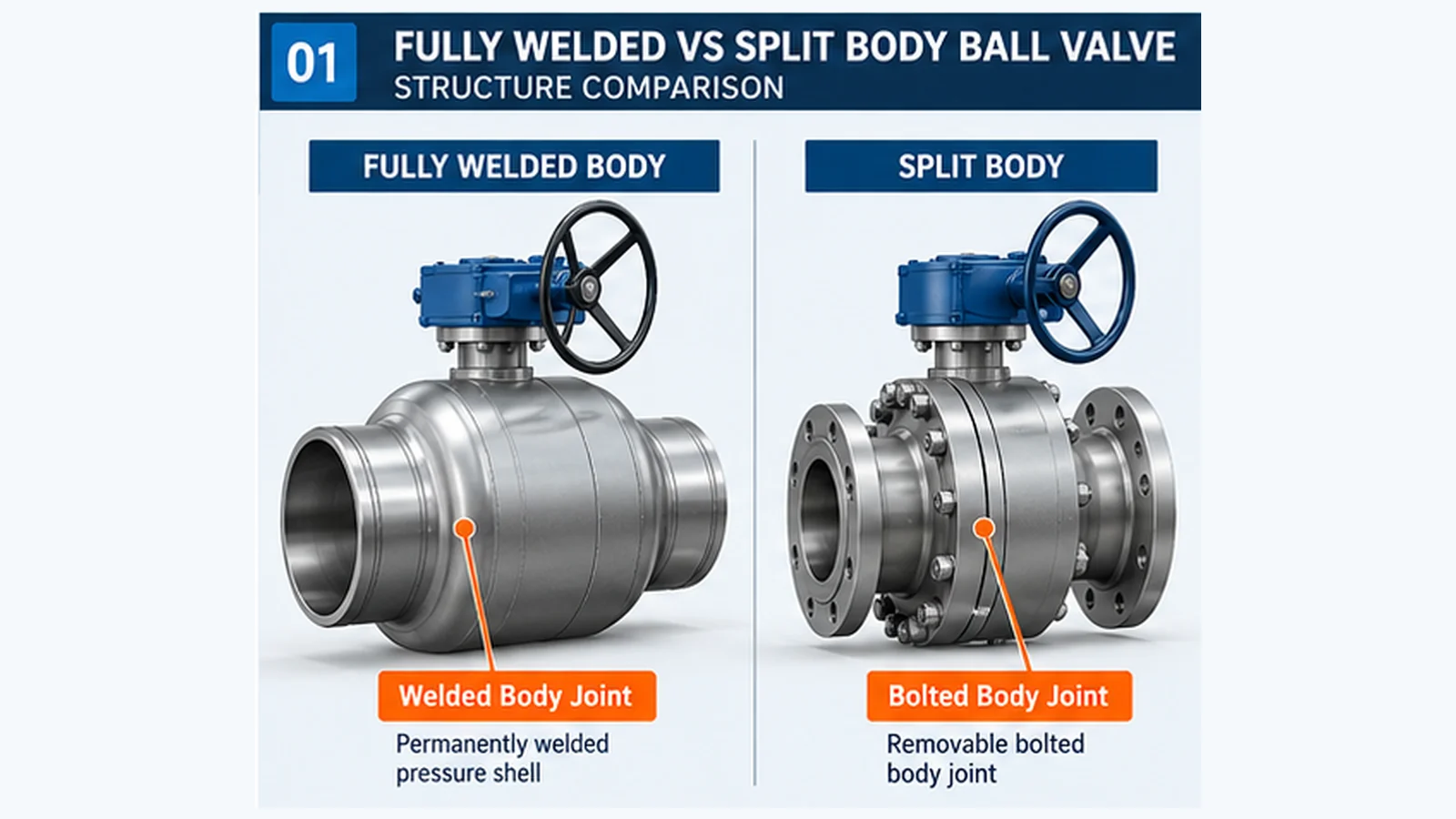
For pipeline engineers and procurement teams, the question is which construction can be installed, inspected, serviced and replaced within the project’s specified lifecycle requirements—not simply which valve has fewer joints. Buyers reviewing industrial ball valve options should separate body construction from ball support, end connection and actuation.
1. Fully Welded vs Split Body Ball Valve: Quick Comparison
| Fator de decisão | Fully welded body | Split body |
|---|---|---|
| Body joint arrangement | Permanently welded pressure-containing body joints | Mechanically separable body joints |
| Conventional body-split gasket | Typically eliminated at welded shell joints | Normally required at relevant bolted joints |
| Pressure-boundary review | Welding quality, inspection and test evidence | Joint geometry, gasket, bolting, assembly and tests |
| Buried installation | Often considered where body-joint access is limited | Conditional on accepted design and burial philosophy |
| Internal disassembly | Conventional field shell opening generally not intended | May be possible under approved instructions |
| Estratégia de manutenção | External service, specialist repair or replacement, design-dependent | Potential disassembly route; installed access still must be proved |
| Corrosion protection | External protection remains essential | External and joint protection remain essential |
Three distinctions: body construction is not the same as pipe end connection; split-body disassembly does not guarantee in-line maintenance; fewer external body joints do not prove better internal seat shutoff.
2. Body Construction and Pressure-Boundary Joint Integrity
How a fully welded pressure shell differs
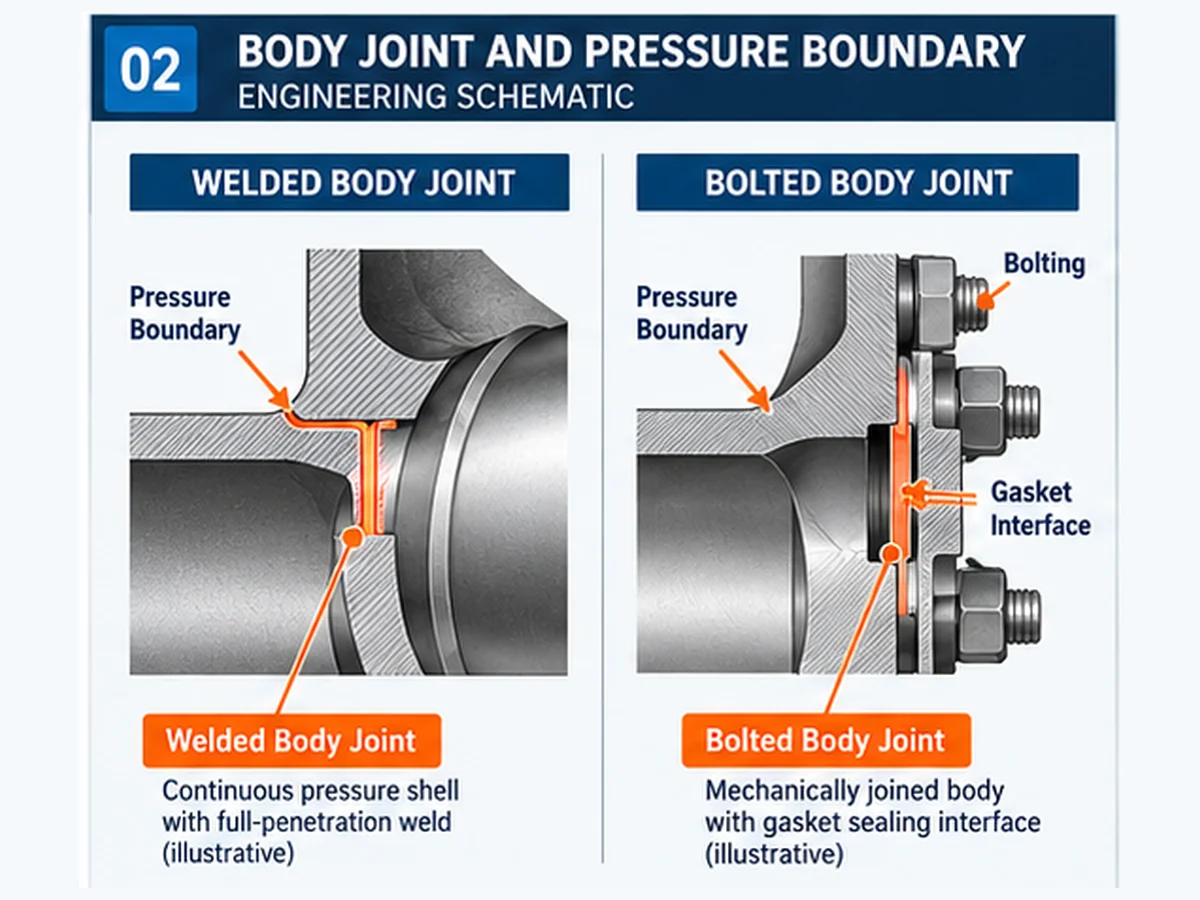
In a fully welded ball valve, the main pressure-containing body sections are permanently joined by welding instead of being closed through conventional removable bolted body-split joints. Depending on the design, internal ball, seats and stem-related parts can be assembled before closure welding. A welded pressure shell still contains design-specific interfaces such as stem sealing, vent and drain connections, injection fittings or other closures. Eliminating one interface does not eliminate all possible external leakage paths.
A welded joint is a manufactured pressure-boundary feature that requires appropriate material control, approved fabrication, examination and pressure testing. Its integrity cannot be established from the valve’s exterior appearance alone. Refer to the actual fully welded ball valve drawing when defining the weld arrangement and service points.
How bolted split-body joints differ
Split body construction uses two or more body sections joined mechanically. The joint design may include mating faces, gaskets or other sealing elements and defined fasteners. These connections offer a potential route to internal components, subject to the exact design and the manufacturer’s procedure. The joint seal, fasteners, mating surface and assembly method must be specified and verified for the expected operating conditions.
External shell leakage is not internal seat leakage
Pressure-boundary leakage at a body joint and leakage past the closed ball seats are separate acceptance questions. Shell pressure testing addresses specified external pressure-boundary tightness; closure testing assesses the seat system under its defined conditions. Welded construction does not automatically improve seat tightness, just as a bolted joint does not automatically imply unacceptable external leakage.
3. Which Body Construction Is Better for Buried Pipeline Service?
Why fully welded bodies are considered
For direct-buried lines, reaching external body connections for inspection or repair can require excavation, removal of surrounding soil and restoration of corrosion protection. Fully welded construction eliminates conventional gasketed body splits that would otherwise remain underground. This is a meaningful design distinction, but it is not an unconditional requirement for every buried valve.
Coating, corrosion protection and external interfaces
The engineering review must include coating selection and continuity, soil and groundwater exposure, pipeline corrosion protection, cathodic-protection interfaces where applicable, and access to stem sealing and service connections. A welded body with unsuitable external protection may still suffer corrosion damage. A split body can also be considered if the joint arrangement and burial details satisfy the owner’s requirements.
Stem extension and operational access
Where a valve is operated from the surface, the stem extension and operating point require review for depth, alignment, torque transmission, environmental conditions and access. Vent, drain and seal-service fittings should not be left inaccessible by default. A direct-buried valve and a chamber-installed valve present different maintenance opportunities.
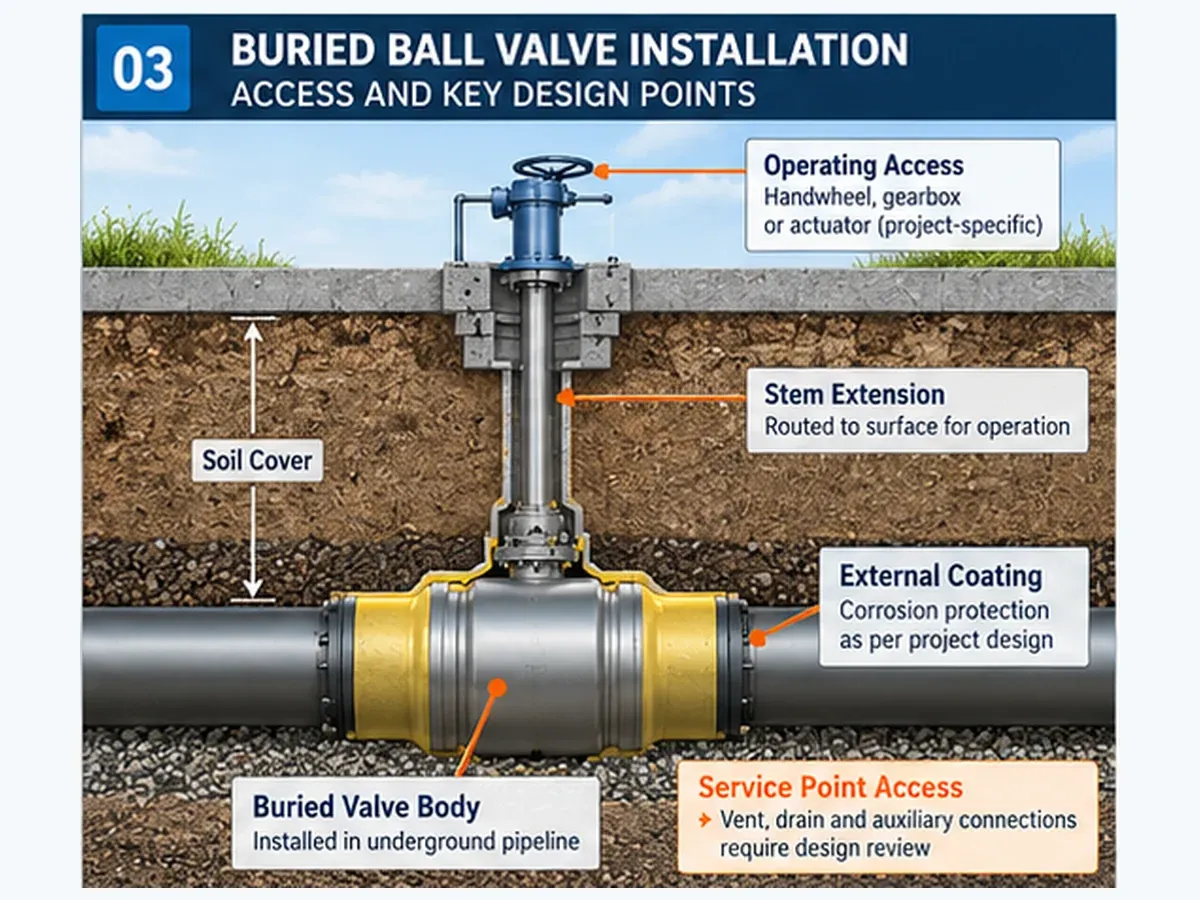
Engineering screening example — directly buried isolation valve: An RFQ may specify a fully welded shell but omit stem-extension, vent/drain and coating-repair details. The body-joint preference then answers only one part of the installation problem. Before approval, request the installed arrangement drawing and a service-point access schedule; otherwise the owner may discover that the operating equipment can be reached but specified service connections cannot.
4. Field Maintenance, Internal Repair and Replacement Strategy
Field-work boundary: This article is not a valve-opening or pipeline-repair procedure. Isolation, lockout/tagout, depressurization, draining, atmospheric testing and work permits must follow the operator’s site controls and the manufacturer’s approved instructions. No body connection should be opened merely because it is mechanically separable.
What can be repaired on a fully welded valve?
“Fully welded” does not mean maintenance-free. External stem sealing or service fittings may be maintainable on some models, but the main welded pressure shell is normally not designed for conventional separation in the field. Replacing internal seats or a ball may require specialized manufacturer procedures or complete valve replacement. The supplier should identify permitted service tasks, replacement parts and restrictions explicitly.
Does split body mean in-line maintainable?
No. Separating body sections may still require isolation, depressurization, disconnection from piping, lifting space and valve removal. Butt-weld ends can make removal difficult even when the body uses bolts; conversely, a removable flanged spool and engineered access space can simplify the work. An approved sectional drawing and maintenance manual are more informative than the marketing phrase “easy maintenance.”
Ask the maintenance questions before purchase
- Which internal components are expected to be replaced during service?
- Which pressure boundary must be opened to reach them?
- Can that opening actually be accessed in the installed piping?
- What isolation, lifting, reassembly and post-maintenance verification will be required?
When buried replacement is planned, also review excavation access, pipe support, coating restoration, shutdown consequences and spare-valve logistics. No reliable universal lifecycle-cost saving can be inferred from the body joint arrangement alone.
Failure Mode, Consequence and Evidence Checklist
Use this preliminary matrix to identify what the supplier must demonstrate. These are possible failure mechanisms, not claims about any particular valve or measured failure frequencies.
| Preocupação | Potential consequence | Evidence / question before purchase |
|---|---|---|
| Bolted body-joint sealing deterioration | External leakage at a pressure-boundary interface | Joint construction, seal material, assembly procedure, shell test records |
| Pressure-shell weld or adjacent material discontinuity | Pressure-boundary integrity concern | Applicable weld qualification, traceability, specified NDE and shell test records |
| Inaccessible vent, drain or stem-seal service point | Excavation or inability to perform intended service | Approved buried GA drawing and accessible service-point schedule |
| Seat wear or solids accumulation | Internal shutoff degradation | Service composition, seat selection, accepted closure test and repair pathway |
| Valve must be removed for overhaul | Shutdown, lifting, excavation or pipe intervention | Installed removal envelope, weight, end connections and maintenance manual |
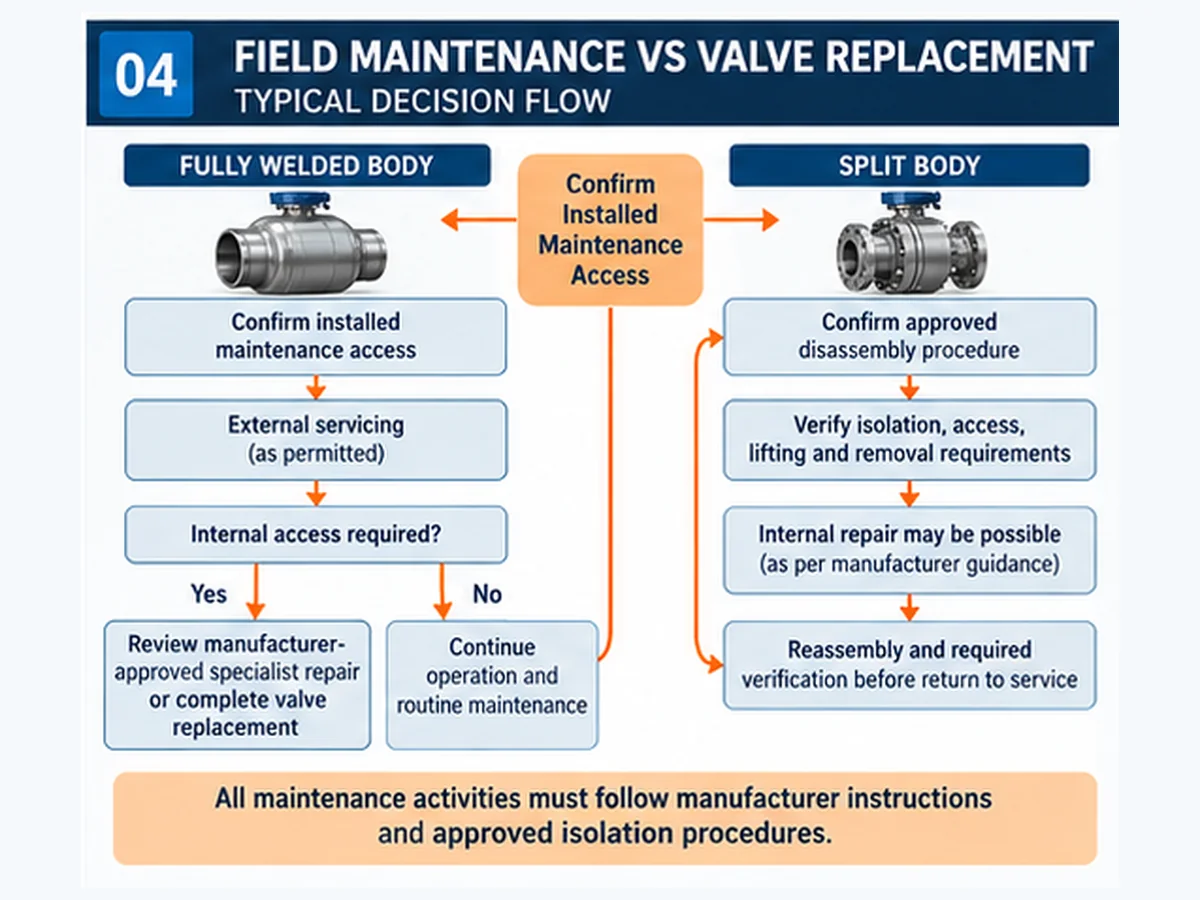
Engineering screening example — split body with butt-weld ends: A supplier may describe the valve as repairable because its body halves are bolted. If the installed piping offers no removal spool or adequate axial clearance, internal disassembly could still require cutting or removing the valve assembly. Compare the approved dismantling sequence with the installed GA drawing and lifting envelope before accepting a claimed field-maintenance advantage.
5. Pipeline Selection: Buried Lines vs Above-Ground Stations
Buried transmission line isolation
Evaluate welded construction where long-term access to gasketed body splits would be restricted. Confirm buried-service corrosion protection, stem extension, pressure-temperature duty, seats, vent/drain arrangements, actuator or operator access and the valve replacement plan. The entire installed system must satisfy the pipeline specification.
Three installation scenarios and what changes
Direct burial: joint access can require excavation, so examine the conventional body-split interfaces, coating system, accessible stem/service points, and an approved removal-and-replacement plan. A welded body can reduce conventional bolted body-split interfaces, but cannot substitute for corrosion control or service-access planning.
Accessible underground chamber: inspection and removal access may be easier than for direct burial. Confirm chamber dimensions, drainage, environmental exposure, lifting clearances, safe access and any bolted-joint service requirements before treating a split-body arrangement as maintainable.
Above-ground station: installed access may support inspection and overhaul, but only if the relevant body joints, end connections, valve lifting route and working envelope allow the manufacturer’s procedure. Neither location nor body construction alone proves that internal seats can be changed in-line.
Above-ground stations and manifolds
Accessible above-ground installations may favor designs with defined repair access when internal maintenance is expected. Split body construction may support this goal, but available working space, valve weight and removal procedure still govern feasibility. Fully welded construction remains an option if the required maintenance philosophy is compatible.
Maintenance-intensive or contaminated service
Applications with deposit formation, particles, expected seat wear or planned periodic internal inspection should place greater weight on component access. That is a reason to request supplier maintenance evidence, not a reason to assume any split-body valve is intrinsically suitable for contaminated media. Seat system, materials and process conditions need separate evaluation.
Keep four specification variables separate
- Body construction: fully welded or mechanically split.
- Pipe ends: butt-weld, flanged or another specified connection.
- Ball support: floating or trunnion-mounted, design-dependent.
- Operação: manual, gear, pneumatic, electric or hydraulic.
Body-joint architecture (permanently welded versus mechanically separable shell) must not be confused with entry/access architecture (the path for reaching internal parts). Internal access architecture is a separate topic; see the related top-entry vs side-entry ball valve comparison.
Engineering screening example — above-ground manifold: A split-body proposal may appear convenient for seat replacement, but closely spaced piping, heavy actuators or restricted lateral access can defeat the planned repair route. Validate the replacement-parts list, removed-component envelope, safe isolation arrangements and required post-reassembly tests at design review rather than after commissioning.
6. Standards, Inspection and Supplier Evidence
Product standard and project requirements
API Specification 6D may be applicable to pipeline valve procurement depending on the project scope. The purchase specification must identify the controlling edition, any addenda, other relevant codes and purchaser supplements. Neither “fully welded” nor “split body” establishes compliance by itself. Obtain model-specific records and document any technical deviations.
Evidência de limite: An API 6D reference in an offer is not proof of a specific valve’s conformity, welded-body NDE acceptance, buried-installation suitability or field reparability. Ask the bidder to name the applicable edition and provide the relevant product-specific evidence against the purchase specification. No standard certification is inferred here.
Official standards: scope and evidence boundaries
A API Specification 6D publication information and API’s API publication updates identify the 25th edition and Addendum 3 (March 2025). For an actual purchase order, specify the controlling edition and amendments in the project documents, and obtain model-specific conformance evidence rather than inferring it from the words “fully welded” or “split body.”
ASME B16.34 is a separate valve standard covering topics such as pressure–temperature ratings, materials, dimensions, testing and marking within its defined scope; ASME lists a 2025 edition. Apply it only where required by the actual project specification and valve scope. Neither standard link certifies a particular Raymon Valve model, substitutes for a maintenance procedure, or independently establishes suitability for direct burial.
Different evidence for different joints
For welded construction, request the applicable material traceability, weld information, qualification and specified NDE records. For split construction, examine body-joint geometry, gasket/seal material, bolting, assembly methods and required replacement seals. The actual record package depends on the applicable standard, approved design and inspection plan.
| Verificação | O que suporta | What it does not replace |
|---|---|---|
| Shell test | Pressure-boundary tightness at defined test conditions | Seat / closure test |
| Seat test | Closure tightness at defined test conditions | Shell test |
| Teste funcional | Specified operation and movement | Long-term reliability qualification |
| NDE | Specified material or weld examination | Teste de pressão |
| PMI and traceability | Specified material identity and record continuity | Full service-compatibility review |
For additional context on the difference between tests, refer to the teste de pressão de válvulas. Requirements for fire-safe qualification, fugitive emissions, sour service, coatings or third-party witnessing should be listed separately where applicable. These cannot be inferred from a valve label.
Engineering screening example — technical bid mismatch: Two proposals can share the same nominal size and pressure class while specifying different seat materials, design-temperature limits, body-joint seals, coatings and inspection scopes. Ask for a side-by-side deviation register tied to the same datasheet revision; compare commercial prices only after unresolved technical differences are closed.
7. Fully Welded vs Split Body Ball Valve Selection Matrix
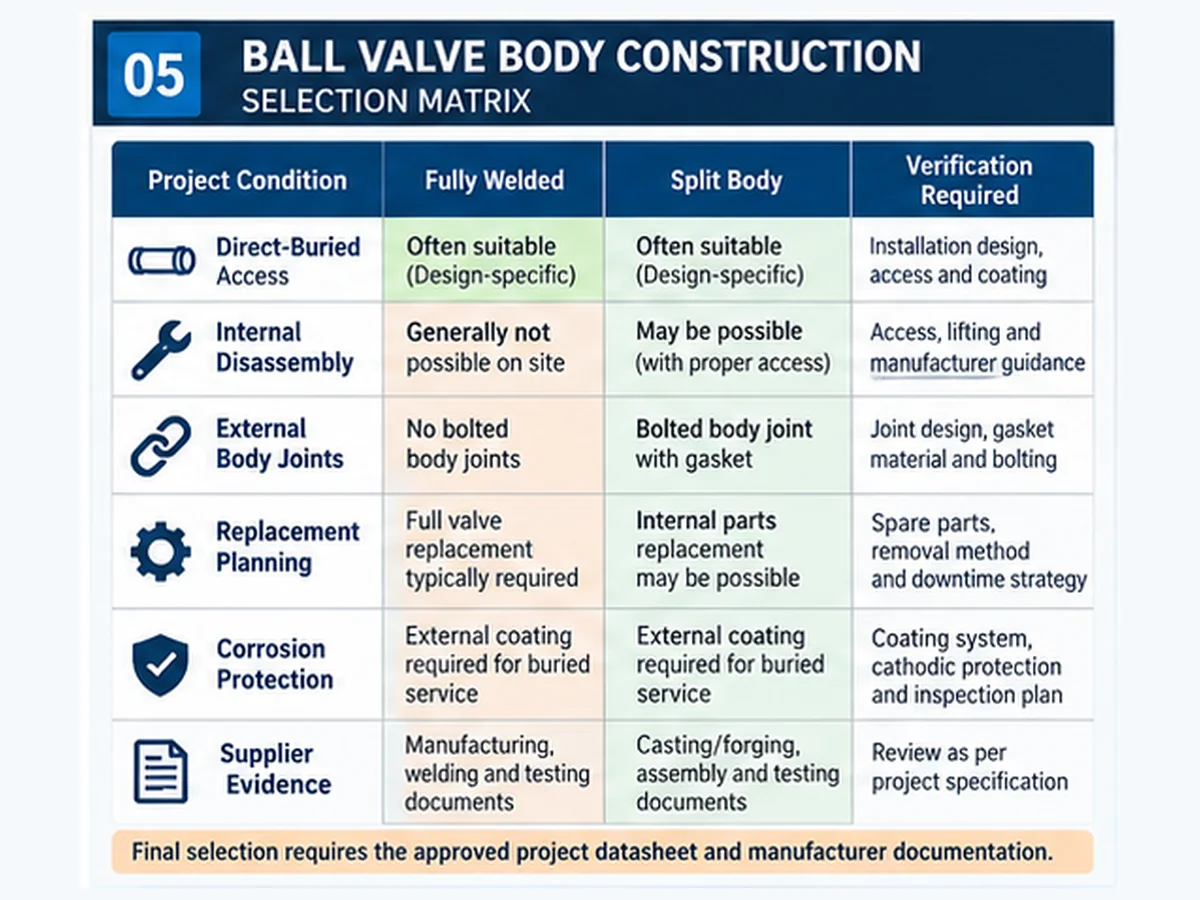
| Project condition | Fully welded | Split body | Confirm before selection |
|---|---|---|---|
| Direct-buried, limited access | Often worth evaluating | Condicional | Burial design, coating, service points |
| Above-ground station | Suitable if maintenance plan permits | May assist disassembly | Lifting clearance and removal plan |
| No conventional bolted body split wanted | Direct design characteristic | Does not meet that preference | Actual body-joint drawing |
| Periodic internal overhaul expected | Potential access restriction | Vantagem potencial | Approved maintenance procedure |
| Butt-weld pipe ends | Removal strategy critical | Removal strategy also critical | Spool, isolation, handling and piping |
| Corrosive soil | Protection still essential | Protection still essential | Approved corrosion-control system |
| High pressure / severe duty | Design-dependent | Design-dependent | Rating, materials, tests and approvals |
Selection sequence: define service duty; confirm installation and access; set the maintenance philosophy; compare pressure-boundary joints; verify the repair/removal route; and normalize each supplier quote against the same technical and inspection requirements.
Evidence-based decision gate before RFQ approval
Before accepting either body style, resolve each buyer question against the exact offered model, not merely a product-family description.
| Buyer question | Evidências do fornecedor a serem solicitadas | Unresolved risk |
|---|---|---|
| Where are the pressure-containing body joints? | Approved sectional and pressure-boundary drawings; weld or bolted joint identification | Unrecognized interfaces or incomplete inspection plan |
| Can the specified internal components be replaced? | Model-specific maintenance manual and replacement-parts list | Repair philosophy incompatible with the valve design |
| Can the operation be performed in the installed location? | Installed GA drawing, clearance envelope, weight and removal procedure | Unexpected excavation, shutdown or lifting constraints |
| How will buried interfaces remain accessible and protected? | Stem/vent/drain access schedule, coating and corrosion-protection details | Inaccessible fittings or coating restoration issues |
| What verifies the assembled pressure boundary? | Project-approved ITP, relevant weld/NDE or joint assembly records, shell test evidence | Unclosed manufacturing or acceptance requirements |
8. Pipeline Ball Valve Construction RFQ Checklist
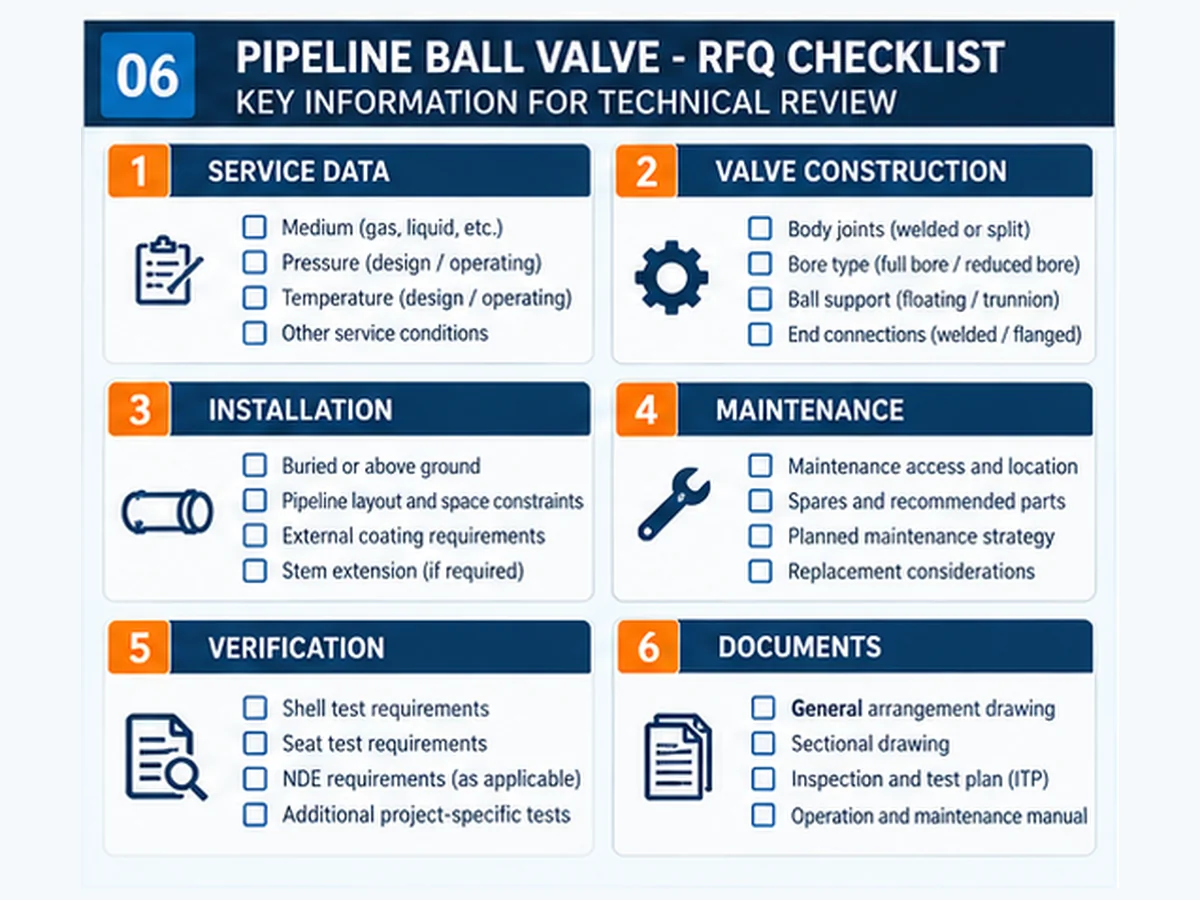
| RFQ category | Information to request |
|---|---|
| Serviço do processo | Medium, composition, solids, normal/design pressure and temperature, shutoff duty |
| Valve sizing and rating | Nominal size, bore, class/PN, rating basis, differential pressure |
| Construção | Welded or split body, ball support, joints, seats, stem, seal materials |
| Connections / installation | Butt-weld or flanged ends, installation layout, buried depth, coating, stem extension |
| Acionamento | Manual or actuator type, required operation and site utilities |
| Manutenção | Permitted service tasks, internal removal, spare parts, valve weight, space and lifting needs |
| Inspeção | Product standard and edition, ITP, NDE as required, shell/seat tests, witnessing |
| Documentos | GA and sectional drawings, material records, maintenance manual, deviations |
Two quotations can differ materially in body material, seat configuration, coating, extensions, documentation or testing even when both use the same nominal size. Clarify technical deviations before comparing price. Unsupported claims such as “easy maintenance” or “suitable for all buried service” should not replace documented design evidence. For pressure-temperature verification, the stated Class/PN designation must be reviewed with the specified material, design temperature, applicable rating rules and the exact offered valve; a class number alone does not establish a single allowable operating pressure. Maximum differential-pressure cases and seat/seal compatibility also affect actuator and maintenance requirements.
Supplier Technical Bid Normalization — Minimum Comparison
Use one row per bidder and resolve differences before price approval. A proposed alternate construction should be explicitly accepted or rejected by the responsible engineer, not treated as equivalent because its nominal size and class match.
| Item de revisão | Evidência exigida | Decision / deviation |
|---|---|---|
| Body joints and repair route | Sectional drawing, maintenance procedure, field removal requirements | Confirm / Clarify / Deviation |
| Burial and environmental protection | Coating system, service-point arrangement, stem extension design | Confirm / Clarify / Deviation |
| Pressure and shutoff duty | Design pressure-temperature basis, seat details, test scope | Confirm / Clarify / Deviation |
| Verification package | ITP, traceability, specified weld/NDE or joint records, shell/seat tests | Confirm / Clarify / Deviation |
| Lifecycle support | Spare parts, replacement approach, component weights and clearances | Confirm / Clarify / Deviation |
RFQ hold point: If the supplier cannot substantiate the proposed body-joint arrangement or the maintenance route for the installed valve, leave that item open for technical clarification before purchase approval.
9. Frequently Asked Questions
What is the main difference between a fully welded and split body ball valve?
A fully welded valve uses permanent welded joints to join its main pressure-containing body sections, while a split body valve uses mechanically separable joints. The difference affects body-joint interfaces and maintenance planning, not automatically seat leakage performance.
Are fully welded ball valves always required for buried pipelines?
No. They are often considered because conventional bolted body-split joints can be difficult to access underground. The actual requirement depends on the pipeline specification, corrosion protection, installation and approved maintenance strategy.
Can a fully welded ball valve be repaired without removing it?
Some external components or service features may be maintainable, depending on the exact design. Internal ball or seat work may need specialist procedures or complete valve replacement. Confirm the manufacturer-approved instructions.
Does a split body ball valve have a higher leakage risk?
Split construction introduces sealed body-joint interfaces that require correct joint design, materials and assembly. A welded body removes conventional bolted splits, but neither arrangement guarantees overall leakage performance or future reliability.
What should buyers verify before specifying a pipeline valve body design?
Verify process duty, rating, body and seat design, end connections, buried-service protection, repair/removal access, inspection and tests, and supplier drawings and maintenance documentation.
10. Final Selection Recommendation
Fully welded bodies are worth evaluating where reducing conventional bolted body-split interfaces supports a buried pipeline design with limited physical access. Split bodies may be useful where internal component access is a documented maintenance objective and the installed piping permits that work. Neither body type should be chosen without reviewing pressure-temperature duty, seat design, corrosion protection, access and supplier evidence.
Nota de engenharia: This comparison is an educational decision aid—not a certified design, maintenance method or field safety procedure. Selection requires the approved project datasheet, current applicable specifications, model-specific manufacturer documents and responsible-engineer review. No named individual engineering author or reviewer has been verified. Images are illustrative concepts, not actual Raymon Valve sectional drawings.
 Portuguese
  English
  German
  Arabic
  French
  Spanish
  Italian
  Russian