
A two-piece vs three-piece ball valve comparison starts with body construction: a two-piece design typically has a main body and one end connector, while a three-piece design has a center body between two end connectors. The three-piece arrangement can make internal components easier to access, but it does not automatically permit in-line or under-pressure maintenance. Selection should account for the exact manufacturer design, service conditions, pipeline layout, isolation procedure and lifecycle cost.

Comparison basis: This article compares typical body-piece arrangements only. Pressure class, pressure-temperature rating, ball support (floating or trunnion), bore, fire-safe design and applicable testing must be specified and verified separately for the exact valve model.
What Is the Difference Between Two-Piece and Three-Piece Ball Valves?
The main difference is how the valve body is divided and assembled. A two-piece ball valve typically consists of a main body section and a separate end connector. A three-piece ball valve consists of a central body section and two end connectors, commonly assembled with bolted connections.
This structural difference affects internal component access, body-joint configuration, maintenance procedures, installation clearance, spare-parts planning and lifecycle cost. The number of body sections should not be confused with the ball-support design: floating and trunnion-mounted describe how the ball is supported, not how many body pieces the valve has.
| Característica | Two-Piece Ball Valve | Three-Piece Ball Valve |
|---|---|---|
| Main construction | Two body sections | Center body plus two end connectors |
| Body joints | Typically one main split joint | Typically two main body joints |
| Internal access | Depends on body design and disassembly | Removable center section can improve access |
| Manutenção | May require valve removal | May allow internal service without disturbing end connections, subject to design |
| Installation clearance | Often more compact | Requires clearance for center-section service |
| Initial cost | Often lower for comparable products | Often higher for comparable products |
Two-Piece Ball Valve: Construction and Operating Characteristics
Two-Piece Body Construction
A two-piece ball valve generally consists of a main valve body and a separate end connector. The two sections are joined by a threaded, bolted or other manufacturer-specific body connection. The ball, seats, stem and sealing components are assembled within the pressure-containing body.
The body joint is part of the pressure boundary. Its sealing arrangement, materials and assembly procedure should be reviewed against the product documentation and project requirements.

Vantagens
- Relatively simple construction: fewer body sections can mean a straightforward assembly arrangement.
- Compact installation: depending on model dimensions, a two-piece design may suit space-constrained piping.
- Often lower initial cost: actual pricing still depends on size, material, pressure rating, end connection and manufacturer.
- General isolation suitability: can be considered where routine internal servicing is not a dominant design requirement.
Limitações
Internal maintenance may be more difficult if the construction requires the valve to be removed from the pipeline. Engineers should consider pipeline disconnection, access, body-joint sealing inspection and spare-valve availability when planning maintenance.
Three-Piece Ball Valve: Construction and Operating Characteristics
Three-Piece Body Construction
A three-piece ball valve typically consists of a central valve body and two end connectors. The three sections are commonly held together by bolts or tie-bolts, depending on the manufacturer’s design. The center body houses the main operating components, while the end connectors provide the pipeline interfaces.

Maintenance and Disassembly
The removable center section can facilitate access to internal components. Depending on the design and approved maintenance procedure, work may include ball inspection, seat replacement, stem-seal inspection, gasket replacement and internal cleaning.
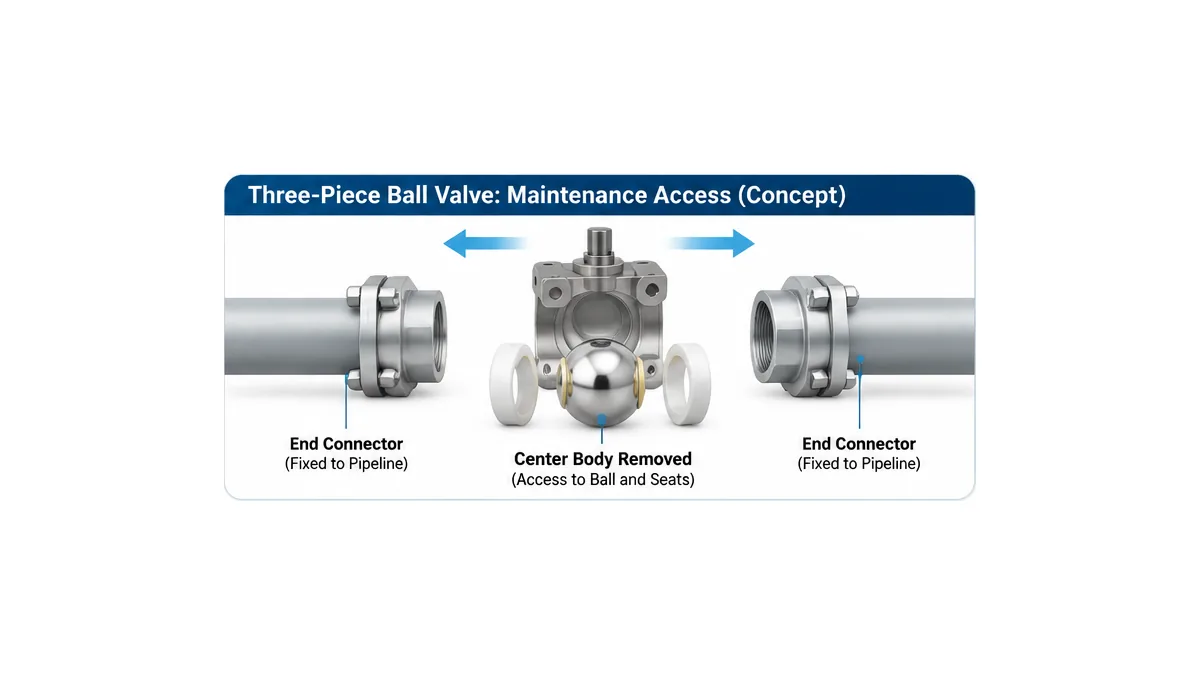
Critical maintenance safety boundary: Never loosen body-joint fasteners or separate a valve body while the valve is pressurized or while hazardous fluid may remain trapped. Before any disassembly, follow the site’s approved isolation and lockout/tagout procedure; isolate all relevant pressure sources, depressurize, drain or vent the cavity and connected sections as applicable, verify zero energy and a safe condition, and confirm the manufacturer’s instructions. The required steps depend on the medium, installation and valve design. A three-piece body does not make live or under-pressure disassembly permissible.
Limitations and Design Checks
- Additional body joints: both main body joints require suitable sealing arrangements and controlled assembly.
- More fastening components: bolts, nuts and related components need appropriate material and assembly review.
- Service clearance: the center section may require space for removal.
- Potentially higher initial cost: compare the premium with the expected maintenance and downtime benefits.
Two-Piece vs Three-Piece Ball Valves: Detailed Comparison
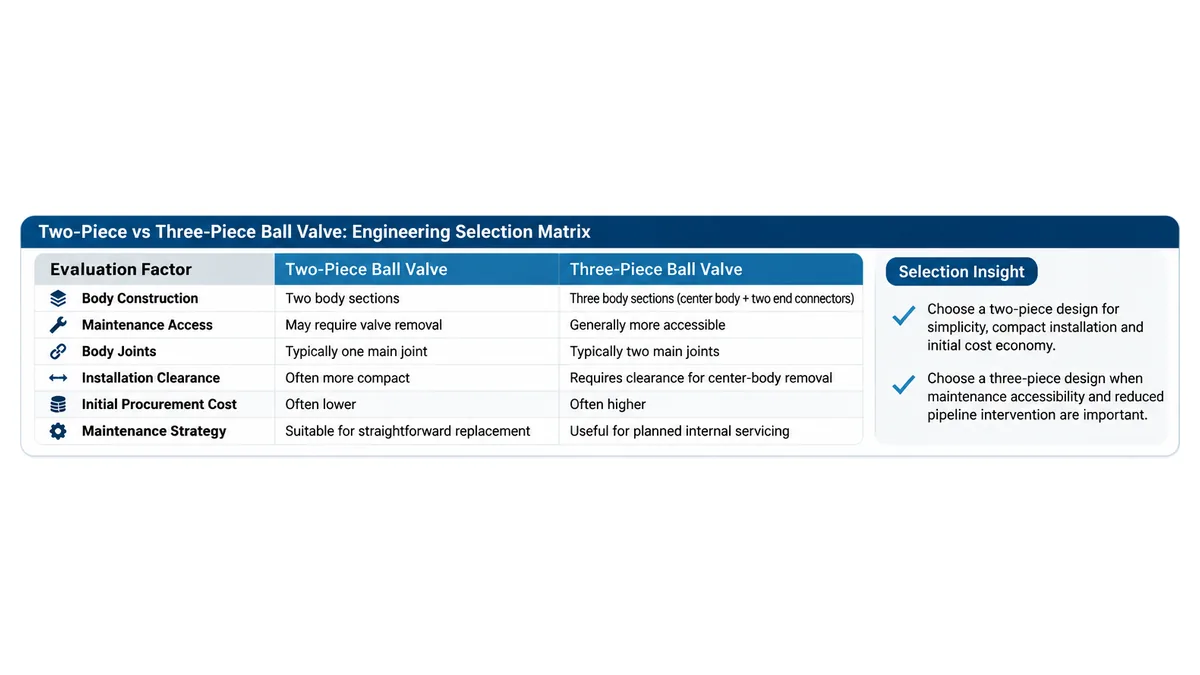
The following table is a preliminary engineering comparison, not a substitute for model-specific drawings or datasheets.
| Evaluation Factor | Duas peças | Três peças |
|---|---|---|
| Construção do corpo | Two sections | Center body and two end connectors |
| Body-joint arrangement | Typically one main split joint | Typically two main body joints |
| Internal component access | Design-dependent; may require valve removal | Generally more accessible through center-section removal |
| Seat replacement | Depends on disassembly arrangement | May be possible without disturbing end connections |
| Installation space | Often more compact | Requires center-section service clearance |
| Initial procurement cost | Often lower | Often higher |
| Estratégia de manutenção | Suitable for straightforward replacement arrangements | Useful where planned internal servicing is important |
| Classe de pressão | Model-specific | Model-specific |
Engineering Decision Workflow: How to Select the Body Construction
Use the following sequence before choosing a two-piece or three-piece arrangement. It is intended for preliminary screening; the final selection must be checked against the valve datasheet, piping layout and manufacturer instructions.
| Decision Gate | Question to Resolve | Selection Implication | Evidence to Request |
|---|---|---|---|
| 1. Service suitability | Do the pressure, temperature, medium and shut-off requirements fit the offered valve design? | Reject any construction that does not meet the service specification, regardless of maintenance convenience. | Datasheet, pressure-temperature rating, material list and applicable test requirements. |
| 2. Maintenance strategy | Will seats, seals or the ball require planned internal access during the expected service period? | Three-piece construction may be advantageous if the center section is genuinely serviceable as required. | Sectional drawing, spare-parts list and approved maintenance procedure. |
| 3. Pipeline constraints | Can the valve be removed or can its center section be accessed within the installed piping arrangement? | Choose the construction that can be safely installed and maintained within the available space. | Face-to-face dimensions, GA drawing, clearance envelope and piping layout. |
| 4. Intervention boundary | Must pipeline end connections remain undisturbed during internal maintenance? | Do not assume this from the three-piece label; make the required maintenance boundary an explicit RFQ condition. | Written manufacturer confirmation and step-by-step service instructions. |
| 5. Commercial evaluation | Does the maintenance benefit justify the initial price difference? | Compare expected intervention cost and downtime, not purchase price alone. | Quoted valve price, spare-part pricing, labor assumptions and maintenance scope. |
Stop/go rule: If the supplier cannot confirm the required pressure-temperature suitability, material compatibility, shut-off requirement or safe maintenance procedure, keep the valve selection open. Do not resolve a missing engineering input by choosing a body-piece count.
Installation and Pipeline Connection Considerations
Threaded Connections
For threaded valves, confirm the specified thread form, such as NPT, BSPP or BSPT, along with connection dimensions, sealing method, installation access and pressure-temperature suitability. Thread standards should not be treated as interchangeable without checking the project specification.
Socket Weld and Butt Weld Connections
Welded-end valves require an approved welding procedure and suitable control of heat input and thermal exposure. Confirm seat and seal protection, valve orientation, inspection requirements and the manufacturer’s installation instructions. For a three-piece design, establish whether the center section may be removed before welding and whether the manufacturer permits that procedure.
Flanged Connections
Specify the flange standard, pressure class or PN rating, facing, face-to-face dimensions, bolt arrangement and gasket requirements. For a three-piece valve, ensure adjacent piping and supports do not obstruct the required center-body service clearance.
Maintenance and Lifecycle Cost Comparison
Initial purchase price is only one part of valve ownership cost. Labor, spare parts, pipeline intervention, inspection and production downtime may influence the preferred construction.
Preliminary cost framework: Total Maintenance Cost = Labor Cost + Replacement Parts + Pipeline Intervention + Production Downtime. This is a simplified comparison model, not a universal accounting formula.
A three-piece design may offer practical value where internal components require periodic replacement, pipeline end connections are difficult to disturb, or downtime has a significant cost. The expected savings should be evaluated against the actual purchase premium and maintenance procedure.
Disassembly is not an operating adjustment. Before opening a valve or loosening body fasteners, the responsible site team must establish an approved safe-work boundary, isolate and lock out the relevant energy sources, depressurize and drain or vent trapped process fluid as applicable, and verify the valve and connected pipework are in a safe zero-energy condition. Do not rely on the valve being closed as proof of isolation. Follow the site procedure and the exact manufacturer’s maintenance instructions; hazardous, toxic, flammable or high-temperature media may require additional controls.
Failure Modes and Verification Points
Body construction alone does not determine reliability. The following review matrix helps the purchaser identify what should be checked in the offered design and its documentation.
| Potential Issue | Possible Contributors | What to Verify |
|---|---|---|
| External leakage at a body joint | Damaged or incompatible gasket, incorrect assembly, unsuitable bolting or loss of joint preload | Joint design, gasket specification, bolting material, assembly instructions and applicable pressure-test records. |
| Vazamento na sede | Seat damage, wear, contamination, unsuitable seat material or service conditions outside the design basis | Seat material, medium and temperature compatibility, shut-off requirement and specified seat-test acceptance criteria. |
| High operating torque or difficult operation | Deposits, corrosion, seat loading, pressure effects or actuator/operating-device mismatch | Operating conditions, manufacturer torque data, operating-device sizing basis and maintenance instructions. |
| Maintenance cannot be completed as planned | Insufficient clearance, inaccessible fasteners, attached actuator or a design that requires pipeline movement | GA drawing, removal envelope, actuator arrangement and approved disassembly procedure. |
| Post-maintenance leakage or malfunction | Incorrect reassembly, damaged sealing parts, contamination or incomplete testing | Replacement-part identification, reassembly procedure, inspection steps and required recommissioning tests. |
These are review prompts, not a claim that either construction has a particular failure rate. Actual failure mechanisms must be established from service history, inspection findings and the selected valve design.
Supplier Technical Evaluation: What Should Be Compared?
For a technical bid evaluation, ask each supplier to quote against the same service data and state deviations explicitly. This avoids comparing a low-cost valve with a different pressure rating, material, seat design or maintenance scope.
| Bid Comparison Item | Fornecedor A | Fornecedor B | Purchaser Review |
|---|---|---|---|
| Body construction and sectional drawing | Record offered design | Record offered design | Confirm piece arrangement and body-joint configuration. |
| Classificação de pressão-temperatura | Record rating and basis | Record rating and basis | Check against project design conditions. |
| Body, ball, stem and seat materials | Record grades | Record grades | Review compatibility and material documentation. |
| End connections and dimensions | Record standard and dimensions | Record standard and dimensions | Check piping interface and installation envelope. |
| Maintenance scope | Record what can be serviced | Record what can be serviced | Require written confirmation of pipeline intervention limits. |
| Spare parts and documentation | Record included items | Record included items | Compare part availability, manuals and inspection records. |
| Commercial deviations | List exclusions | List exclusions | Normalize scope before comparing price. |
When Should You Choose a Two-Piece Ball Valve?
A two-piece ball valve may be appropriate when the application prioritizes straightforward construction, compact installation and initial procurement economy. Consider it for general isolation, relatively infrequent internal maintenance and pipeline arrangements that allow practical valve replacement. Confirm that the selected model meets all service and project requirements.
When Should You Choose a Three-Piece Ball Valve?
A three-piece ball valve may be preferable when maintenance accessibility is an important project requirement. Typical considerations include planned seat or seal replacement, periodic internal inspection, difficult-to-disturb pipeline connections and maintenance-sensitive skid or process systems. Confirm the exact servicing capability in the manufacturer’s instructions before making in-line maintenance a specification requirement.
How to Specify a Two-Piece or Three-Piece Ball Valve
A complete RFQ should identify more than the body construction. Use the following checklist to help engineering and procurement teams prepare a consistent specification.
- Valve type and body construction: two-piece or three-piece
- Nominal size: DN / NPS
- Pressure rating: ASME Class / PN
- Design pressure, design temperature and normal operating envelope
- Medium composition, phase, contaminants, solids and cleaning chemicals where relevant
- Required shut-off duty and project-defined leakage acceptance criteria
- Ball support: floating or trunnion, as applicable
- Bore: full bore or reduced bore
- Body, ball, stem and seat materials
- End connection: threaded, socket weld, butt weld or flanged
- Operation: lever, gear, pneumatic or electric
- Leakage, fire-safe and other project-specific requirements
- Testing, inspection, MTC, ITP, traceability and documentation requirements
- Maintenance access, spare-parts, service clearance and servicing expectations
- Applicable project codes, purchaser specifications and required deviations list
Questions to Confirm with the Supplier
- Can the center section be removed without disconnecting pipeline end connections?
- What isolation, depressurization and verification steps are required?
- Which internal components can be replaced separately?
- Are replacement seats, seals and gaskets available?
- Does the manufacturer provide an approved maintenance procedure?
- What body-joint sealing arrangement is used?
- What inspection and testing documents are supplied, and which acceptance criteria will be applied?
- Can the supplier provide a GA drawing, sectional drawing, datasheet, material list and maintenance manual for technical review?
Erros Comuns na Seleção
- Choosing only by purchase price. Consider maintenance frequency, pipeline intervention and downtime exposure.
- Assuming every three-piece valve supports in-line maintenance. Verify the specific design and approved procedure. Never interpret removable construction as permission to disassemble a pressurized valve.
- Ignoring body-joint sealing. Review gasket materials, assembly and inspection requirements.
- Confusing body construction with ball support. Two-piece/three-piece and floating/trunnion are separate classifications.
- Ignoring welding requirements. Follow the manufacturer’s approved welding and thermal-protection instructions.
- Assuming three-piece means higher pressure capacity. Pressure capability depends on the complete design, materials and pressure-temperature rating.
- Omitting maintenance requirements from the RFQ. State whether servicing without disturbing pipeline connections is required.
Standards and Project Specification: Define the Applicable Requirements
Do not use the terms two-piece or three-piece as a substitute for a complete valve specification. The applicable product standard, pressure class, end-connection standard, material requirements, inspection scope and pressure-test acceptance criteria must be identified in the purchase specification.
Standards such as API 608 e ISO 17292:2015 may be relevant to metal ball valves within their stated scope. API’s published update page lists API 608, 7th Edition, April 2025; ISO records ISO 17292:2015 as reviewed and confirmed in 2025. Confirm the governing edition, purchaser additions and contractual applicability for each project. These product standards do not, by themselves, prove a particular valve’s maintenance capability or authorize in-line disassembly.
Evidence to request: Ask the supplier to identify the standards and editions applied, list deviations, and provide the datasheet, dimensional/sectional drawings, material documentation, inspection and test plan, applicable test records and the model-specific installation/maintenance instructions required by the purchase order. Standard applicability and acceptance criteria must be checked against the complete project specification.
Conclusion: Which Ball Valve Construction Is Right for Your Project?
The choice between two-piece and three-piece ball valves should be based on construction, installation arrangement, maintenance strategy and lifecycle cost. A two-piece design is often suitable for general isolation where straightforward construction and initial cost are important. A three-piece design can provide improved internal access where the approved maintenance procedure and piping arrangement support that benefit.
Neither construction is universally superior. Final selection should consider the complete service conditions, pressure-temperature rating, materials, seat requirements, end connections and project specifications.
Perguntas Frequentes
1. What is the main difference between a two-piece and three-piece ball valve?
A two-piece ball valve has two main body sections, while a three-piece ball valve has a central body section and two end connectors. The three-piece arrangement can provide easier access to internal components.2. Is a three-piece ball valve easier to maintain?
Its removable center section can facilitate internal inspection and component replacement. Actual maintenance capability depends on the manufacturer’s design and procedure.3. Can a three-piece ball valve be repaired without removing it from the pipeline?
Some designs allow the center section to be serviced without disconnecting pipeline end connections, but this is model- and installation-dependent. The valve must never be disassembled under pressure. Follow the approved site isolation and lockout/tagout procedure, depressurize and drain or vent trapped fluid as applicable, verify a safe zero-energy condition, and follow the manufacturer’s maintenance instructions before loosening any body fasteners.4. Are three-piece ball valves suitable for welded connections?
Some designs are available with socket-weld or butt-weld ends. Welding procedures and thermal-protection requirements must be confirmed for the specific model.5. Which ball valve is more economical?
Two-piece ball valves often have a lower initial purchase price. Three-piece designs may offer maintenance advantages that justify a higher initial cost in certain applications.6. Does a three-piece ball valve have a higher pressure rating?
Not necessarily. Pressure capability depends on the complete valve design, materials, dimensions and applicable pressure-temperature rating.7. Can both designs use floating ball construction?
Yes. Body construction and ball support are separate design classifications. Both two-piece and three-piece valves can use floating-ball arrangements.8. What information should be included in a ball valve RFQ?
Include valve size, pressure class, design pressure and temperature, medium, body construction, ball support, bore, body and seat materials, end connections, operation, leakage requirements, testing and documentation.
Request a Ball Valve Selection Review
Selecting between two-piece and three-piece ball valves requires more than comparing body construction. Raymon Valve can review a proposed configuration against the project specification and required service conditions.
Send the valve size, pressure class, medium and phase, operating and design pressure/temperature, shut-off requirement, body and trim materials, end connection, operation method, maintenance boundary and applicable project specification. If available, include the piping layout, GA/sectional drawing and required inspection documents.Contatar Raymon Valve
Related Ball Valve Resources
- Explorar Válvulas Esfera for the product category and available configurations.
- Read the Ball Valve Selection Guide for broader selection considerations.
- Review Valve Pressure Testing for testing-related project considerations.
- Learn about Raymon Valve.
- Explore the Raymon Valve Knowledge Center for additional engineering resources and technical guidance.
Nota de engenharia: This article provides general industrial ball valve selection guidance. It assumes conventional two-piece and three-piece body arrangements; proprietary designs may differ. It does not establish a universal maintenance method or performance ranking. Never disassemble a pressurized valve; use the approved site isolation, depressurization and zero-energy verification procedure and the manufacturer’s instructions. Confirm pressure ratings, materials, sealing performance, dimensions and maintenance capabilities from the selected model’s drawings, datasheet, approved installation/maintenance instructions and project specification. This article is not a substitute for project-specific engineering approval.
 Portuguese
 English
 German
 Arabic
 French
 Spanish
 Italian
 Russian