
Industrial Valve Functions: Isolation, Control and Protection
The six main industrial valve functions are isolation, flow modulation, reverse-flow prevention, downstream pressure regulation, overpressure protection, and flow diversion or mixing. To select an industrial valve by function, define what it must do at its location in the piping system, then record the operating cases and how each duty will be verified.
An isolation valve needs a shutoff differential pressure, sealing direction and leakage limit. A control valve needs flow and pressure data across its operating range. Use the matrix below to turn those differences into datasheet and RFQ requirements.
On this page
- Six valve functions at a glance
- Valve selection by duty
- Multiple duties on one valve
- Datasheet and RFQ checklist
- Часто задаваемые вопросы
What Are the Main Functions of Industrial Valves?
Use this table to match industrial valve functions on a piping and instrumentation diagram (P&ID) to preliminary datasheet requirements. The constructions shown are candidates for screening. Their suitability depends on the proposed design and the service conditions. See the DOE handbook chapter on valve functions for background.
Scroll horizontally to see all columns.
| Функция клапана | What the valve must do | Typical candidates | What the buyer specifies | What the supplier substantiates |
|---|---|---|---|---|
| Запорная арматура вкл/выкл | Stop flow on command and meet the required shutoff criterion | Ball, gate or butterfly valve | Maximum shutoff differential pressure, sealing direction, allowable seat leakage and operating frequency | Seat design and sealing direction, with the applicable closure test conditions and record |
| Регулирование расхода | Vary flow across the operating range | Linear control valve or characterized rotary control valve | Minimum, normal and maximum flow, with upstream and downstream pressure, temperature, fluid data and the control objective | Sizing by operating case, predicted travel and, where relevant, noise, cavitation or flashing assessment |
| Обратный клапан | Limit reverse flow as the system changes direction | Swing, dual-plate or axial-flow check valve | Minimum and normal forward flow, installation orientation, acceptable pressure loss and pump shutdown or other transient cases | Pressure-loss data and, where the system warrants it, closure-response or transient assessment |
| Регулирование давления | Maintain downstream pressure within a specified range as supply or demand changes | Self-operated pressure regulator or control valve with a pressure-control loop | Downstream setpoint, allowable variation, inlet pressure range and load cases | Capacity across operating cases and predicted setpoint deviation or control performance |
| Защита от сверхдавления | Provide a discharge path under the specified overpressure scenarios | Safety or relief valve selected on the project protection basis | Protected equipment, credible relieving cases, required relieving capacity, set pressure and backpressure basis | Project-required sizing record, capacity evidence and documentation for the applicable rules |
| Diversion or mixing | Route one stream to alternate outlets or combine inlet streams along a specified flow path | Three-way or multiport ball, plug or control valve | Port connections by position, required intermediate flow paths, operating sequence and fail position | Port diagram, position table and, where specified, a functional test of the sequence and fail action |
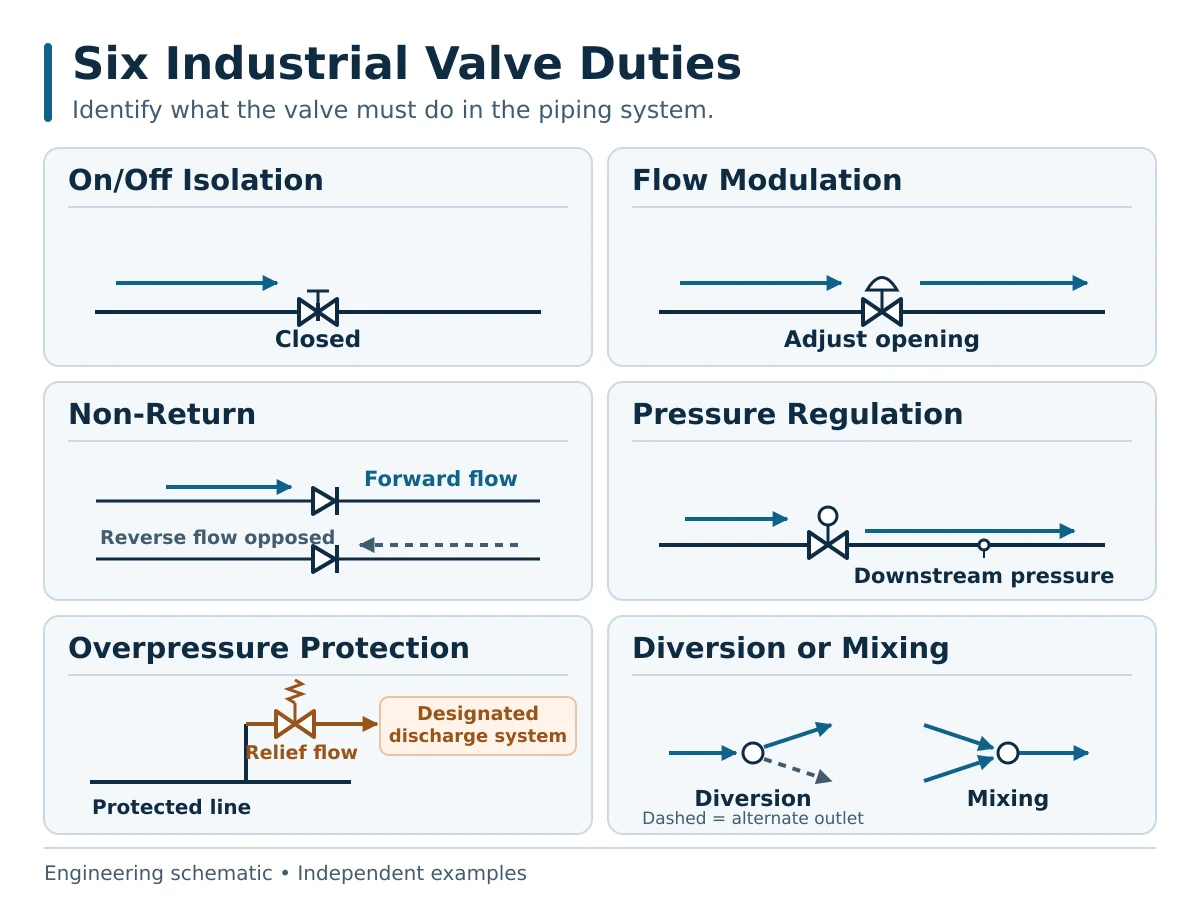
The duty also tells you where to look next. Use the industrial valve product overview to compare construction families after documenting the required duty on the valve datasheet. For mixing or diversion, verify the port arrangement for the proposed design. Emerson provides examples of three-way control valves for both duties.
How Do Industrial Valve Functions Guide Valve Selection?
Isolation and throttling
For isolation, specify the maximum shutoff differential, the direction of pressure across the closed valve, and the permitted seat leakage. If differential pressure reverses during shutdown, a valve tested in the normal flow direction alone may leave the shutdown requirement unverified. Ask the supplier to document the supported sealing direction and closure test conditions for each specified case. Confirm whether the valve must open or close against the maximum differential and request the corresponding torque or thrust data. See the gate valve functions guide for conventional gate valves in isolation service.
For throttling, give the minimum, normal and maximum flow with the corresponding inlet and outlet pressures, temperature and fluid properties. Include piping size, the control target and any allowable pressure loss or noise limit. A control valve chosen solely by line size can spend normal operation close to its seat if the offered trim is oversized. Compare the required Cv or Kv and predicted travel for each case with the offered trim’s usable range.
A published full-travel coefficient describes capacity at full travel under its stated basis. The installed flow response also depends on how the system pressure drop changes with flow. Ask the supplier to identify any cavitation, flashing or noise concerns by operating case.
Conventional wedge gate valves are normally used fully open or closed. Sustained partial opening can expose the gate and seats to vibration and wear. See Emerson’s handbook chapters on isolation valves and control valve sizing, then compare industrial control valves by construction and actuation.
Check valve response at pump shutdown
For a pump discharge check valve, review pressure loss at normal forward flow, disc stability at minimum forward flow, and closure behavior during shutdown. At low or fluctuating flow, the disc may remain partly open and chatter as hydraulic force varies. Ask the supplier for pressure-loss data and the minimum stable opening conditions for the proposed valve and installation orientation. KSB’s SICCA manual gives a product-specific example of this behavior.
If shutdown can cause significant surge, give the responsible engineer the pump deceleration and piping data needed to assess reverse velocity and valve closure. Steady-state pressure-loss data describe forward flow. Closure timing and surge require a separate transient assessment where the project calls for one. Compare industrial check valve types against those conditions.
Pressure regulation and overpressure protection
Pressure regulation is a normal operating duty. Define the downstream setpoint and the acceptable variation across the expected inlet pressures and demand. Overpressure protection is evaluated against specified abnormal scenarios. The project’s protection basis determines the required capacity, discharge conditions and acceptance documentation. Where the system uses both devices, document the regulator’s performance range and the relief device’s protective duty as separate requirements.
Pressure-temperature and wetted-material checks
For valve selection, record operating and design pressure–temperature pairs in the valve datasheet. Include the lowest and highest applicable temperatures and any significant thermal cycles. Pressure class is a designation. The allowable pressure at temperature depends on the material group, applicable rating standard and offered construction. Request the rating basis for the body and bonnet or cover, including any bolting limits, and the separate service limits for trim, seats, packing and gaskets.
For wetted-material review, give fluid phase and composition, concentration, solids, cleaning media and shutdown conditions where relevant. Flag service drivers such as chlorides, pH or velocity when they affect the corrosion or erosion review. Ask for materials by component. Seat wear can affect shutoff and operating force, packing friction contributes to actuator demand, and gasket and seal limits affect containment across the specified temperature cycles.
How Do You Specify Multiple Industrial Valve Functions for One Valve?
Consider a control valve that modulates flow during production and must meet a seat leakage limit during planned shutdown. The production sizing report may show usable travel at all flow cases while leaving the shutdown sealing direction and leakage requirement unspecified. Record the two duties under the same tag on the valve datasheet and request a closure test procedure for the shutdown requirement. The table shows how to carry both requirements through quotation and acceptance.
Scroll horizontally to see all columns.
| Duty for the same valve tag | Define on the datasheet | Request for review |
|---|---|---|
| Modulation during production | Fluid properties and minimum, normal and maximum flow with the corresponding inlet pressure, outlet pressure and temperature | Sizing report with calculated capacity and predicted valve travel for each case |
| Shutoff during planned shutdown | Maximum shutoff differential, pressure direction, allowable seat leakage and the specified test method and conditions | Confirmation of the proposed seat construction and the required closure test procedure and record |

For fail action, identify which loss of air, power or signal triggers movement, the required final position and the stroke time. Ask for torque or thrust through travel at the governing differential pressure, minimum available utility supply, and the margin basis for the selected actuator. Include seat and packing friction, cycle frequency, ambient conditions and accessory loads where they affect the calculation.
Plan valve function testing around the acceptance criteria for each duty. A shell test checks pressure-boundary integrity under the specified test conditions. A closure test checks seat leakage under its stated direction, differential and test medium. A functional test checks the specified movement, timing or fail action at the agreed load and utility conditions. See the valve function testing guide for test methods and documentation.
What Should Go Into the Valve Datasheet or RFQ?
Use these RFQ fields to record the required industrial valve functions and give each supplier the same basis for a proposal. For an early RFQ, flag unresolved values and ask each bidder to identify the assumptions and deviations behind its proposed construction.
- Valve tag and duty. Give the P&ID location, intended normal position, primary function and any secondary duties.
- Service and operating cases. Identify the medium, fluid phase, relevant composition or solids, normal and design pressures and temperatures, and the flow and differential pressure cases that govern operation.
- Piping and installation. Specify nominal size, pressure class or PN, end-connection standard, flange facing or weld-end details where relevant, face-to-face clearance, flow direction and installation orientation.
- Construction and materials. State the required body, bonnet or cover, trim, seat, packing and gasket materials or the function and compatibility criteria each component must meet.
- Operation and control. Define manual or actuated operation, cycle frequency, utilities, operating time and fail position where applicable.
- Acceptance and documentation. State the applicable project specifications and editions, leakage criteria, inspection or witness points, and required drawings, sizing calculations and test records.
Use these fields in the valve datasheet and RFQ, with one entry for each significant duty or operating case.
Valve tag:
Primary or secondary duty:
Operating case, values and units:
Acceptance criterion and test basis:
Supplier evidence and document revision:
Deviation or assumption:
For one-direction shutoff, record the sealing direction, differential pressure and leakage criterion together. Use the same valve datasheet entry to review the quotation and the closure test record.
Compare supplier bids on the same basis
Give each bidder the same operating cases, acceptance criteria and document requirements. Record each item as compliant, a deviation, or pending evidence. Before technical approval, close deviations that affect the specified duty and confirm who supplies the actuator, accessories, tests and records. Before treating bids as equivalent for valve selection, compare the calculations and the scope and conditions of valve function testing.
Scroll horizontally to see all columns.
| Пункт проверки | What to align across bids | When to hold the item open |
|---|---|---|
| Pressure rating and materials | Match the pressure-temperature rating to the offered construction. Compare the listed body, trim, seat and seal materials against the same fluid and service envelope. | The bid lists a pressure class but leaves temperature-dependent limits or wetted materials unclear. |
| Shutoff and seat leakage | Compare closure test direction, medium, test pressure, duration and allowable leakage against the specified method. Review shell pressure-boundary integrity under its own acceptance criteria. | The bid lists a shell test as the only evidence for a seat leakage requirement, or the closure test conditions differ from the RFQ. |
| Control performance | Compare predicted capacity and travel at the same flow, pressure and temperature cases. Record the assumptions used in the sizing calculation. | The bid gives only the full-travel Cv or Kv, omits predicted travel at minimum flow, or leaves the governing operating case undocumented. |
| Fail action and operating time | Match the specified loss of air, power or signal and the required final position and timing. Compare the offered test conditions, including load and utilities where relevant. | Only an unloaded stroke or bench timing result is offered for an action specified under process load. |
Engineering note. Use the industrial valve functions matrix for preliminary valve selection and RFQ preparation. Obtain project engineering approval for final selection using the complete datasheet and proposed model evidence. Escalate unresolved pressure or material limits, shutdown surge, relief duty and critical fail-action requirements before approving the technical bid.
Industrial Valve Functions FAQ
What are the six main functions of industrial valves?
The six main industrial valve functions are isolation, flow modulation, reverse-flow prevention, downstream pressure regulation, overpressure protection, and flow diversion or mixing.
Can the same valve provide both throttling and tight shutoff?
Yes, when the proposed valve and trim are verified for both duties. Specify the flow cases and predicted travel for throttling. Specify the shutoff differential, sealing direction, allowable leakage and closure test conditions for isolation.
What is the difference between a pressure regulator and a relief valve?
A downstream pressure regulator modulates flow to hold pressure near a setpoint in normal operation. A relief valve discharges fluid under specified overpressure conditions. The project protection basis defines the relief duty and required capacity.
What should buyers specify for a pump discharge check valve?
Provide minimum and normal forward flow, fluid properties, installation orientation, acceptable pressure loss and the relevant pump shutdown cases. If the project requires a surge assessment, provide the pump deceleration and piping data needed to evaluate closure and reverse velocity.
Запросить подбор клапана
Use the contact form’s Message field to share the valve tag, primary and secondary duties, medium, size, end connections, and operating and design pressures and temperatures. Include the controlling flow cases, actuation and fail position where applicable, plus the shutoff or functional acceptance criteria for each duty. Identify preliminary values.Запросить подбор клапана
Technical references
- U.S. Department of Energy, Mechanical Science Fundamentals Handbook, Volume 2. Valve Functions and Basic Parts.
- Emerson, Control Valve Handbook. See the control valve sizing and isolation valve chapters.
- Emerson, Control Valve Handbook, section 3.1.1.5, Three-Way Valve Bodies. Examples of converging and diverging flow paths.
- KSB, SICCA Operating Manual. See commissioning notes for the applicable check valve designs and flow conditions.
 Russian
 English
 German
 Arabic
 French
 Spanish
 Italian
 Portuguese