
Home / News / Large Diameter Butterfly Valve Selection Guide: Types, Materials, Applications, and Buying Factors
A large diameter butterfly valve is usually the practical choice when line size is large enough that valve weight, face-to-face length, support load, actuator size, and installation cost begin driving the decision as much as shutoff performance. In cooling water, raw water, HVAC, fire water, seawater, utility headers, wastewater, and many general industrial isolation duties, it often solves the same line-size problem with less weight and less space than a same-size gate valve or ball valve.
That does not make every large diameter butterfly valve interchangeable. The correct choice depends on valve geometry, seat system, body and disc materials, end connection, shutoff requirement, differential pressure at closure, actuator torque, installation layout, and how the valve will actually be cycled in service. A weak selection usually fails in familiar ways: seat leakage after commissioning, actuator stall under live load, replacement mismatch between existing flanges, or rapid wear because an isolation valve was quietly turned into a throttling valve.
This guide focuses on the questions engineers, buyers, maintenance teams, and QA personnel need answered before that happens. If you are reviewing the full valve package rather than the valve alone, see our related pages on butterfly valves, valve standards, and valve end connection types.
Quick Selection Snapshot
| Service Condition | Typical Starting Point | What Usually Controls the Decision | What Commonly Goes Wrong |
|---|---|---|---|
| Large water, HVAC, cooling water, or utility isolation service | Concentric resilient-seated butterfly valve | Compact size, low installed weight, simple quarter-turn operation | Soft seat used outside its chemical or temperature boundary |
| Higher temperature, higher cycle duty, or more demanding industrial isolation | Double-offset high-performance butterfly valve | Better seat disengagement, better cycle life, broader service window | Specified too late after a general-duty resilient-seat valve has already been purchased |
| High temperature or more severe shutoff service where seat wear is a major risk | Triple-offset metal seated butterfly valve | Reduced rubbing at closure, better fit for hot and demanding service | Used as a drop-in upgrade without checking shutoff expectation, torque, or piping fit |
| Corrosive wet service such as seawater or chemical transfer | Corrosion-resistant body, disc, stem, and seat review required | Material compatibility, shutdown exposure, and crevice corrosion risk | Body material reviewed but disc, stem, fasteners, and seat left generic |
| Continuous throttling with solids, cavitation risk, or severe erosion potential | Do not assume a standard butterfly valve is suitable | Flow regime, disc edge loading, erosion, pressure drop | Valve chosen as a cheap control device and loses shutoff quickly |
What Is a Large Diameter Butterfly Valve?
Definition and Key Features
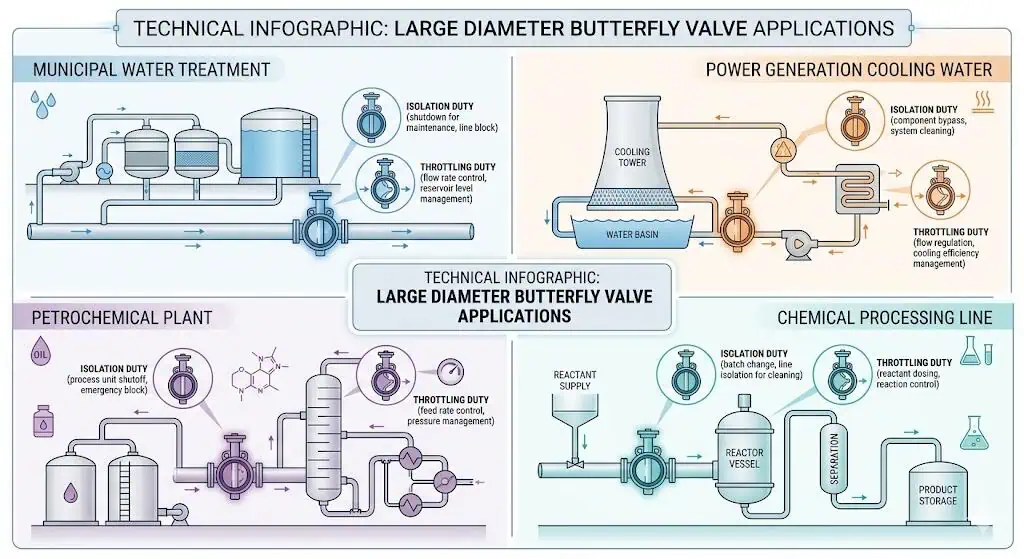
A large diameter butterfly valve is a quarter-turn valve used to isolate or regulate flow in larger pipelines, commonly starting around DN 500 or NPS 20 in many industrial buying discussions, although the exact cutoff varies by project and industry. In waterworks, cooling water, bulk chemical transfer, seawater, and utility headers, butterfly valves are often selected because they provide a lighter and shorter face-to-face package than comparably sized gate or ball valves while still giving fast shutoff and good automation compatibility.
Key features that matter in actual engineering reviews include:
- Compact envelope: The body length and installed weight are usually lower than many other large-bore valve options, which helps when pipe supports and lifting plans are limited.
- Quarter-turn operation: Open-to-close travel is short, which simplifies automation and emergency operation.
- Good suitability for large lines: Butterfly valves are widely used where full-port ball valves become too heavy, too expensive, or too large for available space.
- Multiple seat concepts: Resilient seat, PTFE seat, and metal seat options let you match shutoff and temperature requirements more precisely.
- Flexible connection options: Wafer, lug, flanged, and butt-weld ends are available depending on the piping system and maintenance philosophy.
Tip: Before comparing brands, confirm which standard governs the valve. For industrial butterfly valves, buyers often start with API 609 for butterfly-valve scope, API 598 for inspection and testing, ASME B16.34 for pressure-temperature and material requirements, and ASME B16.10 for installation interchangeability.
| Feature | What It Changes in Practice |
|---|---|
| Compact Structure | Reduces structural load, lifting effort, and required installation space |
| Quarter-Turn Operation | Improves automation response and emergency isolation speed |
| Multiple Seat Designs | Lets you balance shutoff, temperature limit, and maintenance interval |
| Short Face-to-Face | Helps retrofit projects where piping spool changes must be minimized |
| Material Flexibility | Allows better matching for water, hydrocarbons, corrosive media, seawater, or high-temperature service |
Working Principle
A large diameter butterfly valve controls flow by rotating a disc inside the body. When the disc turns parallel to the flow, the passage opens. When the disc turns across the bore, the passage closes. Intermediate disc positions can also be used for throttling, but throttling duty should never be assumed acceptable without checking seat design, erosion risk, and the expected control range.
- Open position: The disc is aligned close to the flow direction, reducing obstruction but not eliminating it entirely.
- Closed position: The disc rotates against the seat to isolate flow.
- Intermediate position: The disc angle restricts flow, but the valve’s stability and wear rate depend heavily on design type and service conditions.
What happens mechanically:
- The operator or actuator applies torque to the stem.
- The stem rotates the disc through a quarter turn.
- The seat and disc geometry determine sealing quality, closing torque, and wear behavior.
In one DN1200 cooling-water retrofit, the valve body size itself was not the problem. The failure came from underestimating breakaway torque after months of low-frequency operation. The electric actuator could stroke the valve in shop testing, but it stalled after commissioning because seat friction, packing drag, and actual differential pressure were higher than the design team assumed. The corrective action was not a different valve size. It was a new torque review plus an actuator with a realistic safety margin.
Note: Large diameter butterfly valves usually require gear operators, electric actuators, pneumatic actuators, or hydraulic systems because torque demand rises quickly with size, differential pressure, and seat load. If the actuator interface is specified to ISO 5211, mounting and drive dimensions are easier to standardize across suppliers.
Why Large Diameter Butterfly Valve Selection Requires More Attention
Size Brings More Than Flow Capacity
Large diameter butterfly valves add mechanical and operational risk that smaller valves may tolerate more easily. Once you move into very large sizes, the disc becomes heavier, shaft bending sensitivity increases, the seat must compress more uniformly around a larger circumference, and transport or handling damage becomes easier to miss until hydrotest or startup.
- Torque rises fast: Closing torque is affected by seat design, differential pressure, bearing friction, packing load, and deposits that build up during idle periods.
- Manufacturing quality matters more: Large castings and weldments require tighter control of porosity, dimensional stability, and coating coverage because small defects become expensive failures in service.
- Hydraulic effects become more serious: Fast closure on large lines can aggravate surge or water hammer if closure logic is not reviewed with the system.
- Maintenance access is no longer trivial: A large flanged butterfly valve may need lifting clearance, gearbox service space, and actuator removal space that was never shown on the early layout.
Another field example is seat damage caused by line debris during commissioning. On a large raw-water line, scale and construction debris passed through the system during the first operating week. The valve was cycled repeatedly while debris was still present, which scored the seat and disc edge. The root cause was not poor valve quality alone. It was startup sequencing: flushing, debris control, and stroke testing were not coordinated.
Tip: For large sizes, ask the supplier not only for a brochure, but also for the GA drawing, torque sheet, seat material data, hydro and seat test plan, coating system, lifting points, and service history in comparable diameter and medium.
Common User Concerns Before Buying
The questions buyers ask at this stage usually determine whether the valve performs well five years later or becomes a shutdown problem after the first season.
| Concern | What You Should Verify |
|---|---|
| Torque and Actuator Matching | Breakaway torque, running torque, seating torque, fail-safe requirement, and margin under actual differential pressure |
| Seat and Material Selection | Compatibility with water, hydrocarbons, solvents, slurry, seawater, steam, and cleaning chemicals |
| End Connection and Dimensions | Face-to-face, flange standard, bolt circle, piping load, and access for removal |
| Testing and Compliance | Applicable design, pressure-temperature, fire test, emissions, and shell and seat test requirements |
| Lifecycle Cost | Seat replacement interval, spare parts availability, shutdown cost, and service support |
- Handling and testing become slower and more expensive as diameter grows, so delivery promises should be checked against actual lifting, machining, and test capacity.
- Large valves that are only similar to your service are not the same as valves already proven in your service. Water, seawater, hydrocarbon, hot gas, and abrasive slurry impose very different demands.
- Documentation matters more than marketing language. If a supplier cannot show what was tested, how it was tested, and to which standard, the risk stays with the buyer.
Note: In refinery and process service, design standard, test standard, and special requirements are often split across several documents rather than one. That is why purchase orders should state each requirement separately instead of assuming the phrase industrial standard is enough.
What Controls Large Diameter Butterfly Valve Selection
Start with real service duty, not just line size
The first selection mistake is to choose a large diameter butterfly valve by nominal size and pressure class only. In the field, the real decision is driven by what the valve must do after installation. Is it mainly an isolation valve with infrequent cycling, or will it open and close every shift? Does it see clean water, seawater, chemical liquid, utility steam, hot gas, or a mixed service with upset conditions? Does it close against low differential pressure or against the full system differential?
A common field issue is that a valve passes workshop open-close checks, then struggles in commissioning because the actual closing load was never defined. That is not a shop defect. It is a selection error that started before the valve was ordered.
Good selection starts with these questions:
- What is the actual service medium in normal operation, startup, upset, and shutdown?
- Is the valve for isolation only, or will it be used for throttling or flow balancing?
- What differential pressure can exist at closure?
- What shutoff expectation does the process really require?
- How often will the valve cycle, and under what load?
Check operating temperature, cycling pattern, and shutdown environment
Many butterfly valve failures are driven by temperature cycling and shutdown exposure, not just normal running condition. A service that looks simple during operation may become much more aggressive after cooldown. Seawater systems, outdoor installations, washdown areas, chloride-bearing deposits, and condensate-prone utility lines often damage the seat, stem sealing area, fasteners, or disc edge long after the unit stops.
A typical project mistake happens when the team reviews pressure and media, but not what happens during outage, cleaning, standby, or restart. The valve survives the hot run, then corrodes, seizes, or leaks on the next startup because the shutdown condition was never treated as part of the service definition.
| Assessment Window | What to Review | Why It Matters |
|---|---|---|
| Operating condition | Pressure, temperature, differential pressure at closure, cycle frequency, shutoff demand | Controls torque, seat wear, sealing performance, and valve type selection |
| Shutdown / standby / washdown | Condensation, chlorides, chemical residue, cleaning fluids, atmospheric exposure | Often controls corrosion, seizure, stem leakage, and maintenance difficulty |
Valve selection is incomplete without actuator, connection, and installation review
A correct valve type can still fail in service if the actuator torque basis, flange arrangement, face-to-face requirement, or installation method is wrong. Large diameter valves magnify alignment problems, unsupported piping loads, and torque mistakes. The difference between wafer, lug, and double-flanged construction is not cosmetic. It directly affects fit-up, maintenance access, bolting pattern, and structural handling during installation.
A typical replacement problem happens when a compact wafer body is bought for a line that actually needs one side disconnected during maintenance. The valve may fit the drawing but still be the wrong valve for the way the line is maintained. If your team is also standardizing actuators and drive packages, review the related valve actuator guide together with the valve specification instead of treating the actuator as an afterthought.
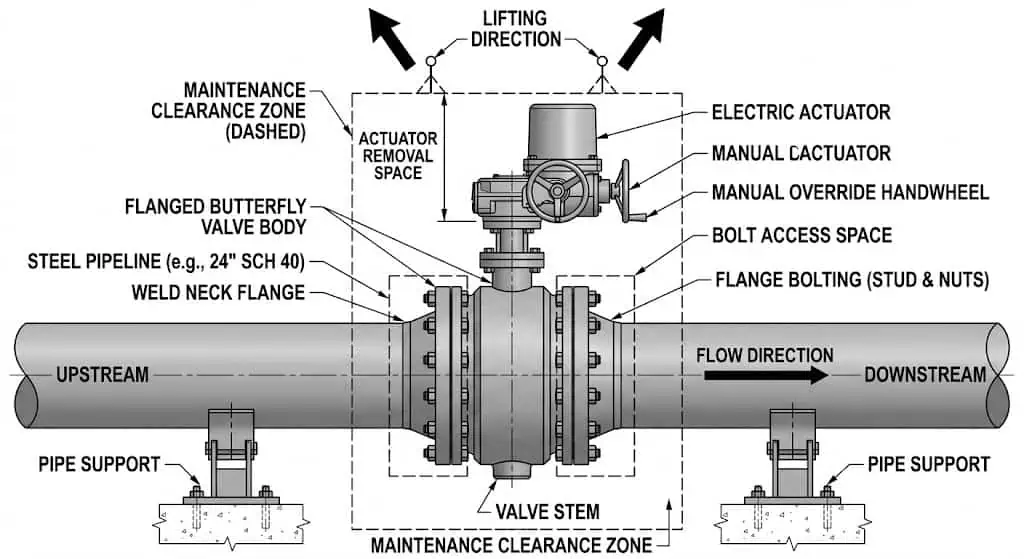
Field rule: Never buy a large diameter butterfly valve as a size-and-class commodity only. Valve type, seat system, actuator torque, end connection, and face-to-face requirement have to be locked together before release.
Types of Large Diameter Butterfly Valves
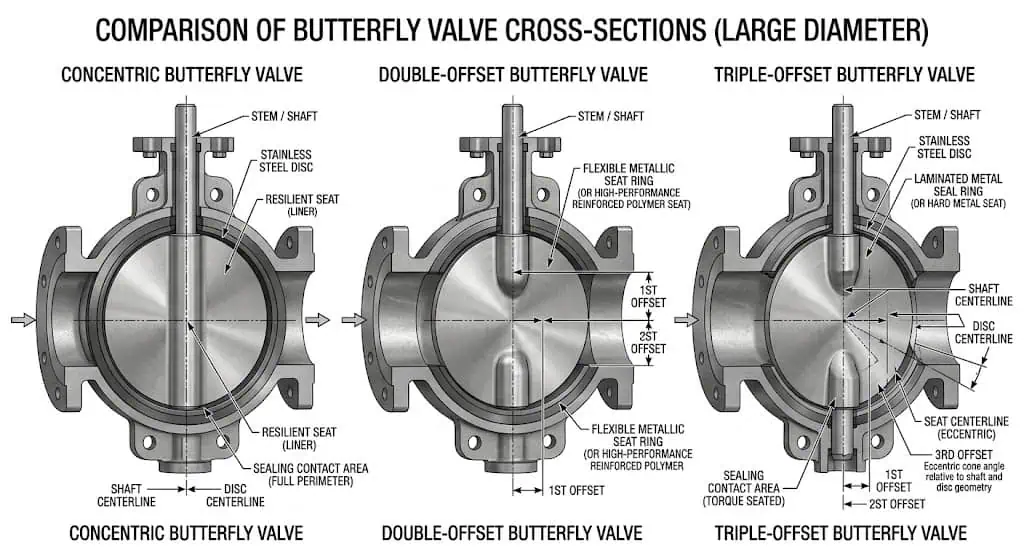
Concentric Butterfly Valve
A concentric butterfly valve places the stem on the centerline of the disc and seat. Because the disc remains in contact with the resilient seat during much of the stroke, the design is economical and compact but generates more rubbing than offset designs. That is why concentric valves are commonly used for water, air, low-pressure utility service, and non-critical isolation where moderate temperature and moderate cycle count are expected.
- You benefit from a simpler structure and lower initial cost.
- You often see these valves in water treatment, HVAC, utility water, and general building services.
- You should be cautious when the line cycles frequently, when the medium contains solids, or when the service temperature approaches the seat limit.
A common selection mistake is using a concentric EPDM-seated valve in a line that occasionally carries oily contamination. In one wastewater project, the valve passed water commissioning with no issue, but leakage appeared months later because the seat saw intermittent hydrocarbon contamination from upstream cleaning operations. The valve style was acceptable for water. The seat material was not.
Tip: Concentric designs are strongest where cost, compact size, and resilient shutoff matter more than hot service, abrasive service, or high-cycle throttling duty.
For a typical Raymon example in this category, see D971X Wafer Type Butterfly Valves.
Double-Offset Butterfly Valve
A double-offset butterfly valve shifts the stem away from the disc centerline and body centerline so that the disc moves away from the seat more quickly during opening. This reduces rubbing during the stroke, lowers seat wear relative to concentric designs, and usually improves service life in larger and more frequently cycled lines.
| Valve Type | Typical Strength | Common Seat Concept | Typical Use |
|---|---|---|---|
| Double Offset | Lower rubbing and more stable cycling than centerline designs | Resilient or PTFE-based seat systems depending on service | Water treatment, cooling water, general industrial isolation, moderate throttling |
- Double-offset valves are often the practical upgrade when concentric seat wear becomes a maintenance issue.
- They are widely used in water treatment, power generation auxiliaries, chemical utilities, and general process lines.
- For a 24 inch butterfly valve and above, double-offset designs often provide a better balance between purchase cost and lifecycle cost than basic centerline designs.
From an engineering standpoint, this is often the budget versus service-life decision point. If the valve must cycle regularly and shutdown cost is meaningful, the lower rubbing of double-offset geometry often pays for itself through longer seat life and fewer unplanned interventions.
Triple-Offset Butterfly Valve
A triple-offset butterfly valve uses three geometric offsets so the sealing surfaces engage with minimal rubbing and typically rely on a metal seat concept for higher temperature and more severe service. This is the design you evaluate when resilient seats are no longer acceptable because of heat, fire-safe requirements, erosive duty, or tighter shutoff expectations under harsher conditions.
| Valve Type | Pressure and Temperature Capability | Seal Type | Selection Logic |
|---|---|---|---|
| Triple Offset | Better suited to high-temperature and higher-severity process service | Metal seat or laminated seat systems | Chosen when resilient seat limits, fire test requirements, or severe shutoff duty justify the cost |
- You commonly find triple-offset valves in steam, hot gas, refinery, petrochemical, and demanding utility isolation.
- Many buyers specify this design where fire testing such as API 607 or project-specific fire-safe requirements are involved.
- A 24 inch butterfly valve with triple-offset design is often justified when the valve is expensive to access or the consequence of leakage is high.
One important correction from many oversimplified articles: triple-offset does not automatically mean zero leakage in every order. The actual shutoff expectation depends on seat design, test standard, test medium, and what is written into the purchase specification. Buyers should ask for the leakage acceptance criteria instead of assuming all metal-seated triple-offset valves perform the same way.
Note: If the service is flammable, do not stop at metal seat. Check whether the project also requires fire testing, emissions limits, and a defined leakage acceptance plan after testing.
Flanged Butterfly Valve for Large Diameters
For large diameters, flanged butterfly valves are often preferred because the connection is more robust, easier to align, and easier to remove for major service. Wafer and lug bodies still have their place, but once the valve becomes very large or the line sees more mechanical loading, flanged ends usually make the installation safer and more maintainable.
- Flanged ends simplify alignment and removal in maintenance-heavy systems.
- They are common in water, wastewater, petrochemical, and large utility lines.
- For retrofits, face-to-face compatibility should be checked against ASME B16.10 or the governing project standard before you assume the existing spool can stay unchanged.
Callout: For very large valves, easy installation should also mean rigging access, gearbox orientation, actuator removal space, and flange bolt access. A technically correct valve can still become a poor choice if it cannot be serviced in place.
If you need a broader review of end connections before finalizing the body style, see types of valve end connections and valve end connection types.
Wafer, Lug, and Double-Flanged Construction
Large diameter butterfly valve selection is not complete until the end connection is fixed. Wafer valves are compact and efficient, but they are less forgiving when flange alignment is poor or when the maintenance plan assumes one side of the line can be removed independently. Lug valves are useful where line segmentation or service-side removal matters. Double-flanged valves are commonly preferred in larger and heavier services because handling, line-up, and structural confidence become more important as diameter increases.
| Butterfly Valve Type | Why Engineers Choose It | Typical Strength of the Choice | Where the Choice Can Fail |
|---|---|---|---|
| Concentric resilient-seated | Compact, simple, widely used in water and utility isolation | Good starting point for general large-bore non-severe service | Used outside seat temperature, chemical, or cycling boundary |
| Double-offset high-performance | Better cycle life and reduced seat rubbing | Useful when service is hotter or more demanding than general-duty water service | Specified too late or treated as interchangeable with basic resilient-seat designs |
| Triple-offset metal seated | Reviewed for high temperature and seat wear risk | Useful in selected hot and demanding isolation duties | Misapplied as a generic upgrade without torque, shutoff, and fit review |
| Wafer body | Lowest envelope and weight | Useful where compact installation matters most | Poor fit-up control or maintenance expectation mismatch |
| Lug or double-flanged body | Better handling and maintenance flexibility | Useful when line isolation, larger support loads, or better alignment control matter | Wrong bolting pattern or unsupported installation assumptions |
Material Selection for Large Diameter Butterfly Valves
Body and Disc Materials
Material selection should start with the actual medium and the worst credible operating condition, not just the normal daily condition. For large diameter butterfly valves, body and disc materials affect corrosion allowance, structural margin, weight, procurement cost, and long-term reliability.
| Common Body Material | Common Disc / Trim Material | Where It Is Commonly Used |
|---|---|---|
| Ductile Iron | Stainless Steel Disc | Municipal water, wastewater, cooling water, general utility service |
| Carbon Steel | Stainless Steel or Hard-Faced Disc | General industrial service where corrosion is controlled and temperature or pressure are higher |
| Stainless Steel | Stainless Steel | Corrosive service, chemical systems, hygienic or cleaner process streams |
| Duplex / Super Duplex | Duplex / Super Duplex | Seawater, chloride-containing service, aggressive offshore or desalination duty |
| Nickel Aluminum Bronze or Titanium Alloys | Matching corrosion-resistant trim | Selected seawater and marine applications where corrosion risk dominates |
- Ductile iron remains common in large waterworks valves because it balances strength, cost, and casting practicality.
- Carbon steel is often selected where pressure and temperature exceed typical waterworks duty and the medium is not strongly corrosive.
- Stainless steel, duplex, and nickel-based options become more attractive once corrosion, chloride attack, or chemical compatibility drive the decision.
In large diameter industrial service, plastic-bodied valves such as CPVC exist in niche chemical applications, but they are not the default body choice for heavy-duty large-bore butterfly valves in mainstream power, water, refinery, or high-mechanical-load piping. That distinction matters because some generic articles blur low-pressure chemical piping and large industrial isolation service as if they were the same selection problem.
Tip: If your team still needs a broader refresher on material tradeoffs, this internal reference on valve materials and packing materials is worth reviewing alongside the final valve datasheet.
Seat and Seal Materials
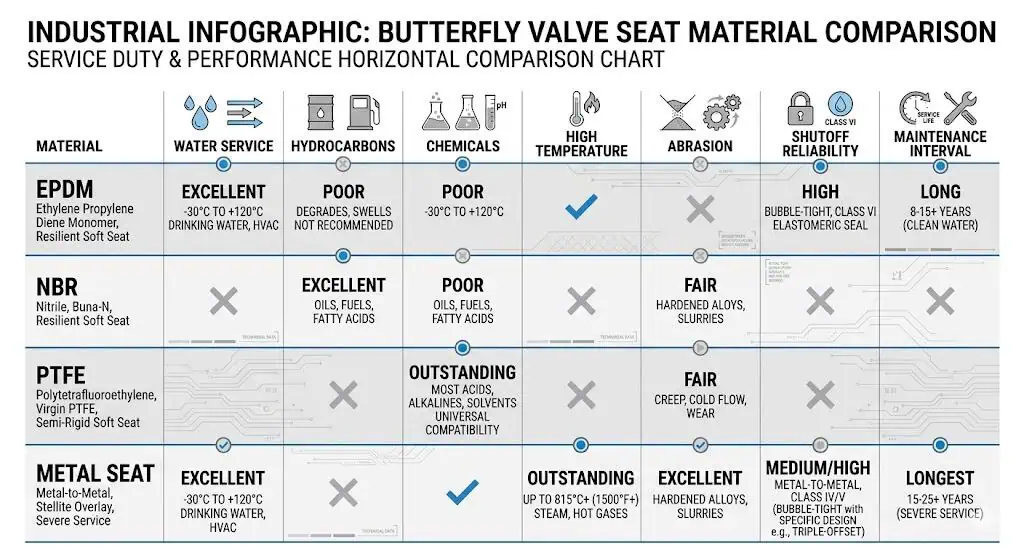
The seat is usually the first component to tell you whether the selection was correct. Body material may survive for years while the wrong seat fails in months. Seat selection controls shutoff quality, chemical compatibility, temperature capability, and maintenance frequency.
- EPDM: Commonly favored for water and many mild chemical services, not the first choice where oils or hydrocarbons are expected.
- NBR: Often chosen where oil resistance matters more than hot-water performance.
- PTFE: Useful when broader chemical resistance is needed, but it still requires review for pressure, temperature, deformation, and seat support design.
- Metal seat: Preferred where temperature, abrasion, or severe shutoff duty exceed the safe limits of soft seats.
One recurring field problem is early leakage caused by choosing the seat from a generic chemical resistant description rather than from the actual chemical list, concentration, temperature, and cleaning cycle. This is especially common when a line normally carries water but periodically sees CIP chemicals, solvent flushes, or hydrocarbon contamination.
From a maintenance perspective, seat mismatch is one of the fastest ways to turn a low-cost valve into a high-cost asset. The purchase price may be lower, but the first unplanned shutdown usually costs more than the initial savings.
Material Compatibility
Material compatibility is not a one-line checkbox. You need to review the full service profile: normal medium, upset medium, startup and shutdown temperatures, cleaning chemicals, solids content, chloride level, oxygen content, and whether the valve will sit idle for long periods.
| Material | Main Strength | Typical Limitation |
|---|---|---|
| Stainless Steel | Good corrosion resistance and widely available trim options | Not automatically suitable for all chlorides or all acids |
| Carbon Steel | Cost-effective with strong mechanical properties | Not the right choice for corrosive fluids without protection strategy |
| Hastelloy / Nickel Alloys | Strong corrosion resistance in aggressive chemical service | Higher cost and longer procurement cycles |
| Titanium Alloys | Excellent seawater resistance in selected duties | Higher material cost and more limited application economics |
In many large diameter applications, corrosion damage appears during standby rather than during normal operation. That is why operating condition and shutdown condition should be reviewed separately.
Standards That Actually Affect the Decision
Good large diameter butterfly valve selection depends on using the right standards for the right question. Do not pile up standard names just to make the page look technical. Each standard matters because it changes an engineering or purchasing decision. If you want a site-level introduction to the relevant standards family, see Raymon’s valve standards and API standard pages.
| Standard | What It Covers | Why It Changes User Decisions |
|---|---|---|
| API 609 | Butterfly valves in double-flanged, lug-, wafer-type, and butt-welding end formats | It is the direct butterfly valve product standard many industrial buyers look for when the valve is part of an API-style specification basis |
| ASME B16.34 | Pressure-temperature ratings, dimensions, tolerances, materials, testing, and marking for new valve construction | It affects what construction scope, materials, and rating logic the buyer is actually ordering |
| API 598 | Valve inspection, examination, and pressure testing | It changes receiving inspection, shutoff test expectations, and acceptance language |
| ISO 5208 | Pressure testing of metallic valves | It matters when project testing language follows ISO valve testing practice rather than API wording |
| ASME B16.5 / B16.47 | Flange compatibility and dimensional basis | They matter directly in replacement and large-diameter piping because the wrong flange basis creates fit-up trouble |
| ISO 15848 | External leakage qualification of valve stem seals and body joints | It matters when fugitive emission performance is part of the project requirement |
If the valve is part of a flange assembly, do not assume the flange standard answers the valve test and shutoff question by itself. Flange standard, valve standard, seat design, and test basis work together, but they do not replace each other.
Do not use “Class 150 butterfly valve” as a complete engineering description. Size and pressure class do not define seat type, disc material, shutoff performance, actuator torque, or connection style.
How to Select the Right Large Diameter Butterfly Valve
Step 1: Define the Real Service Instead of the Tag Description
- Confirm the actual medium in operation, startup, upset, and shutdown.
- Review differential pressure at closure, not just line pressure on the datasheet.
- Check whether the valve is for tight isolation only or for any throttling duty.
- Identify whether corrosion risk exists only in operation, only in shutdown, or in both.
- Define the actual cycle pattern and maintenance expectation.
Step 2: Decide What Is Really Driving the Choice
| Selection Driver | What It Usually Pushes You To Review | Common Error |
|---|---|---|
| Large bore and low installation space | Butterfly valve vs gate valve vs ball valve comparison | Choosing by purchase price only |
| Sustained elevated temperature | Resilient seat vs high-performance vs metal seat review | Assuming any large butterfly valve can handle hot service |
| Corrosive service or seawater | Disc, stem, fasteners, and seat compatibility review | Reviewing body material only |
| Critical shutoff duty | Valve type, seat system, differential pressure, and test basis review | Using a general-purpose valve because the size matches |
| Replacement inside an existing line | Face-to-face, flange standard, drilling, and actuator envelope review | Assuming all same-size butterfly valves are interchangeable |
Step 3: Lock the Valve Body Style, Seat System, and Actuator Together
Do not let purchasing buy a similar butterfly valve after engineering has only specified size and pressure class. A resilient-seat wafer valve, a high-performance lug valve, and a triple-offset double-flanged valve can all share the same nominal size but behave very differently in the field. Valve type without defined actuator basis, end connection, and seat system is incomplete.
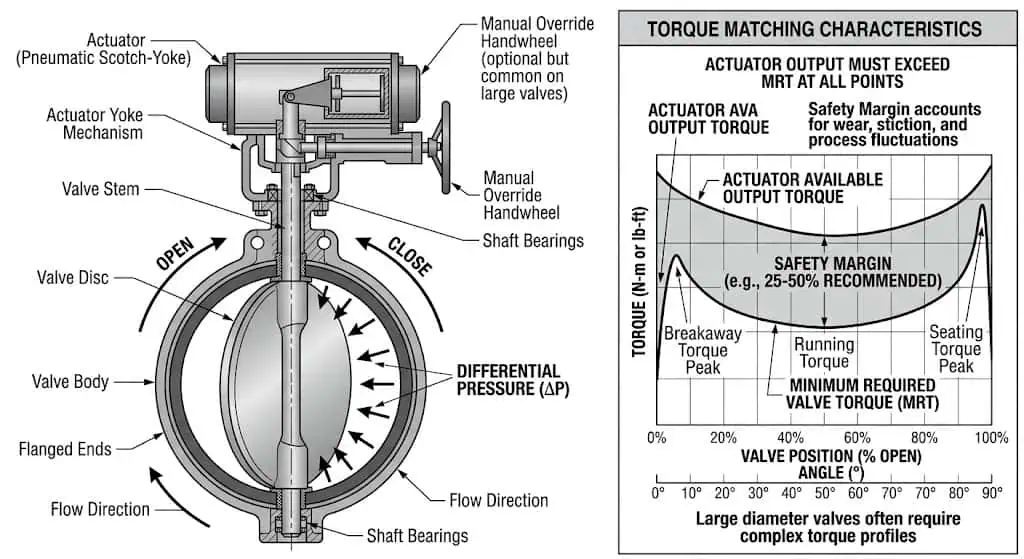
This is also where teams should confirm whether the valve needs manual gear operation, pneumatic actuation, electric actuation, fail-safe action, or special torque margin for closure under live differential pressure. A typical receiving mistake happens when the actuator package is treated as an accessory. The valve arrives on site, cycles freely with no pressure, then cannot close reliably once the real differential pressure is present. Raymon’s valve drive mode page and the newer valve actuator article are useful follow-up references when the actuation side becomes the real decision driver.
| Common Valve Example | Typical Actuation Review | Use This Table For | Do Not Assume |
|---|---|---|---|
| Large resilient-seat butterfly valve | Manual gear or standard quarter-turn actuator review | General service specification cross-check | That dry-cycle torque equals live shutoff torque |
| High-performance double-offset valve | Higher differential pressure and cycle review | Industrial isolation service review | That a standard actuator kit is enough |
| Triple-offset metal-seated valve | Hot service and closure torque review | Detailed engineering and procurement alignment | That the actuator from a soft-seat design transfers directly |
| Replacement valve in existing piping | Envelope, mounting, and stop-setting review | Maintenance and retrofit planning | That same size means same fit and same travel setting |
Step 4: Review Installation Risk Before Release
The selected valve should be reviewed together with piping alignment, flange standard, debris control, support condition, and commissioning method. This matters most in large diameter systems, where flange distortion, poor support, line strain, or leftover fabrication debris can destroy a correct valve choice during startup.
In one commissioning case, the valve type and rating were acceptable, but poor flange parallelism and pipe strain produced seat leakage immediately after installation. The leak looked like a seat problem, but the actual cause was uncontrolled installation loading.
When Not to Use a Common Substitute
- Do not use a resilient-seat butterfly valve in hot service just because the size and class appear to match the line.
- Do not upgrade to stainless automatically just because corrosion has appeared somewhere in the system.
- Do not keep a wafer design by habit when the actual line maintenance plan needs lug or double-flanged construction.
- Do not change only the valve body material while leaving disc, stem, seat, and actuator basis undefined.
- Do not treat throttling duty as irrelevant in systems that actually use the valve half-open for long periods.
Engineering boundary: A butterfly valve that performs well in clean on-off water service may still be the wrong choice for hot shutoff duty, continuous throttling, or solids-bearing service.
Procurement Specification Checklist
Most large diameter butterfly valve mistakes begin in the purchase order, not in the field. If the PO only states size, class, and body material loosely, the supplier has too much freedom to interpret the order. If the service is corrosive or the seat system is critical, it also helps to review Raymon’s valve material and packing material page before releasing the final package.
| PO Item | What to State Clearly | Why It Matters |
|---|---|---|
| Valve type | Concentric, double-offset, or triple-offset construction | Prevents wrong seat and geometry selection |
| Body style | Wafer, lug, or double-flanged | Stops maintenance and fit-up mismatch |
| Seat and sealing system | Exact seat material and shutoff expectation | Prevents chemical or temperature misapplication |
| Body, disc, and stem materials | Exact material grades and corrosion review basis | Stops oversimplified material purchasing |
| Actuator requirement | Manual, gear, pneumatic, electric, fail action, torque basis | Reduces the risk of live-service actuator stall |
| Face-to-face and flange basis | Applicable standard, drilling, and mating flange requirement | Prevents dimensional substitution and piping rework |
| Testing and documentation | API 598 or ISO 5208 basis, MTRs, traceability, certificates | Supports QA, audit, and receiving control |
| Prohibited substitutions | No substitution without written engineering approval | Prevents field replacement with look-alike valves |
Example PO wording: “Large diameter butterfly valve to API 609 construction basis where applicable, body style and face-to-face as specified, seat material and shutoff duty as specified, actuator sized to project differential pressure, test basis per approved specification, full traceability required, no substitution without written approval.”
Incoming Inspection Checklist
| Inspection Item | What QC Should Check | Typical Failure Found |
|---|---|---|
| Nameplate and markings | Valve type, size, class, material, standard basis, manufacturer identification | Wrong construction supplied under correct size |
| Documentation review | MTRs, pressure test records, traceability, coating or seat certificates where required | Correct tag with incomplete supporting records |
| Dimensions | Face-to-face, flange drilling, operator orientation, actuator envelope | Replacement valve does not fit existing piping or support layout |
| Seat and trim condition | Disc edge, seat condition, stem movement, stop setting, shipping damage | Leakage risk or incomplete closure caused by transit damage |
| Body and coating condition | Corrosion damage, coating defects, handling impact, flange face condition | Early corrosion or fit-up trouble at installation |
| Project restrictions | No unauthorized substitute valve type or seat system | Warehouse issue of close-enough valve design |
Common Failure Modes in Large Diameter Butterfly Valves
If the valve is already leaking, the review should be done together with line condition, flange fit, actuator torque basis, and commissioning records rather than treating the seat as the only suspect. For broader application and medium selection context, see Raymon’s valve suitable medium and butterfly valve vs. ball valve pages.
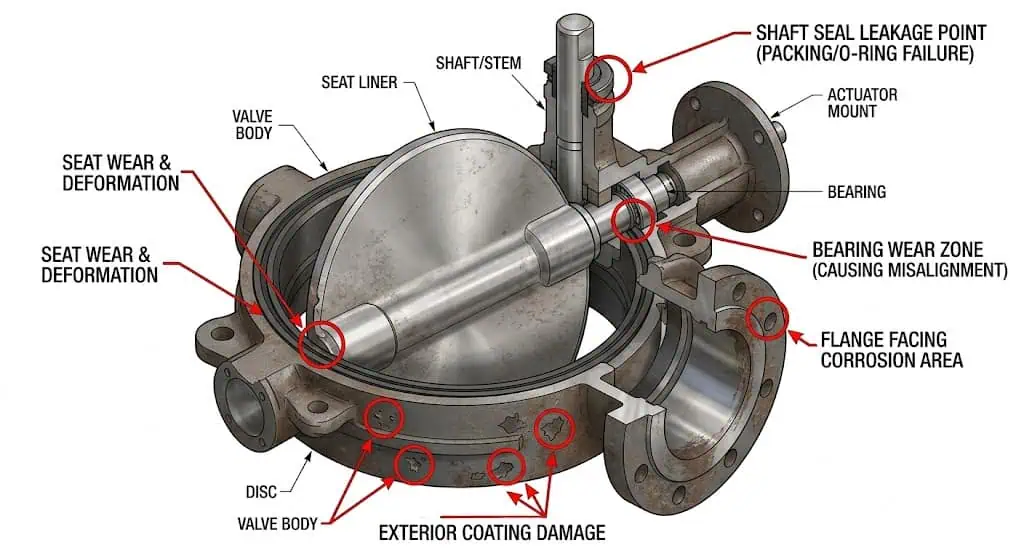
| Failure Mode | Likely Cause | Corrective Action | How to Prevent Repeat |
|---|---|---|---|
| Seat leakage after commissioning | Wrong seat type, debris damage, flange misalignment, or inadequate closure torque | Inspect seat and disc, clean line, verify alignment and actuator basis | Specify duty and installation control together |
| Actuator stall on live closure | Torque sized from catalog habit, not real differential pressure | Recalculate torque and correct actuator sizing | Require torque basis in the purchase package |
| Rapid wear in throttling duty | Valve used as a control device in erosive or cavitating service | Reassess service and valve technology | Treat throttling as a separate engineering review |
| Corrosion after shutdown | Material selected for operating duty only, not standby environment | Review shutdown chemistry, deposits, and material system | Assess operating and shutdown exposure separately |
| Wrong replacement valve installed | Size and class matched, but body style or face-to-face did not | Quarantine valve and verify standard basis before installation | Ban substitutions without written approval |
Composite Field Scenarios for Engineering Training
Scenario 1: Cooling Water Isolation Valve Leaked After Startup
What happened: A large diameter butterfly valve in a cooling water header passed bench cycling but leaked internally after commissioning.
Why it happened: The site assumed the valve was a simple water-service item and focused on delivery time rather than installation and debris control.
The real system cause: Fabrication debris and flange misalignment damaged the seat load path during early operation.
How it was corrected: The valve was removed, the line was cleaned, flange alignment was corrected, and installation procedure was tightened.
How to prevent recurrence: Put line cleanliness, flange alignment, and pre-installation cycling checks into the work package before startup.
Scenario 2: Resilient-Seat Valve Used in Hotter Service Than Expected
What happened: A project team installed a resilient-seated large diameter butterfly valve in a hotter utility service because the size and class matched the line.
Why it happened: The decision was made from a line list view, not from a full service review.
The real system cause: The seat system was never checked against actual operating temperature and thermal cycling.
How it was corrected: The valve was replaced with a design more suitable for the temperature duty, and the actuator torque basis was rechecked.
How to prevent recurrence: Never treat seat material as a secondary detail after the body has been selected.
Scenario 3: Replacement Valve Did Not Fit Between Existing Flanges
What happened: Maintenance removed an old large butterfly valve and found the replacement could not be installed without pipe rework.
Why it happened: The team bought by size and class only.
The real system cause: Face-to-face and body style were assumed rather than locked in against the existing piping arrangement.
How it was corrected: The valve package was changed to the correct dimensional basis and the replacement procedure was revised.
How to prevent recurrence: Add face-to-face, flange standard, and body style verification to every replacement requisition.
Scenario 4: Valve Was Used for Throttling and Lost Shutoff Quickly
What happened: A large diameter butterfly valve used half-open in a solids-bearing process lost shutoff performance and showed rapid seat wear.
Why it happened: Procurement pressure pushed the team toward the lowest-cost valve that physically fit the line.
The real system cause: The valve was selected as an isolation valve but operated like a control valve in erosive duty.
How it was corrected: The service was reclassified, the throttling strategy was changed, and the valve technology was upgraded.
How to prevent recurrence: State clearly whether the valve is isolation-only or will see throttling duty before the order is released.
Related Valve and Joint Checks Engineers Usually Review Next
After reading a large diameter butterfly valve guide, most engineers and buyers move to one of these follow-up decisions:
- What end connection style fits the piping and maintenance plan?
- Should the valve be wafer, lug, or double-flanged in this line?
- What seat and packing materials fit the medium and temperature best?
- What drive mode and actuator package should be reviewed next?
That is why this page should sit close to your related pages on valve end connection types, valve material and packing material, valve actuator, and butterfly valve vs. ball valve. That internal path gives readers a clear move from butterfly valve selection to materials, end connections, actuation, and comparison decisions without sending them into unrelated product pages.
FAQ
What Is a Large Diameter Butterfly Valve Best Used For?
A large diameter butterfly valve is best used where line size is large and the project needs compact quarter-turn isolation or moderate throttling without the weight, face-to-face length, or installation burden of a same-size gate or ball valve. It is commonly selected for cooling water, raw water, HVAC, utility, wastewater, and many general industrial isolation duties.
What Is the Difference Between Wafer, Lug, and Double-Flanged Butterfly Valves?
Wafer valves are compact and efficient between mating flanges, lug valves provide more maintenance flexibility, and double-flanged valves are often preferred in larger and heavier services where handling and alignment control matter more. The correct choice depends on maintenance method, support condition, piping layout, and whether one side of the line must be disconnected during service.
When Should a Metal Seated Butterfly Valve Be Reviewed?
Review a metal seated butterfly valve when service temperature, cycle severity, or seat wear risk is too high for a resilient seat to remain the reliable sealing element. This often comes up in hotter service, more demanding shutdown isolation, erosive duty, or applications where rubbing wear has to be minimized.
Are Butterfly Valves Suitable for Throttling Service?
Sometimes, but not by default. A butterfly valve can handle some throttling duties, but continuous throttling in erosive service, solids-bearing service, or high differential pressure near closed position can damage the seat and disc edge quickly if the valve was selected only as a low-cost isolating valve.
Why Do Large Diameter Butterfly Valves Leak After Commissioning?
The usual reasons are wrong seat selection, flange misalignment, debris left in the line, inadequate closing torque, or a valve being used outside the service boundary it was actually bought for. In many cases, the root cause is not one damaged part. It is a selection-and-installation chain that was never fully controlled.
What Should Purchasing and QC Always Verify?
They should verify the exact valve type, body style, seat system, materials, face-to-face requirement, flange basis, actuator requirement, pressure test records, and traceability documents. Many field failures begin with incomplete purchasing language or look-alike replacement valves that were never fully checked.
 English
  German
  Arabic
  French
  Spanish
  Italian
  Portuguese
  Russian