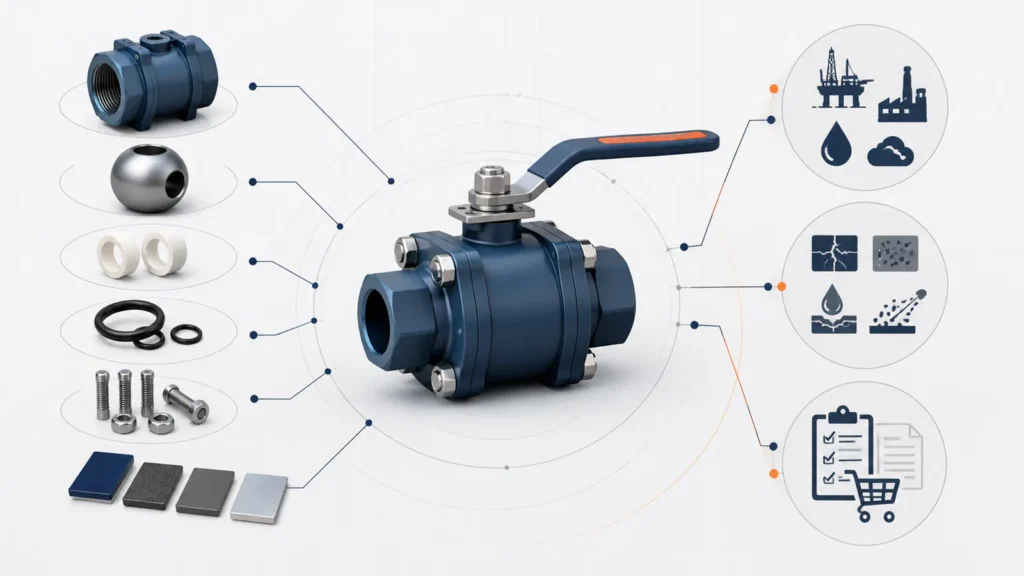
Ball valve material selection is a component-by-component review, not a choice between a few body grades. Define the medium and every operating case first, then specify the body and end connector, ball, stem, seats, packing, body seals, O-rings, bolting and any coating or hardfacing. Check each component against pressure, temperature, differential pressure, corrosion, solids, cycling and shutoff duty. Keep the material decision on hold until exact grades, product forms, limits, traceability and supplier deviations are documented.
Featured illustration: Conceptual ball valve material-system view linking components, service conditions, damage risks and controlled evidence. Not a product drawing, bill of materials, supplied configuration or compatibility approval.
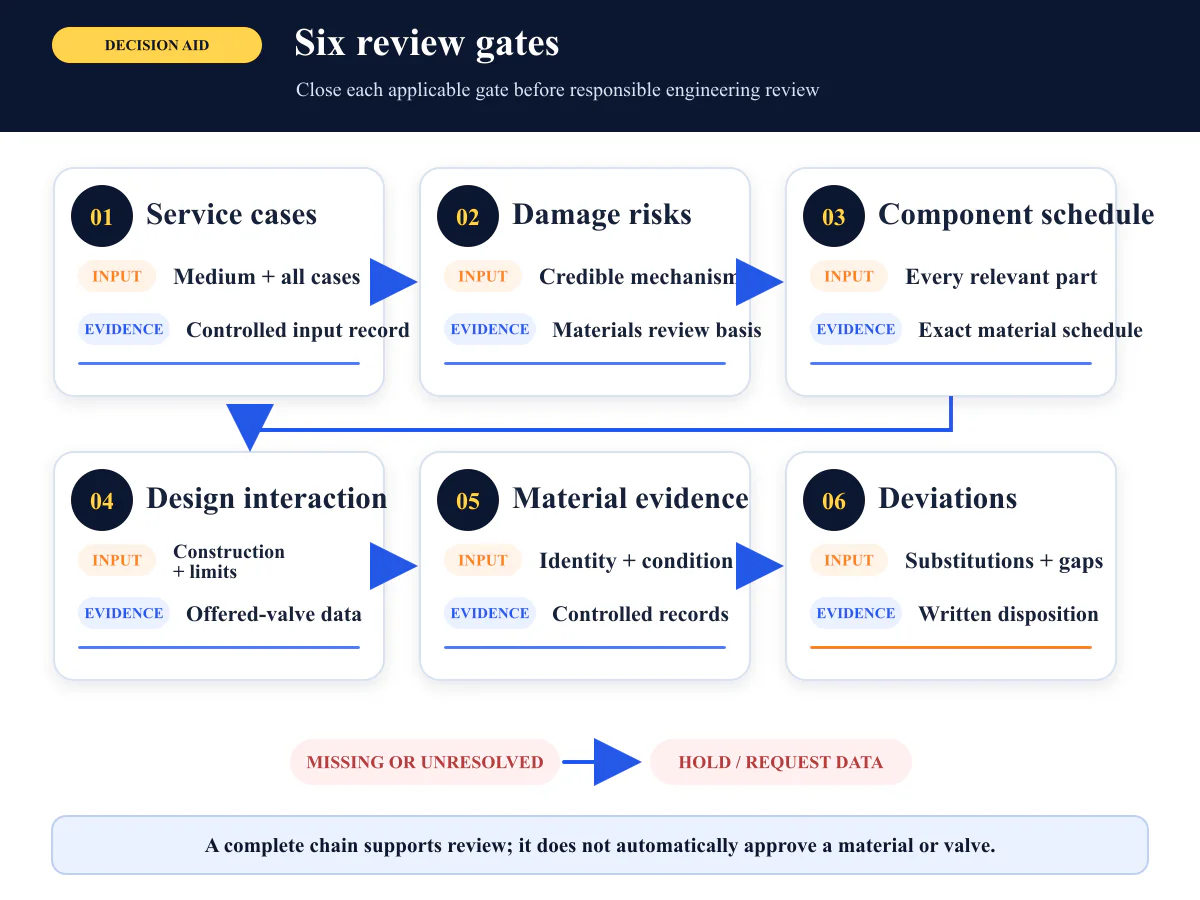
Quick Answer: Use Six Gates Before Approving Ball Valve Materials
A material family is a screening input, not approval. The complete package should pass six separate gates.
How to use these tables: On smaller screens, swipe horizontally inside each table. Read each row as a review prompt, not an approval. Keep any decision marked OPEN o HOLD unresolved until the named input and evidence are confirmed.
| Review gate | Minimum buyer input | Evidencia a solicitar | Hold condition |
|---|---|---|---|
| Service cases | Medium, composition, phase, contaminants, pressure, temperature, differential pressure, duration and external exposure | Approved datasheet, line list and operating-case record | Only a general medium name or normal condition is supplied |
| Damage risks | Credible corrosion, erosion, galling, cracking, swelling, permeation, extrusion, thermal-degradation and fouling risks | Materials/process review and applicable compatibility evidence | A material is chosen before damage mechanisms are reviewed |
| Component schedule | Body, end connector, ball, stem, seats, packing, gaskets, O-rings, bolting, springs and coatings where applicable | Exact component material schedule | The offer states only one body grade or “standard trim” |
| Interacción de diseño | Ball support, body construction, seat design, pressure-temperature boundary, cycling and shutoff criterion | Exact offered-valve data and component limits | Class/PN or a material label is treated as complete approval |
| Material evidence | Specification, grade, product form, condition, heat treatment or hardness where relevant, and required records | Documents tied to the offered valve or order | A general catalog or company certificate is the only evidence |
| Desviaciones | Allowed substitutions, exclusions, open items and decision owner | Technical deviation schedule and written acceptance | “Equivalent” material is proposed without a controlled review |
The practical rule is simple: do not approve a material name. Approve a documented component material package against the complete service conditions and project requirements.
The broader Guía de selección de válvulas de bola covers construction, bore, ends, actuation and test scope. This article focuses on the material decision inside that larger selection process.
Define the Service Before Discussing Materials
Material selection starts with the environment that each component will actually see. A line-list description such as “water,” “chemical,” “oil,” “gas,” “steam” or “seawater” is not enough to close compatibility.
Record the complete medium
State the chemical identity and composition, concentration, phase, water content, relevant contaminants, dissolved gases and solids. Include cleaning, flushing, sterilization or standby fluids when they differ from normal operation. A material that is screened for the normal process fluid may still require another review for startup, shutdown or cleaning exposure.
Record every operating case
Capture normal and maximum operating pressure, design pressure, normal and design temperature, credible upset conditions and maximum operating differential pressure. Add thermal cycles, depressurization and hot or cold shutdown cases where they matter.
Pressure class or PN addresses only part of the valve design question. It does not establish the complete pressure-temperature boundary of the exact valve, because the body material group, seat system, seals, bolting, construction and project design basis must also be consistent.
Record the lifecycle and external environment
Define shutoff direction and acceptance criterion, operating frequency, dwell time, solids, fouling tendency and cleaning method. Review external atmosphere, washdown chemicals, insulation, buried or submerged exposure and the required coating system separately from internal compatibility.
Record these cases in a project table with the medium, pressure, temperature, differential pressure, phase/solids, duration, external exposure and open items. If a controlling case is undefined, the material decision may need to remain on hold.
Service-Case Completeness Table
Use one row for every condition that can change the material, sealing or pressure-temperature decision. Do not combine cases when their composition, phase, differential pressure or exposure duration differs.
| Case | Medium / composition | Pressure / temperature | Presión diferencial | Phase / solids | Duration / frequency | External exposure | Estado |
|---|---|---|---|---|---|---|---|
| Normal operation | Exact composition and concentration | Normal and maximum operating values | Maximum and direction | Phase, solids and contaminants | Continuous or cycle profile | Atmosphere, insulation or washdown | Open / confirmed |
| Startup / shutdown | Fluids and changing composition | Transient limits | Transient differential | Phase change or deposits | Duration and frequency | Temperature or weather exposure | Open / confirmed |
| Cleaning / flushing | Cleaning chemical, concentration and rinse | Cleaning pressure and temperature | Flow direction and differential | Solids removed or introduced | Sequence and frequency | External chemical contact | Open / confirmed |
| Credible upset / standby | Upset or stagnant composition | Design or upset values | Maximum credible differential | Settling, crystallization or permeation risk | Maximum exposure time | Storage or idle environment | Open / confirmed |
HOLD: keep the material package open when a credible controlling case lacks composition, pressure-temperature, differential-pressure or duration data.
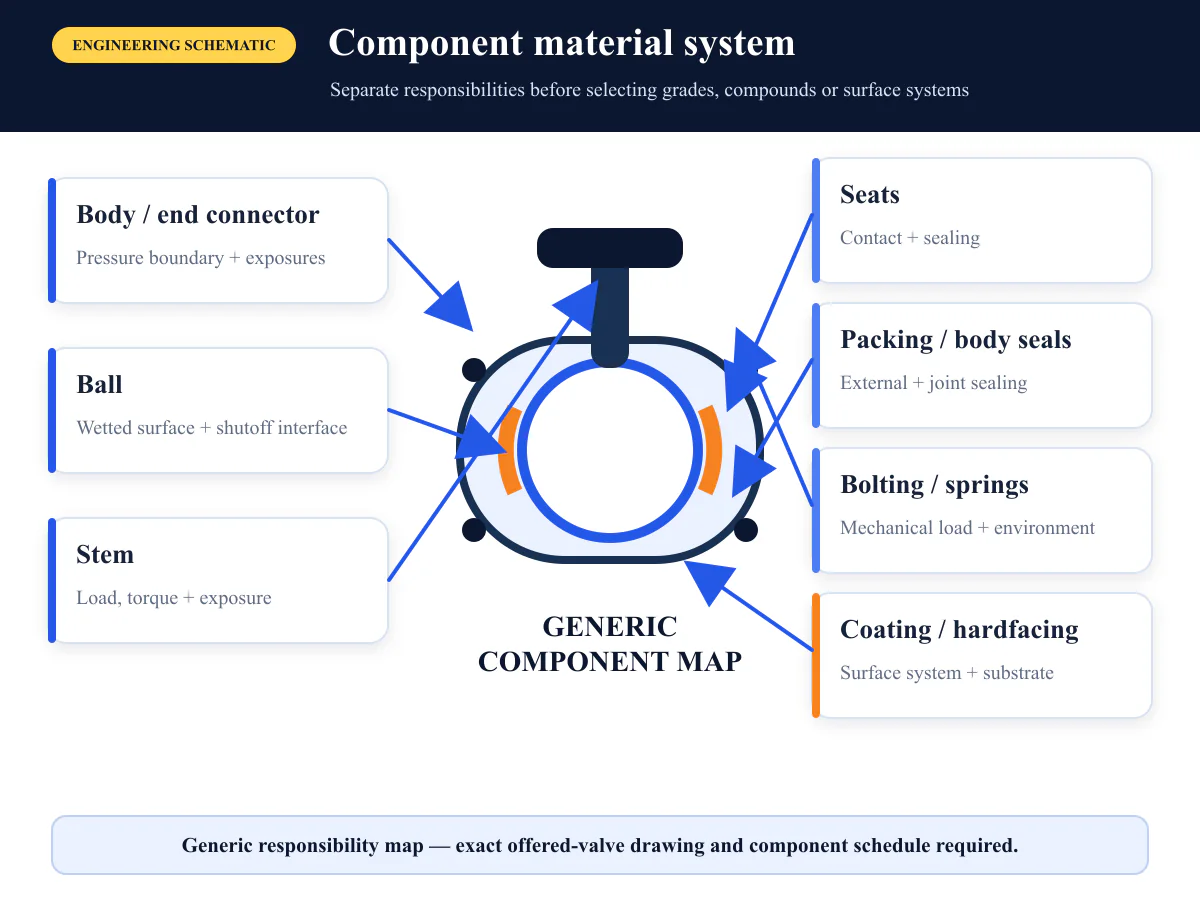
Treat a Ball Valve as a Material System
A purchase description such as “WCB ball valve” or “316 ball valve” identifies, at best, one part of the package. It does not define the ball, stem, seats, packing, gaskets, O-rings, bolting or coatings.
| Componente | Main responsibility | Questions that remain after naming a material family |
|---|---|---|
| Body and end connector | Pressure containment and piping interface | Exact specification, grade, product form, condition, rating basis, internal/external exposure and traceability |
| Válvula de bola | Aislamiento del flujo y superficie de sellado | Base material, corrosion/wear exposure, surface finish, coating or overlay, and pairing with the seats |
| Stem and trunnion parts | Torque transmission and ball support | Strength, condition, corrosion exposure, packing-contact surface, bearings and exact construction |
| Asientos | Primary closure interface | Exact compound or metal-seat system, geometry, differential pressure, media, temperature, cycling and leakage criterion |
| Empaquetaduras y sellos del cuerpo | External and body-joint sealing | Exact compound/system, pressure-temperature basis, cycling, emissions requirement and qualification scope |
| O-rings and secondary seals | Local sealing functions | Exact compound, decompression/permeation risk, media and temperature basis |
| Bolting and springs | Joint load or seat-system function | Exact specification, strength/condition, internal/external exposure and project restrictions |
| Coating, plating or hardfacing | Surface protection or wear/sealing function | Exact component, base material, process, finish, inspection and repair acceptance |
Body, ball and stem do not automatically need the same nominal material. Each part performs a different mechanical and sealing function. The specification should identify the governing material requirement for each component rather than relying on a broad “trim” label.
For a cross-family approach to material decisions, use the Valve Material Selection framework.
Screen Metallic Material Families Without Turning Them Into Service Guarantees
Material families help organize a review, but they do not replace it.
Carbon and low-alloy steels
Carbon-steel valve components may be supplied as castings, forgings or other permitted product forms. The exact product specification matters. For example, ASTM A105/A105M addresses applicable forged carbon-steel piping components, while the ASTM steel standards catalog identifies ASTM A216/A216M for applicable carbon-steel castings.
Those designations establish material-specification scope, not universal approval for a fluid, temperature or valve. Pressure boundary, toughness, corrosion, coating and the complete sealing system remain separate checks.
Austenitic stainless steels
Labels such as 304, 316, CF8 and CF8M do not describe identical grades or product forms. The purchase requirement should state the exact component, specification, grade and condition. Media composition, temperature, chloride or other contaminant levels, crevices, deposits, cleaning fluids and standby exposure still require review.
“Stainless steel” is therefore not a complete specification, and 316 should not be treated as automatic approval for seawater, chloride, chemical, oxygen or cleaning service.
Duplex, super duplex and higher-alloy candidates
Duplex, super duplex, nickel-base and other special-alloy families may enter a project review, but the family name remains incomplete. Confirm the exact designation, component, product form, manufacturing route, condition, repair scope and environmental limits. Trade names such as Monel or Hastelloy should not replace the exact UNS or project-specified grade. A higher-alloy label does not prove pitting resistance, sour-service acceptability, seawater suitability, cryogenic performance or service life.
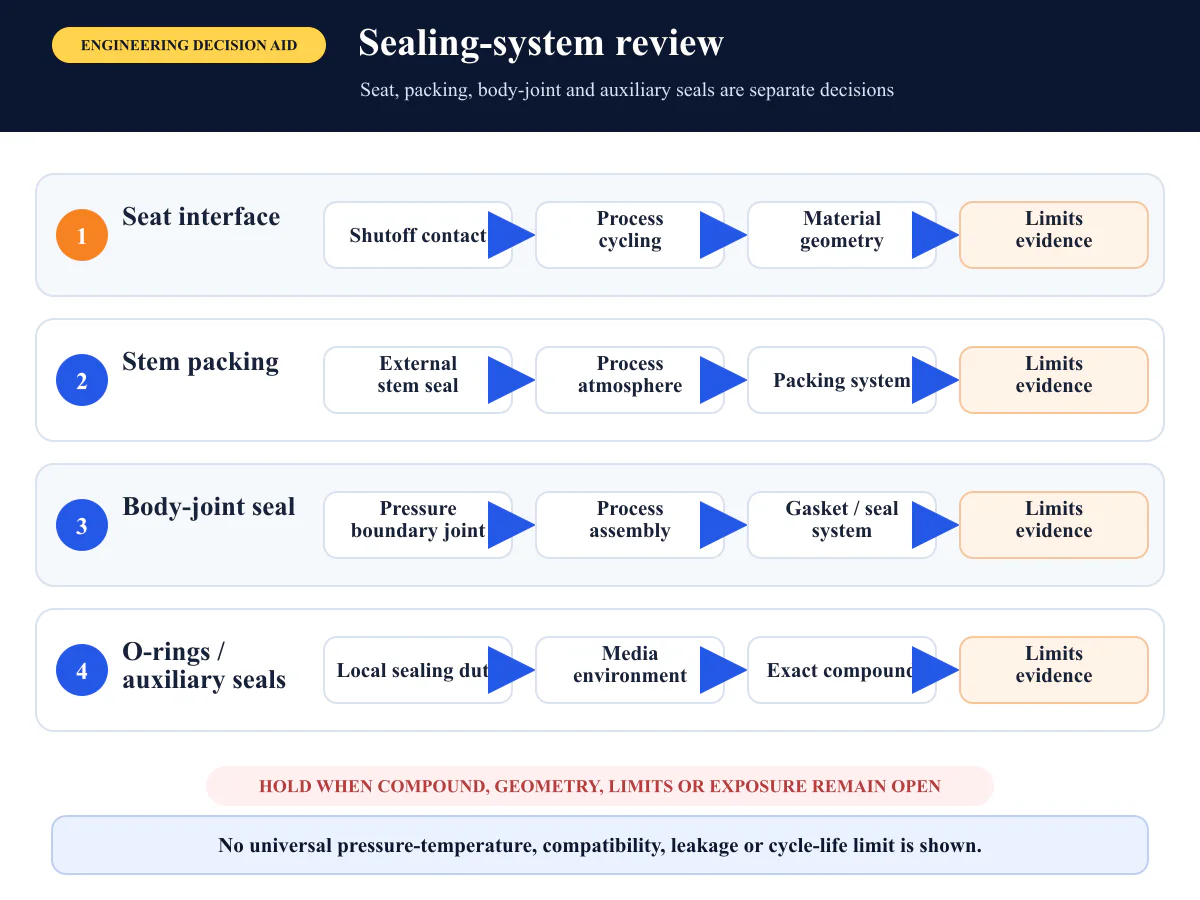
Select Seats, Packing, Gaskets and O-Rings Separately
Soft goods often control the usable envelope even when the body material is acceptable. They should be specified by exact component and controlled supplier data.
Soft-seat and engineering-polymer candidates
PTFE, reinforced PTFE or RTFE, PEEK, PCTFE, UHMWPE, nylon, Devlon and similar names describe material families or commercial formulations. Exact filler or compound, seat geometry, pressure loading, temperature, media, cycling and manufacturer data can change the result.
Do not publish or approve one universal temperature or pressure number for a generic seat label. Use the pressure-temperature data for the exact offered valve and seat system.
Elastomer candidates
NBR, EPDM, FKM and other elastomer acronyms are also incomplete without the exact compound. Review swelling, extraction, permeation, decompression, extrusion and thermal aging against the complete process and cleaning cases. A generic compatibility chart can support screening, but it should not serve as final valve approval.
Metal-seat systems
“Metal seated” does not identify the ball and seat base materials, coating or hardfacing process, surface finish, lapping, directionality, leakage criterion or torque. These items must be stated and supported for the exact offered design.
A metal seat is not automatic approval for high temperature, solids or abrasive service. It is one construction direction that still requires evidence. The detailed trade-off belongs in the Soft Seated vs Metal Seated Ball Valve guide.
Packing and body seals are different decisions
Stem packing, body gaskets and O-rings may see different motion, pressure, temperature and exposure from the main seats. Review them independently. Graphite or PTFE in a material schedule does not prove that the valve is fire safe or qualified for low fugitive emissions.
Sealing-System Review Matrix
Normalize each sealing element separately. The seat designation must not be copied into the packing, body-seal or O-ring rows unless the exact offered construction supports it.
| Componente | Exact material / compound | Base de presión-temperatura | Media basis | Degradation risk | Evidencia a solicitar | Estado |
|---|---|---|---|---|---|---|
| Primary seats | Compound, filler or metal-seat system | Exact offered-valve limit data | All process and cleaning cases | Creep, extrusion, wear, deposits or surface damage | Supplier limit data and applicable shutoff test scope | Open / confirmed / deviation |
| Stem packing / stem seals | Exact packing or seal system | Pressure, temperature and cycling basis | Process and external exposure | Wear, extrusion, permeation or emissions pathway | Construction data and separate qualification evidence where specified | Open / confirmed / deviation |
| Body gasket / body seals | Exact gasket or seal material | Joint and operating-case basis | Process, cleaning and standby exposure | Relaxation, thermal cycling or chemical degradation | Material identity and offered construction data | Open / confirmed / deviation |
| O-rings / secondary seals | Exact compound and location | Pressure change and temperature basis | Every contacted fluid | Swelling, extraction, decompression or permeation | Compound-specific supplier data | Open / confirmed / deviation |
Fire-test, fugitive-emission and normal pressure/leak evidence remain separate scopes. A named seal material does not establish any of those qualifications.
Review the Ball, Stem and Surface Engineering Together
The ball is both a wetted component and a sealing surface. Its base material, surface finish and any coating or overlay must be compatible with the seat system and the expected wear or corrosion mechanisms. The stem transmits torque and interacts with packing, bearings and the external environment.
A generic “stainless ball and stem” statement does not close either decision. Require exact materials and conditions for the offered valve.
Coatings and hardfacing need the same discipline. Identify the component and base material, surface preparation, process, material designation, controlled thickness or finish where specified, inspection/acceptance requirements and repair limits.
Hard chrome, tungsten carbide, chromium carbide or Stellite labels do not guarantee abrasion life, corrosion resistance or leakage performance. The interaction between the ball, seat, deposits, differential pressure, packing, bearings and surface condition can also influence operating torque.
An actuator must not be selected from material name, seat type or nominal valve size. It requires exact valve torque data and revision, maximum operating differential pressure, temperature/service basis, sizing factor, operating time, fail action, supply and accessory scope.
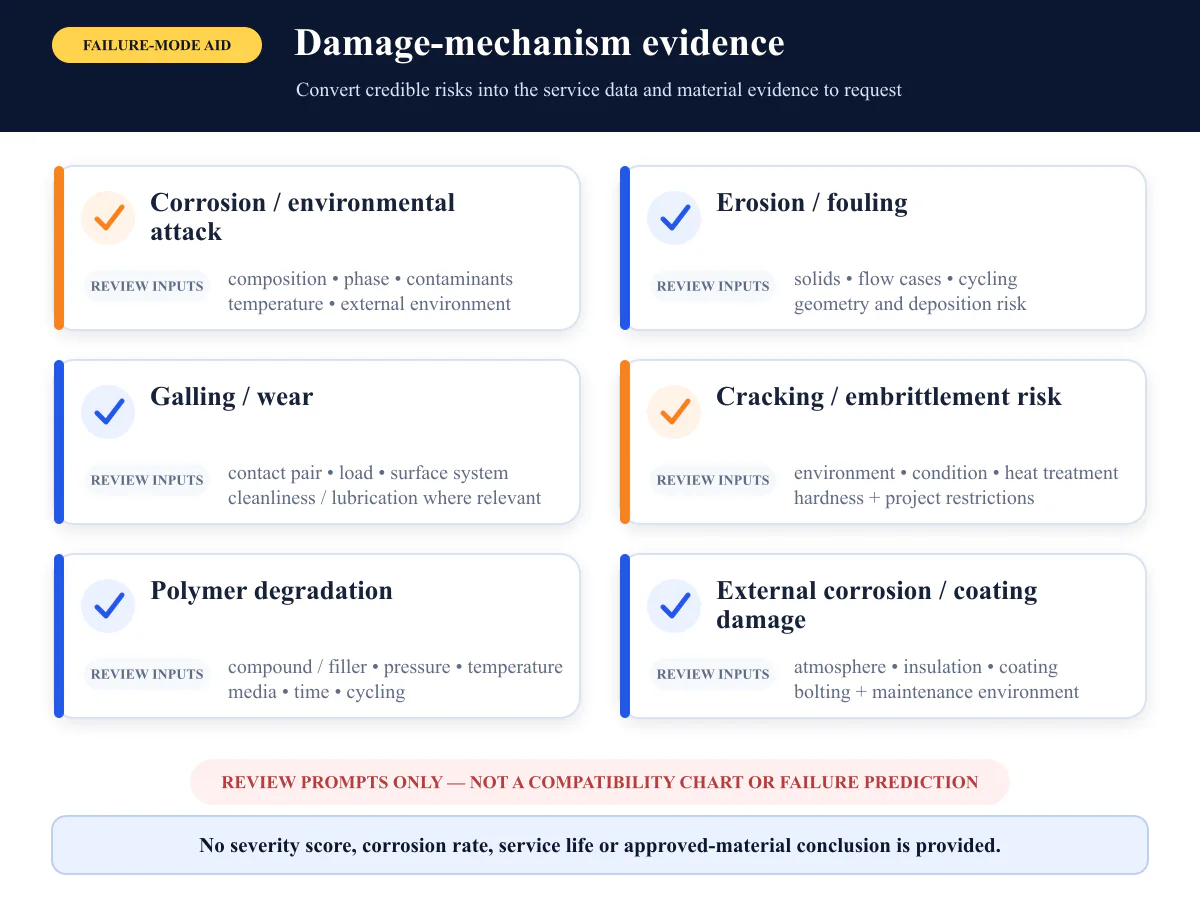
Match Damage Mechanisms to Evidence
The strongest material review starts with the credible damage mechanism and then asks what evidence can close it.
| Damage or degradation risk | Data needed | Components to review | Hold trigger |
|---|---|---|---|
| General or localized corrosion | Full composition, concentration, temperature, phase, contaminants, geometry and exposure duration | All wetted metals and relevant joints | A family name is used without environment-specific review |
| Erosion, abrasion or surface damage | Solids, particle size/hardness, velocity or differential pressure, impact path, cycling and cleaning | Ball, seats, body transitions, coatings and retainers | “Metal seat” or “hard coated” is the only evidence |
| Galling or friction-related damage | Material pairing, loads, movement, finish, lubrication/cleanliness and cycles | Stem, bearings, ball/seat and threaded interfaces | Pairing and surface condition are undefined |
| H2S-related cracking | Defined environment, material condition/processing, hardness where applicable and project standard | Pressure parts, trim, bolting, welds and hardfaced areas as applicable | NACE is stated without an environmental/material basis |
| Polymer or elastomer degradation | Exact compound, media, temperature, pressure change, cycling and cleaning exposure | Seats, packing, gaskets and O-rings | Only an acronym or generic chart is provided |
| External corrosion | Atmosphere, coating, insulation, washdown, storage and maintenance plan | Body exterior, bolting, stem and operator interface | Internal compatibility is treated as external protection |
Sour-service language requires special care. NACE MR0175 / ISO 15156 addresses materials for defined H2S-containing oil and gas production environments within its scope. It is not a universal valve certificate. The exact environment, material condition, processing, project edition and responsible review must be confirmed.
Cross-Check Materials Against Valve Construction and Performance
Materials cannot be approved separately from the exact valve design.
Ball support and seat loading
Floating and trunnion-mounted ball valves use different support and seat-loading arrangements. Body construction, seats, bearings, cavity features and differential pressure can change the mechanical demands on the material package. Construction type cannot be selected from a material label, and a construction name does not establish compatibility.
Pressure-temperature boundary
Where applicable, ASME B16.34 provides pressure-temperature, material, design, examination, testing and marking context for valves within its scope. It does not provide the exact offered valve’s seat and seal limits or prove suitability for a medium.
Cross-check the project design basis, exact body material group, seats, packing, gaskets, O-rings, bolting and every operating case. The controlling boundary may come from a nonmetallic component or a product-specific design limit rather than the body grade.
Shutoff and testing
State the required shutoff direction, differential or test pressure, test medium, duration and allowable leakage or acceptance criterion. Material names do not establish zero leakage, bubble-tight performance, leakage class or cycle life.
ISO 5208, where adopted, addresses pressure testing of metallic valves within its scope. A pressure or seat test does not replace fire qualification, fugitive-emission qualification, NDE, PMI or material compatibility review. Each requirement needs its own scope and evidence.
For internal test-scope planning, the industrial valve pressure testing guide explains how shell, closure and functional test evidence should be specified and reviewed separately; the approved project standard, edition and acceptance criteria still govern.
Separate Specifications, Standards and Order Evidence
These documents answer different questions:
| Document type | What it may establish | What it does not establish |
|---|---|---|
| Material product specification | Grade, product form, chemistry/mechanical and manufacturing requirements within scope | Complete valve rating, media compatibility or product approval |
| Valve design/product standard | Requirements for valves within its exact scope | Automatic compliance, certification or order inclusion |
| Pressure/leak test standard | Test method and acceptance framework where adopted | Material compatibility, fire qualification or service life |
| Fire or fugitive-emission qualification | Qualification for a covered design/configuration | Every size, trim, seal or offered configuration is qualified |
| Sour-service material/environment standard | Material/environment restrictions and review route within scope | Universal suitability from a grade name |
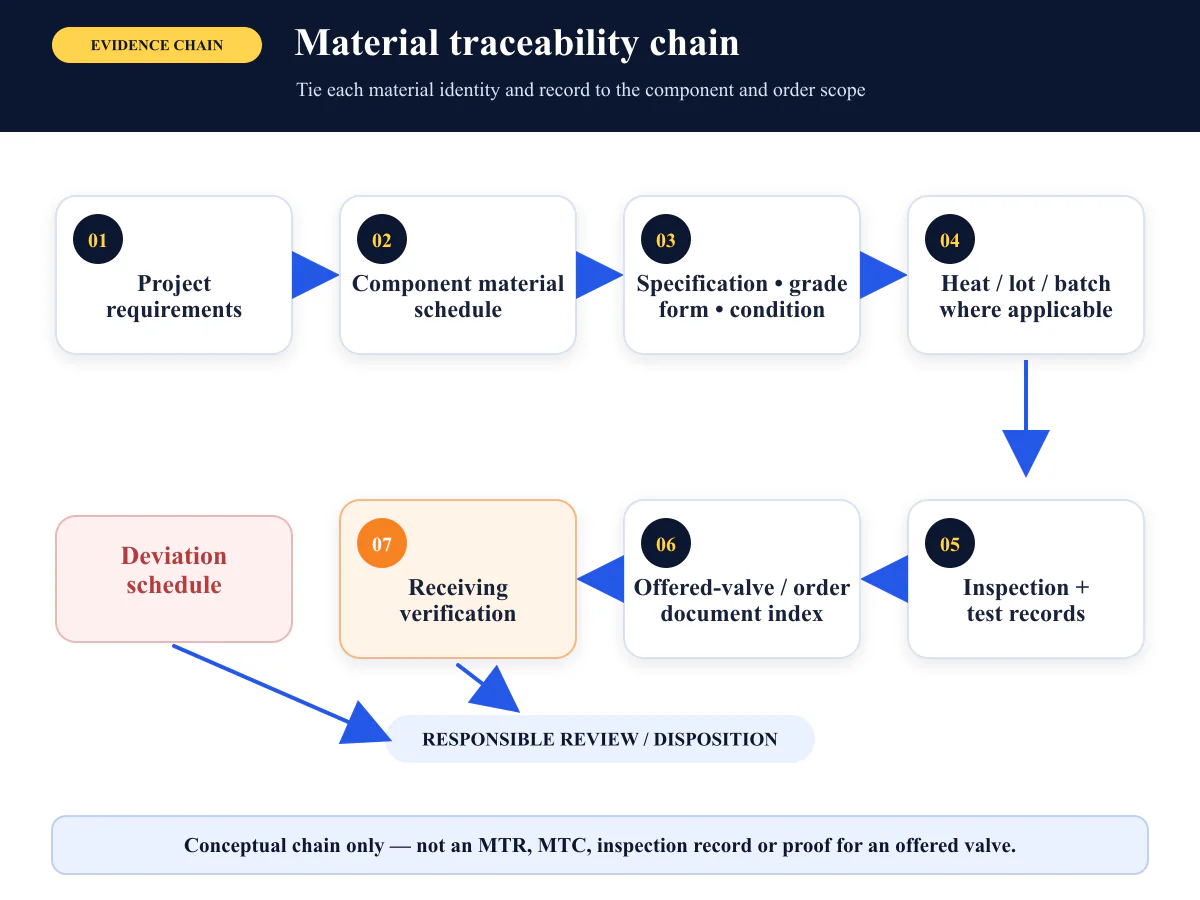
| MTR/MTC, PMI, NDE or coating record | Evidence for the stated material/process and traceable scope | Suitability for an unstated operating environment |
Confirm the project-approved standard edition, purchaser options and precedence. A current standard does not automatically replace the edition named by a project, and a standard reference does not prove that a specific Raymon Valve product is designed, tested, qualified or certified to it.
Build an Auditable Component Material Schedule
An RFQ should turn material selection into fields that suppliers can answer consistently.
| Componente | Specification/grade | Product form/condition | Coating or overlay | Registro requerido | Deviation/status |
|---|---|---|---|---|---|
| Body and end connector | Buyer/supplier entry | Buyer/supplier entry | Buyer/supplier entry | MTR/MTC and other project records where required | Open/confirmed/deviation |
| Válvula de bola | Buyer/supplier entry | Buyer/supplier entry | Buyer/supplier entry | Material and surface/coating record where required | Open/confirmed/deviation |
| Stem/trunnion parts | Buyer/supplier entry | Buyer/supplier entry | Buyer/supplier entry | Material/condition record where required | Open/confirmed/deviation |
| Asientos | Exact compound or metal-seat system | Construction/condition | Exact surface system | Limit and test evidence | Open/confirmed/deviation |
| Packing, gaskets and O-rings | Exact materials/compounds | System/location | Not applicable or stated | Supplier data and order record where required | Open/confirmed/deviation |
| Bolting, springs and retainers | Exact specification/grade | Condición | External protection if required | Material record where required | Open/confirmed/deviation |
Do not leave critical rows as “manufacturer standard” unless the project intentionally permits that wording and assigns an approval route.
Normalize Supplier Evidence Before Comparing Price
Two valves with the same body grade, size and pressure class are not technically equivalent if the ball, stem, seats, seals, bolting, coating, tests or documents differ.
Before commercial ranking, normalize the exact valve and operating cases; component material schedule; seat/seal identities; coating scope; pressure-temperature and shutoff basis; torque; tests/documents; traceability records where specified; and every substitution or exclusion. Generic standard trim, acronym-only seals, hard coated and undocumented equivalent substitutions remain open.
El Valve Inspection resource can support planning for inspection and document scope. It does not prove that a specific order has completed those activities.
Tabla de Normalización Técnica de Ofertas
Complete the technical comparison before commercial ranking. A blank field, generic label or undocumented substitution remains open rather than becoming an assumed match.
| Comparison field | RFQ requirement | Supplier response | Evidence reference | Deviation / clarification | Decision owner |
|---|---|---|---|---|---|
| Exact valve entity and construction | Type, bore, body construction and ball support | Model and offered configuration | Datasheet and controlled drawing | Open / none / listed | Project mechanical engineer |
| Component material schedule | Exact grades, forms, conditions and compounds | Component-by-component offer | Material schedule and required records | Generic trim or equivalent substitutions listed | Project materials / mechanical owner |
| Seats, seals and surface system | Exact identities and construction | Exact offered systems | Limit, coating and test data | Missing compound, process or limit | Project materials / mechanical owner |
| Pressure-temperature and shutoff basis | All operating cases and acceptance criterion | Offered limits and test basis | Controlled product data and test scope | Controlling case not demonstrated | Project mechanical engineer |
| Tests, inspection and documents | Separate required scopes and timing | Included, excluded or optional | ITP/QCP and document index | Scope or witness point mismatch | QA / inspection owner |
| Actuation and torque inputs | Torque basis, factor, fail action, supply and accessories | Valve and package data | Controlled torque data and sizing record | Input or responsibility gap | Project mechanical / controls owner |
Receiving Inspection and Replacement-Valve Checks
At receiving, compare the nameplate, datasheet, approved drawing, component schedule and document index, then verify required traceability and order records within the approved inspection plan. For a replacement, do not copy only the legacy body grade: reconfirm the current service, failed component, trim/seals, dimensions, actuation, standards and documents. Photos cannot establish alloy grade, condition or coating identity. Site isolation, disassembly and return-to-service remain controlled by plant procedures and responsible engineering decisions.
Ball Valve Material RFQ Checklist
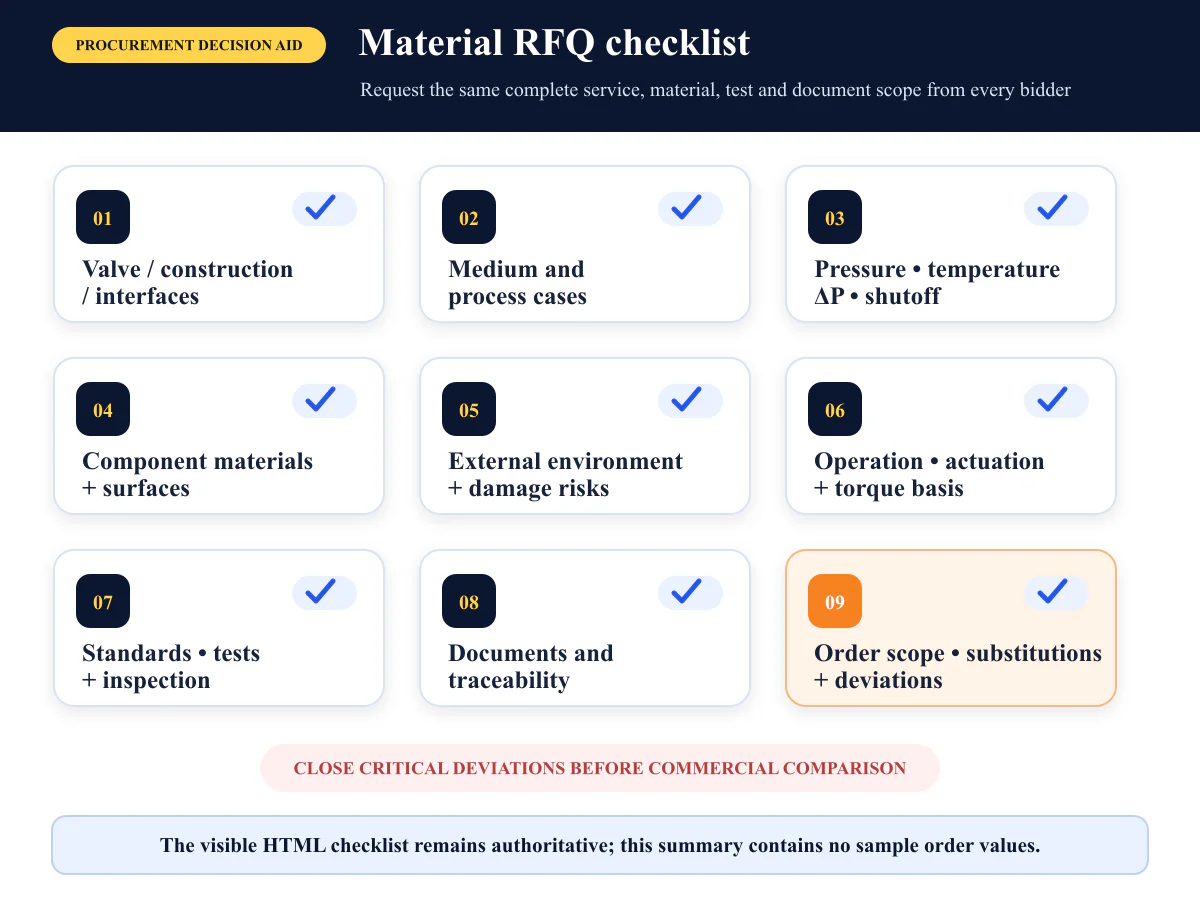
Include the following information in the RFQ or datasheet:
- valve function, type/construction, DN/NPS, Class/PN, bore and end connection;
- medium, full composition, phase, solids, contaminants and cleaning fluids;
- normal, maximum, design and upset pressure and temperature;
- maximum operating differential pressure and direction;
- shutoff/leakage requirement and operating frequency;
- body, end connector, ball, stem, seat, packing, gasket, O-ring, bolting, spring and retainer requirements where applicable;
- exact material specifications, grades, product forms and conditions already defined by the project;
- coating, plating, overlay or hardfacing requirements by component;
- external environment and credible damage mechanisms;
- operation/actuation and required torque-data basis;
- applicable standards and project-approved editions;
- pressure, seat, functional, fire, emission, NDE, PMI and other requirements stated as separate scopes;
- MTR/MTC, heat-treatment, coating, ITP/QCP, witness, drawing and document requirements;
- quantity, destination/project and delivery/document milestones; and
- allowed substitutions, technical deviations and approval owner.
Final selection depends on the complete datasheet and controlled offered-valve evidence, not only valve size, pressure class or product name.
Resumen de la Decisión
Start with the complete service environment and credible damage mechanisms. Specify the Ball Valve as a component material system. Cross-check metals, seats, seals, bolting and surface treatments against the exact construction, pressure-temperature cases, shutoff duty and cycling. Then require material identity, supplier limits, traceability and a visible deviation schedule.
Hold approval when compatibility, product limits, qualification scope, torque or documentation remains open. A higher-alloy body does not correct an unsuitable seat, packing, gasket, coating or stem. The technically defensible decision is the complete documented package, not the most impressive material name.
Engineering enquiry
Request a Ball Valve Material and Seat Review
Send the valve function and construction, medium and complete composition, operating/design pressure and temperature, maximum differential pressure, size and pressure class, end connection, shutoff duty, component material requirements, seat/seal details, actuation method, standards, tests, documents and supplier deviations.
To reduce clarification cycles, attach the latest valve datasheet or line-list entry, service-case table, component material schedule, seat/seal details, applicable project specification, required document index and the supplier's deviation list. Mark unknown fields as OPEN instead of replacing them with assumed values.
Submit the datasheet and supplier offer for a preliminary completeness and consistency review. Final material selection and project acceptance remain with the responsible project engineering and materials team and the approved order documents.
Preguntas frecuentes
What materials are used in an industrial ball valve?
Different materials may be used for the body, end connector, ball, stem, trunnion parts, seats, packing, seals, bolting, springs and coatings. The exact schedule depends on the design and service conditions.
Is the body grade enough to specify a ball valve?
No. It does not identify the ball, stem, seats, seals, bolting or surface treatments. Each critical component needs a controlled requirement or approval route.
What is the difference between cast and forged Ball Valve materials?
Cast and forged are different product forms and specification routes. Neither is universally better; the exact design, component, grade, manufacturing and project requirements control.
Is stainless steel always better than carbon steel?
No. Selection requires the exact environment, component, product form, mechanical requirements, corrosion risks, temperature, coating and lifecycle needs.
Is 316 stainless steel suitable for seawater or chloride service?
The designation alone cannot answer it. Review the exact grade/form, contaminants, temperature, flow, crevices, deposits, standby and cleaning exposure. A higher-alloy route may require review but is not approved by name alone.
What is the best seat material for a Ball Valve?
There is no universal best seat. The exact compound or metal-seat system must match the service cases, shutoff criterion, cycling, torque and offered-valve data.
Does a metal seat make a Ball Valve suitable for high temperature or abrasive media?
Not automatically. Confirm base materials, surface process, finish, leakage criterion, torque, solids, operating cases and exact design evidence.
What does NACE MR0175 / ISO 15156 mean for a Ball Valve material package?
Where applicable, it provides material/environment restrictions and a review route within its H2S-containing oil and gas production scope. It is not a general valve certificate.
Which material records should an RFQ require?
Project requirements may include MTR/MTC, traceability, PMI, NDE, heat-treatment, coating records and an ITP/QCP. State the components, acceptance, witness and document timing.
Can a replacement valve use the same body material as the old valve without another review?
Not from the body grade alone. Reconfirm the current service, failure evidence, trim/seals, pressure-temperature basis, dimensions, actuation, standards and documents.
