A high-temperature Ball Valve cannot be selected from one temperature value or a metal seated label. Define normal, design, upset and cleaning temperatures together with pressure, differential pressure, medium, deposits, cycling and shutoff duty. Then verify the complete assembly: body and closures, ball support, ball and seats, stem, packing, body seals, bolting, coatings and operator. Hold technical approval until the pressure-temperature basis, sealing limits, hot-condition torque, leakage criteria, tests and supplier documents all match the same offered valve configuration.
This approach matters because heat does not affect only the seat. Temperature can change material strength, clearances, seat loading, packing stress, body-joint sealing and operating torque. A valve may satisfy one component limit while another component remains outside its verified envelope.
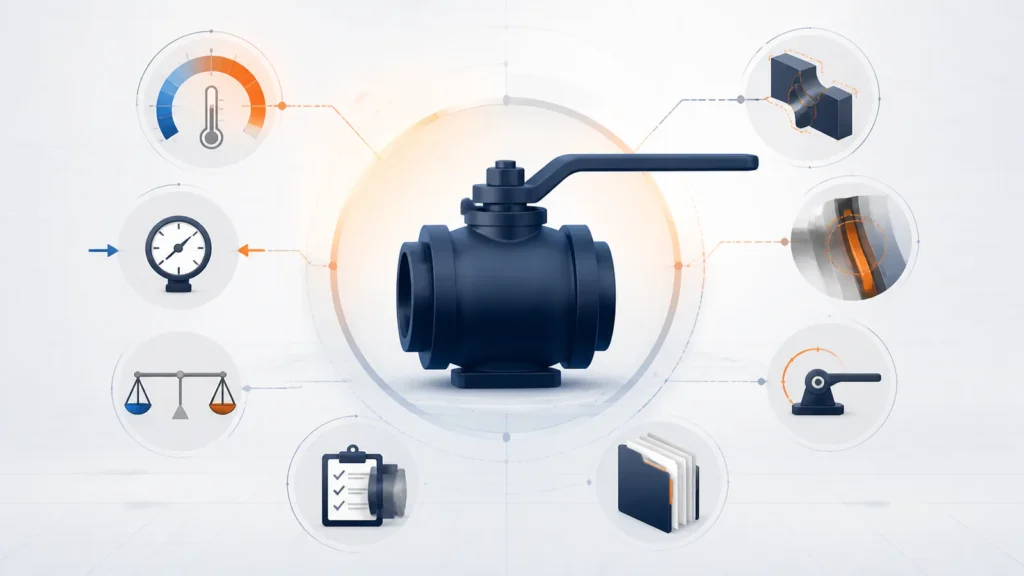
Featured illustration: Conceptual high-temperature Ball Valve engineering review. Selection still requires configuration-specific thermal cases, pressure, materials, sealing, torque, tests and documents. Not a product, test, certificate or order record.
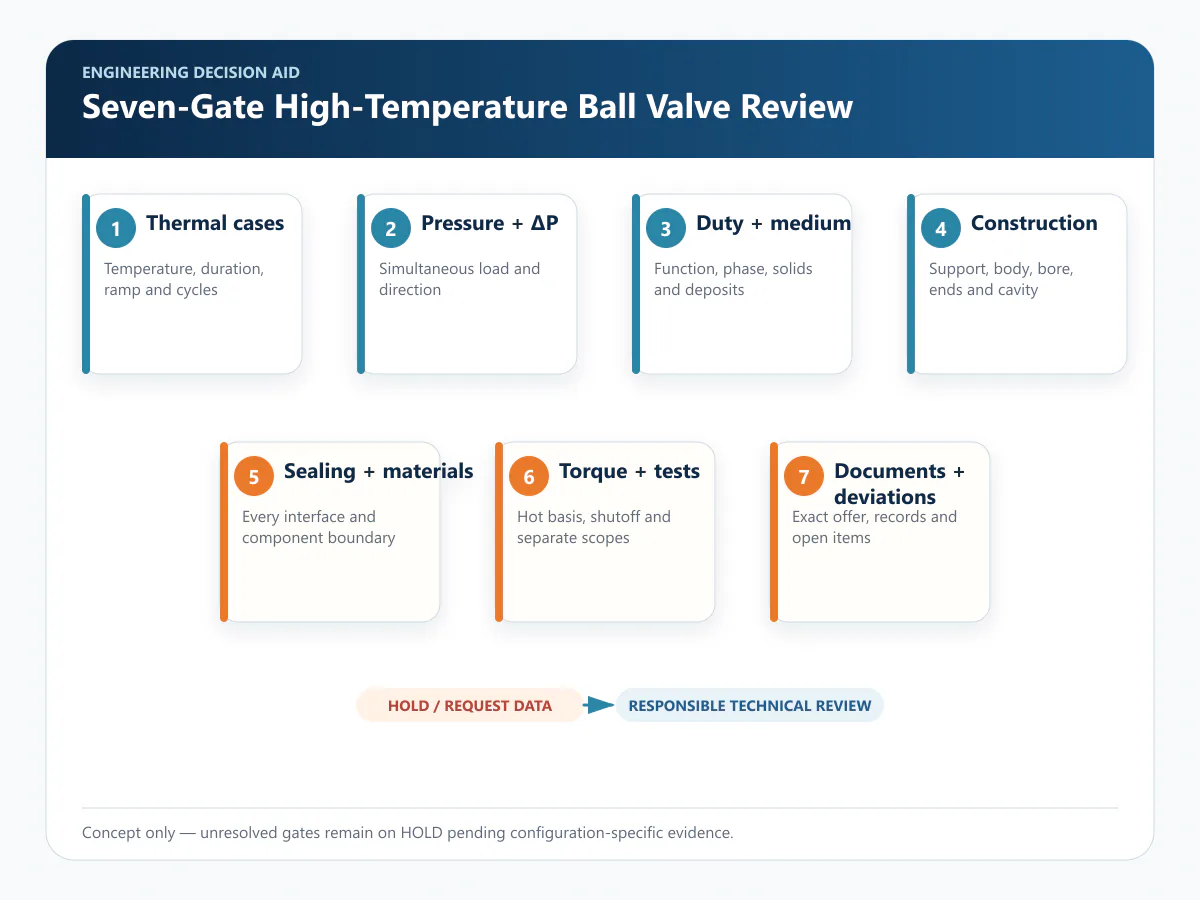
Use a Seven-Gate High-Temperature Ball Valve Review
Start with the service, not with a catalog construction. The following gates prevent a buyer from approving a valve on incomplete assumptions.
| Review gate | Minimum input | Evidence required before approval | Hold the decision when |
|---|---|---|---|
| Thermal cases | Normal, maximum operating, design, upset and cleaning temperatures; duration and cycles | Approved datasheet, line list and operating-case record | Only one maximum temperature is stated |
| Pressure and load | Operating/design pressure and maximum differential pressure at the relevant temperatures | Controlled pressure-temperature basis for the offered valve | Ambient Class or PN is used as hot-service approval |
| Duty and medium | Isolation/throttling duty, composition, phase, contaminants, solids and deposits | Process basis and application/material review | The medium is described only as steam, oil, gas or chemical |
| Construcción | Floating/trunnion, body construction, bore, ends, orientation and cavity requirements | Exact datasheet and drawing revision | A generic family image or catalog is the only evidence |
| Sealing and materials | Seats, ball, stem, packing, body seals, bolting, bearings and surface treatments | Complete component schedule and manufacturer limits | A material or metal seated label is used as the full specification |
| Torque and tests | Hot-condition torque basis, operator data, shutoff criteria and required tests | Controlled torque sheet, sizing record, ITP/procedure and reports | Torque or leakage acceptance is undefined |
| Documents and deviations | Exact offered configuration, records and substitutions | Order-linked document index and approved deviation schedule | Evidence is generic or not tied to the offer |
The result of this table is a review status, not an automatic valve selection. Use PROCEED TO SUPPLIER REVIEW only when the seven inputs and their evidence are complete. Otherwise record HOLD—DATA for missing duty inputs, HOLD—EVIDENCE for an unsupported supplier claim, or HOLD—DEVIATION when the offer differs from the approved requirement. Final acceptance still depends on the complete project datasheet and the responsible engineering parties.
Define "High Temperature" as Operating Cases
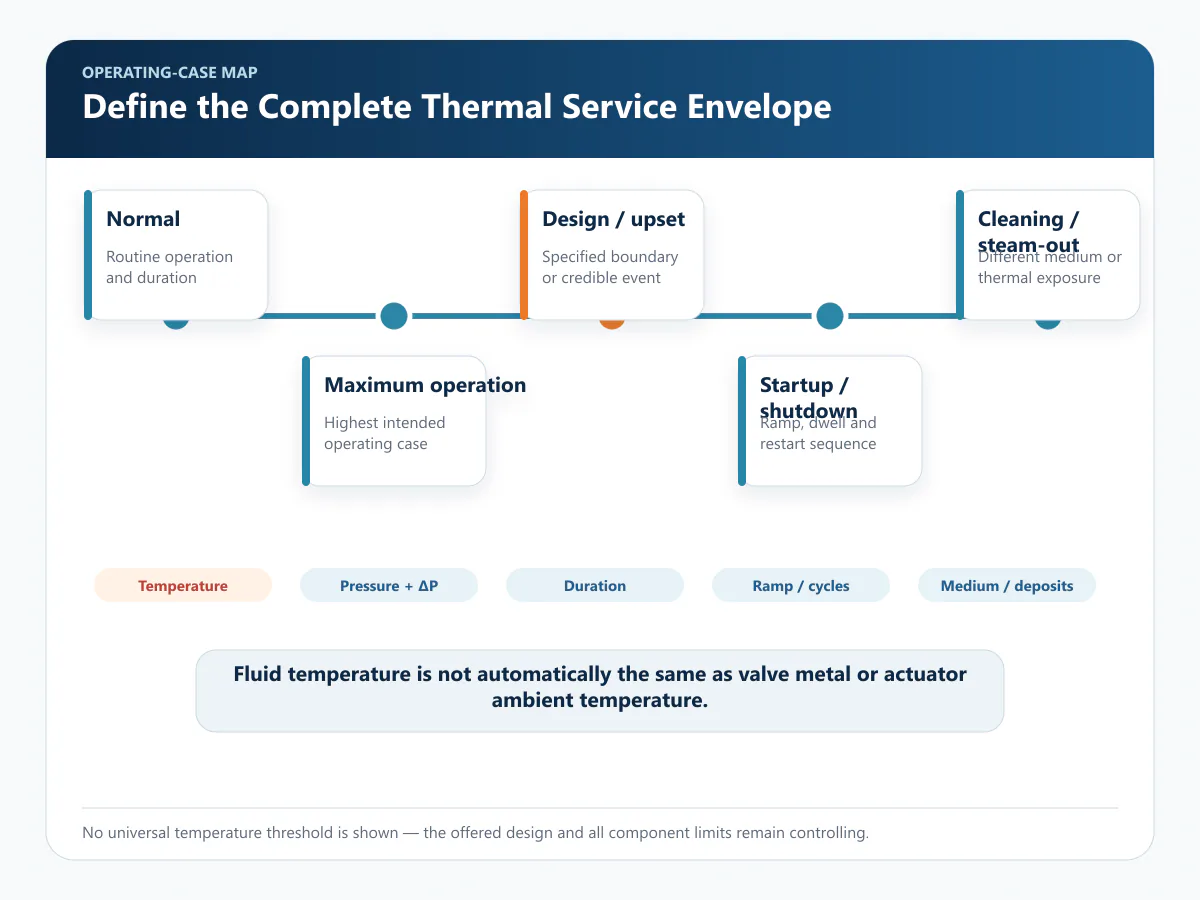
There is no single temperature that makes every Ball Valve a high-temperature valve. The meaningful boundary is the point at which the selected valve design or one of its components requires a different material, seal, clearance, test or operating basis.
Record each credible case separately:
| Case | Fluid and phase | Temperatura | Duration | Presión | Differential pressure and direction | Ramp or cycles | Solids or deposits |
|---|---|---|---|---|---|---|---|
| Normal operation | Entrada del proyecto | Entrada del proyecto | Continuous/intermittent | Entrada del proyecto | Entrada del proyecto | Entrada del proyecto | Entrada del proyecto |
| Maximum operation | Entrada del proyecto | Entrada del proyecto | Entrada del proyecto | Entrada del proyecto | Entrada del proyecto | Entrada del proyecto | Entrada del proyecto |
| Design/upset | Entrada del proyecto | Entrada del proyecto | Entrada del proyecto | Entrada del proyecto | Entrada del proyecto | Entrada del proyecto | Entrada del proyecto |
| Startup/shutdown | Entrada del proyecto | Entrada del proyecto | Entrada del proyecto | Entrada del proyecto | Entrada del proyecto | Heat-up/cool-down profile | Entrada del proyecto |
| Cleaning/steam-out | Cleaning medium | Entrada del proyecto | Entrada del proyecto | Entrada del proyecto | Entrada del proyecto | Frecuencia | Residue/reaction risk |
Fluid temperature, valve metal temperature and actuator ambient temperature may not be identical. Insulation, heat tracing, external heat, long hot dwell and rapid cooldown can also change which component controls the design. These conditions should be stated instead of being hidden inside a generic alta temperatura description.
Confirm That a Ball Valve Fits the Process Duty
Ball Valves are commonly considered for quarter-turn isolation, but the valve type must still fit the actual duty. Standard on-off construction should not be assumed to handle continuous throttling. Partial opening can change velocity, pressure drop, local erosion, noise and heat distribution across the ball and seats.
Before choosing the construction, confirm:
- isolation, emergency isolation, venting or another defined function;
- normal flow direction and required shutoff direction;
- maximum differential pressure during opening and closing;
- allowable seat leakage and the consequence of passing;
- liquid, gas, steam, two-phase or particle-containing flow;
- fouling, coking, crystallization or polymerization risk;
- required operating frequency and hot restart conditions.
If the duty requires control, flashing/cavitation review or an undefined partially open position, keep the Ball Valve decision open until the required process calculation and product-design review are complete. The broader high-temperature valve service review can help place the Ball Valve decision within the complete valve-family selection process.
Review Ball Support, Body Construction and Flow Path
Floating or trunnion-mounted construction
Floating and trunnion-mounted Ball Valves use different support and seat-loading arrangements. These differences can influence pressure load, sealing behavior and operating torque, but they do not create a universal temperature or size cutoff.
The supplier should identify the exact support arrangement and provide the offered valve's pressure-temperature and torque basis. Do not infer the construction from an external photograph or from another size in the same family.
Body construction and joints
One-piece, two-piece, three-piece, side-entry, top-entry and fully welded descriptions identify construction features, not complete suitability. Each body joint, end closure, gasket or seal, bolting set and weld must be included in the hot-service review.
A removable body joint can support certain maintenance strategies, while a welded pressure boundary changes fabrication and replacement planning. Neither route is inherently leak-free or maintenance-free.
Bore and flow path
Full-bore or reduced-bore geometry can affect velocity, pressure loss, cleaning, deposits and pigging requirements. An exact passage drawing is required before confirming piggability or internal clearances. Cv/Kv and pressure-drop conclusions require controlled product data or calculation; they cannot be inferred from the words paso completo alone.
For the wider selection sequence, use the Ball Valve selection guide and keep this article focused on the thermal-duty overlay.
Qualify Every Sealing Interface
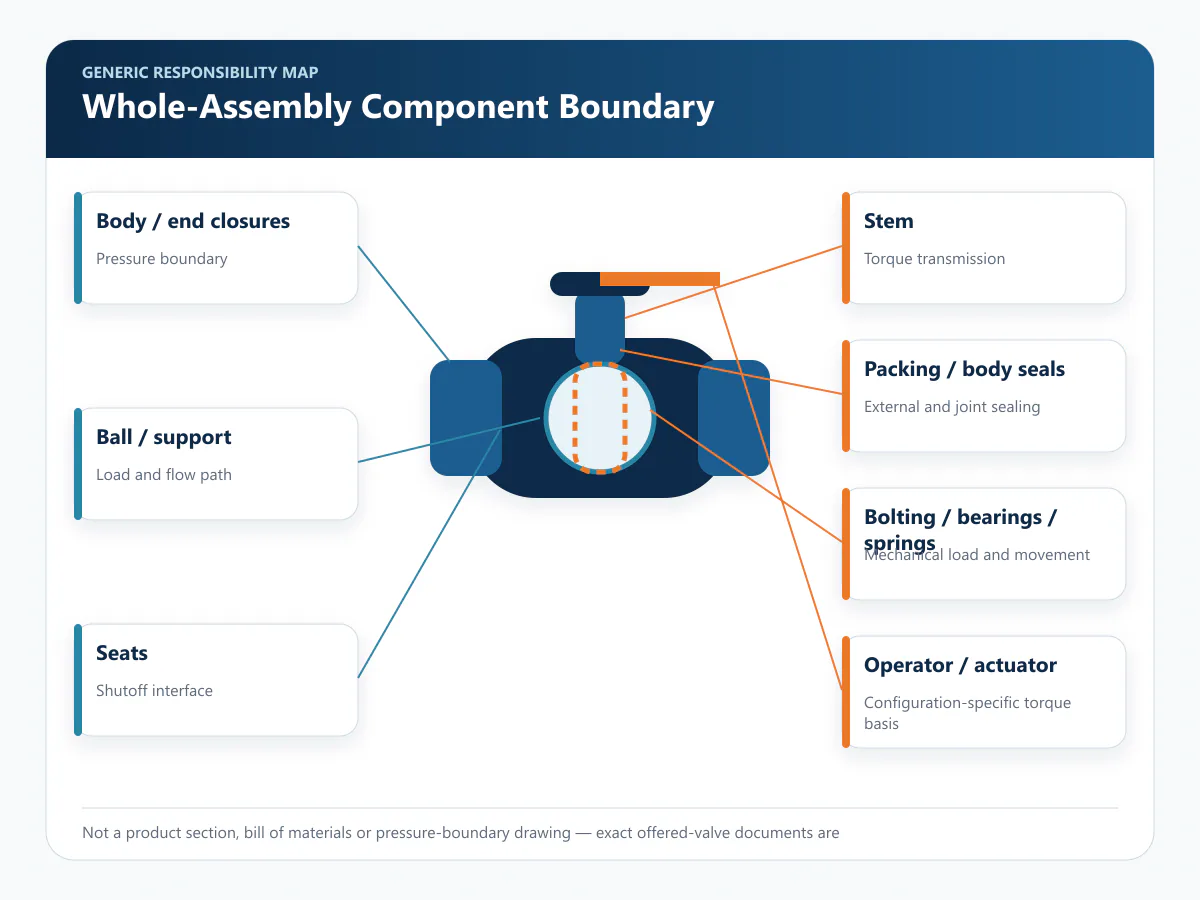
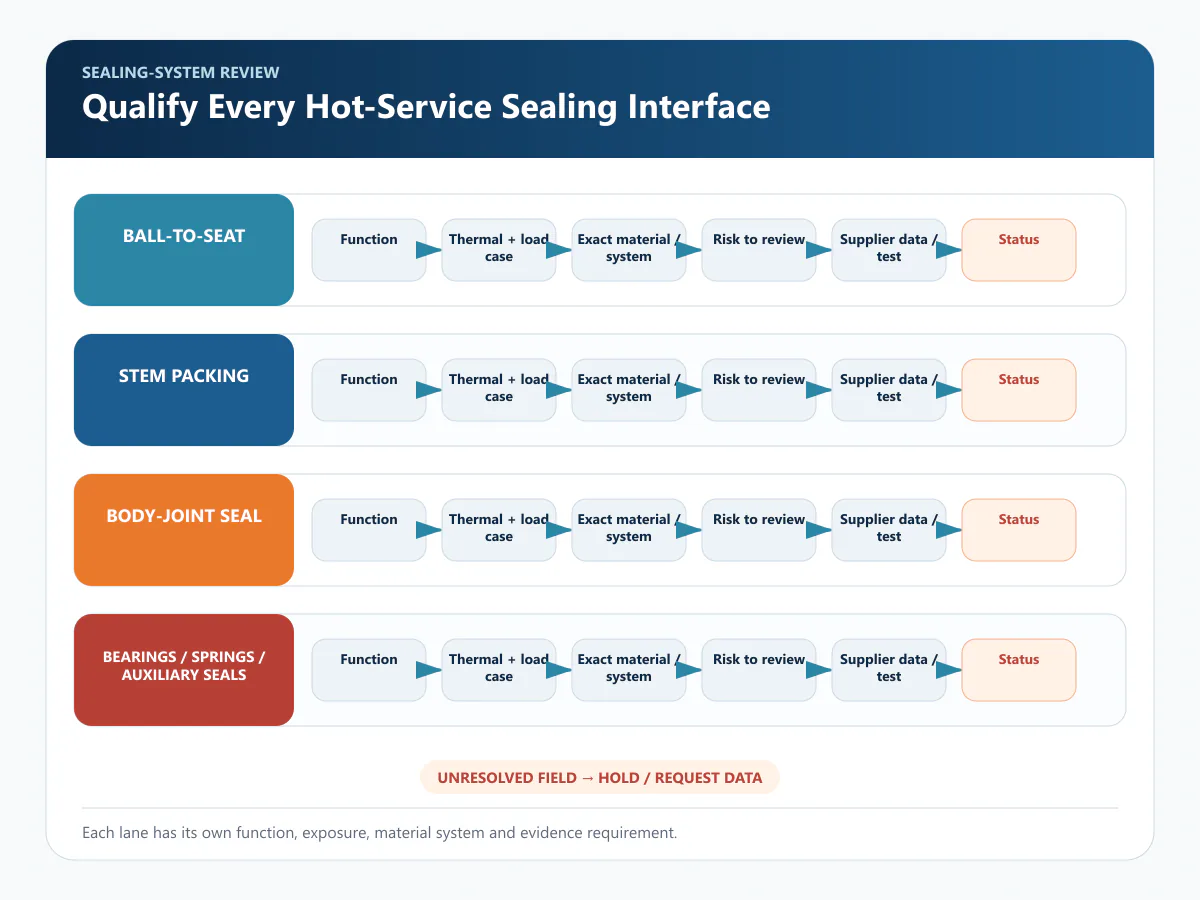
The valve seat is important, but it is not the only seal exposed to heat. The review must include the ball-seat interface, stem packing or seals, body-joint gaskets/seals, O-rings or secondary seals, and any bearing or spring element that influences movement or seat load.
Soft-seat and engineered-polymer candidates
PTFE, reinforced PTFE, PEEK and other engineered polymers may enter a selection review, but their names do not establish a universal temperature rating. The usable boundary depends on the exact compound or filler, seat geometry, valve size, pressure, differential pressure, medium, exposure time and cycling.
Ask for the manufacturer's pressure-temperature data for the exact seat system and offered valve. Review possible creep, relaxation, extrusion, thermal aging and chemical interaction against the actual service. A catalog maximum for a material family is not enough.
Metal-seat systems
A metal-seated construction may be considered when the service requires a sealing system beyond the verified envelope of the selected soft or engineered-polymer seat. However, metal seated does not define:
- ball and seat base materials;
- seat loading or spring arrangement;
- coating, overlay or hardfacing process;
- surface finish and lapping;
- shutoff direction or leakage acceptance;
- operating torque;
- fire or emission qualification.
The detailed seat decision belongs in the soft-seated versus metal-seated Ball Valve comparison. If a metal seat is shortlisted, the metal-seated Ball Valve selection guide provides the focused coating, wear, leakage and severe-service review.
Empaquetaduras y sellos del cuerpo
Stem packing and body-joint seals should be qualified separately from the seats. Heat cycling can change packing load, gasket compression and external-leakage behavior. A graphite material entry does not, by itself, prove a fire-tested or low-emission valve. Exact construction, material/grade, assembly basis and applicable test scope are required.
Use a sealing-system schedule rather than one generic seat material field:
| Interface or component | Exact material/system | Thermal and load case | Degradation risk to review | Required data/test | Estado |
|---|---|---|---|---|---|
| Ball-to-seat | OPEN | Project cases | Wear, galling, relaxation, deposits | Manufacturer limits and closure criterion | OPEN |
| Stem packing/seal | OPEN | Project cases | Relaxation, aging, external leakage | Packing-system data and qualification if required | OPEN |
| Body joint | OPEN | Project cases | Compression loss, differential movement | Drawing, gasket/seal limits and assembly data | OPEN |
| Bearings/springs/secondary seals | OPEN | Project cases | Friction, loss of load, degradation | Component schedule and design basis | OPEN |
Review Materials and Surface Engineering as an Assembly
High-temperature material selection is a component-by-component task. The body, end closures, ball, stem, trunnions or bearings, seats, packing, gaskets, bolting, springs and coatings can have different functions, exposures and evidence requirements.
Carbon steel, stainless steel, alloy steel and nickel-base alloy are screening families. Names such as WCB, CF8M, 316, duplex, Monel, Hastelloy or Inconel do not establish a complete service recommendation. The exact material specification, grade, product form, condition or heat treatment, component assignment and project environment must be defined.
The same rule applies to surface engineering. Tungsten carbide, chromium carbide, Stellite or a hardness value alone does not prove hot-service life, corrosion resistance or leakage performance. For a coating or hardfacing system, specify:
- the exact component and base material;
- the process and material designation;
- thickness and finish where controlled;
- temperature, corrosion, erosion and cycling exposure;
- inspection and repair acceptance;
- product or order validation evidence.
Use the Ball Valve materials guide for the full component-material package. This article adds the required thermal cases and hot-service evidence boundary.
Cross-Check Pressure-Temperature Rating and Thermal Movement
Nominal Class or PN does not provide the complete allowable pressure at elevated temperature. The review must reconcile the applicable valve design/rating basis, exact pressure-boundary material group, end connection, bolting and every seat/seal/component limit.
ASME B16.34 is one possible project reference for covered valve pressure-temperature ratings, materials, examination, testing and marking. Its general scope does not prove that a particular Raymon Valve product has been designed, rated or qualified to it. The project-approved edition and product applicability must be verified.
Temperature can also change the relative dimensions and loads of the body, ball, seats, stem and packing. Differential thermal movement may affect clearance, seat contact, stem alignment, packing compression and torque. The manufacturer should demonstrate how the offered design addresses the defined cases. A generic thermal-expansion formula or a competitor's construction does not validate the proposed valve.
Review hot operation, cooldown, restart and long dwell separately. Binding, leakage, packing relaxation or deposit-related resistance are possible mechanisms to investigate, not guaranteed outcomes.
Add System Integration and Thermal Transition Hold Points
The valve datasheet is not the only boundary. Piping layout, insulation, supports, operating transitions and acceptance measurements can change the conditions seen by the valve and operator. Close these interfaces before technical approval.
| Integration review | Why it can change the decision | Evidence or check to request | Hold-point owner |
|---|---|---|---|
| Insulation and heat tracing boundary | Local body, stem, packing or operator temperatures may differ from the stated fluid case | Insulation/heat-tracing layout, exposed-stem boundary and supplier temperature assumptions | Piping/process engineer with valve supplier |
| Pipe thermal expansion and external loads | Thermal movement or unsupported mass can transfer loads into the valve ends and body | Stress/support review, allowable interface loads and controlled GA/end details | Piping/mechanical engineer |
| Orientation and operator location | Mounting position and hot-zone exposure can affect access, heat transfer and actuator ambient conditions | Installed-orientation drawing, local ambient case, extension/mounting details and accessory limits | Project engineer with package supplier |
| Startup, shutdown and hot restart | Transient clearances, deposits and breakaway demand may differ from steady operation | Ramp, dwell, cycle and restart cases tied to the torque and operating review | Process/operations engineer |
| Cleaning or steam-out | A separate medium, temperature, pressure or residue reaction may control a component limit | Cleaning procedure, simultaneous cases and component/material review | Process/materials engineer |
| Isolation, cooldown and maintenance access | Safe inspection or removal may be impractical if the installed isolation and access route are undefined | Isolation boundary, cooldown criterion, access/removal envelope and maintenance plan | Plant owner/maintenance authority |
| Temperature measurement and acceptance | Fluid, valve metal and actuator ambient temperatures may not be represented by one measurement point | Measurement locations, instrument range, test sequence and acceptance record | Project QA/process owner |
These are coordination hold points, not a universal installation procedure. The responsible project parties must define the applicable checks, limits and acceptance criteria for the installed system.
Size the Operator from Hot-Condition Torque Data
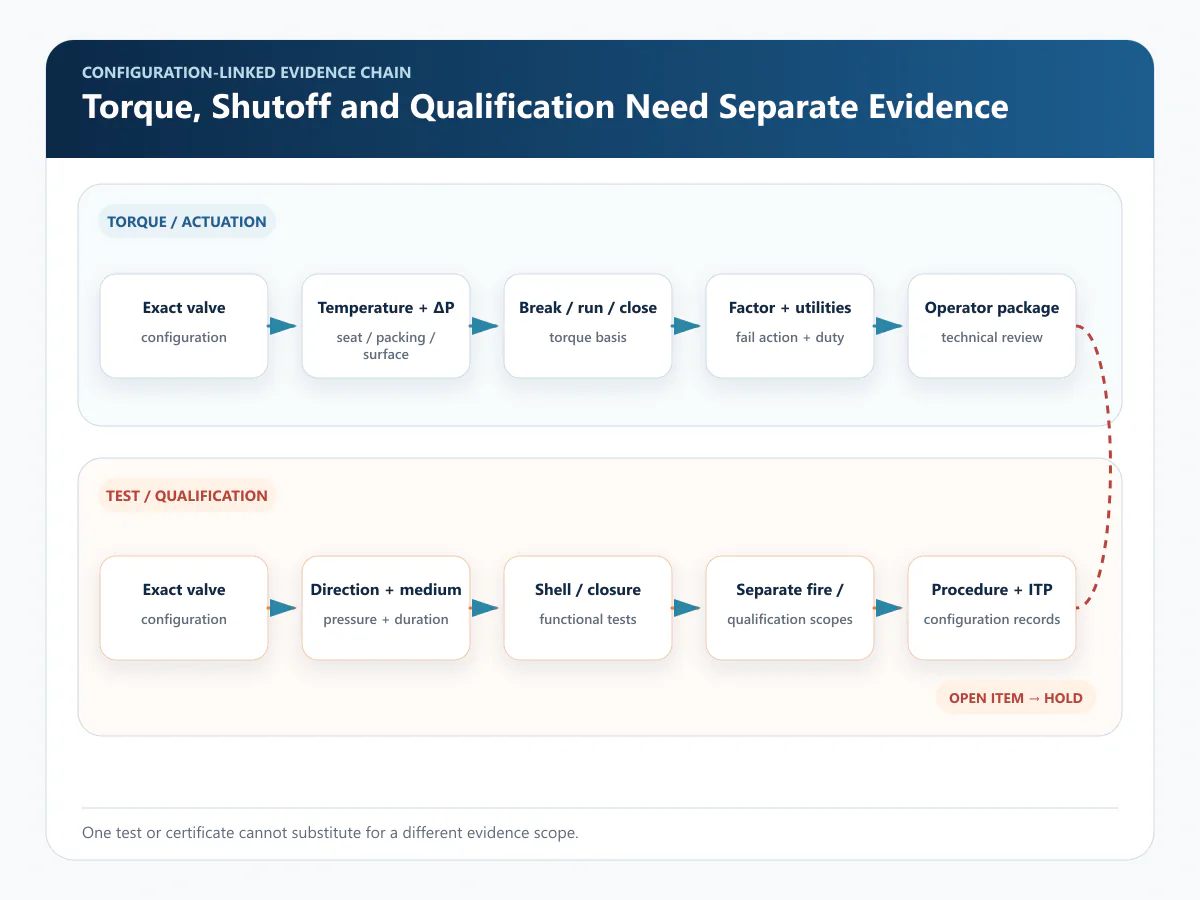
Do not select a lever, gearbox or actuator from nominal size and pressure class. Request torque data tied to the exact valve configuration and revision.
At minimum, record:
| Torque/actuation input | Required basis | Evidencia |
|---|---|---|
| Torque states | Break-to-open, running and closing/reseat states as defined by the manufacturer | Controlled valve torque sheet |
| Load case | Maximum differential pressure, direction and relevant temperature | Datasheet and calculation basis |
| Friction assumptions | Seat system, packing, bearings, surface condition and deposits | Manufacturer design assumptions |
| Sizing factor | Project/manufacturer-approved factor | Package sizing record |
| Utilities | Supply pressure or electrical supply | Site data and actuator data |
| Función | On-off/modulating, fail action and travel time | Control narrative/project requirement |
| Interface/accessories | Mounting, coupling, enclosure/protection, positioner, solenoid and switches | Package drawing and bill of scope |
The process temperature and actuator ambient temperature may differ. Insulation, stem extension, mounting orientation and local heat exposure require manufacturer and project review. No final actuator size can be stated until the torque basis, supply, fail action, duty and accessories are confirmed.
Define Leakage and Testing as Separate Requirements
Cierre hermético is incomplete procurement language. State the direction, test medium, pressure, duration, temperature condition and acceptance criterion.
ISO 5208 provides a pressure-testing framework for metallic industrial valves within its scope. It addresses pressure-boundary integrity and closure tightness when applied with relevant product-standard requirements. It does not prove high-temperature suitability, fire qualification, fugitive-emission performance or service life.
Keep these evidence scopes separate:
| Requirement | What it may establish | Qué no demuestra |
|---|---|---|
| Shell/pressure-boundary test | Integrity under the specified production test conditions | Hot-service suitability or closure tightness under every field case |
| Seat/closure test | Closure performance under the stated test conditions | Fire qualification or long-term thermal-cycling performance |
| Prueba funcional | Operation under the defined test setup | Worst-case field torque unless the required service basis is represented |
| Fire type-test | Performance of the tested design/configuration within the qualification scope | Every size, material, seat or operator variant is fire safe |
| Fugitive-emission test | External stem/body-joint leakage classification within the tested scope | Seat leakage or general corrosion resistance |
ISO 15848-1 concerns type-testing classification and qualification for external leakage at valve stem/shaft seals and body joints within its scope. A standard reference is not evidence that an offered valve configuration has that qualification.
If the project specifies API 598, API 607, API 6FA, API 6D, ISO 5208, ISO 15848-1 or another reference, confirm its exact role, edition, options, acceptance criteria and evidence. Pressure testing, fire testing and fugitive-emission testing are not interchangeable.
Treat Cavity and Special Features as Controlled Options
High temperature can make trapped-fluid behavior and cavity requirements important, but the correct response depends on the exact valve design and process. Where applicable, clarify:
- cavity pressure-relief requirement and direction;
- body cavity drain and vent;
- DBB or DIB definition and acceptance;
- emergency sealant injection;
- anti-static device;
- blow-out-resistant stem feature;
- fire-test and low-emission requirements.
These features cannot be inherited from the words Válvula de bola, trunnion, metal seated o alta temperatura. Request the exact drawing, functional definition, pressure/direction basis, test procedure and qualification scope for the offered valve.
Use Symptoms to Guide Verification, Not to Invent a Diagnosis
The following are engineering review scenarios, not Raymon customer cases.
| Observed symptom | Possible mechanisms to review | Evidence to collect | What remains unknown |
|---|---|---|---|
| Valve passes a shop test but leaks after thermal cycling | Seat/seal relaxation, differential movement, deposits or surface damage | Leakage location, temperature/pressure history, cycles, inspection and test records | Root cause until evidence is reviewed |
| Valve will not operate after hot shutdown | Hot breakaway torque, interference, deposits, packing/bearing friction or operator basis | Differential pressure, temperature, torque/actuator data, position feedback and safe inspection | Whether the valve or operator is controlling |
| Stem/body-joint leakage during heat-up | Packing/gasket load change, thermal gradient, assembly or material degradation | Exact leak location, thermal history and assembly/inspection records | Corrective action until safely assessed |
| Increased seat leakage in hot particle service | Trapped solids, erosion/scoring, coating damage or partial-open duty | Particle data, operating position, differential pressure and surface inspection | Suitability of a replacement design |
Do not adjust, retighten or dismantle a hot or pressurized valve based on a blog article. Follow the site's isolation, depressurization, temperature-control, permit and responsible-engineering procedures.
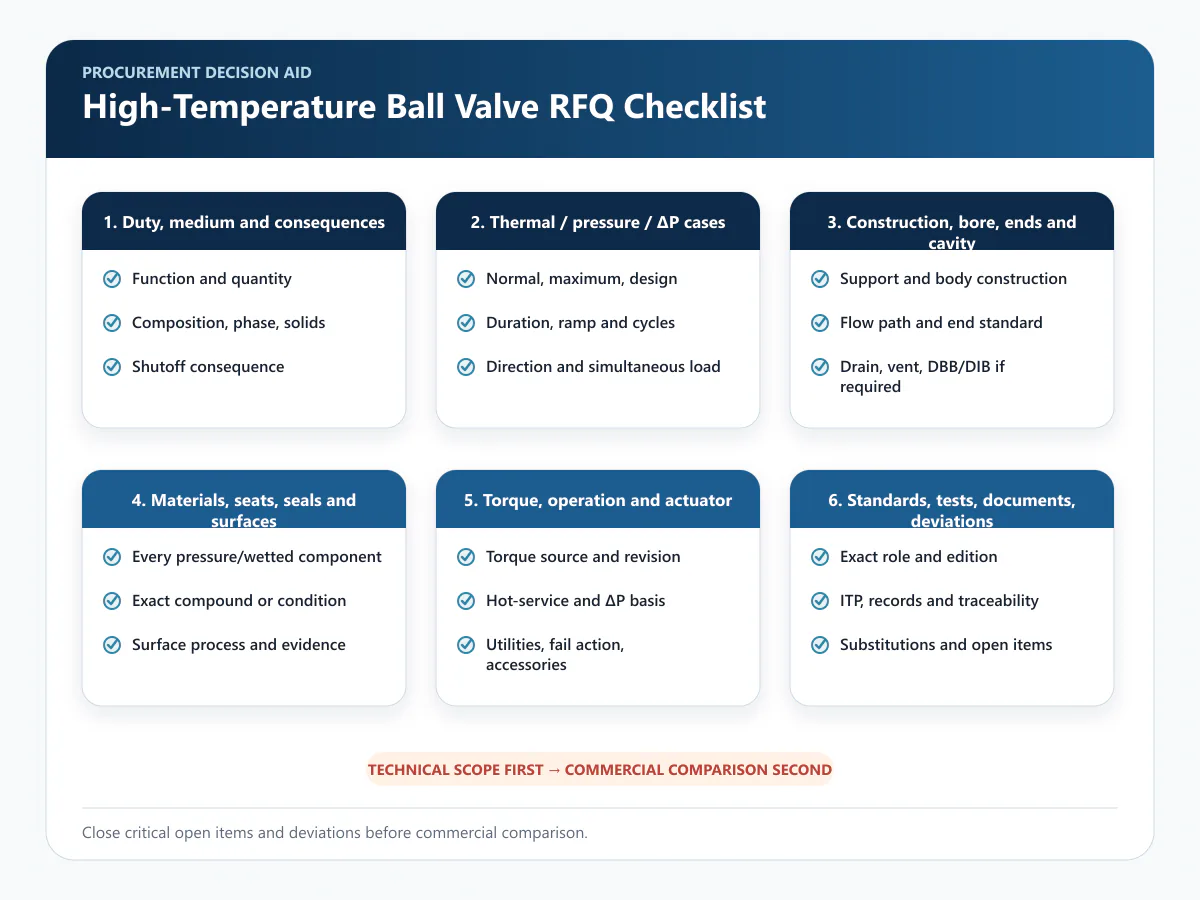
Normalize Supplier Evidence Before Comparing Price
Two quotations with the same size and Class may describe materially different valves. Normalize the technical scope first.
| Elemento de revisión | Buyer requirement | Evidencia del proveedor | Hold rule |
|---|---|---|---|
| Exact configuration | Support, body, bore, ends, size/Class and operator | Exact model and controlled drawing | Generic family offer held |
| Thermal cases | Complete cases, duration and cycles | Stated design basis and exclusions | One maximum temperature held |
| Component schedule | All pressure, wetted, sealing and joining components | Exact grades, compounds, conditions and coatings | Standard trim held |
| Rating and seals | Pressure-temperature and differential-pressure boundaries | Controlled selection/rating record | Ambient Class or material label held |
| Torque and operation | Worst-case torque and operator basis | Torque sheet and sizing record | Room-temperature-only basis held |
| Tests and qualifications | Exact standard, edition, acceptance and coverage | Procedure, ITP and configuration-linked records | Logo or unrelated certificate held |
| Trazabilidad | Material, heat/lot, coating, heat treatment and inspection | Order-linked document index | Capability statement held |
| Desviaciones | Approved substitutions and exclusions | Programa de desviaciones técnicas | Silent substitution held |
Commercial comparison should follow technical normalization, not precede it.
High-Temperature Ball Valve RFQ Checklist
Include the following information in the inquiry or datasheet.
Service conditions
- valve function and quantity;
- medium, composition, phase, contaminants, solids/deposits and cleaning media;
- normal, maximum operating, design, upset and cleaning temperatures;
- duration, heat-up/cool-down rate, thermal cycles and hot restart conditions;
- operating/design pressure and maximum differential pressure/direction;
- shutoff direction, allowable leakage and consequence of passing.
Configuración de la válvula
- DN/NPS and PN/Class;
- floating or trunnion preference if already defined;
- body construction and maintenance strategy;
- full/reduced bore and cleaning/pigging requirement;
- end connection and governing connection standard;
- orientation, drain/vent and DBB/DIB requirement where applicable;
- manual, gear, pneumatic, electric or hydraulic operation.
Materiales y sellado
- body/end closures, ball, stem, seats, packing, body seals/gaskets, bolting, bearings/springs and coatings;
- exact material specifications, grades, product forms, conditions or compounds;
- corrosion, oxidation, erosion, galling, coking/fouling and external-environment concerns;
- required pressure-temperature and component-limit data.
Actuation, tests and documentation
- valve torque source/revision and hot-service/differential-pressure basis;
- sizing factor, supply, fail action, duty, travel time, controls and accessories;
- applicable standards and project-approved editions;
- shell, closure, functional, elevated-temperature validation, fire or fugitive-emission requirements;
- ITP/QCP, drawings, MTR/MTC, PMI/NDE, heat-treatment/coating records and third-party witness;
- quantity, destination/project, delivery documents, substitutions and deviations.
Regla de selección final
A high-temperature Ball Valve is ready for technical approval only when all operating cases and all limiting components refer to the same offered configuration. Do not approve from temperature, Class, body material, seat type or certificate name alone.
Use the current industrial Ball Valve range as the commercial family route, then submit the project datasheet and supplier offer for configuration, evidence and deviation review.
Request High-Temperature Ball Valve Review
Send the valve function, medium and composition, every operating/design temperature and pressure case, maximum differential pressure, size/Class, construction, end connection, material and seat requirements, shutoff criterion, torque/actuation data, required tests, documents and supplier deviations.
Mark each submitted field as CONFIRMED, ASSUMED o OPEN. Attach the exact supplier offer, valve datasheet, controlled drawing revision and technical deviation schedule so unresolved items are visible before commercial comparison.
Submit the application details for review. Final process, material, piping, safety and project acceptance remain with the responsible project parties.
Preguntas frecuentes
What is a high-temperature Ball Valve?
It is a Ball Valve being evaluated for an elevated-temperature operating envelope that can affect pressure rating, materials, sealing, clearances, packing and torque. The term does not define one universal construction or temperature threshold.
Is there one temperature at which a Ball Valve becomes high temperature?
No universal number applies to every valve. The boundary depends on the exact design, pressure, differential pressure, medium, exposure duration, cycles and the limits of every component.
Does a high-temperature Ball Valve always require metal seats?
No. Seat selection requires the exact soft/polymer or metal-seat system, pressure-temperature data, medium, differential pressure, duration, cycles, shutoff criterion and supplier evidence. A metal seat may enter the review but is not automatic approval.
Can PTFE, reinforced PTFE or PEEK be used at high temperature?
Only after the exact compound/filler, seat geometry, valve configuration, pressure, differential pressure, medium, duration and manufacturer limits are verified. A generic material chart is not sufficient.
What changes when a Ball Valve experiences thermal cycling?
Repeated heating and cooling can affect component dimensions, seat loading, packing stress, deposits and operating torque. The actual effect must be evaluated for the offered construction and service history.
How should pressure rating be checked at elevated temperature?
Check the applicable valve design/rating basis, exact pressure-boundary material, end connection, bolting and all seat/seal/component limits at every relevant temperature-pressure case. Ambient Class or PN is not enough.
Why can operating torque change in hot service?
Temperature can affect clearances, seat load, packing, bearings, surface condition and deposits. Use controlled hot-condition torque data tied to maximum differential pressure and the exact valve configuration.
Are metal-seated Ball Valves automatically zero leakage?
No. Shutoff must be defined by direction, test medium, pressure, duration, temperature and acceptance criterion. Metal-seat construction alone does not establish zero leakage or a leakage class.
Does graphite packing make a Ball Valve fire safe or low emission?
No. Material selection, fire type-testing and fugitive-emission qualification are separate evidence scopes. The exact tested design and certificate/qualification coverage must be verified.
Which standards may be relevant?
The project may reference standards for valve design/rating, product scope, pressure testing, fire testing, emissions, materials or piping. Confirm the exact designation, edition, role and applicability. A standard mention does not prove that an offered product is compliant or certified.
Can a standard Ball Valve throttle hot fluid?
Do not assume so. Throttling can change velocity, pressure drop, erosion and thermal exposure. Confirm the process duty, calculation requirements and controlled valve design before using a Ball Valve for regulation.
What should a high-temperature Ball Valve RFQ include?
Include all temperature/pressure cases, medium and contaminants, differential pressure, size/Class, construction, bore, ends, materials, every sealing component, shutoff acceptance, hot-condition torque, actuation, tests, documents and deviations.
