
Types of Check Valves: Construction and Naming Differences
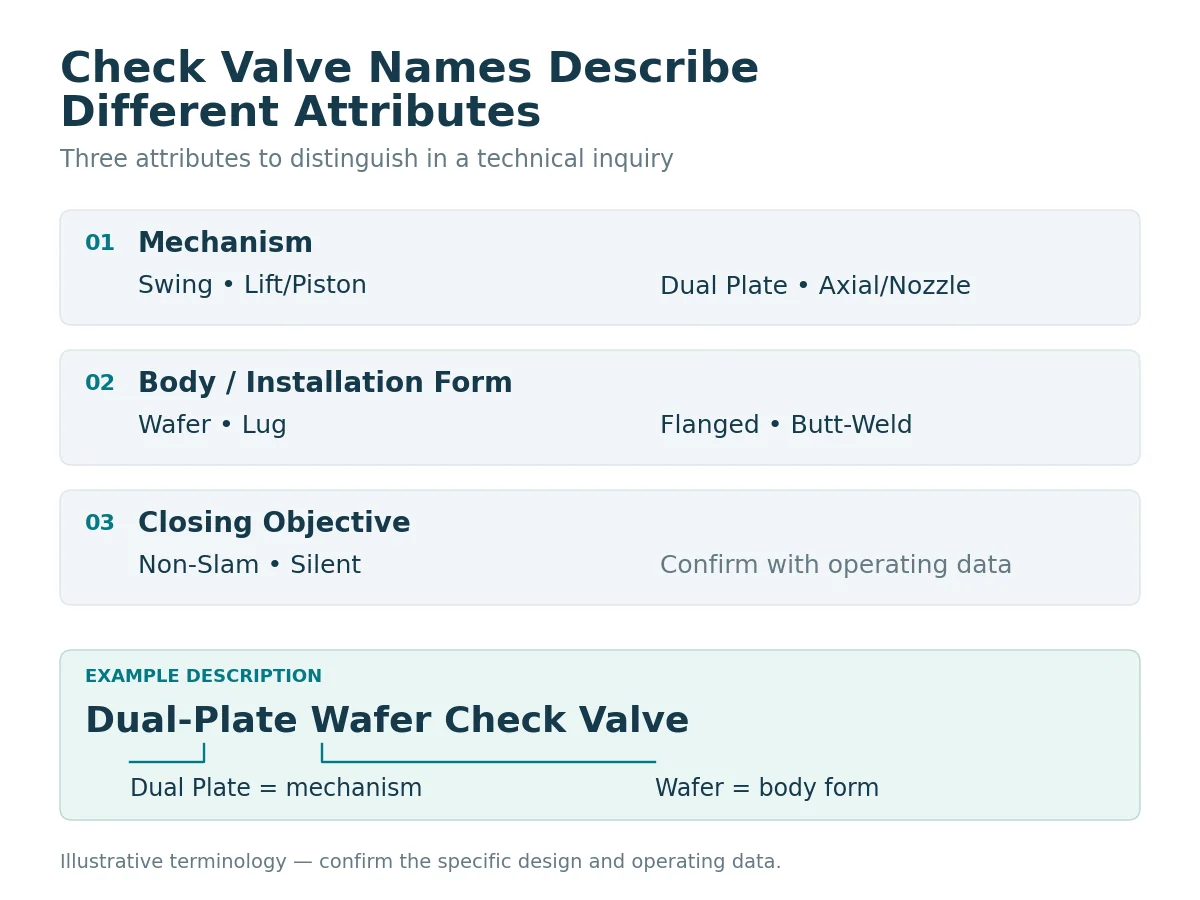
Common types of check valves include swing, lift or piston, dual-plate, axial-flow or nozzle, ball and tilting-disc designs. The mechanism affects closure movement, installation constraints and the operating data needed for selection. Wafer describes a body form, while non-slam describes a closing objective; these terms are not interchangeable type names. Use the comparisons below to identify a construction shortlist, separate naming from performance claims and prepare an industrial RFQ that suppliers can answer against the same service conditions.
| Classification | What it identifies | Examples | What to request |
|---|---|---|---|
| Mechanism | How the closure member moves | Swing, lift/piston, dual plate, axial/nozzle | Sectional drawing and description of operation |
| Body and installation form | How the valve connects to the piping | Wafer, lug, flanged or butt-weld ends | Dimensions, connection details and installation requirements |
| Closing behavior | A design objective requiring verification | Non-slam or silent | Relevant valve dynamic data and stated application limits |
Before shortlisting: identify the mechanism and body form, then check the medium, flow range, installation direction and shutdown duty. Keep suitability open until the proposed configuration is supported by its own data. A matching line size or a “non-slam” label does not close these questions.
Isolation boundary: an ordinary check valve is not a substitute for the approved isolation arrangement needed for maintenance. Spirax Sarco’s check-valve guidance specifically distinguishes reverse-flow prevention from isolating live steam.
When comparing types of check valves, specify the mechanism and body form separately, then state the required flow range, installation direction and closing-response review. A product name identifies a route to investigate; the supporting drawing and operating data determine whether that route remains on the shortlist.
Types of Check Valves by Closure Mechanism
Clapets anti-retour à battant
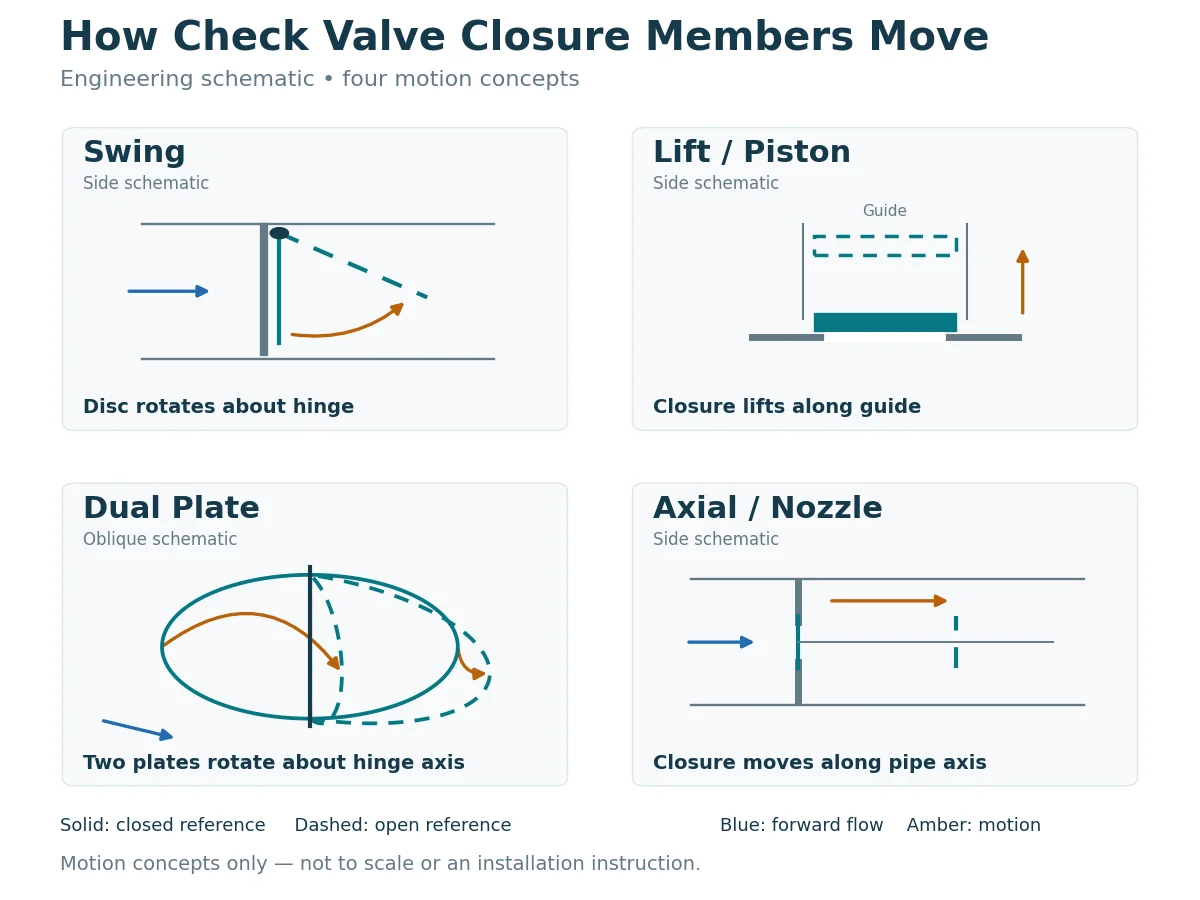
A swing check uses a hinged disc that rotates away from the seat under forward flow. When assessing this arrangement, request the permitted installation orientation, disc travel and maintenance clearance. Low-flow operation and shutdown conditions should be included in the review.
For procurement, ask the supplier to identify the actual hinge and disc configuration. The word “swing” does not establish stable operation, allowable leakage or closing performance for the proposed duty.
Illustrative low-flow review: a swing check is reported to tap during reduced-demand operation. One possible explanation is an unstable partly open disc, although pulsation or disturbed inlet flow may also contribute. Compare measured minimum flow and the piping arrangement with the proposed model’s stable-operation guidance before recommending a different size or construction.
Review Swing Check Valve specifications →
Lift and Piston Check Valves
A lift or piston check uses a guided closure member that moves away from its seat. Body layout, guide arrangement and any closing spring influence how the particular design operates. Cracking pressure identifies the differential at which opening begins under stated conditions; it does not establish stable or fully open operation at the required flow.
Request the section drawing and installation instructions rather than assuming that every lift check has the same orientation limit. Include deposits, suspended particles and fluid properties in the inquiry so the supplier can assess guide clearance and internal passage suitability. Confirm pressure loss from data for the proposed configuration.
Review Lift Check Valve specifications
Clapets anti-retour à double disque
A dual-plate check has two plates that pivot open; spring assistance is common. Compact body arrangements can make these designs candidates where installation length and weight matter.
The RFQ should request plate clearance, flange compatibility, spring details and any restrictions on orientation. Compare the dimensions against the actual mating pipework, including nearby reducers and other internal obstructions. A compact body alone does not establish acceptable pressure loss or closing response.
Illustrative installation review: a dual-plate wafer valve matches the nominal flange size but its opening plates conflict with a nearby reducer or restricted mating bore. Matching bolt holes does not establish internal clearance. Compare the full plate-travel envelope, pipe bore, gasket arrangement and adjoining equipment against the installation drawing before accepting the interface.
Review Dual Plate Check Valve specifications
Axial-Flow and Nozzle Check Valves
Axial-flow checks use closure movement generally along the pipe axis. Nozzle check valves commonly use an axially guided closure within a shaped flow passage. The names overlap in industry usage, so compare drawings and operating data before treating two quoted designs as equivalent.
Where the proposed model uses spring-assisted closure, request its opening requirements and relevant dynamic characteristics. For a critical pump duty, ask the supplier to state the system information needed to assess its recommendation. Avoid approving the construction solely because the quotation calls it a nozzle, axial or non-slam valve.
Illustrative pump-trip review: an axial/nozzle proposal meets normal-flow pressure-drop requirements, but a parallel-pump shutdown raises a closing-response concern. A steady operating point does not represent the changing header conditions during the trip. Obtain the pump sequence and available pressure/flow histories, then review model-specific dynamic data and the need for a system transient assessment.
Review Axial Flow Check Valve specifications · Review Nozzle Check Valve specifications
Ball Check Valves
A ball check uses a moving ball to open or close the flow passage. For a proposed configuration, ask the supplier to identify the ball material or coating, seat arrangement, flow path and permitted orientation. If solids or viscous fluid are present, request confirmation against the actual fluid data rather than assuming that every ball check can pass the same contaminants.
Tilting-Disc Check Valves
A tilting-disc check uses a disc pivoted about a shaft. Ask for a section drawing showing the pivot and disc movement, together with any counterweight, spring or damping arrangement actually included in the offer. Confirm the operating and closing behavior for that configuration; the name alone does not establish a response advantage.
These additional mechanisms are included for terminology coverage, not as a statement of Raymon supply scope. Confirm availability for the required size, materials and duty separately. AVK’s technical introduction to non-return valves discusses several variants in water and wastewater service.
How Wafer and Non-Slam Fit the Classification
Wafer Describes the Installation Form
A wafer check valve fits between compatible pipe flanges. Wafer describes the body arrangement, while dual plate describes the moving closure. Other internal mechanisms can also use wafer bodies. Confirm the actual section drawing, flange interface and disc-clearance envelope instead of treating the two names as synonyms.
An illustrative description such as “dual-plate wafer check valve” identifies both the mechanism and the body form. It still needs a size, rating, end-interface definition, materials and operating requirements before it becomes a usable procurement description.
Review Wafer Check Valve specifications
Non-Slam Describes a Closing Objective
Treat “non-slam” as a prompt to request evidence about closing behavior. Ask which model and configuration were assessed, what operating conditions apply, and how the proposed valve relates to the system’s shutdown conditions. Published manufacturer data must be used within its stated scope.
For the closing-response review, identify the medium and phase, shutdown sequence and available flow-deceleration or transient-study data. Ask the supplier to state which actual cases its model-specific dynamic information addresses and which remain unresolved. Select an analysis basis appropriate to the fluid and system rather than using one closing-time target for every duty.
Do not assume that selecting a check valve eliminates every source of water hammer. In steam and condensate systems, TLV’s installation guidance distinguishes backflow-related events from condensation-induced water hammer, for which a check valve is generally not an effective remedy.
Review Non Slam Check Valve specifications
Compare Types of Check Valves Before Shortlisting
Use this table to decide what to investigate and when to keep a selection open. A reason to evaluate a construction is not an approval or a universal ranking.
| Construction | Reason to evaluate | Hold the decision when | Preuves nécessaires |
|---|---|---|---|
| Battant | Evaluate a hinged-disc arrangement where its flow path and maintenance envelope fit the duty. | Minimum-flow behavior, orientation or pump-trip response is unresolved. | Permitted orientation, stable-operation basis and closing-response review for the proposed model. |
| Lift/piston | Evaluate a guided closure where the passage and layout meet the process requirements. | Guide fouling, available opening differential or installation position has not been reviewed. | Section drawing, contamination assessment, opening requirements and pressure-loss data. |
| Dual plate | Evaluate a compact two-plate arrangement where face-to-face length and weight affect the shortlist. | Plate clearance, mating bore, spring configuration or solids exposure is unspecified. | Dimensioned interface drawing, installation restrictions and model-specific operating data. |
| Axial/nozzle | Evaluate an axially guided arrangement where closing response is a stated project concern. | The recommendation relies on the name alone, without actual flow and shutdown cases. | Configuration drawing, stable-flow basis, pressure-loss data and relevant closing characteristics. |
For quotation comparisons across different types of check valves, require each supplier to identify the proposed mechanism and body form separately. Ask them to list assumptions and deviations against the same datasheet. An unspecified “equivalent check valve” can conceal differences in dimensions, materials, leakage acceptance or operating requirements.
Once a construction shortlist is established, continue to the check valve sizing and operating review for the detailed flow, pressure-drop and closing-dynamics questions.
What Makes Two Proposals Comparable?
Ask suppliers to return the following items against the same operating cases. Record missing evidence as an open point rather than assuming that an omitted requirement is included in the price.
| Comparison item | Réponse requise du fournisseur | Vérification de l'acheteur |
|---|---|---|
| Construction and fit | Identify the mechanism, body form, model, size, rating, end standard and drawing revision. | Confirm face-to-face length, mating interfaces, orientation and removal access against the piping. |
| Operating basis | State minimum, normal and maximum flow, fluid-property assumptions and the pressure-loss basis. If Cv or Kv is quoted, identify its test or calculation conditions and the closure position represented. | Check that the data apply to the quoted size and internals at the actual operating point. A published fully open flow coefficient does not prove stable opening at minimum flow or acceptable response during shutdown. |
| Closing-response scope | Identify the shutdown cases reviewed, supporting data and any further system analysis required. | Keep transient acceptance open if the evidence does not address the actual system and consequence. |
| Materials, tests and documents | List body, closure, seat and spring materials where applicable; identify tests, acceptance criteria, records and deviations. | Compare the same scope. A generic certificate or a shell test does not establish dynamic suitability. |
For shell and seat test requirements, review the valve pressure-testing scope and acceptance separately from the closing-dynamics assessment.
Example screening decision: if one proposal states “dual-plate wafer” and another states only “non-slam,” first request the second proposal’s mechanism and body form. Then compare drawings and operating evidence. The descriptions alone do not show whether the offers are technically interchangeable.
RFQ Data for Different Types of Check Valves
To compare types of check valves against the same requirements, send the available service data and identify open points. An inquiry can begin with incomplete information if the supplier states what is still needed:
- Medium, phase, composition and relevant contaminants, solids or viscosity information;
- Minimum, normal and maximum flow, with units and the operating cases they represent;
- Pression et température de fonctionnement et de conception ;
- Allowable pressure drop and any opening-pressure constraint;
- Line size, pressure class or PN, end connections and available installation length;
- Horizontal or vertical installation, intended flow direction and nearby fittings;
- Pump or compressor startup, shutdown, parallel-operation and trip scenarios where relevant;
- Body, trim and seat requirements, allowable leakage, tests and documentation scope.
For a replacement, include the existing valve identification, drawings if available, and a description of the observed problem. Separate known measurements from suspected causes. This gives the reviewer a clearer basis than a request to replace a valve with the same nominal size.
Material and seat selection must address fluid composition, concentration, temperature, solids and relevant cleaning or shutdown conditions. Review the closure, seat, spring where fitted and pressure-boundary seals as well as the body; an acceptable body material does not establish compatibility of every component. Define allowable leakage and its test conditions instead of assuming that a soft or metal seat alone determines acceptance.
Pressure class or PN is not a fixed pressure allowance at every temperature. Confirm the applicable material and pressure-temperature rating, design pressure and temperature, and any lower limits imposed by seats, gaskets or other components. Where ASME B16.34 governs the construction, its official scope includes ratings and other construction requirements. Use the project-specified edition and exact product data; the standard’s scope is not evidence that a particular valve is certified or suitable.
Request Check Valve Selection Review
For a review of different types of check valves, send the medium, minimum/normal/maximum flow, pressure, temperature, installation orientation and any pump-trip or surge concern. Identify any available datasheet or existing valve drawing and mark unknown values as open. Coordinate document transfer with the contact team.
Ask the proposal to identify the construction and model, supporting operating data, remaining information needs and technical deviations.
For company information supporting supplier evaluation, visit À propos de Raymon Valve.
Types of Check Valves FAQ
What are the main types of check valves?
Common industrial mechanisms include swing, lift/piston, dual plate, axial/nozzle, ball and tilting disc. The list is not exhaustive. Separate the mechanism from wafer body form or a non-slam closing objective, then confirm suitability against the service data.
Is a wafer check valve always a dual-plate design?
No. Wafer describes a body installed between compatible flanges; dual plate describes the closure mechanism. Specify both when both are required and verify the section drawing, mating bore and plate clearance.
Are axial-flow and nozzle check valves the same?
The names often overlap. Axial flow describes the general direction of closure movement, while nozzle commonly identifies an axially guided arrangement within a shaped passage. Compare actual geometry and model-specific data before treating two offers as equivalent.
Does a non-slam check valve eliminate water hammer?
The label alone does not establish that result. Match the proposed model’s closing characteristics to the actual shutdown conditions and surge mechanism. Condensation-induced water hammer, for example, cannot generally be resolved by adding a check valve.
Note technique
This overview of types of check valves supports construction screening and RFQ preparation. The diagrams illustrate motion concepts and do not establish the geometry, permitted orientation or performance of a Raymon product. Confirm the selected model against the complete datasheet, materials, pressure-temperature rating, test requirements and project specification. Detailed sizing and closing-dynamics approval require valve-specific data and the appropriate system review.
 French
 English
 German
 Arabic
 Spanish
 Italian
 Portuguese
 Russian