
NACE MR0175 vs MR0103 is a service-scope decision before it is a hardness check. For sour-service valve specification, MR0175/ISO 15156 addresses oil and gas production and natural gas treatment within its scope; MR0103/ISO 17945 addresses sulfide stress cracking in petroleum refining and related processing. Choose the governing requirement from the actual duty, then assess each applicable component’s material condition, environment and fabrication evidence. This comparison helps buyers prepare an RFQ and identify gaps before accepting a supplier’s compliance statement. 1, 4

In this guide
- MR0175 vs MR0103: The Difference at a Glance
- Which Standard Applies to Your Valve Service?
- What H₂S Environment Data Must the Purchaser Define?
- How Material Selection Works at Component Level
- Hardness Requirements: Why One Number Is Not Enough
- What These Standards Do—and Do Not—Prove
- How to Specify Sour-Service Valves in an RFQ
- What Evidence Should the Valve Supplier Submit?
- Perguntas Frequentes
- Ask for Material and Sour-Service Specification Review
- Official References and Edition Note
MR0175 vs MR0103: The Difference at a Glance
The useful comparison is which requirements govern the valve tag. There is no reliable universal ranking that makes one standard a substitute for the other.
On smaller screens, scroll this table sideways to read all columns.
| Ponto de comparação | NACE MR0175 / ISO 15156 | NACE MR0103 / ISO 17945 | Purchaser action |
|---|---|---|---|
| Service focus | Oil and gas production and natural gas treatment within the defined scope | Sour petroleum refining and related processing within the defined scope | Identify the actual process duty and governing project specification |
| Cracking coverage | Multiple H₂S-related cracking mechanisms, addressed through the applicable parts | Sulfide stress cracking, or SSC | Review other credible damage mechanisms separately |
| Material assessment | Use the applicable material route and environmental limits | Use the applicable refinery-service material and fabrication requirements | Require a component-level compliance schedule |
| Hardness | Limits and verification depend on the applicable material route | Limits and verification depend on the applicable material route | State the method, location, acceptance basis and records |
| Valve design and performance | Does not replace the governing design requirements | Does not provide a complete valve design specification | Specify rating, design, sealing and testing separately |
The scope comparison follows the official ISO descriptions. The purchaser actions are recommended procurement controls, not a reproduction of mandatory clauses. 1, 2, 3, 4
Which Standard Applies to Your Valve Service?
Use the following screening path to assign the review. These are recommended purchaser actions; acceptance still depends on the applicable scope and adopted requirements.
On smaller screens, scroll this table sideways to read all columns.
| Service / specification status | Review route | Required closeout |
|---|---|---|
| Production or natural gas treatment duty appears within ISO 15156 scope | Assess the applicable MR0175/ISO 15156 parts | Record equipment applicability, exclusions and environmental basis |
| Refining or related processing duty appears within ISO 17945 scope | Assess MR0103/ISO 17945 | Define SSC requirements and review other damage mechanisms separately |
| The purchase documents explicitly require both | Assess each requirement independently | Obtain a component-level assessment and resolve differences |
| Duty, chemistry or governing documents are unresolved | Keep material acceptance open | Assign an owner to the missing data or standard-selection clarification |
Oil and Gas Production and Natural Gas Treatment
Start with MR0175/ISO 15156 when the valve serves an application within its oil and gas production or natural gas treatment scope. Review equipment applicability and exclusions before assigning the requirement. A valve’s location inside a gas facility alone does not establish its material route.
For the published 2020 series, Part 1 establishes general principles, Part 2 addresses carbon and low-alloy steels and cast irons, and Part 3 addresses corrosion-resistant alloys and other alloys. Identify the parts relevant to the actual bill of materials. 1, 2, 3
Petroleum Refining and Related Processing
For applicable sour refinery duties, review MR0103/ISO 17945. Its focus is SSC resistance. Other wet-H₂S cracking mechanisms and corrosion remain separate assessment tasks. Its scope includes components whose SSC failure could compromise containment, basic function or restoration to service while maintaining pressure. 4
The responsible materials engineer should therefore define the component boundary. A specification limited to the valve body may leave important functional components unresolved.
Mixed Duties and Conflicting Specifications
Illustrative RFQ problem: the line class cites MR0175 while a package specification cites MR0103. The conflict may reflect different service boundaries or a copied requirement. Before accepting a bid, record the affected tags, actual duty, adopted editions and component coverage in a technical clarification. Resolve the governing requirement through the project’s document hierarchy and responsible reviewer; the supplier should identify any resulting material, fabrication or documentation deviation.
If both standards remain contractual requirements, retain separate assessments and record how differences are resolved. Neither declaration automatically substitutes for the other. The project specification can add restrictions or examinations; departures from governing requirements need the applicable approval rather than a blanket “dual compliant” statement.
For the broader material-review framework, see Válvulas NACE / Serviço Ácido.
What H₂S Environment Data Must the Purchaser Define?
A datasheet stating only “sour gas” leaves the supplier without a controlled environmental basis. Provide the relevant operating cases and identify whether values describe the gas phase, liquid phase or total stream.
Recommended inputs include:
- Normal, minimum and maximum operating pressure and temperature, alongside design conditions.
- H₂S composition, units, measurement basis and the process case to which it applies.
- Water presence, possible condensation and changes in phase during credible operating transitions.
- Aqueous chemistry, including pH and relevant contaminants where required by the material assessment.
- Startup, shutdown, cleaning, stagnant and upset exposures that can affect the material decision.
These inputs control different parts of the assessment: phase and water presence define the exposure to review; H₂S composition and absolute pressure establish a gas-phase partial-pressure input; aqueous pH, chloride content, temperature and other relevant contaminants can affect the applicable material limits. Record a parameter only with its units and service case. The selected standard and material route determine which limits apply; a missing controlling input leaves that decision open.
Keep Process Cases and Data Gaps Visible
Record each credible exposure as a case with its associated pressure, temperature, phase and chemistry. Avoid inventing a combination of independent maxima that cannot coexist; equally, do not discard a credible wet or upset case because the normal stream is described as dry. The process owner should confirm the case set.
For each controlling input, retain its source, units, revision and responsible owner. If a required pH or H₂S basis is missing, identify which material decision remains open and when it must be resolved. A preliminary quotation should declare those assumptions.
Use the gas-phase absolute pressure and composition belonging to the same credible exposure case. The valve’s design pressure is a mechanical design input and is not automatically the pressure for every environmental assessment. Preserve the distinction between gauge and absolute values. Where an upset reaches a higher pressure, assess that case with its associated phase and chemistry.
H₂S Concentration and Partial Pressure
For a preliminary ideal-gas mixture calculation, H₂S partial pressure equals its gas-phase mole fraction multiplied by total absolute pressure:
p(H₂S) = y(H₂S) × P(absolute)
Illustrative assumption: a gas containing 1 mol% H₂S at 10 bar absolute has a calculated H₂S partial pressure of 0.10 bar. This example converts composition and pressure; it does not determine whether a valve material is acceptable.
Use consistent units and the confirmed gas-phase composition basis. A liquid concentration or an unspecified “ppm” value cannot be substituted for the gas-phase mole fraction. Where phase equilibrium or non-ideal behavior matters, obtain an appropriate process calculation.
Avoid a Single Universal H₂S Threshold
Do not use one concentration or partial-pressure value as the complete selection rule for both standards and every alloy. Establish the applicable assessment method first, then compare the confirmed environment with its requirements.

How Material Selection Works at Component Level
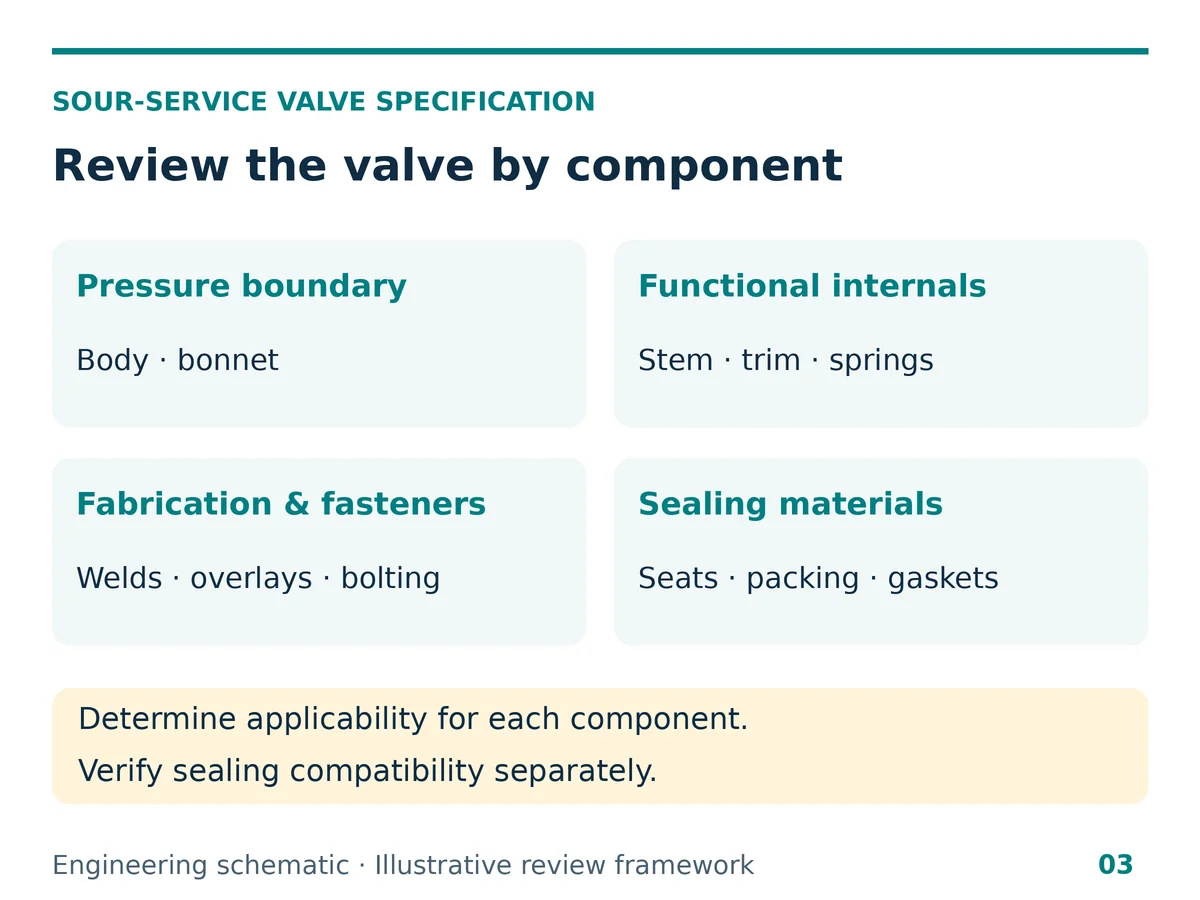
Ask the supplier to map the proposed construction against the applicable requirements. The following matrix is a recommended review template; it does not imply that every listed component is automatically subject to identical requirements.
On smaller screens, scroll this table sideways to read all columns.
| Grupo de componentes. | Revisar pergunta | Suggested evidence |
|---|---|---|
| Corpo e castelo | Does the proposed grade, product form and manufacturing condition meet the specified route? | Traceable material certificates, heat-treatment and required hardness records |
| Stem, shaft and closure parts | Are alloy condition, cold work and applicable environmental limits compatible with the required strength, wear and movement duty? | Component material schedule, manufacturing condition and applicable qualification basis |
| Springs, pins and small internals | Could exposure and failure affect required function? | Defined applicability and component-specific material assessment |
| Aperto de parafusos | What exposure, location and functional requirements apply? | Bolting schedule and documented acceptance or exclusion basis |
| Welds and repair welds | Which fabrication, qualification and heat-treatment controls apply? | Approved procedures, qualification records and required inspection results |
| Overlays and hardfacing | How are the deposited material, substrate and affected zones assessed? | Approved application route and relevant qualification records |
| Seats, packing and gaskets | Are chemical exposure, temperature cycling, shut-off, external leakage, wear and operating friction addressed separately? | Seal-material data, construction-specific performance evidence and maintenance requirements |
Carbon and Low-Alloy Steels
Define the actual grade and product form, then check its applicable condition of supply and fabrication requirements. A material designation on a drawing does not describe every subsequent manufacturing operation.
Require the supplier to identify the acceptance basis after the relevant processing. Where welding or repair is involved, the review should connect the finished component to the approved fabrication route.
Stainless Steels, Duplex and Other Alloys
For the 2020 ISO 15156 series, Part 3 covers cracking-resistant CRAs and other alloys. Its scope does not establish resistance to general or localized corrosion. 3
In the purchase specification, ask for the exact alloy designation, product form and material condition, together with the applicable environmental assessment. Avoid approving a stem or spring solely because the body uses an accepted alloy.
For sealing and moving parts, a sour-service metallic-material assessment leaves other questions to close. Seat wear or chemical attack can change shut-off performance; packing selection affects stem friction and external leakage; gasket selection affects joint integrity. Review temperature cycling, cleaning exposure and maintenance provisions, and confirm any resulting torque or thrust requirement from the proposed construction. Fire-safe and fugitive-emission evidence remain separate requirements.
Welds, Repairs and Surface Treatments
Require proposed repair welding, overlays and hardfacing to be declared before approval. Assign the applicable inspection and acceptance requirements to the relevant zones.
For applicable P-No. 1 carbon-steel equipment, ISO 17945 specifically references NACE SP0472 for SSC prevention. Confirm the project-required edition and fabrication provisions rather than applying a generic welding statement. 4
Example: Three Separate Material Decisions for One Valve Tag
Illustrative proposal: a carbon-steel body, an austenitic stainless-steel stem and a declared body repair weld. The following review register identifies what is needed for each decision. It does not approve these materials or assign a hardness limit.
On smaller screens, scroll this table sideways to read all columns.
| Component / proposal | Condition to establish | Evidências a solicitar | Disposition while unresolved |
|---|---|---|---|
| Carbon-steel body | Exact grade, casting condition, heat treatment and subsequent repairs | Heat-linked certificate; applicable material route; required final-condition examination records | Keep acceptance open until the supplied condition is matched to its requirement |
| Austenitic stainless-steel stem | Exact alloy, product form, final condition and any cold work | Manufacturing route; applicable environmental assessment; required material-condition records | Do not inherit approval from the body material |
| Declared body repair weld | Repair location and procedure, deposited material and any required post-weld treatment | Repair map; procedure and qualification records; applicable weld-metal and HAZ examination evidence | Resolve the repair route separately from the original casting records |
For each line, the purchaser and supplier should agree the requirement reference and examination scope. Record the numerical acceptance limit and units only after the applicable material route or approved qualification has been established. The example is an RFQ review tool; clause-level acceptance remains to be verified against the project-adopted documents.
Hardness Requirements: Why One Number Is Not Enough
Where the Common 22 HRC Statement Needs Qualification
If an RFQ states only “maximum 22 HRC,” ask which component, material condition and adopted clause it applies to. The number is an incomplete acceptance instruction without that context.
Determine the applicable limit from the project-adopted material route. CRAs, springs, bolting, welds and overlays can require different assessments; one body hardness result does not resolve them.
Define the Examination Before Manufacture
The inspection plan should answer five questions:
- Which component and material condition are being assessed?
- Which standard clause or approved qualification establishes acceptance?
- Which hardness method, scale and load are required?
- Where and when are measurements made, and what sampling applies?
- How will the results remain traceable to the supplied component?
A report with a value and “PASS” leaves the reviewer unable to reconstruct these decisions. Where a hardness conversion is proposed, require its applicability and contractual acceptance to be documented. Do not treat different scales as interchangeable by assumption.

Example: Return an Incomplete Hardness Submission
Illustrative review case: a supplier submits a body hardness result without identifying the measurement locations or the governing acceptance clause. Log the missing information and request the method, examination stage, component identity and applicable acceptance basis. Keep body acceptance open until these points are resolved; the result also leaves the stem and weld requirements to be assessed separately.
A useful hardness schedule has one line for each applicable component or zone: material and final condition; requirement reference; numerical limit and units; test method and load; locations and sampling; examination stage; and traceable report reference. Populate the limits from the adopted standard or approved qualification rather than from a generic valve datasheet.
What These Standards Do—and Do Not—Prove
Keep sour-service material requirements separate from the valve’s other acceptance requirements. The purchase specification should also address:
- Governing valve design standard and pressure-temperature rating.
- General and localized corrosion assessment and any required allowance.
- Seat, packing and gasket compatibility.
- Shell and seat tests, leakage acceptance and functional testing.
- Fire-safe or fugitive-emissions qualification where specified.
- Actuation, operating loads and required fail position.
Neither material selection nor a pressure test completes all these assessments. Review the NACE MR0175 / ISO 15156 resource for the related standards-scope framework.
Separate Material Qualification from Production Inspection
A standard’s coverage of a cracking mechanism does not, by itself, define an identical test programme for every valve or heat. Establish the applicable material-selection or qualification route first, then identify the examinations and records that it and the project specification require. Keep supporting material-qualification evidence separate from inspection of the delivered components.
If SSC or HIC testing is required, specify the test method and edition, specimen or material condition, test environment, acceptance criteria, sampling or frequency, and the required linkage to the supplied material. Identify supplementary purchaser requirements explicitly. ISO 17945 addresses SSC; other cracking mechanisms require separate consideration rather than being assumed to be covered by an MR0103 declaration. 4
Keep the mechanical and environmental bases distinct. A pressure class is not a fixed allowable pressure: the applicable material group, temperature and valve design determine the pressure-temperature rating. Use the design envelope to review the body, bonnet, bolting, trim and seals; use each credible operating or upset exposure case for the environmental assessment. Minimum temperature and thermal cycling may require additional material or seal review.
How to Specify Sour-Service Valves in an RFQ
Minimum RFQ Fields
On smaller screens, scroll this table sideways to read all columns.
| RFQ field | What to state |
|---|---|
| Service identity | Valve tag, line or package, function and process duty |
| Governing documents | Exact standard designation, applicable parts, edition, amendments or circulars, and project precedence |
| Environmental basis | Relevant pressure-temperature cases, phase, H₂S basis, water and required chemistry |
| Mechanical requirements | Size, rating, end connections, design standard and operating requirements |
| Component materials | Required or proposed grades, product forms and material conditions |
| Fabrication controls | Welding, repairs, overlays, heat treatment and approval requirements |
| Aceitação | Applicable hardness requirements, inspection methods, sampling and witness points |
| Records and deviations | Required traceability, final document index and supplier exceptions |
Suggested Purchase-Specification Wording
The following is an original drafting template. The bracketed fields require project completion before issue:
Provide a component-level assessment against [governing standard, applicable parts and edition] for the service cases in [approved process datasheet and revision]. Identify each applicable component’s material designation, product form, final condition, environmental limits, acceptance basis and supporting records. Declare exclusions, alternative qualification routes and deviations for purchaser approval before manufacturing release. Submit the agreed material, fabrication, inspection and test records with traceability to the supplied valve tags.
Add the separate design, sealing and testing requirements. Avoid leaving the entire technical scope inside the phrase “NACE valve.”
What Evidence Should the Valve Supplier Submit?
Agree the documentation scope at bid evaluation. The recommended evidence matrix below should be adjusted to the governing requirements and inspection plan.
On smaller screens, scroll this table sideways to read all columns.
| Record | What it helps establish | Limit of the record |
|---|---|---|
| Component compliance schedule | Declared material route and applicability | Requires supporting records and review of exceptions |
| Material test report / certificate | Reported heat or lot identity and material properties | Does not independently prove every requirement for the assembled valve |
| PMI report, where specified | Verified composition within the method’s capability | Does not establish heat treatment or hardness |
| Registro de tratamento térmico | The documented processing cycle | Must be linked to the relevant material or components |
| Hardness report | Results for the stated locations and method | Does not establish chemistry or all environmental limits |
| Welding and repair records | Approved route and execution evidence | Must cover the relevant work and required examinations |
| Qualification test evidence, where required | Results within the tested qualification envelope | Does not justify applications beyond that basis |
| Pressure and functional test reports | Performance against the stated test conditions | Do not establish sour-service material resistance |
When comparing bids, use the same document matrix for every supplier. One quotation may include only body material records while another includes trim traceability, fabrication controls and purchaser witness points. Resolve these scope differences before comparing price.
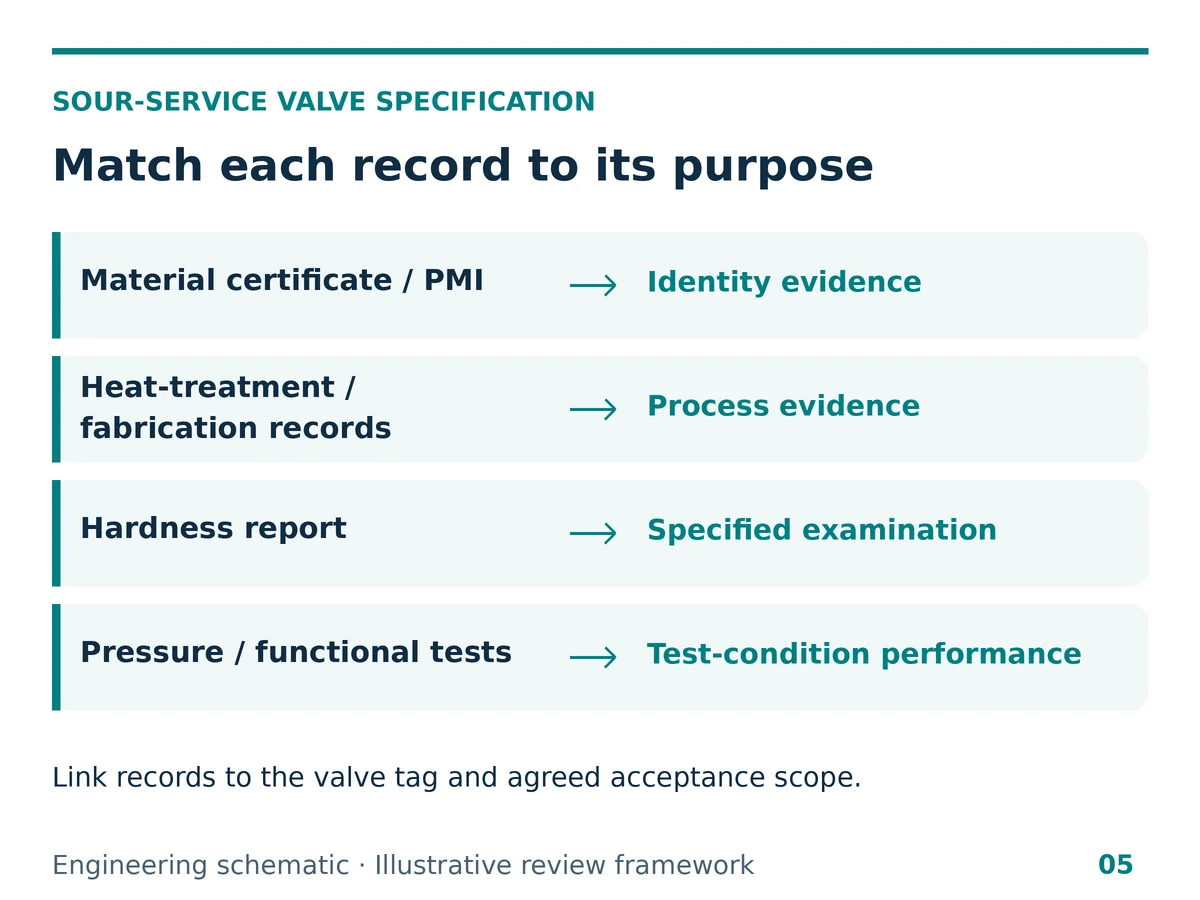
Illustrative receiving-inspection problem: the certificate is complete, but a stem marking or specified PMI result cannot be reconciled with the approved bill of materials. The issue may be an identity or traceability break rather than a chemistry calculation. Hold acceptance of the affected item, reconcile component markings, heat or lot references and manufacturing records, and resolve any nonconformance through the agreed inspection process. A body pressure-test pass does not close a stem identity discrepancy.
Normalize Technical Bids Before Comparing Price
Use the same clarification register for every bidder. The dispositions below are recommended review controls, not additional requirements automatically imposed by either standard.
On smaller screens, scroll this table sideways to read all columns.
| Supplier response | Clarification to request | Suggested disposition |
|---|---|---|
| “NACE compliant” without a designation or edition | Exact requirement, parts, component coverage and declared deviations | Keep the compliance scope open |
| Body records only | Stem, trim, bolting and fabrication applicability schedule | Identify and resolve coverage gaps |
| Proposed alloy, condition or fabrication change | Revised assessment and effect on inspection, cost and delivery | Purchaser approval before the affected work |
| Qualification report from another material or condition | Demonstrate applicability to the proposed component and service envelope | Keep the claimed qualification open |
| Required final records offered as optional extras | Align the quotation with the agreed document index and ITP | Resolve scope and price before order release |
Give each open item a valve tag, requirement reference, supplier response, reviewer, due milestone and closeout record. Agree hold and witness points in the inspection and test plan. Review the final dossier against that index before contractual release.
Perguntas Frequentes
What Is the Main Difference Between NACE MR0175 and MR0103?
The main difference is service scope and cracking coverage. MR0175/ISO 15156 addresses applicable oil and gas production and natural gas treatment duties; MR0103/ISO 17945 addresses SSC in petroleum refining and related processing. Confirm the actual duty, exclusions and adopted edition before selecting the material route.Can MR0175 Be Used Instead of MR0103?
Not automatically. Compare the proposed component materials, final conditions, welding and other fabrication controls against the required standard. Record approval of any substitution or deviation through the project’s document hierarchy.Does Every Sour-Service Valve Component Need a Maximum Hardness of 22 HRC?
No single hardness value establishes acceptance for every valve component. Verify the limit, material condition, examination method and applicable exceptions in the adopted material route or approved qualification. Do not extend a body result to the stem, welds or bolting.Is 316 Stainless Steel Automatically Suitable for Sour Service?
The grade name alone is insufficient. Establish the exact material designation, product form, final condition and applicable environmental limits. Review the actual service cases and corrosion compatibility before acceptance.Does a Material Certificate Prove Complete NACE Compliance?
A material certificate supports reported identity and properties but requires traceability to the supplied component. Review the manufacturing condition, required examinations and fabrication records as well. PMI can support identity checks within its capability; it does not replace heat-treatment or hardness evidence.What Should a Purchaser Send for a Sour-Service Valve Review?
Send the valve tag and datasheet, service cases with composition and phase information, pressure and temperature, governing standard and edition, proposed component materials, fabrication restrictions and inspection/document requirements. Include supplier deviations and identify unknown inputs.
Continue the valve review
For isolation duties, review the ball valve product range alongside the complete sour-service specification. Product type alone does not establish material suitability. See informações da empresa when preparing your supplier review.
Ask for Material and Sour-Service Specification Review
For a new RFQ, send the valve tag and datasheet, governing standard and edition, proposed component materials, service cases with H₂S and phase/chemistry data, and the required inspection and document list.
For a quotation review, add the supplier’s bill of materials and deviation list, and identify the unresolved decision. Mark missing inputs so the review can address them explicitly.
Request a Sour-Service Specification Review.
Final selection depends on the confirmed process data, applicable design requirements, component materials, manufacturing route, sealing duty and approved purchase documents.
Nota de engenharia
Publisher: Raymon Valve. This article supports service screening, RFQ preparation and technical bid review. Its standards-scope statements use the official public references below; the review registers and examples are original procurement guidance.
Component acceptance requires the adopted standards and updates, confirmed service cases, approved material and fabrication assessments, and the agreed inspection records. This article does not provide a clause-by-clause material qualification.
Official References and Edition Note
- ISO 15156-1:2020 — General principles.
- ISO 15156-2:2020 — Carbon and low-alloy steels and cast irons. Scope verified against the official part catalogue; the series entry is linked in reference 1.
- ISO 15156-3:2020 — CRAs and other alloys. Scope verified against the official part catalogue; the series entry is linked in reference 1.
- ISO 17945:2015 — SSC-resistant materials in petroleum refining environments.
- AMPP — Standards by industry, identifying the paired NACE/ISO designations.
Edition check — 3 November 2026:
- Published basis: the ISO catalogue lists the 2020 ISO 15156 parts as published. The part descriptions in this article refer to that published structure.
- Revision in progress: replacement FDIS documents remain under development. The ISO/FDIS 15156-2 catalogue entry identifies a draft replacement; it is not evidence that a new edition has been published or adopted for the order.
- Refinery standard: ISO 17945:2015 remains listed as current and is under systematic review.
- Order-specific checks: confirm the adopted AMPP/ISO designation, applicable amendments, technical circulars, interpretations and project supplements before release. Public catalogue checks do not establish that every such update has been reviewed.
 Portuguese
 English
 German
 Arabic
 French
 Spanish
 Italian
 Russian