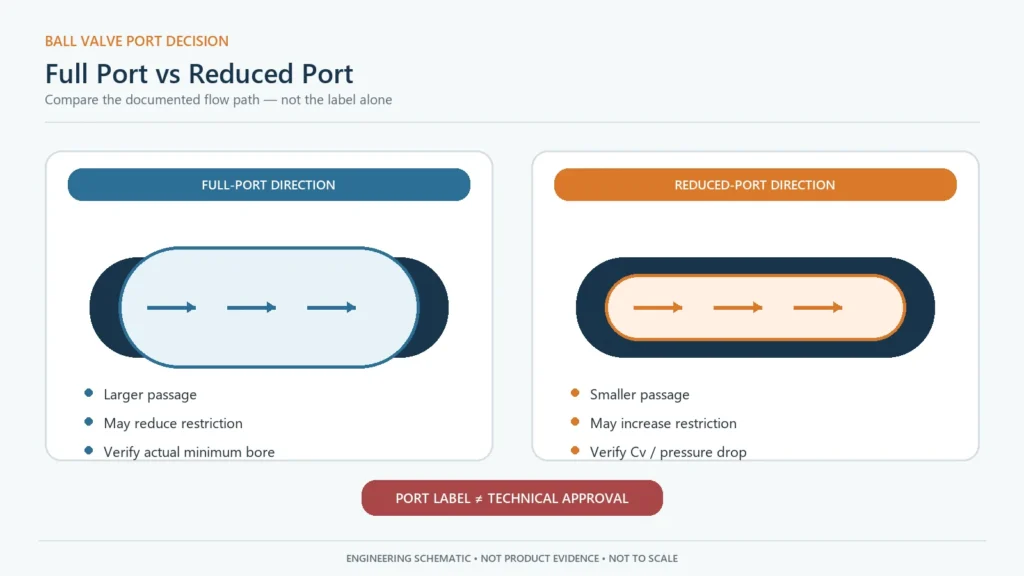
A full port ball valve generally provides a larger internal passage and can reduce flow restriction, while a reduced port design uses a smaller passage and may offer a more compact or lower-cost configuration. Choose neither from the label alone. Confirm the actual minimum bore, pipe inside diameter, exact offered-model Cv or Kv, allowable pressure drop and local velocity. If pigging is required, verify the complete unobstructed passage against the actual pig envelope and the fully open valve position.
Featured illustration: Conceptual comparison of larger and smaller ball-valve flow passages. Actual minimum bore and valve geometry require the exact offered-model drawing.
Seleção Rápida Gaveta
The practical question is not whether full port is universally better. It is whether the offered valve provides the passage and hydraulic performance required by the line without creating an unacceptable technical or commercial compromise.
| Project condition | Initial direction | Evidência exigida | Hold condition |
|---|---|---|---|
| Pigging or an inline inspection device must pass | Review a full-port direction | Pig envelope, required clearance, sectional drawing and fully open alignment | “Full port” is stated, but the complete passage is not verified |
| Allowable valve pressure drop is limited | Compare exact offered-model Cv/Kv and calculate the operating cases | Flow and fluid data, allowable pressure drop and exact valve coefficient | Only a generic catalog value is available |
| Clean utility isolation with adequate hydraulic margin | A reduced-port direction may be acceptable | Actual bore, flow cases, pressure-drop result and project acceptance | The supplier substitutes reduced port without technical review |
| Solids, viscosity or fouling may affect the flow path | Review geometry and service risk before choosing either design | Particle or viscosity data, velocity, seat/body geometry and cleaning plan | The decision relies only on a general application label |
Port geometry is only one part of ball valve selection. Pressure-temperature rating, body and trim materials, seat and seal selection, shutoff duty, end connections, torque, actuation, testing and documents require separate confirmation. For the broader selection framework, see the Guia de seleção de válvulas esfera.
Use Four Separate Approval Gates
A reliable comparison separates four questions that are often mixed together. Passing one gate does not close the others.
Gate 1: Geometry and Bore
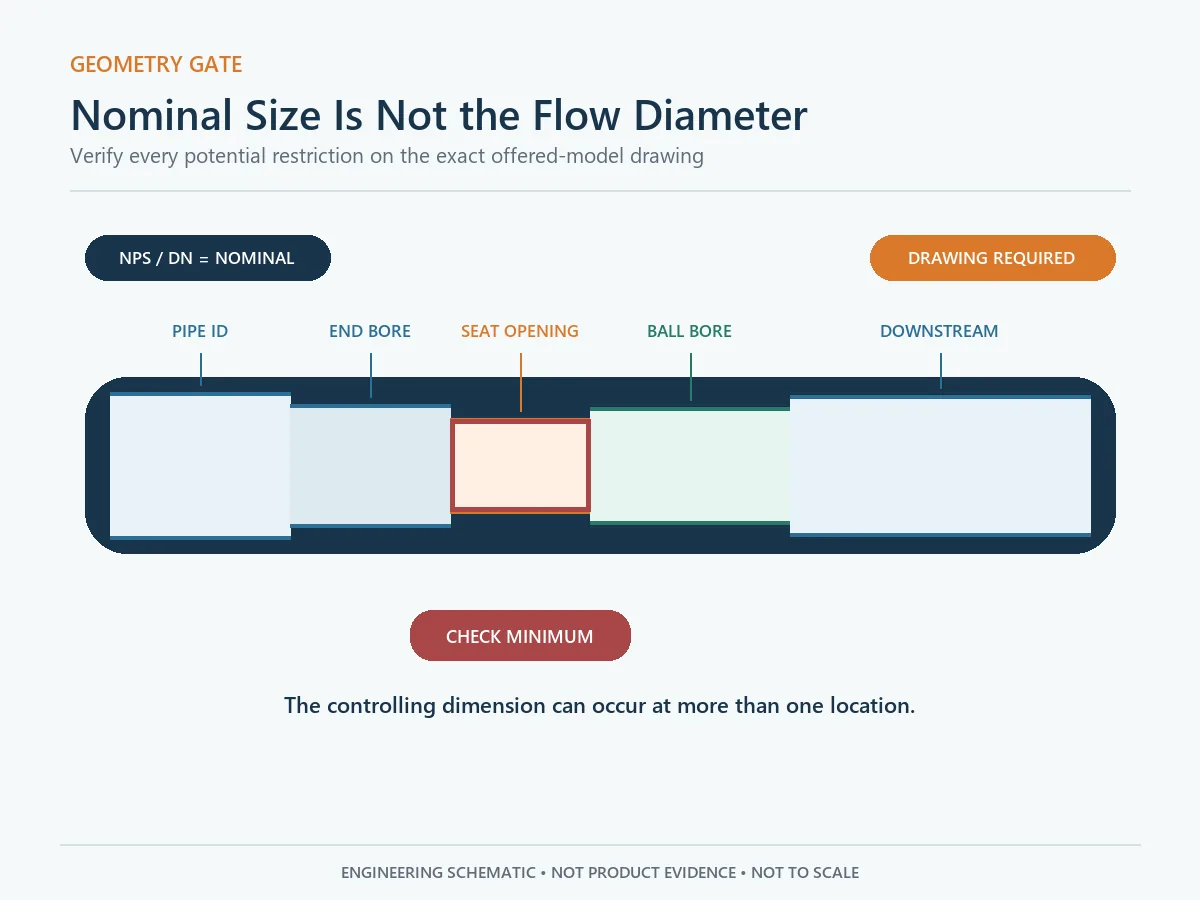
Confirm the nominal pipe size, pipe schedule and actual inside diameter. Then identify the valve end bore, seat opening, minimum ball bore and any internal projection or transition that can restrict the route.
The controlling document should be the drawing for the exact offered valve configuration. A family brochure or a drawing for a similar size does not establish the minimum bore of the quoted item.
Gate 2: Hydraulic Performance
Define the minimum, normal and maximum flow cases. Obtain the Cv or Kv for the exact offered size, series, pressure class, end connection and port configuration. Compare the calculated valve loss with the project’s allowable pressure drop and review the local velocity through the controlling passage.
Pressure class does not establish flow capacity. It addresses a different engineering question.
Gate 3: Pigging and Passage
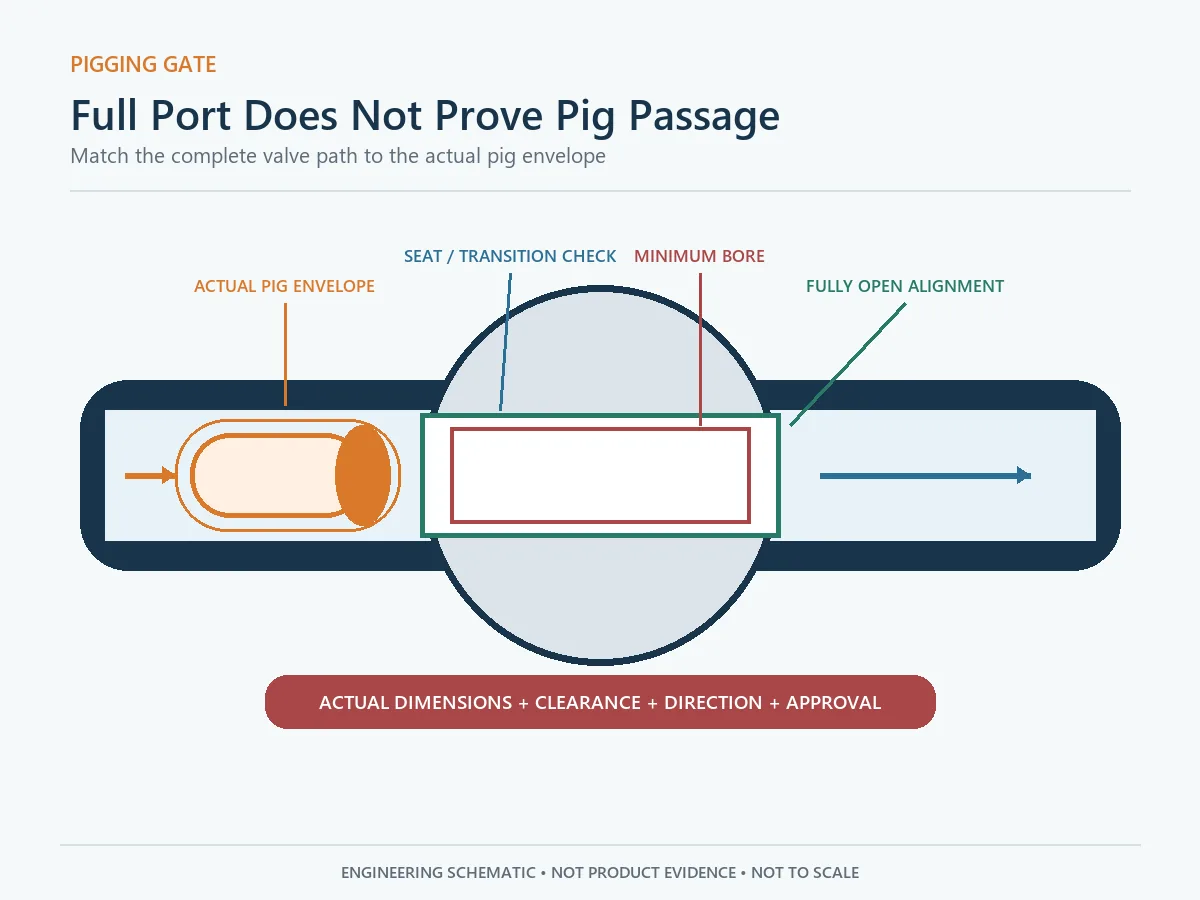
Where a pig or inspection device must pass, define its maximum operating envelope, flexibility, required clearance and travel direction. Check the complete valve passage, including the seat opening, end transitions, internal projections and fully open ball alignment.
A large ball bore is not sufficient if another point in the route is smaller or if the valve does not reach the correct fully open position.
Gate 4: The Complete Valve Package
Finally, confirm the pressure-temperature basis, materials, seats and seals, shutoff requirement, operating differential pressure, torque source, actuation scope, end connection, tests, documents and technical deviations.
Do not accept a bore design that passes the hydraulic check but fails the material, actuation, testing or project-document requirement.
What Do Full Port, Full Bore, Reduced Port and Standard Port Mean?
Full Port or Full Bore
Os termos porta cheia e diâmetro interno total are commonly used for a ball valve with a relatively large internal flow passage, generally closer to the adjoining pipe bore than a reduced-port alternative. The larger passage can reduce flow restriction in comparable designs.
That description does not mean the valve bore automatically equals the inside diameter of every pipe carrying the same NPS or DN. Pipe inside diameter changes with schedule, wall thickness, lining, corrosion allowance and manufacturing tolerance. Valve seats, end transitions and body geometry can also introduce a smaller controlling passage.
Reduced Port or Reduced Bore
A reduced-port valve has an internal passage smaller than the adjoining line bore. Depending on the construction, the smaller ball and passage may support a more compact or lower-cost configuration. Whether that trade-off is acceptable depends on the actual hydraulic and operating requirements.
“Standard Port” Is Not a Universal Dimension
Suppliers may use porta padrão as another term for a reduced-port design, but the term does not define one universal bore. Two suppliers can use the same description while offering different minimum bores and different flow coefficients.
An RFQ should therefore specify a measurable requirement—such as minimum unobstructed bore, required Cv/Kv or allowable valve pressure drop—instead of relying on terminology alone.
Tamanho Nominal Não é o Diâmetro Real de Fluxo
A valve marked NPS 8 or DN 200 is connected to a line of that nominal size, but the marking does not by itself define the unobstructed internal diameter. The flow route may include:
- the adjoining pipe inside diameter;
- the valve end bore;
- a reducer or body transition;
- the seat inside diameter;
- the ball bore;
- internal projections; and
- the downstream transition.
The smallest point may control local velocity, pressure loss or pig passage. Where bore continuity matters, require the minimum dimension on the offered-model drawing.
Comparação entre Válvula Esfera de Porta Cheia vs. Porta Reduzida
| Fator de seleção | Full-port direction | Reduced-port direction | Verificação do comprador |
|---|---|---|---|
| Passagem interna | Generally larger | Smaller than the line bore | Minimum bore on the exact drawing |
| Capacidade de fluxo | Geralmente maior para projetos comparáveis | Generally lower for comparable designs | Exact offered-model Cv/Kv |
| Queda de pressão | Geralmente menor com o mesmo fluxo | Generally higher at the same flow | Cálculo hidráulico do projeto |
| Velocidade local | Generally lower through the larger passage | Higher through the restriction at the same volumetric flow | Flow case and actual bore |
| Limpeza com 'pig' | May be possible after dimensional confirmation | Normally conflicts with full-line pig passage | Pig envelope and complete passage |
| Solids and fouling | Larger passage may reduce restriction exposure | Smaller passage may increase blockage exposure | Particle data, velocity and cleaning plan |
| Envelope, weight and cost | May be larger, heavier or higher cost | May be more compact, lighter or lower cost | Exact GA, weight and normalized quotation |
| Torque e acionamento | Específico do produto | Específico do produto | Manufacturer torque data and sizing basis |
The table shows typical decision directions, not guaranteed product outcomes. Construction, materials, pressure class, seat design, differential pressure and supplier design can change the result.
How Port Size Changes Flow Capacity and Pressure Drop
A área de fluxo é apenas a primeira verificação
For a circular passage, reducing the diameter reduces flow area. At the same volumetric flow, velocity increases through the smaller section. That is why a reduced passage generally creates more local loss than a larger passage in an otherwise comparable valve.
Bore area alone does not determine the final pressure drop. Body transitions, seat geometry, port alignment, surface condition, end connections, fluid viscosity, gas compressibility and adjacent piping can all affect performance.
Use the Exact Offered-Model Cv or Kv
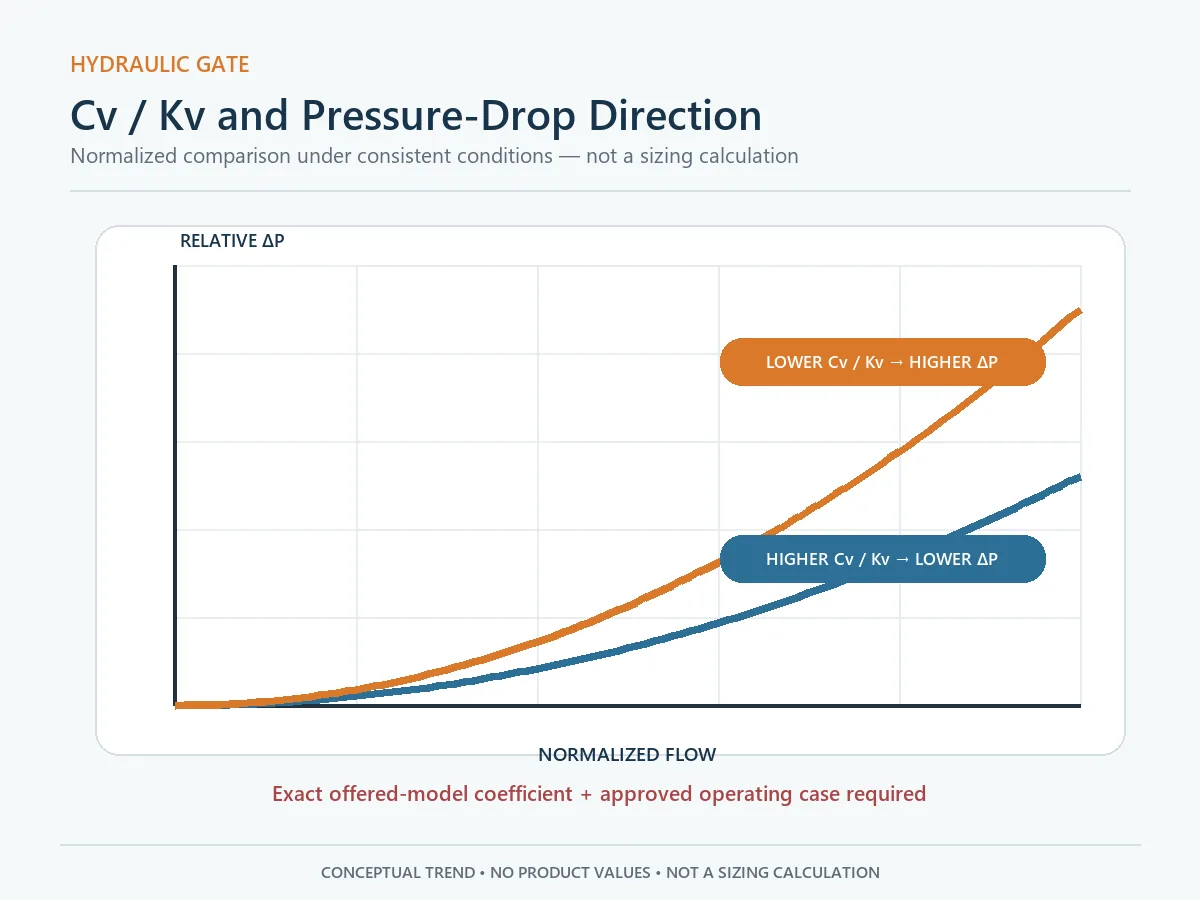
Cv and Kv express valve flow capacity under defined reference conditions. For a consistent fluid and operating basis, a higher coefficient generally corresponds to lower valve pressure loss. The comparison is useful only when each value belongs to the exact offered valve.
Do not use a coefficient from another size, pressure class, body series, end connection or port design. A generic internet table cannot prove the performance of a quoted valve.
A formal pressure-drop review needs three groups of inputs:
- Process data: minimum, normal and maximum flow; medium and phase; density or specific gravity; viscosity; pressure; and temperature.
- System data: actual pipe ID, total line loss, available pump or compressor margin, required downstream pressure and future-capacity cases.
- Valve data: exact-model Cv/Kv, minimum bore, port configuration and fully open condition.
Passagem Plena Não Significa Queda de Pressão Zero
A full-port valve remains a component in the piping system. Seats, body transitions, end geometry and alignment can still produce local loss. A verified full-port design may reduce restriction compared with a reduced-port alternative, but it does not create zero pressure drop.
Use the Correct Calculation Route
A preliminary single-phase liquid estimate is not a universal sizing method. Compressible gas or steam requires inlet and outlet pressure, temperature, gas properties and an applicable calculation method. Flashing, high-viscosity, slurry and multiphase service can require further correction or specialist analysis.
Escalate to a system-level hydraulic review when the valve is on a pump suction line, the downstream equipment has a minimum inlet-pressure requirement, several restrictions accumulate, future throughput is being evaluated, or energy and production losses are commercially significant.
Local Velocity, Solids, Erosion and Fouling
At the same volumetric flow, a smaller passage creates higher local velocity. That can matter when the medium contains sand, scale, crystals, catalyst fines, fibres, sludge or other solids. It can also affect fluids that deposit or foul around the seats and body cavity.
Port size does not decide erosion or blockage risk by itself. Review particle size, concentration and hardness; impact angle; differential pressure; material and coating system; seat geometry; installation orientation; operating duration; and the cleaning strategy.
Full port does not eliminate erosion, and reduced port is not automatically unsuitable for every solids-bearing service. Likewise, a material or hardfacing name is not a service guarantee without the complete process conditions and controlled material specification.
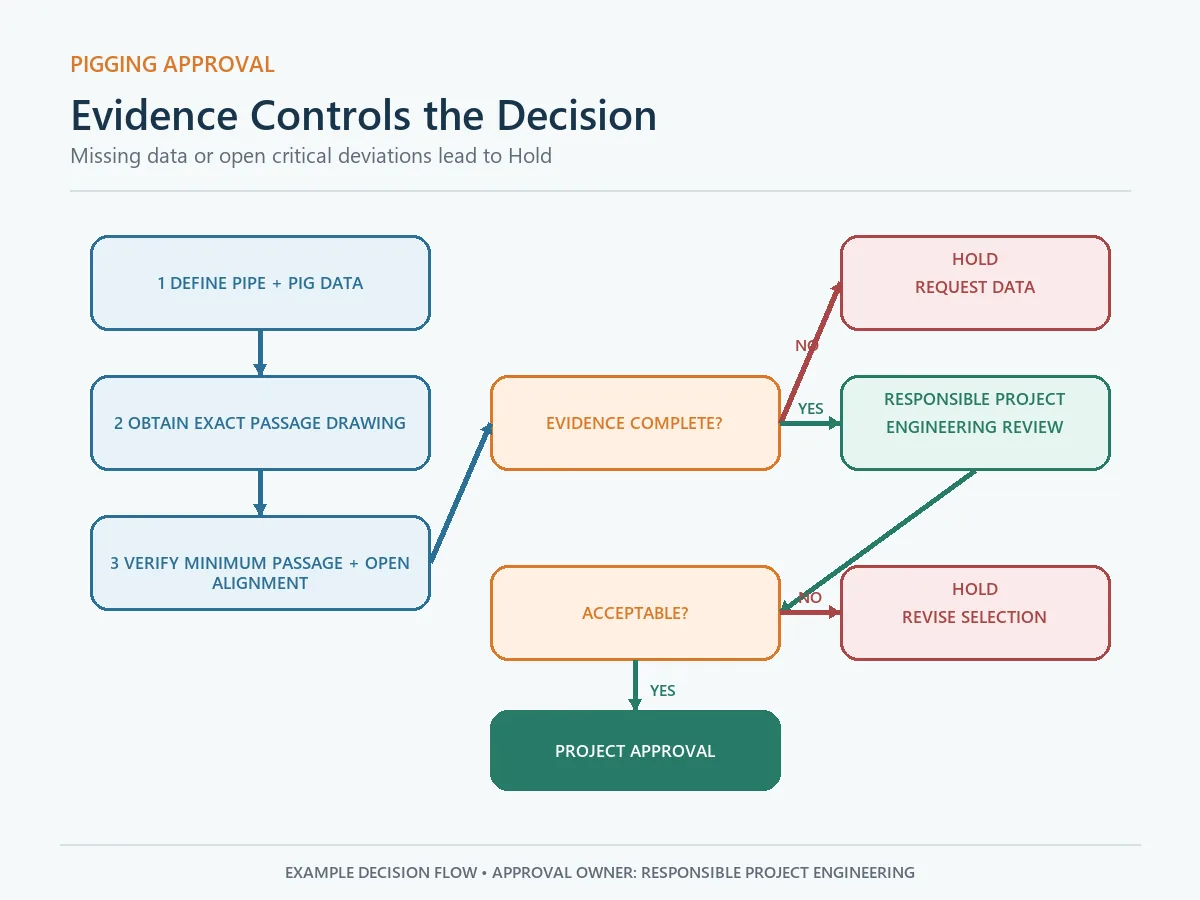
Pigging: Why “Full Port” Is Not Approval
Pigging is a strong reason to review a full-port direction, but approval requires more than the port label.
Verificar a Passagem Completa
Check the minimum ball bore, seat inside diameter, valve end bore, weld or flange transitions, internal projections, ball-to-body alignment and downstream transition. The smallest point in that route can control pig passage.
Confirmar a Posição Totalmente Aberta
An adequate bore can still obstruct a pig if the ball stops short of the correct open position. For gear- or actuator-operated valves, review the open stop, actuator travel stop, stem-to-ball alignment, position indication and commissioning setting.
Match the Actual Pig
A foam pig, cup pig and instrumented inspection tool do not share one envelope or flexibility. The controlling dimensions can include the body, cups, discs, brushes, magnets, gauges, centralizers and instrumentation.
Record the pig type, maximum operating envelope, required clearance and direction of travel. The valve supplier should review the exact information rather than a generic statement that the line is “piggable.”
Pigging Approval Checklist
- Confirm pipe size, schedule and actual inside diameter.
- Identify the pig type and maximum operating envelope.
- State the required clearance and travel direction.
- Obter o desenho seccional ou de furo mínimo da válvula oferecida.
- Identificar a menor passagem desobstruída.
- Review seat and end-transition geometry.
- Confirm the fully open stop position and alignment.
- Record supplier assumptions and technical deviations.
- Obtain written manufacturer confirmation against the stated pig data where required.
- Aprovação completa de engenharia do projeto.
Where a project adopts API Specification 6D, that document can form part of the pipeline-valve design, manufacturing, testing and documentation framework. It does not replace the offered-model passage drawing, the pig envelope or project approval.
Size, Weight, Cost and Actuation Trade-Offs
A full-port construction may require a larger ball or body than a comparable reduced-port design. This can affect the installation envelope, weight and purchase cost. The difference must come from the exact GA, weight schedule and supplier quotation; fixed saving percentages should not be assumed.
A smaller passage may allow a smaller ball, but reduced port does not automatically mean lower operating torque. Ball support, seat design, differential pressure, temperature, packing friction, deposits, cycling and manufacturing details can all influence torque.
For manual or automated operation, require the valve manufacturer’s torque data and revision basis. An actuator review should also define maximum operating differential pressure, sizing factor, operating time, fail action, supply pressure or voltage, control mode, cycle requirement and accessory scope. A visible actuator or a general catalog pairing does not establish the included package.
A válvulas esfera industriais can be used to review available construction directions, while the final offered configuration must still be confirmed against the project datasheet.
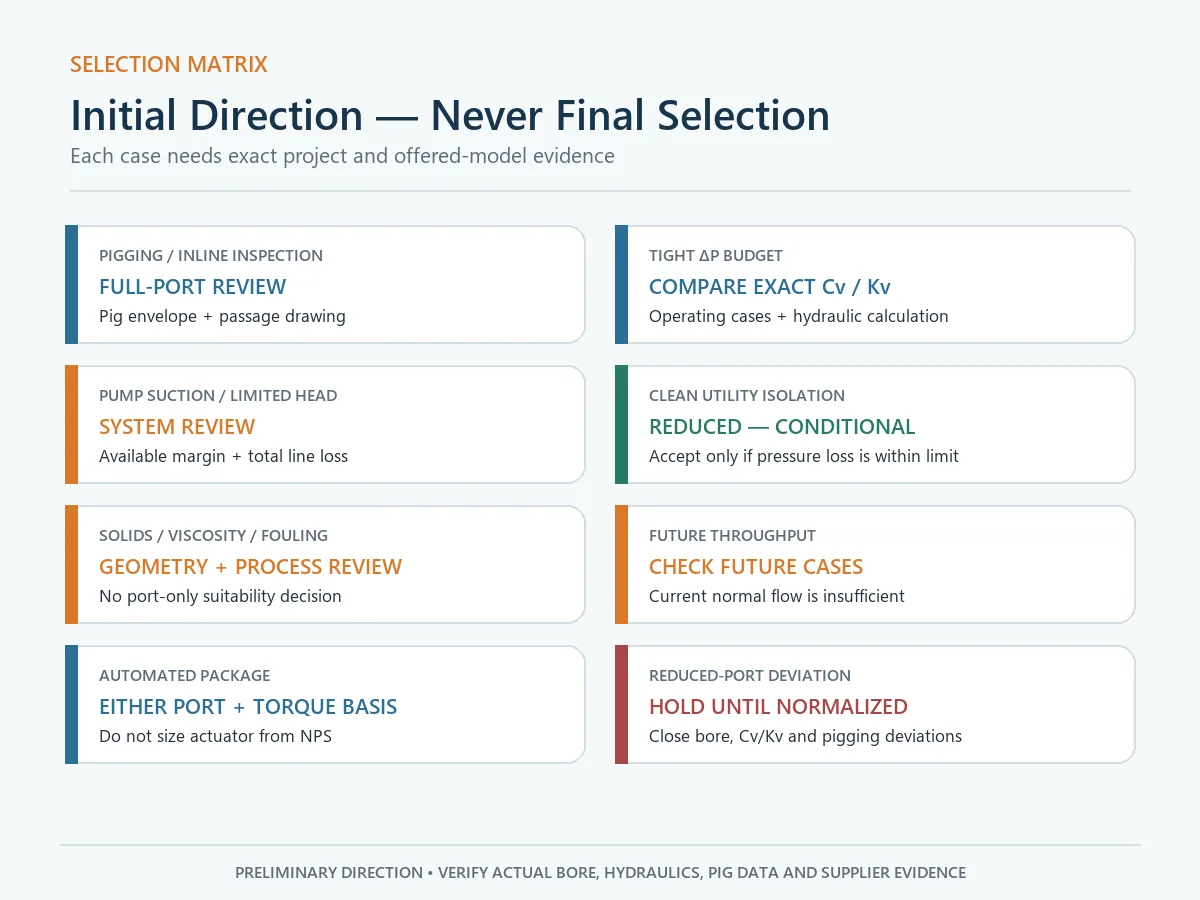
Matriz de Seleção Preliminar
| Condição de serviço | Initial direction | Evidência requerida | Hold or reject condition |
|---|---|---|---|
| Pigging or inline inspection is mandatory | Full-port review | Pig envelope, clearance, passage drawing and open-stop confirmation | Complete passage is unverified |
| Tight pressure-drop budget | Compare verified coefficients; full port may be favored | Operating cases, exact Cv/Kv and system calculation | Generic coefficient or no allowable loss |
| Pump suction or limited available head | System hydraulic review | NPSH/system margin basis, line losses and valve data | Valve evaluated in isolation |
| Clean utility isolation with hydraulic margin | Reduced port may be acceptable | Bore, flow cases and accepted pressure-drop result | Substitution is based only on price |
| Solids, viscosity or fouling risk | Geometry and process review before either choice | Solids/viscosity, velocity, seats and cleaning plan | Universal suitability statement |
| Future throughput increase | Review all future cases | Future flow, downstream pressure and energy impact | Only current normal flow is checked |
| Automated valve package | Either port, subject to complete actuator review | Exact torque data, differential pressure, fail action and supply | Actuator selected from size alone |
| Reduced port offered as a deviation | Technical equivalence review | Minimum bore, Cv/Kv, pigging status and deviation schedule | Commercial ranking before technical closure |
Evidências do Fornecedor e Normalização Técnica da Proposta
Procurement should not compare totals until the offers share the same technical basis. A reduced-port quotation is not equivalent to a full-port requirement merely because the nominal size and pressure class match.
| Campo da proposta | Fornecedor A | Fornecedor B | Requisito de normalização |
|---|---|---|---|
| Designação da porta | Termo oferecido | Termo oferecido | Do not assume dimensional equivalence |
| Diâmetro mínimo | Enter exact dimension | Enter exact dimension | Compare com o mesmo ID de tubulação e o mínimo do projeto |
| Exact-model Cv/Kv | Enter offered value and basis | Enter offered value and basis | Use the same operating cases |
| Pigging status | Confirmed, excluded or conditional | Confirmed, excluded or conditional | Use the same pig envelope and direction |
| Construção da válvula | Ball support and body pattern | Ball support and body pattern | Identify changes affecting envelope, torque and price |
| Materiais e sedes | Offered specifications | Offered specifications | Confirm the same service and shutoff basis |
| Base de acionamento | Torque and package data | Torque and package data | Compare the same differential pressure, margin and fail action |
| Tests and documents | Escopo incluído | Escopo incluído | Exclusões separadas das diferenças de preço |
| Desvios | Open or closed | Open or closed | Do not award with critical items unresolved |
The minimum approval record should identify the exact valve, minimum bore, pipe ID, operating cases, exact flow coefficient, pigging status, torque basis, materials, pressure-temperature basis, testing/document scope and every unresolved deviation.
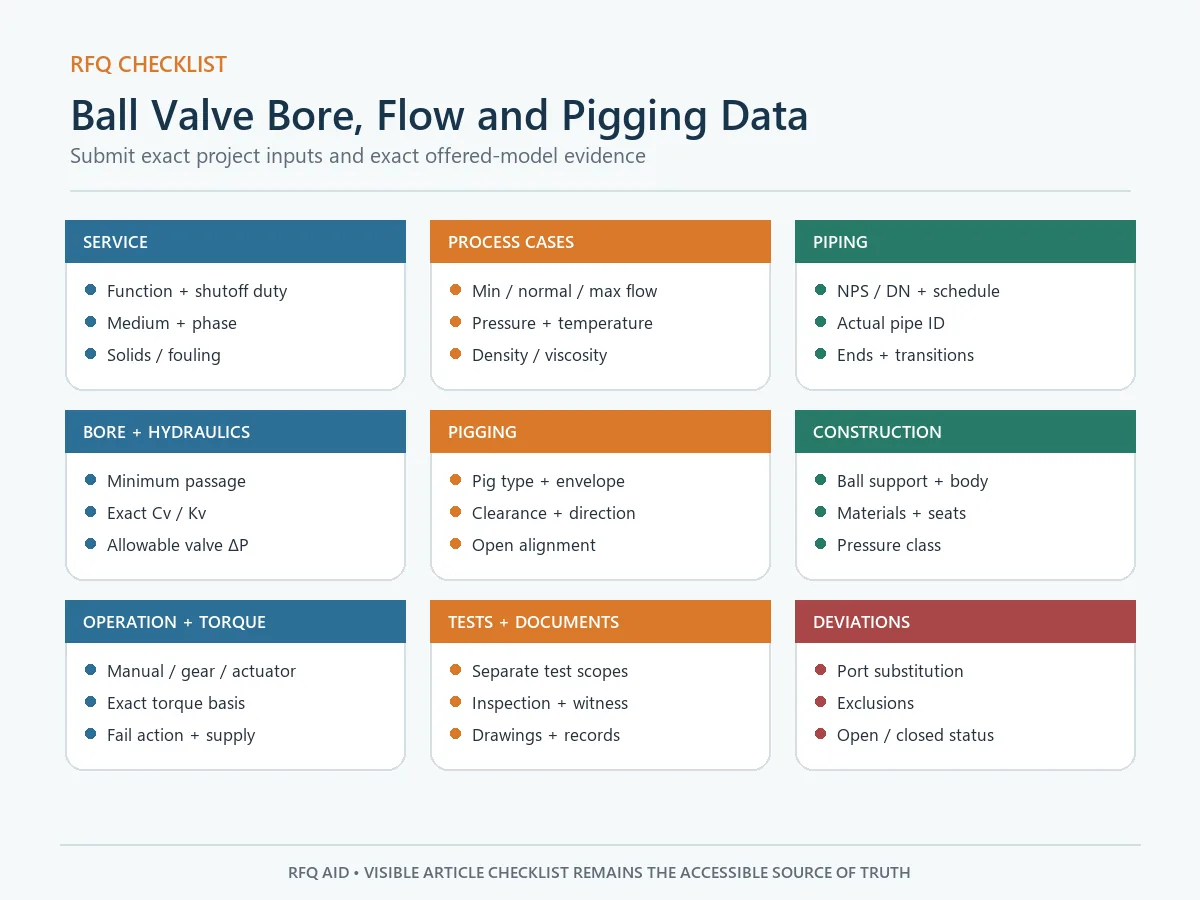
Lista de verificação de RFQ para porta e fluxo de Válvulas Esfera
Include the following information in the RFQ or datasheet:
- valve function and shutoff duty;
- medium, composition and phase;
- fluxo mínimo, normal e máximo;
- operating and design pressure;
- operating and design temperature;
- density or specific gravity and viscosity where relevant;
- solids, particle size, fouling and cleaning conditions;
- pipe NPS/DN, schedule, actual ID and adjacent transitions;
- valve size, pressure class and end connection;
- required minimum unobstructed bore;
- exact-model Cv/Kv requirement or allowable valve pressure drop;
- pig type, maximum envelope, required clearance and travel direction;
- floating or trunnion preference if known;
- body, ball, stem, seat, packing and gasket requirements;
- manual, gear, pneumatic, electric or hydraulic operation;
- maximum operating differential pressure and torque-data requirement;
- fail action, supply and accessory scope for automated packages;
- applicable project standards and approved editions;
- pressure, seat, functional and other required tests stated separately;
- inspection, witness and document requirements; and
- a technical deviation and exclusion schedule.
For test-scope planning, the industrial valve pressure testing guide explains how shell, seat and specified verification requirements should be stated separately in the RFQ.
For end-connection-specific review, the Guia de Seleção de Válvula Esfera Flangeada provides additional piping-interface questions.
Resumo da Decisão
Use a verified full-port direction when a minimum passage, low valve pressure loss, pigging or cleaning-device passage is mandatory. Consider a reduced-port direction only when pigging is excluded and the exact offered-model coefficient, calculated pressure drop, local velocity and complete system performance remain acceptable.
Hold technical approval when the minimum bore, pipe schedule, exact Cv/Kv, allowable pressure drop, pig envelope, passage drawing, torque basis or critical deviation status is missing.
Do not approve a port label. Approve a documented flow path and a verified operating case for the exact offered valve.
Solicitar Revisão de Passagem e Fluxo de Válvula Esfera
Send the valve datasheet, piping information and supplier offer for a preliminary completeness and consistency review. Include the medium and phase, flow range, operating and design pressure and temperature, allowable valve pressure drop, pipe size and schedule, minimum bore, pig data where applicable, end connection, materials, operation method, torque data, test scope and required documents.
Submit your project information to identify missing bore, hydraulic, pigging and bid-normalization data before technical approval. Final hydraulic approval and project acceptance remain with the responsible project engineering team.
Perguntas Frequentes
Uma válvula esfera de passagem plena é o mesmo que uma válvula esfera de diâmetro interno total?
The terms are commonly used for the same general design direction. Buyers should still rely on the stated minimum bore and offered-model drawing because the terminology does not prove dimensional continuity with every pipe schedule.
Uma válvula esfera de passagem plena tem queda de pressão zero?
No. A larger passage can reduce restriction compared with a smaller-bore alternative, but seats, body transitions, end geometry and alignment still produce local loss.
Can every full port ball valve pass a pig?
No. Passage depends on the minimum unobstructed bore, seat geometry, end transitions, internal projections, fully open alignment and the envelope and flexibility of the actual pig.
When can a reduced port ball valve be acceptable?
It may be acceptable when pigging is not required and the exact offered-model hydraulic result confirms that pressure drop, local velocity and total system performance remain within project limits.
Does reduced port always mean lower cost, lower weight or lower torque?
No. Those outcomes also depend on ball support, body construction, pressure class, materials, seats, differential pressure and supplier design. Compare exact drawings, weights, quotations and torque data.
O que uma RFQ deve declarar além de porta cheia ou porta reduzida?
State the required minimum bore, pipe schedule and ID, operating flow cases, allowable pressure drop, exact-model Cv/Kv requirement, pig data, pressure class, materials, operation method, required drawings, tests and documents.
Can reduced port be considered for solids-bearing service?
Possibly, but the decision requires the particle size and concentration, local velocity, erosion and blockage risk, seat/body geometry, material system and cleaning method. The port label alone cannot approve the service.
Is full port always the better choice?
No. Full port may be justified by pressure-drop, minimum-passage or pigging requirements, but it may add envelope, weight or cost without meaningful system benefit in some duties. The project should compare verified technical and commercial data.
