Full Port vs Reduced Port Ball Valve: Flow Capacity, Pressure Drop, Pigging and Selection

Engineering Comparison

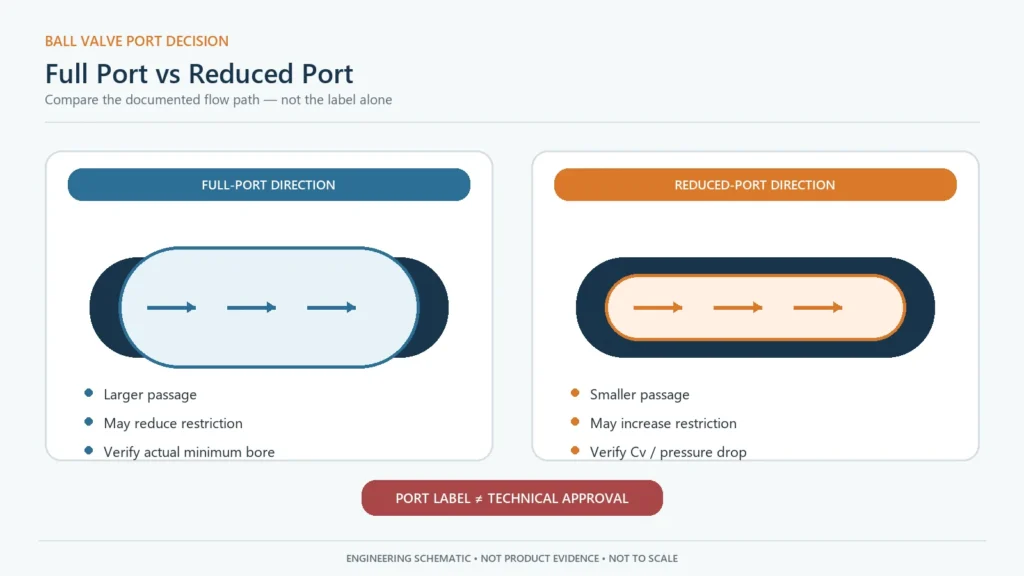
A full port ball valve normally provides a bore closer to the inside diameter of the adjoining pipe, helping reduce flow restriction and maintain a larger passage. A reduced port valve uses a smaller internal opening and may be acceptable where pressure drop and local velocity remain within the system limits. Technical approval should be based on the actual minimum bore, pipe schedule, exact-model Cv and, where pigging is required, the complete unobstructed passage—not the port label alone.

Quick Selection Gate

Pigging is required Verify the minimum unobstructed passage and the actual pig envelope. “Full port” by itself is not approval.
Allowable pressure drop is limited Obtain the exact offered-model Cv and calculate the minimum, normal and maximum flow cases.
Utility or low-flow isolation duty A reduced port design may be acceptable after pressure-drop and local-velocity review.
Bore or Cv data is missing Hold technical approval until the supplier provides the drawing and performance data.

Technical Approval Gate

A port designation should pass four separate review gates before it is accepted. Failure at one gate is not corrected by passing another. For example, an adequate pressure class does not prove flow capacity, and a large bore does not prove material or actuator suitability.

Gate 1

Geometry and Bore

  • Pipe schedule and actual inside diameter confirmed
  • Valve end bore and minimum ball bore identified
  • Seat or internal projections reviewed
  • Offered-model drawing submitted
Gate 2

Hydraulic Performance

  • Minimum, normal and maximum flow cases defined
  • Exact offered-model Cv supplied
  • Allowable valve pressure drop stated
  • Local velocity and system margin reviewed
Gate 3

Pigging and Passage

  • Pig type and maximum envelope defined
  • Complete minimum unobstructed passage checked
  • Fully open stop alignment confirmed
  • Written supplier confirmation obtained
Gate 4

Complete Valve Package

  • Pressure-temperature rating verified
  • Materials, seats and seals reviewed
  • Torque and actuation basis confirmed
  • Testing, documents and deviations aligned
Approval rule: accept the offered port design only after the bore, hydraulic, pigging and complete-package evidence are consistent with the same valve model and project datasheet.
Full port and reduced port ball valve flow passage comparison
Engineering schematic comparing the larger passage of a full port design with the restriction created by a reduced port design. Not a product drawing.

For broader review of construction, seat, material and operating choices, see the complete ball valve selection guide. Buyers comparing available constructions can also review Raymon Valve’s industrial ball valve range and flanged ball valve configurations.

What Do Full Port and Reduced Port Mean?

Full Port or Full Bore Ball Valve

The terms full port and full bore are commonly used for a valve whose internal passage is close to the adjoining pipe bore. The larger passage generally produces less flow restriction than a smaller-bore valve of the same nominal size.

That does not mean the internal diameter automatically matches every pipe identified by the same NPS or DN. Actual pipe inside diameter changes with pipe schedule, wall thickness, corrosion allowance, lining, manufacturing tolerance and the geometry of adjoining transitions.

Reduced Port or Standard Port Ball Valve

A reduced port valve has an internal passage smaller than the connected line bore. Depending on the design, the smaller ball and passage may support a more compact body or a lower normalized purchase cost.

The term standard port is not a universal dimensional definition. Two suppliers can both use that term while offering different minimum bores and different Cv values. A technical RFQ should therefore state the required bore, Cv or allowable pressure drop rather than rely on terminology alone.

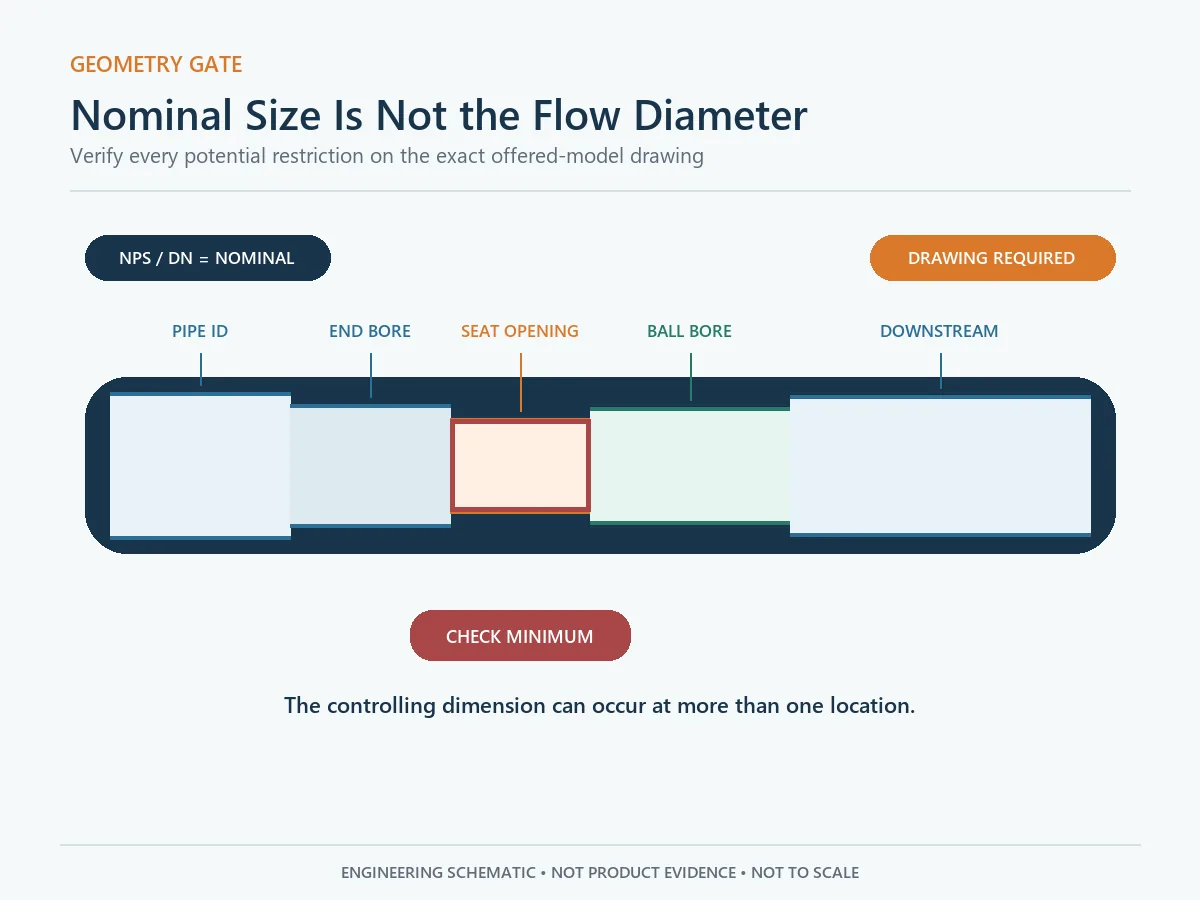
Nominal Size Is Not the Actual Flow Diameter

A valve marked NPS 8 or DN 200 does not automatically provide an 8-inch or 200-millimetre unobstructed passage. The complete route can include the adjoining pipe ID, valve end bore, body transition, seat opening, ball bore and downstream transition. The smallest unobstructed diameter often becomes the controlling dimension.

Pipe inside diameter and ball valve minimum bore comparison
Example geometry showing why nominal size does not replace the actual pipe ID and minimum valve-bore check.
Approval boundary: Where bore continuity, cleaning-device passage or pigging matters, require a minimum-bore dimension on the offered-model drawing. Do not infer the passage from the nameplate size.
Full Port vs Reduced Port Ball Valve Comparison

Selection factor Full port direction Reduced port direction Buyer verification
Internal passage Closer to the adjoining pipe bore Smaller than the adjoining line bore Minimum bore on the drawing
Flow capacity Generally higher for comparable designs Generally lower Exact offered-model Cv
Pressure drop Generally lower at the same flow Generally higher Project hydraulic calculation
Local velocity Lower through the larger passage Higher through the restriction Flow rate and actual bore
Pigging May be suitable after dimensional confirmation Normally unsuitable for full-line pig passage Pig envelope and sectional drawing
Solids passage Larger opening may reduce restriction Smaller opening may increase blockage risk Particle size, concentration and cleaning method
Body envelope May require a larger ball or body May be more compact GA drawing
Weight and cost May be higher May be lower Normalized supplier quotation
Operating torque Product-specific Product-specific Manufacturer torque data

How Port Size Changes Flow Capacity

Flow Area Is Only the First Check

Reducing a circular bore reduces its flow area. At the same volumetric flow rate, fluid velocity increases through the smaller opening. This explains the general direction of the pressure-loss difference, but bore area alone does not determine final performance.

Seat geometry, body transitions, port alignment, surface condition, end connections, viscosity, Reynolds number, gas compressibility and adjoining piping can all affect the result.

Use the Exact Offered-Model Cv

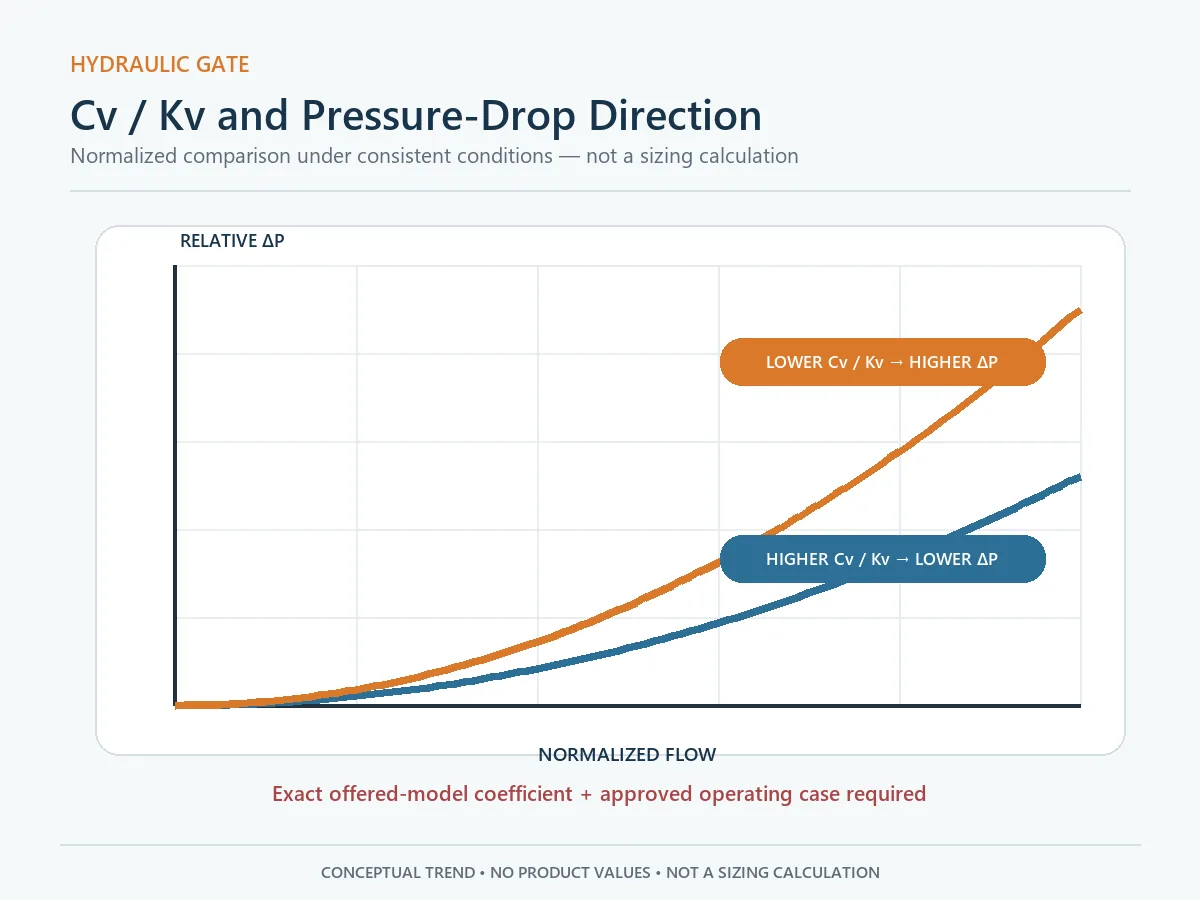
Cv represents valve flow capacity under defined reference conditions. For the same liquid and operating basis, a higher Cv generally corresponds to lower valve pressure loss. The value used for comparison should belong to the exact offered valve size, body series, pressure class, end connection and port design.

A generic online table is not product evidence. Two valves carrying the same nominal size and the same “full port” description can still have different body transitions and different Cv values.

Higher Cv and lower Cv ball valve pressure drop trend
Example liquid-flow trend under the same conditions. Normalized axes are used; this is not a product-sizing calculation.

Full Port Does Not Mean Zero Pressure Drop

A full port valve is still a component in the piping system. Flow can encounter local geometry changes at the valve ends, seats, body cavity and bore transitions. A verified full port design may reduce restriction compared with a reduced port alternative, but it does not create zero pressure loss.

Pressure Drop: What Must Be Calculated?

The relevant question is not merely whether reduced port creates more pressure drop. The project must determine whether the additional loss is acceptable within the complete system.

Process inputs

  • Minimum, normal and maximum flow
  • Medium and phase
  • Density or specific gravity
  • Viscosity
  • Operating pressure and temperature

System inputs

  • Actual pipe inside diameter
  • Available pump or compressor margin
  • Required downstream pressure
  • Total line loss
  • Future-capacity cases

Valve inputs

  • Exact-model Cv
  • Minimum bore
  • Port configuration
  • Fully open condition
  • Allowable valve pressure drop

Liquid Service

For a single-phase liquid under an applicable non-choked calculation method, a lower Cv results in a higher pressure drop at the same flow and fluid properties. Supplier comparisons must use a consistent flow case, fluid basis, units and fully open Cv.

Simple Liquid Estimate — Limited Use

For a preliminary single-phase incompressible-liquid estimate in compatible US units:

ΔP = SG × (Q / Cv)² Q = flow in US gpm; ΔP = valve pressure drop in psi; SG = liquid specific gravity; Cv = fully open flow coefficient for the exact offered valve.

This simplified relationship is not a gas, steam, flashing, high-viscosity, slurry or multiphase sizing method. Final review should use the project-approved calculation method and offered-model data.

Gas and Steam Service

Compressible flow requires inlet pressure, outlet pressure, temperature, gas properties and an applicable sizing method. A simple liquid relationship should not be transferred directly to gas or steam, particularly where a high pressure ratio or critical-flow condition may occur.

Viscous, Slurry and Multiphase Service

Published clean-fluid Cv data may not complete the review for high-viscosity liquids, slurries or multiphase streams. Viscosity correction, solids, settling, erosion, flashing, gas release and phase distribution may require additional engineering analysis.

When a System-Level Hydraulic Review Is Required

A simple comparison of two catalog Cv values may be insufficient when the valve can materially affect the complete system. Escalate the review where any of the following applies:

  • The valve is on a pump suction line or a system with limited available head.
  • The downstream equipment has a minimum required inlet pressure.
  • The line includes several valves or restrictions whose losses accumulate.
  • The project is evaluating increased future throughput.
  • The fluid is compressible, highly viscous, flashing, multiphase or solids-bearing.
  • The operating range includes startup, cleaning, upset or low-temperature cases.
  • The cost of additional energy or lost production is significant relative to the valve-price difference.
Decision boundary: pressure class confirms neither adequate Cv nor acceptable system pressure loss. Hydraulic performance and pressure-containing capability are separate approval questions.

Local Velocity, Erosion and Fouling

At the same volumetric flow, the smaller passage in a reduced port valve creates higher local velocity. This can matter for abrasive solids, catalyst fines, sand, scale, crystals, fibres, sludge and fluids that tend to deposit around the seats or body cavity.

Port size does not determine erosion resistance by itself. Particle concentration, hardness, impact angle, differential pressure, material hardness, seat design, orientation and operating duration must also be reviewed. Full port does not eliminate erosion, and reduced port is not automatically unsuitable for every solids-bearing service.

Pigging: Why “Full Port” Is Not Enough

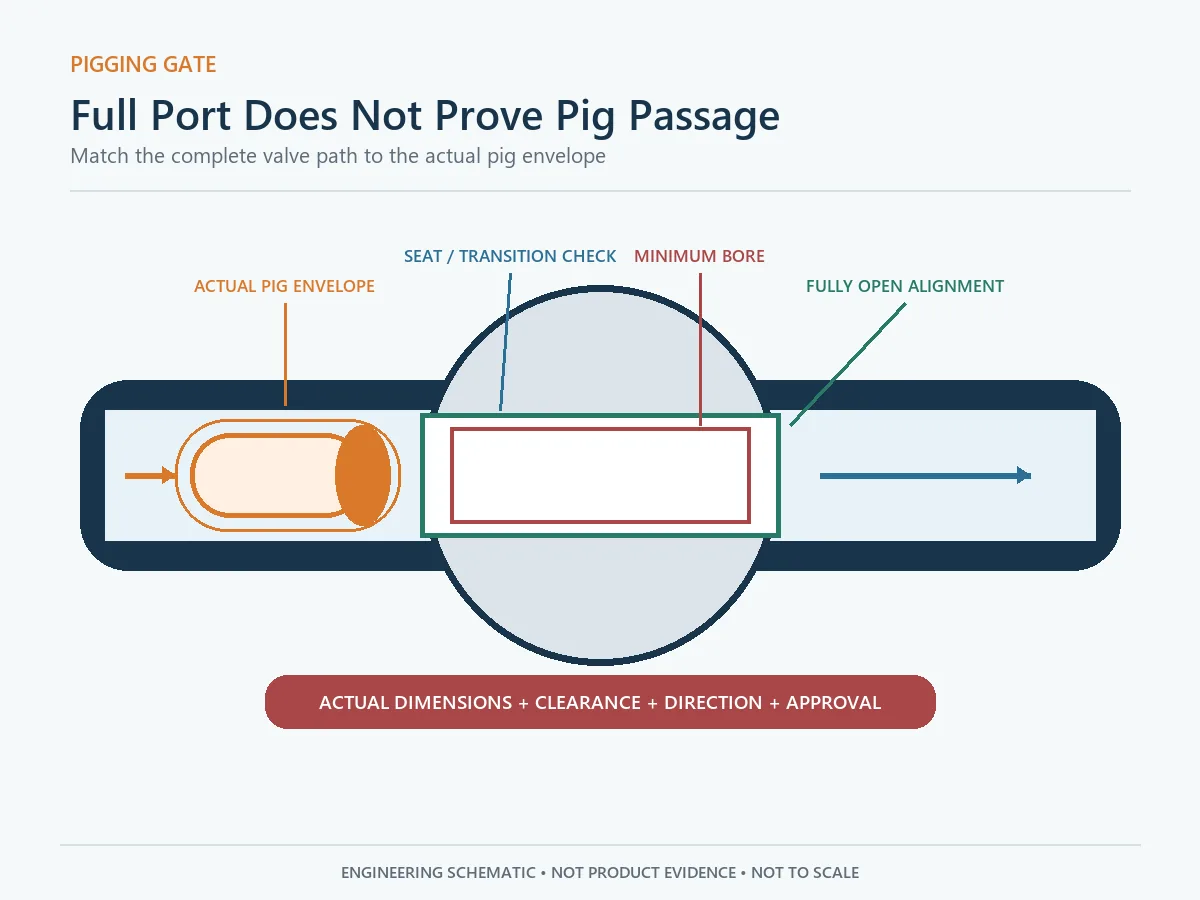
Pigging is one of the strongest reasons to specify a full-bore direction, but the actual pig must pass through the valve’s complete internal geometry. The controlling envelope may include the pig body, cups, discs, brushes, magnets, gauges, centralizers or inspection instrumentation.

Pig clearance through a full bore ball valve
Engineering schematic of the pig envelope, minimum ball bore, seat opening, end transition and fully open alignment. Project dimensions remain required.

Verify the Complete Passage

The technical review should check the minimum ball bore, seat inside diameter, valve end bore, weld-end transition, internal projections, ball-to-body alignment and downstream transition. The smallest dimension in that route can control pig passage.

Confirm the Fully Open Position

An adequate ball bore can still become an obstruction if the valve does not reach the correct fully open position. For gear- or actuator-operated valves, review the open stop, actuator travel stop, stem-to-ball alignment, position indication and commissioning setting.

Piggable Does Not Mean Suitable for Every Pig

A flexible foam pig and a rigid instrumented inspection pig do not impose the same clearance requirement. Technical approval should identify the pig type, maximum envelope, required clearance, travel direction and supplier assumptions.

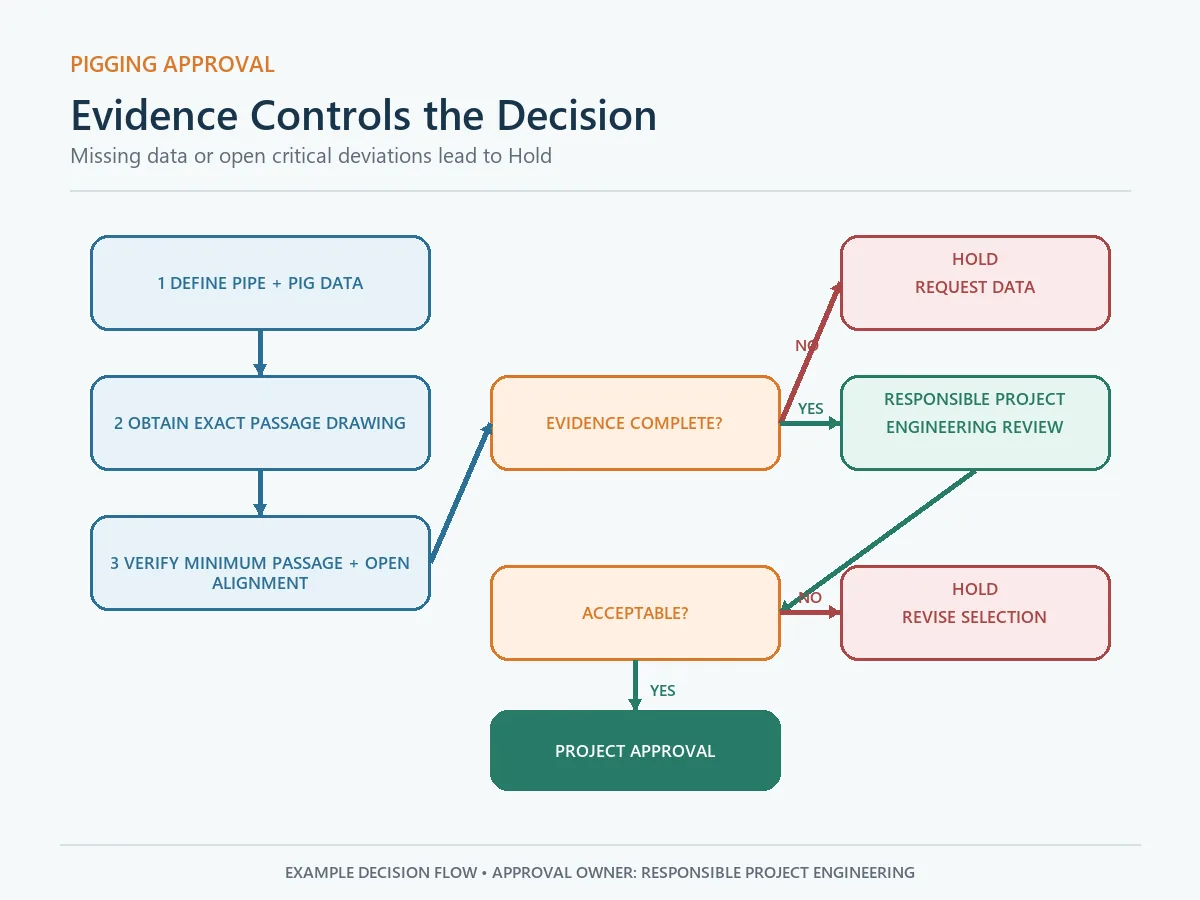
Ball valve pigging approval flow with hold and approval branches
Revised approval flow: incomplete evidence or unresolved critical deviations lead to Hold; only complete and acceptable evidence proceeds to engineering approval.

Pigging Approval Gate

  1. Confirm the pipe size, schedule and actual inside diameter.
  2. Confirm the pig type and maximum operating envelope.
  3. Obtain the offered valve’s sectional or minimum-bore drawing.
  4. Identify the smallest unobstructed passage.
  5. Review the seat and end-transition geometry.
  6. Confirm the fully open stop position.
  7. Confirm the required direction of pig travel.
  8. Obtain written manufacturer confirmation against the stated pig data.
  9. Record technical deviations.
  10. Complete project engineering approval.
Standards boundary: API Specification 6D and ISO 14313 provide relevant pipeline-valve design, manufacturing, testing and documentation context where adopted by the project. A standard reference does not replace the offered-model bore drawing, pig envelope or written pigging confirmation.

Size, Cost and Actuation Trade-Offs

A full port valve may require a larger ball, body envelope, support load and installation space. A reduced port offer may be smaller or less expensive, but only after the buyer normalizes body construction, pressure class, materials, seats, testing, documentation and actuation.

  • Compare exact GA dimensions and weight rather than assuming them from port terminology.
  • Do not treat a lower reduced-port price as a saving until hydraulic and pigging requirements pass.
  • Do not infer torque from port type; request breakaway, running and ending torque for the exact offered model.
  • For actuated valves, confirm differential pressure, temperature, fail position, supply conditions, operating time and design margin.

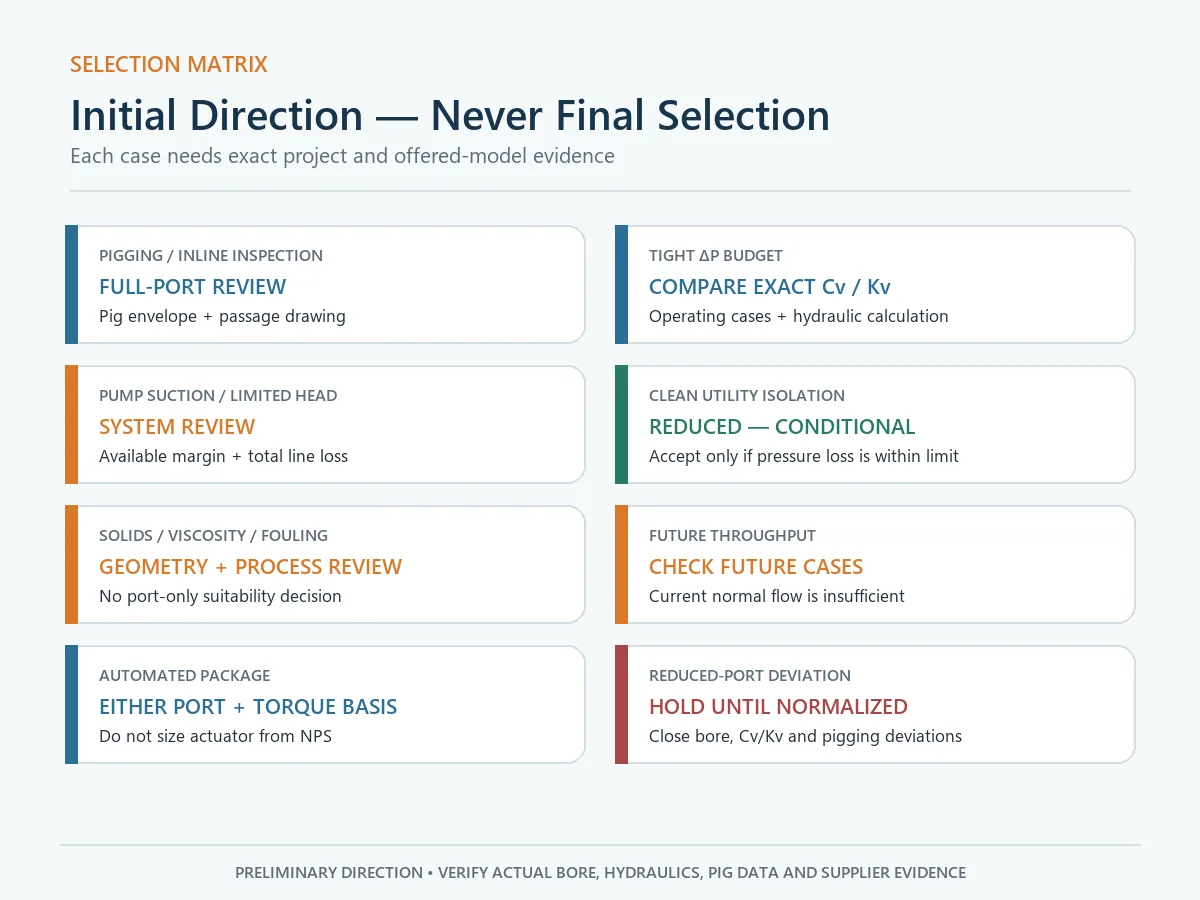
Preliminary Selection Matrix

Full port and reduced port ball valve selection matrix
Preliminary direction only. Confirm actual bore, exact-model Cv, allowable pressure drop, pig envelope and supplier drawings.

The matrix is a preliminary direction only. Any case involving gas, steam, abrasive solids, uncertain future pigging or missing Cv/bore data requires additional engineering review.

Wrong Selection Consequence and Verification Matrix

This matrix helps engineering and procurement teams connect an apparently minor port-choice error with the evidence required to prevent it.

Selection error Possible project consequence Evidence to check Approval action
Reduced port accepted where pressure-loss margin is limited Lower downstream pressure, reduced throughput or additional energy demand Exact Cv, maximum-flow case and system pressure balance Recalculate before award
“Full port” assumed to mean piggable Pig damage, obstruction or inability to complete inspection or cleaning Pig envelope, sectional drawing, minimum passage and open-stop details Hold until written confirmation
Nominal size treated as actual bore Unexpected transition, local velocity increase or passage mismatch Pipe schedule, actual pipe ID and minimum valve bore Normalize dimensions
Generic Cv used instead of offered-model data Incorrect pressure-drop comparison and false technical equivalence Manufacturer Cv for the exact size, class, body series and port Reject estimated value
Torque inferred from port type Undersized actuator, incomplete travel or unreliable fail action Breakaway, running and ending torque with stated basis Complete actuator review
Lowest price selected before technical normalization Commercial saving based on a smaller bore, reduced documentation or different scope Normalized bid table and technical-deviation schedule Compare like-for-like scope

Approval Data and Supplier Evidence

For approval, the project team should keep the process, piping, valve, pigging and supplier-evidence fields together in one controlled record. The value must identify the exact offered model where bore, Cv, torque or passage geometry is an approval point.

Minimum Approval Record

Approval field Required supplier or project evidence Why it changes the decision
Pipe ID basis NPS/DN, schedule and actual inside diameter Defines the adjoining passage used for comparison
Minimum valve bore Dimension on the exact offered-model drawing Identifies the smallest stated passage
Flow capacity Fully open Cv for the offered size, class and port Supports normalized pressure-drop review
Operating cases Minimum, normal and maximum flow with fluid data Prevents approval at one convenient condition
Allowable valve ΔP Project limit or documented system allocation Determines whether a reduced port can be accepted
Pig passage Pig envelope, sectional drawing and open-stop details Confirms the complete unobstructed route
Torque and actuation Breakaway, running and ending torque with stated basis Supports gearbox or actuator review
Materials and rating Material list and pressure-temperature data Confirms that flow geometry is not the only approval gate
Testing and documents Included inspection, test and document scope Normalizes technical and commercial offers
Deviations Explicit deviation schedule with resolution status Prevents unrecorded port or scope substitution
Standard scope: ASME B16.34 covers areas such as pressure-temperature ratings, materials, dimensions, examination, testing and marking for valves within its scope. It does not provide the offered valve’s Cv or prove pig passage suitability.

Technical Bid Normalization

Procurement should not compare the commercial totals until each quotation has been placed on the same technical basis. The following fields are particularly important where one supplier proposes full port and another proposes reduced port.

Bid comparison field Supplier A Supplier B Normalization requirement
Port designation State offered term State offered term Do not treat terminology as dimensional equivalence
Minimum bore Enter millimetres Enter millimetres Compare with the same pipe ID and project minimum
Exact-model Cv Enter offered value Enter offered value Use the same fluid and flow cases for ΔP review
Pigging confirmation Confirmed / excluded / conditional Confirmed / excluded / conditional Record the same pig envelope and direction
Valve construction Floating/trunnion, body pattern Floating/trunnion, body pattern Identify changes that affect size, torque and price
Materials and seats Offered specification Offered specification Confirm equal service and leakage basis
Testing and documents Included scope Included scope Separate exclusions from price differences
Actuation basis Torque and actuator data Torque and actuator data Compare the same differential pressure, fail action and margin
Deviation status Open / closed Open / closed Do not award while critical port or pigging deviations remain open
Commercial control: a lower reduced-port price is not a saving if the offer fails the required pressure-drop, pigging or future-throughput condition. Technical equivalence should be established before commercial ranking.

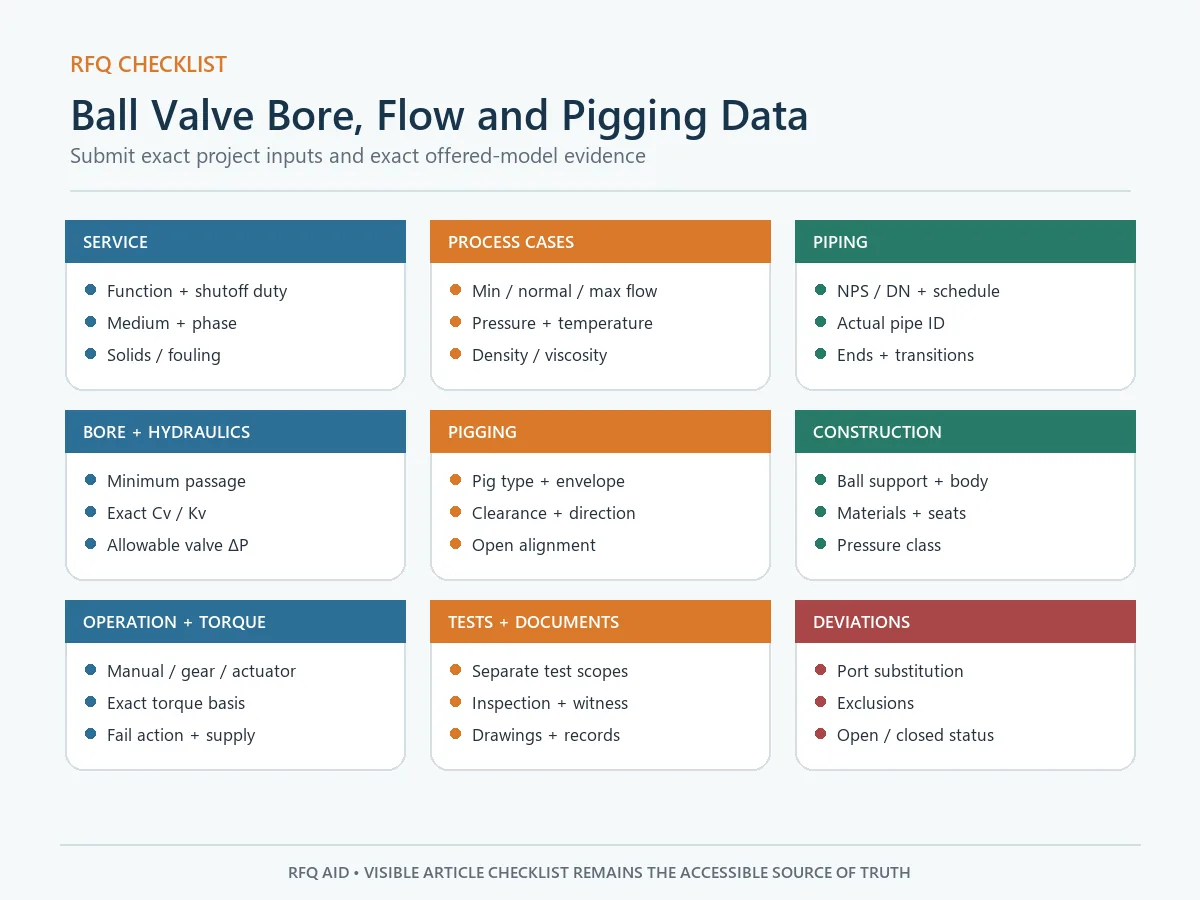
Ball Valve Port and Flow RFQ Checklist

Ball valve bore flow and pigging RFQ checklist
Revised RFQ checklist with safe text margins and a normalized set of process, piping, valve, pigging and supplier-evidence inputs.

A normalized RFQ should define the following groups:

  • Function and service: valve duty, medium, phase, flow range, pressure, temperature, viscosity, solids and fouling.
  • Piping: NPS/DN, schedule, actual pipe ID, end connection and adjacent transitions.
  • Port performance: port requirement, minimum unobstructed bore, exact-model Cv and allowable valve ΔP.
  • Pigging: pig type, maximum envelope, required clearance and travel direction.
  • Construction: floating/trunnion design, pressure class, materials, seats and seals.
  • Operation: manual, gear or actuator method plus exact torque data where applicable.
  • Evidence: GA drawing, sectional drawing, test scope, documents and written pigging confirmation.
  • Commercial control: explicit technical deviations and exclusions.

Decision Summary

Use a verified full-port direction when pigging, minimum passage, low pressure loss or cleaning-device passage is mandatory. Accept a reduced-port direction only when pigging is excluded and the exact-model Cv, calculated pressure drop and local velocity remain within the project limits.

Hold technical approval when: the minimum bore, exact-model Cv, pipe schedule, allowable pressure drop, pig envelope, passage drawing, critical deviation status or required actuator torque data is missing.
Do not approve a port designation. Approve a documented bore, verified flow capacity and confirmed service condition.

Request Ball Valve Port and Flow Review

Send the project datasheet, piping information and supplier offer for a preliminary port-design review. The review can identify missing bore, Cv, pigging and bid-normalization data before technical approval.

  • Medium and phase
  • Flow range
  • Operating and design pressure
  • Operating and design temperature
  • Allowable valve pressure drop
  • Pipe size, schedule and inside diameter
  • Valve size and pressure class
  • Required minimum bore
  • Pig type and maximum OD
  • Solids, viscosity and fouling conditions
  • End connection and actuation method
  • Required drawings, tests and documents
Request Port and Flow Review

Raymon Valve can review the completeness and consistency of submitted data. Final hydraulic approval and project acceptance remain with the responsible project engineering team.

Final selection remains subject to the complete datasheet, piping specification, offered-model information and project engineering approval.

Frequently Asked Questions

Is a full port ball valve the same as a full bore ball valve?

The terms are often used for the same general design direction, but buyers should rely on the stated minimum bore and offered-model drawing rather than terminology alone.

Does a full port ball valve have zero pressure drop?

No. A full port design can reduce restriction compared with a smaller-bore alternative, but seats, body transitions and other internal geometry still produce pressure loss.

Can a pig pass through every full port ball valve?

No. Passage depends on the minimum unobstructed bore, seat geometry, end transitions, fully open alignment and the dimensions and flexibility of the actual pig.

When is a reduced port ball valve acceptable?

It may be acceptable when pigging is not required and calculations confirm that pressure drop, local velocity and total system performance remain within project limits.

Does reduced port always mean lower cost and torque?

No. Cost and torque also depend on valve construction, pressure class, materials, seats, differential pressure, temperature and operating conditions.

What should an RFQ state besides full port or reduced port?

The RFQ should state the required minimum bore, pipe schedule, flow rate, allowable pressure drop, exact-model Cv requirement, pig data, materials, pressure class, operation method and required drawings.

Can a reduced port valve be used with solids?

Possibly, but the decision requires review of particle size, concentration, velocity, erosion, blockage, seat design and cleaning requirements.

Is a full port valve always the better choice?

No. Full port can be justified by pressure-drop, bore-continuity or pigging requirements, but it may add size, weight or cost without meaningful system benefit in some duties.

Engineering Note and Limits

  • This page provides preliminary comparison and RFQ guidance, not final hydraulic sizing.
  • No Raymon Valve product-specific Cv, bore, torque, weight, pressure-drop or cost values are assumed.
  • Liquid, gas, steam, viscous, slurry and multiphase services may require different calculation methods.
  • Pigging approval requires the actual pig envelope and offered-valve passage drawing.
  • Mention of API, ISO or ASME standards does not prove that a specific product is certified or suitable.
  • Material, seat and actuator selection require separate project data and manufacturer confirmation.
  • Supplier evidence should reference the exact offered model; general catalog statements are insufficient where bore, Cv, torque or pigging is an approval point.

For company and supply information, see About Raymon Valve.

Official Reference Scope

Share:

Leave a Comment

Your email address will not be published. Required fields are marked *

want totalk
with us?

Leave your details and one of our experts will contact you!

en_USEnglish
Scroll to Top

Contact us

Please fill out this form with a brief description of your issue and we will get back to you as soon as possible.