
Auswahlhilfe für Kugelhähne mit Flansch: Konstruktion, Normen, Werkstoffe und Anwendungen
Ein Flansch-Kugelhahn wird üblicherweise ausgewählt, wenn ein Rohrleitungssystem ein robustes, austauschbares und standardisiertes Absperrventil benötigt. In der Wasseraufbereitung, Öl und Gas, chemischen Verarbeitung, Energieerzeugung, HLK, im maritimen Einsatz und in allgemeinen Industrieleitungen erleichtern Flanschverbindungen die Installation, Inspektion, Entfernung und den Austausch des Ventils im Vergleich zu geschweißten oder Gewindeanschlüssen.
Das bedeutet jedoch nicht, dass jeder Flansch-Kugelhahn austauschbar ist. Ein Ventil mit der richtigen Nennweite kann im Betrieb immer noch ausfallen, wenn die Druckstufe, die Flanschbohrung, das Sitzmaterial, das Gehäusematerial, die Bohrungsart, die Einbaulänge, das Antriebsdrehmoment oder die Prüfanforderung nicht an die tatsächlichen Betriebsbedingungen angepasst sind.
Eine fehlerhafte Auswahl führt meist zu vorhersehbaren Problemen: Flansch-Fehlanpassung bei der Installation, Sitzleckage nach der Inbetriebnahme, Antriebsblockade unter Differenzdruck, Probleme mit der Dichtung oder schnelle Sitzbeschädigung, weil ein Standard-Absperrventil in Hochtemperatur-, abrasiven oder Drosselungsanwendungen eingesetzt wurde.
Dieser Leitfaden zur Auswahl von Flansch-Kugelhähnen konzentriert sich auf die Fragen, die Ingenieure, Einkäufer, Wartungsteams und QS-Personal vor dem Kauf eines Flansch-Kugelhahns für industrielle Anwendungen klären sollten. Wenn Sie das komplette Armaturen-Paket und nicht nur den Armaturenkörper prüfen, lesen Sie auch verwandte Seiten wie Kugelhähne, Flansch-Kugelhähne, Schwimmend gelagerte Kugelhähne, ZapfengelagerterKugelhahns, und metallisch dichtende Kugelhähne.
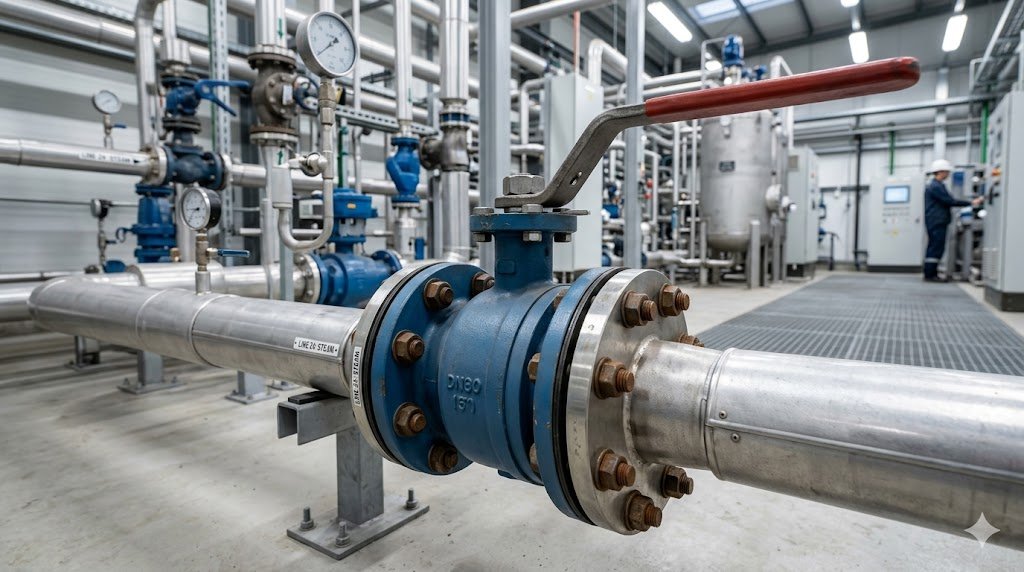
Schnellauswahl-Übersicht
| Einsatzbedingungen | Typischer Ausgangspunkt | Was die Entscheidung normalerweise beeinflusst | Was häufig schiefgeht |
|---|---|---|---|
| Allgemeiner Wasser-, Luft-, Versorgungs- und Niederdruck-Industriedienst | Schwimmend gelagerter Kugelhahn mit Flanschanschluss und Weichsitz | Kosten, Absperrleistung, Flanschkompatibilität, Temperaturgrenze des Sitzes, einfache Wartung | Ventil nur nach Größe ausgewählt, ohne Überprüfung des Sitzmaterials oder des Flanschstandards |
| Mitteldruck-Öl-, Gas- oder Prozessisolierung | Schwimmend gelagerter oder zapfengelagerter Kugelhahn mit Flanschanschluss | Druckstufe, Bohrungstyp, Firesafe-Anforderung, antistatisches Design, Absperrzuverlässigkeit | Schwimmende Ausführung, wenn das Drehmoment für den manuellen Betrieb zu hoch wird |
| Großdimensionierte oder Hochdruck-Rohrleitungsdienste | Zapfengelagerter Kugelhahn mit Vollbohrung und Flanschen | Betriebsdrehmoment, Kugelunterstützung, Vollbohrungsanforderung, Antriebsdimensionierung, Rohrleitungsstandard | Reduzierte Bohrung oder falsches Anbaumaß führt zu Installations- oder Molchproblemen |
| Korrosive chemische Medien | Kugelhahn mit Flanschen aus Edelstahl, Duplex oder Legierung | Gehäuse-, Kugel-, Schaft-, Sitz-, Dichtungs- und Packungskompatibilität | Gehäusewerkstoff geprüft, aber Sitz- und Packungsmaterialien generisch belassen |
| Hochtemperatur-, abrasiver oder verschmutzter Dienst | Kugelhahn mit Flanschen und metallischer Dichtung | Sitzverschleiß, Temperaturbeständigkeit, Leckageklasse, Antriebsdrehmoment | Weichdichtung außerhalb ihres Einsatzbereichs verwendet |
| Automatisierte Absperrung oder Fernsteuerung | Pneumatisch oder elektrisch betätigter Kugelhahn mit Flanschen | Anlaufdrehmoment, Differenzdruck, Sicherheitsfaktor, Signalart, Betriebsgeschwindigkeit | Antrieb nur anhand des Katalogdrehmoments dimensioniert, ohne Korrektur für reale Betriebsbedingungen |
| Austausch bestehender Rohrleitungen | Gleicher Flanschstandard, Anbaulänge, Bohrung, Druckstufe und Betriebsart | Installationskompatibilität | Neuer Ventil passt zur Nennweite, lässt sich aber nicht zwischen bestehende Flansche einbauen |
Was ist ein Flansch-Kugelhahn?
Ein Kugelhahn mit Flanschen ist ein Vierteldrehungs-Absperrventil mit beidseitigen Flanschen am Ventilkörper. Er wird zwischen zwei passenden Rohrflanschen mittels Schrauben, Muttern und Dichtungen montiert. Wenn der Schaft die Kugel um 90 Grad dreht, richtet sich die Bohrung in der Kugel entweder mit der Rohrleitung aus, um den Durchfluss zu ermöglichen, oder dreht sich senkrecht zum Durchfluss, um die Leitung zu sperren.
Der Hauptzweck eines Kugelhahns mit Flanschen ist die Ein-Aus-Absperrung. Standard-Kugelhähne werden normalerweise nicht als Präzisions-Drosselventile ausgewählt, da eine teilweise Öffnung bei bestimmten Medien zu hoher Geschwindigkeit, Sitzerosion, Vibrationen, Kavitation oder instabiler Durchflussregelung führen kann.
Ein typischer Kugelhahn mit Flanschen umfasst:
- Ventilkörper
- Kugel
- Spindel
- Dichtringe
- Körperdichtungen
- Spindelabdichtung
- Flanschanschlüsse
- Dichtflächen
- Hebel, Getriebe, pneumatischer Antrieb oder elektrischer Antrieb
Für den industriellen Einsatz werden Flansch-Kugelhähne üblicherweise in schwebender oder zapfengelagerter Ausführung, in Vollbohrung oder reduzierter Bohrung sowie mit weichdichtenden oder metallisch dichtenden Systemen geliefert. Die richtige Wahl hängt von der Leitungsgröße, dem Druck, der Temperatur, dem Medium, der erforderlichen Absperrfunktion, dem Einbauraum, dem Wartungsplan und dem Projektstandard ab.
Warum die Auswahl von Flansch-Kugelhähnen mehr Aufmerksamkeit erfordert
Ein Flansch-Kugelhahn sieht von außen einfach aus, aber seine Betriebsleistung hängt von mehreren Details ab, die zusammenarbeiten. Die Flanschverbindung muss zur Pipeline passen. Das Gehäusematerial muss Druck, Temperatur und Medium standhalten. Das Sitzmaterial muss das tatsächliche Medium überstehen. Die Betätigungsart muss genügend Drehmoment liefern. Der Prüfstandard muss der Projektvorgabe entsprechen.
Im Feld entstehen viele Ventilprobleme nicht nur durch mangelhafte Fertigung. Sie resultieren oft aus unvollständigen Spezifikationen.
Zum Beispiel:
- Die Bestellung lautet “Flansch-Kugelhahn DN100 Class 150”, spezifiziert aber nicht die Flanschbohrung nach ASME, EN oder JIS.
- Der Ventil wird mit PTFE-Sitzen bestellt, aber die tatsächliche Betriebstemperatur ist höher als erwartet.
- Ein Kugelhahn mit reduziertem Durchgang wird installiert, wo die Pipeline eine volle Durchgangsbohrung für die Rohrinspektion (Pigging) erfordert.
- Ein manuell betätigter Hebelventil wird gekauft, aber das tatsächliche Drehmoment erfordert ein Getriebe.
- Ein weichdichtender Ventil wird in schmutzigen oder abrasiven Medien eingesetzt und verliert schnell seine Dichtheit.
Aus diesem Grund sollte ein Flansch-Kugelhahn als komplettes Ventilpaket ausgewählt werden, nicht nur als einfaches Artikel mit Größe und Druckstufe.
Technische Anmerkung: In der praktischen Beschaffung ist “Flansch-Kugelhahn, DN100, PN16” keine vollständige Spezifikation. Mindestens sollte der Käufer die Ventilbauart, den Flanschstandard, den Flanschtyp, die Druckstufe, das Gehäusematerial, das Innengarniturmaterial, das Sitzmaterial, den Bohrungstyp, den Prüfstandard und die Betätigungsart definieren.
Hauptbauarten von Flansch-Kugelhähnen
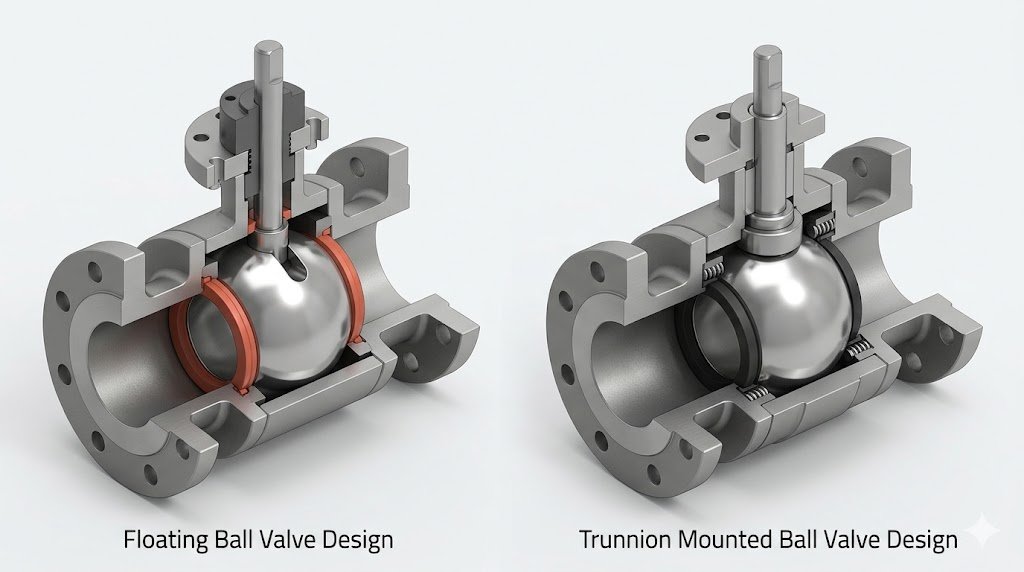
Schwimmend gelagerter Flansch-Kugelhahn
Ein schwimmend gelagerter Flansch-Kugelhahn verwendet eine Kugel, die von den Sitzen gehalten wird, anstatt von Zapfen fixiert zu sein. Unter Leitungsdruck bewegt sich die Kugel leicht zum stromabwärtigen Sitz, wodurch ein druckunterstützter Dichtungseffekt entsteht.
Dieses Design wird häufig für kleine bis mittlere Größen und niedrige bis mittlere Druckstufen verwendet.
Typische Anwendungen umfassen:
- Wassersysteme
- Druckluft
- Brennstoffgas
- Allgemeiner Ölservice
- HLK-Rohrleitungen
- Leichter chemischer Service
- Absperrung von Versorgungsleitungen
Die Hauptvorteile sind kompakte Bauweise, zuverlässige Abdichtung, einfaches Design und relativ wirtschaftliche Kosten. Wenn jedoch die Ventilgröße und der Druck steigen, nimmt auch die Kraft zu, die die Kugel gegen den nachgeschalteten Sitz drückt. Dies kann das Betätigungsmoment erhöhen und die manuelle Bedienung erschweren.
Auswahlhilfe: Schwimmend gelagerte Kugelhähne sind für viele allgemeine Industrieanwendungen praktikabel, aber für größere Größen, hohe Differenzdrücke oder automatisierte Anwendungen sollten die Drehmomentdaten überprüft werden, bevor der Antrieb oder das Getriebe bestätigt wird.
Zapfengelagerter Flansch-Kugelhahn
Ein zapfengelagerter Flansch-Kugelhahn verwendet obere und untere mechanische Stützen, um die Kugel in einer festen Position zu halten. Anstatt dass die Kugel zur nachgeschalteten Dichtung schwimmt, bewegen federbelastete oder druckunterstützte Dichtungen auf die Kugel zu, um die Abdichtung zu bilden.
Dieses Design wird häufig für große Nennweiten, Hochdruckanwendungen und Pipeline-Anwendungen ausgewählt.
Typische Anwendungen umfassen:
- Öl- und Gaspipelines
- Erdgastransport
- Petrochemische Anlagen
- Hochdruck-Prozessleitungen
- Wasser- oder Versorgungssysteme mit großem Durchmesser
- Isolierung von Lagerterminals
- Kompressorstationen
Der Hauptvorteil ist ein geringeres Betätigungsdrehmoment im Vergleich zu einem gleich großen, schwimmend gelagerten Kugelhahn. Die Zapfenkonstruktion verbessert auch die Kuglstabilität unter hohem Differenzdruck.
Auswahlhilfe: Wenn die Ventildimension, die Druckstufe oder das Betätigungsdrehmoment zu einem Problem werden, sollte die zapfengelagerte Konstruktion vor der Auftragserteilung geprüft werden. Dies ist besonders wichtig für Klasse 300 und höher, Leitungen mit großem Durchmesser, Gasleitungen oder Notabschaltanwendungen.
Vollbohrungs-Kugelhahn mit Flanschen
Ein Vollbohrungs-Kugelhahn mit Flanschen hat eine Kugelbohrung, die nahe am Innendurchmesser des Rohrs liegt. Dies reduziert den Strömungswiderstand und den Druckabfall.
Vollbohrungsventile werden häufig ausgewählt, wenn das System Folgendes erfordert:
- Geringer Druckabfall
- Hohe Durchflusskapazität
- Pipeline-Pigging
- Reinigungzugang
- Weniger Turbulenzen durch das Ventil
- Bessere Strömungskontinuität
Die Vollbohrungskonstruktion ist besonders wichtig in Öl- und Gaspipelines oder Prozessleitungen, wo interne Reinigungswerkzeuge das Ventil passieren müssen.
Reduzierte Bohrung Flansch Kugelhahn
Ein Kugelhahn mit reduzierter Bohrung und Flanschen hat eine kleinere Bohrung als der Innendurchmesser der Pipeline. Er ist in der Regel kompakter, leichter und wirtschaftlicher als ein Vollbohrungsventil.
Reduzierte Bohrungsventile sind geeignet, wenn:
- Das Ventil hauptsächlich zur Absperrung verwendet wird
- Ein geringer Druckverlust akzeptabel ist
- Keine Rohreinigung (Pigging) erforderlich ist
- Kosten und Gewicht kontrolliert werden müssen
- Der Platz begrenzt ist
Auswahlhinweis: Ersetzen Sie kein Vollbohrungsventil durch ein reduziertes Bohrungsventil, es sei denn, der Systemingenieur bestätigt, dass die Anforderungen an Druckverlust, Durchflussrate, Rohreinigung (Pigging) und Wartung akzeptabel sind.
Wichtige Normen für Flansch-Kugelhähne
Die korrekte Auswahl der Normen ist einer der wichtigsten Teile der Beschaffung von Flansch-Kugelhähnen. Ein Ventil kann äußerlich korrekt aussehen, aber dennoch ungeeignet sein, wenn die Konstruktionsnorm, die Flansch-Norm, die Prüfnorm und die Anbaulängen nicht den Projektanforderungen entsprechen.
| Standard | Hauptzweck bei der Auswahl von Flansch-Kugelhähnen | Was es in der Praxis beeinflusst |
|---|---|---|
| ASME B16.34 | Armaturen – mit Flansch-, Gewinde- und Schweißenden | Druck-Temperatur-Zuordnung, Werkstoffe, Wanddicken, Prüfung, Kennzeichnung und Konstruktionsanforderungen |
| API 608 | Metall-Kugelhähne mit Flansch-, Gewinde- und Schweißenden | Konstruktionsanforderungen für Kugelhähne für Erdöl-, Petrochemie- und Industrieanwendungen |
| API 6D | Pipeline- und Rohrleitungsarmaturen | Kugelhähne, Absperrschieber, Rückschlagventile, Schieberventile, Anforderungen an Herstellung und Dokumentation |
| ISO 17292 | Metall-Kugelhähne für Erdöl-, Petrochemie-, Erdgas- und verwandte Industrieanwendungen | Kugelhahn-Größen, Druckstufen, Bohrungstypen, Werkstoffe, Inspektions- und Prüfumfang |
| API 598 | Ventilinspektion und Druckprüfung | Gehäuseprüfung, Dichtheitsprüfung, Inspektion, Zusatzprüfung und Druckprüfungsanforderungen |
| ASME B16.5 | Rohrflansche und Flanschverbindungen | Flanschabmessungen, Druck-Temperatur-Werte, Werkstoffe, Toleranzen, Kennzeichnung und Prüfung |
| ASME B16.10 | Anschlussmaße und Einbaulängen von Armaturen | Installationskompatibilität bei Ersatz- und Nachrüstprojekten |
| ISO 5211 | Anbauteile für Drehantriebe | Montageflansch und Antriebsschnittstelle für Getriebe, pneumatische und elektrische Antriebe |
Regel für die Auslegung: Geben Sie niemals nur “Kugelhahn mit Flanschen” an. Bestätigen Sie immer den Armaturendesignstandard, den Flanschstandard, die Druckklasse, die Einbaulänge, den Prüfstandard und die Dokumentationsanforderung.
Auswahl von Flanschstandard und Druckstufe
Der Flanschanschluss muss mit dem Rohrleitungssystem übereinstimmen. Dies umfasst Druckstufe, Lochkreis, Flanschdichtfläche, Dichtungstyp und Maßnorm.
Gängige Druckstufen umfassen:
- ASME Klasse 150
- ASME Klasse 300
- ASME Klasse 600
- ASME Klasse 900
- ASME Klasse 1500
- ASME Klasse 2500
- PN16
- PN25
- PN40
- PN63
- PN100
Der Nenndruck sollte nicht allein nach dem Druck ausgewählt werden. Die Temperatur beeinflusst auch den zulässigen Arbeitsdruck. Ein Ventilkörperwerkstoff kann bei erhöhter Temperatur andere Druck-Temperatur-Grenzwerte haben als bei Umgebungstemperatur. Deshalb kann nicht automatisch davon ausgegangen werden, dass ein Ventil der Klasse 150 bei Raumtemperatur für denselben Druck bei hoher Temperatur geeignet ist.
Vor der Bestellung bestätigen:
- Auslegungsdruck
- Auslegungstemperatur
- Betriebsdruck
- Betriebstemperatur
- Möglichkeit von Druckstößen oder Wasserschlägen
- Flanschstandard
- Flanschdichtung
- Dichtungstyp
- Bolzenwerkstoff und Bolzengüte
- Anwendbarer Rohrleitungscode
- Endbenutzer-Projektspezifikation
ASME-, EN-, JIS- und andere Flanschsysteme sind nicht automatisch austauschbar. Ein Ventil, das zu einem Flanschstandard passt, passt möglicherweise nicht zu einer anderen Flanschbohrung oder Dichtfläche. Bei Ersatzprojekten ist auch die Einbaulänge entscheidend, da ein Ventil mit demselben DN/NPS und derselben Druckstufe dennoch zu lang oder zu kurz für die vorhandene Rohrleitung sein kann.
Flanschdichtflächen
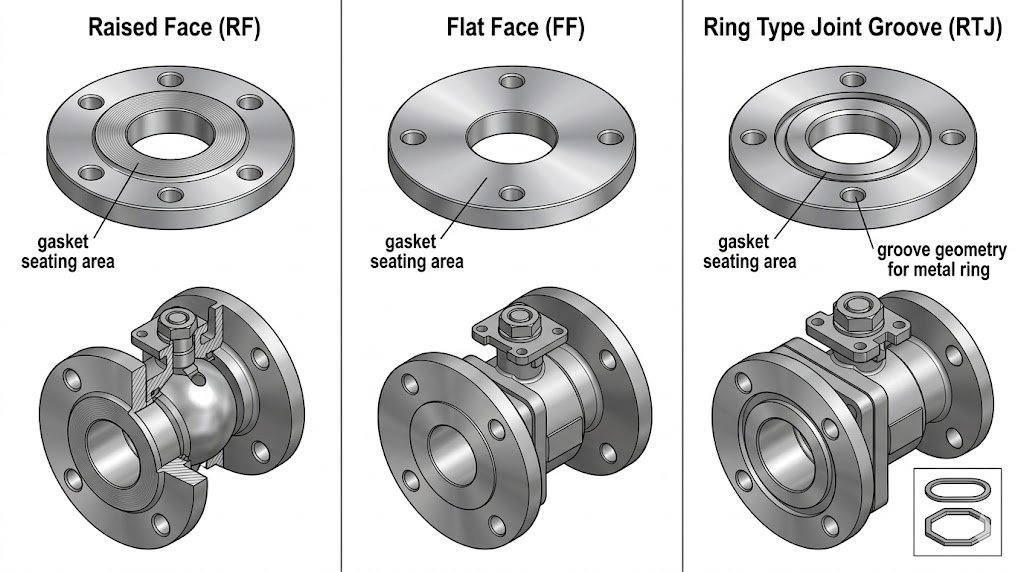
Vorgelagerte Dichtfläche
Vorgelagerte Dichtfläche, oder RF, ist eine der gebräuchlichsten Flanschdichtflächenarten in industriellen Rohrleitungen. Die Dichtfläche für die Dichtung ist gegenüber dem Schraubenbereich erhöht, was hilft, die Dichtungskompression zu konzentrieren.
RF-Flansche werden häufig verwendet in:
- Öl und Gas
- Chemische Verarbeitung
- Kraftwerke
- Allgemeine Industriesysteme
- Wasser- und Versorgungsleitungen
Flansch mit glatter Dichtfläche (FF)
Flansche mit glatter Dichtfläche (FF) werden häufig mit Guss- oder duktilen Eisenrohrkomponenten verwendet. Sie helfen, das Risiko von Biegebelastungen auf spröde Flanschmaterialien zu reduzieren.
FF-Flansche werden häufig verwendet in:
- Wassersysteme
- HLK (Heizung, Lüftung, Klimatechnik)
- Niederdruck-Versorgungsleitungen
- Duktile Gussrohrsysteme
Flansch mit Ringnut (RTJ)
Flansche mit Ringnut (RTJ) werden für höhere Drücke oder anspruchsvollere Betriebsbedingungen eingesetzt. Eine metallische Ringdichtung sitzt in einer maschinell bearbeiteten Nut, um eine starke Druckabdichtung zu erzeugen.
RTJ-Flansche werden häufig verwendet in:
- Hochdruck-Öl- und Gasanwendungen
- Pipelinesystemen
- Schwere Prozessanwendungen
- Hochdruck-Absperrfunktionen
Auswahl des Gehäusematerials
Die Materialauswahl beeinflusst Druckbelastbarkeit, Korrosionsbeständigkeit, Temperaturbereich, Lebensdauer und Kosten. Das Gehäusematerial sollte entsprechend Medium, Druck, Temperatur und Umgebungsbedingungen ausgewählt werden.
Geflanschter Kugelhahn aus Kohlenstoffstahl
Kohlenstoffstahl wird häufig für Öl-, Gas-, Wasser-, Dampf-Hilfssysteme und allgemeine industrielle Anwendungen eingesetzt. Er bietet gute mechanische Festigkeit und eignet sich für viele nicht-korrosive oder leicht korrosive Anwendungen.
Gängige Materialbeispiele sind:
- ASTM A216 WCB Guss-Kohlenstoffstahl
- ASTM A105 Schmiede-Kohlenstoffstahl
Typische Anwendungen:
- Ölleitungen
- Gasleitungen
- Wasserleitungen
- Kraftstoffsysteme
- Allgemeine Anlagenversorgungsleitungen
Kohlenstoffstahl ist wirtschaftlich und robust, kann jedoch eine geeignete Beschichtung, Korrosionszugabe oder eine Überprüfung des internen Materials erfordern, abhängig von der externen Umgebung und dem Prozessfluid.
Edelstahl Kugelhahn mit Flanschanschluss
Edelstahl bietet eine bessere Korrosionsbeständigkeit als Kohlenstoffstahl. Er wird häufig in der chemischen Verarbeitung, für aufbereitetes Wasser, in Systemen mit leicht korrosiven Flüssigkeiten, in maritimen Umgebungen sowie in lebensmittelnahen oder hygienischen Systemen eingesetzt, sofern die geltenden Konstruktionsnormen erfüllt sind.
Gängige Materialbeispiele sind:
- CF8
- CF8M
- Edelstahl 304
- Edelstahl 316
Typische Anwendungen:
- Chemikalientransfer
- Aufbereitetes Wasser
- Leicht korrosive Flüssigkeiten
- Marine-Umgebungen
- Versorgungssysteme für Lebensmittel und Getränke
- Pharmazeutische Versorgungslinien
Für chloridhaltige Umgebungen wird oft Edelstahl 316 gegenüber 304 bevorzugt. Die endgültige Auswahl sollte jedoch die Chloridkonzentration, den pH-Wert, die Temperatur, den Sauerstoffgehalt, Reinigungschemikalien und die Möglichkeit von stehendem Medium im Ventilsitz berücksichtigen.
Geflanschter Kugelhahn aus Gusseisen mit Kugelgraphit
Geflanschte Kugelhähne aus Gusseisen mit Kugelgraphit werden häufig für Wasser-, HLK-, Bewässerungs- und Niederdruck- bis Mitteldruck-Versorgungssysteme ausgewählt. Sie bieten eine wirtschaftliche Lösung, wenn starke Korrosion, hohe Temperaturen oder hoher Druck nicht die Hauptanliegen sind.
Typische Anwendungen:
- Wasserversorgung
- Kühlwasser
- HLK-Systeme
- Bewässerungssysteme
- Löschwasser
- Allgemeiner Versorgungsdienst
Sphäroguss sollte nicht als universeller Ersatz für Kohlenstoffstahl oder Edelstahl behandelt werden. Temperatur, Druck, Flanschstandard, Beschichtungssystem und Medienverträglichkeit müssen weiterhin geprüft werden.
Geflanschter Kugelhahn aus Legierung und Spezialwerkstoffen
Für extreme Beanspruchungen reichen Standard-Kohlenstoffstahl oder Edelstahl möglicherweise nicht aus. Legierungsstahl, Duplex-Edelstahl, Super-Duplex-Edelstahl, Monel, Inconel, Hastelloy oder andere korrosionsbeständige Legierungen können erforderlich sein.
Diese Werkstoffe können geprüft werden für:
- Sauergas
- Meerwasser
- Dienst in Umgebungen mit hohem Chloridgehalt
- Starke Säuren
- Hohe Temperaturen
- Hoher Druck
- Offshore-Plattformen
- Schwerer chemischer Einsatz
Technische Anmerkung: Bei korrosivem Einsatz nicht nur das Ventilkörpermaterial prüfen. Auch Kugel, Spindel, Sitz, Befestigungselemente, Dichtung, Packung und Beschichtungssystem müssen mit dem Medium und dem Reinigungsverfahren kompatibel sein.
Auswahl des Sitzmaterials
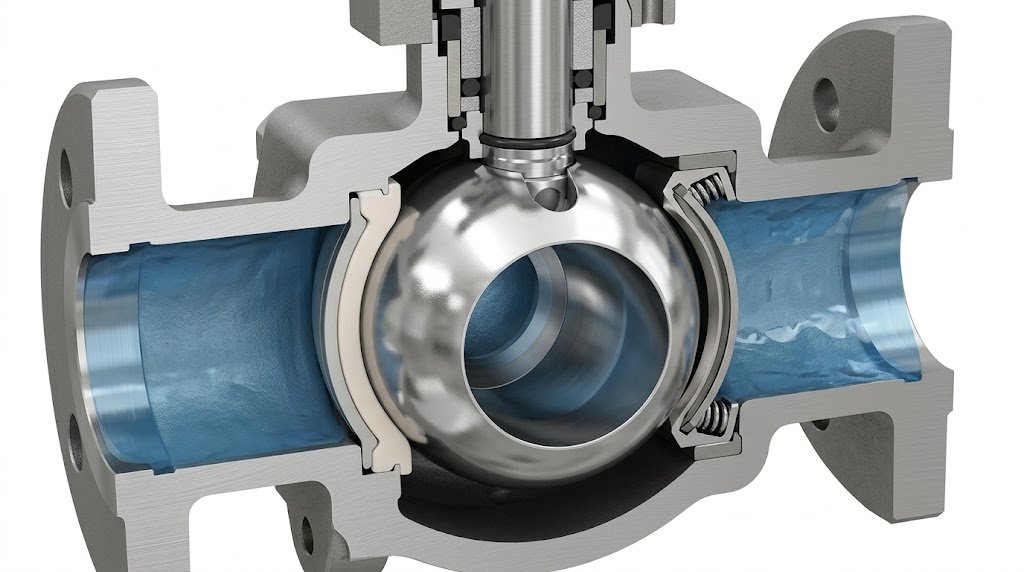
Das Sitzmaterial bestimmt die Dichtleistung, das Betätigungsdrehmoment, die chemische Beständigkeit, die Temperaturbeständigkeit und die Verschleißfestigkeit. Es ist oft die erste Komponente, die ausfällt, wenn das Ventil nur nach Druckstufe und Gehäusewerkstoff ausgewählt wird.
PTFE-Sitz
PTFE wird häufig verwendet, da es eine gute chemische Beständigkeit und geringe Reibung aufweist. Es ist für viele saubere, allgemeine Industrie-Flüssigkeiten geeignet.
Typischer Einsatz:
- Wasser
- Luft
- Öl
- Gas
- Milde Chemikalien
- Allgemeine Prozessflüssigkeiten
PTFE-Sitze sind im Allgemeinen nicht die erste Wahl für abrasive Feststoffe, stark drosselnde Anwendungen oder Hochtemperaturanwendungen über die vom Hersteller angegebene Sitztemperatur hinaus.
RPTFE-Sitz
RPTFE, oder verstärktes PTFE, bietet eine bessere mechanische Festigkeit und Verschleißfestigkeit als reines PTFE. Es wird oft ausgewählt, wenn eine verbesserte Sitzstabilität erforderlich ist.
Typischer Einsatz:
- Öl und Gas
- Allgemeine chemische Anwendungen
- Mitteldrucksysteme
- Industrielle Absperrung für hohe Schaltspiele
PEEK-Sitz
PEEK bietet eine höhere mechanische Festigkeit und bessere Temperaturbeständigkeit als PTFE-basierte Sitze. Es wird häufig in anspruchsvolleren Anwendungen eingesetzt.
Typischer Einsatz:
- Hochdruckgas
- Flüssigkeiten bei hohen Temperaturen
- Schwere Prozessanwendungen
- Anwendungen, die eine verbesserte Verschleißfestigkeit erfordern
Metallischer Sitz
Geflanschte Kugelhähne mit metallischer Dichtung werden dort eingesetzt, wo Weichdichtungen aufgrund von Hitze, Abrieb, verschmutzten Medien oder extremen Betriebsbedingungen versagen könnten.
Typischer Einsatz:
- Hochtemperatur-Dampf
- Abrasive Medien
- Schlamm
- Katalysatorhandling
- Aschehandling
- Schwerer chemischer Einsatz
- Schmutzige oder partikelhaltige Flüssigkeiten
Metallisch dichtende Ventile erfordern in der Regel ein höheres Betätigungsmoment als weichdichtende Ventile. Die Dichtheitsleistung sollte ebenfalls gemäß dem geltenden Standard und den Projektanforderungen bestätigt werden.
Weichdichtung vs. Metalldichtung: Wie wählt man aus?
| Arbeitsbedingung | Empfohlener Startpunkt | Grund |
|---|---|---|
| Sauberes Wasser | PTFE-, RPTFE- oder Elastomersitz je nach Ausführung | Gute Absperrung, geringes Drehmoment, wirtschaftliche Wartung |
| Luft oder Inertgas | PTFE oder RPTFE | Geringe Reibung und zuverlässige Abdichtung im Einsatz mit sauberem Gas |
| Allgemeiner Ölservice | RPTFE oder PEEK je nach Druck und Temperatur | Bessere Sitzstabilität als Standard-PTFE bei anspruchsvolleren Einsätzen |
| Leichter chemischer Service | PTFE oder RPTFE nach Kompatibilitätsprüfung | Chemische Kompatibilität muss Sitz, Packung und Dichtung umfassen |
| Einsatz bei hohen Temperaturen | PEEK oder Metall-Sitz | Temperaturlimit des Weichsitzes kann der bestimmende Faktor werden |
| Abrasive Medien | Metall-Sitz | Partikel können weiche Dichtungen beschädigen oder sich darin einbetten |
| Schlamm-Service | Metallischer Sitz oder spezielles Design für anspruchsvolle Betriebsbedingungen | Sitzverschleiß und Kavitätenbildung müssen überprüft werden |
| Dampf-Service | Metallischer Sitz oder vom Hersteller zugelassenes Hochtemperatur-Sitzdesign | Temperatur, thermische Zyklen und Leckageklasse sind entscheidend |
| Häufiges Schalten | Verstärkter Weichsitz oder metallischer Sitz, abhängig von der Beanspruchung | Die Lebensdauer der Dichtung hängt von der Sitzlast, Schmierung, Partikeln und Temperatur ab |
Für saubere Anwendungen und normale Temperaturen bieten weichdichtende Flansch-Kugelhähne normalerweise eine dichte Abdichtung und geringes Drehmoment. Für Hochtemperatur-, abrasive, schmutzige oder anspruchsvolle Betriebsbedingungen sollte eine metallisch dichtende Konstruktion in Betracht gezogen werden.
Firesafe-, Antistatik- und Blow-Out-Proof-Design
Für den Einsatz in der Öl-, Gas-, Petrochemie- und bei gefährlichen Medien können Sicherheitsmerkmale erforderlich sein. Diese Merkmale dürfen nicht angenommen werden, es sei denn, sie sind eindeutig im Datenblatt, in der Zeichnung, im Inspektionsbericht und in der Einkaufspezifikation angegeben.
Firesafe-Ausführung
Firesafe-Kugelhähne sind so konstruiert, dass sie nach einer Brandeinwirkung ein definiertes Dichtungsverhalten beibehalten. Dies ist üblicherweise in brennbaren Flüssigkeitssystemen, Kohlenwasserstoff-Anwendungen, Tanklagern, Raffinerien und petrochemischen Anlagen erforderlich.
Gängige Firesafe-Referenzen sind API 607 und API 6FA, abhängig von der Projektvorgabe.
Antistatische Ausführung
Während des Ventriebs kann die Reibung zwischen Kugel und Sitz statische Elektrizität erzeugen. Antistatische Vorrichtungen helfen, eine elektrische Kontinuität zwischen Kugel, Spindel und Gehäuse herzustellen.
Dieses Merkmal ist wichtig für:
- Erdgas
- Brennstoffgas
- Kohlenwasserstoffe
- Lösungsmittel
- Brennbare Flüssigkeiten
Blow-Out-Proof-Spindel
Eine Blow-Out-Proof-Spindel ist so konstruiert, dass der Innendruck die Spindel nicht aus dem Ventilkörper schleudern kann. Dies ist ein wichtiges Sicherheitsmerkmal für unter Druck stehende industrielle Systeme.
Beschaffungshinweis: Diese Merkmale müssen im Datenblatt, in der Zeichnung, im Prüfprotokoll und in den geltenden Prüfdokumenten des Ventils bestätigt werden. Gehen Sie nicht davon aus, dass sie enthalten sind, es sei denn, dies ist spezifiziert.
Handbetätigt, mit Getriebe, Pneumatisch und Elektrisch
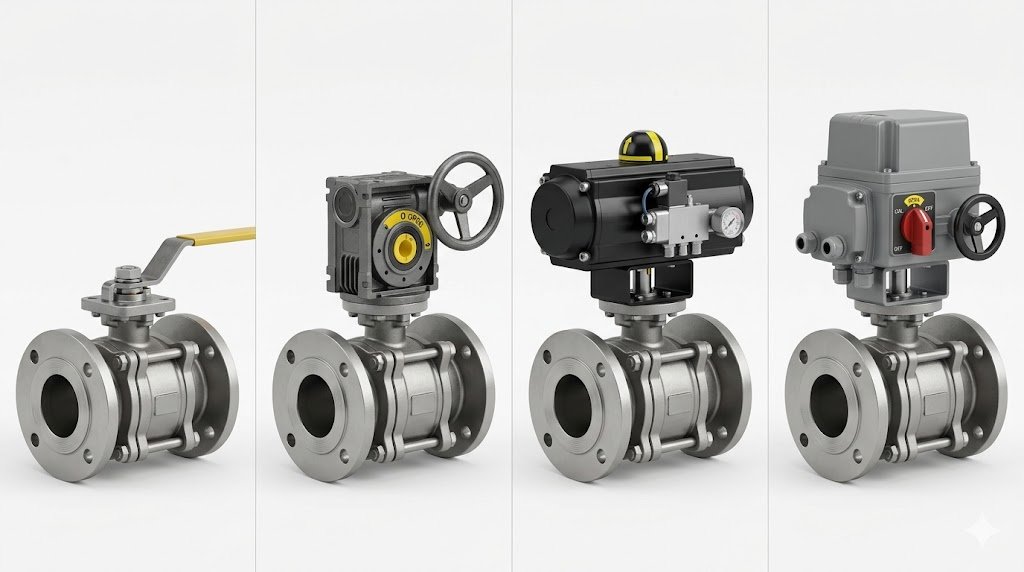
Die Betätigungsart sollte entsprechend der Ventilstation, des Drehmoments, der Betätigungshäufigkeit, der Automatisierungsanforderung und der Zugänglichkeit vor Ort ausgewählt werden.
Hebelbetätigter Flansch-Kugelhahn
Die Hebelbetätigung ist für kleine Ventile mit beherrschbarem Drehmoment geeignet.
Am besten geeignet für:
- Kleine Größen
- Geringes bis mittleres Drehmoment
- Allgemeiner Versorgungsdienst
- Leicht zugängliche Standorte
Getriebebetätigter Flansch-Kugelhahn
Die Getriebebetätigung wird eingesetzt, wenn die direkte Hebelbetätigung schwierig oder unsicher wird.
Am besten geeignet für:
- Mittlere und große Größen
- Höheres Drehmoment
- Manuelle Betätigung unter Druck
- Sichereres und sanfteres Öffnen oder Schließen
Pneumatisch betätigter Flansch-Kugelhahn
Pneumatische Antriebe werden für eine schnelle, zuverlässige automatisierte Betätigung eingesetzt.
Am besten geeignet für:
- Prozessautomatisierung
- Fernsteuerung
- Notabschaltsysteme
- Schnelle Öffnungs-/Schließfunktion
- Anlagen mit Instrumentenluft
Elektrisch betätigter Flansch-Kugelhahn
Elektroantriebe eignen sich, wenn keine Druckluft verfügbar ist oder wenn eine elektrische Steuerung bevorzugt wird.
Am besten geeignet für:
- Wasseraufbereitung
- HLK (Heizung, Lüftung, Klimatechnik)
- Fernabschaltung
- Langsame, gesteuerte Betätigung
- Standorte ohne Instrumentenluft
Warnung zum Antrieb: Dimensionieren Sie den Antrieb nicht nur anhand eines allgemeinen Katalogs. Anlaufdrehmoment, Differenzdruck, Sitztyp, Temperatur, Packungsreibung, Betriebsfaktor und der Alterungszustand des Ventils müssen berücksichtigt werden.
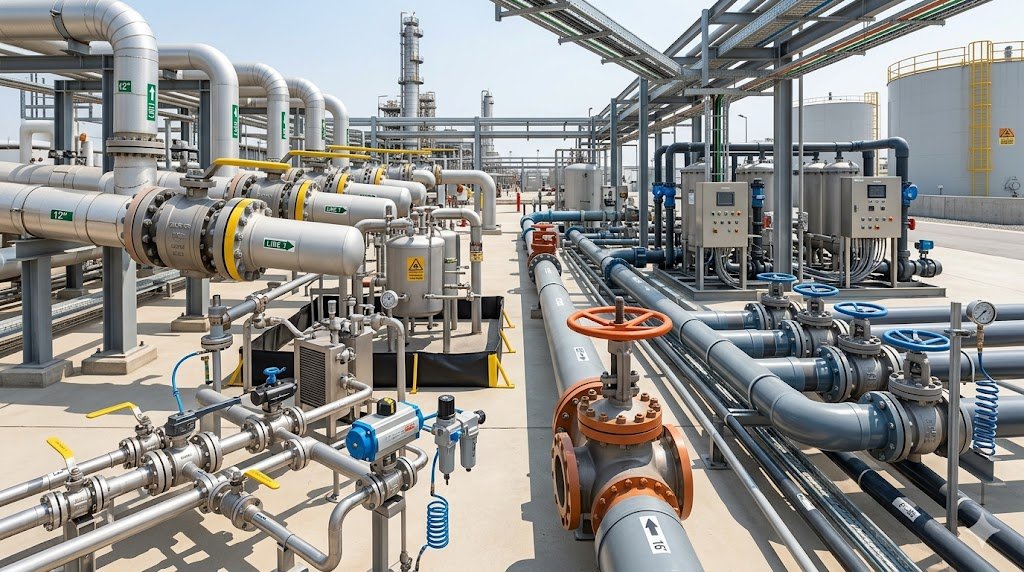
Anwendungsbereiche von Flansch-Kugelhähnen
Öl und Gas
Flansch-Kugelhähne werden häufig in Systemen zur Öl- und Gasförderung, -verarbeitung, -lagerung und -leitung eingesetzt. Für den Rohrleitungsdienst werden oft zapfengelagerte Kugelhähne mit vollem Durchgang in Betracht gezogen, da sie bei großen Nennweiten oder Hochdruckanwendungen ein geringeres Drehmoment und eine bessere Stabilität bieten.
Häufige Anforderungen können sein:
- API 6D Auslegung
- Vollbohrung
- Firesafe-Ausführung
- Antistatik-Einrichtung
- Ausblassichere Spindel
- Double Block and Bleed Funktion
- Betrieb mit Getriebe oder Antrieb
Chemische Verarbeitung
Für chemische Anwendungen ist eine sorgfältige Prüfung der Werkstoffe für Gehäuse, Kugel, Spindel, Sitz, Dichtung und Packung erforderlich. Je nach chemischer Zusammensetzung können Edelstahl, Duplex-Edelstahl oder Speziallegierungen erforderlich sein.
Wichtige Auswahlfaktoren sind:
- Chemische Konzentration
- Betriebstemperatur
- Korrosionsrate
- Sitzverträglichkeit
- Packungsverträglichkeit
- Reinigungsverfahren
- Leckageanforderung
Wasseraufbereitung
Geflanschte Kugelhähne werden zur Absperrung in Wasseraufbereitungsanlagen, Pumpstationen, Filtrationssystemen und Trinkwasserleitungen eingesetzt. Abhängig von der Wasserqualität können duktiles Gusseisen, Kohlenstoffstahl oder Edelstahl ausgewählt werden.
Typische Anwendungen:
- Rohwasser
- Aufbereitetes Wasser
- Kühlwasser
- Pumpenabsperrung
- Filterabsperrung
- Trinkwassersysteme
Energieerzeugung
Kraftwerke können Dampf-, Kondensat-, Kühlwasser-, Brennstoffsysteme und chemische Dosierleitungen umfassen. Temperatur, Druck und Sitzmaterial sind in diesen Anwendungen wichtig.
Typische Anwendungen:
- Kühlwasserleitungen
- Brennstoffgassysteme
- Hilfsdampf
- Kondensatsysteme
- Chemiedosiersysteme
- Allgemeine Anlagenisolierung
HLK und Gebäudetechnik
In HLK-Systemen werden flanschlagerte Kugelhähne für Kühlwasser, Warmwasser, Pumpenisolierung und Rohrleitungen in Technikräumen eingesetzt.
Typische Anwendungen:
- Kühlwasser
- Heizungswasser
- Kühltürme
- Pumpstationen
- Gebäudetechniksysteme
Marine und Offshore
Marine- und Offshore-Umgebungen erfordern eine stärkere Korrosionsprüfung. Edelstahl, Duplex-Edelstahl, spezielle Beschichtungen oder Speziallegierungen können je nach Meerwasserexposition und Projektspezifikation erforderlich sein.
Typische Anwendungen:
- Seewasserleitungen
- Feuerlöschsysteme
- Offshore-Versorgungssysteme
- Marine-Kühlsysteme
- Kraftstoff- und Serviceleitungen
Technische Beispiele: Häufige Auswahlprobleme und deren Vermeidung
Beispiel 1: Armatur vor Ort, aber passt nicht zum Rohrflansch
Problem: Die Armaturengröße und Druckstufe waren korrekt, aber die Schraubenlöcher passten nicht zum vorhandenen Rohrflansch.
Ursache: Die Bestellung gab nur “DN100 PN16 Flansch-Kugelhahn” an, definierte aber nicht den Flanschstandard, die Flanschdichtung oder das Bohrungsmuster. Bei vielen Projekten reichen DN und PN allein nicht aus, um die Austauschbarkeit zu bestätigen.
Vermeidung: Bestätigen Sie vor der Produktion den Flanschstandard, die Druckstufe, den Flanschtyp, das Schraubenlochbild, den Dichtungstyp und die Einbaulänge. Fordern Sie für Nachrüstarbeiten vor dem Kauf die Maßzeichnung an.
Beispiel 2: Sitzleckage nach Inbetriebnahme
Problem: Das Ventil bestand die anfängliche hydrostatische Prüfung, war aber nach dem Anfahren undicht.
Ursache: Rohrablagerungen, Schweißschlacke und Bauschutt verblieben in der Leitung. Das Ventil wurde mehrmals betätigt, bevor eine ordnungsgemäße Spülung erfolgte, und harte Partikel beschädigten den weichdichtenden Sitz.
Vermeidung: Spülen Sie die Rohrleitung vor wiederholtem Ventilbetrieb. Bei verschmutzten Medien oder Leitungen mit unvermeidbaren Partikeln prüfen Sie eine metallisch dichtende Ausführung oder eine für Feststoffe geeignete Sitzkonstruktion.
Beispiel 3: Manuelles Ventil war zu schwergängig zu bedienen
Problem: Das installierte Ventil erforderte übermäßige Kraft zum Öffnen oder Schließen. Die Bediener benutzten eine Verlängerung am Hebel, was ein Sicherheitsrisiko darstellte.
Ursache: Das Ventil wurde mit einem Hebel bestellt, aber der tatsächliche Differenzdruck, die Sitzlast und die Packungsreibung erforderten ein Getriebe oder einen Antrieb.
Vermeidung: Fragen Sie den Hersteller nach den Betätigungsmomentdaten unter dem angegebenen Druck und der Temperatur. Prüfen Sie für größere Größen oder höhere Druckstufen vor der Bestellung die Betätigung mit Getriebe oder Antrieb.
Beispiel 4: Ersatzventil passte nicht zwischen die vorhandenen Flansche
Problem: Die Wartung entfernte das alte Ventil, aber das neue Ventil konnte ohne Rohrleitungsmodifikation nicht installiert werden.
Ursache: Die Einbaulänge wurde angenommen, anstatt verifiziert zu werden. Das Ventil hatte die gleiche Nenngröße und Druckstufe, aber die Körperlänge war unterschiedlich.
Vermeidung: Für Austauschprojekte, bestätigen Sie vor der Freigabe die ASME B16.10 oder projektspezifische Einbaulänge, die vorhandene Spulenlänge, die Dichtungsdicke und den Bolzenzugangsraum.
Häufige Auswahlfehler bei Flansch-Kugelhähnen
Fehler 1: Nur nach Größe und Druckklasse auswählen
Ein Ventil mit der richtigen Nennweite und Druckklasse kann immer noch falsch sein, wenn der Flanschstandard, die Einbaulänge, der Bohrungstyp, das Sitzmaterial oder die Prüfanforderung nicht mit dem System übereinstimmen.
Fehler 2: Temperaturgrenze des Sitzes ignorieren
Weichdichtende Sitze bieten eine ausgezeichnete Abdichtung in sauberem Service, haben aber Temperaturgrenzen. Die Verwendung des falschen Sitzmaterials im Hochtemperaturbetrieb kann zu Verformung, Leckage, hohem Drehmoment oder vorzeitigem Ausfall führen.
Fehler 3: Vermischung von Flanschstandards
ASME, EN, JIS und andere Flanschsysteme können unterschiedliche Schraubenmuster, Flanschdicken und Dichtflächenabmessungen aufweisen. Bestätigen Sie immer den Flanschstandard vor der Produktion oder dem Kauf.
Fehler 4: Verwendung eines weichdichtenden Ventils in abrasivem Service
Partikel können weichdichtende Sitze schnell beschädigen. Für abrasive oder schmutzige Medien sollte eine metallisch dichtende Konstruktion geprüft werden.
Fehler 5: Einbaulänge vergessen
Bei Austauschprojekten ist die Einbaulänge entscheidend. Ein Ventil, das die gleiche Druckklasse erfüllt, passt möglicherweise trotzdem nicht in die vorhandene Rohrleitung.
Fehler 6: Unterdimensionierung des Antriebs
Wenn das Drehmoment des Antriebs zu gering ist, kann das Ventil unter realem Differenzdruck möglicherweise nicht öffnen oder schließen. Dies ist besonders wichtig für Ventile großer Nennweiten, metallisch dichtende Ventile und Hochdruck-Gas-Anwendungen.
Fehler 7: Behandlung von Kugelhähnen als Regelventile
Ein Standard-Kugelhahn ist hauptsächlich ein Absperrventil. Wenn eine kontinuierliche Drosselung oder eine präzise Durchflussregelung erforderlich ist, kann ein Regelventil oder ein speziell entwickelter Kugelhahnen mit V-Port-Öffnung geeigneter sein.
Auswahlliste für Flansch-Kugelhähne
Bestätigen Sie die folgenden Informationen, bevor Sie einen Flansch-Kugelhahn auswählen oder kaufen:
- Nennweite
- Druckstufe
- Auslegungsdruck
- Auslegungstemperatur
- Betriebsdruck
- Betriebstemperatur
- Medium
- Medienzustand: sauber, verschmutzt, korrosiv, abrasiv oder Hochtemperatur
- Schwimmend gelagerte oder zapfengelagerte Ausführung
- Vollbohrung oder reduzierte Bohrung
- Gehäusewerkstoff
- Kugelwerkstoff
- Spindelwerkstoff
- Sitzwerkstoff
- Dichtungs- und Packungswerkstoff
- Flanschstandard
- Flanschtyp
- Einbaulänge
- Firesafe-Anforderung
- Antistatik-Anforderung
- Blow-out proof Spindel-Anforderung
- Manuelle, Getriebe-, Pneumatik- oder Elektrobetätigung
- Anforderungen an Antriebsdrehmoment
- Prüf- und Testnorm
- Erforderliche Zertifikate und Dokumentation
Eine vollständige Anfrage hilft dem Armaturenhersteller, das richtige Design zu empfehlen und reduziert das Risiko von Installations- oder Serviceproblemen.
Spezifikation eines Flansch-Kugelhahns
Eine klare technische Spezifikation sollte das Design, die Größe, die Druckstufe, das Material, den Sitz, den Flanschstandard, die Prüfnorm und die Betätigungsart umfassen.
Beispiel 1: Allgemeiner Industrie-Einsatz
Flansch-Kugelhahnen, DN100 / NPS 4, Klasse 150, schwimmend gelagertes Design, Vollbohrung, Gehäuse aus Kohlenstoffstahl ASTM A216 WCB, Kugel und Spindel aus Edelstahl, RPTFE-Sitz, ASME B16.5 RF-Flanschanschlüsse, ASME B16.34 Design, API 598 geprüft, antistatische Vorrichtung, ausblassichere Spindel, Hebelbetätigung.
Beispiel 2: Rohrleitungs-Einsatz
Zapfengelagerter Flansch-Kugelhahnen, NPS 12, Klasse 600, Vollbohrung, API 6D Design, Gehäuse aus Kohlenstoffstahl, Edelstahl-Innengarnitur, RPTFE- oder PEEK-Sitz, ASME B16.5 RF-Flanschanschlüsse, Firesafe-Design, antistatische Vorrichtung, ausblassichere Spindel, Getriebebetätigung oder pneumatischer Antrieb.
Beispiel 3: Korrosiver Chemikalien-Einsatz
Edelstahl-Flansch-Kugelhahnen, DN80, PN16, schwimmend gelagertes Design, Vollbohrung, CF8M-Gehäuse, Kugel und Spindel aus 316 Edelstahl, PTFE- oder RPTFE-Sitz nach Prüfung der chemischen Verträglichkeit, EN 1092-1 RF-Flansch, geprüft nach Projektvorgabe, Hebel- oder pneumatischer Antrieb.
Verwandte Armaturen und technische Prüfungen
Nach der Auswahl eines flanschen Kugelhahns prüfen Ingenieure üblicherweise weiter:
- Kugelhahn-Typ: schwimmend gelagert oder zapfengelagert
- Bohrungsart: Vollbohrung oder reduzierte Bohrung
- Sitzdesign: weichdichtend oder metallisch dichtend
- Flanschstandard und Dichtungsauswahl
- Ventilwerkstoff und Korrosionsbeständigkeit
- Antriebsart und Drehmomentanforderung
- Firesafe- und antistatische Anforderungen
- Ventilinspektion und Druckprüfung
- Installationsspielraum und Wartungszugang
Für die interne Verlinkung auf der Website sollte dieser Blog natürlich verknüpft werden mit Geflanschter Kugelhahn, Schwimmend gelagerter Kugelhahn, Zapfengelagerter Kugelhahn, Metallisch dichtender Kugelhahn, und der Haupt- Kugelhähne Kategorieseite.
FAQ
Wofür wird ein Flansch-Kugelhahn verwendet?
Ein Flansch-Kugelhahn wird zur Ein-/Aus-Isolierung in industriellen Rohrleitungssystemen eingesetzt. Er wird häufig in Rohrleitungen für Wasseraufbereitung, Öl und Gas, chemische Verarbeitung, Energieerzeugung, HLK, Schifffahrt und allgemeine Industrie installiert. Die Flanschverbindung erleichtert den Aus- und Einbau des Ventils während der Wartung.
Wann sollte ich einen Flansch-Kugelhahn anstelle eines Gewinde-Kugelhahns wählen?
Ein Flansch-Kugelhahn wird in der Regel für größere Nennweiten, Systeme mit höherem Druck und industrielle Rohrleitungen bevorzugt, insbesondere wenn das Ventil zur Inspektion oder Wartung entfernt werden muss. Gewinde-Kugelhähne sind häufiger in kleinen Niederdruck-Versorgungssystemen zu finden.
Was ist der Unterschied zwischen einem schwimmend gelagerten und einem zapfengelagerten Flansch-Kugelhahn?
Ein schwimmend gelagerter Kugelhahn nutzt den Leitungsdruck, um die Kugel gegen den nachgeschalteten Sitz zu drücken. Ein zapfengelagerter Kugelhahn stützt die Kugel mit oberen und unteren Zapfen ab, was das Drehmoment reduziert und die Stabilität bei großen Nennweiten oder Hochdruckanwendungen verbessert.
Sollte ich Vollbohrung oder reduzierte Bohrung wählen?
Wählen Sie Vollbohrung, wenn ein geringer Druckabfall, das Durchführen von "Pigs" (Rohrreinigungskörper), Zugang zur Reinigung oder maximale Durchflusskapazität erforderlich ist. Wählen Sie reduzierte Bohrung, wenn ein leichter Druckabfall akzeptabel ist und Kosten, Gewicht oder Platzbedarf kontrolliert werden müssen. Ersetzen Sie Vollbohrung nicht durch reduzierte Bohrung, ohne die Durchfluss- und Wartungsanforderungen zu bestätigen.
Welches Material ist am besten für einen Flansch-Kugelhahn geeignet?
Es gibt kein einziges bestes Material. Kohlenstoffstahl ist üblich für allgemeine Industrie- und Ölförderanwendungen. Edelstahl ist besser für korrosive Flüssigkeiten geeignet. Sphäroguss wird oft für Wasser- und HLK-Systeme verwendet. Spezielle Legierungen werden für extreme Korrosion, Offshore-Anwendungen, Hochtemperatur- oder Hochdruckanwendungen eingesetzt.
Kann ein Flansch-Kugelhahn zum Drosseln verwendet werden?
Ein Standard-Flansch-Kugelhahn kann teilweise geöffnet werden, ist aber hauptsächlich für die Isolierung ausgelegt. Für kontinuierliches Drosseln oder präzise Durchflussregelung kann ein Kugelventil mit V-Port oder ein Regelventil besser geeignet sein. Drosselbetrieb sollte hinsichtlich Sitzverschleiß, Kavitation, Vibration und Durchflussstabilität geprüft werden.
Welche Normen sollten beim Kauf eines flanschigen Kugelhahns beachtet werden?
Gängige Normen sind ASME B16.34, API 608, API 6D, ISO 17292, API 598, ASME B16.5, ASME B16.10, EN 1092-1 und ISO 5211, abhängig von der Projektvorgabe. Die richtige Kombination hängt von der Ventilkonstruktion, dem Flanschsystem, den Prüfanforderungen und der Schnittstelle zum Antrieb ab.
Warum sind flanschige Kugelhähne nach der Installation undicht?
Häufige Gründe sind falsches Sitzmaterial, Rohrverunreinigungen, Fluchtungsfehler der Flansche, Dichtungsprobleme, unzureichendes Schließmoment, falsche Antriebsdimensionierung oder eine Ventilauswahl außerhalb der tatsächlichen Einsatzbedingungen. Bevor das Ventil beanstandet wird, prüfen Sie die Sauberkeit der Rohrleitung, die Flanschfluchtung, die Anzugsreihenfolge der Schrauben, das Sitzmaterial und das Betriebsdrehmoment.
Fazit
Ein flanschiger Kugelhahn sollte nicht nur nach Nennweite und Druckstufe ausgewählt werden. Die richtige Auswahl erfordert eine vollständige Überprüfung von Ventilkonstruktion, Druck-Temperatur-Einstufung, Flanschstandard, Gehäusewerkstoff, Sitzwerkstoff, Bohrungstyp, Antriebsdrehmoment, Prüfanforderungen und Einbaubedingungen.
Für allgemeine Industrieanwendungen kann ein schwimmend gelagerter, weichdichtender flanschiger Kugelhahn ausreichend sein. Für große Nennweiten, Hochdruckanwendungen oder Rohrleitungsdienste ist ein zapfengelagerter flanschiger Kugelhahn oft die bessere technische Wahl. Für Hochtemperatur-, abrasive, schmutzige oder extreme Einsatzbedingungen sollte eine metallisch dichtende Konstruktion geprüft werden.
Ein richtig spezifizierter flanschiger Kugelhahn verbessert die Zuverlässigkeit der Absperrung, reduziert das Installationsrisiko, vereinfacht die Wartung und trägt dazu bei, dass das Rohrleitungssystem über seine vorgesehene Lebensdauer sicher betrieben wird.
Hilfe bei der Auswahl eines flanschigen Kugelhahns benötigt?
Raymon Valve liefert flanschige Kugelhähne in schwimmend gelagerter Ausführung, zapfengelagert, Vollbohrung, reduzierte Bohrung, weichdichtend, metallisch dichtend, aus Kohlenstoffstahl, Edelstahl, Sphäroguss, manueller Bedienung, mit Getriebe, pneumatischem Antrieb und elektrischem Antrieb.
Senden Sie uns Ihre Ventildimension, Druckstufe, Flanschstandard, Medium, Temperatur, Materialanforderung und Betriebsart. Unser Ingenieurteam kann Ihnen helfen, die richtige Konfiguration für Ihren flanschigen Kugelhahn für Ihr Rohrleitungssystem zu überprüfen.
 German
  English
  Arabic
  French
  Spanish
  Italian
  Portuguese
  Russian