
What Construction Difference Actually Changes the Decision?
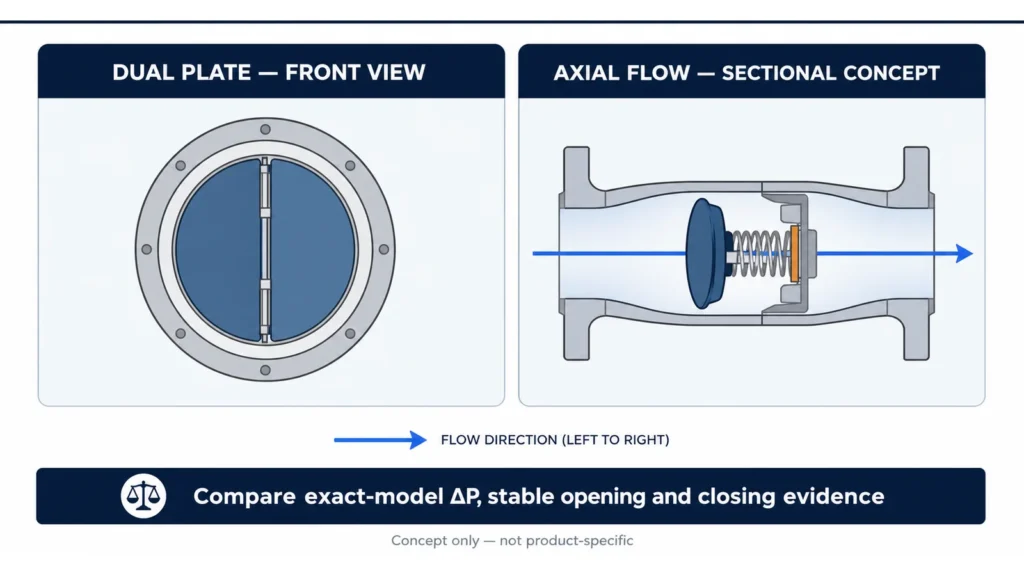
Typical Dual-Plate Mechanism
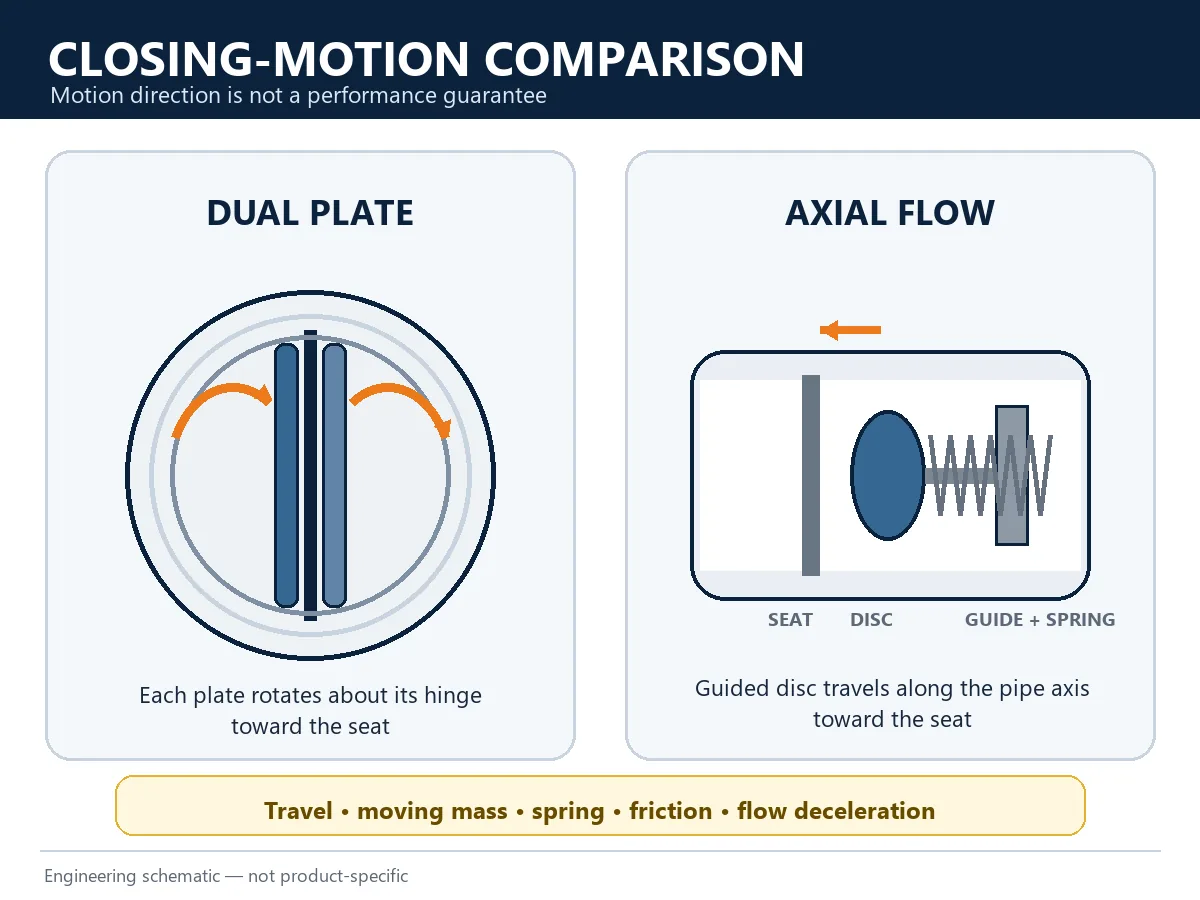
A typical dual-plate check valve uses two rotating plate halves mounted around a central hinge or pin. Springs may assist the plates toward the closed position as forward flow decays. Compared with a long-travel swing disc, the plate movement can be short, but the exact closing behavior still depends on plate mass, travel, spring characteristics, hinge friction, stops, fluid conditions, and flow deceleration.
The open flow path must also be reviewed. Plates, springs, pins, and supports can remain within the flow stream. Their geometry and the plate opening position influence loss and stability. A compact body does not automatically mean low pressure loss, and a nominally full-open plate position does not prove stable behavior at minimum flow.
Buyers evaluating a dual-plate check valve should request the exact sectional drawing and model data rather than transfer a generic family description into the project specification.
Typical Axial-Flow Mechanism
A typical axial-flow check valve uses a guided closing element that travels substantially along the pipe axis. Flow passes around the disc or poppet through an annular or shaped passage. A spring commonly acts on the moving element, while internal guides control its travel.
Guide arrangement, spring design, seat geometry, diffuser or nozzle profile, and travel vary between models. Those differences affect pressure loss, opening position, friction, wear, and closing response. Commercial terms such as axial flow, nozzle, silent, and non-slam may overlap, but they do not prove identical internal construction or equal performance.
La axial-flow check valve product route can help identify the requested construction. Final approval still requires controlled information for the exact model offered.
What the Drawing Must Confirm
Before comparing performance, confirm that both bids describe the construction the project intends to evaluate:
- exact valve type and model;
- body pattern and end connection;
- internal flow path;
- plate, disc, or poppet travel;
- hinge, pin, guide, stop, and spring arrangement;
- seat geometry and replacement method;
- flow arrow and permitted installation orientation;
- access required for inspection and maintenance.
Without this identity check, two quotations may use the same family name for materially different internal designs.
Pressure Loss: Compare Curves, Not Valve Names
Why a Single Cv or Kv Value Is Incomplete
Pressure loss depends on flow rate, fluid properties, valve geometry, and the position of the moving element. A catalogue Cv or Kv can be useful only when its basis is known. Ask whether it represents a fully open valve, a particular spring, a defined flow direction, and the exact offered size and construction.
A valve may show acceptable loss at maximum flow while operating at an unstable partial-open position at minimum flow. Conversely, a design with a higher catalogue coefficient is not automatically the better choice if its opening behavior or dynamic evidence is insufficient for the duty.
For a broader explanation of why check valves should be evaluated beyond line size, see the check valve sizing and flow-stability guide.
Three-Flow-Case Evidence Table
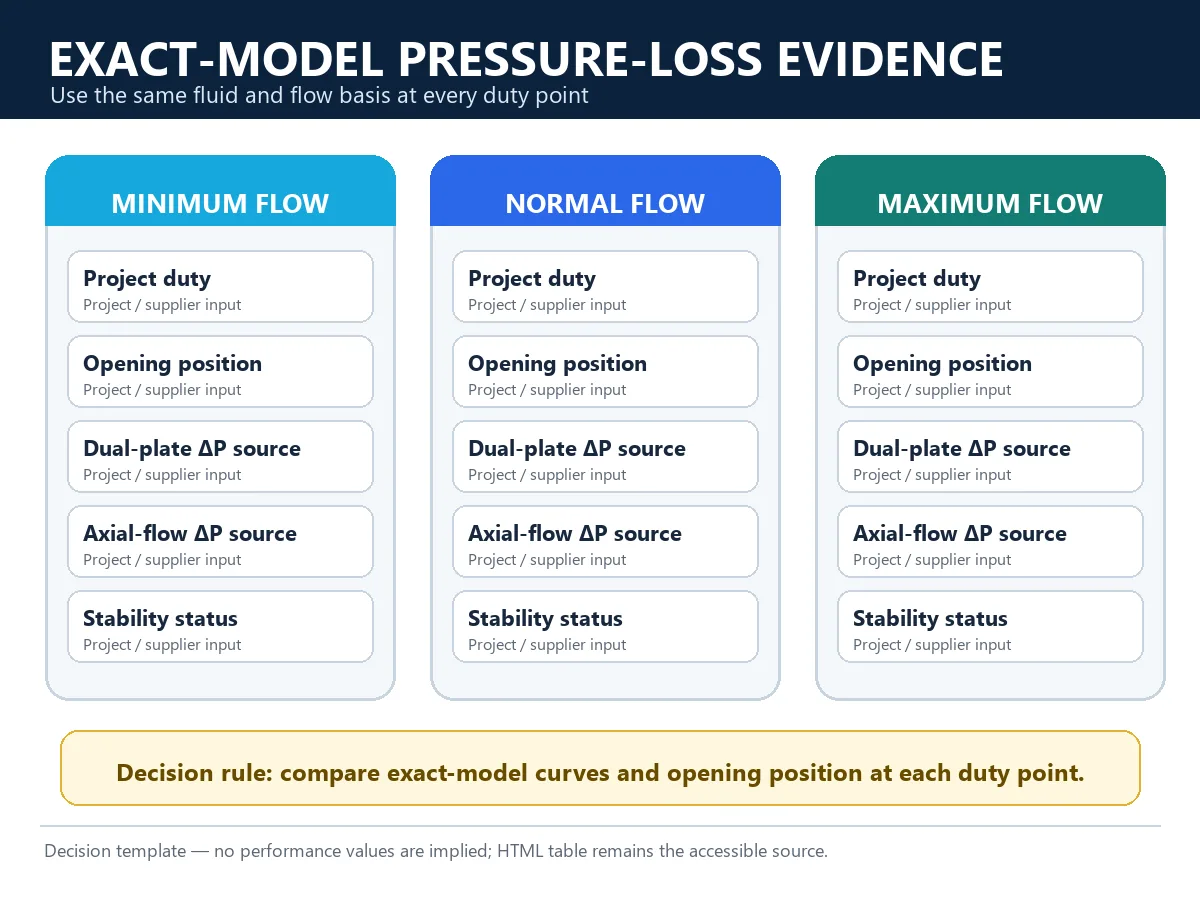
Use the same cases and fluid basis for every bidder. Complete this table with supplier-controlled data; do not substitute a generic family brochure.
| Flow case | Project flow or velocity | Supplier opening-position evidence | Cv/Kv or ΔP source | Stability status | Elemento aperto |
|---|---|---|---|---|---|
| Minimo | Project input required | Exact-model evidence required | Curve/test/calculation reference required | Confirmed / Partial / Open | Record risk of unstable motion or incomplete opening |
| Normale | Project input required | Exact-model evidence required | Curve/test/calculation reference required | Confirmed / Partial / Open | Confirm normal operating margin |
| Massimo | Project input required | Exact-model evidence required | Curve/test/calculation reference required | Confirmed / Partial / Open | Confirm acceptable loss and mechanical position |
The final pressure-loss comparison should state the fluid, temperature, density where relevant, flow basis, valve size, and exact model. A graph without those conditions is not sufficient evidence for project approval.
Low-Flow Instability Is a Separate Check
If flow is too low to hold the moving element in its intended stable position, the plates or disc may move repeatedly. The field symptom may be noise, vibration, fluctuating pressure, or accelerated wear, but these symptoms are not unique to one valve family. Valve oversizing, pump operation, local flow disturbance, spring selection, and installation can all contribute.
Do not publish or accept a universal minimum velocity. Request the basis for the exact offered model and compare it with the project’s minimum continuous, intermittent, startup, and shutdown conditions. Detailed symptom separation is covered in the check valve chatter versus slamming guide.
Closing Response: Travel, Spring, and Deceleration Matter
The Closing Sequence
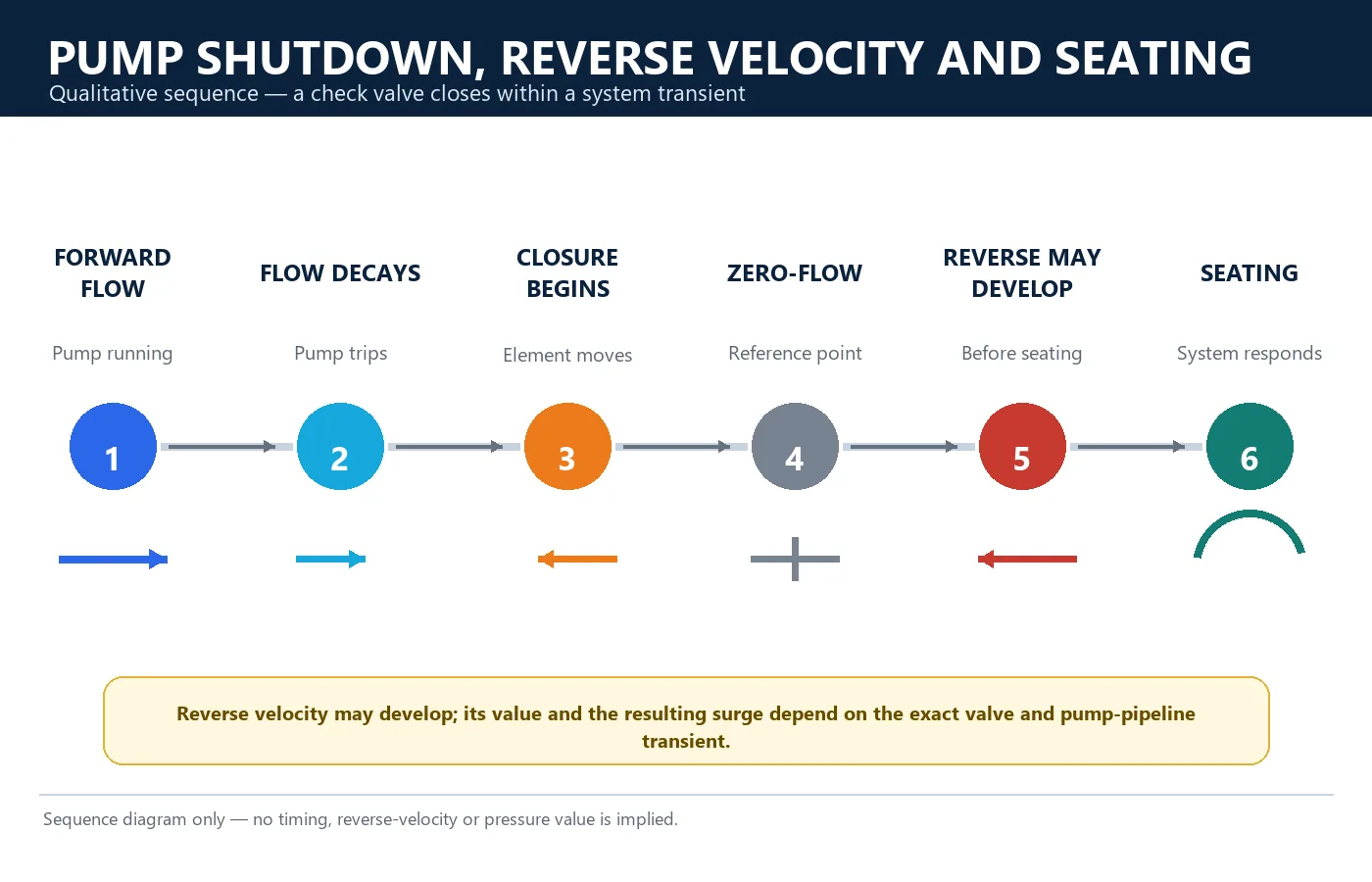
During a pump shutdown, forward flow decays. The valve’s moving element begins to return toward the seat. Depending on the system and valve response, the element may seat before, at, or after the flow reaches zero. If reverse velocity develops before seating, the moving fluid and the closure event can influence the pressure transient.
The relevant engineering question is therefore not simply “Which valve closes faster?” It is: how does the exact model respond under the deceleration conditions that the system will impose?
Parameters That Affect Response
Review at least:
- moving-element mass and inertia;
- travel distance;
- spring force, rate, and preload;
- hinge or guide friction;
- seat-contact behavior;
- fluid density and phase;
- forward-flow decay and reverse acceleration;
- installation orientation;
- upstream and downstream system arrangement;
- expected cycling frequency.
Both dual-plate and axial-flow designs can use short travel and spring assistance. Those features can support responsive closure, but they do not establish an actual closing time or reverse velocity without model-specific evidence.
Evidence Ladder for Closing Performance
Use evidence appropriate to the consequence of the duty:
- Generic construction information supports early screening only.
- Exact-model static data—drawing, travel, spring basis, cracking pressure, and flow curve—supports a preliminary comparison.
- Exact-model dynamic data tied to stated deceleration or test conditions supports a more consequential closing-response review.
- System transient analysis or relevant system testing may be required where surge, reverse rotation, or equipment damage has a high consequence.
An unrelated model’s test, an animation, or a generic “non-slam” label should not be treated as project evidence.
Pump Protection: Where Valve Selection Ends and System Analysis Begins
A check valve can influence when closure occurs relative to flow reversal, how much reverse flow develops before seating, and how much steady-state pressure loss is added to the system. It cannot, by its name alone, prove that the complete pump and pipeline system is protected.
La Hydraulic Institute’s waterhammer resources describe surge as a system response to changes in liquid velocity, including pump shutdown and valve operation. This is why pump protection cannot be reduced to a valve-family comparison.
What the Valve Name Cannot Prove
Neither “dual plate” nor “axial flow” proves:
- elimination of water hammer;
- an acceptable maximum or minimum system pressure;
- prevention of pump reverse rotation or mechanical damage;
- acceptable response for every trip sequence;
- suitability for all parallel-pump headers;
- a universal safe closure time;
- a universal permitted reverse velocity.
Pump-Trip Escalation Path
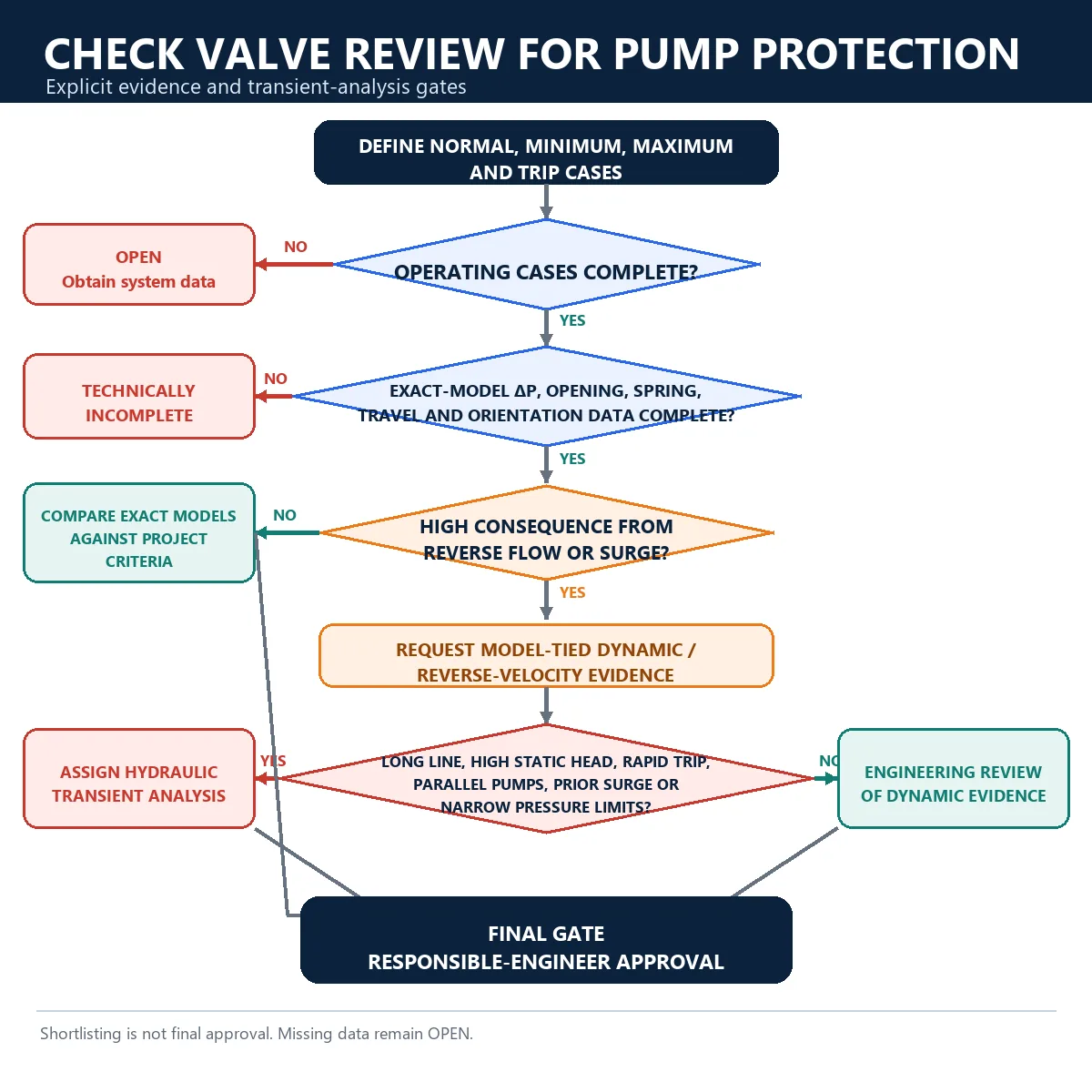
Use the following decision path:
- Are minimum, normal, maximum, startup, shutdown, and trip conditions defined? If no, keep selection OPEN and obtain the missing operating cases.
- Does each bidder provide exact-model pressure-loss, opening, spring, travel, orientation, and material data? If no, keep the bid technically incomplete.
- Could reverse flow or surge cause significant equipment, piping, or process consequences? If yes, request model-tied dynamic or reverse-velocity evidence.
- Does the system include a long line, high static head, rapid trip, parallel pumps, a narrow pressure envelope, prior surge, or strict reverse-flow limits? If yes, assign a responsible owner for hydraulic transient analysis.
- Are the valve and system evidence consistent with the project acceptance criteria? Only then can the responsible engineer make the final selection.
This flowchart identifies when additional analysis is required. It does not calculate surge pressure or approve a valve.
RFQ Normalization Checklist
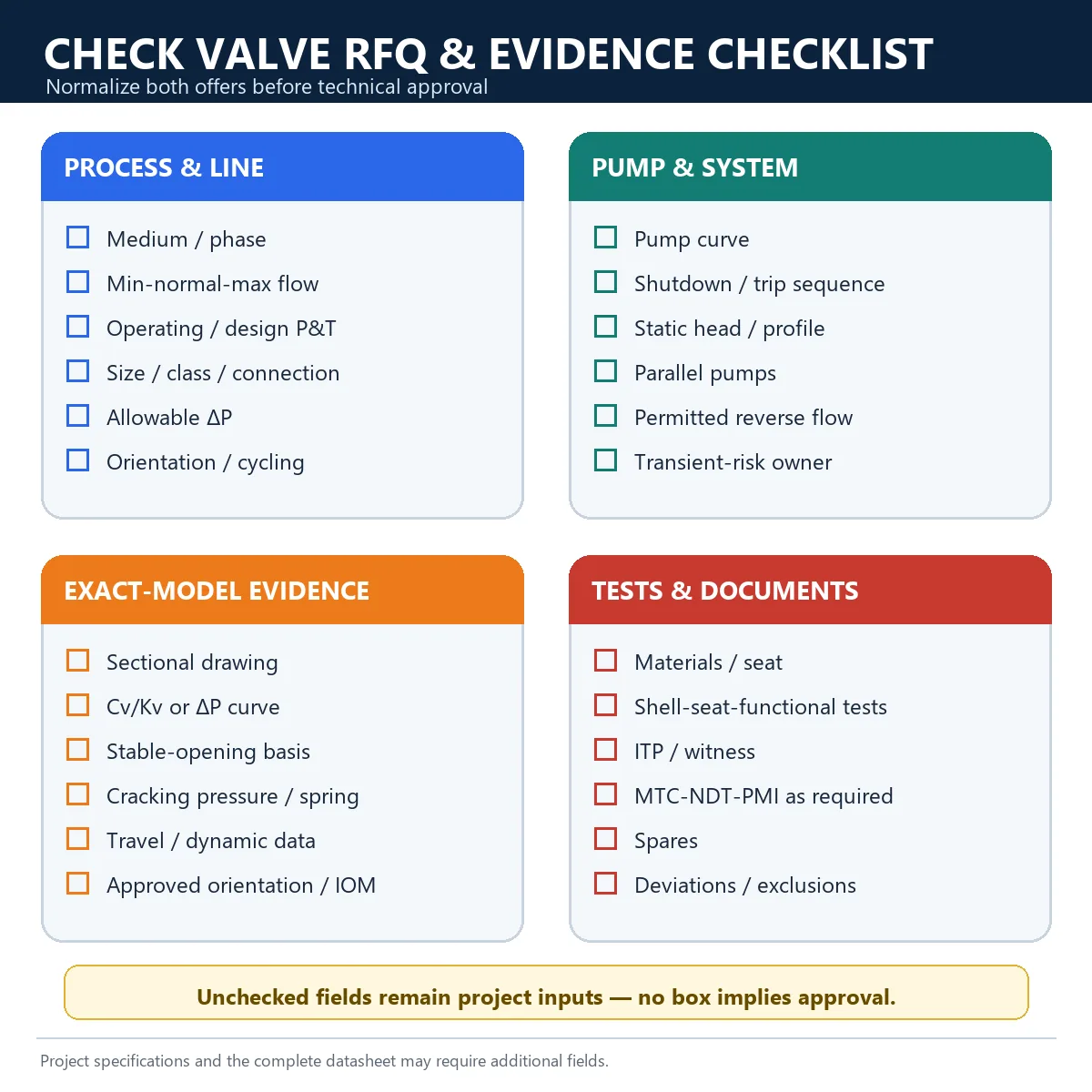
Process and System Data
- valve function and location;
- medium, composition, solids, and phase;
- density and viscosity where relevant;
- minimum, normal, and maximum flow or velocity;
- startup, shutdown, and trip conditions;
- operating and design pressure;
- operating and design temperature;
- nominal size, pressure class/PN, and end connection;
- curva della pompa e sequenza di arresto;
- prevalenza statica e profilo della tubazione;
- parallel-pump or common-header arrangement;
- allowable steady-state pressure loss;
- permitted reverse-flow or reverse-rotation objective;
- installation orientation and nearby piping geometry;
- expected cycling.
Valve and Supplier Evidence
- exact valve type, model, and sectional drawing;
- face-to-face, mass, envelope, and connection data;
- body, plates/disc, hinge/guide, spring, seat, and hardfacing materials;
- Cv/Kv or pressure-drop curve with stated basis;
- minimum stable flow or opening-position evidence;
- cracking pressure and spring basis where relevant;
- moving-element travel;
- dynamic or reverse-velocity evidence where required;
- approved orientation and IOM;
- shell, seat, functional, and any special test scope;
- ITP, MTC, NDT/PMI, witness, and documentation requirements;
- spare-parts scope;
- technical deviations, exclusions, and optional items.
Use the checklist to make both offers comparable. A lower quoted price is not meaningful if one bid omits dynamic evidence, tests, materials, documents, or spares required by the other.
 Italian
  English
  German
  Arabic
  French
  Spanish
  Portuguese
  Russian