
A rising-stem gate valve provides a visible indication of gate travel because the stem moves axially as the valve opens, but it requires enough vertical clearance for the fully open stem. A non-rising-stem gate valve keeps the external stem height nearly fixed, which can suit restricted-headroom or some below-grade installations. The final choice should also consider position feedback, stem-thread location, maintenance access, buried-service construction and the approved operating envelope—not stem type alone.
Choosing only by the words “rising stem” or “non-rising stem” can create installation and RFQ problems. The technical review should compare the complete supplied arrangement, including approved dimensions, operator scope, indication method, maintenance envelope and any below-grade or buried-service accessories.
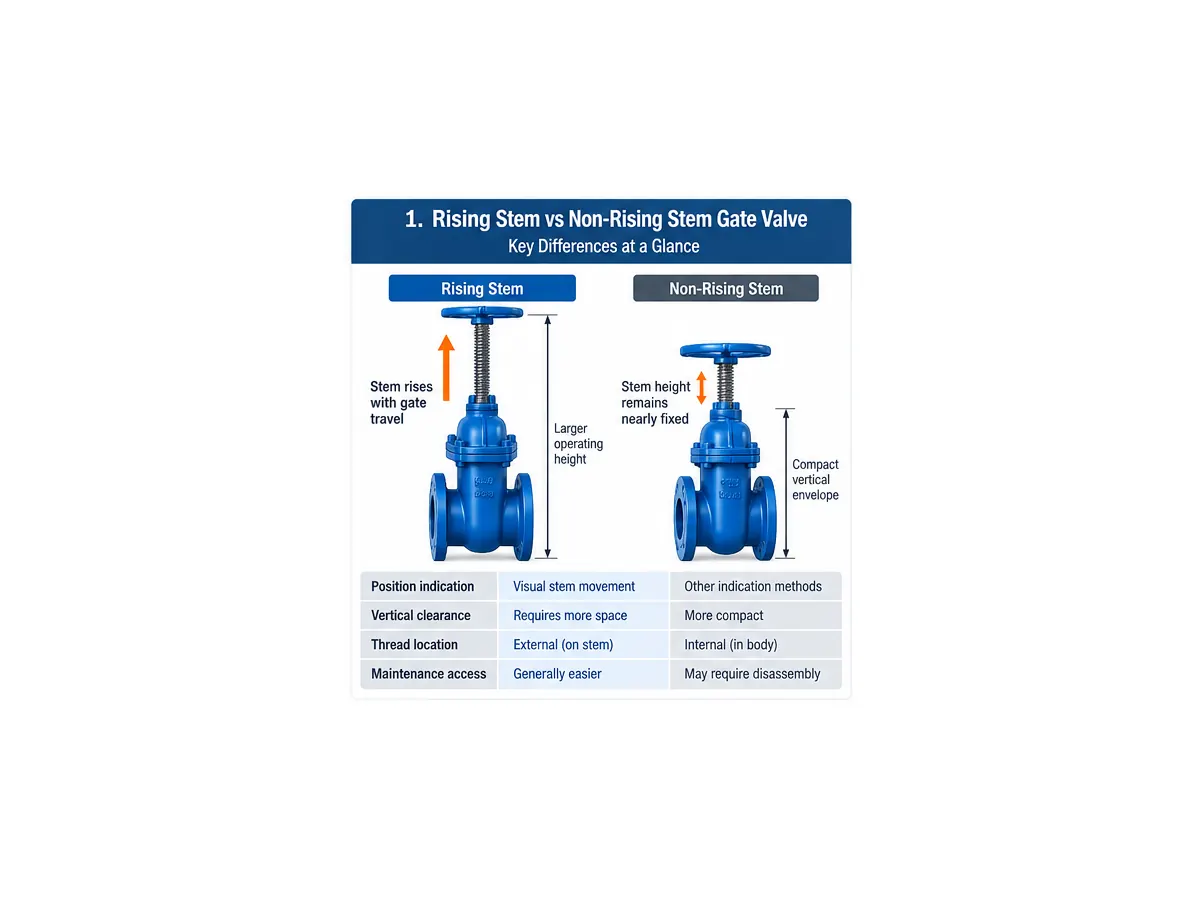
Rising Stem vs Non-Rising Stem Gate Valve: Quick Comparison
The practical difference is how the stem arrangement affects position verification, required operating envelope, thread accessibility and future maintenance.
| Fattore di selezione | Rising Stem Gate Valve | Non-Rising Stem Gate Valve | What the Buyer Should Verify |
|---|---|---|---|
| Valve position visibility | Stem travel usually gives a direct mechanical position cue | External stem height normally does not indicate gate travel | Required local or remote indication |
| Vertical operating space | Requires clearance for full stem travel | More compact external operating envelope | Approved fully open dimensional drawing |
| Above-ground access | Often convenient where the stem is visible and accessible | Also possible where indication and access are adequate | Operator and maintenance access |
| Valve box or chamber | May need greater chamber height | Often easier to accommodate vertically | Valve-box or chamber dimensions |
| Buried installation | Requires installation-specific review | Often practical where vertical space is restricted | Burial arrangement, coating, extension, sealing and access |
| Stem thread inspection | Often more accessible in typical outside-screw-and-yoke arrangements | Internal thread engagement may be less directly inspectable | Sectional drawing and stem/thread construction |
| Dirty or scaling media | External stem still needs environmental protection | Internal operating interfaces may need contamination review | Solids, deposits, scaling or crystallization risk |
| Funzionamento con attuatore | Visible stem travel does not replace actuator feedback | Independent indication may be especially important | Actuator datasheet, switches and feedback scope |
What Actually Changes Between Rising-Stem and Non-Rising-Stem Designs?
Both arrangements are used on industrial valvole a saracinesca. The distinction discussed here concerns the stem and operating arrangement rather than gate geometry, pressure rating or the complete valve design.
For broader construction and specification decisions beyond stem arrangement, use the gate valve selection framework before freezing the valve datasheet.
Rising Stem Gate Valve
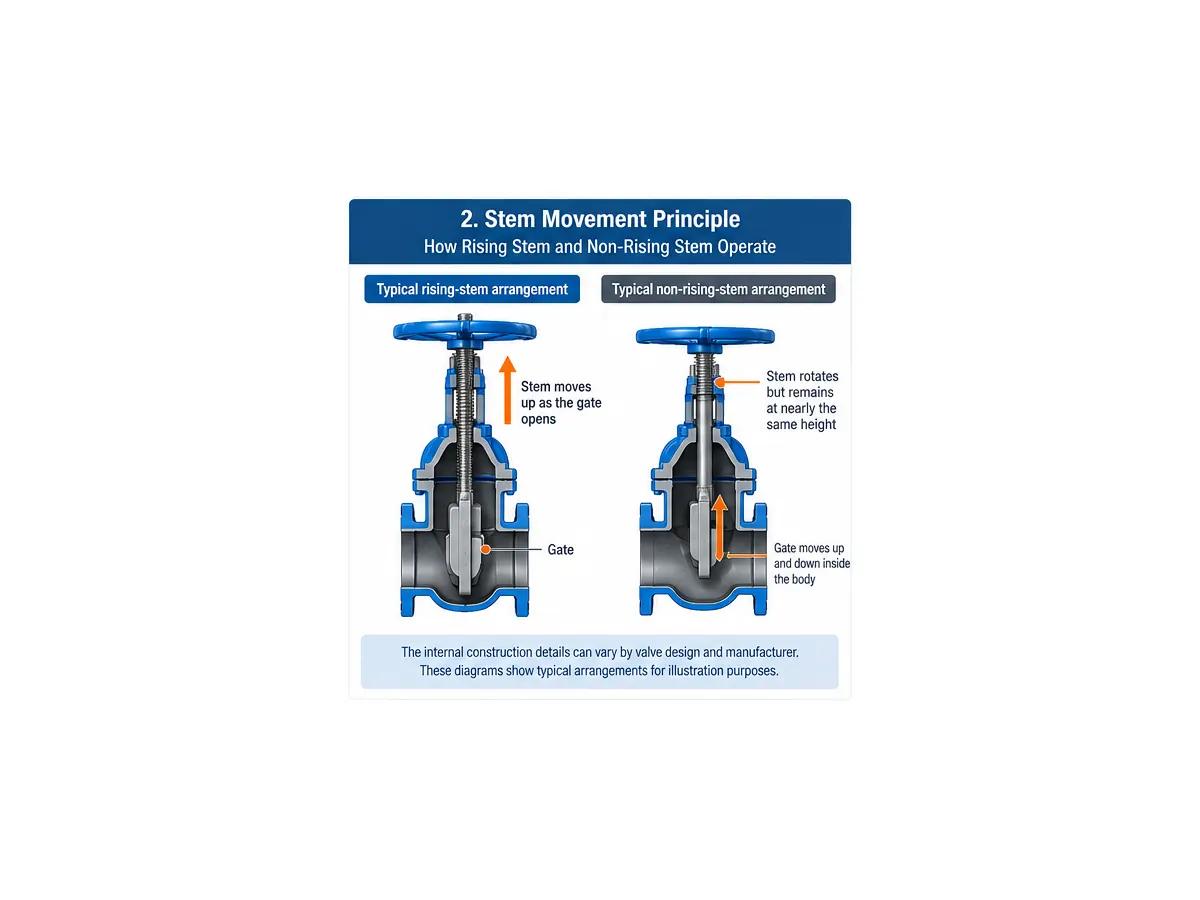
In a typical rising-stem design, the stem translates axially as the gate moves. As the valve opens, a greater length of stem becomes visible above the handwheel, yoke or operator.
Many industrial rising-stem gate valves use an outside-screw-and-yoke arrangement, or OS&Y. In a typical OS&Y configuration, the operating threads are externally accessible. Exact stem, stem-nut and thread construction should still be confirmed from the sectional drawing for the selected valve.
Non-Rising Stem Gate Valve
In a non-rising-stem design, the external stem height remains substantially fixed while the gate moves internally. This can reduce the required vertical operating envelope.
Depending on the construction, the threaded operating interface may be located inside the valve body or another internal operating zone. Where solids, scale, sediment or crystallizing deposits are relevant, the actual sectional drawing and manufacturer data should be reviewed rather than applying one generic assumption to every NRS valve.
Stem Arrangement Does Not Define Pressure-Temperature Capability
Rising-stem and non-rising-stem construction should not be used as a shortcut for pressure or temperature capability. Stem arrangement describes part of the operating mechanism; it does not by itself establish the valve’s allowable pressure-temperature rating or service suitability.
Those limits depend on the complete valve design and applicable project requirements, including body and bonnet construction, materials, pressure-rating basis, trim, packing, bolting and the exact manufacturer configuration.
Position Indication: Can Operators Tell Whether the Gate Is Open or Closed?
Rising Stem Provides a Useful Mechanical Position Cue
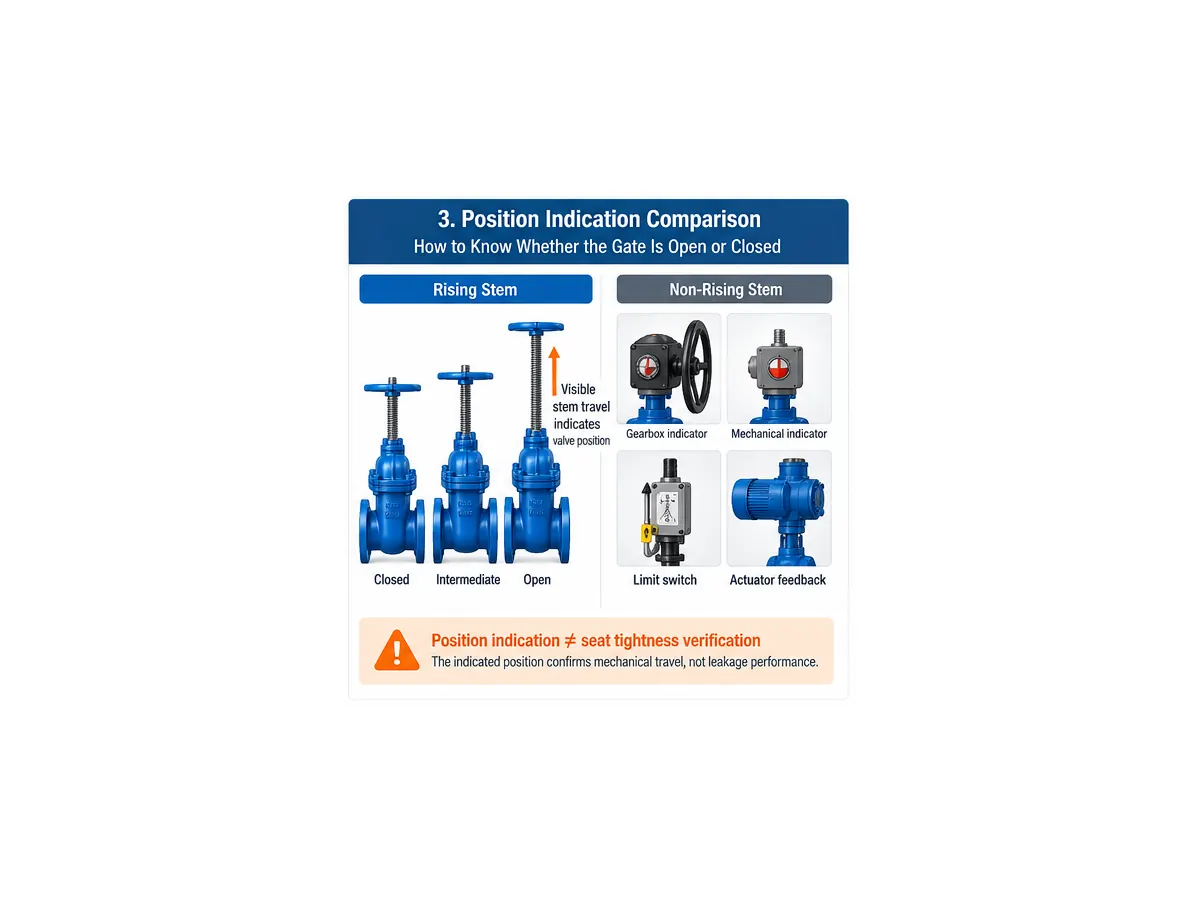
On a typical rising-stem design, external stem travel provides a useful visual indication of mechanical gate travel. This can simplify local operating checks on accessible valves.
If shut-off acceptance is important, the buyer should define the applicable inspection and collaudo a pressione valvole requirements separately.
How Is Position Indicated on a Non-Rising Stem Gate Valve?
Because external stem height normally stays nearly fixed, NRS valve position may need to be confirmed through the supplied operating equipment.
- Mechanical open/close indicator
- Gearbox position indicator
- Limit switches
- Actuator open and closed feedback
- Position transmitter
- Remote control-system status
When Position Verification Should Be Written into the RFQ
Position indication should be specified rather than assumed when the valve is remotely operated, located in an inaccessible chamber, included in an operating sequence, actuated or used where incorrect status could affect plant operation.
Installation Space: Why Closed-Valve Height Is Not Enough
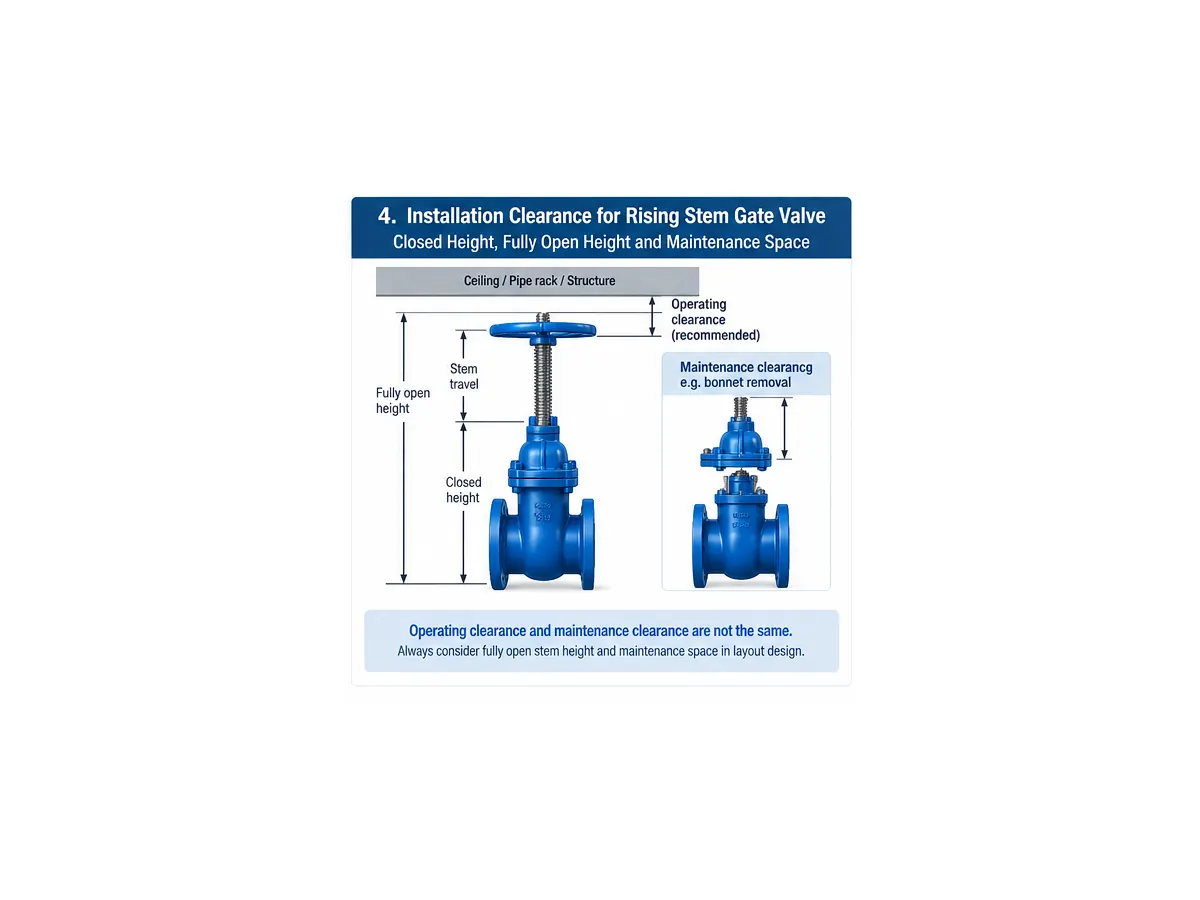
The approved installation review should use the complete supplied assembly, not just the catalogue closed height.
The project should verify:
- Closed overall height
- Fully open overall height
- Stem projection
- Handwheel or gearbox envelope
- Actuator dimensions
- Overhead piping, structure or cable trays
- Operator access
- Packing adjustment space
- Bonnet, gearbox or actuator removal space
Where a Non-Rising Stem Saves Space
A non-rising-stem arrangement avoids the same external stem projection during opening, which can help in restricted vertical spaces. However, the complete assembly may still include a gearbox, actuator, stem extension or indicator that determines the final envelope.
Operating Clearance and Maintenance Clearance Are Different
A valve can have enough space to operate while still lacking enough room for disassembly or maintenance. Packing replacement, gearbox removal, actuator lifting and bonnet or stem work may all require additional clearance.
Below Grade, Valve Chamber and Direct Burial Are Not the Same
The terms “underground” and “buried” are often used loosely, but they can describe very different installation conditions.
| Installation Condition | Typical Meaning | Main Review Points |
|---|---|---|
| Below grade | The valve elevation is below ground level, but the valve may still be inside an accessible structure | Access, clearance, drainage, environment and operation |
| Valve chamber / vault | The valve is housed inside a dedicated accessible enclosure | Chamber dimensions, maintenance space, flooding risk and lifting access |
| Valve box | Limited surface access is provided mainly for operation | Extension stem, operating nut, indication and future maintenance strategy |
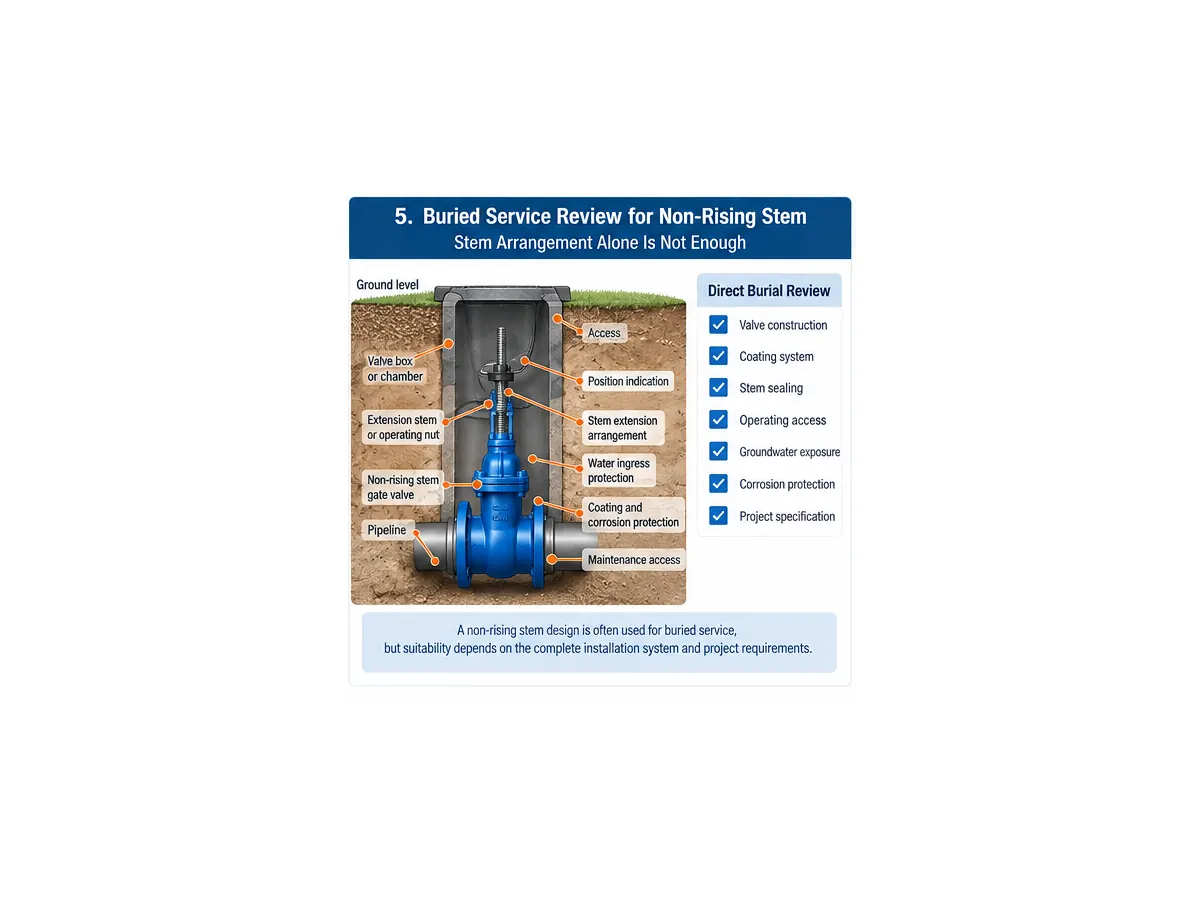
| Direct burial | The valve body is installed in direct contact with the surrounding buried environment | Valve construction, coating, sealing, corrosion protection, groundwater and project specification |
Buried Service: Why “Use Non-Rising Stem Underground” Is Too Simple
Non-rising-stem gate valves are often considered for below-grade installations because the compact stem arrangement reduces external vertical travel. That advantage is relevant to layout, but it does not prove direct-burial suitability.
Why Non-Rising Stem Is Often Considered for Buried Installations
- Reduced vertical operating envelope
- Easier accommodation in some valve boxes
- No long rising-stem projection during opening
- Possible use with extension stems
- Possible use with operating nuts or remote manual operation
What Must Be Checked Before Specifying Buried Service
- Direct burial, valve box or accessible chamber
- Approved valve construction
- Extension-stem arrangement
- Operating nut or gearbox
- Local or remote position indication
- External coating specification
- Groundwater and water-ingress exposure
- Stem and bonnet sealing arrangement
- Future operating access
- Future inspection and maintenance access
- Applicable installation and project specification
Can a Rising-Stem Gate Valve Be Used Below Grade?
A rising-stem design should not automatically be rejected because the valve elevation is below grade. Installation inside an adequately sized chamber may still provide the required stem travel, inspection access, corrosion protection and maintenance clearance.
That condition should be distinguished from direct burial, where the complete valve construction and environmental protection require separate project review.
Stem Threads, Corrosion, Fouling and Operating Resistance
External Threads on Typical OS&Y Arrangements
On many rising-stem OS&Y valves, operating threads are externally accessible. This can simplify visual inspection, cleaning and lubrication, but external exposure also means the stem and threads may require protection from the surrounding environment.
Relevant environmental risks can include:
- Rain
- Salt-laden atmosphere
- Dust and sand
- Coating overspray
- Atmospheric corrosion
- Mechanical damage
Internal Thread Considerations on Non-Rising Stem Designs
Where operating threads or the stem nut are located in an internal operating zone, contamination risk should be reviewed against the actual process.
Additional review may be appropriate for:
- Suspended solids
- Scale-forming fluids
- Sediment
- Corrosion products
- Crystallizing chemicals
- Sticky deposits
- Fouling materials
For these services, use the supplier’s sectional drawing and product data to confirm the stem, stem nut, thread and lubrication arrangement instead of relying on the generic NRS label.
Does Stem Type Determine Operating Torque?
No. Rising versus non-rising stem arrangement alone does not provide enough information to calculate or compare operating torque.
Actual torque or thrust can depend on:
- Dimensione valvola
- Pressione differenziale
- Gate and seat design
- Stem diameter and thread geometry
- Stem nut arrangement
- Lubrication condition
- Corrosion and deposits
- Frequenza operativa
- Gearbox efficiency
- Valve wear
- Temperature and actual service condition
For an actuated gate valve, actuator matching should use the exact valve torque or thrust data together with the confirmed differential pressure, required operating time, available power or air supply and fail-action requirement.
Maintenance: Which Design Is Easier to Inspect and Service?
Neither design is universally easier to maintain. A better comparison is which components are externally inspectable, which require disassembly and whether technicians can reach them in the actual installed arrangement.
Rising Stem Maintenance Considerations
- Stem surface condition
- Thread cleanliness
- Atmospheric corrosion
- Scoring or mechanical damage
- Lubrication condition
- Perdita dalla premistoppa
- Gland condition
- Stem protection
Non-Rising Stem Maintenance Considerations
- Internal thread or stem-nut condition
- Process contamination
- Gearbox condition
- Position-indicator condition
- Valve-box accessibility
- Disassembly requirements
- Inspection frequency
For below-grade installations, chamber or valve-box access can have a greater effect on maintainability than the stem arrangement itself.
Rising Stem vs Non-Rising Stem Selection Matrix
| Service or Installation Condition | Preliminary Direction | Engineering Review Required |
|---|---|---|
| Above-ground manual isolation with good access | Rising stem often offers useful visibility | Confirm environment, space and maintenance access |
| Restricted overhead clearance | Non-rising stem often has a geometric advantage | Check operator and removal envelope |
| Direct visual position confirmation required | Rising stem or independent indication | Define local and remote indication requirement |
| Valve box | Non-rising stem is often practical | Confirm extension, operation and indication |
| Accessible below-grade chamber | Either arrangement may be possible | Review chamber dimensions and maintenance access |
| Direct burial | Do not select from stem type alone | Confirm complete buried-service construction and project requirements |
| Dirty or scaling medium | Review thread location carefully | Confirm sectional construction |
| Remote actuation | Either design may be used | Confirm torque/thrust data and feedback scope |
Common Specification Mistakes
1. Choosing NRS Only Because the Valve Is Underground
Below-grade location, chamber installation and direct burial should first be distinguished.
2. Comparing Only Closed-Valve Height
The approved fully open operating and maintenance envelope should be reviewed.
3. Treating Visible Stem Position as Proof of Shut-Off
Stem travel indicates mechanical position. Seat leakage acceptance requires separate verification.
4. Assuming Stem Type Determines Pressure or Temperature Capability
Pressure-temperature suitability depends on the complete rated valve construction and project requirements, not simply whether the stem rises.
5. Ignoring Process Contamination Around Internal Operating Parts
Solids, scale, sediment and crystallization may affect internal operating mechanisms depending on the exact construction.
6. Specifying an Actuated NRS Valve Without Position Feedback
Where valve status matters operationally, the operator or actuator package should include the required indication.
7. Forgetting Maintenance and Removal Clearance
Packing, gearbox, actuator and bonnet access should be reviewed before layout approval.
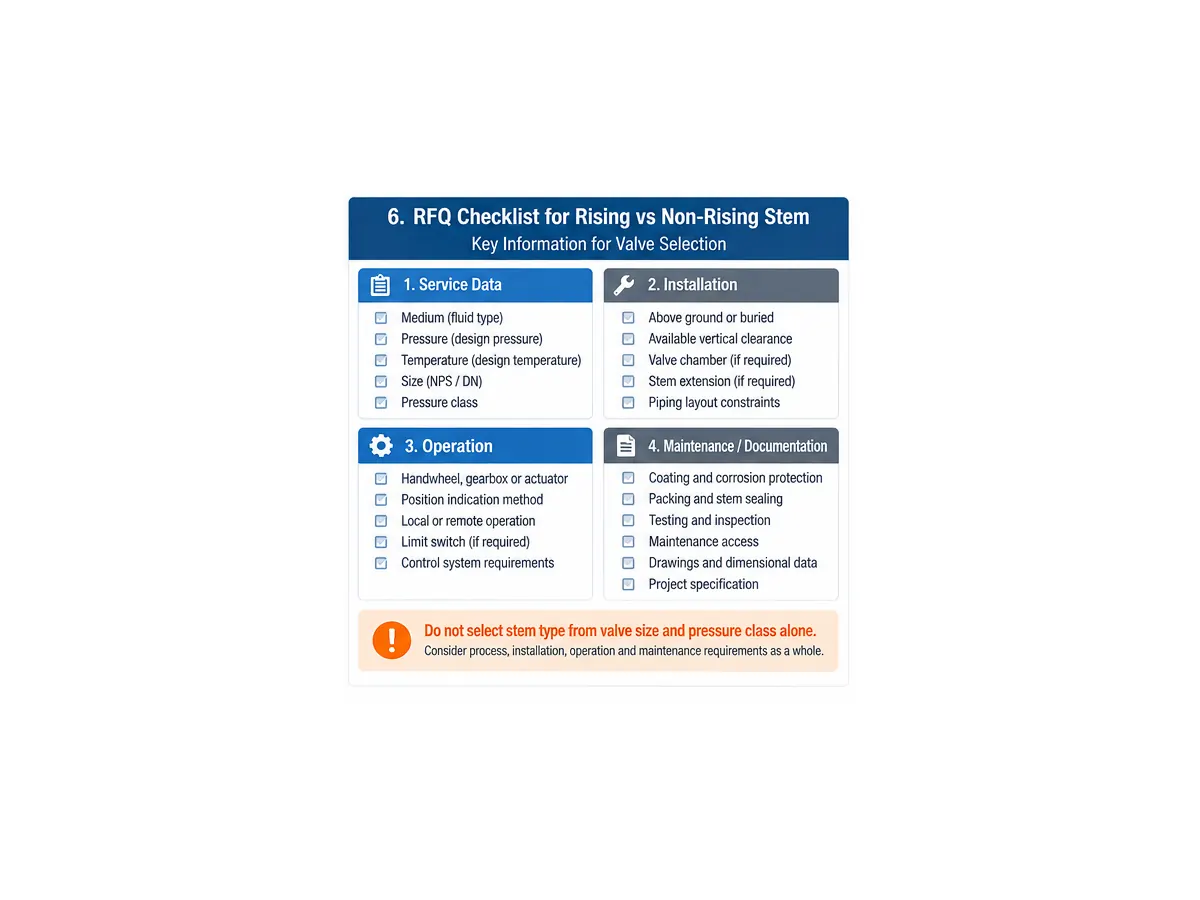
RFQ Checklist for Rising-Stem and Non-Rising-Stem Gate Valves
A useful RFQ should allow suppliers to quote the same technical scope rather than filling missing information with different assumptions.
If the project specification is still being developed, define the gate valve datasheet requirements before comparing supplier quotations.
| RFQ Input | Perché è importante | What Should Be Confirmed |
|---|---|---|
| Funzione della valvola | Confirms isolation duty | Normal operation and operating frequency |
| Dimensione nominale | Affects geometry | Exact approved dimensions |
| Pressure class or PN | Part of specification | Applicable rating basis and project requirement |
| Pressione di progetto | Required for service review | Design differential where relevant |
| Temperatura di progetto | Affects material and sealing review | Normal and design condition |
| Medio | Influences corrosion and contamination risk | Composition, solids and deposits |
| Configurazione dello stelo | Defines RS/NRS requirement | Required or open to supplier proposal |
| Condizione di installazione | Controls access and environmental review | Above ground, chamber, valve box or direct burial |
| Vertical clearance | Controls layout | Fully open approved dimension |
| Position indication | Controls status verification | Local, remote or both |
| Metodo di azionamento | Affects supplied scope | Handwheel, gearbox or actuator |
| Stem extension | Relevant below grade | Length and operating interface |
| External coating | Important for environment | Specifiche di rivestimento di progetto |
| Accesso per la manutenzione | Affects layout | Operating and removal envelope |
| Collaudi | Defines acceptance | Inspection/test requirement and records |
| Documentazione | Supports approval | GA drawing, sectional drawing, datasheet and test records |
| Deviazioni tecniche | Allows quote normalization | Supplier deviation list |
| Specifiche di progetto | Governs final requirement | Applicable document revision |
- Approved GA or dimensional drawing
- Valve sectional drawing
- Final valve datasheet
- Operator or gearbox datasheet
- Actuator datasheet when the valve is actuated
- Coating specification for relevant below-grade or buried service
- Inspection and test requirements
- Supplier technical deviation list
Pre-PO Technical Approval Checklist
Before PO approval, compare the supplier datasheet, quotation, approved drawing and deviation list against the original RFQ. Two valves carrying the same RS or NRS description may still represent different supplied scopes.
| Elemento di approvazione | Verifica |
|---|---|
| Configurazione dello stelo | Datasheet and sectional drawing identify the agreed construction |
| Fully open height | Approved GA or dimensional drawing fits the available envelope |
| Position indication | Local and remote feedback scope matches the RFQ |
| Below-grade / buried scope | Installation type, extension, operator, coating, sealing and access are defined |
| Stem/thread construction | Sectional arrangement is reviewed where fouling or corrosion matters |
| Azionamento | Operator or actuator scope matches exact valve data and service conditions |
| Accesso per la manutenzione | Removal clearance exists for gearbox, actuator, bonnet and packing work |
| Collaudi e documenti | Inspection/test requirements and required records are identified |
| Deviazioni tecniche | Supplier deviations are listed, reviewed and resolved before approval |
How to Choose Between Rising and Non-Rising Stem Gate Valves
For additional valve engineering articles and selection resources, see the Centro Conoscenza Raymon Valve.
Request Gate Valve Selection Review
Send the valve function, medium and solids information, size, pressure class or PN, design pressure and temperature, installation condition, available fully open clearance, required position indication, operation method, stem-extension requirement, coating requirement and maintenance-access constraints.
Include the project datasheet, applicable specification and available layout drawing so the proposed stem arrangement and supplied scope can be reviewed against the actual installation requirement.
Request Gate Valve Selection ReviewDomande frequenti
What is the main difference between a rising stem and non-rising stem gate valve?
In a rising-stem gate valve, the external stem normally moves axially with gate travel. In a non-rising-stem valve, the external stem height remains substantially fixed while the gate moves internally. The difference affects position indication, installation envelope and maintenance access.
How can you tell if a rising stem gate valve is open or closed?
Stem travel normally provides a useful visual indication of mechanical gate position. It does not prove seat leakage performance, so shut-off acceptance should be verified separately where required.
How do you know whether a non-rising stem gate valve is open?
The valve may use a gearbox indicator, mechanical indicator, limit switches, actuator feedback or a position transmitter. The required method should be specified in the RFQ and confirmed in the operator or actuator scope.
Is a non-rising stem gate valve always better for buried service?
No. Compact operating height can be useful, but direct-burial suitability also depends on the complete valve construction, coating, sealing, groundwater exposure, extension arrangement, operator access and project specification.
Does a rising stem gate valve need more installation space?
It normally needs more vertical operating clearance because the stem projects outward during opening. The exact fully open height and maintenance-removal clearance should be verified from the approved supplier drawing.
Does rising stem or non-rising stem determine the valve pressure rating?
No. Stem arrangement alone does not determine pressure-temperature capability. The complete valve design, materials, rating basis and project requirements must be reviewed.
Which gate valve is easier to maintain?
Neither design is universally easier. Rising-stem arrangements often make more operating components externally inspectable, while NRS arrangements reduce exposed stem travel. Maintenance difficulty depends on the construction, service environment and installation access.
Can rising stem and non-rising stem gate valves both be actuated?
Yes. Both can be actuated, but actuator selection should be based on exact valve torque or thrust data, differential pressure, operating time, supply condition and fail-action requirement rather than stem type alone.
Buyers evaluating supplier capability can also review Raymon Valve company information before submitting project requirements.
 Italian
  English
  German
  Arabic
  French
  Spanish
  Portuguese
  Russian