Ball Valve End Connections: Flanged, Threaded, Welded, and Wafer-Type Designs

Ball Valve End Connections: Flanged, Threaded, Welded, and Wafer-Type Designs

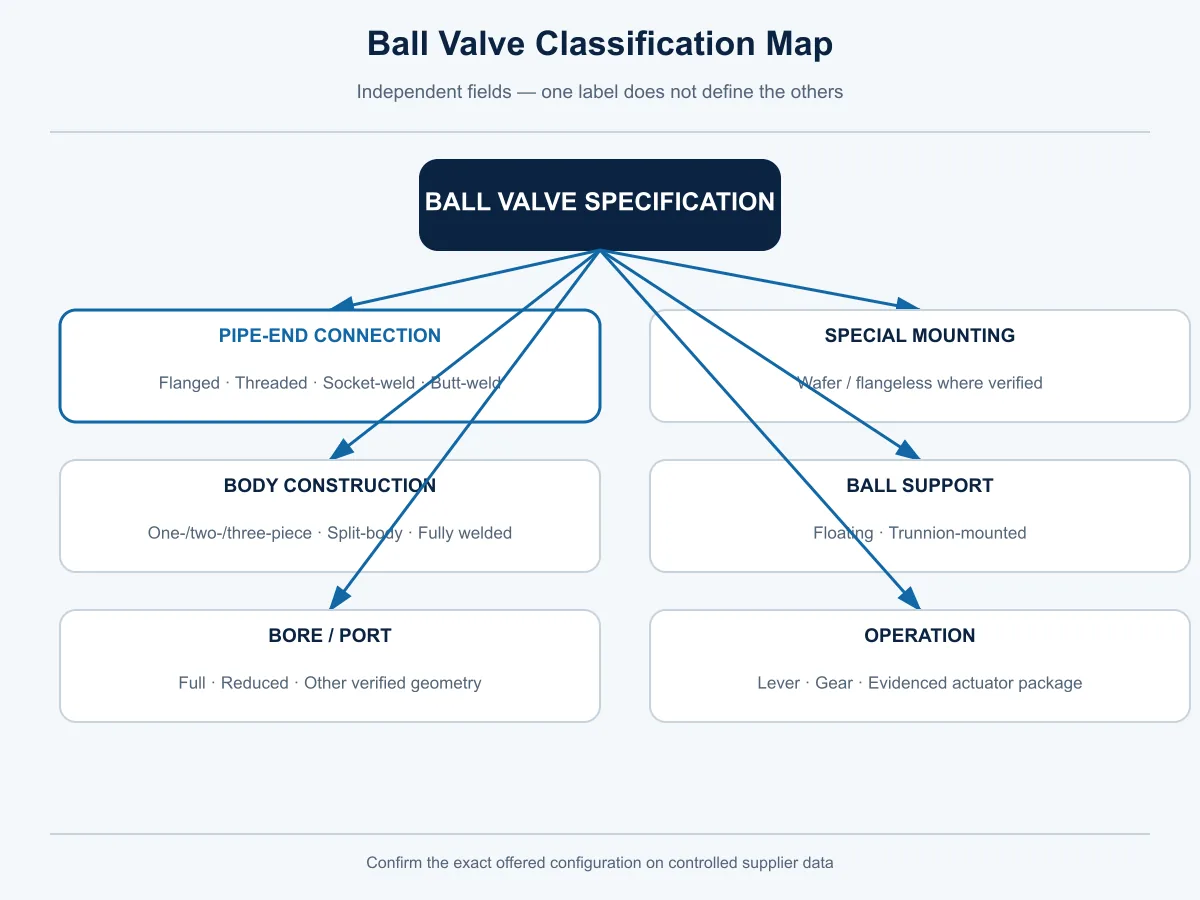
Selecting a ball valve is not only a matter of body material, seat type, ball design, or pressure class. The end connection is the part that decides how the valve is joined to the piping system, how the load is transferred, how the joint seals, and how difficult the valve will be to remove during maintenance.

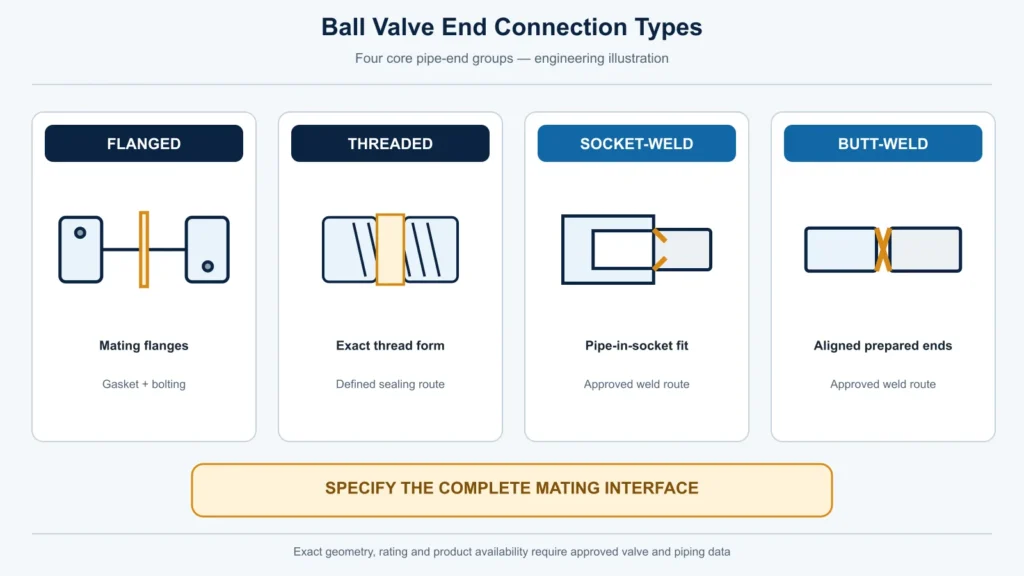
In industrial piping, the main ball valve end connection types include flanged, threaded, welded, and wafer-type designs. A flanged ball valve is usually selected for process pipelines where bolted maintenance access is required. A threaded ball valve is common in small-size utility lines, equipment skids, compressed air, water, and general service. Welded ball valves are used where a permanent joint and reduced external leakage risk are more important than easy removal. Wafer-type ball valves are used in compact piping layouts where space and weight must be controlled.

From an engineering point of view, the connection type should be checked together with pipe size, pressure-temperature rating, gasket or thread sealing method, piping standard, installation clearance, and future maintenance plan. A valve with the correct body material but the wrong end connection can still create leakage, alignment stress, or unnecessary shutdown cost.

Why Ball Valve End Connection Types Matter

The end connection is the mechanical and sealing interface between the valve and the pipeline. If the connection type does not match the piping condition, the valve may still open and close correctly, but the system can fail at the joint. In actual plant maintenance, many “valve leakage” problems are not internal seat leakage. They are external leakage at flanges, threads, welds, or incorrectly supported compact valve bodies.

A proper ball valve end connection should match the following engineering conditions:

  • Pipe size: small-bore piping often uses threaded or socket weld ends, while larger process lines normally use flanged or butt weld ends.
  • Pressure-temperature rating: the valve body, end connection, gasket, bolting, and sealing material must be suitable for the actual operating condition.
  • Pipeline material: carbon steel, stainless steel, alloy steel, or non-metallic piping may require different joining methods.
  • Fluid service: clean water, compressed air, steam, fuel gas, chemical media, slurry, or hazardous fluids place different demands on the joint.
  • Maintenance access: valves that need periodic removal are usually easier to manage with flanged ends.
  • Installation space: threaded, welded, and wafer-type valves can reduce face-to-face length in compact systems.
  • Applicable standards: flange dimensions, thread form, pressure class, testing, and marking should follow the project specification.

For example, a threaded ball valve may be practical for a DN15 or DN25 compressed air line, but it is rarely the best option for a large process pipeline with frequent thermal cycling. A welded ball valve gives a strong permanent joint, but replacing it later may require cutting the pipe. A flanged ball valve needs more space and more components, but it allows the maintenance team to remove the valve without damaging the pipeline.

There is no single best end connection for all ball valves. The correct choice depends on the installation, service condition, maintenance strategy, and risk level of the piping system.

Main Ball Valve End Connection Types

ball valve end connection types comparison
Ball Valve End Connections: Flanged, Threaded, Welded, and Wafer-Type Designs 7

The four common ball valve end connection types are compared below. The table gives a practical selection view rather than a fixed rule. Actual suitability must be confirmed by valve design, pressure class, material, project standard, and manufacturer documentation.

End Connection TypeTypical Size UseMain AdvantageTypical ApplicationMain Limitation
Flanged Ball ValveSmall to large sizesEasy removal and standardized connectionProcess pipelines, water systems, oil and gas, chemical plantsRequires more space, gaskets, bolting, and correct torque control
Threaded Ball ValveUsually small sizesCompact, economical, and fast to installUtility lines, compressed air, water, equipment connectionsLimited for large size, vibration, severe service, or repeated disassembly
Welded Ball ValveSmall to large sizes depending on designStrong permanent joint with fewer mechanical leak pathsHigh-pressure lines, buried pipelines, steam, oil and gas, critical serviceDifficult to remove; welding procedure and heat control are required
Wafer-Type Ball ValveCompact piping layoutsShort face-to-face dimension and lower weightSkid systems, space-limited installations, compact process unitsRequires accurate flange alignment and proper piping support

For steel industrial valves, ASME B16.34 is often used as a key reference because it covers flanged, threaded, welding end, and wafer or flangeless valves for new construction, including pressure-temperature ratings, dimensions, tolerances, materials, nondestructive examination, testing, and marking.

Flanged Ball Valves

flanged ball valve installed between pipe flanges
Ball Valve End Connections: Flanged, Threaded, Welded, and Wafer-Type Designs 8

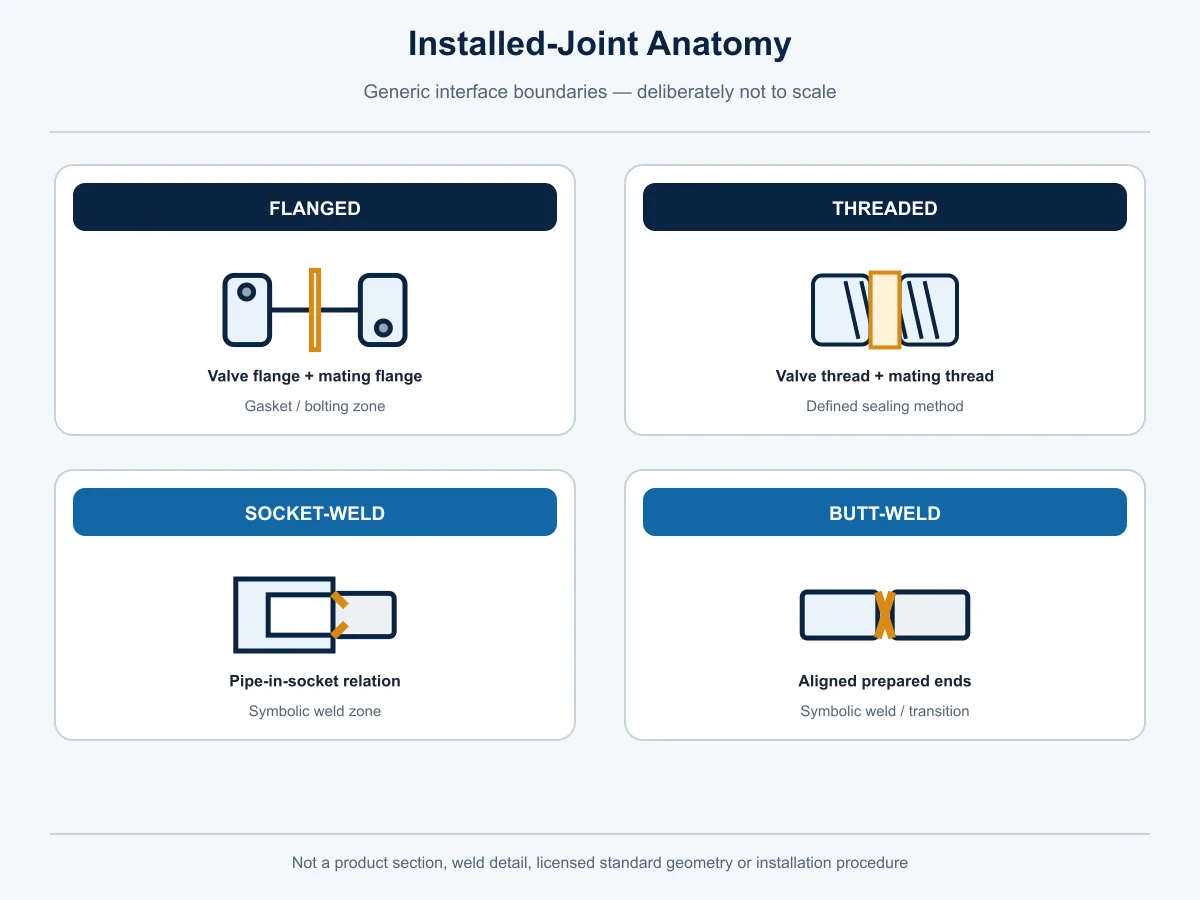
A flanged ball valve has flanged ends on both sides of the valve body. The valve is installed between matching pipe flanges using bolts, nuts, and gaskets. The gasket is compressed between the valve flange face and the pipe flange face to create the external seal.

Flanged ball valves are one of the most common choices for industrial pipelines because they combine strength, standardization, and maintainability. They are especially useful where the valve may need inspection, replacement, actuator change, or seat maintenance during the service life of the plant.

How Flanged Ball Valves Are Installed

A flanged ball valve is installed by aligning the valve flanges with the pipeline flanges. A suitable gasket is placed between each flange pair, and bolts are tightened gradually using a cross-pattern sequence. Correct alignment matters because flange stress can distort the gasket seating area or introduce side load into the valve body.

Common flange standards include ASME, EN, DIN, JIS, and project-specific standards. In ASME systems, ASME B16.5 is widely used for pipe flanges and flanged fittings from NPS 1/2 through NPS 24, covering pressure-temperature ratings, materials, dimensions, tolerances, marking, and testing.

The flange facing must also match the piping requirement. Raised face, flat face, and ring-type joint faces are not interchangeable in a casual way. Gasket type, flange finish, bolt material, and tightening procedure all affect sealing reliability.

Advantages of Flanged Ball Valves

Flanged ball valves are widely used because they are easier to remove than welded valves and more suitable for medium and large piping than threaded valves. When a valve is installed in a pump station, chemical unit, or water treatment line, the ability to unbolt and replace the valve can save considerable downtime.

  • Suitable for medium and large pipeline sizes
  • Good maintenance access because the valve can be unbolted
  • Standardized flange dimensions and pressure classes
  • Compatible with many industrial piping systems
  • Suitable for manual, pneumatic, electric, and hydraulic actuation
  • Practical for plant systems where inspection or future replacement is expected

For process pipelines requiring bolted access, standardized flange dimensions, and easier field replacement, see our Flanged Ball Valves for industrial piping applications.

Limitations of Flanged Ball Valves

Flanged ball valves require more installation space than compact threaded or welded valves. They also have more joint components: two pipe flanges, two gaskets, bolts, nuts, and the valve itself. Any error in gasket material, flange facing, bolt tightening, or alignment can create external leakage.

  • Heavier than threaded valves in the same nominal size range
  • Larger face-to-face dimension
  • Requires suitable gasket selection and controlled bolt tightening
  • Incorrect flange alignment can create body stress
  • Gaskets may need replacement after disassembly
  • Bolting material and coating must match the environment and temperature

Engineering example: In a water treatment project, leakage appeared after commissioning around a DN150 flanged ball valve. The valve seat was initially suspected, but inspection showed external seepage at one flange. The root cause was uneven bolt tightening combined with a gasket that was slightly off-center. The correction was to depressurize the line, replace the damaged gasket, realign the flanges, and tighten the bolts in a cross pattern with controlled torque. The prevention method is simple: check flange parallelism, gasket centering, bolt grade, and tightening sequence before hydrostatic testing.

Typical Applications of Flanged Ball Valves

Flanged ball valves are commonly used in systems where strength and maintenance access are both important.

  • Water treatment pipelines
  • Chemical processing plants
  • Oil and gas systems
  • Power plant auxiliary systems
  • Industrial utility lines
  • Pump inlet and outlet lines
  • Storage tank isolation
  • Medium and large diameter process piping

For most industrial process pipelines, flanged end connections offer a practical balance between mechanical strength, serviceability, and standardization.

Threaded Ball Valves

threaded ball valve connection detail
Ball Valve End Connections: Flanged, Threaded, Welded, and Wafer-Type Designs 9

A threaded ball valve uses internal or external threads to connect with threaded pipe or fittings. Threaded end connections are usually selected for small-size piping where compact installation, lower cost, and quick assembly are important.

Threaded ball valves are common in general industrial service, compressed air lines, water systems, fuel lines, equipment skids, drain and vent points, and instrument-related piping. They are not designed to replace flanged or welded valves in every duty. Their strength is compact utility service, not large-diameter severe process service.

How Threaded Ball Valves Are Installed

Threaded ball valves are installed by screwing the valve ends directly onto compatible threaded pipe or fittings. A sealing material such as PTFE tape or pipe thread compound is usually applied to the male thread, depending on the medium and site specification.

Thread form must be confirmed before installation. Common thread standards include NPT, BSPT, and BSPP. In inch-thread systems, ASME B1.20.1 covers dimensions and gaging for common pipe threads such as NPT, NPSC, NPTR, NPSM, and NPSL. Mixing thread types can cause poor engagement, thread damage, or leakage even when the valve body itself is good.

The installer should avoid using the valve body as a lever. Over-tightening can distort small valve bodies or damage the threads. The correct method is to use proper tools on the wrench flats and keep the pipe aligned before tightening.

Advantages of Threaded Ball Valves

Threaded ball valves are compact and economical. They do not require flanges, gaskets, or field welding, so they are fast to install in small-bore systems.

  • Compact structure for small piping systems
  • Lower installation cost compared with flanged valves
  • No flange bolting or welding required
  • Suitable for equipment skids and utility lines
  • Easy to stock for maintenance and replacement
  • Available in stainless steel, brass, carbon steel, and other materials depending on service

For compact small-size piping, equipment connections, compressed air, and general utility service, explore our Threaded Ball Valves for industrial applications.

Limitations of Threaded Ball Valves

Threaded ball valves are not suitable for every system. Threaded joints rely on thread engagement and sealing material. Under vibration, thermal cycling, mechanical stress, or repeated disassembly, leakage risk increases if the joint is not properly designed and supported.

  • Usually limited to small pipe sizes
  • Not ideal for large pipelines or severe vibration without support
  • Thread damage can reduce sealing reliability
  • Repeated removal may require rework of the threaded joint
  • Not preferred for many hazardous or critical process services
  • Over-tightening may distort small valve bodies or crack weaker fittings

Engineering example: A maintenance team replaced a leaking small ball valve on an air header and installed an NPT valve into a BSPT fitting because the sizes looked similar. The joint tightened before full thread engagement, but the sealing line was not correct. Leakage appeared after pressure was restored. The fix was to replace the mismatched fitting and valve with the same thread standard. The prevention method is to check thread type on the purchase order and confirm it during receiving inspection, especially for imported equipment packages.

Typical Applications of Threaded Ball Valves

Threaded ball valves are widely used in small-size services where installation simplicity is important.

  • Compressed air systems
  • Small water lines
  • Fuel gas and fuel oil auxiliary lines, where permitted by specification
  • Equipment drain and vent connections
  • Instrument air
  • Hydraulic and pneumatic systems
  • Small pump and compressor connections
  • HVAC and general utility service

For non-critical utility service, threaded ball valves are often the most practical choice. For hazardous, high-temperature, or high-vibration service, the end connection should be reviewed carefully before approval.

Welded Ball Valves

butt weld and socket weld ball valve ends
Ball Valve End Connections: Flanged, Threaded, Welded, and Wafer-Type Designs 10

Welded ball valves are joined to the pipeline by welding. The two common welded end designs are butt weld and socket weld. Butt weld ends are typically used in process pipelines, while socket weld ends are common in small-bore high-pressure piping.

Welded connections are selected when a permanent joint is required and the project wants to reduce mechanical leak paths such as flange gaskets or threaded joints. The trade-off is that future valve removal becomes more difficult.

Butt Weld Ball Valves

A butt weld ball valve has weld ends prepared to match the pipe. The valve and pipe are welded together around the circumference. When the pipe schedule, bevel preparation, filler material, welding procedure, and inspection are correct, a butt weld joint provides strong mechanical continuity.

Butt weld ball valves are often used in:

  • High-pressure process pipelines
  • High-temperature service
  • Oil and gas transmission
  • Steam systems
  • Power plant piping
  • Chemical process lines
  • Buried or inaccessible pipelines
  • Critical isolation service

MSS SP-72 is a relevant reference for ball valves with flanged or butt-welding ends for general service. It covers ball valves that may be full port, regular port, or reduced port types.

Socket Weld Ball Valves

A socket weld ball valve has socket-type ends. The pipe is inserted into the socket and welded around the joint. Socket weld designs are generally used for small-bore piping where threaded joints are not preferred and compact high-pressure construction is required.

ASME B16.11 is a useful reference for forged socket-welding and threaded fittings. It covers ratings, dimensions, tolerances, marking, and material requirements for these fitting types. While a valve is not the same as a fitting, the piping connection practice around socket-welded and threaded forged components is often reviewed together in project specifications.

Socket weld ball valves are commonly used in:

  • Small-bore process piping
  • High-pressure utility lines
  • Steam and condensate systems
  • Chemical injection systems
  • Instrument-related piping
  • Compact industrial installations

Advantages of Welded Ball Valves

Welded ball valves reduce the number of mechanical joints in the pipeline. This is useful when external leakage control, vibration resistance, or buried installation is important.

  • Strong permanent connection
  • Reduced external leakage risk compared with gasketed or threaded joints
  • Suitable for high-pressure and high-temperature service when properly specified
  • No flange gasket maintenance
  • Compact compared with flanged valves
  • Useful for buried, insulated, or difficult-to-access pipelines

Engineering example: A socket weld ball valve on a small steam line failed seat testing after field welding. The external weld was acceptable, but internal soft seats were damaged by heat because welding was performed without proper heat control and cooling intervals. The corrective action was valve replacement. The prevention method is to follow the manufacturer’s welding instruction, keep the valve in the recommended position during welding, control heat input, and avoid overheating non-metallic seats and seals.

Limitations of Welded Ball Valves

The main disadvantage of a welded ball valve is removal difficulty. Once welded into the pipeline, the valve cannot be removed without cutting the pipe or preparing a special maintenance plan. Welding also requires qualified procedures, qualified welders, and suitable inspection.

  • Difficult to remove or replace
  • Requires welding procedure control
  • Internal seats and seals must be protected from heat
  • Not ideal where frequent replacement is expected
  • Field welding quality affects long-term reliability
  • Additional nondestructive examination may be required by project specification

Welded ball valves should be selected when permanent pipeline integrity is more important than quick removal. If the valve is expected to be replaced during routine maintenance, a flanged design is usually easier to manage.

Wafer-Type Ball Valves

wafer type ball valve installed between flanges
Ball Valve End Connections: Flanged, Threaded, Welded, and Wafer-Type Designs 11

Wafer-type ball valves have a compact body designed to be installed between two pipe flanges. Unlike a full flanged ball valve, a wafer-type body does not normally have two complete integral flanges. The valve is clamped between pipeline flanges by long bolts or studs, depending on the design.

Wafer-type construction is more common in butterfly valves, but compact wafer-pattern ball valves are used in some piping systems where short face-to-face length and lower weight are required.

How Wafer-Type Ball Valves Work

A wafer-type ball valve is positioned between two flanges. Gaskets are installed at the sealing faces, and the flange bolts compress the valve body between the pipe flanges. Because the valve body is shorter and lighter, it can help reduce installation space in compact piping layouts.

Under ASME B16.34, wafer or flangeless valves installed between flanges or against a flange are treated as flanged-end valves for the scope of that standard. This is important because the designer should not treat wafer-type valves as “non-standard simple components.” They still require correct pressure-temperature rating, materials, marking, and installation review.

Advantages of Wafer-Type Ball Valves

Wafer-type ball valves are selected when the piping layout has limited space or when the system designer wants to reduce weight.

  • Short face-to-face dimension
  • Lower weight than many full flanged designs
  • Compact structure for skid-mounted equipment
  • Useful where installation space is limited
  • Can be economical in suitable low-to-medium risk applications

Limitations of Wafer-Type Ball Valves

Wafer-type valves require careful installation because alignment and piping support strongly affect sealing performance. If the pipe flanges are not parallel or if the valve is carrying pipe load, leakage or body stress can occur.

  • Less common than flanged and threaded ball valves
  • Requires accurate flange alignment
  • Not always suitable for high mechanical loads
  • May be harder to center during installation
  • Limited availability in some pressure classes, sizes, and materials
  • Pipeline support must be reviewed before removal or maintenance

Engineering example: A wafer-type compact ball valve installed in a skid package started leaking after shipment vibration. The valve was not damaged internally. The issue was slight flange misalignment and insufficient pipe support near the valve. After support correction, gasket replacement, and bolt retightening, the joint sealed properly. For compact valves, the prevention method is to check pipe support and flange parallelism before final tightening, not only after pressure testing.

Comparison: Flanged vs Threaded vs Welded vs Wafer-Type Ball Valves

The following comparison gives a quick engineering view of the main ball valve end connection types.

Selection FactorFlanged Ball ValveThreaded Ball ValveWelded Ball ValveWafer-Type Ball Valve
Maintenance AccessGoodModerateDifficultModerate
Installation CostMedium to highLowMedium to highMedium
External Leakage PathGasketed flange jointThreaded jointWelded jointGasketed flange compression
Suitable for Large SizesYesUsually noYes, depending on designLimited by design
Suitable for Small SizesYesYesYesSometimes
Removal from PipelineEasy after depressurizing and unboltingPossible, but threads may need reworkDifficult; cutting may be requiredPossible, but pipe support must be controlled
Space RequirementHigherLowLow to mediumLow
Common UseProcess pipelines and plant systemsUtility and equipment linesCritical or permanent serviceCompact piping layouts

This comparison shows that valve end connection selection should not be based only on valve price. Installation labor, leakage risk, downtime, testing, and future replacement cost must be included in the decision.

How to Select the Right Ball Valve End Connection

ball valve end connection selection checklist
Ball Valve End Connections: Flanged, Threaded, Welded, and Wafer-Type Designs 12

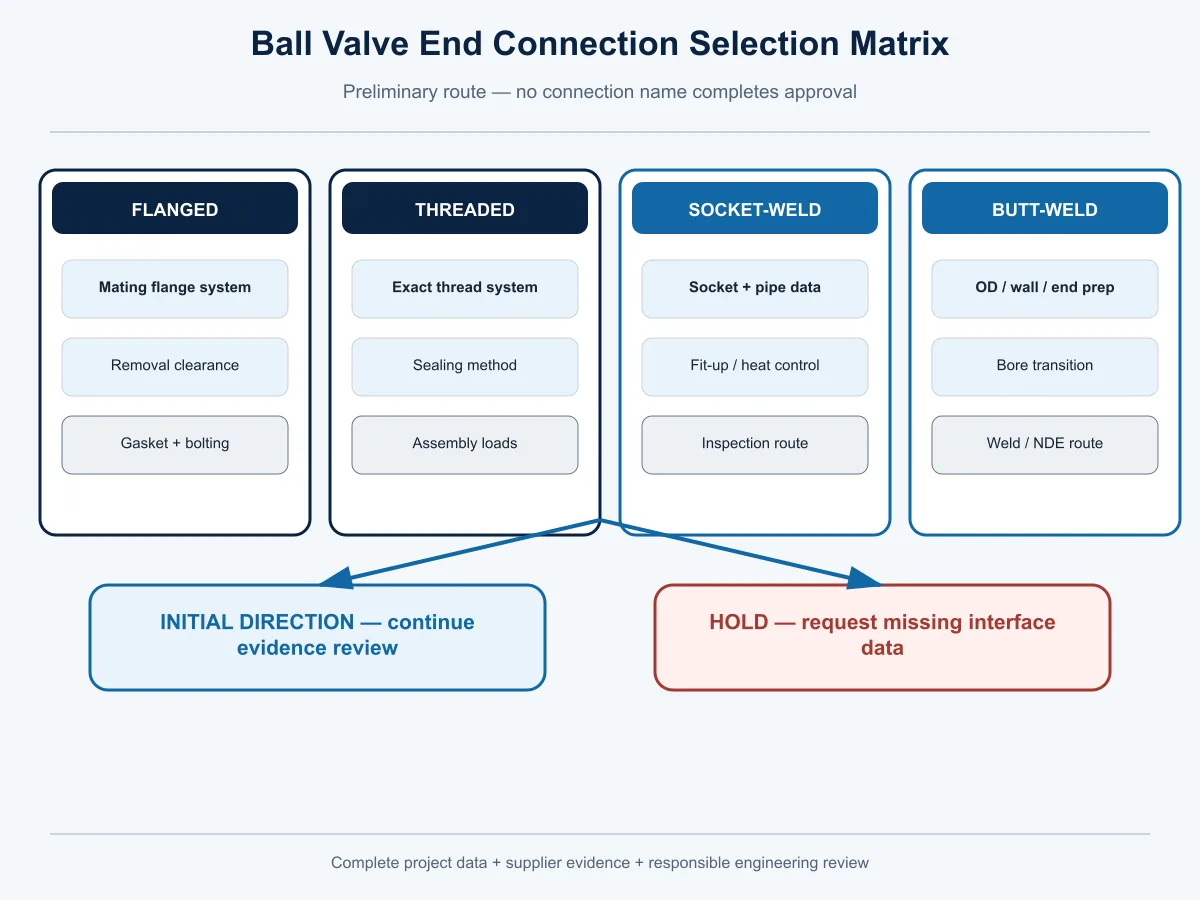
The following checklist can be used during engineering selection, purchasing review, or supplier technical clarification.

1. Confirm Pipe Size

For small pipe sizes, threaded ball valves are often practical and economical. For medium and large process lines, flanged or welded ball valves are generally more suitable. As pipe size increases, threaded installation becomes harder to control because thread engagement, tightening torque, joint stress, and pipe alignment become more critical.

2. Check Pressure and Temperature

Pressure and temperature affect the valve body, end connection, gasket, bolting, stem seal, seat material, and welding or threading method. A threaded valve may be acceptable for many small utility lines, but a high-temperature or high-pressure process line may require flanged or welded ends.

The pressure-temperature rating should be checked against the applicable valve standard, material group, and manufacturer datasheet. For carbon steel forged pressure components such as flanges, fittings, valves, and similar parts, ASTM A105/A105M is a commonly referenced material specification for ambient and higher-temperature pressure systems.

3. Consider Maintenance Requirements

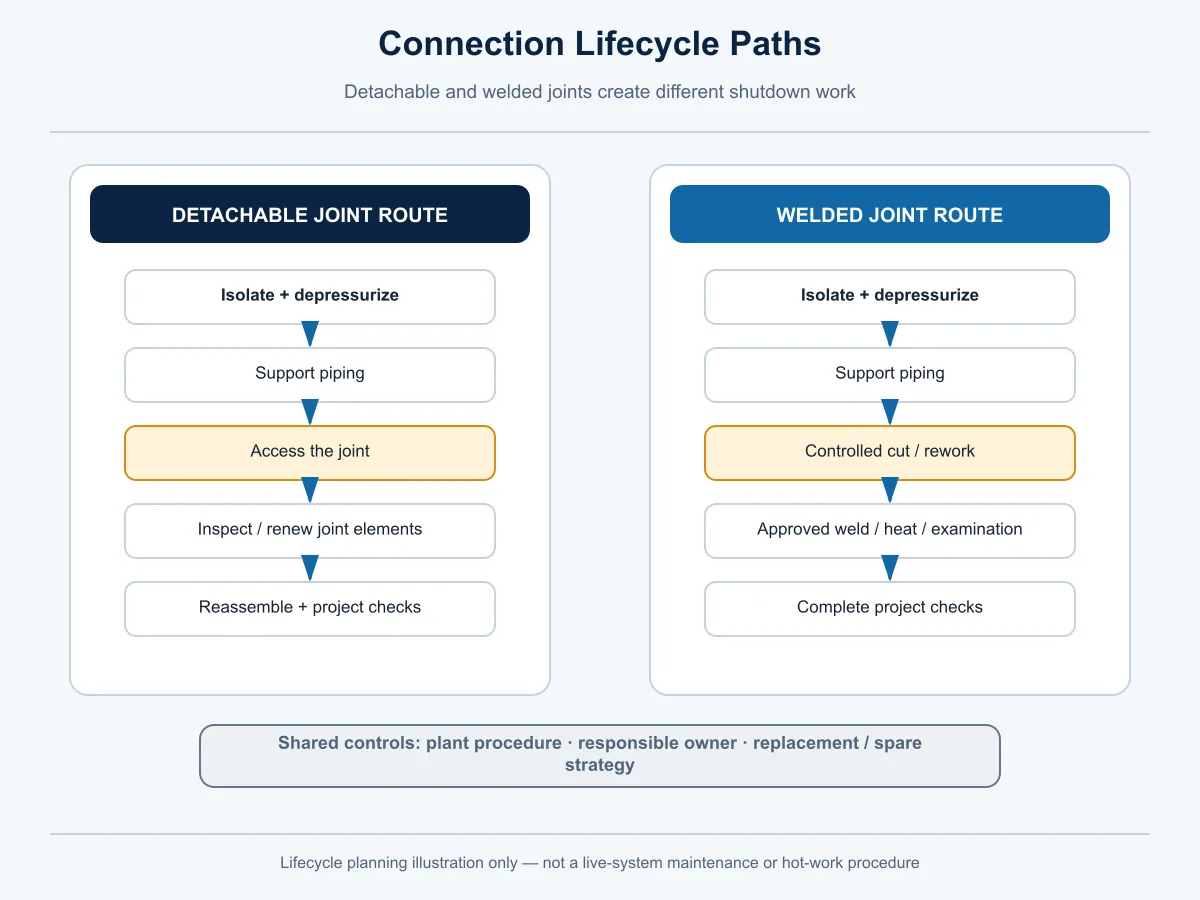
If the valve may need to be removed for inspection, cleaning, seat replacement, actuator replacement, or line modification, flanged ends are usually the most practical. If the valve is expected to remain in place for long-term permanent service and leakage risk must be reduced, welded ends may be more suitable.

Threaded valves can be removed, but repeated disassembly may damage threads or require new sealing material. In maintenance-heavy systems, a low-cost threaded valve can become expensive if the connection is frequently disturbed.

4. Evaluate Leakage Risk

For hazardous, flammable, toxic, or environmentally sensitive fluids, external leakage control is a major selection factor. Welded connections reduce mechanical leak paths, but they reduce maintainability. Flanged connections can also be reliable when the correct gasket, flange face, bolt material, and tightening procedure are used.

For clean water, compressed air, and non-critical utility service, threaded connections may be acceptable when pipe size, pressure, vibration, and site standard allow it.

5. Review Installation Space

In compact equipment, packaged skids, and dense piping layouts, threaded, socket weld, or wafer-type ball valves can reduce the required face-to-face space. Flanged valves require more room for flange thickness, bolt access, gasket replacement, and future removal.

6. Match Pipeline Standard

The valve end connection must match the pipeline standard. Flange drilling, pressure class, face type, gasket type, and bolt pattern must be compatible. Thread type must also match exactly. A valve marked NPT should not be installed into a BSP threaded fitting unless the design uses an approved adapter and the sealing method is verified.

7. Consider Future Replacement

A cheaper connection type can become expensive later if the valve is difficult to replace. For systems requiring routine maintenance, flanged valves usually provide better long-term serviceability. For buried or inaccessible lines where leakage risk is more critical than easy removal, welded valves may be justified.

Common Selection Mistakes

The following mistakes appear frequently during procurement review, site installation, and troubleshooting.

Choosing Threaded Valves for Oversized Lines

Threaded valves are convenient for small sizes, but they are not suitable for every pipeline. Large threaded connections are difficult to install correctly and may be less reliable under vibration, thermal expansion, or pipe stress.

Ignoring Flange Compatibility

A flanged ball valve must match the pipeline flange standard. Problems can occur when pressure class, bolt hole pattern, flange facing, gasket dimensions, or flange finish are not checked before ordering. A raised face flange, flat face flange, and ring-type joint flange require different sealing arrangements.

Selecting Welded Ends Without Maintenance Planning

Welded ball valves are strong, but they are not easy to remove. If the valve is installed in a system where future replacement is likely, a flanged valve may be more practical. The maintenance team should be involved before welded-end valves are approved for areas with limited access.

Using Wafer-Type Valves Without Proper Support

Wafer-type ball valves depend on correct installation between pipe flanges. Poor alignment, uneven bolt tightening, or unsupported piping can lead to leakage or mechanical stress. Pipe support should be checked before pressure testing and again after transportation if the valve is installed in a skid.

Focusing Only on Valve Body Material

Material is important, but it is not enough. The end connection type, pressure class, seat material, seal material, gasket, bolting, thread standard, welding procedure, and pipeline design all influence valve performance.

Application-Based Selection Guide

The following guide gives practical selection direction for common industrial services. It should be used as an engineering starting point, not as a replacement for project specifications.

ApplicationRecommended End ConnectionEngineering Reason
General industrial water pipelineFlangedEasy installation, inspection, and replacement
Small compressed air lineThreadedCompact, economical, and easy to assemble
Equipment skid utility connectionThreaded or socket weldSpace-saving connection for small-bore piping
High-pressure small-bore process lineSocket weld or flangedBetter mechanical integrity than ordinary threaded service
Buried pipelineButt weldReduced mechanical leak paths and permanent joint integrity
Chemical process line requiring maintenanceFlangedAllows valve removal while maintaining standard piping practice
Compact packaged systemThreaded, socket weld, or wafer-typeReduces face-to-face space and total installed weight

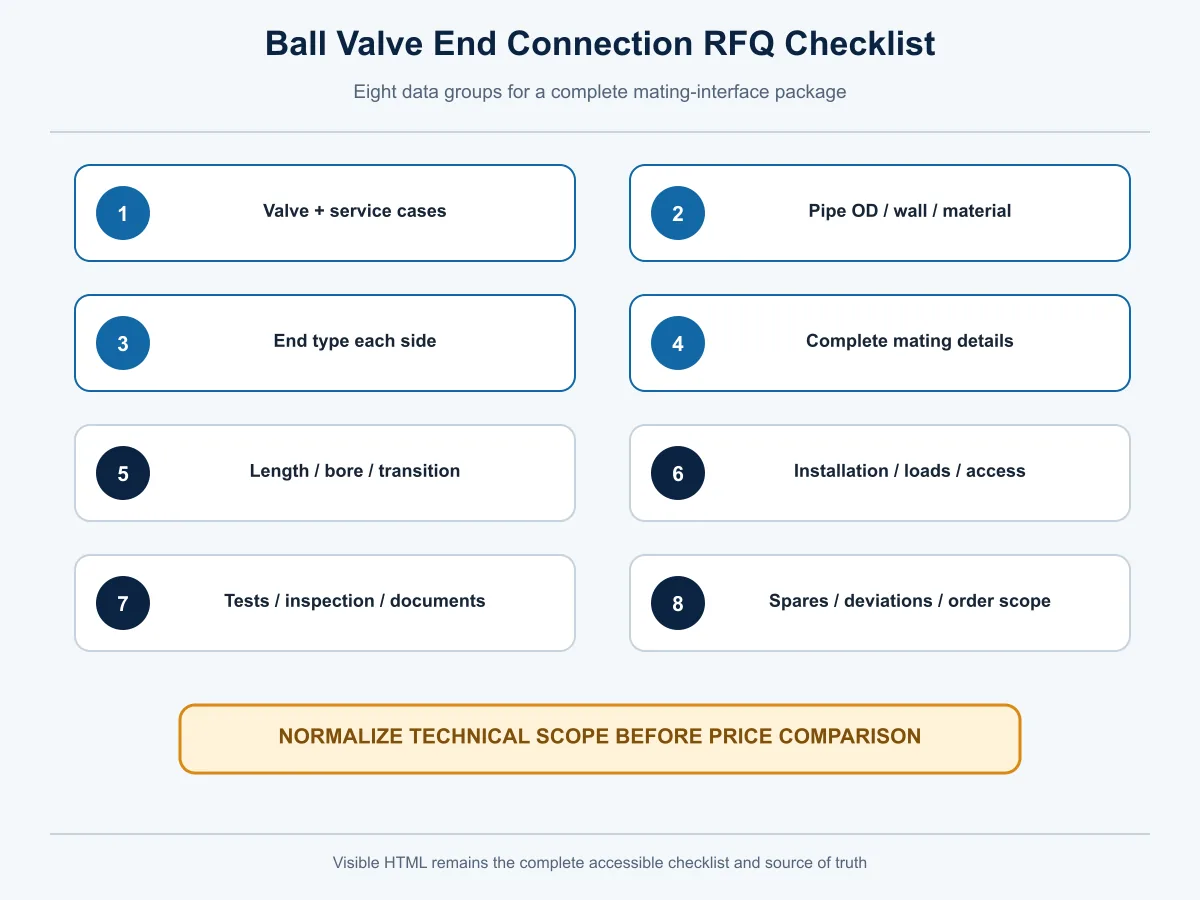
For most industrial buyers, the safest approach is to define the end connection at the inquiry stage. The purchase specification should include valve size, pressure class, body material, seat material, end connection standard, testing requirement, operation method, and service medium.

Related Ball Valve Categories for Further Selection

If your piping system requires bolted installation, standardized flange dimensions, and easier valve removal, review our Flanged Ball Valve category page for industrial process pipelines.

If your system uses small-size pipework, equipment connections, compressed air, water, or general utility service, review our Threaded Ball Valve category page for compact valve options.

For complex projects, especially where the service involves high pressure, high temperature, corrosive media, abrasive solids, or hazardous fluids, the valve end connection should be confirmed with the piping engineer before purchase.

FAQ: Ball Valve End Connection Types

What are the main ball valve end connection types?

The main ball valve end connection types are flanged, threaded, welded, and wafer-type designs. Flanged ends are common in industrial process pipelines, threaded ends are used for small-size utility and equipment lines, welded ends are selected for permanent or critical service, and wafer-type designs are used where compact installation is required.

When should I use a flanged ball valve?

Use a flanged ball valve when the pipeline requires standardized bolted connection, easier removal, and maintenance access. Flanged ball valves are commonly used in water treatment, chemical processing, oil and gas, power plants, pump stations, and medium to large process pipelines.

When should I use a threaded ball valve?

Use a threaded ball valve for small-diameter piping, compressed air, water, drain and vent points, equipment skids, and general industrial utility systems. Before installation, confirm the thread standard, sealing material, pressure-temperature rating, and whether vibration or repeated disassembly may affect the joint.

Are welded ball valves better than flanged ball valves?

Welded ball valves are better when the project needs a permanent joint and reduced external leakage risk. Flanged ball valves are better when the valve may need to be removed, inspected, or replaced. The better choice depends on pressure, temperature, medium, maintenance access, and project specification.

Are wafer-type ball valves common?

Wafer-type ball valves are less common than flanged, threaded, and welded ball valves. They are used in compact piping systems where short face-to-face length and lower weight are important. Installation requires accurate flange alignment, proper gasket selection, and adequate pipe support.

Which ball valve connection type is easiest to maintain?

Flanged ball valves are usually the easiest to maintain because the valve can be removed after depressurizing the line and loosening the flange bolts. Threaded valves can also be removed, but thread damage or resealing problems may occur after repeated disassembly. Welded valves are the most difficult to remove.

Which ball valve end connection is best for high-pressure service?

High-pressure service often uses flanged, socket weld, or butt weld ball valves, depending on pipe size, pressure class, temperature, material, and maintenance requirement. Threaded valves may be used in some small-bore services, but the thread standard, pressure rating, vibration, and safety risk must be reviewed carefully.

Conclusion

Ball valve end connection types directly affect installation quality, leakage control, maintenance cost, and long-term piping reliability. Flanged ball valves are suitable for industrial process pipelines where maintenance access and standardized bolted connection are important. Threaded ball valves are compact and economical for small-size utility and equipment piping. Welded ball valves provide strong permanent joints for critical or inaccessible service. Wafer-type ball valves help reduce space and weight in compact installations.

The correct selection should be based on pipe size, pressure-temperature rating, medium, installation space, leakage risk, applicable standards, and future maintenance plan. In procurement, the end connection should be specified clearly together with the valve size, pressure class, material, seat type, operation method, and testing requirement. This reduces the risk of field modification, installation delay, leakage, and unnecessary replacement cost.

Share:

Lascia un commento

Il tuo indirizzo email non sarà pubblicato. I campi obbligatori sono contrassegnati *

want totalk
with us?

Leave your details and one of our experts will contact you!

it_ITItalian
Torna in alto

Contact us

Please fill out this form with a brief description of your issue and we will get back to you as soon as possible.