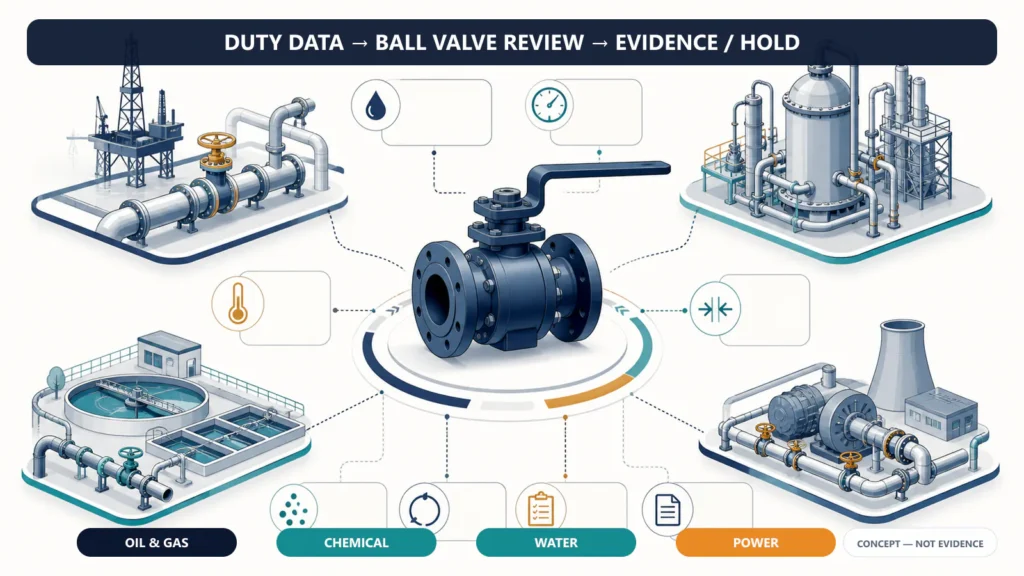
Industrial Ball Valve application review linking service data to oil and gas chemical water and power duties

Industrial Ball Valve Applications: How Duty Changes Selection

Industrial Ball Valves are commonly screened for isolation, shutdown, transfer, drain, vent and utility duties in oil and gas, chemical processing, water treatment and power plants. Industry name alone does not select the valve. Define the exact medium, pressure, temperature, differential pressure, solids, corrosion risk, shutoff requirement, operating frequency and installation conditions first. Then verify the ball support, bore, seat and sealing system, materials, cavity behavior, end connection, torque, actuation, tests and documents for the offered configuration.

This application guide focuses on how industry duty changes engineering review, evidence and RFQ requirements. For a general comparison of Ball Valve types, materials and construction choices, use the Guida alla selezione delle valvole a sfera.

Featured illustration: Conceptual duty-to-review map only. It links application data, engineering questions and evidence holds; it is not a product drawing, supplied configuration, test record or service approval.

Quick Answer: Screen the Duty Before Choosing the Ball Valve

A common application identifies a review path, not a finished valve specification. Two valves with the same nominal size and pressure class can require different constructions because their media, temperature cases, shutoff consequences, solids, cycling and maintenance conditions are different.

Use the following table before shortlisting a Ball Valve:

Application duty Minimum inputs First Ball Valve questions Approval hold
Pipeline or transfer isolation Medium and phase, pressure, temperature, maximum differential pressure, bore or pigging need, shutoff consequence Floating or trunnion? Full or reduced bore? Which ends? Are cavity or isolation functions specified? Hold if oil and gas service, line size and Class are the only inputs
Process or chemical isolation Composition, concentration, temperature, cleaning fluid, corrosion risk, deposits or polymerization, external-leakage consequence Is the complete wetted and sealing package defined? Can fluid remain in the cavity? Hold if body material alone is treated as compatibility proof
Water or utility isolation Water chemistry, pressure, temperature, surge risk, solids, external environment, cycling Is this clean water, dosing chemical or wastewater duty? What closure time and maintenance access are required? Hold if all water services are treated as equivalent
Fuel or power auxiliary service Exact plant system, fluid and phase, pressure-temperature cases, cycling, shutdown role, leakage consequence What limits the seat and sealing system? Is manual or automated operation required? Which tests and documents apply? Hold if power plant service is used as a universal suitability statement
Arresto automatico Maximum differential pressure and direction, travel time, fail action, utilities, operating demand and safety logic Is controlled valve torque available? Which sizing factor, mounting and accessories apply? Hold if the valve and actuator are selected separately without a package calculation
Dirty, abrasive or high-temperature duty Solids or deposits, particle characteristics, temperature cases, thermal cycling, allowable leakage, flushing and maintenance plan Is a Ball Valve still appropriate? Which seat and surface system enters review? How does the duty affect torque? Hold if metal seated is treated as automatic approval

Three rules apply across all industrial Ball Valve applications:

  1. A standard Ball Valve is normally screened for on-off or isolation duty. Throttling and process-control duties require a separate design and sizing review.
  2. A common industry use does not prove that every Ball Valve construction is suitable.
  3. Approval should remain open until the exact offered configuration and its supporting documents match the project data.

For the complete cross-functional selection sequence, use the Guida alla selezione delle valvole a sfera. This article focuses specifically on how application duty changes the questions that buyers and engineers must ask.
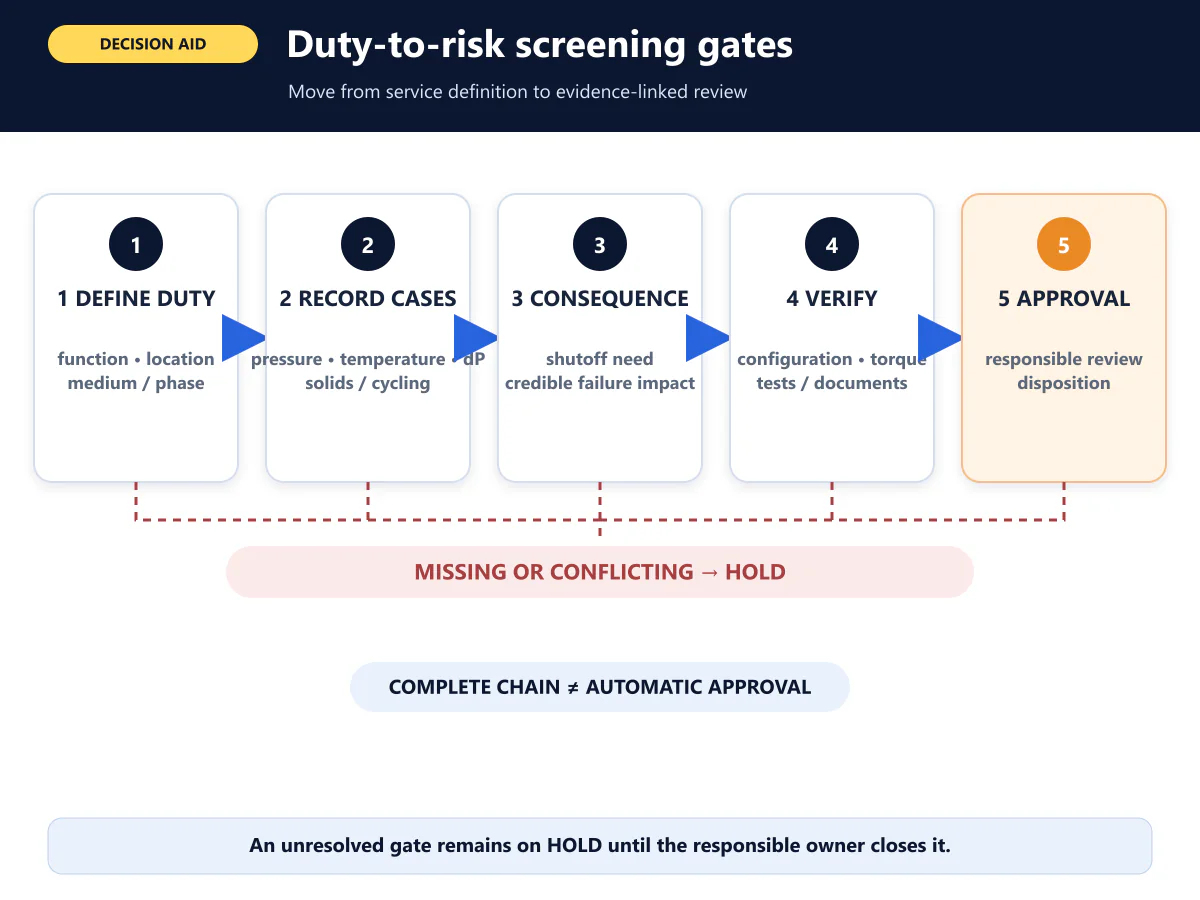
Duty to risk screening gates for industrial Ball Valve applications
Engineering decision aid: define duty, operating cases, failure consequence and evidence before shortlisting a Ball Valve. An unresolved gate remains on HOLD.

Define the Application as a Duty, Not an Industry Label

Start by stating what the valve must do. Typical functions include process isolation, maintenance block, emergency shutdown, transfer, tank isolation, bypass, drain, vent, sampling and automated sequencing. The function affects the required shutoff direction, frequency of operation, acceptable leakage, operating speed and failure consequence.

The application definition should record at least:

  • medium, composition, concentration, phase, contaminants and cleaning or flushing fluids;
  • normal, design and credible upset pressure and temperature;
  • maximum differential pressure and its direction during opening, closing and shutoff;
  • solids, abrasion, crystallization, polymerization, coking, fouling or cavity deposits;
  • flow and velocity information, pressure-drop sensitivity, bore requirement and any cleaning or pigging need;
  • required shutoff direction and acceptance criterion;
  • operating frequency, required travel time and maintenance strategy;
  • internal corrosion or erosion risk and the external site environment;
  • installation orientation, available space and piping-interface requirements.

The Ball Valve decision should remain open when the service includes undefined continuous throttling, flashing, cavitation, severe erosion, two-phase instability, sticky or crystallizing media, fibrous solids, or an unassessed hydraulic transient. Missing process data is not a reason to make a conservative-sounding product claim. It is a reason to identify an engineering hold point.

Application Definition Sheet

Campo Input di progetto Why it changes selection Stato
Funzione della valvola Isolation, shutdown, transfer, drain, vent or other Defines operating and failure requirements Confirmed / Open
Casi operativi Normal, design, upset, cleaning and shutdown Prevents selection from one nominal condition Confirmed / Open
Medio Composition, concentration, phase, contaminants Controls material and sealing review Confirmed / Open
Pressione differenziale Value and direction during each operating state Affects seat load, torque and actuator sizing Confirmed / Open
Solids and deposits Type, size, concentration and behavior Affects seat damage, cavity retention and torque Confirmed / Open
Conseguenza del guasto Seat passing, external leakage, failure to move, rapid closure Defines testing, actuation and documentation depth Confirmed / Open
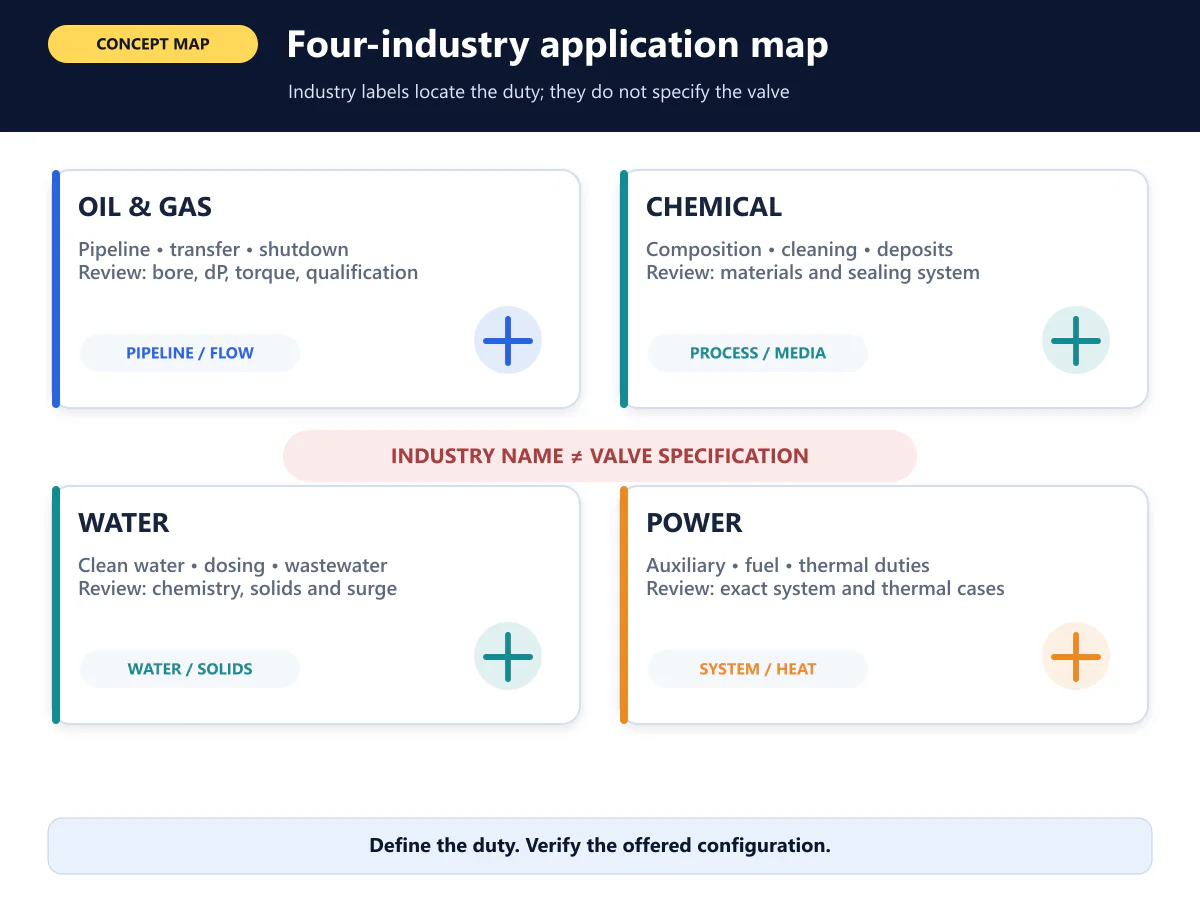
Four industry Ball Valve application map for oil and gas chemical water treatment and power plants
Concept map only: each industry contains multiple duties, risks and hold points. The industry name does not specify the valve construction.

Oil and Gas Ball Valve Applications

Oil and gas is not one service condition. Transmission pipelines, refinery process lines, terminals, tank farms, fuel systems and emergency-shutdown stations impose different requirements.

Transmission and Pipeline Isolation

Pipeline isolation may require review of bore geometry, pigging or inspection-tool passage, pressure and differential pressure, ball support, end connection, remote operation and access for maintenance. Full bore, trunnion support, welded ends or special cavity functions may enter the review, but none should be inherited from the phrase pipeline Ball Valve alone.

Where a project specifies a pipeline-valve product standard, the buyer should confirm the exact standard, project-approved edition, product scope and required evidence for the offered valve. A product name or catalog heading is not proof of compliance or certification.

Refinery, Terminal and Tank-Farm Isolation

Clean hydrocarbon transfer, fuel service, high-temperature process fluid, drain and vent duty, and utility service should be treated separately. The review may include external-leakage consequence, stem and body-joint sealing, thermal cases, operating frequency, shutdown philosophy and access for inspection.

Fire type-testing, anti-static design and fugitive-emission qualification are separate project requirements. They must not be inferred from hydrocarbon service or from a visible valve feature. If any of these requirements apply, request the exact design description and evidence scope for the offered configuration.

Gas and Emergency-Shutdown Duty

For an automated shutdown valve, define:

  • maximum differential pressure and direction during closure;
  • required closing or opening time;
  • fail position and utility failure case;
  • operating frequency and test-stroke requirements;
  • control signal, solenoid, position feedback and enclosure requirements;
  • valve torque source, revision and service assumptions;
  • project sizing factor and actuator supply conditions.

No actuator size can be approved from nominal valve size and pressure class alone. A safety-function or SIL conclusion also falls outside a basic valve application review; it requires the complete safety function, certified data and responsible project assessment.

Oil and gas location Main duty Required project inputs Approval hold
Transmission pipeline Isolation or sectionalizing Bore/pigging, pressure and dP, ends, operation, cavity requirements Generic pipeline label without exact design and evidence
Terminal or tank farm Transfer and tank isolation Fluid, temperature, leakage consequence, cycling, fire/emission requirements Hydrocarbon service treated as proof of special qualification
Gas shutdown station Automated isolation Closing dP, travel time, fail action, utilities, torque and controls Valve and actuator offered without a package sizing record

La oil and gas valve applications page owns the broader multi-valve industry context. The present guide only defines the Ball Valve screening boundary.

Chemical Processing Applications

Chemical-service selection should begin with the complete fluid description. Chemical name alone may be insufficient; concentration, temperature, impurities, water content, phase, cleaning fluid and operating cycle can all change the material and sealing review.

Qualify Every Wetted and Sealing Component

Review the body, end closures, ball, stem, seats, packing, body seals or gaskets, and any exposed bearings or springs. A stainless steel, duplex, alloy, lined, PTFE-based, PEEK or metal-seat label does not establish compatibility by itself. The exact component, material specification or compound, condition, geometry and service boundary are relevant.

This is why a chemical compatibility review must extend beyond the body:

Component or interface Informazioni richieste Possible mechanism to review Evidence owner
Body and end closures Exact material specification, condition and fluid exposure Corrosion, localized attack or environmental cracking Materials and project engineering
Ball and stem Exact material, surface condition and load Corrosion, wear, galling or torque transmission Manufacturer and materials engineering
Sistema di tenuta Exact compound or surface system, pressure-temperature basis Swelling, extraction, creep, wear or chemical attack Manufacturer and process/materials engineering
Tenuta dello stelo Exact packing system and external-leakage requirement Chemical attack, relaxation, permeation or cycling effects Manufacturer and quality
Body seals or gaskets Exact material and joint design Chemical attack, compression loss or thermal cycling Manufacturer and materials engineering

Dosing, Solvents and Batch Operation

Dosing systems can combine low flow, frequent cycling and concentrated chemicals. Solvent service may raise questions about swelling, extraction, permeation and external leakage. Batch production can add cleaning fluids and repeated changes in temperature or composition. These conditions should be recorded rather than hidden under a broad chemical service description.

Crystallizing, Polymerizing or Fouling Media

A Ball Valve cavity may retain fluid when the valve changes position. If the medium can crystallize, polymerize, cure or deposit solids, review cavity behavior, flushing or drain strategy, seat damage, breakaway torque and maintenance access. Selection should remain open when the process and manufacturer cannot support the proposed cavity and sealing arrangement.

For component-level specification logic, see the Ball Valve Materials guide.

Water and Wastewater Applications

Water-service Ball Valves may be used for utility isolation, pump isolation, treatment skids and distribution systems, but clean water, dosing chemicals, seawater and wastewater are not equivalent duties.

Clean Water and Utility Systems

Confirm pressure and temperature, water chemistry, disinfectants, external environment, coating requirements, cycling and maintenance strategy. End connection should be selected as a complete piping interface: flange facing and bolting, thread form and sealing method, or weld preparation and inspection requirements must match the system.

Treatment Chemicals and Dosing Skids

Separate water duty from hypochlorite, coagulant, acid, alkali and cleaning duties. Record chemical concentration, temperature, soft-part compatibility, leakage consequence and flushing conditions. Oxygen, chlorine or strong-oxidizer service requires exact material, cleaning and project evidence; it cannot be approved from a generic material label.

Wastewater, Sludge and Solids

For wastewater, record the type, size and concentration of solids, fibers, grit and deposits. Review cavity accumulation, seat cutting, operating torque, flushing and the maintenance interval. A standard soft-seated Ball Valve should not be assumed suitable, but a metal seat or severe-service label is not an automatic solution either. The actual duty may require a different Ball Valve construction or review of another valve family.

Closure Speed and Hydraulic Transients

Quarter-turn operation can close a flow path quickly. In systems sensitive to pressure surge, required closure time should be established through the system design or transient analysis. Do not claim water-hammer prevention or select a closing time from a generic rule.

Water duty What changes Ball Valve review Hold point
Clean utility water Chemistry, pressure, coating, cycling Materials, ends, operator and maintenance Water quality or interface remains undefined
Chemical dosing Concentration, temperature, cleaning fluid, leakage consequence Complete wetted and sealing package Body material is the only compatibility check
Wastewater or sludge Solids, fibers, grit, deposits, flushing Cavity, seat, torque and alternative-family review Duty is treated as clean water
Surge-sensitive line Flow condition and transient consequence Closure profile and actuator/control strategy Closing time is selected without analysis

The broader industry route is the Water Treatment Valves application guide.

Power Plant Applications

A power plant contains many different systems. Cooling water, service water, compressed air, chemical treatment, fuel gas, fuel oil, drains, vents and high-temperature lines should not share one generic Ball Valve specification.

Auxiliary Water, Air and Treatment Systems

Define the exact medium, pressure-temperature envelope, cleanliness, cycling and maintenance requirement for each system. A valve used on service water may require a different material and operating review from one used on a chemical-treatment skid or compressed-air line.

Fuel Gas and Fuel Oil Isolation

Fuel duty requires a clear leakage consequence, shutdown role, pressure-temperature basis, stem and body-joint sealing review, actuation basis and project test requirements. Fire testing, fugitive-emission qualification and safety-function requirements are independent evidence items. One does not prove another.

High-Temperature or Steam Duty

A standard Ball Valve is not automatically suitable for steam or high-temperature service. Define normal, design, upset and cleaning temperatures; pressure at each relevant temperature; duration and cycling; deposits; shutoff acceptance; and hot-condition torque. Then qualify the complete pressure boundary, seat, packing, body seals and operator.

For deeper thermal-duty review, use the High-Temperature Ball Valve guide.

Plant system Main questions Evidenza richiesta Hold trigger
Cooling or service water Chemistry, pressure, coating, cycling, access Datasheet, materials and interface data Generic utility-service approval
Chemical treatment Composition, concentration, cleaning and soft parts Complete component and compatibility review Body material alone
Fuel gas or fuel oil Leakage consequence, shutdown, actuation, tests Torque/package record and scoped qualification evidence Flammable service treated as proof of fire qualification
High-temperature line Pressure at temperature, cycling, seals, hot torque Controlled rating, component limits and torque data Seat type or nominal Class used as full approval

La Power Plant Valves application page covers the wider multi-valve plant context.
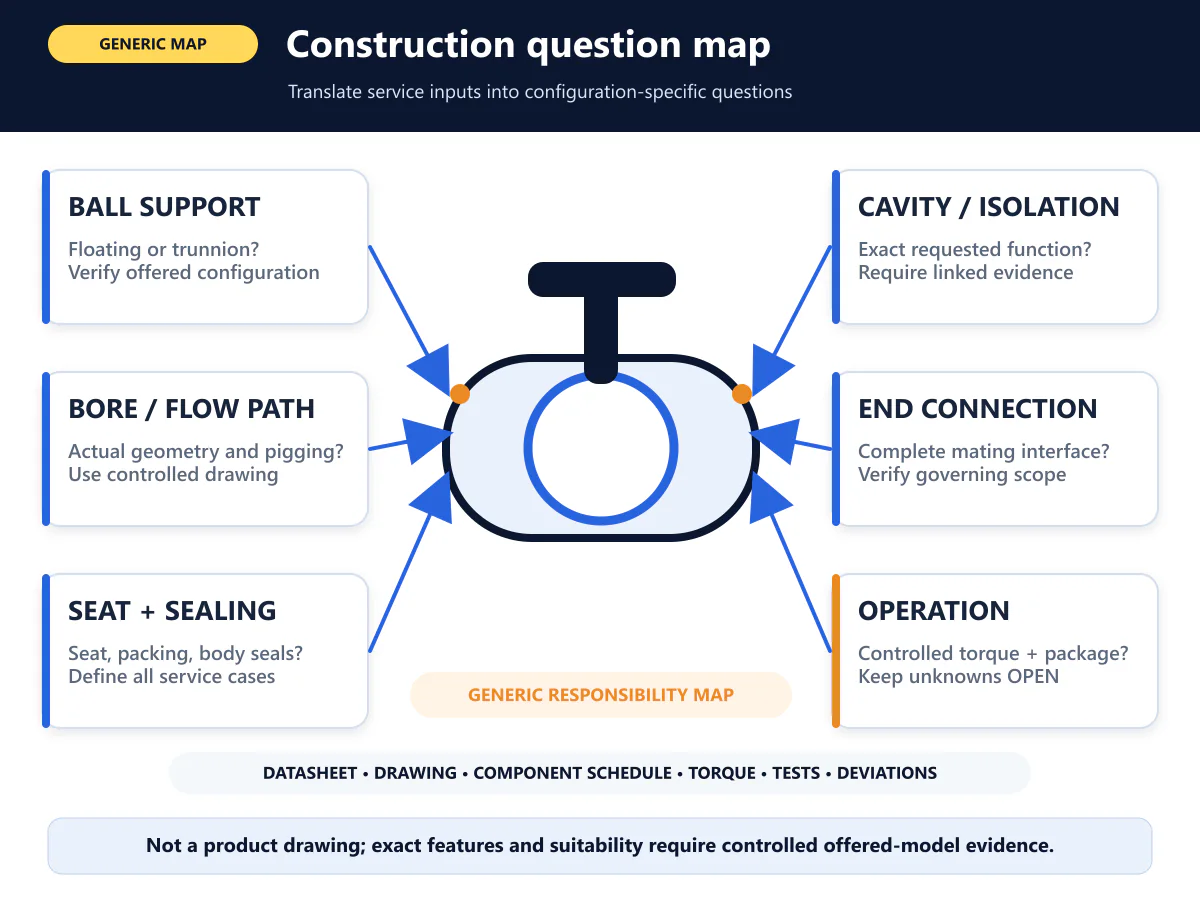
Industrial Ball Valve construction questions for support bore sealing cavity connections and actuation
Generic engineering map only. Actual construction, component materials, features and suitability require the offered-model drawing and controlled evidence.

Translate the Duty into Ball Valve Construction Questions

After defining the service, translate each risk into a construction question.

Ball Support and Body Construction

Floating and trunnion-mounted designs use different ball-support and load paths. The appropriate route depends on the exact size, pressure, differential pressure, duty, offered design and torque basis. There is no universal industry, size or pressure cutoff that can replace manufacturer and project data.

Side-entry, top-entry, one-piece, two-piece, three-piece and fully welded descriptions identify construction features. They may affect pressure-boundary joints, maintenance, installation and access, but no construction is inherently leak-free, maintenance-free or suitable for every application.

Bore and Flow Path

Full or reduced bore affects geometry, velocity, pressure drop, cleaning and possible pigging requirements. Piggability, Cv/Kv and pressure-drop conclusions require exact dimensions and, where necessary, calculation. They should not be inferred from a family description or image.

Seat and Complete Sealing System

Review the seat, stem packing or seal, body-joint gasket or seal, and any secondary sealing components separately. Soft seat versus metal seat is a decision path, not an application shortcut. Exact material or compound, geometry, pressure-temperature and differential-pressure limits, medium, cycles and acceptance criteria must align.

Cavity and Isolation Features

Cavity pressure relief, drain or vent, double block and bleed, double isolation and bleed, emergency sealant injection, anti-static devices and fire-tested designs are evidence-controlled features. If a project requires one, define the function and terminology, then request the exact drawing, pressure and direction basis, test scope and offered-model evidence.

Service input Construction question Evidenza richiesta Do not infer
High dP or large operating load How is the ball supported and what torque applies? Exact design and controlled torque sheet Trunnion suitability from application name
Pigging or low-resistance flow path What is the actual bore and geometry? Approved drawing and process requirement Full bore or piggability from catalog wording
Corrosive or thermal duty What are all seat, packing and body-seal components? Component schedule and controlled limits Suitability from one material name
Isolation or cavity requirement Which exact function and pressure direction are specified? Drawing, functional description and test evidence DBB, DIB or cavity relief from valve type

Review Materials, End Connections and Pressure–Temperature Separately

A complete material package identifies the body, end closures, ball, stem, seats, packing, body seals or gaskets, bolting, bearings, springs and any coatings or hardfacing. Each item should be tied to an exact component, specification or compound, product form or condition where relevant, and an operating boundary. Material family names do not guarantee corrosion resistance, abrasion life or special-service suitability.

End connection is a separate piping-interface decision. For flanged, threaded, socket-weld or butt-weld ends, specify the mating standard, pipe dimensions, facing or thread form or weld preparation, gasket and bolting or welding and inspection requirements, and removal strategy. The Ball Valve End Connection Types guide provides the detailed interface framework.

Nominal Class or PN is also not a complete operating approval. The applicable design and pressure-temperature basis, exact material group, end connection and every seat or sealing limit should be checked against each credible operating case. The lowest applicable component or design boundary may control.
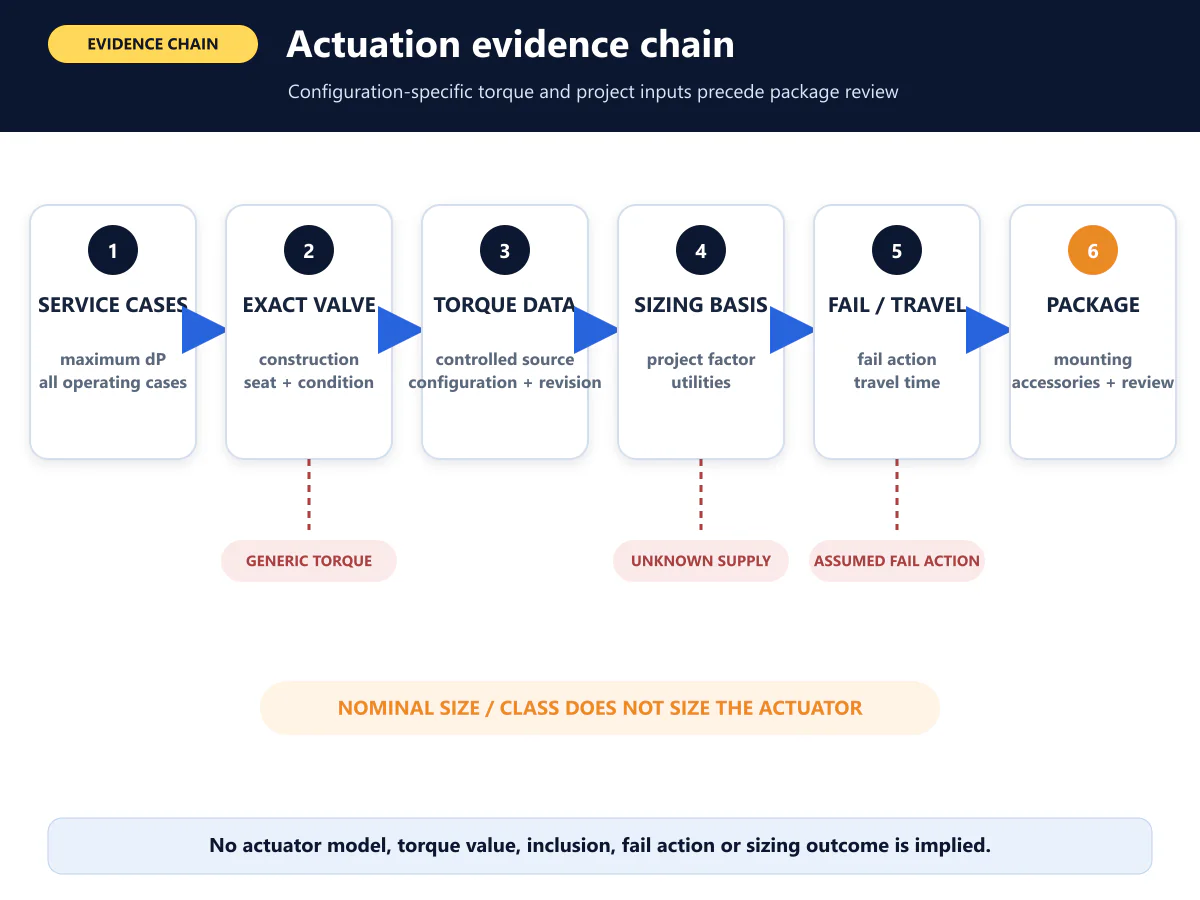
Ball Valve torque and actuator evidence chain from differential pressure to package approval
Valve size does not select the actuator. Use configuration-specific torque, project sizing factor, utilities, fail action, travel time, interface and accessory evidence.

Size Manual or Automated Operation from Controlled Torque Data

Valve torque is not one universal number. The manufacturer may define break-to-open, running and end-to-close or reseat torque states. The applicable values depend on the exact configuration, maximum differential pressure and direction, seat and packing system, temperature, deposits, cycling assumptions and document revision.

Manual lever or gearbox selection should consider controlled torque, operating frequency, access and project limits. Manual operability should not be promised from valve size or pressure class.

Use the Actuator Torque Review guide to organize the torque states, sizing basis, utilities, fail action and package records that require engineering confirmation.

For an automated package, request:

Input Required basis Evidenza del fornitore Approval hold
Valve torque Exact valve configuration, dP, direction, temperature and service assumptions Controlled torque sheet and revision Generic or ambient-only torque
Sizing factor Project or approved package basis Calcolo dimensionamento attuatore Unstated margin
Utilities Minimum/maximum air pressure or electrical supply Actuator data and project utility sheet Nominal supply only
Fail action and travel time Process and safety requirement Package functional record Assumed fail position
Controls and accessories Signal, solenoid, switches, positioner, protection Bill of materials and wiring/pneumatic documents Visible actuator treated as complete scope
Interfaccia Mounting, coupling and orientation Assembly drawing Valve and actuator purchased without interface review

No final actuator size or included package can be stated until these fields are closed.
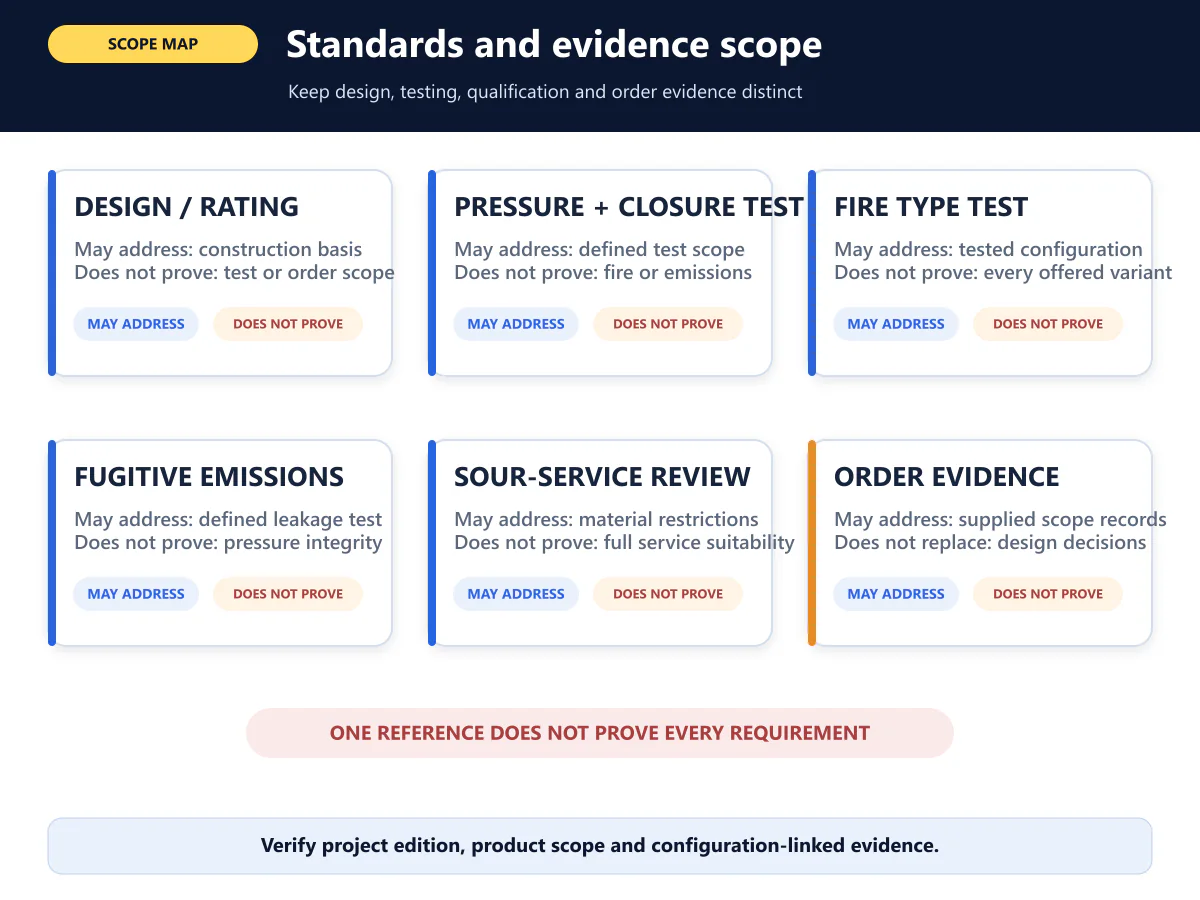
Industrial Ball Valve standards and evidence scope map for design testing emissions and sour service
Educational scope map: one standard, test or certificate cannot substitute for another requirement or prove every offered valve configuration.

Separate Standards, Tests and Order Evidence

Standards should be assigned by role. A product design standard, pressure-shell/rating reference, pressure-test standard, face-to-face standard, flange standard, fire-test standard, fugitive-emission qualification and sour-service material/environment standard answer different questions.

For example, ASME B16.34 describes a scope that includes pressure-temperature ratings and other construction-related requirements for covered valves. It does not by itself establish chemical compatibility, seat limits or approval of a Raymon Valve configuration. The API standards catalog identifies product and testing publications, but project applicability and the exact offered-product evidence must still be confirmed.

Similarly, a pressure and closure test does not prove fire-test qualification, external-emission performance, corrosion compatibility or service life. ISO 15848-1 addresses a fugitive-emission type-testing and qualification scope for external leakage at stem or shaft seals and body joints; it does not establish seat shutoff. AMPP's MR0175 / ISO 15156 resources concern material and environmental restrictions in the defined H2S-containing oil and gas production scope; they do not establish a universal valve certification.

La Valve Pressure Testing guide provides the internal review path for shell and closure test requirements while keeping fire, emission, material-environment and order-evidence scopes separate.

Requirement What the reference or evidence may address Cosa non dimostra
Design or pressure-rating basis Construction and rating requirements within scope Chemical compatibility, seat limits or exact product approval
Pressure and closure test Pressure-boundary integrity and closure acceptance under defined test conditions Fire qualification, emissions, corrosion resistance or service life
Fire type test Behavior of a covered tested design and configuration Every size, material, seat and operator variant
Fugitive-emission qualification External stem or body-joint leakage within the valid scope Seat leakage or corrosion suitability
Sour-service materials review Material and environment restrictions within the application scope Universal NACE compliance or product certification

For a quotation or technical bid, request controlled datasheets and drawings, component material schedules, pressure-temperature and seat-limit data, torque sheets, actuator sizing records, approved test and inspection procedures, applicable qualification evidence, material traceability, special-process records and a clear deviation schedule. Generic capability statements and blank templates are not order-specific evidence.

Use the Quality & Inspection process to organize inspection planning, test records, traceability and document review without treating a generic capability page as order-specific evidence.
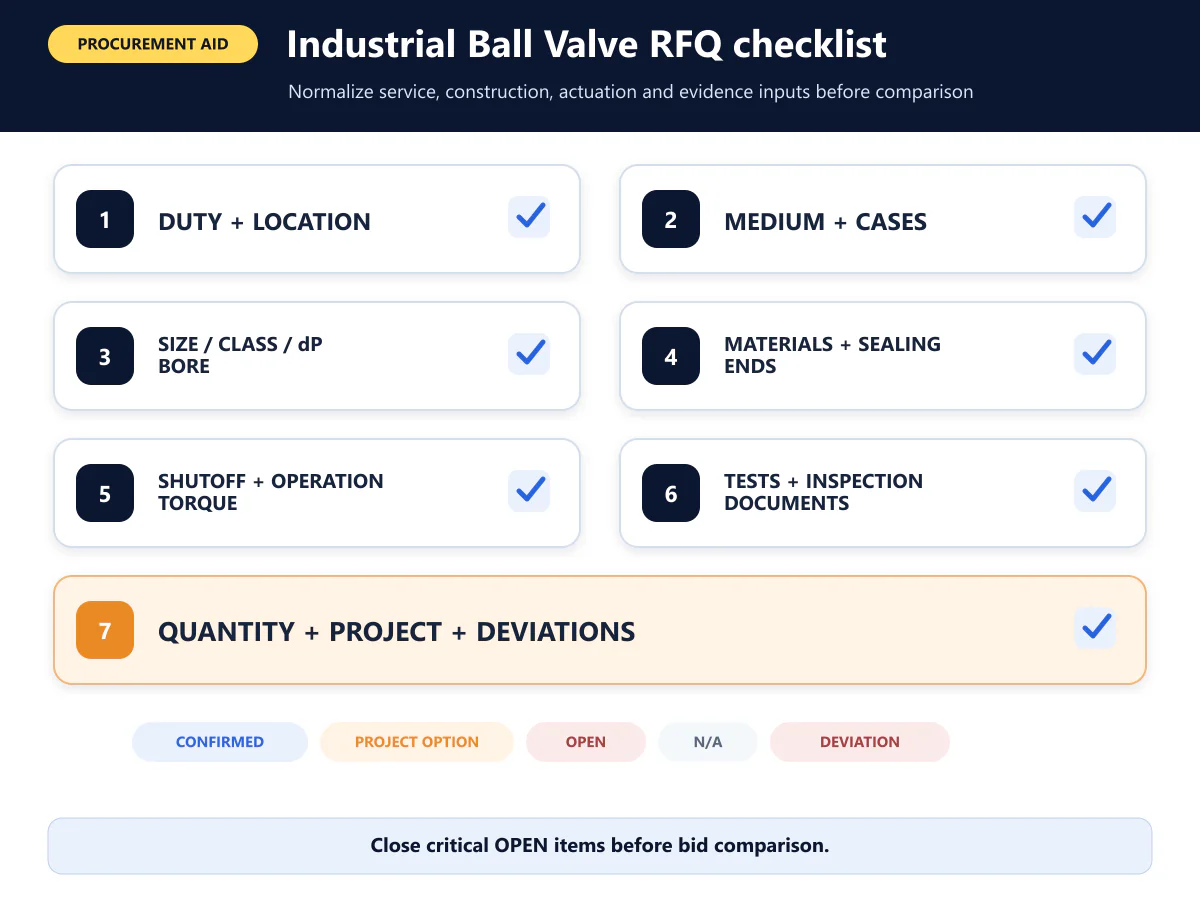
Industrial Ball Valve application RFQ checklist for service construction actuation tests documents and deviations
Complete the service, construction, actuation, testing, document and deviation fields before comparing industrial Ball Valve quotations.

Build an Auditable Industrial Ball Valve RFQ

An RFQ should allow suppliers to quote the same technical scope and identify deviations. Include:

  • valve function, system location, quantity and tag requirements;
  • DN/NPS, pipe OD or schedule, PN/Class and bore or pigging requirement;
  • operating and design pressure and temperature, including credible upset and cleaning cases;
  • maximum differential pressure and direction during operation and shutoff;
  • medium, composition, concentration, phase, contaminants, solids and cleaning fluids;
  • corrosion, erosion, deposit, cycling, surge and external-environment conditions;
  • body, ball, stem, seat, packing, body seal or gasket, bolting and coating requirements;
  • end connection and governing mating-interface requirements;
  • shutoff direction, allowable leakage and operating frequency;
  • manual, gear or actuated operation and required torque data;
  • actuator utilities, sizing factor, fail action, travel time, signal, protection and accessories;
  • applicable project standards and editions, tests, inspection, witness points and documents;
  • material traceability, tagging, preservation, packing, destination and deviation schedule.

Mark every critical field as Confirmed, Project Option, Open, Not Applicable o Deviation. An open critical field should remain visible during supplier comparison instead of being filled with an assumption.

Normalize Supplier Technical Bids Before Commercial Comparison

Compare suppliers against the same confirmed duty and evidence fields. Do not normalize a deviation by silently assuming equivalence.

Review lineSupplier response requiredNormalize and compareHOLD or deviation trigger
Offered valve entityModel, construction, size, Class/PN, bore and end connectionConfirm every bid refers to one identifiable offered configurationCatalog family only, mixed models or missing drawing revision
Pressure-temperature and sealing basisRating basis plus seat, packing and body-seal limits for every operating caseCompare the controlling limit and stated assumptionsOne nominal Class/PN or ambient data used as complete approval
Materials and surfacesComponent-by-component material/compound schedule, condition, coating or hardfacingCompare the same component scope, not body material aloneSubstitution, generic trim or missing soft-part identity
Torque and operationConfiguration-specific torque revision and manual or actuator sizing recordCompare worst-case dP, factor, utilities, fail action and travel timeGeneric torque, unknown supply or assumed fail action
Tests and qualificationApplicable procedure, acceptance basis and configuration-linked evidenceSeparate pressure, closure, fire, emissions and material-environment scopesOne test or certificate presented as proof of unrelated requirements
Documents and deviationsDrawing, datasheet, material records, ITP, document index and explicit deviation listCompare inclusions, exclusions, witness points and delivery recordsBlank templates, capability brochure or unlisted exception

Record each line as Comply, Project Option, Open, Not Applicable o Deviation. Commercial comparison should not close an engineering HOLD.

Application Review Scenarios — Not Customer Case Studies

The following hypothetical scenarios show how to use the framework. They are not Raymon Valve project records.

Scenario 1: Gas Pipeline with Pigging and Remote Shutdown

Assume the line requires pig passage and remote isolation. The review must close the exact bore and geometry, support concept, maximum closing differential pressure, torque revision, actuator factor, supply condition, closure time, fail action and any cavity or isolation definition.

What remains open: the exact valve construction, product-standard applicability, special features and actuator size until controlled project and manufacturer data are available.

Scenario 2: Chemical Dosing Line with Incomplete Composition Data

Assume the RFQ states only the chemical name and body material. Concentration, temperature, cleaning fluid, seat compound, packing and gasket are missing. The quotation cannot establish compatibility from the body material alone.

What remains open: the complete material and sealing package until process and compatibility data are confirmed.

Scenario 3: Wastewater Line with Fibers and Grit

Assume the line contains variable solids and requires frequent isolation. Review cavity retention, seat damage, flushing, breakaway torque, cycling and maintenance. A different Ball Valve construction or another valve family may need assessment.

What remains open: whether a Ball Valve is the correct family and which design can be supported by the actual solids and operating data.

Scenario 4: Power Auxiliary Line with a High-Temperature Upset

Assume normal temperature is moderate but a credible upset is substantially hotter. Approval must include pressure at the upset temperature, duration, cycling, complete sealing-system limits, hot-condition torque and relevant testing or documentation.

What remains open: pressure-temperature suitability, seat and seal selection, torque and operator until the full thermal case and controlled component data are reconciled.

Request an Industrial Ball Valve Application Review

Send the valve function, medium and composition, operating and design pressure and temperature, maximum differential pressure, DN/NPS, Class/PN, bore requirement, materials, end connection, shutoff criterion, operating frequency, actuation requirements, required tests and project documents.

Use the enquiry to request a review of whether the submitted application data and proposed configuration are complete and internally consistent. Final process, materials, piping, safety and project acceptance remain with the responsible project parties.

Richiedi revisione selezione valvola

FAQ

What are the main industrial Ball Valve applications?

Ball Valves are commonly screened for isolation, transfer, shutdown, tank isolation, pump isolation, drain, vent and utility duties in oil and gas, chemical processing, water treatment, power generation and other process industries. Each duty still requires project-specific selection.

Are Ball Valves mainly used for isolation or throttling?

Standard Ball Valves are normally screened for fully open or fully closed isolation. Continuous throttling can create different velocity, pressure-drop, erosion and seat-loading conditions. A V-port or control-style design requires process data, sizing and controlled product evidence.

What data is needed for an oil and gas Ball Valve?

Provide the exact service location and function, medium and phase, pressure and temperature cases, maximum differential pressure, bore or pigging requirement, shutoff consequence, end connection, operation method and any project-specific fire-test, emission, sour-service, testing or document requirements.

How should a Ball Valve be reviewed for chemical service?

Confirm chemical identity, concentration, temperature, phase, contaminants and cleaning fluids. Review every wetted and sealing component, including the body, ball, stem, seat, packing and body seals or gaskets. A body-material label alone is insufficient.

Can the same Ball Valve be used for clean water and wastewater?

Not automatically. Wastewater may contain grit, fibers, sludge or deposits that affect the cavity, seat and operating torque. Clean water, dosing chemicals, seawater and wastewater should be treated as separate duties.

Are Ball Valves suitable for steam or high-temperature power-plant service?

Some Ball Valve designs may be reviewed for defined thermal duties, but a standard Ball Valve is not automatically suitable. Pressure at temperature, duration, cycling, complete sealing-system limits, allowable leakage and hot-condition torque must be verified.

When should floating versus trunnion construction be reviewed?

Review the support concept using the exact valve size, pressure, maximum differential pressure, duty, offered design and torque basis. Do not apply one universal size or pressure cutoff.

Does a metal seat automatically make a Ball Valve suitable for severe service?

No. A sede metallica does not define the base materials, loading, coating or hardfacing, contact geometry, leakage acceptance, operating torque or qualification. The complete seat system and service conditions require review.

What information is required to size a Ball Valve actuator?

Use controlled valve torque for the exact configuration and worst operating differential pressure, together with the required sizing factor, supply conditions, fail action, travel time, duty, mounting and accessory scope. Nominal size and Class are not sufficient.

Which documents should be requested with an industrial Ball Valve quotation?

Request the controlled datasheet and drawing, component material schedule, pressure-temperature and seat-limit basis, torque sheet, actuator sizing record where applicable, test and inspection documents, traceability requirements, qualification scope, order document index and deviation schedule.

Lascia un commento

Il tuo indirizzo email non sarà pubblicato. I campi obbligatori sono contrassegnati *

it_ITItalian
Torna in alto