
Floating Ball Valve vs Trunnion Mounted Ball Valve: Key Differences and Selection Guide
Choosing between a floating ball valve and a trunnion mounted ball valve is not only a matter of comparing purchase price. In real piping projects, the wrong valve structure can lead to excessive operating torque, seat damage, actuator oversizing, leakage during pressure testing, or poor shut-off performance after commissioning.
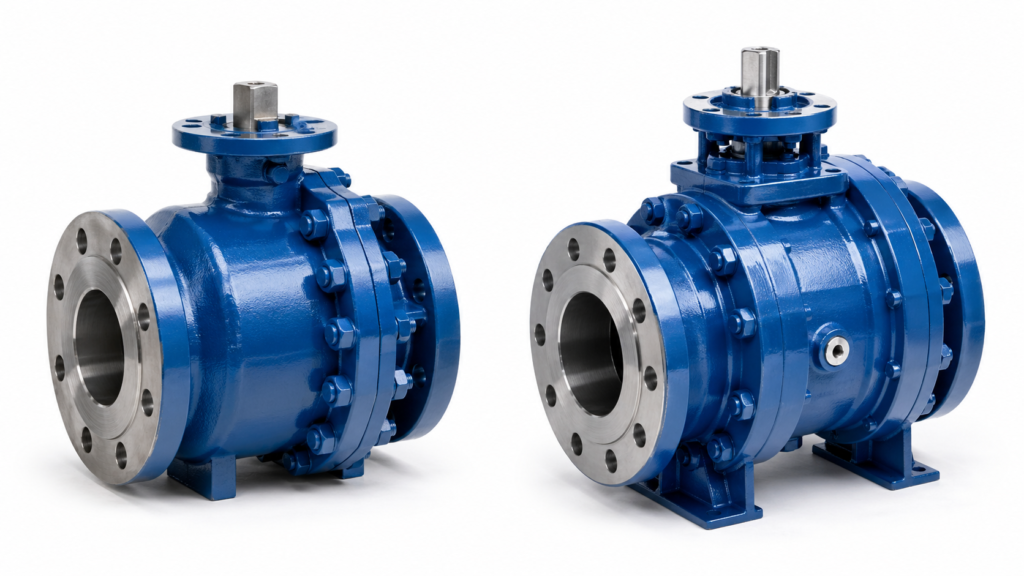
A floating ball valve is often the practical choice for small to medium-size pipelines, general industrial service, equipment packages, and systems where compact structure and cost efficiency are important. A trunnion mounted ball valve is usually selected when valve size, pressure class, pipeline duty, torque control, or double block and bleed requirements become more critical.
This guide compares floating ball valve vs trunnion ball valve from an engineering selection perspective. It explains the structure, sealing principle, operating torque, pressure suitability, seat material review, application limits, maintenance considerations, common selection mistakes, and the practical checks buyers should complete before placing an order.
If you are reviewing ball valve options for a project, you may also visit our related pages for Floating Ball Valves, Trunnion Mounted Ball Valves, and Industrial Ball Valves.
Quick Selection Snapshot
For a fast decision, start with the service condition rather than the valve name. The same nominal size may require different ball valve structures depending on pressure, differential pressure at closing, medium, operating frequency, seat material, and actuation method.
| Service Condition | Typical Starting Point | What Usually Controls the Decision | What Commonly Goes Wrong |
|---|---|---|---|
| Small to medium-size water, air, oil, or gas line | Floating ball valve | Compact structure, simple shut-off, lower cost | Valve selected without checking pressure, seat material, or temperature limit |
| General industrial utility service | Floating ball valve | Manual operation, simple maintenance, economical procurement | Used in a service where differential pressure makes torque too high |
| Equipment skid or package unit | Floating ball valve | Space limitation, easy installation, short delivery | End connection and face-to-face length not checked against skid layout |
| Large-size pipeline isolation | Trunnion mounted ball valve | Lower torque, stable ball support, actuator sizing | Floating design selected only to reduce initial cost |
| High-pressure oil or gas service | Trunnion mounted ball valve | Pressure load, sealing stability, pipeline specification | Seat load and breakaway torque underestimated |
| Pipeline service requiring double block and bleed | Trunnion mounted ball valve | Seat design, body cavity relief, DBB function | DBB assumed without confirming seat configuration and test requirement |
| Automated on-off service | Depends on size and pressure | Breakaway torque, running torque, actuator safety factor | Actuator sized from catalog size only, without differential pressure review |
What Is a Floating Ball Valve?
Definition and Key Features
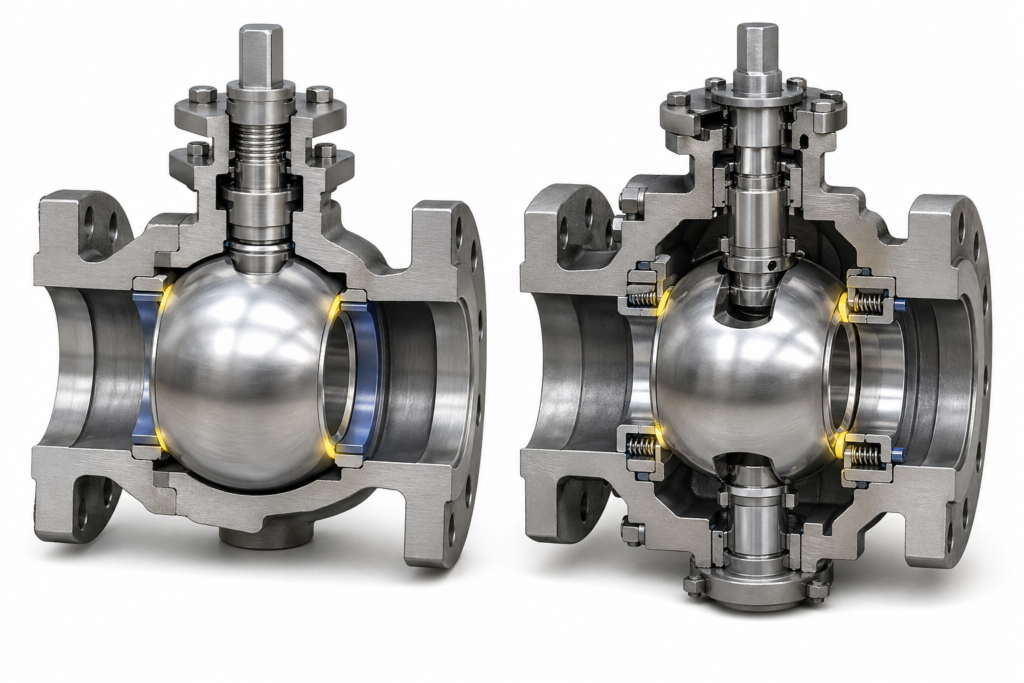
A floating ball valve is a quarter-turn valve in which the ball is held mainly by the valve seats. The stem rotates the ball, but the ball is not fixed by a lower trunnion support.
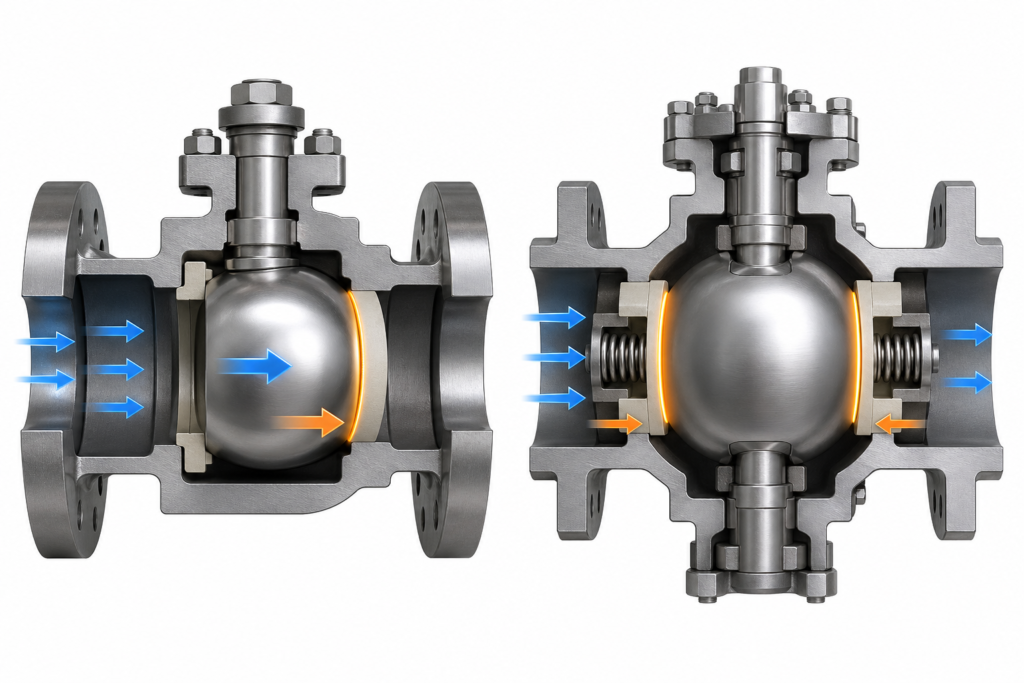
When the valve is closed and upstream pressure increases, the ball moves slightly toward the downstream seat. This pressure-assisted movement pushes the ball against the downstream seat and creates the sealing contact.
Key features of floating ball valves include:
- Simple structure: Fewer internal support components compared with a trunnion mounted design.
- Compact body design: Suitable for small and medium-size piping systems where installation space matters.
- Good shut-off performance: Reliable for many clean or moderately clean services when pressure, temperature, and seat material are correctly selected.
- Cost efficiency: Usually more economical than a trunnion mounted ball valve in smaller sizes.
- Easy maintenance: Simpler internal structure makes inspection, replacement, and repair easier in general service applications.
Floating ball valves are widely used in water systems, compressed air lines, fuel gas lines, oil service, chemical utility lines, equipment packages, tank connections, and general industrial piping.
Engineering limitation: As valve size and pressure increase, the pressure force acting on the floating ball also increases. This raises the contact load between the ball and downstream seat, which can increase breakaway torque and accelerate seat wear. For this reason, floating ball valves should not be treated as a universal replacement for trunnion mounted ball valves in large-size or high-pressure service.
What Is a Trunnion Mounted Ball Valve?
Definition and Key Features
A trunnion mounted ball valve uses a mechanically supported ball. The ball is fixed by trunnions, usually at the top and bottom, and rotates around a stable axis. Unlike a floating ball valve, the ball does not move downstream to create the main sealing force.
In a trunnion mounted design, the seats move toward the fixed ball. Seat springs and line pressure help maintain sealing contact between the seat rings and the ball surface.
Key features of trunnion mounted ball valves include:
- Fixed ball support: The trunnion structure carries pressure load and improves stability in large-size or high-pressure service.
- Lower operating torque: Torque is usually more manageable than a floating ball valve in larger sizes and higher pressure classes.
- Better suitability for automation: Lower and more stable torque supports gearbox, pneumatic, electric, or hydraulic actuator selection.
- Pipeline service capability: Commonly used in oil and gas pipelines, gas transmission, refinery service, and petrochemical systems.
- Optional DBB function: Many trunnion mounted designs can be supplied with double block and bleed features, depending on seat design and project requirements.
Trunnion mounted ball valves are normally selected when size, pressure, safety, torque control, and long-term sealing reliability are more important than the lowest initial valve price.
For pipeline and petroleum service, buyers may need to review standards such as API 6D, API 608, and ASME B16.34. These standards do not replace project specifications, but they help define the engineering basis for valve construction, pressure-temperature rating, testing, and documentation.
Floating Ball Valve vs Trunnion Ball Valve: Core Difference
The core difference is how the ball is supported and how sealing force is generated. This difference affects torque, seat loading, actuator sizing, service life, and suitability for pipeline duty.
| Comparison Item | Floating Ball Valve | Trunnion Mounted Ball Valve |
|---|---|---|
| Ball Support | Ball is supported mainly by the seats | Ball is mechanically supported by trunnions |
| Ball Movement | Ball can move slightly downstream under pressure | Ball remains fixed and rotates around a stable axis |
| Sealing Method | Pressure pushes ball against downstream seat | Seats move toward the fixed ball |
| Typical Size Range | Small to medium sizes | Medium to large sizes |
| Pressure Suitability | Low to medium pressure | Medium to high pressure |
| Operating Torque | Increases significantly with size and pressure | Lower and more stable in large-size service |
| Structure | Simpler structure | More complex internal structure |
| Cost | More economical in smaller sizes | Higher initial cost, better for demanding service |
| Common Use | General industrial piping, utility lines, equipment systems | Oil and gas pipelines, high-pressure gas, large-bore isolation |
Engineering Example 1: High Torque After Hydrostatic Test
Problem: A small plant utility line used a floating ball valve in a size and pressure condition close to the upper limit of the supplier’s recommended range. After hydrostatic testing, operators found the valve difficult to open.
Cause: High differential pressure increased the load between the ball and downstream seat. The valve was not damaged, but the breakaway torque was higher than expected.
Prevention: For larger sizes or higher pressure classes, confirm breakaway torque under maximum differential pressure before selecting manual operation or actuator size. If torque margin is tight, review a trunnion mounted design.
How the Sealing Principle Affects Valve Selection
Floating Ball Valve Sealing
In a floating ball valve, the pressure load acts on the ball and pushes it toward the downstream seat. This helps create tight shut-off, but it also increases the contact force between the ball and seat.
For small sizes and moderate pressure, this design works effectively. However, as valve size and pressure increase, the force acting on the ball becomes much larger. This can increase operating torque, seat compression, and wear during cycling.
Trunnion Mounted Ball Valve Sealing
In a trunnion mounted ball valve, the ball is fixed. The seat rings move toward the ball under spring force and pressure assistance. This design controls how the sealing load is applied and prevents the full pressure load from being carried only by the downstream seat.
This is why trunnion mounted ball valves are preferred for larger sizes, higher pressure classes, gas pipelines, and critical isolation duties.
Engineering note: Do not select the valve only by nominal size and pressure class. Confirm the actual differential pressure at closure, required shut-off performance, seat material, operating frequency, actuator torque requirement, and project standard.
Engineering Example 2: Leakage During Commissioning
Problem: A gas line passed shell pressure testing but showed seat leakage during final commissioning.
Cause: The selected soft seat was suitable for normal temperature service, but the actual medium contained fine particles from pipeline flushing. The particles scratched the seat contact area and reduced shut-off performance.
Prevention: Confirm medium cleanliness, flushing procedure, filtration, seat material, and leakage test requirement before ordering. For dirty gas, abrasive particles, or high-temperature service, a metal seated ball valve or special seat design may be required.
Operating Torque: Why It Matters More Than Many Buyers Expect
Operating torque is one of the most important differences in the floating ball valve vs trunnion ball valve comparison.
In a floating ball valve, pressure pushes the ball into the downstream seat. As pressure and size increase, friction between the ball and seat increases. This means the torque required to open or close the valve also increases.
In a trunnion mounted ball valve, the ball is supported by the trunnion structure. The seats move toward the ball, but the ball itself is not forced downstream in the same way. This usually results in lower and more predictable torque in larger sizes.
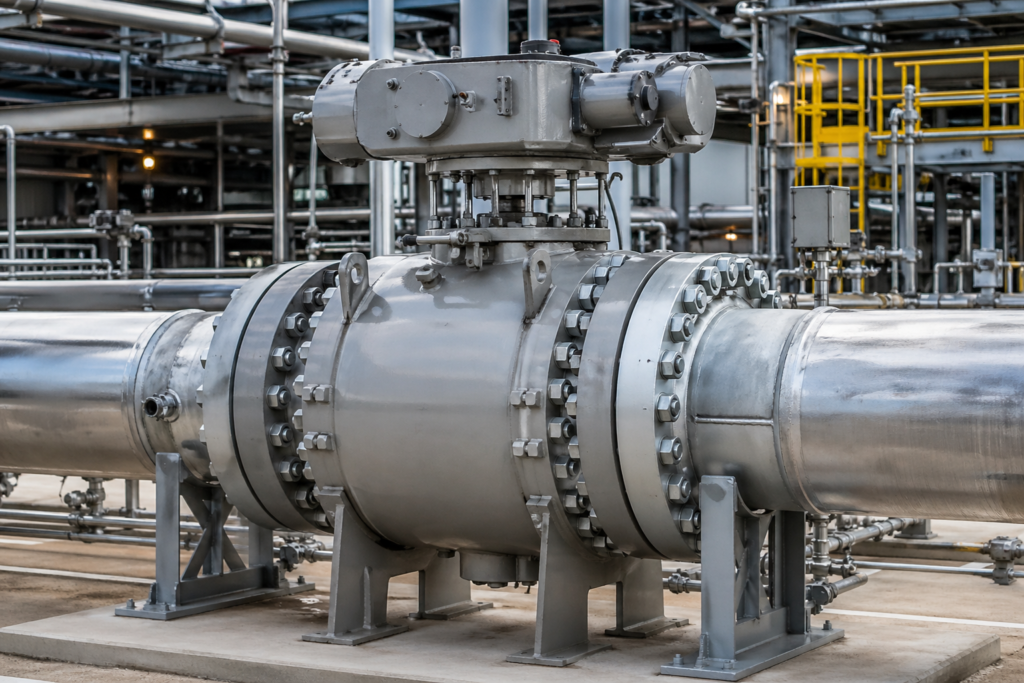
Torque Affects More Than Manual Operation
- Hand lever or gearbox selection
- Stem diameter and stem strength
- Pneumatic actuator sizing
- Electric actuator output torque
- Emergency shutdown reliability
- Seat wear during operation
- Long-term maintenance interval
If torque is underestimated, the valve may not fully open or close under live pressure. In automated systems, this can cause actuator stall, incomplete shut-off, motor overload, pneumatic actuator undersizing, or premature actuator failure.
Engineering Example 3: Electric Actuator Oversized but Still Unreliable
Problem: A buyer selected an electric actuator with a high nominal torque output, but the valve still failed to close reliably during a process upset.
Cause: The actuator was sized using normal running torque instead of maximum breakaway torque under differential pressure. The valve seat material, pressure load, and long idle period were not included in the torque review.
Prevention: Ask the valve supplier for breakaway torque, running torque, maximum allowable stem torque, and recommended actuator safety factor under the actual pressure condition. For large-size automated valves, trunnion mounted ball valves usually provide better torque control.
Size and Pressure Range: General Selection Direction
There is no single size boundary that applies to every manufacturer or every project. Valve size, pressure class, seat material, end connection, and operation method must be reviewed together.
A floating ball valve is usually reviewed first when the valve size is relatively small, the pressure is not extreme, and the system does not require pipeline-grade isolation features.
A trunnion mounted ball valve should be reviewed when the valve size becomes larger, the pressure class increases, the medium is gas or oil, or the application requires more controlled torque and sealing performance.
| Selection Factor | Floating Ball Valve Is Usually Suitable When… | Trunnion Mounted Ball Valve Is Usually Suitable When… |
|---|---|---|
| Valve Size | Small to medium size | Medium to large size |
| Pressure | Low to medium pressure | Medium to high pressure |
| Operation | Manual operation or small actuator | Gearbox, pneumatic, electric, or hydraulic actuator |
| Service Criticality | General isolation service | Critical isolation or pipeline service |
| Budget Priority | Lower initial cost matters | Lifecycle reliability matters more |
| Project Requirement | General industrial specification | API 6D-type pipeline requirement or DBB requirement |
Fact check for buyers: MSS SP-72 covers flanged or butt-weld end ball valves for general service. For petroleum, petrochemical, industrial, or pipeline projects, API and ASME standards may also be required by the project specification. Always confirm the applicable standard before comparing quotations.
Cost Difference: Initial Price vs Lifecycle Cost
A floating ball valve is normally less expensive in smaller sizes because the design is simpler. It has fewer support components, fewer precision internal parts, and a more compact body structure.
A trunnion mounted ball valve usually has a higher initial cost because it includes trunnion supports, seat spring systems, additional sealing components, and often more complex testing or project-specific features.
However, the lower initial price is not always the lower project cost.
For a small utility line, a floating ball valve can be the best economic choice. For a high-pressure gas line or large-bore pipeline, selecting a floating design only to save cost may lead to higher actuator cost, difficult operation, faster seat wear, or greater leakage risk.
Review Total Cost by Including:
- Valve purchase cost
- Gearbox or actuator cost
- Installation and lifting cost
- Maintenance access
- Seat replacement risk
- Leakage consequence
- Downtime cost
- Project specification compliance
Engineering Example 4: Low Purchase Price, Higher Site Cost
Problem: A contractor selected a lower-cost floating ball valve for a higher-pressure service to reduce procurement cost.
Cause: The valve was technically close to its practical operating limit. After installation, the required gearbox ratio was higher than expected, manual operation was slow, and maintenance access became difficult.
Prevention: Compare valve price together with torque, gearbox size, actuator cost, maintenance access, and project risk. In many large-size or high-pressure services, a trunnion mounted ball valve has a higher purchase price but a better engineering fit.
Application Comparison
Where Floating Ball Valves Are Commonly Used
- Water supply systems
- Compressed air pipelines
- General industrial utility lines
- Small oil and gas lines
- Fuel gas systems
- Equipment skids
- Tank inlet and outlet connections
- Chemical utility service
- HVAC and plant service piping
Floating ball valves are a good fit when the valve must be compact, economical, easy to operate, and suitable for general shut-off service.
Where Trunnion Mounted Ball Valves Are Commonly Used
- Oil and gas transmission pipelines
- Natural gas pipeline systems
- High-pressure gas stations
- Refinery process lines
- Petrochemical plants
- Compressor stations
- Metering stations
- Large-diameter process piping
- Pipeline isolation service
Trunnion mounted ball valves are normally selected when the system requires stronger ball support, lower operating torque, high-pressure capability, stable sealing, and better compatibility with automated operation.
Seat Material and Service Condition Review
The structure of the ball valve is important, but it is not the only selection factor. Seat material must also match the medium, temperature, pressure, operating cycle, cleanliness, and leakage requirement.
| Seat Type | Typical Use | Selection Notes |
|---|---|---|
| PTFE | General chemical resistance and low-friction service | Good chemical resistance, but pressure-temperature limits and creep behavior must be checked |
| RPTFE | Higher strength than standard PTFE | Common in many industrial ball valves where better seat strength is needed |
| PEEK | Higher pressure or higher temperature service than many standard soft seats | Often reviewed when PTFE or RPTFE is not sufficient |
| Metal Seat | High temperature, abrasive media, severe service | Requires review of leakage class, surface coating, hardfacing, and operating torque |
| Soft Seat with Fire-Safe Design | Oil, gas, and flammable service | Confirm fire-safe test requirement and project specification |
As a material reference, PTFE fluoropolymer data commonly shows temperature resistance up to about 260°C under suitable conditions, while PEEK data also lists high continuous-use temperature capability. However, these values are material data, not automatic valve ratings. In valve service, actual allowable temperature depends on seat load, pressure, medium, cycling frequency, valve design, and manufacturer rating. See PTFE temperature resistance data and PEEK material property data for material-level reference.
For floating ball valves, soft seats are common in general service. For trunnion mounted ball valves, soft seat, metal seat, fire-safe design, emergency sealant injection, anti-static design, and special sealing structures may be selected depending on the project.
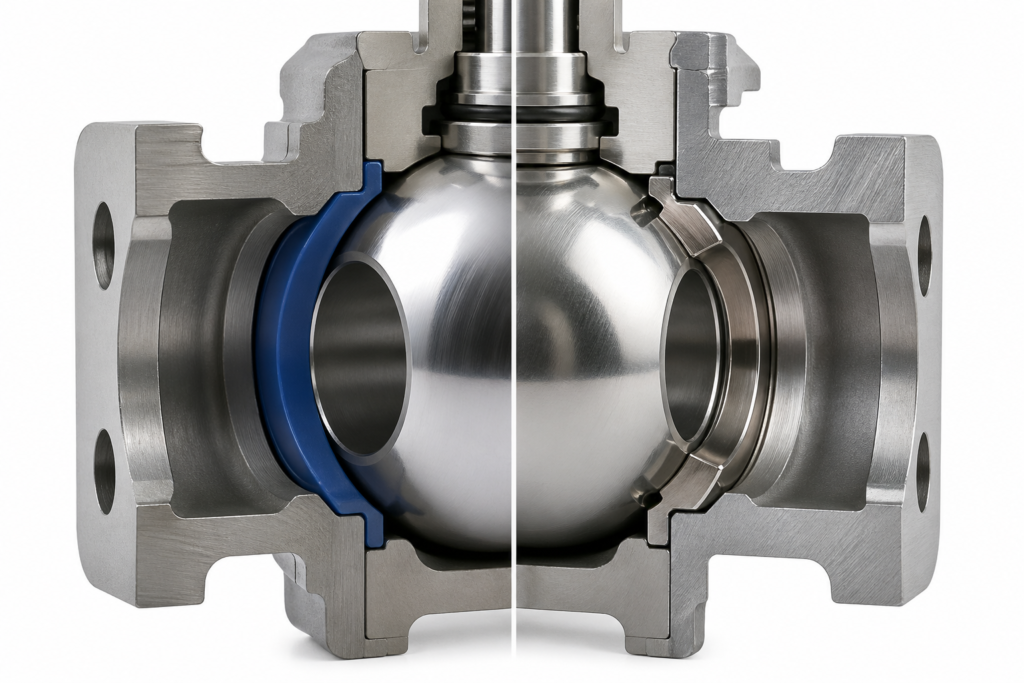
Common Mistakes When Comparing Floating and Trunnion Ball Valves
1. Selecting Only by Valve Price
A floating ball valve may be cheaper, but it is not always suitable for large-size or high-pressure service. If torque, seat load, and pressure differential are ignored, the lower initial cost may become a maintenance problem later.
2. Ignoring Breakaway Torque
Breakaway torque is often higher than buyers expect, especially after the valve has stayed closed for a long time. This matters for both manual and automated valves.
3. Treating All Ball Valves as the Same
A small threaded floating ball valve and a large API 6D-type trunnion mounted pipeline ball valve are not interchangeable products. They may both be ball valves, but their design purpose is different.
4. Not Confirming Double Block and Bleed Requirements
Double block and bleed should not be assumed just because the valve is a ball valve. It depends on the valve design, seat configuration, body cavity design, and project specification.
5. Choosing the Seat Material Too Late
Seat material affects temperature limit, pressure capability, leakage performance, chemical compatibility, operating torque, and service life. It should be confirmed early, not after the valve body material has already been selected.
6. Oversimplifying Actuator Selection
Actuator sizing should be based on real operating torque under service conditions, not only on nominal valve size. Differential pressure, seat type, operating frequency, safety factor, and fail position should all be reviewed.
How to Choose Between Floating Ball Valve and Trunnion Mounted Ball Valve
Before choosing the valve type, confirm the actual service data. A correct valve selection cannot be made from pipe size alone.
Engineering Data to Confirm
- Pipe size
- Pressure class
- Design standard
- Working pressure
- Differential pressure at closure
- Working temperature
- Medium type
- Medium cleanliness
- Required shut-off performance
- Operation method
- End connection
- Body material
- Seat material
- Fire-safe requirement
- Anti-static requirement
- Double block and bleed requirement
- Testing and inspection requirements
Practical Selection Rule
Choose a floating ball valve when the valve is small to medium in size, the pressure is low to medium, the service is general industrial isolation, and cost efficiency is an important factor.
Choose a trunnion mounted ball valve when the valve is larger, the pressure is higher, the medium is oil or gas, the valve is automated, or the project requires pipeline-grade isolation performance.
Recommended Valve Type by Working Condition
| Working Condition | Recommended Valve Type | Reason |
|---|---|---|
| Small water pipeline | Floating ball valve | Compact, economical, easy to operate |
| Compressed air line | Floating ball valve | Good general shut-off performance |
| Small oil line | Floating ball valve | Cost-effective for moderate pressure |
| Equipment skid | Floating ball valve | Simple structure and compact installation |
| Large gas pipeline | Trunnion mounted ball valve | Lower torque and stronger ball support |
| High-pressure oil service | Trunnion mounted ball valve | Better pressure load control |
| Natural gas transmission | Trunnion mounted ball valve | Suitable for pipeline isolation duty |
| Automated large-size valve | Trunnion mounted ball valve | More stable torque for actuator sizing |
| Double block and bleed requirement | Trunnion mounted ball valve | Available with suitable seat and body cavity design |
| High temperature or abrasive media | Metal seated ball valve design should be reviewed | Seat material, coating, leakage class, and torque become critical |
Buying Checklist Before Ordering
Before sending a purchase inquiry, prepare the following information. This helps the valve supplier recommend the correct structure instead of only quoting the lowest-price option.
- Valve size and pressure class
- Floating or trunnion mounted design preference
- Full port or reduced port requirement
- End connection: flanged, threaded, socket weld, butt weld, or other type
- Body material: carbon steel, stainless steel, alloy steel, or special material
- Seat material: PTFE, RPTFE, PEEK, metal seat, or project-specified material
- Medium and temperature
- Required leakage performance
- Manual, gear operated, pneumatic, electric, or hydraulic operation
- Fire-safe and anti-static requirements
- Double block and bleed requirement
- Applicable standard, such as API 6D, API 608, ASME B16.34, API 598, or project specification
- Inspection and documentation requirements
Floating Ball Valve vs Trunnion Ball Valve: Which One Is Better?
Neither design is always better. A floating ball valve and a trunnion mounted ball valve are designed for different operating conditions.
A floating ball valve is better when the system needs a compact, economical, simple shut-off valve for small to medium-size general service.
A trunnion mounted ball valve is better when the system needs a large-size or high-pressure valve with lower torque, stronger ball support, stable sealing, and better suitability for pipeline or automated service.
The correct question is not “which ball valve is better?” The correct question is “which ball valve design matches the actual pressure, size, medium, temperature, operation method, and project specification?”
Raymon Valve Engineering Support
Raymon Valve supplies industrial ball valves for general industrial service, oil and gas pipelines, water systems, chemical plants, refinery service, and process piping applications.
Our ball valve range can include:
- Floating Ball Valves
- Trunnion Mounted Ball Valves
- Flanged Ball Valves
- Threaded Ball Valves
- Metal Seated Ball Valves
- Soft Seated Ball Valves
- Manual Ball Valves
- Gear Operated Ball Valves
- Pneumatic and Electric Actuated Ball Valves
If you are not sure whether your project requires a floating ball valve or a trunnion mounted ball valve, send us the valve size, pressure class, medium, temperature, connection standard, and operating method. Our engineering team can help review the suitable valve structure and configuration.
For more engineering selection resources, continue through the Raymon Valve Knowledge Center.
After the service conditions and evidence requirements are defined, review the Floating Ball Valve product overview and Trunnion Mounted Ball Valve product overview as secondary technical references.
FAQ: Floating Ball Valve vs Trunnion Mounted Ball Valve
1. What is the main difference between a floating ball valve and a trunnion mounted ball valve?
The main difference is the ball support structure. In a floating ball valve, the ball can move slightly under pressure and seals against the downstream seat. In a trunnion mounted ball valve, the ball is fixed by trunnions, and the seats move toward the ball to create sealing.
2. Which valve is better for high-pressure service?
A trunnion mounted ball valve is generally better for high-pressure service because the fixed ball structure reduces excessive seat load and helps maintain lower operating torque. The final selection should still confirm pressure class, seat material, end connection, leakage requirement, and project standard.
3. Is a floating ball valve suitable for gas service?
Yes, a floating ball valve can be used for gas service when the size, pressure, material, seat design, and testing requirements are suitable. For large-size or high-pressure gas pipelines, a trunnion mounted ball valve is usually preferred because torque and sealing stability become more important.
4. Why does a trunnion mounted ball valve have lower torque?
The ball is mechanically supported by trunnions, so it does not rely on pressure-driven downstream movement to create the main sealing force. This helps reduce friction between the ball and seat and keeps torque more stable in larger sizes.
5. Which valve is more economical?
For small and medium-size general service, a floating ball valve is usually more economical. For large-size or high-pressure service, a trunnion mounted ball valve may provide better lifecycle value because of lower torque, better stability, and stronger suitability for demanding service.
6. Can both floating and trunnion mounted ball valves be automated?
Yes. Both valve types can be automated with pneumatic or electric actuators. However, trunnion mounted ball valves are often more suitable for larger automated valves because their operating torque is lower and more predictable. Actuator sizing should be based on breakaway torque under actual differential pressure.
7. Which ball valve should be used for oil and gas pipelines?
For oil and gas pipeline service, trunnion mounted ball valves are commonly selected, especially when the project involves high pressure, large size, API 6D-type requirements, double block and bleed, fire-safe design, or automated operation.
8. Can a floating ball valve replace a trunnion mounted ball valve?
Only if the pressure, size, torque, sealing, seat material, operation method, and project specification allow it. A floating ball valve should not be used as a simple low-cost replacement for a trunnion mounted ball valve in critical pipeline service.
 English
  German
  Arabic
  French
  Spanish
  Italian
  Portuguese
  Russian