Butterfly Valve Selection Guide: Types, End Connections, Materials, and Applications
Butterfly Valve Selection Guide: Types, End Connections, Materials, and Applications
Butterfly valves are widely used in water systems, HVAC, fire protection, chemical processing, power plants, and general industrial pipelines because they offer a compact quarter-turn design, relatively low installed weight, short face-to-face dimensions, and efficient shut-off or throttling performance when properly selected. In real projects, however, choosing a butterfly valve is rarely a simple matter of matching nominal size to the pipe. The correct selection depends on valve geometry, seat system, end connection, body and disc materials, shut-off requirement, differential pressure at closure, actuator torque, and how the valve will actually be operated after commissioning.
That is why butterfly valves that look similar in a catalog often behave very differently in the field. Weak selection usually fails in familiar ways: seat leakage after startup, actuator stall under real differential pressure, body style mismatch during maintenance, or premature wear because an isolation valve was quietly turned into a throttling valve. In many cases, the valve itself is not defective. The real problem is that the service boundary was never fully defined before the order was released.
This guide focuses on the questions engineers, buyers, maintenance teams, and QA personnel should answer before that happens. If you want one practical rule before reading further, it is this: start with service condition, not with valve size alone. Then lock valve type, seat concept, end connection, material system, testing basis, and actuator torque together before purchasing. For a broader product overview, see our butterfly valves category page.
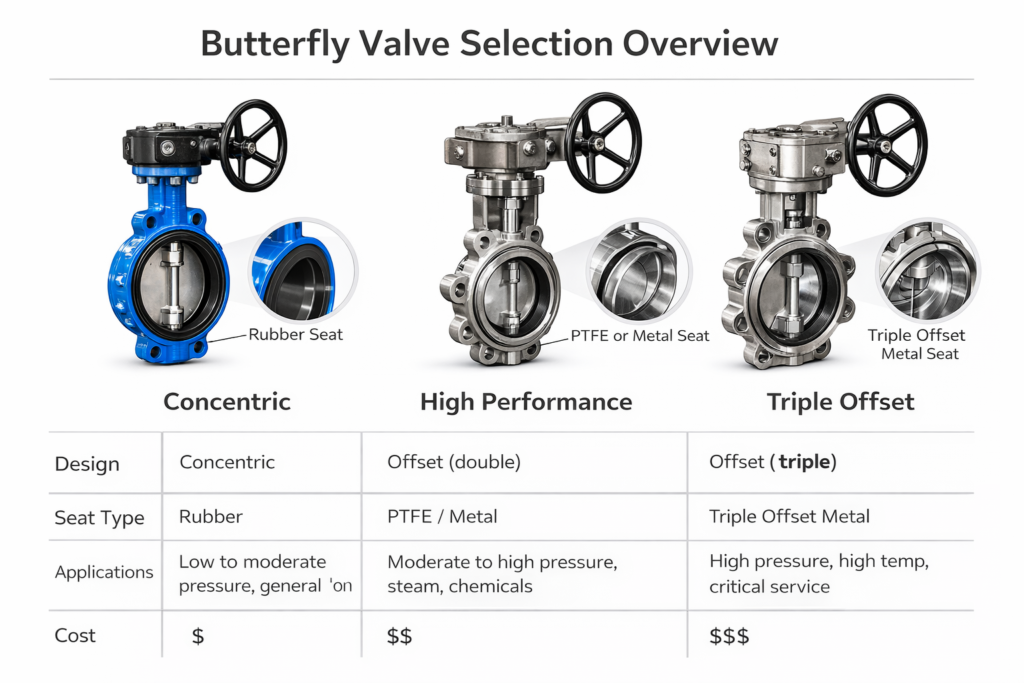 Selection starts by matching valve design, end connection, materials, and actuation method to the actual service condition.
Quick Selection Snapshot
| Selection Question | Typical Starting Point | What Usually Controls the Decision | What Commonly Goes Wrong |
|---|
| General water, HVAC, fire protection, or utility isolation | Resilient seated concentric butterfly valve | Compact size, low weight, simple installation, economical shut-off | Soft seat applied outside its chemical or temperature boundary |
| Higher cycle duty or broader industrial service window | Double-offset / high performance butterfly valve | Reduced rubbing, improved seat life, better cycling stability | Specified too late after a general-duty valve has already been ordered |
| High temperature or severe shut-off service | Triple-offset metal seated butterfly valve | Minimal rubbing at closure, better fit for hot and demanding service | Treated as a generic upgrade without checking torque, shut-off basis, or piping fit |
| Compact piping layout | Wafer butterfly valve | Lower weight, smaller envelope, lower installed cost | Maintenance plan actually requires lug or flanged construction |
| Larger waterworks or heavier-duty lines | Flanged butterfly valve | Alignment control, structural stability, removal convenience | Body style chosen correctly but face-to-face or flange basis not checked |
1. What Is a Butterfly Valve?
A butterfly valve is a quarter-turn valve that uses a rotating disc to isolate, start, stop, or regulate flow. It is commonly selected where the project needs a compact body, fast opening and closing, and better weight efficiency than many same-size gate or ball valves.
In practice, butterfly valves are not one interchangeable product family. They include resilient seated centerline designs for general utility service, higher-performance offset designs for broader industrial duty, and triple-offset metal seated designs for more demanding shut-off conditions. From an engineering standpoint, the valve should be treated as a system made up of body style, disc geometry, shaft arrangement, seat concept, end connection, operating device, and test basis. A valve that works well in clean cooling water may be the wrong choice for hot hydrocarbon vapor, chemical washdown exposure, or repeated cycling under load.
Engineering note: a request such as “DN200 butterfly valve” is not a complete engineering description. It does not define seat type, shut-off expectation, flange standard, pressure class, actuator torque basis, or whether the valve will isolate only or also throttle. Those missing details often become the real source of field trouble.
2. The First Selection Step: Choose the Right Valve Design
The first selection decision is valve design. Before comparing suppliers or prices, decide whether the service needs a resilient seated centerline butterfly valve, a double-offset high performance design, or a triple-offset metal seated design.
Resilient Seated / Centerline Butterfly Valve
A resilient seated butterfly valve is usually the most economical choice for water, HVAC, fire protection, and general utility systems. It is commonly selected where service temperatures are moderate, shut-off requirements are straightforward, and the medium is compatible with elastomeric seat materials.
- Compact structure
- Lower initial cost
- Easy installation
- Good shut-off in general-purpose service
This is normally the correct starting point for non-severe service. It is not automatically the right answer for hot duty, repeated thermal cycling, abrasive media, or frequent throttling.
Field example: in a building utility retrofit, a soft-seated centerline valve performed well on the chilled-water branch but failed early on a nearby chemical-dosing skid. The body size was correct and the valve operated smoothly during dry testing. The actual problem was material selection: the seat compound had never been checked against the chemical-cleaning cycle that occurred during shutdowns.
Double Offset / High Performance Butterfly Valve
A double-offset butterfly valve is generally selected when the system requires higher pressure capability, reduced seat rubbing, improved cycling performance, or a broader industrial service window than a standard centerline soft-seated design can offer. It is often reviewed for larger industrial pipelines, utility plants, cooling water systems, chemical utilities, and applications where seat life matters more than lowest initial cost.
From an engineering perspective, this is often the point where lifecycle cost starts to matter more than purchase price. If the valve cycles regularly and shutdown cost is meaningful, the reduced rubbing of offset geometry often pays back through longer seat life and fewer maintenance interventions.
Triple Offset Butterfly Valve
A triple-offset butterfly valve is typically selected for severe service. It is the design reviewed when the project requires metal seating, higher temperature resistance, improved shut-off confidence in demanding service, or a lower risk of rubbing wear during operation. In practical terms, this becomes relevant in refinery, petrochemical, power, steam, hot-oil, and other higher-severity isolation duties.
- Metal seated shut-off
- Higher temperature resistance
- Better fit for severe service
- Reduced friction between sealing surfaces during operation
- Improved confidence for demanding industrial isolation duty
Field example: on a hot-oil bypass line, a soft-seated butterfly valve was initially accepted because the face-to-face dimension matched the existing spool. The valve sealed during cold commissioning but leaked after repeated temperature cycles. The correction was not simply changing supplier. The valve design itself was wrong for the thermal duty, and the actuator torque basis had to be recalculated under actual shut-off differential pressure.
For a severe-service product example, see our triple offset butterfly valve page.
3. The Second Selection Step: Choose the Right End Connection
Once the seat concept and overall design are clear, the next decision is end connection. This is where many procurement teams make avoidable mistakes, because connection style affects installation method, maintenance flexibility, structural stability, flange compatibility, and total project cost.
Wafer Butterfly Valve
A wafer butterfly valve is installed between two mating flanges. It is usually the strongest recommendation when the project values compactness, lower weight, and cost-efficient installation.
- Space is limited
- System cost must be controlled
- The application is general utility or light-to-medium industrial duty
- The line does not require the maintenance flexibility of lug construction
For a product category example, see our wafer butterfly valve page.
Field example: on a municipal-water retrofit, a wafer valve leaked at one side immediately after startup even though the disc and seat were correct. The real cause was not the valve body. Old flanges with poor flatness and uneven bolt loading distorted the sealing path. In wafer installations, flange condition and centering are often part of the shut-off problem.
Lug Butterfly Valve
A lug butterfly valve uses threaded lugs on the body, which can be advantageous when the piping system may require easier downstream disassembly or more flexible maintenance arrangements.
- One side of the pipeline may need to be removed during maintenance
- The maintenance method benefits from more flexible installation arrangements
- The project wants a stronger piping-side service option than a basic wafer body
Do not assume that every lugged body is automatically suitable for every dead-end or end-of-line case. The allowable duty still depends on design rating, line pressure, flange arrangement, and bolting details.
For a category example, see our lug butterfly valve page.
Flanged Butterfly Valve
A flanged butterfly valve has integral flanges on both sides and is directly bolted to the piping flanges. It is usually preferred when the system is larger, heavier-duty, or more sensitive to alignment and maintenance access.
- The system is large or heavy-duty
- Stable alignment is important
- Waterworks or infrastructure specifications are involved
- The client prefers a more robust connection style
For a category example, see our flanged butterfly valve page.
| Connection Type | Best Fit | Main Advantage | Main Caution |
|---|
| Wafer | General utility, limited space, cost-sensitive lines | Compact and economical | More sensitive to flange condition and installation alignment |
| Lug | Lines requiring maintenance flexibility | Better service-side removal flexibility | Dead-end service must be checked against actual rating |
| Flanged | Waterworks, infrastructure, larger or heavier-duty systems | Stable connection and easier alignment control | Higher installed weight and often higher cost than wafer |
If the valve is part of a replacement package, face-to-face and flange basis should be checked before release rather than assumed from size alone.
4. Seat Material Selection Matters More Than Many Buyers Expect
One of the most common selection errors is focusing on body style while underestimating seat material compatibility. In practical procurement, the seat is not just a sealing detail. It directly affects sealing reliability, media compatibility, temperature range, wear life, torque level, and long-term maintenance risk.
| Seat Material | Typical Use | Main Strength | Main Limitation |
|---|
| EPDM | Water service, HVAC, general utility | Good water and weather resistance | Not usually the first choice for hydrocarbon-containing media |
| NBR | Selected oil-related and utility media | Useful oil resistance in many utility applications | Not automatically suitable for every hot-water or oxidizing condition |
| PTFE | Chemical service and broader compatibility needs | Broad chemical resistance | Selection must still consider pressure, deformation, and seat support design |
| Metal seat | High temperature and severe shut-off duty | Better fit for hot or more demanding service | Requires tighter review of leakage basis and torque requirement |
Field example: a valve may look correctly specified because the body is stainless steel, but if the seat was chosen from a generic “chemical resistant” note instead of the actual chemical list, concentration, temperature, and cleaning cycle, early leakage can appear even while the body remains in good condition. Seat mismatch is one of the fastest ways to turn a low-cost valve into a high-cost maintenance issue.
As a practical rule, published seat temperatures should be treated as starting guidance, not automatic approval. Actual limits depend on compound formulation, media exposure, differential pressure, cycle frequency, and whether the valve isolates only or also throttles.
5. Body and Disc Materials Should Follow the Service Condition
Butterfly valve body and disc materials should be chosen according to the real combination of pressure class, media corrosiveness, temperature, outdoor or buried installation environment, coating requirement, flange standard, and required service life.
In general, buyers should not ask only “carbon steel or stainless steel?” The better question is: what material combination gives the required corrosion resistance, mechanical strength, seat compatibility, and lifecycle cost for this service?
- Ductile iron or other common cast materials are often acceptable for water and general utility duty where project standards allow them.
- Carbon steel is commonly selected where pressure and temperature rise above typical waterworks service and corrosion is controlled.
- Stainless steel or upgraded alloys become more relevant once chemical compatibility, chloride exposure, or corrosion risk control the decision.
Engineering note: disc material, stem material, and fastener material are often under-specified in RFQs. That is risky. A suitable body material does not automatically make the trim suitable for corrosive, erosive, or standby-exposure conditions.
6. Selection by Application
A strong butterfly valve selection process starts from service condition, not from product name alone.
For Water Treatment and Municipal Systems
Wafer or flanged soft-seated butterfly valves are often the practical first options, depending on line size, installation requirements, and project specification. In waterworks service, it is also useful to separate standard resilient-seated duty from higher-performance duty because the required test basis and performance expectation may differ.
For HVAC and General Building Utilities
Compact resilient seated wafer valves are often preferred when space saving, easy installation, and cost control matter most. Even here, the engineer should still verify seat material, flange drilling, and actual shut-off differential pressure rather than assuming every utility line is low-risk.
For Fire Protection and Utility Duty
Soft-seated butterfly valves are commonly considered where the governing approvals, shut-off performance, and compatible elastomer materials fit the system requirements. If approvals are required, they should be stated clearly in the project specification rather than assumed from appearance alone.
For Chemical or Mild Corrosive Service
The valve should be selected from actual media compatibility, seat material, disc material, temperature, and shutdown environment—not by product name only. PTFE-lined or corrosion-resistant configurations may be more appropriate depending on the service.
For Oil & Gas, Refinery, Steam, and High-Temperature Service
This is where triple-offset butterfly valves become much more relevant. The real question is no longer “will it fit?” but “will it maintain shut-off reliability after thermal movement, repeated operation, and actual process exposure?”
Field example: on a steam isolation point, the selected valve matched line class and face-to-face dimensions, but after heat cycles the manual closing effort rose sharply and the operator could not shut the valve consistently under load. The final solution required both a more suitable valve design and a gearbox sized for maximum in-service torque rather than handwheel convenience during workshop testing.
7. Don’t Ignore Actuation During Valve Selection
Many butterfly valve selection mistakes happen because the team chooses the valve first and leaves actuation until the end. In practice, operating method should be reviewed early because torque demand rises with size, seat load, differential pressure, and service history.
- Lever operation
- Worm gear operation
- Pneumatic actuation
- Electric actuation
Actuation should be selected from required torque, valve size, operating frequency, automation level, fail-safe requirement, control accuracy, ambient conditions, and available site utilities such as compressed air or electrical power.
Field example: on a wastewater line, a pneumatic actuator was sized from catalog torque values only. The valve passed shop testing, but after several months the breakaway torque increased because of solids deposition and seat aging. The result was intermittent failure to reach full closed position. The lesson was simple: size the actuator against maximum expected operating torque with a realistic service factor, not only new-valve dry-cycle torque.
If actuation becomes the main decision driver, see our related page on valve actuator basics.
8. A Simple Butterfly Valve Selection Checklist
Before issuing RFQ or finalizing valve type, confirm the following:
- What is the medium?
- What are the normal and maximum pressure conditions?
- What are the normal and maximum temperature conditions?
- Is the duty on-off isolation, throttling, or both?
- Is tight shut-off required?
- Is the project general utility, waterworks, chemical service, or severe service?
- Is compact installation more important, or is stronger connection and easier maintenance more important?
- Which end connection is required: wafer, lug, or flanged?
- What seat and disc materials are compatible with the medium?
- Is manual, pneumatic, or electric actuation required?
For better procurement results, add these items as well: flange basis, pressure class, test standard, coating requirement, fail position, and accessory requirements such as limit switches, solenoids, or manual override. A buyer who answers these questions clearly will usually make much better valve decisions than someone who starts and ends with “send me your price for a DN200 butterfly valve.”
9. Recommended Internal Navigation
To help visitors move from informational intent to product intent, this article should link naturally to the related commercial pages and technical references already available on your site:
Suggested anchor texts include butterfly valve manufacturer, wafer butterfly valve, flanged butterfly valve, lug butterfly valve, triple offset butterfly valve, and butterfly valve for severe service. Do not force the same exact-match anchor every time. Mix exact-match anchors with natural variants so the internal-link profile stays readable and useful.
10. Conclusion
There is no single “best” butterfly valve for every pipeline. The correct choice depends on design type, seat structure, end connection, materials, pressure and temperature range, application duty, maintenance method, and operating method.
For general utility service, resilient seated wafer or flanged butterfly valves are often the most practical choice. For systems requiring easier maintenance flexibility, lug designs may be more appropriate if the actual service basis supports them. For higher temperature, higher pressure, or more demanding shut-off duty, triple-offset butterfly valves are usually the stronger engineering solution.
If the project team starts with service condition and selection logic instead of catalog appearance alone, butterfly valve procurement becomes faster, more accurate, and much safer.
FAQ Section
What is the difference between wafer, lug, and flanged butterfly valves?
Wafer valves are compact and installed between two flanges. Lug valves use threaded lugs and can provide more maintenance flexibility. Flanged valves have integral flanges and are often preferred for larger or heavier-duty systems where alignment and structural stability matter more.
When should I use a triple offset butterfly valve?
A triple-offset butterfly valve is generally reviewed for severe service, especially when metal seating, higher temperature resistance, higher pressure capability, or improved shut-off confidence is required. It is often considered for refinery, petrochemical, power, hot-oil, and steam-related isolation duties.
Which butterfly valve is better for water treatment?
For many water treatment and municipal applications, wafer or flanged soft-seated butterfly valves are the normal starting point. The better choice depends on line size, maintenance method, project specification, and whether the service is standard resilient-seated duty or a higher-performance requirement.
How do I choose butterfly valve seat material?
Seat material should be selected from actual media compatibility, temperature, differential pressure, cycle frequency, shut-off requirement, and cleaning or shutdown exposure. EPDM, NBR, PTFE, and metal seat concepts each fit different service boundaries.
What should be included in a butterfly valve RFQ?
At minimum, state the medium, normal and maximum pressure, normal and maximum temperature, valve size, flange basis, pressure class, end connection, seat material preference, test requirement, actuation type, fail position if actuated, and any accessory requirement such as limit switches or solenoids.
Can a lug butterfly valve always be used for dead-end service?
No. Lug construction by itself does not guarantee acceptable end-of-line duty in every case. That decision should be checked against the actual design rating, service pressure, flange arrangement, bolting details, and installation basis.

 English
  German
  Arabic
  French
  Spanish
  Italian
  Portuguese
  Russian