
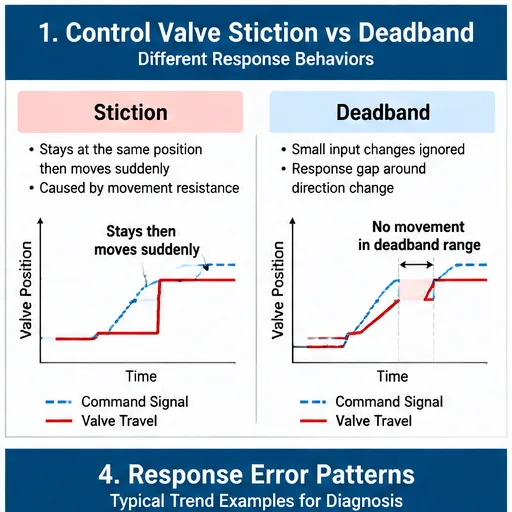
Control valve stiction and deadband can create similar operating symptoms, but they represent different response behaviors and require different troubleshooting approaches. Stiction is mainly associated with resistance that delays smooth valve movement, while deadband describes a range where an input change does not create the expected measurable response.
For maintenance teams and control engineers, distinguishing these conditions helps determine what information should be reviewed, including positioner trends, valve travel feedback, mechanical condition and operating history. However, a single symptom such as process oscillation or delayed response is not enough to confirm one specific cause.
What Is Control Valve Stiction?
Control valve stiction describes a condition where static friction prevents the valve from moving smoothly after a change in control signal.
During normal operation, the actuator applies force to move the valve toward the requested position. When resistance becomes significant, the valve may remain stationary until sufficient force overcomes the resistance. The valve may then move suddenly instead of following a smooth response pattern.
Common Contributors to Stiction-Like Behavior
- Excessive mechanical friction;
- Packing friction or packing condition changes;
- Actuator or linkage issues;
- Valve stem movement resistance;
- Positioner calibration or configuration factors;
- Mechanical condition changes during service.
Packing friction is one possible contributor to increased movement resistance. However, confirming the actual cause requires reviewing the complete valve assembly, actuator, position feedback and operating conditions.
Typical Symptoms of Control Valve Stiction
| Observed Symptom | Possible Response Pattern |
|---|---|
| Delayed valve response | Command changes while travel feedback remains unchanged for a period. |
| Sudden movement | Valve position changes rapidly after resistance is overcome. |
| Process oscillation | Controller adjustments continue while valve response is delayed. |
| Poor repeatability | Similar commands may produce different movement behavior. |
What Is Control Valve Deadband?
Control valve deadband refers to a range of input change where the valve output does not respond as expected.
When a controller signal changes slightly, the valve position may remain unchanged until the difference becomes large enough to create measurable movement.
Deadband-like behavior may be associated with mechanical clearance, linkage effects, actuator connection conditions or position feedback characteristics.
Common Contributors to Deadband-Like Behavior
- Mechanical backlash;
- Linkage clearance;
- Connection looseness;
- Position feedback issues;
- Directional response differences.
Control Valve Stiction vs Deadband vs Hysteresis: Key Differences
Stiction, deadband and hysteresis can create overlapping symptoms in control applications, but they describe different response characteristics. Understanding the difference helps engineers review valve behavior more accurately instead of treating every unstable response as the same problem.
| Behavior | Main Characteristic | Engineering Review Method |
|---|---|---|
| Stiction | Resistance delays movement until sufficient force overcomes friction. | Review command signal, travel feedback trend and mechanical condition. |
| Deadband | An input change occurs without measurable output movement within a response range. | Compare small signal changes and opening/closing response behavior. |
| Hysteresis | The valve response differs depending on the direction of movement. | Review increasing and decreasing travel response patterns. |
These conditions may appear similar during operation, but they require different verification methods. A complete troubleshooting review should consider valve construction, actuator arrangement, positioner behavior and process conditions.
Control Valve Response Problems: Cause and Verification Matrix
Process instability does not always indicate one specific valve failure. Similar symptoms may result from mechanical conditions, actuator behavior, positioner configuration, control tuning or changing process conditions.
| Observed Condition | Possible Contributors | Verification Approach |
|---|---|---|
| Stiction-like response | Packing friction, mechanical resistance, actuator issues or movement restriction. | Review trend behavior together with mechanical inspection and equipment condition. |
| Deadband-like response | Backlash, linkage clearance, connection issues or feedback response characteristics. | Review directional response and travel feedback behavior. |
| Slow valve response | Actuation issues, friction, calibration factors or operating conditions. | Review actuator performance, positioner condition and operating data. |
| Continuous control cycling | Control tuning, process variation or valve response issues. | Review loop performance and valve response together. |
Using Positioner Data to Diagnose Valve Response Problems
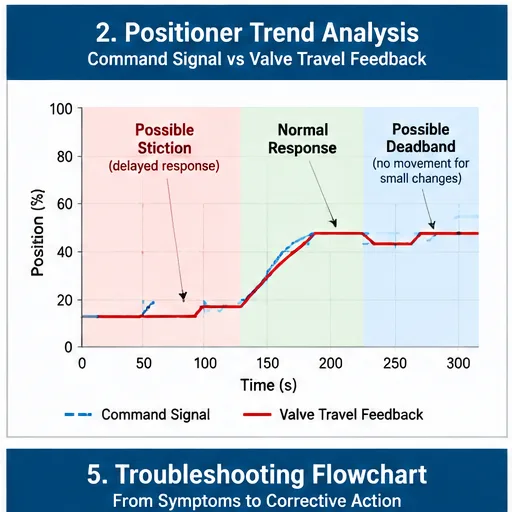
Positioner data can help engineers identify response patterns by comparing the requested valve position with actual travel feedback. This information is useful for narrowing possible causes, but it does not independently prove the failure source.
What Positioner Data Can Help Identify
| Data Point | Engineering Purpose |
|---|---|
| Command signal | Shows the requested valve movement from the control system. |
| Actual travel feedback | Shows how the valve responds to the requested position. |
| Position error | Shows the difference between requested position and actual movement. |
| Response time | Helps review delayed movement behavior. |
| Opening and closing response | Helps identify direction-related response differences. |
Example Diagnostic Interpretation
| Trend Pattern | Possible Interpretation |
|---|---|
| Command changes before travel response | May indicate delayed response requiring further friction or mechanical review. |
| Travel changes suddenly after delay | May indicate resistance-related movement behavior. |
| Different response during opening and closing | May indicate directional response differences such as hysteresis or deadband effects. |
| Repeated cycling around a position | May require review of control tuning, process conditions and valve response. |
Positioner trends provide diagnostic evidence and help narrow possible causes. Final corrective decisions should consider mechanical inspection, maintenance history and complete operating conditions.
Packing Friction and Mechanical Factors
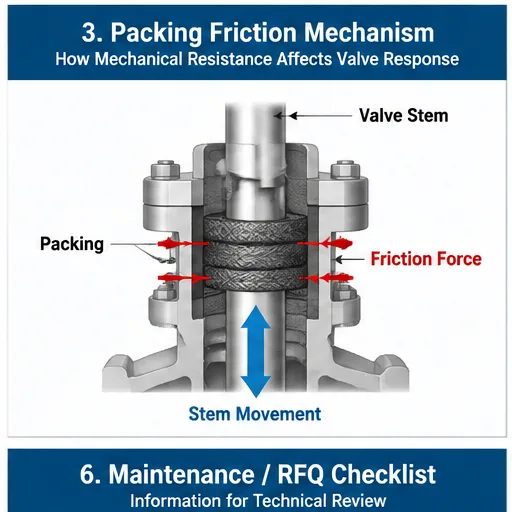
Packing provides sealing around the valve stem, but its condition is only one possible factor affecting movement resistance.
- Packing compression condition;
- Stem surface condition;
- Operating temperature and service conditions;
- Maintenance history;
- Related actuator and mechanical components.
Packing friction is one possible contributor to increased movement resistance and should be evaluated together with other mechanical factors.
Adjusting packing force should not be considered a universal solution. Any corrective action should follow equipment requirements and confirmed inspection findings.
Troubleshooting Workflow for Control Valve Stiction and Deadband
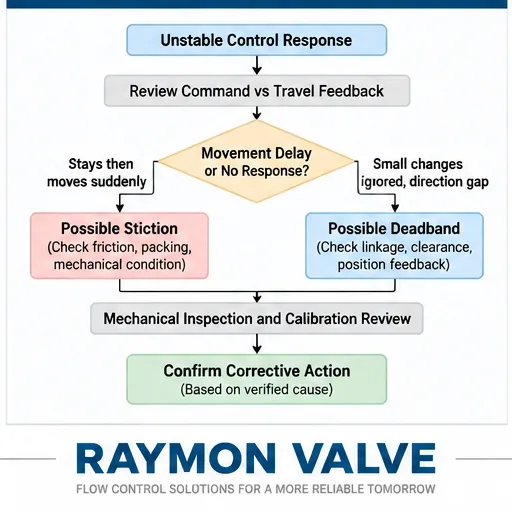
Step 1 — Review Operating Data
- Controller output trend;
- Valve command signal;
- Valve position feedback;
- Process response trend.
Step 2 — Identify the Response Pattern
Before selecting a corrective direction, review how the valve responds to command changes.
- Does the valve delay movement and then move suddenly?
- Do small command changes fail to produce expected travel?
- Does response behavior change between opening and closing direction?
Step 3 — Review Mechanical and Instrument Conditions
- Actuator connection;
- Linkage condition;
- Positioner mounting;
- Valve travel consistency;
- Maintenance history.
Step 4 — Confirm Corrective Direction
Corrective action depends on the confirmed cause. Possible actions may include calibration review, mechanical inspection, component evaluation or control-loop review.
Engineering Review Examples
The following examples describe common troubleshooting situations. They are not customer case studies, but typical engineering review patterns used to organize possible causes and verification steps.
Example 1 — Command Changes but Valve Travel Responds Late
A control system output changes while valve travel feedback remains unchanged for a period. This pattern may require review of possible movement resistance, actuator response, positioner behavior and mechanical condition.
Recommended verification: command trend comparison, travel feedback review and mechanical inspection where required.
Example 2 — Small Signal Changes Do Not Produce Expected Movement
When small controller adjustments do not create expected valve movement, the review should consider possible deadband-like response, linkage effects, feedback behavior and control-system factors.
Recommended verification: opening and closing response comparison together with equipment condition review.
Control Valve Troubleshooting Checklist for Maintenance Teams
Providing complete technical information helps engineering teams review possible causes more efficiently.
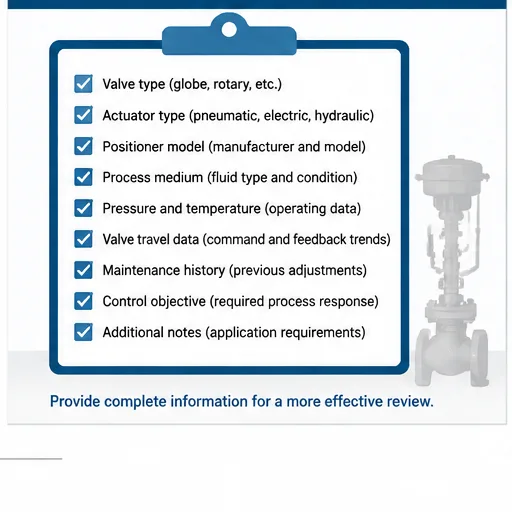
| Category | Required Information |
|---|---|
| Valve information | Valve type, size, pressure class and service function. |
| Actuator | Actuator type, model and operating method. |
| Positioner | Manufacturer and model information. |
| Process condition | Medium, pressure and temperature. |
| Operating evidence | Command trends and valve travel feedback. |
| Maintenance history | Previous repair, adjustment or inspection records. |
| Required outcome | Troubleshooting review, replacement evaluation or optimization support. |
When to Request Manufacturer Technical Review
A technical review may be useful when unstable control performance continues after initial checks, valve response remains inconsistent or additional equipment information is required before further action.
For a project-specific review, provide:
- Valve datasheet;
- Actuator information;
- Positioner model;
- Process conditions;
- Operating trends;
- Maintenance history.
Related product information: control valve products
FAQ
Is control valve stiction the same as deadband?
No. They may create similar symptoms, but stiction is mainly related to resistance that delays smooth movement, while deadband describes an input range where the expected response does not occur.
Can positioner data confirm control valve stiction?
Positioner trends can help identify response patterns and narrow possible causes. However, mechanical inspection and process review may still be required.
Does packing friction always cause control valve stiction?
No. Packing friction is one possible contributor. Other mechanical, actuator, positioner and process-related factors should also be reviewed.
What information is needed for control valve troubleshooting?
A useful review normally requires valve details, actuator information, positioner data, process conditions and operating trend information.
Request Control Valve Troubleshooting Review
Submit your valve datasheet, actuator information, positioner model, process medium, pressure and temperature conditions, operating trends and valve travel feedback data for a project-specific technical review.
Request Control Valve Troubleshooting Review English
  German
  Arabic
  French
  Spanish
  Italian
  Portuguese
  Russian