
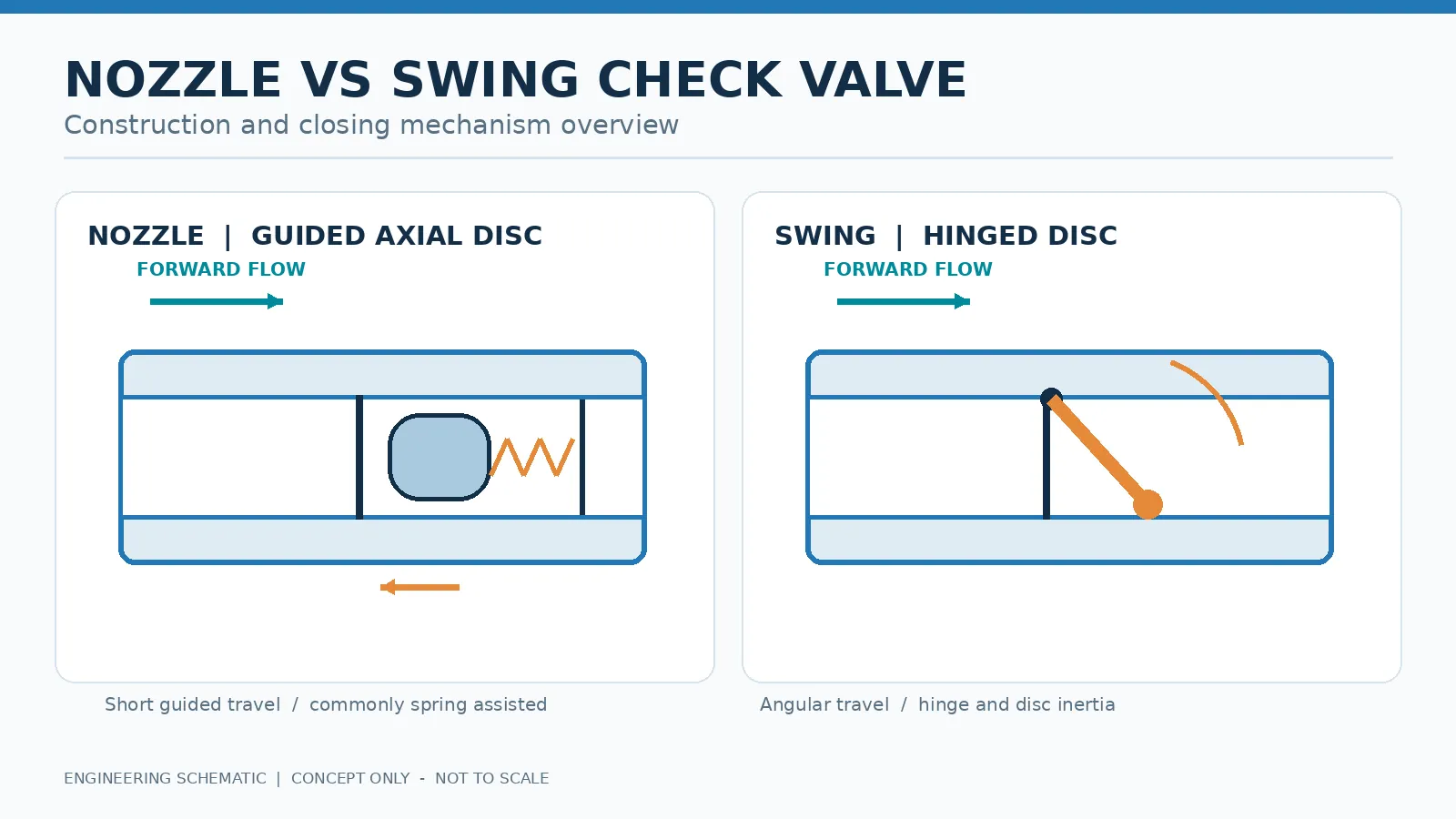
Nozzle and swing check valves differ primarily in how their closing elements move as forward flow decays. A swing check valve uses a hinged disc, while a typical nozzle check valve uses a guided, spring-assisted disc with comparatively short axial travel. This distinction can influence reverse-flow exposure during pump or compressor shutdown. However, neither construction guarantees lower pressure loss or surge-free operation. Compare exact-model pressure-loss curves, stable-opening behavior, closing-response evidence, and the complete system transient before specifying either valve.
1. Nozzle vs Swing Check Valve: Quick Engineering Decision
Both types permit forward flow and restrict reverse flow automatically, but their internal motion and response to decelerating flow differ. A nozzle check valve is often shortlisted when guided closure and limited reverse-flow exposure merit particular attention. A swing check valve may be shortlisted when its hinged-disc opening, flow resistance, and shutdown response meet the specified duty. Start with the industrial check valve range, then evaluate the exact models.
| Engineering factor | Nozzle check valve | Swing check valve |
|---|---|---|
| Closing member | Guided axial disc or poppet | Hinged rotating disc |
| Travel | Typically short axial travel | Angular travel about a hinge |
| Closing assistance | Commonly spring assisted | Gravity and fluid forces; options may include closing aids |
| Pressure loss | Model, flow and opening position dependent | Model, flow and opening position dependent |
| Low-flow behavior | Check stable opening and spring/disc response | Check disc flutter and opening stability |
| Dynamic performance | Request exact-model response evidence | Request exact-model response evidence |
| Maintenance review | Spring, guides, disc and seat | Hinge, pin, disc and seat |
When to Shortlist a Nozzle Check Valve
Prioritize technical screening of a guided spring-assisted design where rapid flow deceleration makes reverse-flow exposure consequential. Confirm the offered model’s spring configuration, opening stability, pressure loss, approved orientation, and dynamic performance before approval.
When to Shortlist a Swing Check Valve
Consider a hinged-disc design when minimum-through-maximum flow keeps the disc stable and its closing response is compatible with the system. Review conventional and assisted-closure variants separately rather than treating all swing designs as interchangeable.
2. Construction and Closing Travel: Hinged Disc vs Guided Axial Disc
Swing Check Valve Disc Movement and Hinge Inertia
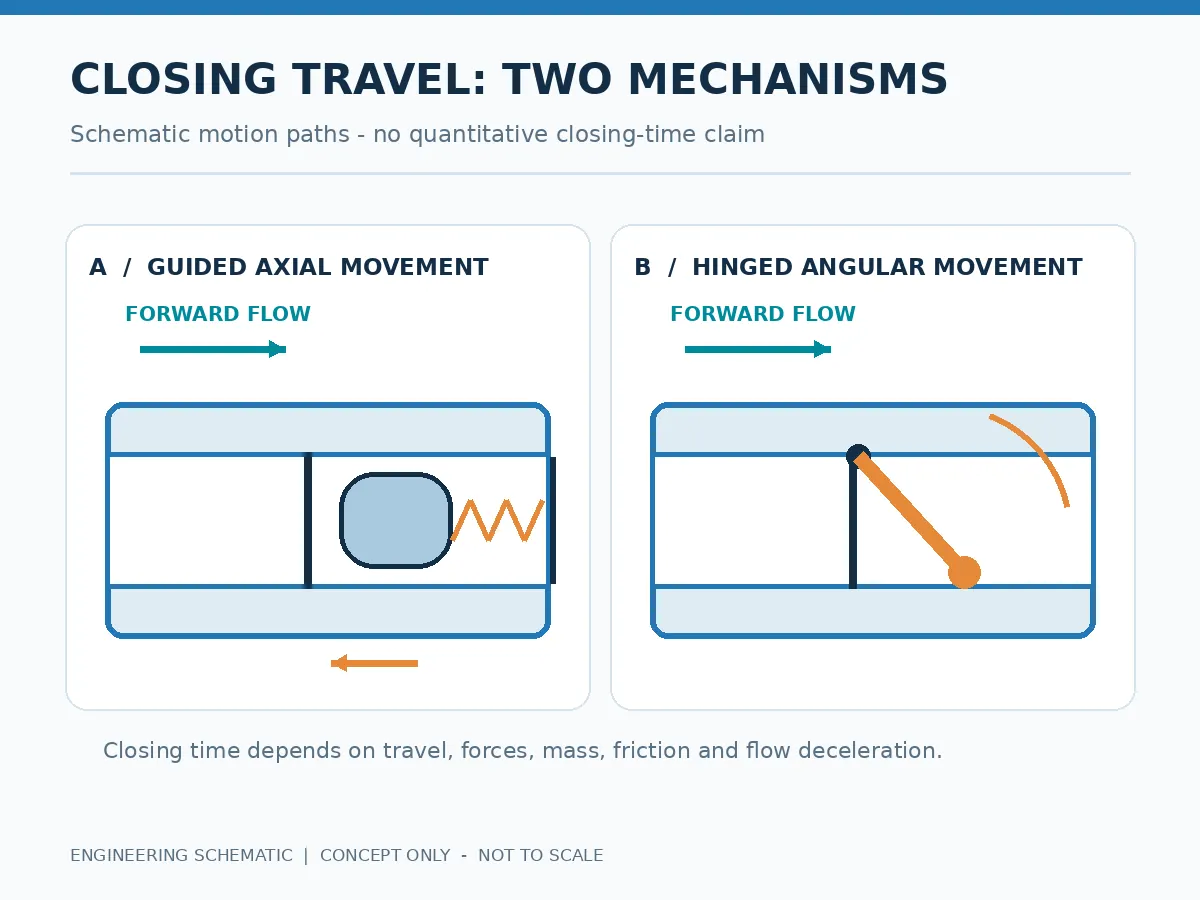
Forward flow moves the hinged disc away from its seat. As flow decays, gravity, fluid forces, hinge resistance, and optional closure devices affect its return. Relevant inputs include disc mass and distribution, angular travel, hinge geometry, friction, orientation, differential pressure, and the deceleration imposed by the system. At insufficient flow, disc flutter may accelerate wear at the hinge, stops, and seating surfaces.
Field screening example — low-flow flutter: A swing disc that remains partly open at reduced flow can repeatedly move against its stop or hinge. The potential mechanism is insufficient steady opening force combined with disturbed or pulsating flow. Before recommending replacement, compare the actual minimum and normal flow with the manufacturer’s stable-opening guidance; inspect hinge and disc condition only under the site’s isolation, depressurization and work-permit procedures. Avoid assuming that a valve matching the pipe diameter is correctly sized for the operating range.
Nozzle Check Valve Short-Travel Spring-Assisted Closure
A typical nozzle construction guides the disc or poppet along the flow axis. Forward differential pressure acts against the spring, and the spring assists return as the available forward-flow force declines. Short travel can reduce the displacement required for seating; actual response still depends on moving mass, spring force, friction, geometry, and fluid behavior. For model-specific configurations, see the nozzle check valve product page and swing check valve product page.
Why Travel Alone Does Not Establish Closing Time
Two valves with different strokes can exhibit different responses to the same deceleration. Spring characteristics or closing aids may matter as much as travel length. Obtain the supplied configuration’s controlled drawings and dynamic evidence rather than inferring performance from the family name.
3. Pressure Loss: Which Valve Has Lower Resistance?
There is no reliable universal pressure-loss ranking. A swing disc changes the effective passage as it rotates; a nozzle valve directs fluid around its guided closing member and supporting internals. Body geometry, actual opening, fluid properties, spring loading, and flow rate all matter.
Compare Exact-Model Cv/Kv and Pressure-Drop Curves
For a defined incompressible liquid flow basis, coefficient relationships are commonly expressed as:
RFQ comparison example: Supplier A may report a fully open flow coefficient while Supplier B submits a pressure-drop curve covering partly open operation. Those documents are not automatically comparable. Request the same fluid basis, size, minimum/normal/maximum operating points, opening position assumptions and curve provenance. If stable-opening evidence is missing, mark the bid Open instead of treating the highest catalogue coefficient as the winner.
Here SG is the liquid specific gravity referenced to water under the relevant conditions. These screening relations are not complete compressible-flow, cavitating, multiphase, or transient calculations. Verify whether published coefficients assume a fully open position; actual low-flow opening may differ.
Evaluate Minimum, Normal, and Maximum Flow
| Operating case | What to verify | Potential consequence |
|---|---|---|
| Minimum flow | Stable disc opening, cracking/opening behavior and ΔP | Flutter, chatter, elevated resistance |
| Normal flow | Actual operating-point ΔP and opening margin | Continuous energy use and wear |
| Maximum flow | ΔP and all permitted flow/velocity limits | Excessive resistance or component loading |
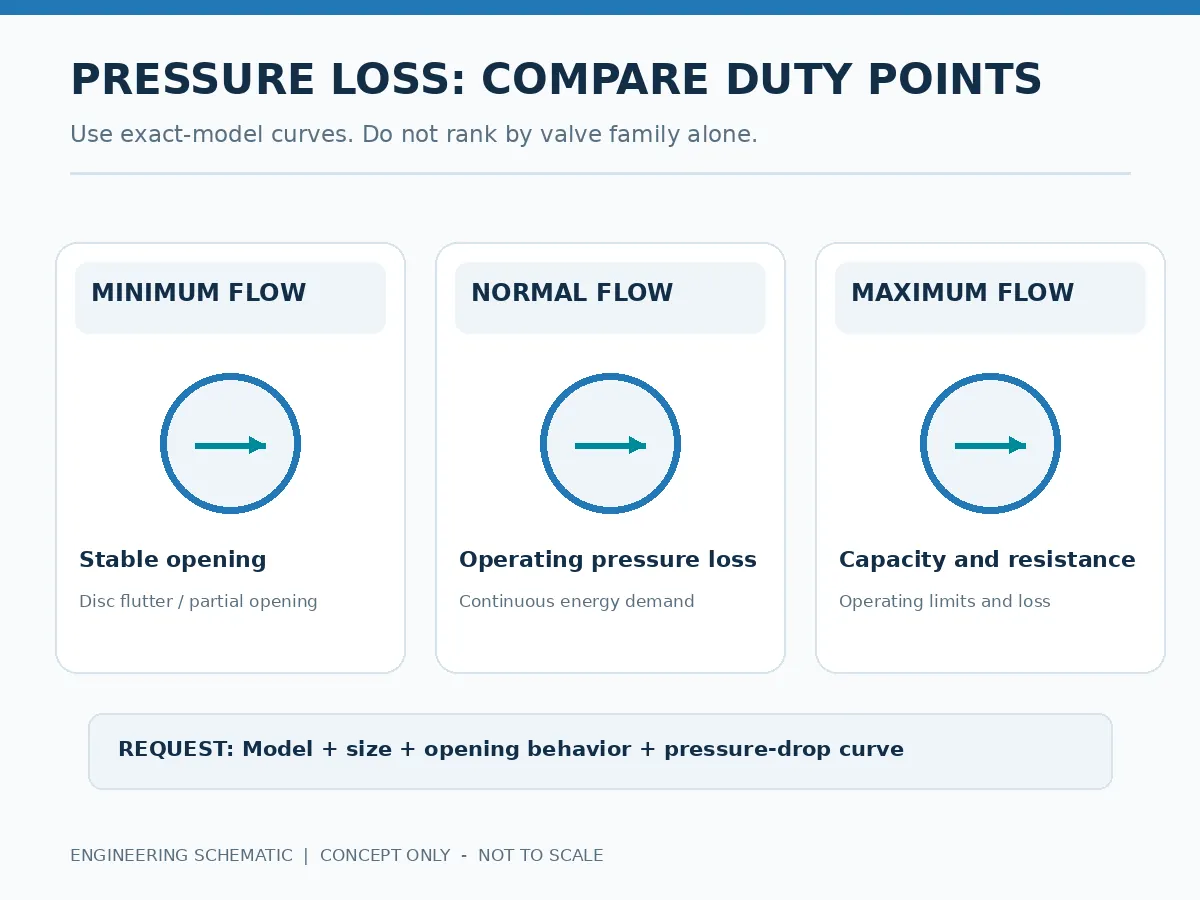
Compare supplier curves on the same fluid, pressure, temperature, valve size, and operating-point basis. A single fully-open Cv or Kv value does not describe the entire operating range.
For a broader explanation of operating range and minimum-flow stability, review the check valve sizing and stable-opening requirements before accepting model-specific pressure-loss curves.
4. Closing Dynamics: Reverse Velocity, Valve Slam and Transient Response
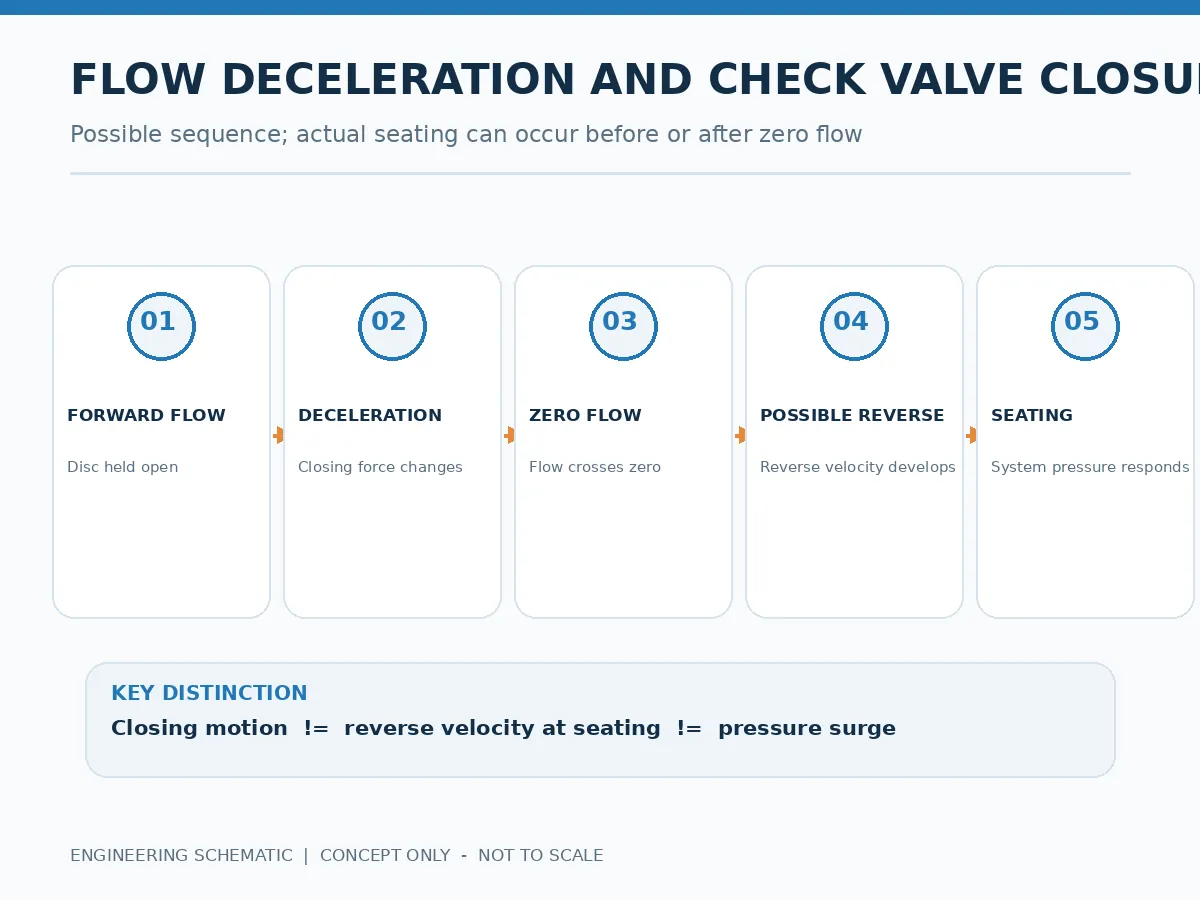
After a pump trip or compressor shutdown, forward flow may decline toward zero and then reverse. The check valve can seat before, near, or after the zero-flow crossing. If appreciable reverse flow develops before closure, suddenly arresting that flow may contribute to a pressure transient.
Closing Sequence and Reverse Velocity
Dynamic evidence acceptance: Where reverse-flow consequences are significant, ask for a closing-characteristic or reverse-velocity-versus-flow-deceleration basis, with valve size, fluid medium, spring/hinge configuration, test limitations and comparability to the proposed installation. If a supplier cannot provide relevant dynamic data, record the gap as an open technical deviation rather than assigning a presumed non-slam rating.
- Forward flow holds the closure member open.
- Deceleration reduces the opening force and the closure member begins returning.
- Flow approaches zero while the valve continues moving.
- Depending on dynamics, reverse flow may develop before seating.
- Closure and subsequent pressure-wave behavior reflect the complete system.
Reverse velocity at seating is distinct from elapsed closing time. Where consequences are material, request dynamic closing evidence tied to the offered model and relevant flow-deceleration conditions.
Why Fast Closure Does Not Guarantee Low Surge Pressure
Pressure transients depend on pipe geometry, boundary conditions, fluid properties, wave propagation, pump behavior, and how velocity changes. For an idealized rapid liquid velocity change, the simplified Joukowsky relation is:
Here ρ is density, a is wave speed, and ΔV is velocity change. This is not a complete valve–pipe transient model, nor is it a compressor gas-dynamic calculation. A rapidly seated valve may limit one reverse-flow mechanism without eliminating other surge mechanisms.
Distinguish Slam, Chatter and Water Hammer
Slam is an impact during closure; chatter is repeated unstable movement; water hammer is a system pressure-wave phenomenon. These events can interact but must be evaluated separately. For diagnostic details see check valve chatter vs slamming.
5. Pump Discharge Protection: Pump Trip and Reverse Flow
Pump Coast-Down and Flow Reversal
After power loss, the pump speed decays according to rotating inertia and hydraulic loading. The flow trajectory depends on pump curves, pipeline resistance, static head, control logic, and operating equipment. A discharge check valve should be evaluated against the resulting deceleration rather than a generic closing-speed label.
Shutdown review example: In an elevated liquid discharge line, a stopped pump may face reverse-flow driving head before the disc seats. The potential result depends on pump coast-down, line profile, system wave speed and the valve’s reverse-velocity-at-closure behavior. Review the shutdown cases, and request a hydraulic transient analysis when pressure excursions or reverse rotation consequences are significant. The comparison should not assume that the shortest travel alone prevents surge.
Parallel Pumps and Static Head
Study trigger: For long discharge pipelines, appreciable static head, parallel pump changeover, prior water-hammer incidents or sensitive rotating equipment, obtain a project hydraulic-transient assessment. Compare maximum and minimum transient pressure, possible column separation, reverse-flow/rotation exposure and the proposed valve’s modeled closure behavior; do not rely on a nominal valve closing-time claim.
Elevated lines, shared headers, and pumps stopping while others run can change the reverse-flow driving pressure. Obtain pump coast-down and performance information, static-head/line profile, operating sequence, bypass connections, and acceptable reverse-flow or reverse-rotation limits.
When Each Design Deserves Review
Short-travel spring-assisted nozzle designs merit screening for consequential rapid deceleration when dynamic evidence is available. Swing designs may remain suitable when their response satisfies the actual transient and operating envelope, including any counterweight or damping features. A system hydraulic-transient study may be required for long lines, high static head, parallel-pump changes, sensitive equipment, or prior surge events.
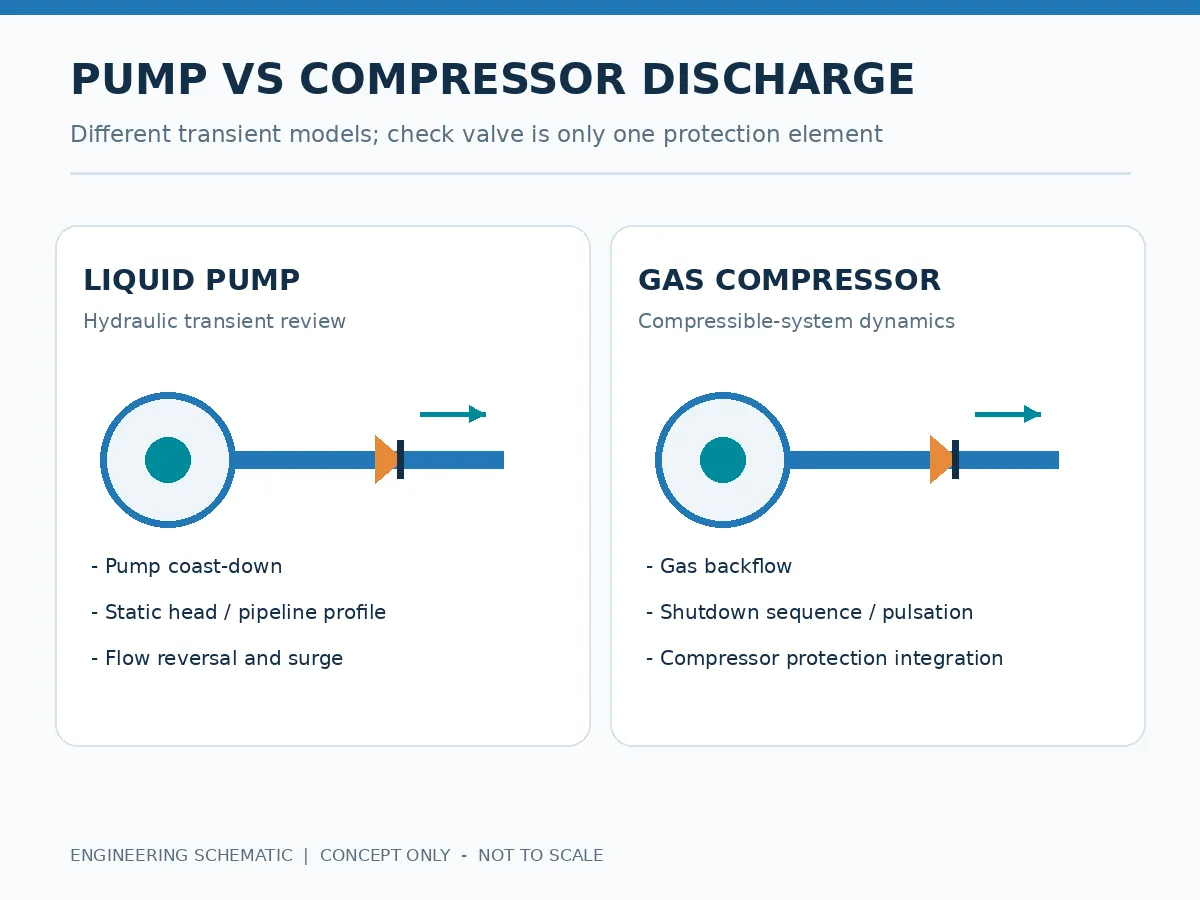
6. Compressor Discharge Protection: Gas Backflow and Shutdown
Gas systems require compressible-flow and compressor-system review; liquid water-hammer screening cannot simply be transferred to gas. Shutdown, gas properties, discharge volumes, pressure ratios, pulsation, and protective controls influence the transient.
Non-Return Valve Limits
Compressor package interface: Confirm the equipment supplier’s permitted backflow and reverse-rotation conditions, shutdown and recycle/anti-surge valve sequencing, gas pulsation characteristics, the valve’s minimum stable opening and its allowable pressure loss. A liquid-system surge formula is not sufficient to approve compressor discharge dynamics.
Compressor package review example: When a supplier proposes a spring-loaded check valve for a compressor discharge, the product description does not demonstrate stability across recycle, turndown or emergency shutdown cases. Request gas-property and compressor-system input, pulsation exposure, exact-model opening/closing data and integration review with the anti-surge and shutdown philosophy. Treat missing dynamic evidence as a technical deviation requiring a package-engineer decision.
The check valve can limit reverse flow but does not replace anti-surge controls, isolation functions, shutdown sequencing, or other safeguards required by the compressor design. Compare exact-model opening stability, gas pressure loss, spring/hinge motion, and any relevant dynamic evidence for both nozzle and swing candidates.
7. Selection Matrix: Match Construction to Duty
| Project condition | Nozzle screening | Swing screening | Approval evidence |
|---|---|---|---|
| Rapid flow deceleration | Review spring-assisted guided closure | Review hinge and any closing aids | Dynamic closing data and system transient |
| Tight steady-state ΔP limit | Compare exact-model curve | Compare exact-model curve | Same-basis pressure-loss evidence |
| Wide variable-flow range | Verify minimum stable opening | Verify disc flutter/stability | Opening-position evidence |
| Pump trip and parallel operation | Assess reverse-flow exposure | Assess closure under trip duty | Pump curves, trip data, transient evaluation |
| Compressor discharge | Gas dynamic and pulsation review | Gas dynamic and pulsation review | Compressor map, shutdown and model data |
| Unusual orientation | Confirm approval for precise model | Confirm gravity/hinge constraints | GA, IOM, vendor acceptance |
| Maintenance constraints | Review spring and guide access | Review hinge and seat access | Sectional drawing and spares |
Use this table to form a shortlist, not as an approval certificate. For another construction comparison, consult dual-plate vs axial-flow check valve.
8. Standards, Testing and Supplier Evidence
Design, Dimensional and Pressure-Test Scope
Where contractually applicable, API 594 addresses specified check-valve product constructions and connections; API’s standards plan lists a tenth edition dated 15 September 2026. ASME B16.10-2022 concerns applicable face-to-face and end-to-end valve dimensions. ISO 5208:2015 addresses pressure-boundary integrity and defined closure tightness testing of metallic industrial valves; ISO confirmed the 2015 edition in its 2025 review. These are different scopes. None establishes the exact model’s operating pressure loss, minimum stable opening, reverse velocity at seating or system transient response. Confirm the contractual editions, product applicability, project acceptance criteria and any current errata before ordering.
Do Not Substitute Seat Testing for Dynamic Evidence
Shell/closure testing, functional movement checks, material verification and transient performance evidence answer different questions. Where reverse-flow consequences justify it, request documented closing/reverse-velocity information for the exact construction and size; specify test medium, deceleration basis, conditions and limitations. Define ITP, MTC, NDT/PMI, witness and deviation requirements in the purchase specification. See also the valve pressure testing resource for broader testing distinctions.
9. Nozzle vs Swing Check Valve RFQ Checklist
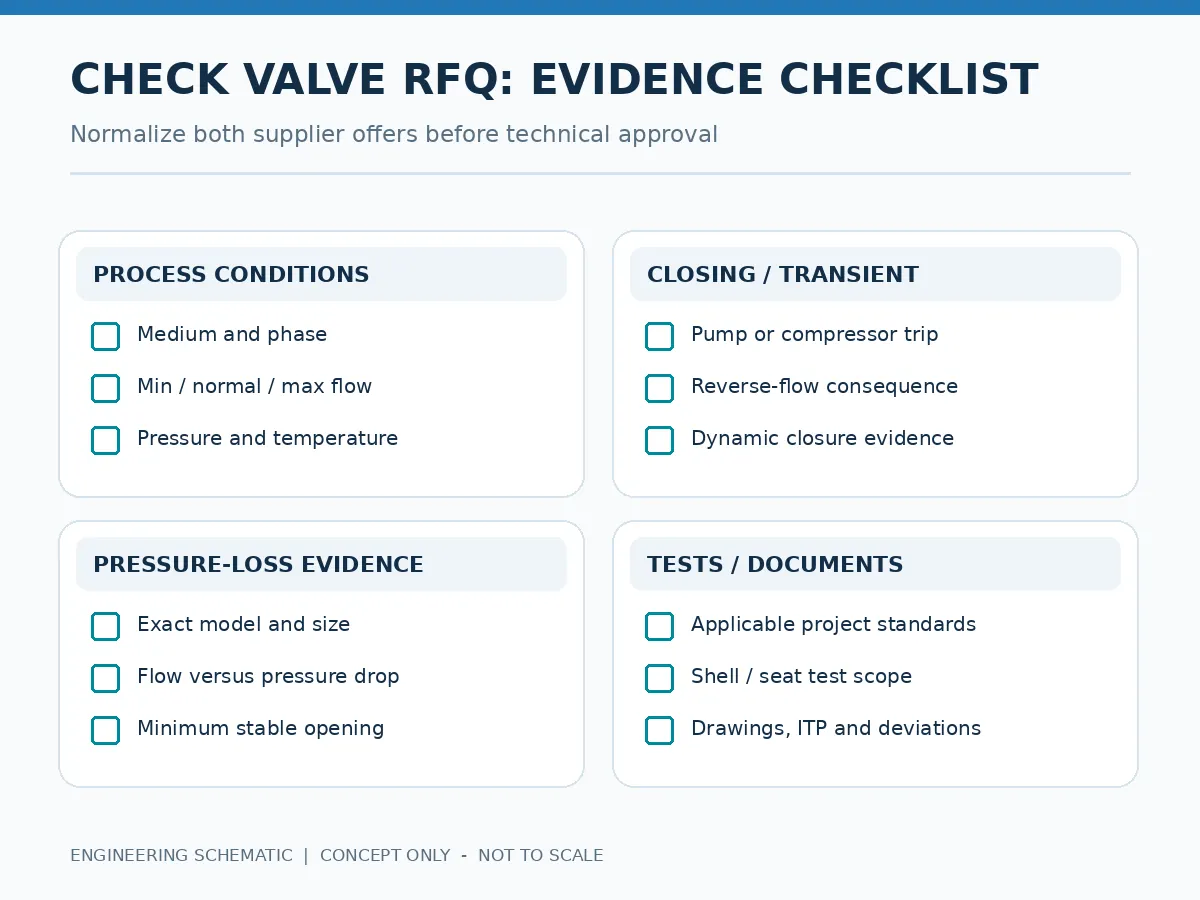
Bid comparison is meaningful only when suppliers use the same project input and documentation basis.
| RFQ field | Required input |
|---|---|
| Process duty | Medium, phase, composition, density/viscosity when needed |
| Operating envelope | Minimum/normal/maximum flow; operating/design pressure and temperature |
| Mechanical interface | Nominal size, pressure class/PN, end connections and orientation |
| Hydraulic objective | Allowed ΔP and stable-opening requirement at defined flow points |
| Pump duty | Pump curve, coast-down, trips, static head, pipeline profile, parallel arrangement |
| Compressor duty | Compressor map, gas conditions, discharge volumes, shutdown and pulsation |
| Transient acceptance | Maximum/minimum system pressure, reverse-flow/rotation constraints, analysis scope |
| Critical scenario / proof | Worst credible trip or shutdown case, model-specific closing evidence, system transient study responsibility, evidence deviations |
| Valve-specific documents | Exact model, GA/section, disc travel, spring or hinge configuration, opening data |
| Evidence and inspection | Pressure-loss curves, applicable dynamic results, shell/seat tests, ITP, materials, deviations |
Normalize Technical Bids Before Approval
| Decision item | Nozzle supplier | Swing supplier |
|---|---|---|
| Exact configuration and drawing | Confirmed / Partial / Open / N/A | Confirmed / Partial / Open / N/A |
| ΔP at specified duty points | Confirmed / Partial / Open / N/A | Confirmed / Partial / Open / N/A |
| Minimum-flow stability | Confirmed / Partial / Open / N/A | Confirmed / Partial / Open / N/A |
| Relevant closing-response evidence | Confirmed / Partial / Open / N/A | Confirmed / Partial / Open / N/A |
| Orientation and maintainability | Confirmed / Partial / Open / N/A | Confirmed / Partial / Open / N/A |
| Materials, inspection and deviations | Confirmed / Partial / Open / N/A | Confirmed / Partial / Open / N/A |
Record unresolved items as open technical deviations; do not silently assume a feature or test is included because it is commonly associated with the valve type.
10. Final Selection: Balance Closing Response and Pressure Loss
A nozzle check valve’s guided short-travel arrangement is a useful screening direction where reverse-flow exposure is consequential. A swing check valve may be appropriate when its disc remains stable during normal operation and its closing response meets the required shutdown duty. Neither type can be approved from its name. Final selection requires exact-model pressure-loss and opening data, service compatibility, documented closing behavior where needed, and project-specific system engineering.
If neither configuration meets the project requirements, consult the broader check valve selection framework to screen additional construction options against the same operating and evidence requirements.
11. Frequently Asked Questions
Is a nozzle check valve always better than a swing check valve for pump discharge?
No. Nozzle designs may be considered for guided short-travel closure, but the exact model must meet pressure-loss, stable-opening, shutdown and transient requirements. Swing designs can also be appropriate where their response is supported.
Which has lower pressure loss, a nozzle or swing check valve?
Neither family always has lower loss. Compare exact-model ΔP or Cv/Kv evidence at the same minimum, normal and maximum flow conditions, taking actual opening position into account.
Can a nozzle check valve eliminate water hammer?
No check valve guarantees elimination of water hammer. A suitable closure design can influence reverse-flow exposure, but the system transient depends on fluid, piping, equipment and operating events.
Why does closing travel matter during a pump trip?
Travel affects how far the disc must move before seating. Whether it seats before significant reversal also depends on inertia, force, friction and flow deceleration.
Are nozzle check valves suitable for compressor discharge service?
They can be candidates. Confirm gas properties, compressor operating and shutdown dynamics, pressure loss, opening stability and valve-specific closure evidence; a check valve does not replace anti-surge protection.
What information is needed to compare nozzle and swing check valve quotations?
Supply operating medium, flow range, pressures, temperatures, size and connections, installation orientation, pump/compressor and shutdown data, allowed pressure loss and transients, plus materials, testing and document requirements.
12. Request a Check Valve Selection Review
Submit the operating medium and phase, minimum/normal/maximum flow, normal and design pressure/temperature, valve size/class and connections, installation orientation, allowable pressure loss, and the governing pump-trip or compressor-shutdown case. Include pump curves and coast-down data or compressor maps and shutdown sequences where available, together with system transient limits, material requirements, test and documentation scope. Raymon Valve can help organize the technical comparison and identify missing exact-model evidence; final engineering acceptance remains project-specific.
Submit Project Data for a Valve Review English
  German
  Arabic
  French
  Spanish
  Italian
  Portuguese
  Russian