Dual Plate vs Axial Flow Check Valve: Pressure Loss, Closing Response and Pump Protection

工程对比 · 止回阀

双板阀因其结构紧凑、安装经济性好而常被列入考虑范围。而当导向短行程关闭和泵或压缩机保护性能更为重要时,轴流阀则值得更深入地研究。

简而言之:这两种设计都不能自动实现低损耗或无冲击。请结合压降、稳定开启、弹簧、行程、反向速度和安装情况等数据,在最小、正常、最大和跳闸工况下对具体型号进行比较。
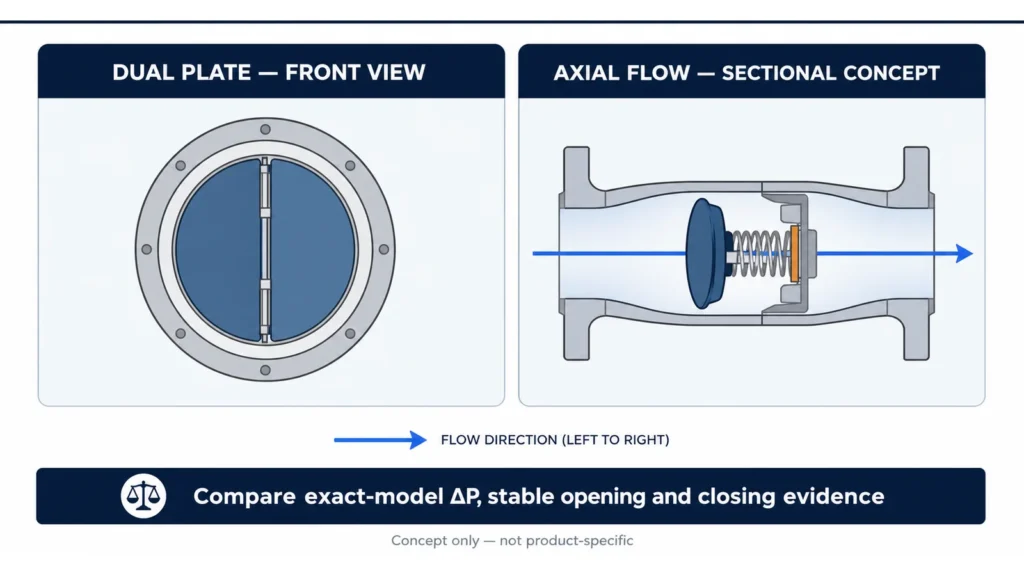
平行管道中双板式和轴流式止回阀设计的概念比较
概念图比较了典型的双板式和轴流式结构方向。具体的内部几何形状和性能因制造商和型号而异。

此对比有助于更广泛的工业止回阀选型流程。但它不能取代完整的数据手册、泵系统评估或负责工程师的批准。有关流量范围、稳定开启和关闭动态特性的更详细说明,请参阅止回阀尺寸和选型指南

快速决策:双板式还是轴流式?

结构类型可以提供一个有用的初步方向,但它并不能确定所提供阀门的实际压力损失或关闭响应。请使用以下矩阵来确定哪种设计值得进一步评估。

在较小的屏幕上,水平滚动表格以查看所有比较字段。

快速决策:双板式还是轴流式?
项目优先级 初步方向 仍需确认
紧凑型晶圆安装 双牌照可能入围 端面尺寸、法兰兼容性和批准方向
降低阀门安装重量 双板经常被纳入比较范围。 精确重量、螺栓连接、管道支撑和搬运要求
引导式短行程闭合 轴流式可能入围 碟片行程、弹簧基础、导向摩擦和动态证据
关键泵跳闸保护 轴流值得更深入的研究。 反向速度、瞬态分析和系统后果
最低初始阀门成本 双板可能具有优势 总安装成本、运行压力损失和故障后果
最低运行压力损失 没有自动获胜者 精确模型 Cv/Kv、压降曲线和开度
低流量或流量变化很大 没有自动获胜者 在整个工作范围内保持最小稳定流量和板/盘位置
结垢或含固体介质 没有自动获胜者 铰链、弹簧、导轨、间隙和座椅暴露
选择边界:宣传册中的“静音”、“无冲击”或“低损耗”等术语不能替代特定模型的水力和动力学数据。
1. 功能定义基本不循环工作或关键旋转设备保护。
2. Hydraulic FitCompare exact-model pressure loss and stable opening across the full flow range.
3. Dynamic FitReview flow deceleration, closure travel, spring force and reverse velocity at seating.
4. Procurement FitNormalize materials, testing, documentation, deviations, spares and installation limits.

What Physically Differs Between the Two Designs?

Typical Dual Plate Check Valve Construction

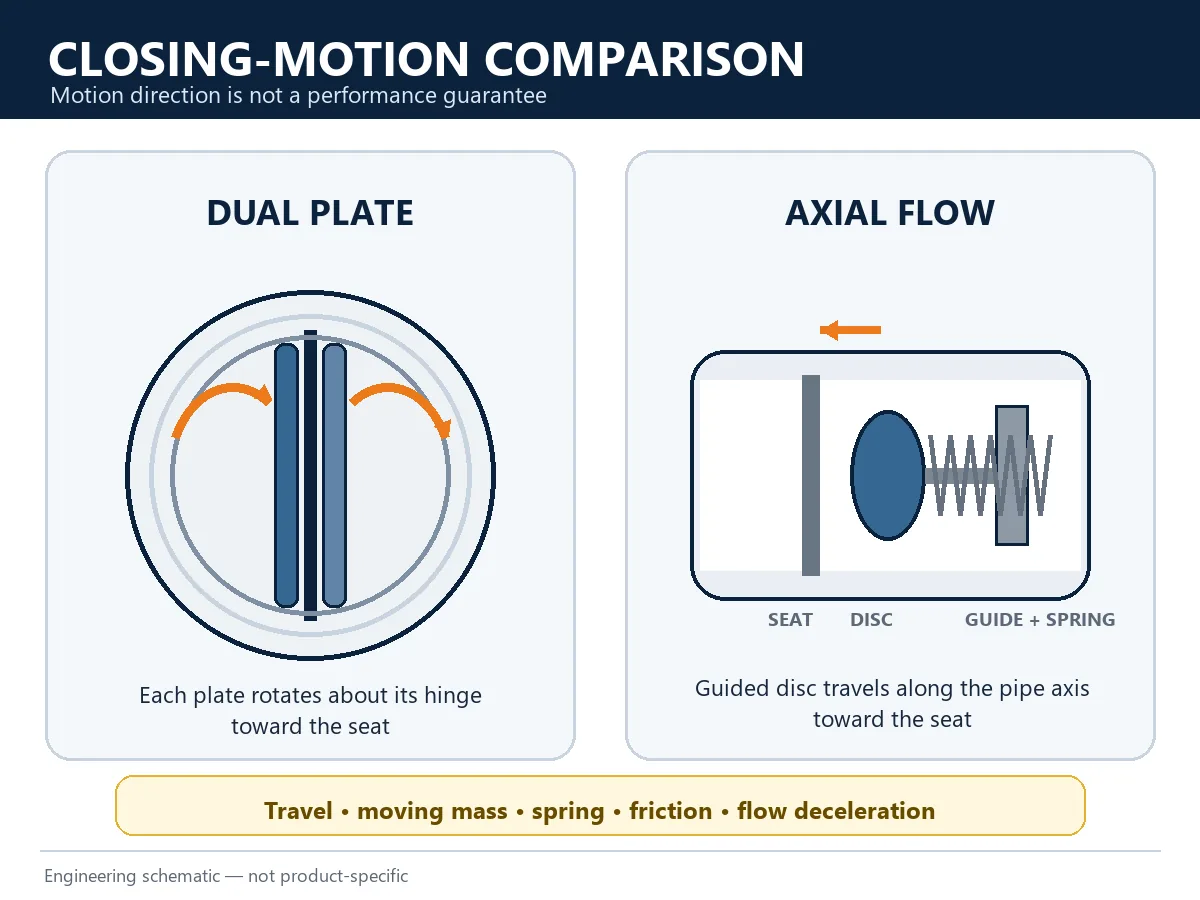
A typical dual plate valve uses two spring-assisted plates rotating around hinge pins, often in a compact wafer body. Plate profile, hinge location, spring torque, stops and seat geometry vary by model, and all remain relevant to flow obstruction, stable opening and closing response.

Typical Axial Flow Check Valve Construction

A typical axial flow valve uses a spring-assisted guided disc moving approximately along the pipe axis through a short linear stroke. Annular flow area, disc mass, guide geometry, spring force and seat approach remain model-specific; the design name alone does not prove low loss or non-slam performance.

旋转双板及导向轴向止回阀阀瓣的工程示意图
Engineering schematic showing typical rotational plate movement and guided axial disc movement. Travel, mass, springs and internal geometry remain model-specific.

Dual Plate vs Axial Flow: Side-by-Side Engineering Comparison

Dual Plate vs Axial Flow: Side-by-Side Engineering Comparison
Decision factor Dual plate check valve Axial flow check valve Buyer verification
Closure element Two rotating plates, typically spring-assisted Guided disc moving approximately along the flow axis Approved sectional drawing
Closure travel Short rotational movement Short linear movement Exact travel distance
Moving inertia Depends on plate size, mass and hinge arrangement Depends on disc mass and guide arrangement Offered-model data
Spring arrangement Torsion or model-specific plate springs Central or guided spring arrangement Spring basis and cracking pressure
Flow path Plates, hinges and supports occupy part of the bore Often annular or streamlined around a guided element Sectional drawing and flow coefficient
Pressure loss Model- and opening-position-dependent Model- and opening-position-dependent Exact pressure-drop curve
Low-flow stability Plates may remain partly open or move unstably if incorrectly selected Disc may remain partly open below its stable operating range Minimum stable flow data
Closing response Influenced by plate inertia, springs, friction and deceleration Influenced by disc inertia, spring force, guide friction and deceleration Dynamic evidence
Installation envelope Often compact Frequently longer, depending on design Certified dimensional drawing
Maintenance focus Plates, hinges, springs, stops and seats Guide, disc, spring and seat IOM and spare-parts scope
Initial commercial cost Often commercially attractive May carry a higher initial price Normalized total scope

Pressure Loss: Why the Valve Type Alone Does Not Decide ΔP

Pressure loss through either design depends on the complete internal flow path, not simply on the words “dual plate” or “axial flow.” Relevant variables include internal area, plate or disc obstruction, hinge or guide geometry, spring components, seat profile, valve opening position, fluid density and viscosity, operating flow and compressibility where applicable.

Fully Open Data May Not Represent Normal Operation

A check valve is self-actuated. Its operating position results from the balance between flow force, spring force, moving-element weight, friction and gravity where relevant. At maximum flow, the valve may approach the fully open position used to establish a catalogue coefficient. At normal or minimum flow, it may operate partly open, producing a different loss and potentially unstable movement.

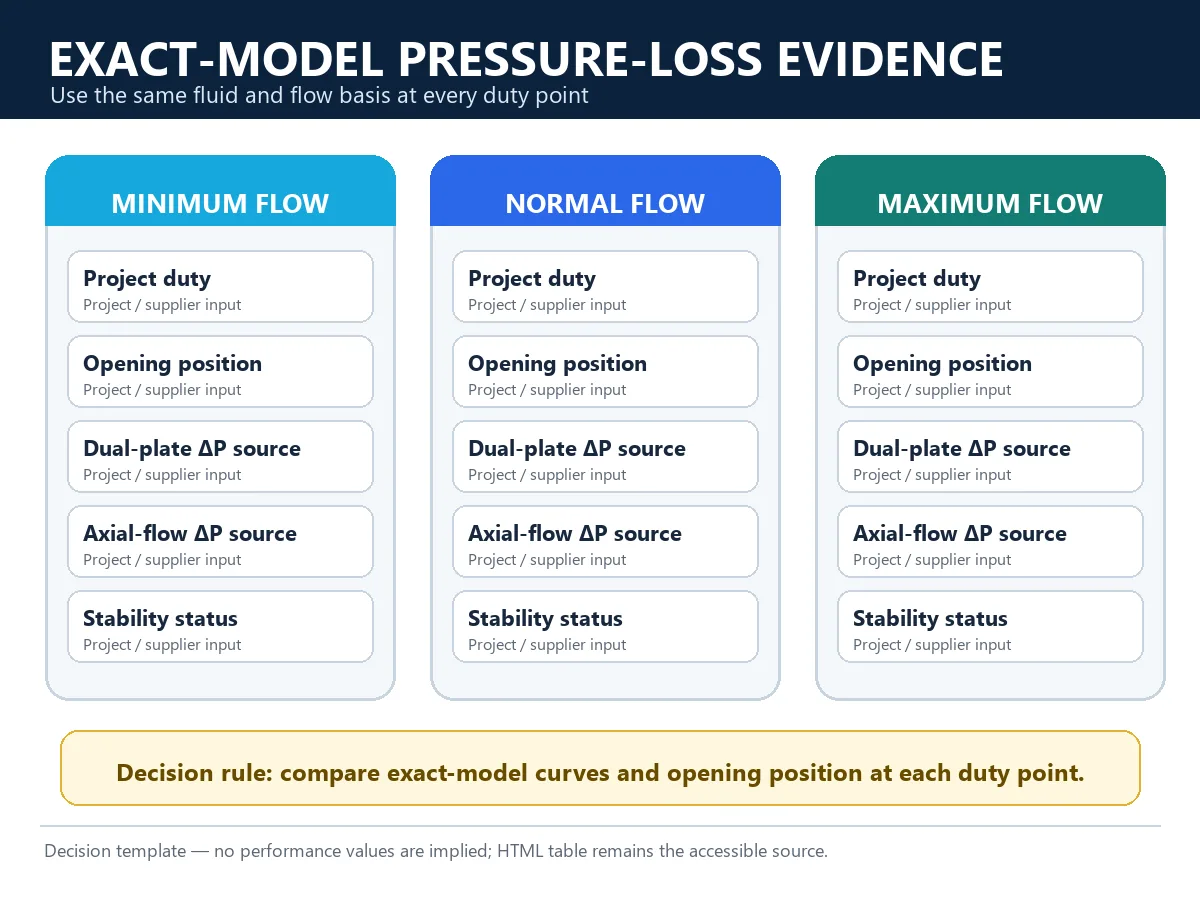
For this reason, buyers should compare exact offered models at the project’s minimum, normal and maximum flow points rather than comparing a single maximum Cv or Kv value.

用于比较止回阀在最小正常流量和最大流量下的压力损失证据矩阵
Example decision matrix for comparing exact-model pressure loss and opening position across the operating flow range. Values must come from project and supplier data.
Engineering comparison table 3
Operating point Required flow Dual plate ΔP Axial flow ΔP Opening position Evidence source
Minimum Project input Supplier input Supplier input Supplier input Curve, calculation or test
Normal Project input Supplier input Supplier input Supplier input Curve, calculation or test
Maximum Project input Supplier input Supplier input Supplier input Curve, calculation or test

Pressure-loss review should also separate purchase cost, installed cost, energy loss over the operating duty, maintenance burden and the consequence of unsuitable closure. A less expensive valve may not be economical if its actual operating loss is materially higher, while a premium design may not be justified where operating hours and risk are limited.

Low-flow approval warning: a valve can satisfy maximum-flow pressure-drop limits yet remain unsuitable at minimum or normal flow. Require the supplier to identify the expected opening position, stable-operating range and any continuous-operation restrictions for the exact offered size and spring configuration.

Closing Response: What Actually Controls Slam Risk?

Check valve slam is a system event: the closure element may reach the seat after reverse flow has developed, rapidly changing fluid momentum. Relevant inputs include pump deceleration, shutdown sequence, static head, pipeline profile, moving-element mass, spring force, friction, travel and reverse velocity at seating.

Dual Plate Closing Behaviour

Two plates can shorten individual travel compared with some single-disc swing arrangements, while springs may initiate closure as forward flow falls. Unequal plate movement, hinge friction, spring condition, disturbed inlet flow and low-flow operation can still change the response.

Axial Flow Closing Behaviour

A guided short-stroke disc may follow falling forward flow more closely, but performance still depends on disc mass, spring rate, guide friction, seat approach and the real system deceleration. Fast movement does not by itself guarantee an acceptable pressure transient.

Reverse Velocity at Closure

Reverse velocity at seating is more useful than a marketing label. Static Cv/Kv, cracking pressure and shell-test results do not establish it; a meaningful offer should tie dynamic evidence to the exact valve configuration and stated deceleration conditions.

What a Supplier Dynamic Curve Should State

  • exact valve model, nominal size and internal configuration;
  • fluid, temperature and installation orientation;
  • spring configuration and cracking-pressure basis;
  • opening position or forward velocity before deceleration;
  • flow-deceleration basis and calculation or test method;
  • reverse velocity, closure characteristic or stated response output;
  • range of sizes or conditions represented by the data; and
  • limits that prevent applying the curve to a different system without review.

For field symptoms after unstable operation has occurred, use the separate check valve chatter and slamming resource.

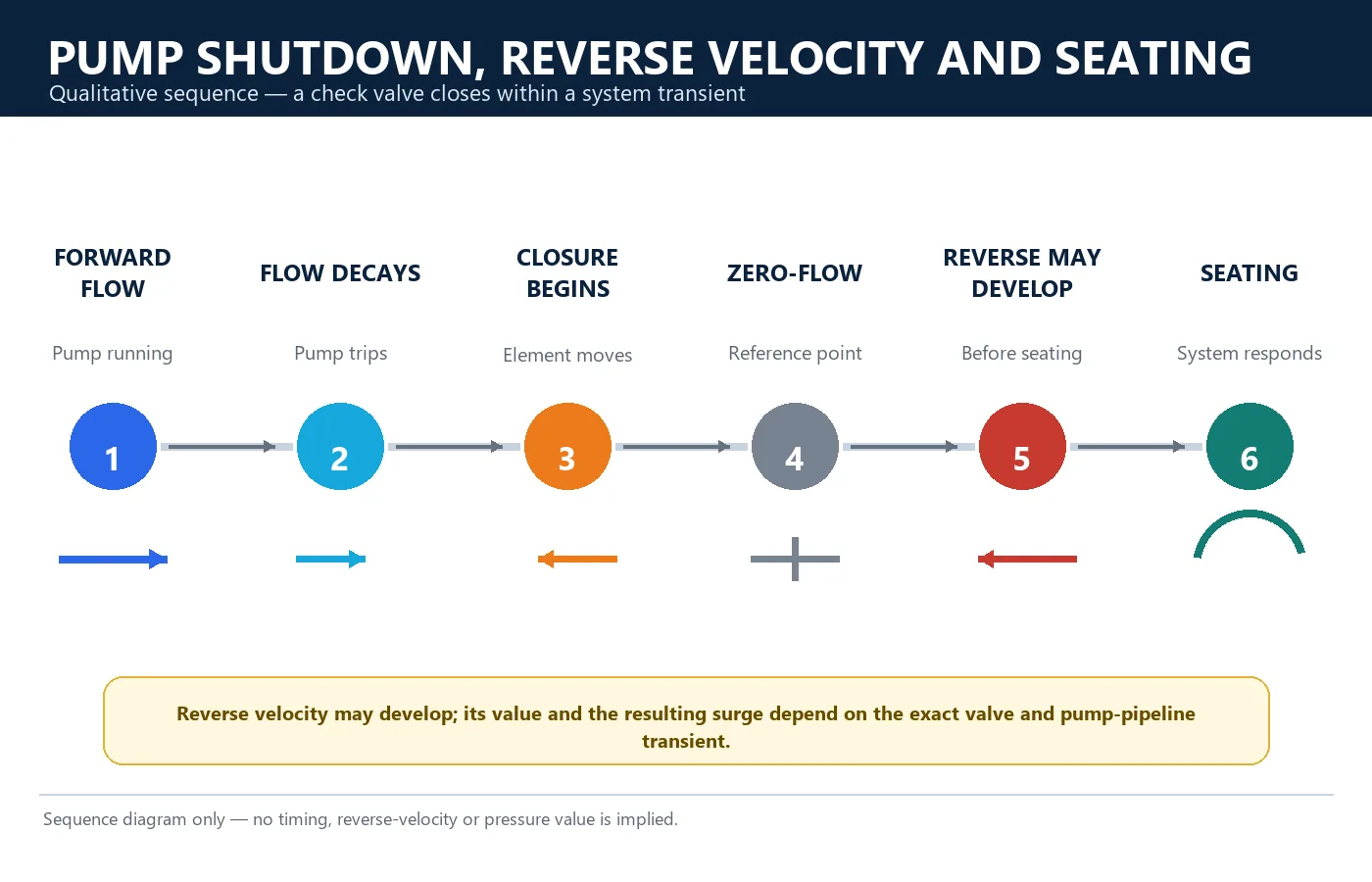
泵停机过程显示流量衰减、反向速度和止回阀关闭情况
Engineering sequence illustrating how flow deceleration and reverse velocity can develop before check valve seating. Actual response depends on the valve and complete piping system.

Pump Protection: The Check Valve Is Only One Layer

Normal Shutdown vs Sudden Pump Trip

During controlled shutdown, forward flow may decay gradually; after power loss or emergency trip, speed and flow may change much faster. Pump curve, rotating inertia, control sequence, downstream pressure, system resistance and valve location determine whether the valve follows the decay or allows significant reverse flow before seating.

Parallel Pumps

In a common header, a running pump can drive reverse flow through a stopped unit. Review the operating sequence, header pressure, permissible reverse flow, isolation arrangement and repeated low-flow cycling—not only the selected check-valve family.

Long Pipelines and High Static Head

Long rising mains, high static head and strict pressure limits can make valve closure a system-transient problem. The Hydraulic Institute notes that water-hammer severity depends on velocity change, pipe configuration and material, fluid properties, pump characteristics and valve-closure behavior; complex installations may require mathematical system analysis and modeling. Review the Hydraulic Institute system guidance.

A Hydraulic Institute field evaluation measured pressure after induced pump power loss and compared a swing check valve with a nozzle check valve at one municipal station. It supports the value of field data and transient modeling, but its result is case-specific and must not be converted into a universal performance percentage for dual plate versus axial flow valves. See the case-study scope.

System boundary: a check valve may be one pump-protection measure, but it does not replace review of controlled shutdown, surge vessels, air or vacuum devices, relief arrangements, rotating inertia or other project-specific measures.
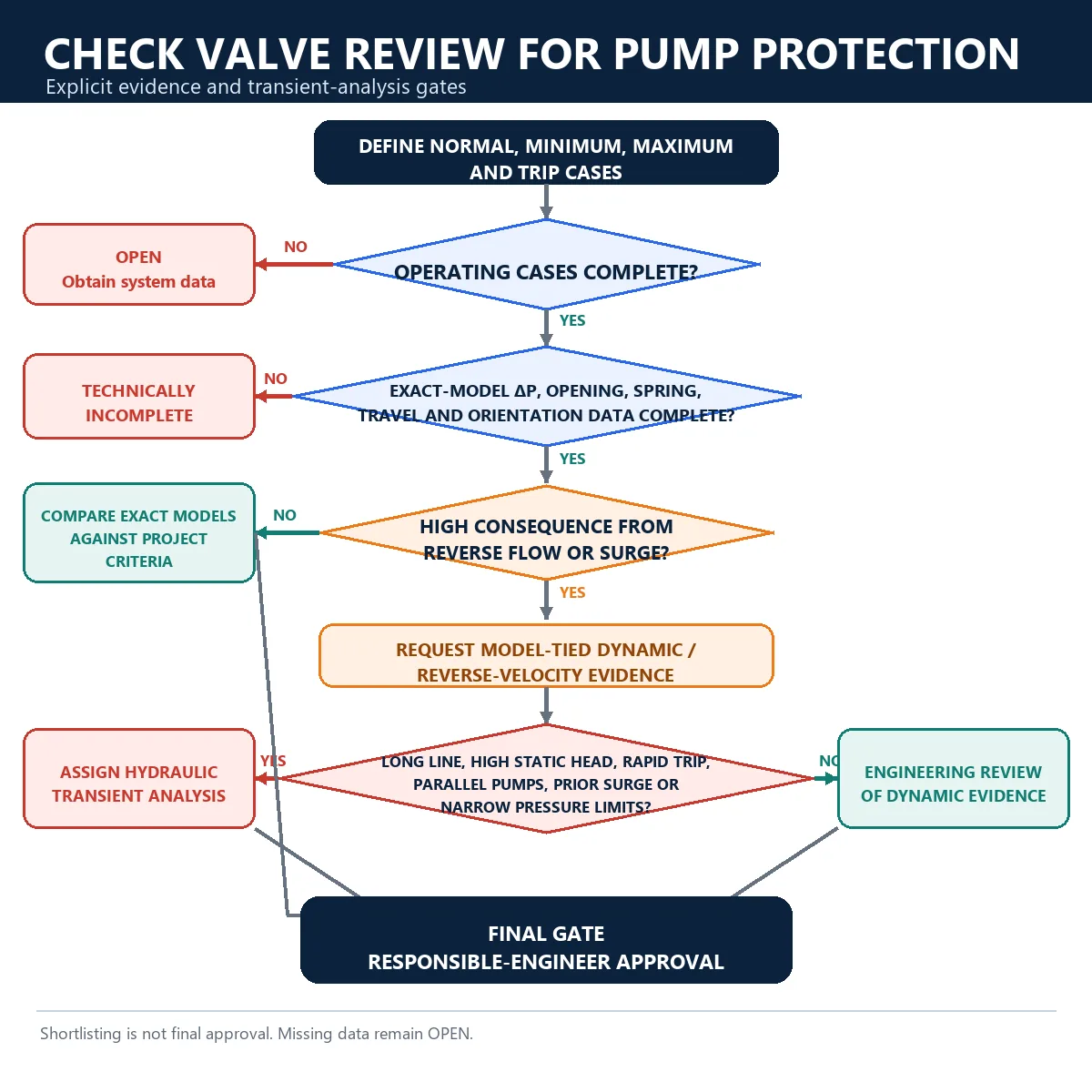
泵系统中双板式和轴流式止回阀审查的决策流程图
Example engineering decision path for shortlisting check valves and identifying duties that require dynamic or transient review.

When Each Design May Be Preferred

Dual Plate May Be Preferred When

  • compact wafer installation or lower support load matters;
  • large size makes a short envelope valuable;
  • initial commercial economy has high priority; and
  • exact-model hydraulic and dynamic evidence supports the duty.

Axial Flow May Be Preferred When

  • rotating-equipment protection has high consequence;
  • guided short-stroke closure is an important objective;
  • permitted reverse flow is low or flow decay is rapid; and
  • dynamic evidence supports the offered model and system basis.

Both options still require pressure-loss, stable-opening, orientation, materials, fouling, maintenance and transient review. See the related swing vs lift check valve comparison for a different construction decision.

Installation and Maintenance Factors That Can Change the Decision

The RFQ should state the actual flow direction, orientation, nearby fittings and available maintenance access. Gravity, swirl or an uneven velocity profile can change plate loading or disc position, while deposits and wear can affect hinges, guides, springs and seats.

  • Use the offered model’s approved installation orientations rather than a generic rule.
  • Review elbows, reducers, pump nozzles and tees against model-specific supplier guidance.
  • Confirm replaceable internals, spare assemblies, special tools and removal space.
  • Do not invent a universal straight-pipe distance without project or manufacturer support.

Failure Indication, Likely Cause and Verification Matrix

This matrix is intended for specification review and supplier clarification. It does not replace safe isolation, inspection procedures or system-level failure analysis.

Failure Indication, Likely Cause and Verification Matrix
Observed or predicted indication Possible engineering cause Evidence to request or verify Selection implication
Repeated plate or disc movement at normal flow Valve oversized, unstable opening position, disturbed inlet flow or unsuitable spring Minimum stable flow, opening-position data, piping layout and model-specific installation guidance Do not approve until stable operation is demonstrated
High measured or calculated pressure loss Restricted internal path, partial opening, unsuitable nominal size or inaccurate catalogue comparison Exact-model ΔP curve, fluid assumptions and opening position at all duty points Recompare size and design using normalized data
Impact noise or pressure spike after pump trip Reverse flow develops before seating, excessive closure travel, low spring force or severe system deceleration Trip sequence, deceleration, reverse-velocity curve, transient model and event data Escalate to dynamic or transient review
Unequal dual-plate movement Asymmetric flow, hinge wear, spring variation, debris or installation disturbance Sectional drawing, inspection findings, spring/hinge condition and upstream layout Correct root cause before return to service or approval
Axial disc drag or delayed return Guide friction, deposits, galling, corrosion, misalignment or unsuitable clearance Guide materials, clearances, medium condition, maintenance evidence and exact IOM Review material, fouling and maintenance suitability
Leakage after closure Seat damage, debris, misalignment, wear or acceptance criterion mismatch Seat design, leakage requirement, inspection and pressure-test acceptance Separate shut-off acceptance from dynamic suitability

Required Service Data Before Selecting Either Design

Required Service Data Before Selecting Either Design
Data field Why it matters
Valve function Distinguishes basic non-return duty from critical equipment protection
Medium and phase Affects density, viscosity, compressibility and compatibility
Minimum flow Identifies partial-opening and stability risk
Normal flow Defines normal position and energy loss
Maximum flow Defines peak velocity and pressure loss
Operating/design pressure and temperature Supports rating, material, spring and seat review
Pump curve and rotating inertia Supports operating and shutdown analysis
Shutdown sequence Influences flow deceleration and reverse-flow development
Static head and pipeline profile Influence reverse acceleration and transient behaviour
Parallel-pump arrangement Creates stopped-pump reverse-flow scenarios
Allowable valve pressure loss Supports hydraulic comparison
Permitted reverse flow Defines the equipment-protection objective
Installation orientation Affects moving-element behaviour
Solids or fouling risk Affects hinges, guides, springs and seats
Testing and documentation scope Defines procurement acceptance and traceability

Supplier Evidence and Technical Bid Normalization

A purchase decision becomes more reliable when every supplier quotes against the same evidence fields. Pressure-boundary and closure tests must remain separate from hydraulic and dynamic performance. The site’s valve pressure testing resource is included only as a navigational reference; it does not substantiate the offered valve’s pressure loss, stable opening or pump-trip response. The purchase specification and current applicable standards remain controlling.

Supplier Evidence and Technical Bid Normalization
Evidence required What it supports What it does not prove
Approved sectional drawing Construction and internal flow path Actual system closing response
Cv/Kv data Hydraulic comparison Stable operation at every flow point
Pressure-drop curve ΔP at stated conditions Pump-trip performance
Cracking pressure Initial opening requirement Minimum stable flow
Minimum stable flow data Low-flow suitability Surge protection under every shutdown
Plate or disc travel Closure distance Reverse velocity by itself
Spring data Closing-force basis Complete transient behaviour
Dynamic test or analysis Behaviour under stated conditions Different system conditions
Pressure-test report Pressure-boundary and closure acceptance Hydraulic efficiency or pump protection
Material certificates Material traceability Universal corrosion resistance
Installation instructions Approved orientation and handling Suitability for an unreviewed layout
Technical deviation schedule Transparent bid comparison Compliance unless deviations are accepted

Technical Bid Normalization Fields

Before comparing price, place each quotation into the same technical format. A lower-priced offer should not appear equivalent when it omits performance data, documentation, inspection, spares or installation restrictions.

Supplier Evidence and Technical Bid Normalization
Bid field Required common basis Acceptable evidence Deviation treatment
Valve construction Exact design, size, class/PN, end connection and face-to-face Datasheet and approved sectional/dimensional drawing List all geometry or connection differences
Hydraulic performance Same medium properties and minimum/normal/maximum flow Cv/Kv and ΔP curve with stated calculation or test basis Reject untraceable “low-loss” claims
Dynamic performance Same pump trip, deceleration and permitted reverse-flow basis Dynamic curve, test evidence or project-specific analysis Identify static-only offers as incomplete for critical duty
Materials and seat Same body, closure element, hinge/guide, spring and seat requirements Material schedule, MTC scope and compatibility review Record every substitution for engineering acceptance
Testing and inspection Same shell, seat, functional, NDT/PMI and witness scope where required ITP, procedures and report/document list Separate included, optional and excluded activities
Documentation and spares Same drawing, certificate, manual, spare and packing scope Document register and commercial inclusion list Price omitted scope separately before award
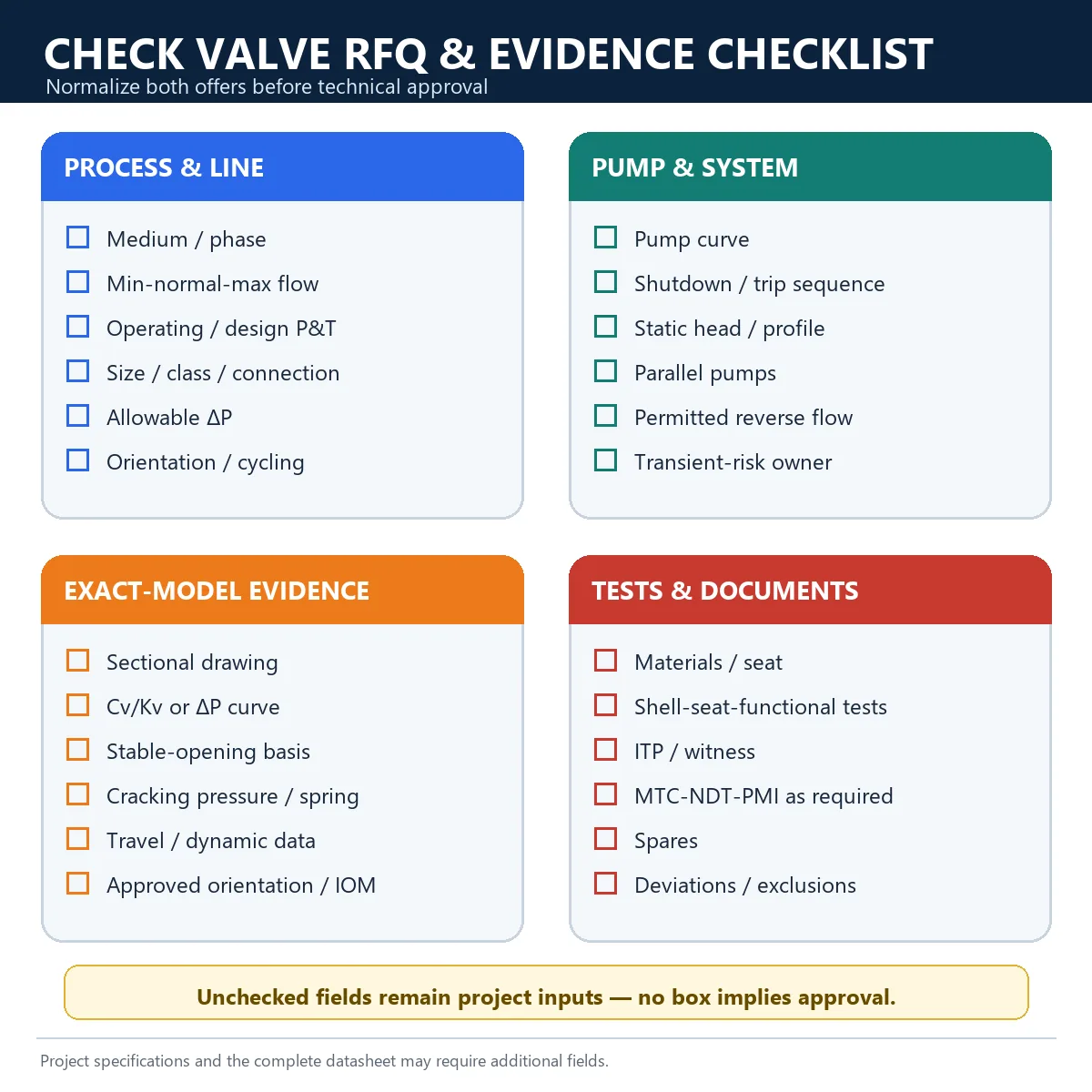
询价清单:止回阀工艺数据、泵状况及供应商证据
Example RFQ checklist for normalizing dual plate and axial flow check valve quotations. Project specifications may require additional fields.

Engineering Evidence Hierarchy

Use the highest available evidence level for the consequence of the duty. General brochures are suitable for screening, not final approval of critical pump protection.

Project and system dataPump curve, operating range, trip sequence, static head, pipeline profile, permitted reverse flow and transient criteria.
Exact offered-model dataSectional drawing, materials, Cv/Kv or ΔP curve, stable-opening evidence, travel, spring basis and approved orientation.
Dynamic evidence where consequence requires itReverse-velocity characteristic, test evidence or a model tied to the offered valve and the stated deceleration conditions.
Procurement acceptance evidenceITP, pressure-test scope, MTCs, inspection records, deviation schedule, documentation register and spare-parts list.

Technical Approval Gate

Do Not Approve Either Valve Until the Supplier Confirms

  • exact valve type, model and internal construction;
  • nominal size, pressure class or PN, and end connection;
  • applicable pressure-temperature rating;
  • body, plate/disc, hinge/guide, spring and seat materials;
  • exact-model Cv/Kv or pressure-drop curve;
  • minimum stable flow or opening-position basis;
  • cracking pressure and spring basis;
  • plate or disc travel;
  • approved installation orientation;
  • shell and seat test scope;
  • material traceability, inspection and documentation;
  • spare-parts scope and technical deviations.

Escalate to System-Level Engineering Review When

  • pump shutdown is rapid;
  • reverse flow must be tightly limited;
  • parallel pumps share a common header;
  • the pipeline is long or static head is high;
  • previous slam or surge has occurred;
  • rotating-equipment damage has high consequence;
  • the offered evidence is limited to static catalogue data;
  • pressure excursions must remain within strict project limits.

Final Selection Summary

Shortlist dual plate where compactness, installed mass and commercial economy matter; shortlist axial flow where guided closure and low permitted reverse flow justify closer dynamic review. Approve neither from the family name alone—compare the exact models across the operating and trip conditions, and review the wider piping transient for critical systems.

Request a Check Valve Selection Review

Submit enough project information to compare dual plate and axial flow offers on the same hydraulic, dynamic and procurement basis.

Attach or provide
  • medium and phase;
  • minimum, normal and maximum flow;
  • operating/design pressure and temperature;
  • line size, class/PN and end connection;
  • pump curve and shutdown sequence;
  • static head and pipeline profile;
  • parallel-pump arrangement and permitted reverse flow;
  • orientation, materials, tests and document requirements.
Use the review to clarify
  • which design should remain on the shortlist;
  • which exact-model data are still missing;
  • whether low-flow stability needs confirmation;
  • whether dynamic or transient analysis is required;
  • which technical deviations must be resolved before award.

Review boundary: the review can identify missing supplier evidence and conditions that require hydraulic transient analysis; it does not replace the project engineer’s final approval.

Submit Project Data for Review

Frequently Asked Questions

Which has lower pressure loss: a dual plate or axial flow check valve?

The design name does not decide it. Compare exact-model Cv/Kv or pressure-drop curves and opening position at minimum, normal and maximum flow.

Which check valve closes faster?

It depends on travel, moving mass, spring characteristics, friction and flow deceleration. Axial discs and dual plates can both have short travel, but performance remains model- and system-specific.

Can an axial flow check valve eliminate water hammer?

No. It may reduce reverse velocity under stated conditions, but the pump, pipeline, fluid and shutdown transient still require review.

Is a dual plate check valve suitable for pump discharge?

It may be, provided pressure loss, stable opening, closing response, orientation and materials suit the duty. Critical trips may require dynamic evidence or transient analysis.

Is an axial flow check valve the same as a nozzle check valve?

The terms can overlap commercially but do not guarantee identical internals. Confirm the disc, guide, spring, flow path, seat and travel from the approved drawing.

Can a dual plate check valve be installed vertically?

Some models permit it, but approved direction and flow orientation depend on the exact spring and plate design. Follow the offered model’s instructions.

What data should be included in the RFQ?

Include medium, flow range, pressure, temperature, pump and pipeline data, allowable loss, permitted reverse flow, orientation, materials, tests and documents.

When is a hydraulic transient study necessary?

Consider it for long lines, high static head, rapid trips, parallel pumps, strict reverse-flow limits, previous surge or high-consequence equipment.

Standards and Evidence Scope

At the time of this review, API’s official update record identifies API 594, 9th Edition, February 2022. Confirm the edition and project applicability before procurement. ISO 5208:2015, reviewed and confirmed by ISO in 2025, addresses metallic-valve pressure testing within its scope. ASME B16.10 addresses face-to-face and end-to-end dimensional interchangeability. None of these standards proves the offered valve’s exact pressure loss, stable opening or pump-trip response.

For system-level dynamic context, use the Hydraulic Institute water-hammer guidance. Its municipal pump-station field evaluation is useful case evidence for measurement and modeling, but it compares swing and nozzle check valves in one defined system and is not a universal dual-plate-versus-axial performance result.

Additional site navigation is available through the Raymon Valve Knowledge Center. Company context can be reviewed on the about Raymon Valve.

工程说明:本文仅用于初步比较、技术标书标准化和询价准备。文中未计算任何项目特定的压降、关闭时间、反向速度、冲击压力、材料兼容性或最终阀门选型。最终审批取决于已确认的项目数据、适用标准、准确的制造商数据以及负责工程师的审核。内容所有者:Raymon Valve 技术内容团队;本草案未指定任何持证审核人员。

Share:

Leave a Comment

Your email address will not be published. Required fields are marked *

want totalk
with us?

Leave your details and one of our experts will contact you!

en_USEnglish
Scroll to Top

Contact us

Please fill out this form with a brief description of your issue and we will get back to you as soon as possible.