By Raymon Valve · Engineering Decision Support
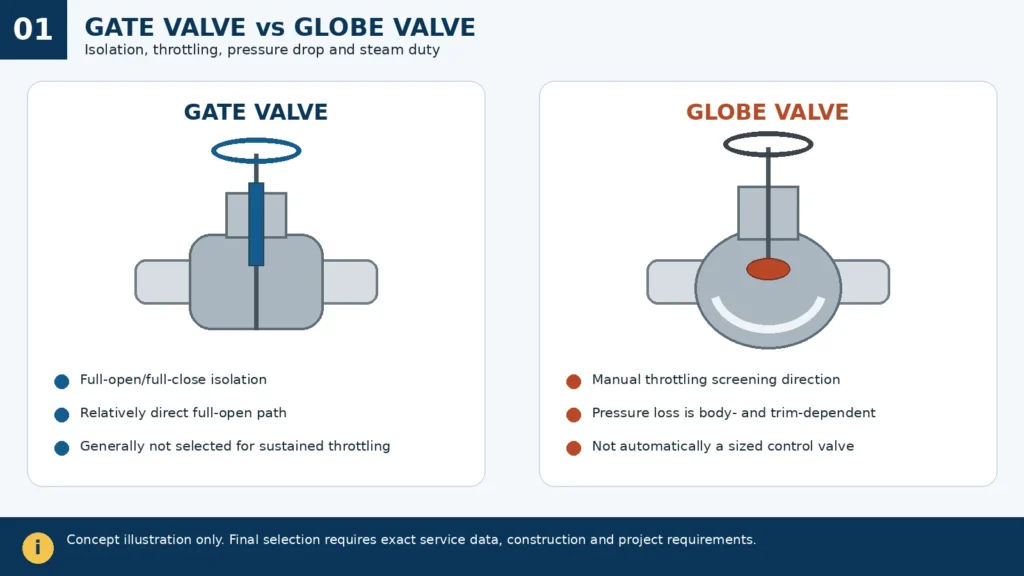
Screen a Gate valve first when the duty is mainly full-open/full-close isolation and low permanent pressure loss matters. Screen a Globe valve first when the valve must spend meaningful time at intermediate openings for manual adjustment or throttling. Neither choice is final from valve type, size, pressure class or steam service alone. Confirm the flow range, differential pressure, allowable pressure loss, body and closure design, flow direction, pressure-temperature rating, leakage requirement, operation method and project documents before approving an exact valve.
Featured illustration: Gate and Globe valve duty comparison for isolation, throttling and steam-service screening. Concept illustration only; final selection requires exact service data, construction and project requirements.
Gate Valve or Globe Valve? Quick Selection Table
| Selection question | Gate valve screening direction | Globe valve screening direction | Evidence still required |
|---|---|---|---|
| Full-open/full-close isolation | Usually screened first | May also be considered | Shut-off differential pressure, leakage acceptance and cycling |
| Frequent manual throttling | Generally unsuitable for conventional designs | Usually screened first | Exact plug/disc profile, permitted travel and pressure-drop data |
| Low full-open pressure loss | Often favorable | Usually higher; body pattern matters | Exact-model Cv/Kv, loss coefficient or tested curve |
| Main steam isolation | Common preliminary direction | Conditional alternative | Steam state, pressure-temperature rating, thermal cycles and shut-off duty |
| Warm-up, bypass, drain or vent | Conditional | Often favorable | Flow range, differential pressure, velocity, trim and noise |
| Large pressure reduction or automatic control | Not a generic selection | A standard manual Globe valve may still be insufficient | Control-valve sizing, severe-service review, trim and actuation |
This table is a preliminary screening tool, not an approval table. Product name, nominal size or pressure class alone cannot establish that a valve is suitable for a specific line or duty.
What Data Must Be Confirmed Before Comparing the Designs?
The first question is not simply, “Which valve is better?” It is, “What must the valve do in every operating case?” A Gate valve selected for infrequent main-line isolation is being evaluated for a different duty than a Globe valve used to adjust a warm-up bypass several times per shift.
Process and duty data
Confirm the following before selecting a direction:
- isolation, throttling, bypass, drain, vent or automatic process-control duty;
- medium, composition, phase, solids and condensate condition;
- normal operating and design pressure and temperature;
- minimum, normal and maximum flow;
- normal and maximum differential pressure;
- allowable permanent pressure loss;
- operating frequency, expected travel range and thermal cycling;
- erosion, flashing, cavitation, fouling, noise or vibration risk where relevant.
Valve and acceptance data
The RFQ or datasheet should also define:
- DN/NPS, PN/Class and end connection;
- body pattern and closure-element design;
- body, bonnet, gate/disc/plug, seat, stem, packing, gasket and bolting requirements;
- required flow direction and installation restrictions;
- shut-off direction and allowable leakage;
- manual, gear, pneumatic, electric or hydraulic operation;
- applicable design, pressure-rating, dimensional, connection and test requirements;
- inspection, witness, traceability and document requirements.
Unknown values can remain open, but they should be recorded as RFQ clarifications, technical deviations or approval hold points. They should not be replaced with a generic Gate-versus-Globe rule.
How Internal Design Changes Flow and Operation
Gate and Globe valves are both linear-motion families, but the closure element interacts with the flow passage differently. That difference affects pressure loss, intermediate-position behavior, operating force and the evidence needed for approval.
Gate-valve closure path
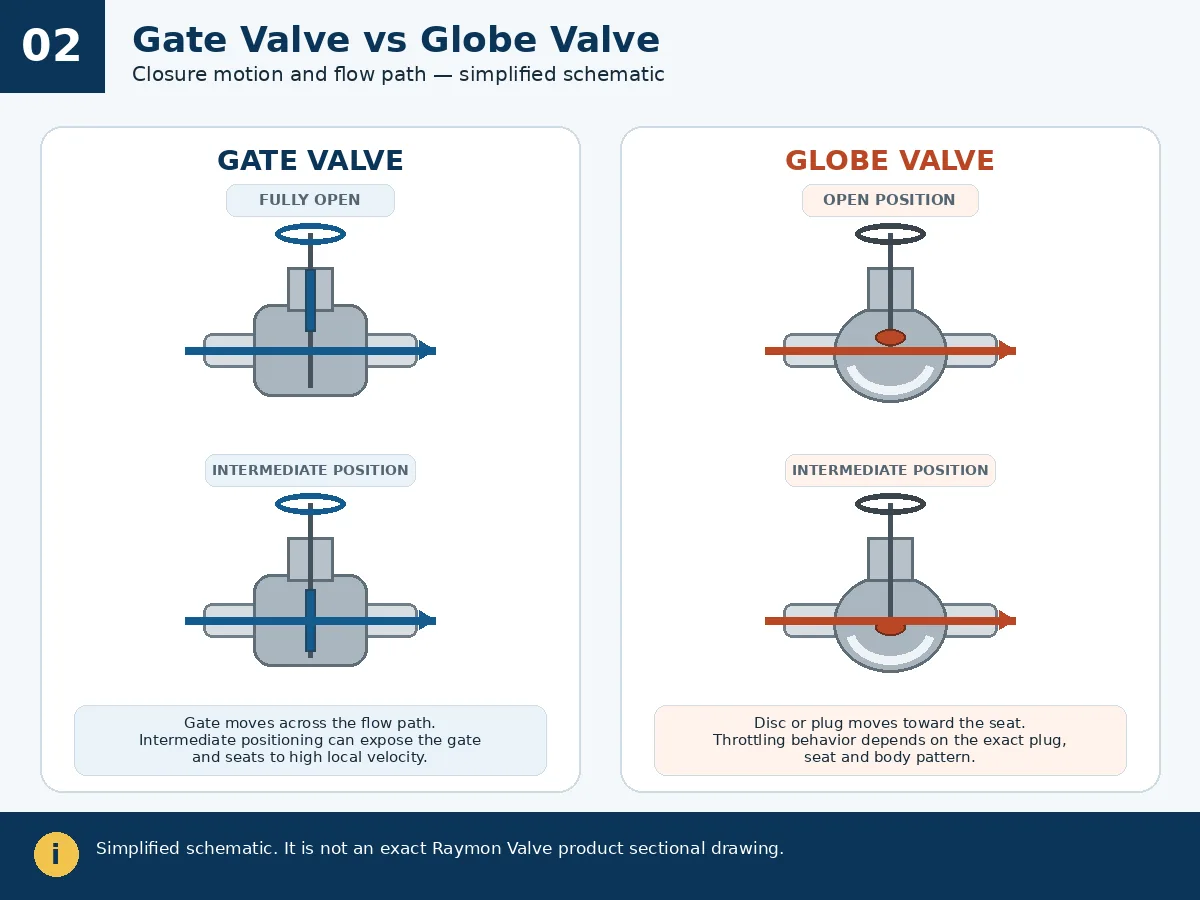
A Gate valve moves a gate, wedge or slab across the flow passage. In many conventional designs, the closure element is substantially withdrawn from the flow path when fully open. This is one reason an industrial Gate valve range is commonly screened for isolation duty where the valve normally remains fully open or fully closed.
The family name does not define one construction. Wedge, parallel-slide, slab, expanding and knife-gate designs do not have identical seating behavior, operating force, solids tolerance or service limits. Rising and non-rising stems, bonnet arrangements, end connections and seat designs must also be confirmed for the exact offered valve.
Globe-valve closure path
A Globe valve moves a disc or plug toward or away from a stationary seat opening. The body and seat region usually redirect or restrict the flow. This commonly creates more resistance than a conventional fully open Gate valve, but it can provide more usable behavior at intermediate positions.
Straight or T-pattern, Y-pattern and angle-pattern Globe valve designs should be compared separately. An on-off disc, throttling plug and characterized control trim are not equivalent. The supplier should identify the exact closure profile, guide or cage arrangement where applicable, permitted travel and flow data.
Operating travel and force
Handwheel turns or stem position do not automatically define flow rate. Differential pressure, seating direction, stem and packing friction, trim geometry and the exact mechanism affect operating force. For an automated valve, the actuator package requires a controlled thrust or torque basis, sizing factor, supply condition, travel requirement, fail action and accessory scope.
An actuator visible in a photo or listed as an option is not proof that it is included or correctly sized for the proposed duty.
Which Valve Is Better for Isolation?
When a Gate valve is usually screened first
A Gate valve is commonly the first screening direction when the primary requirement is full-open/full-close isolation and the system benefits from a relatively direct open flow path. Typical decision conditions include:
- the valve spends long periods fully open or fully closed;
- permanent pressure loss matters to system performance;
- the duty does not require sustained intermediate positioning;
- the exact construction can close against the specified differential pressure;
- maintenance and operating access fit the selected stem and bonnet arrangement.
This does not approve every Gate design. The project team must still verify pressure-temperature rating, closure direction, maximum differential pressure, seat construction, operating force, leakage acceptance and installation restrictions.
When a Globe valve may still be considered
A Globe valve may be considered for smaller auxiliary lines, equipment bypasses, drains, vents or services that combine shutoff with occasional adjustment. The additional pressure loss must be acceptable, and the supplier should identify the body pattern, disc or plug, seat design, flow direction and maximum shut-off differential pressure.
Shutoff requires a defined acceptance criterion
Neither family name guarantees a particular leakage result. A request for “tight shutoff” is incomplete unless the quotation identifies:
- the seat and closure construction;
- the test method and applicable edition;
- test pressure and medium;
- test direction;
- allowable leakage or acceptance criterion;
- whether the requirement applies to production testing, type testing or an order-specific witnessed test.
Shell testing, seat/closure testing, functional testing, fire testing, fugitive-emission testing, NDT and PMI are separate activities. One does not substitute for another.
Why Conventional Gate Valves Are Generally Unsuitable for Sustained Throttling
A conventional Gate valve is generally not selected for sustained throttling. At an intermediate position, the restricted opening can create high local velocity, turbulence and uneven loading around the closure element and seats. Depending on the design and service, this may contribute to vibration, erosion, unstable positioning or deterioration of later shut-off performance.
Handwheel position also does not normally provide a predictable flow relationship. A partly open Gate valve cannot be assigned a repeatable flow rate unless the exact design has suitable, documented flow characteristics and approved operating limits.
The engineering wording should remain “generally unsuitable,” not “never permitted.” A specially engineered construction or a controlled short-duration procedure may exist, but it requires written manufacturer limits, project review and an approved operating basis.
Why a Globe Valve May Be Better for Manual Throttling
The Globe-valve closure element moves toward or away from a defined seat opening. This can provide a more usable relationship between travel and restriction than the exposed edge of a partly open Gate valve.
On-off disc versus throttling plug
A standard on-off disc may support isolation and limited adjustment, but it should not be assumed to perform like a throttling plug, characterized trim or cage-guided control trim. For a throttling duty, request:
- disc or plug profile and guiding arrangement;
- permitted operating travel;
- Cv or Kv by travel where required;
- minimum, normal and maximum flow cases;
- differential-pressure limits;
- velocity, erosion, flashing, cavitation and noise review where relevant.
Calling every Globe valve “precise” or “excellent for throttling” hides the engineering work still required.
Manual adjustment is not automatic process control
A manual Globe valve may be suitable for coarse adjustment, balancing or warm-up duty. It is not automatically a Control Valve. Automatic modulation requires engineered Control Valve selection, complete process cases, sizing, suitable trim, an actuator, a positioner where applicable and defined accessories and control signals.
This comparison cannot determine a final Cv/Kv, valve size, trim, noise result, cavitation conclusion or actuator thrust. Those decisions require the actual medium, flow, upstream and downstream pressure, temperature, piping and control objective.
Gate Valve vs Globe Valve Pressure Drop
When fully open, many conventional Gate valves provide a more direct path through the body than a conventional straight-pattern Globe valve. A Globe valve normally redirects and accelerates the flow around the seat region, creating additional local resistance.
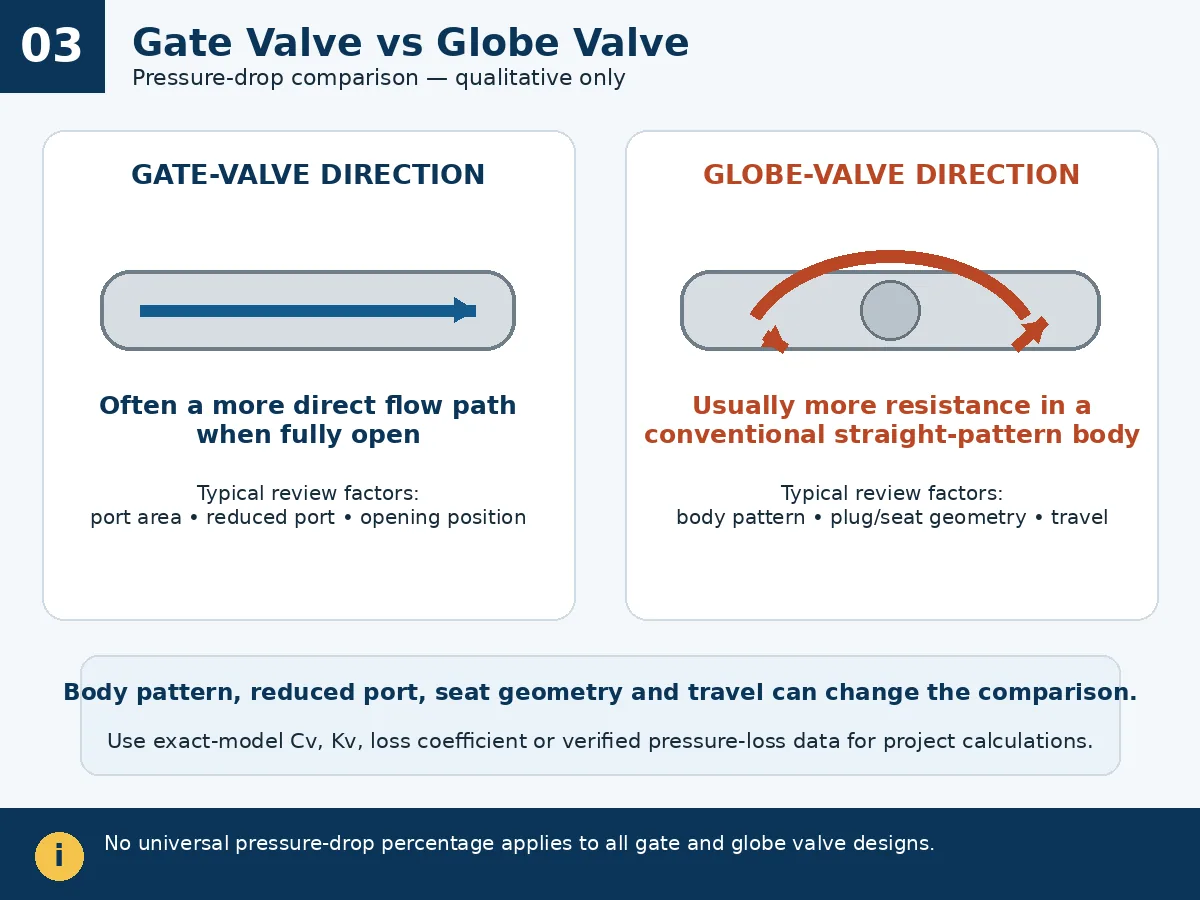
That comparison is qualitative. Body pattern and exact geometry matter:
- a Y-pattern or flow-optimized Globe body may reduce resistance compared with a conventional straight-pattern body;
- reduced-port Gate valves, seat geometry and the actual opening position can change the result;
- trim, guides, cage structures and internal transitions can affect the Globe-valve coefficient;
- fluid properties and operating Reynolds number may matter to the applicable calculation method.
Where system performance depends on valve loss, request exact-model evidence. Suitable inputs may include Cv or Kv, a loss coefficient for the defined configuration, a coefficient-by-travel curve, tested pressure-drop data or a manufacturer calculation using the specified fluid, flow rate and opening position.
Do not approve phrases such as “almost no pressure drop” or use a generic percentage reduction without a defined basis.
Gate Valve vs Globe Valve for Steam Service
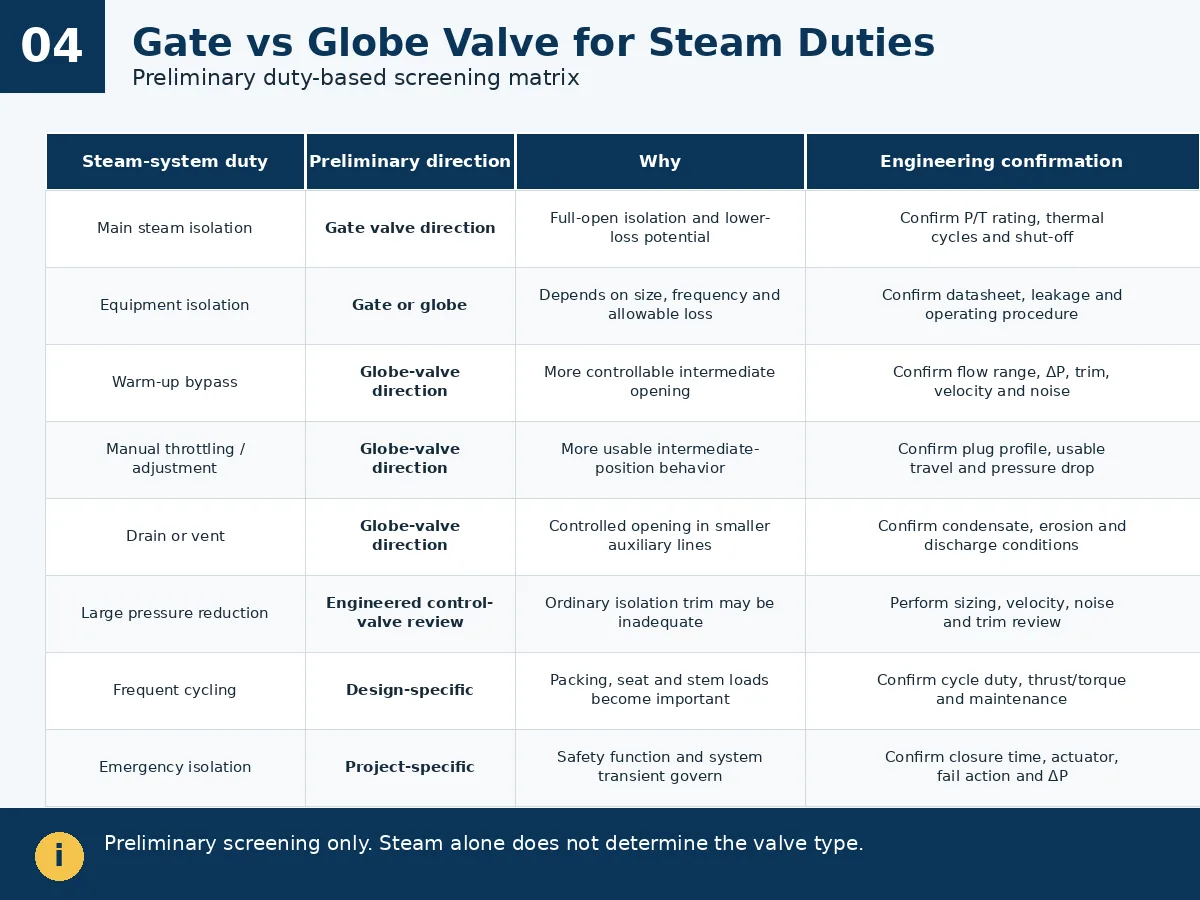
Steam is not one valve duty. Main isolation, equipment isolation, warm-up, bypass, drain, vent and large pressure reduction impose different operating conditions.
| Steam duty | Preliminary direction | Why | Required approval data |
|---|---|---|---|
| Main isolation | Gate often screened first | Lower open-path loss may matter | Steam state, rating, thermal cycles, differential pressure and closure duty |
| Equipment isolation | Gate or Globe | Line size, cycling and auxiliary function can change the choice | Exact duty, loss allowance, leakage and maintenance access |
| Warm-up or bypass | Globe often screened first | Meaningful intermediate operation may be needed | Flow range, trim, differential pressure, velocity, noise and thermal gradient |
| Drain or vent | Globe often practical | Controlled opening may be useful | Condensate/flashing, erosion, discharge routing and operating procedure |
| Large pressure reduction | Engineered control route | A standard manual Globe valve may be insufficient | Full Control Valve sizing and severe-service review |
Main steam isolation
For a valve that normally remains fully open and closes for isolation, a Gate valve may be the initial direction because permanent pressure loss can be important. Final review must still include steam condition, line size, thermal cycles, maximum differential pressure, closure time, pressure-temperature rating, body and bonnet construction, trim, packing and project acceptance requirements.
Warm-up and bypass duty
Warm-up and bypass valves can spend meaningful time at intermediate openings. A Globe valve with an appropriate throttling plug may therefore be the better starting direction. High differential pressure, velocity, noise and thermal gradients can still require specialized trim, staged pressure reduction or a sized Control Valve.
Drain and vent duty
Globe valves are often practical for drains, vents and smaller auxiliary lines because controlled opening can be useful. The review must still address condensate, flashing, erosion, discharge routing and the facility’s approved isolation and operating procedures.
Large steam pressure reduction
A standard manual Globe valve should not automatically be specified for a large pressure drop. The application may require Control Valve sizing, staged pressure reduction, low-noise or severe-service trim, outlet-velocity review, downstream piping review and actuator selection.
Steam suitability cannot be inferred from the valve type, bonnet style, pressure class or material name. The exact offered construction and rating basis govern.
Does Globe Valve Flow Direction Matter?
Flow direction can affect operating force, seating behavior, stability and allowable differential pressure. A universal “flow under the disc” or “flow over the disc” rule should not be applied to every Globe construction. Follow the body arrow, approved drawing and exact-model manufacturer instructions.
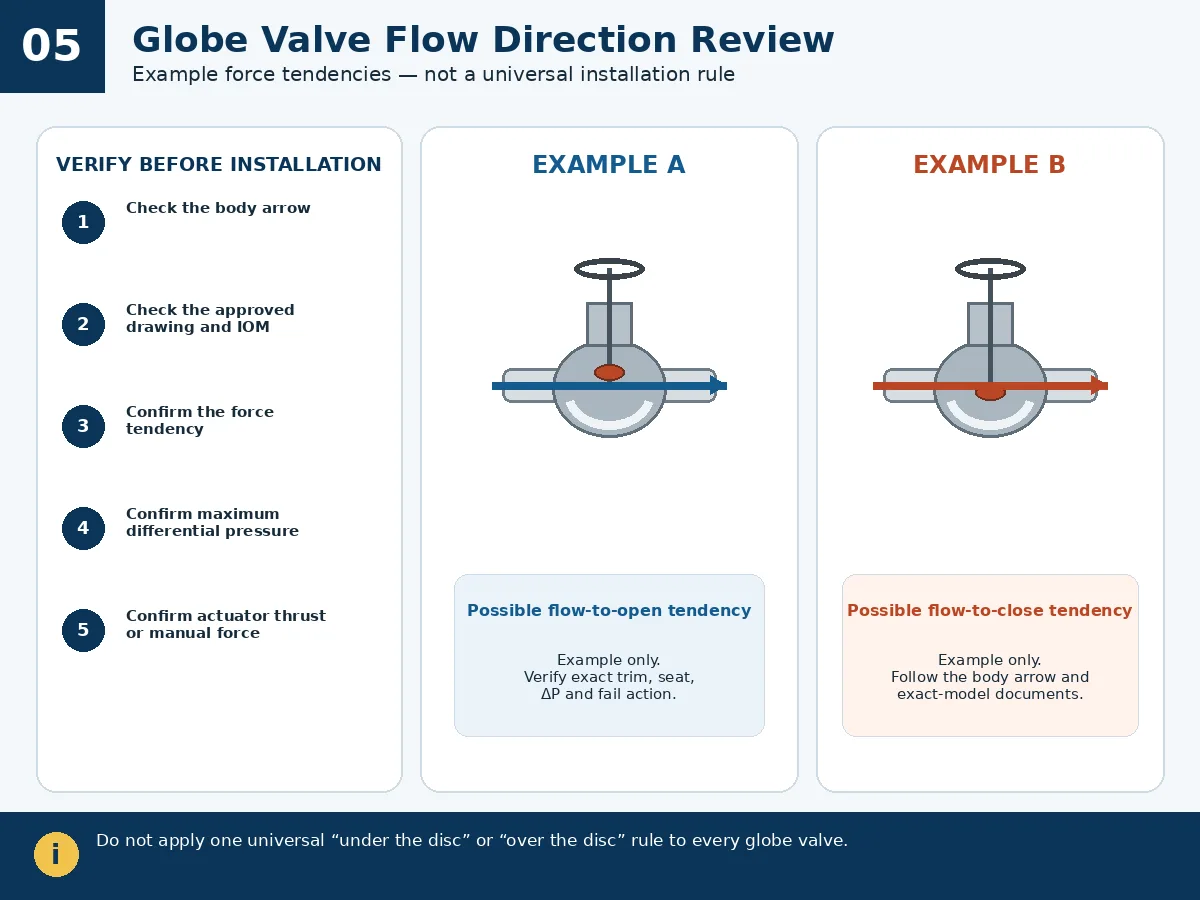
The same caution applies to broad bidirectional claims for Gate valves. The RFQ should state whether bidirectional shutoff is required and ask the supplier to confirm the proposed direction, maximum differential pressure in each required direction and the resulting manual operating-force or actuator sizing basis.
For an automated package, request the thrust or torque calculation, sizing factor, supply pressure or electrical supply, travel time if specified, fail action, control signal, positioner/solenoid/limit-switch scope, enclosure requirement and mounting interface.
Failure and Installation Risks to Screen Before Approval
The same symptom can have different causes, so these are review prompts rather than failure predictions. Record the responsible party and required evidence for each applicable risk before technical approval.
| Risk signal | Possible selection or installation cause | Evidence to request | Preliminary action |
|---|---|---|---|
| A conventional Gate valve must remain partly open for long periods | The duty is regulation rather than isolation; local velocity, turbulence, vibration or uneven loading may become relevant | Operating travel, duration, flow and differential-pressure cases, plus written exact-design limits | Review a suitable Globe or engineered Control Valve route unless the manufacturer documents the exceptional Gate-valve duty |
| A standard manual Globe valve is proposed for a large pressure reduction | On-off or general-purpose trim may not address velocity, noise, erosion, flashing or cavitation risks | Minimum/normal/maximum process cases, sizing calculation, trim description and downstream review | Route the duty to Control Valve and severe-service review where required |
| Required Globe-valve flow direction is unclear | Operating force, seating behavior, stability or allowable differential pressure may depend on the exact design | Body arrow, approved GA/sectional drawing and exact-model IOM or manufacturer statement | Hold installation orientation until the supplied documents agree |
| The valve is selected only by line size and Class/PN | Process differential pressure, pressure-temperature basis, leakage requirement and construction remain unresolved | Completed datasheet, applicable rating table, material list and test acceptance criteria | Record HOLD — DATA; do not approve from nominal designations alone |
| An automated package has no controlled operating-load basis | Valve torque or stem thrust, supply condition, sizing factor, fail action or accessories may be incomplete | Valve load calculation, actuator sizing record, supply data, travel time and accessory schedule | Keep the actuator package OPEN until the full calculation chain is approved |
| Stem, bonnet, handwheel or actuator access conflicts with piping or structure | The installation envelope, stem rise, removal space or maintenance route was not checked | Approved GA drawing, piping layout, support review, IOM and maintenance-clearance check | Resolve orientation and access before fabrication or installation approval |
Pressure-Temperature Rating, Materials and Stem Sealing
Pressure class is not a complete rating
A Class or PN designation does not provide one universal allowable pressure at every temperature. The review should connect the body material group, design temperature, applicable pressure-temperature table, end connection, bolting, packing, gasket and any project derating.
Confirm materials by component
The quotation and bill of materials should distinguish:
- body and bonnet;
- gate, disc or plug;
- stem, guides and cage where applicable;
- seat and hardfacing;
- packing, gasket and bolting;
- bellows or live-loaded packing where specified.
A material grade does not by itself prove corrosion resistance, sour-service suitability, abrasion life, cryogenic suitability or a maximum service temperature. Medium composition, temperature, pressure, velocity, solids, cycling, manufacturing condition and project restrictions must be reviewed together.
Standards, Tests and Documents: Keep the Roles Separate
Standards should be assigned to their actual role. A design/construction standard, pressure-boundary standard, dimensional standard, connection standard and pressure-test standard do not prove the same thing.
| Requirement role | Candidate reference context | What it may support | What it does not prove |
|---|---|---|---|
| Gate design/construction | API 600 for its defined steel Gate scope; API 602 for its defined compact Gate/Globe/Check scope | Questions about applicable construction requirements | Raymon product conformity, certification or applicability to every Gate design |
| Globe design/construction | API 623 for its defined steel Globe scope; API 602 where its exact scope applies | Questions about applicable construction requirements | Raymon product conformity or universal Globe performance |
| Pressure boundary/rating | ASME B16.34 where applicable | Pressure-boundary design/rating context | Complete valve selection, test acceptance or project approval |
| Face-to-face/end-to-end | ASME B16.10 where applicable | Dimensional basis | Interchangeability without an approved drawing |
| Flanged interface | ASME B16.5 where applicable | Mating flange/interface basis | Valve design or service suitability |
| Pressure/leak testing | API 598 or ISO 5208 where specified | Test-method and acceptance context | Design suitability, service life or a zero-leakage guarantee |
The API Standards Plan and API Digital Catalog provide current publication identity and development context. The official ASME B16.34 page identifies its valve construction scope. The purchase specification must confirm the required edition, product applicability, options and acceptance criteria.
These references do not prove that a proposed Raymon valve is designed, tested or certified to a standard. Product-level and order-level evidence is required before making such a claim. See the separate guide to industrial valve pressure testing for test-scope questions that should be normalized in an RFQ.
Supplier Technical Evidence Matrix
| Supplier claim | Evidence required | Approval warning |
|---|---|---|
| Low pressure drop | Exact-model Cv/Kv, coefficient or tested curve | Valve family alone is insufficient |
| Suitable for throttling | Closure/trim description, permitted travel and duty limits | An on-off disc is not automatically throttling trim |
| Suitable for steam | Rating, materials, duty and thermal-cycle review | “Steam valve” is not sufficient |
| Bidirectional or required flow direction | Drawing and written exact-model confirmation | Direction may affect force, seating and stability |
| Tight shutoff | Test standard, pressure, direction and acceptance criterion | Avoid unsupported zero-leakage wording |
| Automated package | Thrust/torque basis, sizing factor, supply, fail action and accessories | A visible actuator does not prove included or sized scope |
| Standard conformity | Exact product evidence and applicable edition | A general standard page does not prove conformity |
This matrix helps procurement teams compare technical offers on the same basis. A supplier deviation schedule should identify every missing input, alternative construction, excluded test and document exception before purchase approval.
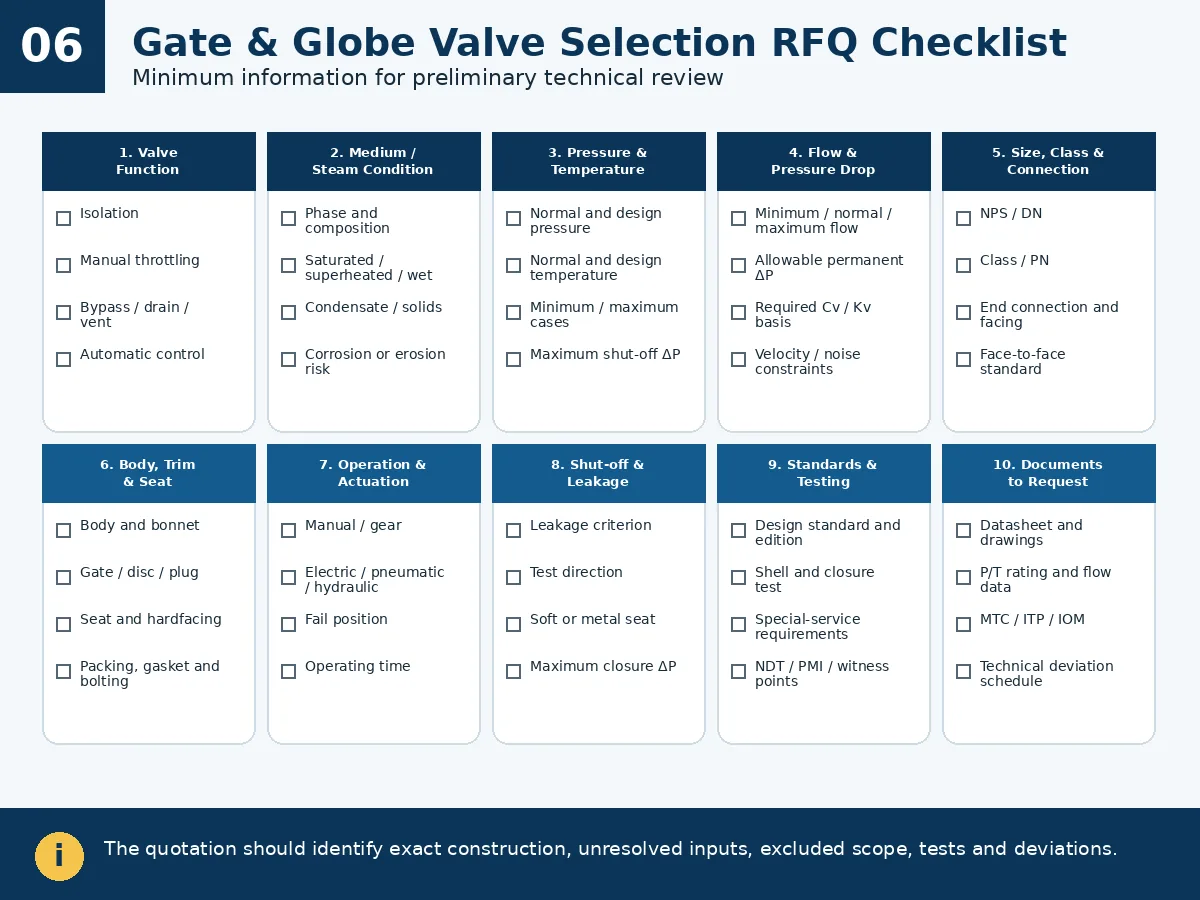
Gate and Globe Valve RFQ Checklist
Process and operating data
- tag number, line reference and required duty;
- medium, composition, solids and phase;
- operating and design pressure and temperature;
- minimum, normal and maximum flow;
- normal and maximum differential pressure;
- allowable permanent pressure loss;
- operating frequency, expected travel range and thermal cycles;
- erosion, flashing, cavitation, fouling, noise and vibration risks.
Valve construction
- valve family and exact design or body pattern;
- DN/NPS, PN/Class and end connection;
- closure element, seat, stem, packing and gasket;
- materials identified by component;
- flow direction and installation orientation;
- manual, gear or actuated operation.
Gate-specific additions
- isolation duty and bidirectional requirement where relevant;
- wedge, slab or knife-gate route if specified;
- solids/slurry data for relevant constructions;
- stem and bonnet preference where specified;
- operation cycles and packing/emission requirement;
- actuator thrust/torque input basis if automated.
Globe-specific additions
- straight/T, Y or angle body pattern;
- shutoff versus throttling duty;
- flow and differential-pressure cases if throttling;
- disc/plug/trim and permitted travel;
- packing or bellows requirement;
- actuator and fail action if automated.
Tests, documents and commercial scope
- design, connection, dimension and test requirements with editions;
- leakage acceptance, test direction and test pressure;
- material certificates, drawings, ITP, NDT, PMI and third-party witness requirements;
- quantity, destination, project stage, required spares and delivery documents;
- supplier deviations, exclusions and unresolved items.
The accepted quotation should distinguish confirmed data, supplier assumptions, alternatives and open items. That separation is more useful than a simple statement that one valve type is “better.”
Request a Gate or Globe Valve Selection Review
Send the valve duty, medium, flow cases, differential pressure, size, pressure-temperature conditions, end connection, construction, materials, leakage criterion, operation method, applicable specifications and required documents. Attach the line list, P&ID reference, datasheet and deviation form where available.
Minimum review pack: line/tag and duty; medium and process cases; flow and differential pressure; DN/NPS, Class/PN and connection; required construction and component materials; leakage criterion; operation or actuator inputs; applicable specifications; inspection and document scope; quantity and destination.
Raymon Valve can review the preliminary direction and prepare a project-specific quotation. Final selection remains subject to the approved project specification and exact offered-model data.
Frequently Asked Questions
What is the main difference between a Gate valve and a Globe valve?
A Gate valve moves its closure element across the flow passage and is primarily screened for full-open/full-close isolation. A Globe valve moves a disc or plug toward a seat and may provide more useful intermediate-position behavior for manual throttling. Exact construction and duty still govern.
Which valve is usually better for isolation?
A Gate valve is often screened first where low full-open pressure loss matters. A Globe valve may also provide isolation in auxiliary, bypass, drain or vent duties. Confirm leakage acceptance, differential pressure, operating frequency and exact construction before approval.
Can a Gate valve be used for throttling?
A conventional Gate valve is generally unsuitable for sustained throttling because partial opening may create localized velocity, vibration, erosion or unstable positioning. Any exceptional use requires a specifically engineered design, written limits and project approval.
Why does a Globe valve usually have a higher pressure drop?
A conventional Globe valve redirects and restricts flow around the seat region. Actual loss depends on body pattern, port, trim and opening position, so quantitative decisions should use exact-model Cv/Kv or other approved data.
Which valve is better for steam service?
Neither is automatically better for every steam duty. Gate valves are commonly screened for main isolation, while Globe valves are often screened for warm-up, bypass, drain or manual regulating duty. Steam state, pressure, temperature, flow and differential pressure must be confirmed.
Does flow direction matter for a Globe valve?
It can. Flow direction may affect operating force, seating, stability and allowable differential pressure. Follow the body arrow, approved drawing and exact-model manufacturer instructions instead of applying one universal rule.
Is a manual Globe valve the same as a Control Valve?
No. A manual Globe valve may support coarse adjustment. Automatic process control requires process sizing, suitable control trim, actuation, accessories and confirmed operating cases.
What information should be included in a Gate or Globe valve RFQ?
Include duty, medium, size, rating, pressure-temperature cases, flow and differential pressure, body and closure design, materials, flow direction, leakage acceptance, operation method, applicable standards, tests, documents, quantity, destination and supplier deviation requirements.
Conclusion
A Gate valve is commonly the first screening direction for isolation where low open-flow loss matters. A Globe valve is commonly the first screening direction for manual throttling or frequent adjustment. Neither family name approves an exact valve.
Final approval depends on duty, process data, body and closure construction, pressure-temperature rating, flow direction, leakage acceptance, actuation, applicable standards, tests, documents and supplier deviations. Use the comparison to prepare a better datasheet and RFQ—not to replace project-specific engineering review.