
Lined Valve vs Alloy Valve for Corrosive Service: Chemical Compatibility, Temperature, Permeation and Lifecycle Selection
Lined valves and alloy valves solve corrosive service challenges through different protection mechanisms. A lined valve uses a corrosion-resistant barrier between the process medium and the valve body, while an alloy valve relies on the corrosion resistance of metallic wetted materials.
The correct choice is not determined only by corrosion resistance. Engineers and procurement teams need to evaluate chemical compatibility, concentration, temperature, pressure, permeation risk, mechanical requirements and lifecycle expectations before selecting a valve construction.
This guide compares lined and alloy valve approaches to help EPC contractors, process engineers and buyers understand when each option should be considered and what information should be reviewed during RFQ preparation.
How Lined Valves and Alloy Valves Handle Corrosive Media Differently
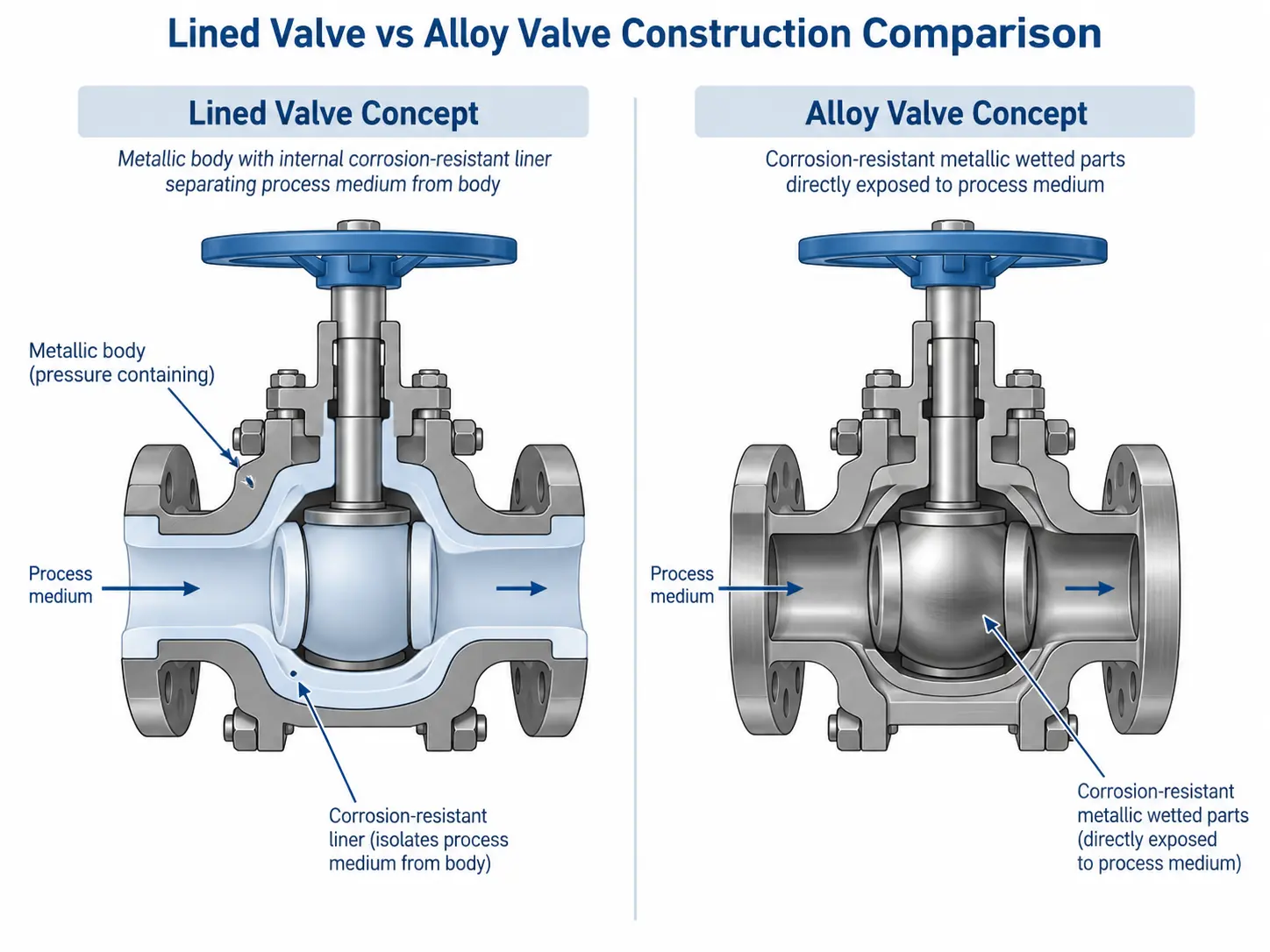
The fundamental difference between lined valves and alloy valves is the way corrosion protection is achieved.
A lined valve separates the process medium from the pressure-containing body by using a compatible liner system. The liner acts as a corrosion-resistant barrier, while the metallic body provides structural support.
An alloy valve takes a different approach. The wetted metallic components themselves are selected according to the expected corrosion environment and mechanical requirements.
| Consideration | Lined Valve | Alloy Valve |
|---|---|---|
| Protection mechanism | Corrosion-resistant liner isolates the process medium from the valve body | Corrosion-resistant metallic materials are used in wetted areas |
| Primary evaluation focus | Liner compatibility, integrity and operating limits | Metal corrosion behavior and material suitability |
| Main engineering concern | Chemical exposure, temperature effects and mechanical damage risk | Corrosion mechanisms, alloy selection and service environment |
Corrosion Protection Mechanism: Barrier System vs Material Resistance
When comparing lined and alloy valve construction, the key question is not which material is universally more corrosion resistant. The real engineering question is which protection method matches the actual service conditions.
| Review Point | Lined Construction | Alloy Construction |
|---|---|---|
| Chemical isolation | Provides separation between process media and metallic body | Depends on corrosion resistance of exposed metallic materials |
| Material review | Requires evaluation of liner compatibility | Requires evaluation of alloy corrosion performance |
| Mechanical considerations | Requires protection of liner system from damage | Metallic construction may provide different mechanical characteristics |
Engineering Selection Note
Corrosion resistance cannot be determined by material name alone. Actual suitability depends on the complete service environment, including chemical composition, concentration, temperature, pressure, contaminants and operating conditions.
Chemical Compatibility Comparison: Lined Valve vs Alloy Valve
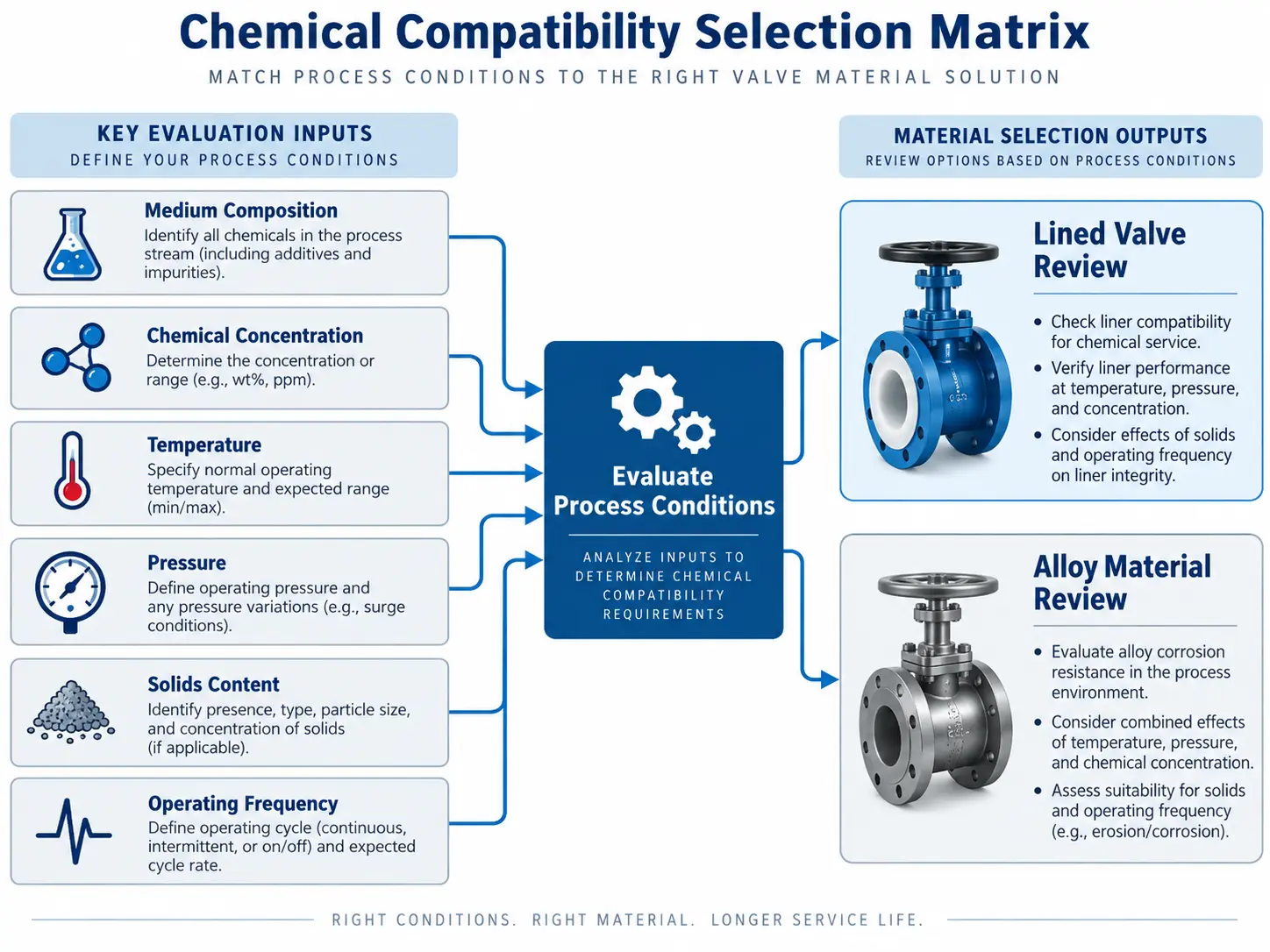
Chemical compatibility is one of the most important factors in corrosive service valve selection. However, compatibility cannot be judged only by the chemical name.
The review should consider:
- Medium composition and concentration
- Operating and design temperature
- Pressure conditions
- Presence of solids or contaminants
- Cleaning chemicals or process changes
- Exposure duration and operating cycle
| Selection Factor | Lined Valve Review | Alloy Valve Review |
|---|---|---|
| Chemical exposure | Verify liner compatibility with process medium | Verify alloy corrosion behavior under actual conditions |
| Mixed chemicals | Review combined chemical interaction with liner | Review corrosion mechanisms affecting alloy material |
| Long-term service | Consider liner durability and permeation factors | Consider corrosion rate and material stability |
Temperature Considerations in Corrosive Valve Selection
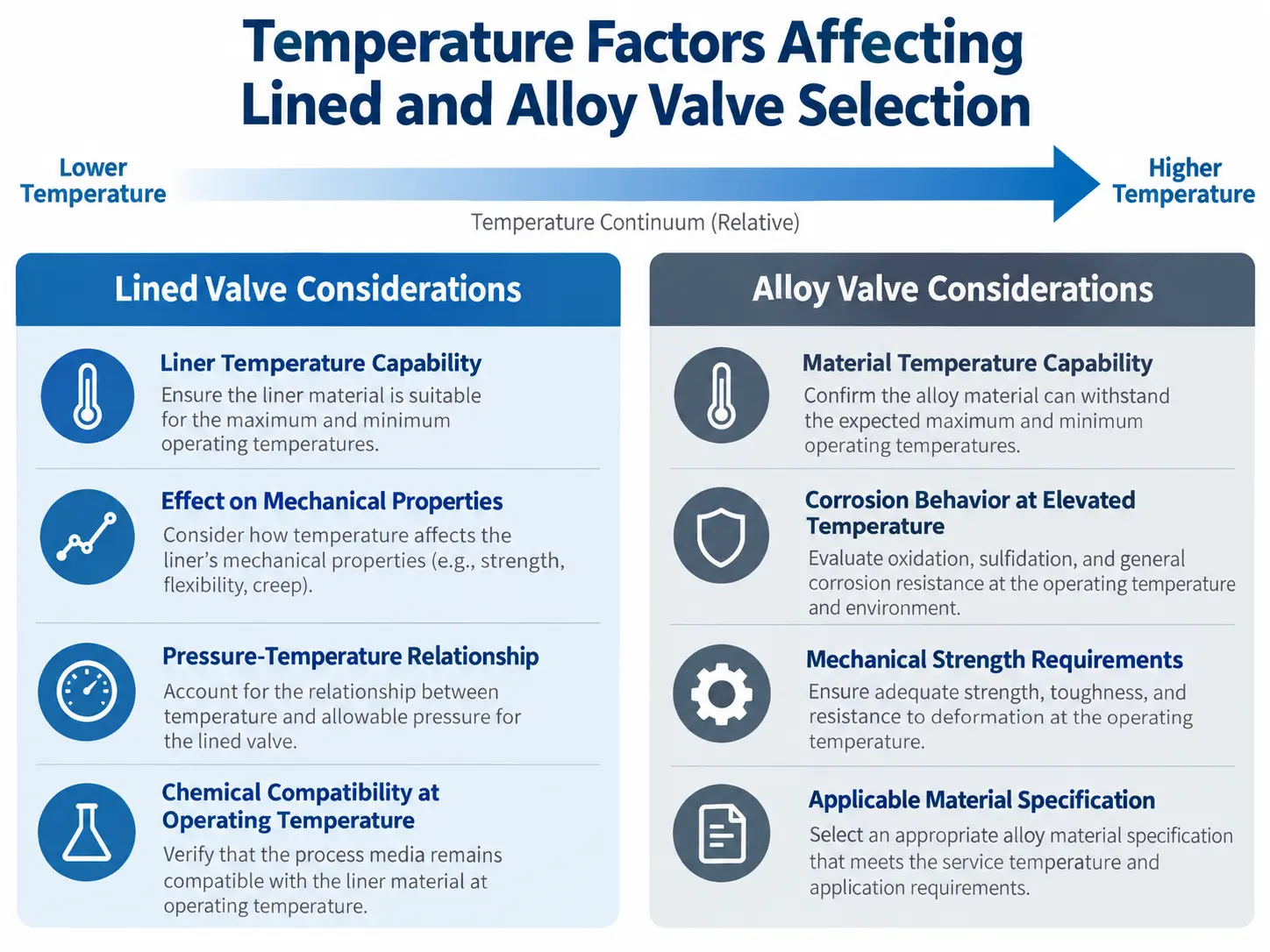
Temperature is one of the factors that can significantly influence whether a lined valve or alloy valve construction is suitable for a corrosive application.
The selection should not be based on temperature alone. Temperature must be evaluated together with chemical exposure, pressure conditions, mechanical requirements and the expected operating environment.
Temperature Review for Lined Valves
For lined valves, engineers should review how the liner system performs under the actual service conditions.
- Operating temperature and design temperature
- Pressure-temperature relationship
- Chemical interaction at operating temperature
- Potential liner degradation mechanisms
A liner system that performs well in one application may require additional evaluation when temperature, pressure or chemical exposure changes.
Temperature Review for Alloy Valves
For alloy valves, the evaluation focuses on how the selected metallic material performs under the process environment.
- Corrosion mechanism at operating temperature
- Mechanical requirements
- Material stability under process conditions
- Applicable project specifications
| Question | Lined Valve Review | Alloy Valve Review |
|---|---|---|
| Does temperature affect material suitability? | Review liner capability and chemical interaction | Review alloy corrosion behavior and mechanical properties |
| Does pressure change the evaluation? | Review liner system pressure-temperature limitations | Review valve design conditions and material requirements |
| Is higher temperature always better suited for alloy? | Not necessarily; application data is required | Not automatically; alloy selection still requires corrosion review |
Permeation Risk: An Important Difference Between Lined and Alloy Valves
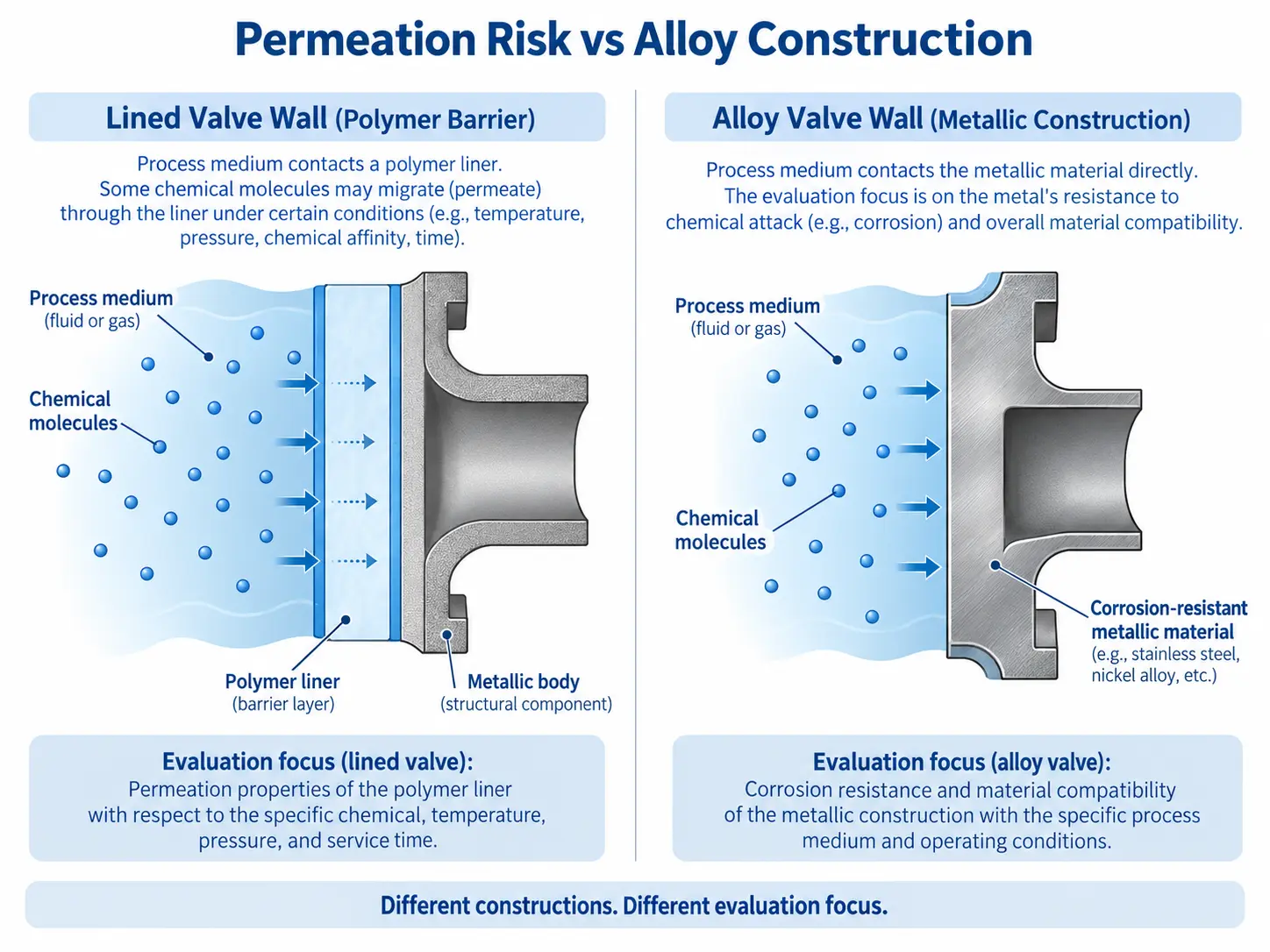
Permeation is an important consideration in some lined valve applications because certain chemicals may migrate through polymer-based materials under specific service conditions.
Permeation does not mean that a lined valve is automatically unsuitable. It means the liner system should be evaluated according to the specific chemical, temperature, pressure and exposure duration.
Permeation Evaluation Factors
- Chemical type and concentration
- Operating temperature
- Pressure conditions
- Exposure time
- Liner material characteristics
Alloy valves involve a different evaluation approach because the process medium contacts metallic wetted materials directly. The review focuses on corrosion behavior, localized corrosion risks and material suitability.
| Factor | Lined Valve | Alloy Valve |
|---|---|---|
| Barrier layer | Yes, corrosion isolation is provided through liner system | No separate barrier layer; wetted metal provides resistance |
| Primary concern | Chemical compatibility and liner integrity | Metal corrosion mechanism and material selection |
| Engineering review | Evaluate permeation where applicable | Evaluate corrosion performance under service conditions |
Lifecycle Selection: Beyond Initial Valve Cost
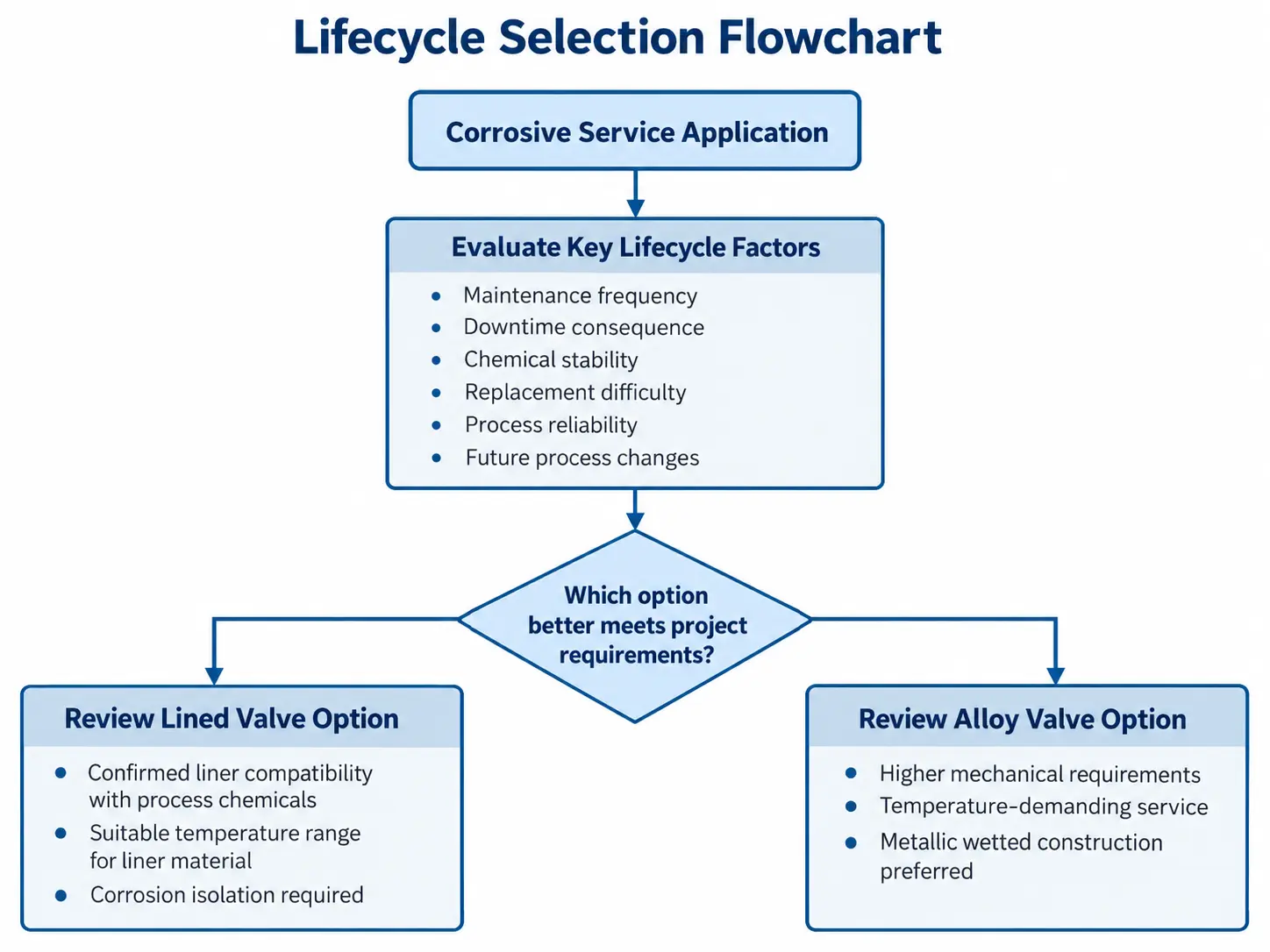
The initial purchase price is only one factor in corrosive service valve selection. Lifecycle evaluation should consider maintenance requirements, replacement difficulty, downtime impact and future process changes.
Three Lifecycle Questions Before Final Selection
1. How difficult is replacement?
Valve replacement may involve shutdown requirements, accessibility limitations and operational impact. Applications with high replacement consequences require careful lifecycle review.
2. What is the consequence of failure?
Critical process applications should consider the impact of leakage, downtime, maintenance access and operational interruption.
3. Will service conditions change?
Future changes in chemical concentration, temperature or process operation may influence whether a lined or alloy construction remains suitable.
Engineering Scenarios in Corrosive Valve Selection
Scenario 1 — RFQ Provides Only Chemical Name
Problem: The buyer specifies only the chemical name without concentration, temperature or pressure information.
Reason: Material compatibility depends on the complete service environment rather than chemical name alone.
Verification: Request medium composition, concentration, operating temperature, pressure and contaminants before material review.
Prevention: Include complete process data in the valve RFQ package.
Scenario 2 — Liner Selection Without Temperature Review
Problem: A liner may appear chemically suitable but actual operating temperature conditions are not reviewed.
Reason: Temperature can influence liner performance and pressure capability.
Verification: Confirm operating temperature, design temperature and pressure-temperature conditions.
Prevention: Review liner suitability using complete operating conditions.
Scenario 3 — Valve Body Material Reviewed Without Internal Components
Problem: Only the body material is considered while seats, packing or sealing components are ignored.
Reason: Different valve components may experience different chemical exposure.
Verification: Review liner, seat, packing, gasket and trim requirements.
Prevention: Evaluate the complete wetted and sealing system.
RFQ Checklist for Corrosive Service Valve Selection
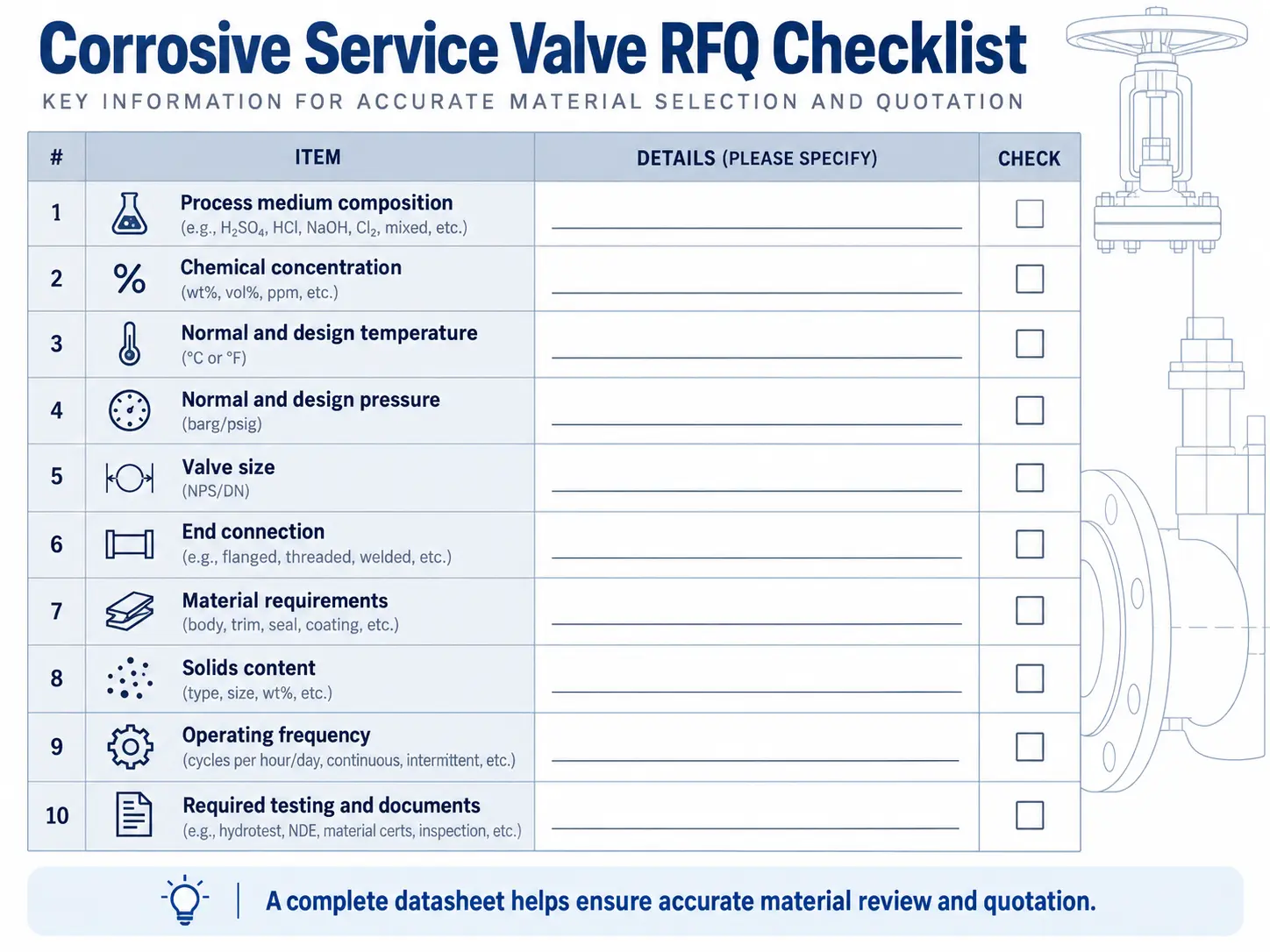
A complete RFQ package helps suppliers review valve construction, material requirements and documentation expectations more accurately.
| Required Information | Why It Matters |
|---|---|
| Valve type | Defines construction and application requirements |
| Medium composition | Determines corrosion evaluation direction |
| Chemical concentration | Influences compatibility assessment |
| Normal and design temperature | Affects material suitability review |
| Normal and design pressure | Defines mechanical requirements |
| Valve size and connection | Determines installation requirements |
| Operating frequency | Supports lifecycle and mechanical review |
| Testing and documentation requirements | Defines supplier submission scope |
When to Consider a Lined Valve
A lined valve may be considered when corrosion isolation is required and the liner system can be verified as compatible with the actual service conditions.
- The process medium requires a corrosion-resistant barrier between the fluid and the valve body.
- Chemical compatibility of the liner system has been reviewed.
- Operating temperature and pressure conditions are suitable for the selected construction.
- The application benefits from separating process media from metallic body materials.
Additional engineering review may be required for high temperature applications, abrasive media, mechanical damage risks or permeation-sensitive services.
When to Consider an Alloy Valve
An alloy valve may be considered when corrosion resistance is expected from metallic wetted materials and the application requires evaluation of alloy performance under the process environment.
- Metallic wetted construction is preferred.
- Mechanical robustness is a key consideration.
- Temperature or pressure conditions require detailed metallic material review.
- The corrosion mechanism is better addressed through alloy selection.
The selected alloy still requires verification against the actual process conditions, including chemical composition, concentration, temperature and operating environment.
Final Selection Framework: Lined Valve or Alloy Valve?
A simplified selection process can help organize the engineering review. However, final valve selection should always be based on confirmed project data.
| Selection Step | Key Question |
|---|---|
| 1. Define service condition | What is the medium composition, concentration, temperature and pressure? |
| 2. Review corrosion protection approach | Is a barrier liner system or corrosion-resistant metallic material more appropriate? |
| 3. Evaluate mechanical requirements | Are pressure, temperature and operating cycles within the construction capability? |
| 4. Review lifecycle impact | How will maintenance, replacement and downtime affect the selection? |
| 5. Confirm RFQ requirements | Are material, testing and documentation requirements clearly defined? |
Common Selection Mistakes in Corrosive Service Applications
Selecting Materials Only by Chemical Name
A chemical name alone does not define valve suitability. Concentration, temperature, pressure, contaminants and operating conditions can significantly influence material performance.
Ignoring Sealing and Internal Components
The valve body is only one part of the complete system. Liner, seat, packing, gasket and trim requirements should also be reviewed.
Comparing Only Initial Purchase Cost
A lower purchase price does not necessarily represent the best lifecycle choice. Maintenance requirements, replacement difficulty and process reliability should also be considered.
Additional Valve Engineering Resources
For broader technical information, visit our valve engineering resources to explore additional valve selection and application topics.
Learn more about Raymon Valve engineering background and our approach to industrial valve solutions.
Submit Your Valve Service Datasheet for Material Review
For corrosive service applications, provide your process information for a project-specific review.
- Medium composition
- Chemical concentration
- Operating and design temperature
- Normal and design pressure
- Valve size and pressure class
- End connection requirements
- Material and documentation requirements
Our team can review the selection basis together with valve construction requirements and project specifications.
Request Material and Seat ReviewFrequently Asked Questions
Are lined valves better than alloy valves for corrosive service?
Neither option is universally better. The suitable construction depends on chemical compatibility, temperature, pressure, mechanical requirements and lifecycle considerations.
What is the main difference between lined and alloy valves?
A lined valve uses a corrosion-resistant barrier layer to isolate the process medium from the valve body, while an alloy valve relies on corrosion-resistant metallic wetted materials.
Do lined valves have temperature limitations?
Yes. The liner system should be evaluated according to operating temperature, pressure conditions and chemical exposure.
What information is needed before selecting a corrosive service valve?
Typical information includes medium composition, concentration, temperature, pressure, valve size, connection type, operating frequency and required documentation.
 English
  German
  Arabic
  French
  Spanish
  Italian
  Portuguese
  Russian