
The main difference between a lubricated and a sleeved plug valve is the sealing and friction-management interface between the plug and body. A lubricated design uses an injected sealant system, while a sleeved design uses an engineered polymer sleeve as the primary sealing and bearing interface. Neither construction is universally preferable. Differential pressure, temperature, media chemistry, solids, contamination limits, cycling, idle periods, maintenance access and verified operating torque should be reviewed together before specifying either design.
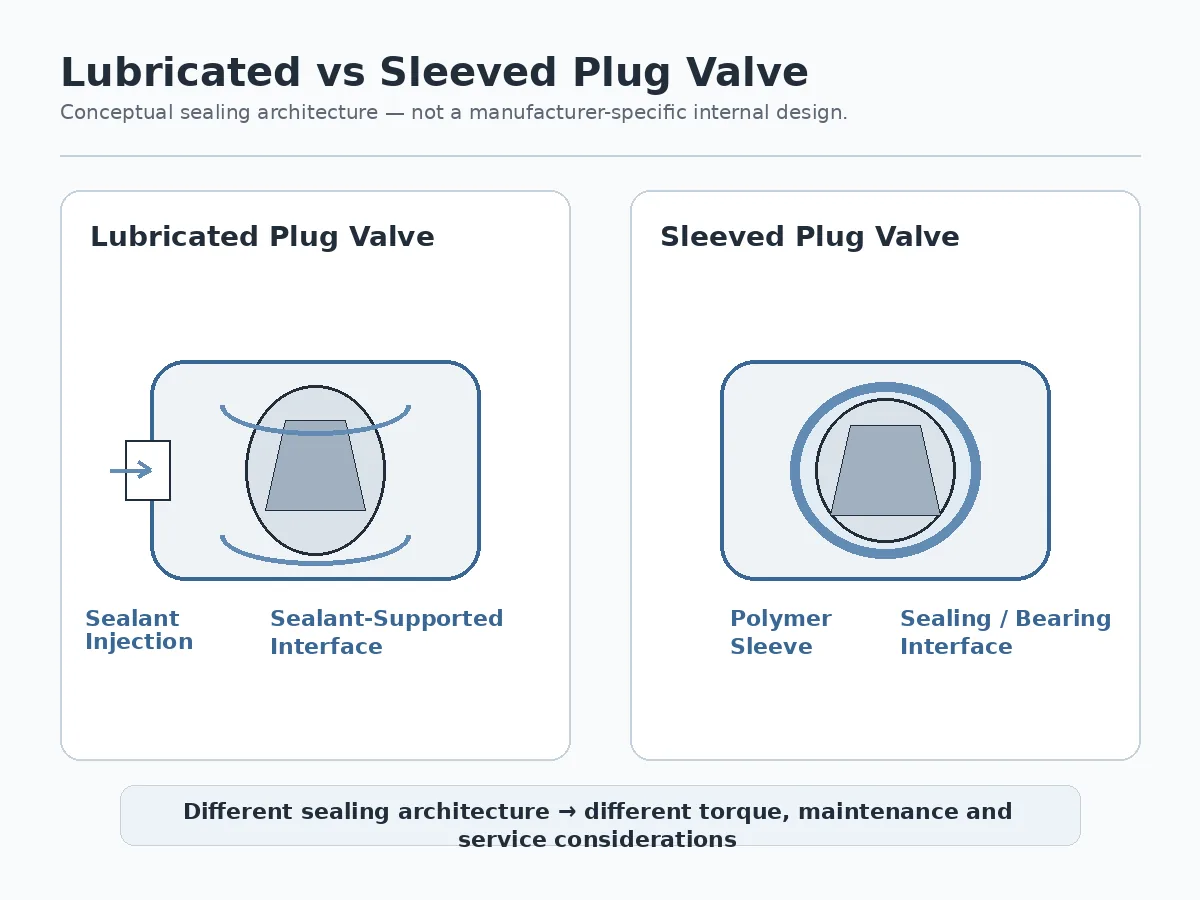
Lubricated vs Sleeved Plug Valve: What Actually Changes?
Both designs use a quarter-turn plug to open or isolate the flow path, but the plug-to-body interface is fundamentally different. That difference affects friction, operating torque, maintenance tasks, process contamination risk, sealing-material compatibility and actuator review.
For a broader review of plug configurations, port arrangements and operating methods, see the industrial plug valve selection overview.
How a Lubricated Plug Valve Works
A lubricated plug valve uses a sealing compound introduced through an injection system into passages or grooves associated with the plug/body interface. Depending on the exact construction, the sealant can support the sealing interface while also affecting friction between moving surfaces.
This makes sealant management part of the valve’s operating and maintenance philosophy. Engineering review should consider sealant chemistry, temperature capability, compatibility with the process medium, injection accessibility, passage condition, operating frequency and restrictions on possible process contamination.
The presence of a sealant system does not mean that wear, damaged sealing surfaces or unsuitable service conditions can always be corrected by injecting additional sealant. Buyers reviewing this construction can also refer to the lubricated plug valve specification page, while final suitability should remain tied to the exact offered construction and project datasheet.
How a Sleeved Plug Valve Works
A sleeved plug valve places an engineered polymer sleeve between the plug and valve body. The sleeve becomes the primary sealing and bearing interface as the plug rotates.
PTFE-based materials are common in this valve category, but the term “sleeved plug valve” does not define one universal sleeve formulation, pressure-temperature limit, chemical compatibility range, cycle capability or operating torque.
The sleeve must therefore be reviewed as part of the complete wetted and mechanical system. For corrosive or polymer-lined applications, the broader lined and plug valve selection route provides additional material and service-condition context.
Quick Comparison: Lubricated vs Sleeved Plug Valve
| Selection Factor | Lubricated Plug Valve | Sleeved Plug Valve | Confirm Before Selection |
|---|---|---|---|
| Primary sealing approach | Plug/body sealing system supported by injected sealant | Plug/sleeve sealing interface | Exact construction and sealing-system details |
| Friction and torque | Influenced by sealant condition, geometry and service | Influenced by sleeve material, preload, geometry and condition | Differential pressure, temperature and product-specific torque data |
| Routine maintenance | Sealant inspection or replenishment may be required | No routine sealant injection, but sleeve condition still requires review | Maintenance access and recommended service strategy |
| Process contamination concern | Sealant compatibility and contamination restrictions require review | No injected sealant at the primary sealing interface | Process cleanliness requirements and sleeve compatibility |
| Chemical service | Body, plug, packing and sealant must be reviewed | Body, plug, packing and sleeve must be reviewed | Complete composition, concentration and temperature |
| Solids or deposits | May affect sealing surfaces, sealant passages and torque | May affect sleeve condition, friction and torque | Particle size, hardness, concentration and exact geometry |
| Long idle periods | Sealant condition, corrosion and deposits may affect breakaway torque | Sleeve condition and deposits may affect breakaway torque | Product-specific breakaway torque basis |
What Data Actually Change the Lubricated vs Sleeved Decision?
The construction should not be selected from nominal size, pressure class or valve type alone. The following inputs can materially change the preliminary selection direction.
Process Conditions
- medium and complete composition;
- concentration where relevant;
- liquid, gas or multiphase condition;
- solids, particle size and hardness;
- fouling or deposition tendency;
- normal and design temperature.
Pressure and Operating Duty
- normal and design pressure;
- maximum differential pressure;
- cycle frequency;
- expected idle period;
- required opening and closing time;
- manual or automated operation.
Sealing and Contamination
- required shutoff performance;
- whether injected sealant is acceptable;
- product contamination restrictions;
- sealant compatibility;
- sleeve material compatibility;
- cleaning or flushing chemicals.
Maintenance and Project Requirements
- maintenance accessibility;
- available sealant servicing capability;
- planned inspection strategy;
- testing requirements;
- material traceability requirements;
- third-party inspection or documentation scope.
Why Operating Torque Is a Critical Difference
Torque is often used as a shortcut when comparing lubricated and sleeved plug valves. That shortcut can be misleading because operating torque is not a fixed property of the valve category.
Relevant inputs include valve size, maximum differential pressure, plug geometry, sealing preload, sleeve interference, sleeve material, sealant condition, temperature, process deposits, solids, corrosion, idle duration and operating frequency.
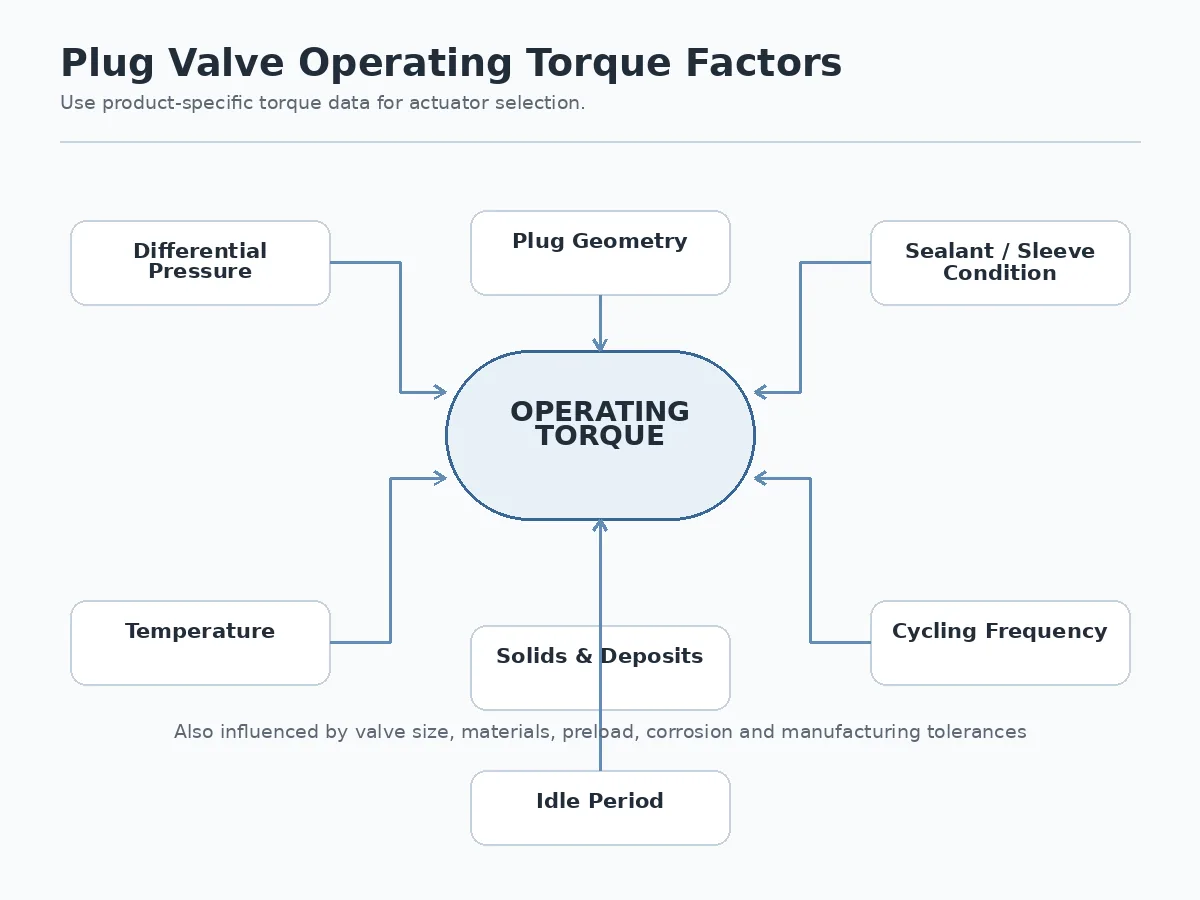
Torque Is Not a Fixed Property of the Valve Type
For an actuated valve, the supplier may need to distinguish breakaway torque, running torque and closing or seating torque where applicable. The relevant value should also be tied to the defined differential pressure and service temperature.
A valve should not be assigned an actuator merely because another valve with the same nominal size and pressure class uses that actuator. For the wider load, utility, fail-action and interface inputs used to review an automated package, see the guide to valve actuator selection inputs.
What Procurement Should Ask About Torque
- What valve torque is the actuator selection based on?
- At what differential pressure?
- At what operating temperature?
- Is the stated value breakaway, running or maximum required torque?
- What sleeve or sealant condition is assumed?
- Has an engineering margin already been included?
- Is gearbox efficiency included where applicable?
- What actuator supply pressure or electrical condition is assumed?
A common RFQ mistake occurs when an actuator model is quoted beside a plug valve without the valve-load basis. The commercial offer may look complete, but the reviewer cannot tell whether the actuator was matched to maximum differential pressure, normal running conditions or a generic catalogue value. The practical correction is to request the valve torque basis and actuator output basis separately before technical acceptance.
Sealing Mechanism: Sealant System vs Sleeve
Lubricated Plug Valve Sealing
In a lubricated design, sealing performance depends on the interaction between the plug, body sealing surfaces and sealant distribution system. Sealant can support sealing and friction management, but its performance depends on correct selection and condition.
Review the process medium, sealant chemistry, service temperature, injection fittings, passage condition, contamination restrictions and maintenance access. The sealant system should be treated as an engineered part of the valve specification rather than as an unspecified consumable.
Sleeved Plug Valve Sealing
In a sleeved design, the plug rotates against an engineered sleeve that provides the primary sealing interface. Relevant risks may include wear, deformation, abrasion, chemical degradation, deposits, temperature effects and changes in preload or operating torque.
For chemical service, the sleeve should be reviewed against actual composition, concentration, pressure, temperature, solids and cleaning conditions. A generic polymer name alone does not establish service compatibility.
A typical bid-review problem is a quotation that lists only “PTFE sleeve” without defining the exact proposed material or service basis. That description is not enough to approve aggressive chemical service. The reviewer should confirm the actual sleeve specification and compare it with the process composition, concentration, temperature, pressure, cleaning media and other relevant exposure conditions.
Maintenance: Different Strategies, Not “Maintenance-Free”
The maintenance distinction is better described as two different maintenance philosophies rather than maintenance versus maintenance-free.
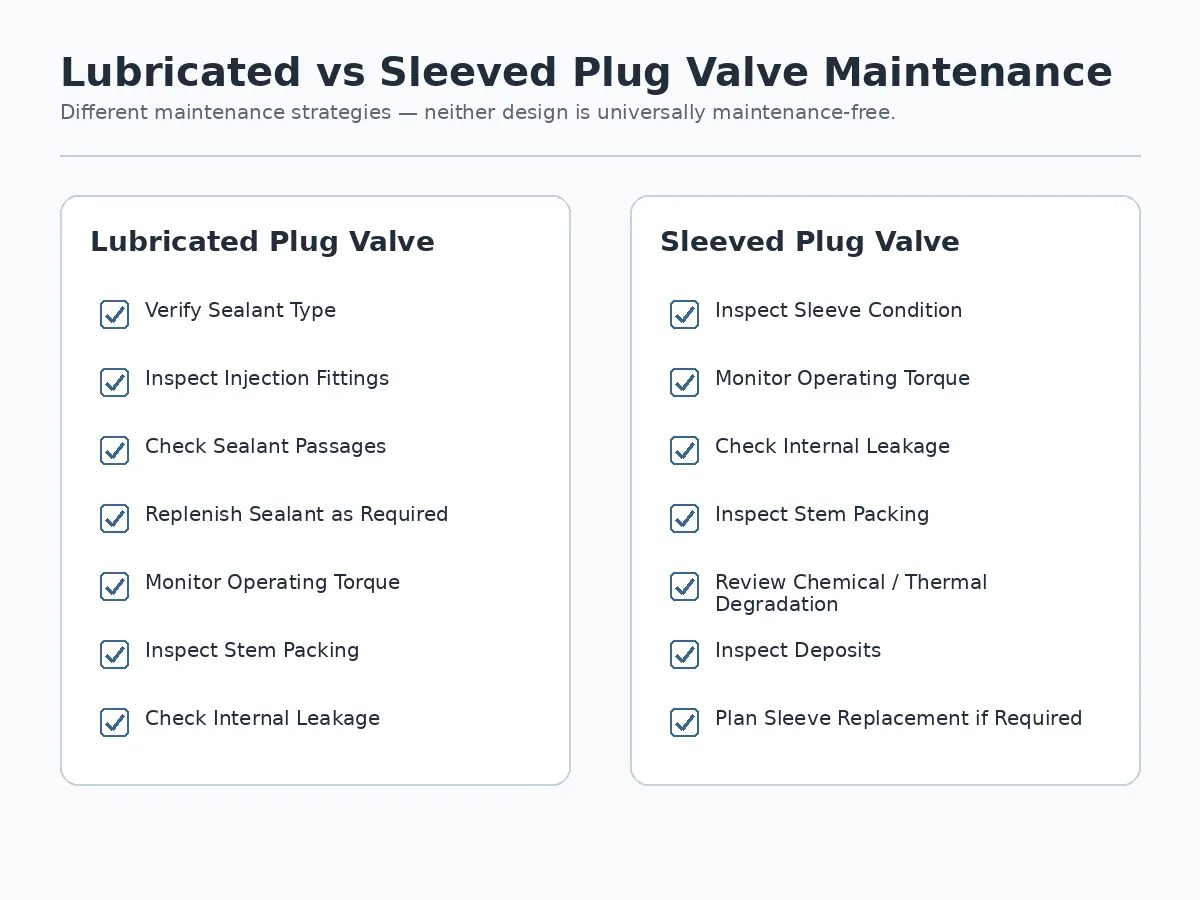
Lubricated Valve Maintenance
- verify the specified sealant;
- inspect injection fittings;
- check sealant passages;
- replenish sealant when required by the design and service;
- monitor operating torque;
- inspect stem packing and external leakage;
- review shutoff performance.
Sleeved Valve Maintenance
- monitor operating torque;
- inspect sleeve condition during appropriate maintenance;
- review internal leakage trends;
- inspect stem sealing;
- check deposits and fouling;
- review chemical or thermal degradation;
- plan sleeve replacement where required by the design.
Actual maintenance intervals should come from the valve manufacturer, service history and the plant’s maintenance program rather than from a universal calendar interval.
Which Service Conditions Change the Selection?
Clean Liquid and Gas Service
For relatively clean service, compare differential pressure, temperature, cycle frequency, contamination limits, maintenance philosophy, shutoff requirement and automation needs.
If process contact with injected sealant is undesirable, a sleeved construction may deserve evaluation, provided the sleeve and complete valve construction are compatible with the medium and operating envelope.
Corrosive Chemical Service
Chemical service requires more than selecting a corrosion-resistant body. For a lubricated design, review the body, plug, stem, packing and sealant against the complete process chemistry. For a sleeved design, review the exact sleeve material together with all other wetted materials.
Composition, concentration, temperature, pressure, solids, cleaning chemicals and possible degradation or permeation mechanisms can change the suitability of a polymer or sealant.
Dirty, Fouling or Solids-Containing Service
A lubricated design should not automatically be specified simply because a process contains solids. Solids can affect sealing surfaces, sleeve condition, sealant passages, friction, torque, wear and shutoff behavior in either construction.
Review particle size, hardness, concentration, settling behavior, deposition tendency, cleaning practice and the exact internal geometry before making a final selection.
Elevated Temperature Service
Temperature affects both sealing philosophies. Lubricated designs require verification of sealant stability and the other sealing materials. Sleeved designs require verification of sleeve behavior, friction, dimensional stability and chemical resistance at the actual operating temperature.
The allowable operating range must come from the exact valve construction, material combination, applicable pressure-temperature rating basis and project specification.
When May a Lubricated Plug Valve Be Considered?
A lubricated plug valve may be evaluated when:
- a sealant-managed sealing system is acceptable;
- a compatible sealant can be specified;
- maintenance personnel can access the injection system;
- sealant replenishment fits the maintenance strategy;
- process contamination restrictions permit the sealing approach;
- the design is compatible with the differential pressure and service;
- relevant operating torque data are available.
Additional engineering review is advisable for contamination-sensitive service, aggressive chemicals, elevated temperatures, abrasive solids, inaccessible installations, frequent automated cycling or long idle periods.
When May a Sleeved Plug Valve Be Considered?
A sleeved plug valve may be evaluated when:
- routine injected sealant is undesirable;
- a compatible sleeve material is available;
- the operating envelope fits the specific sleeve and valve design;
- the cycle duty matches the construction;
- the maintenance strategy can accommodate sleeve inspection or replacement;
- operating torque has been confirmed for the specified service.
Additional review is advisable for abrasive solids, uncertain chemical compatibility, elevated temperatures, high differential pressure, frequent cycling, long idle periods and actuated service where torque margin is critical.
Lubricated vs Sleeved Plug Valve Selection Matrix
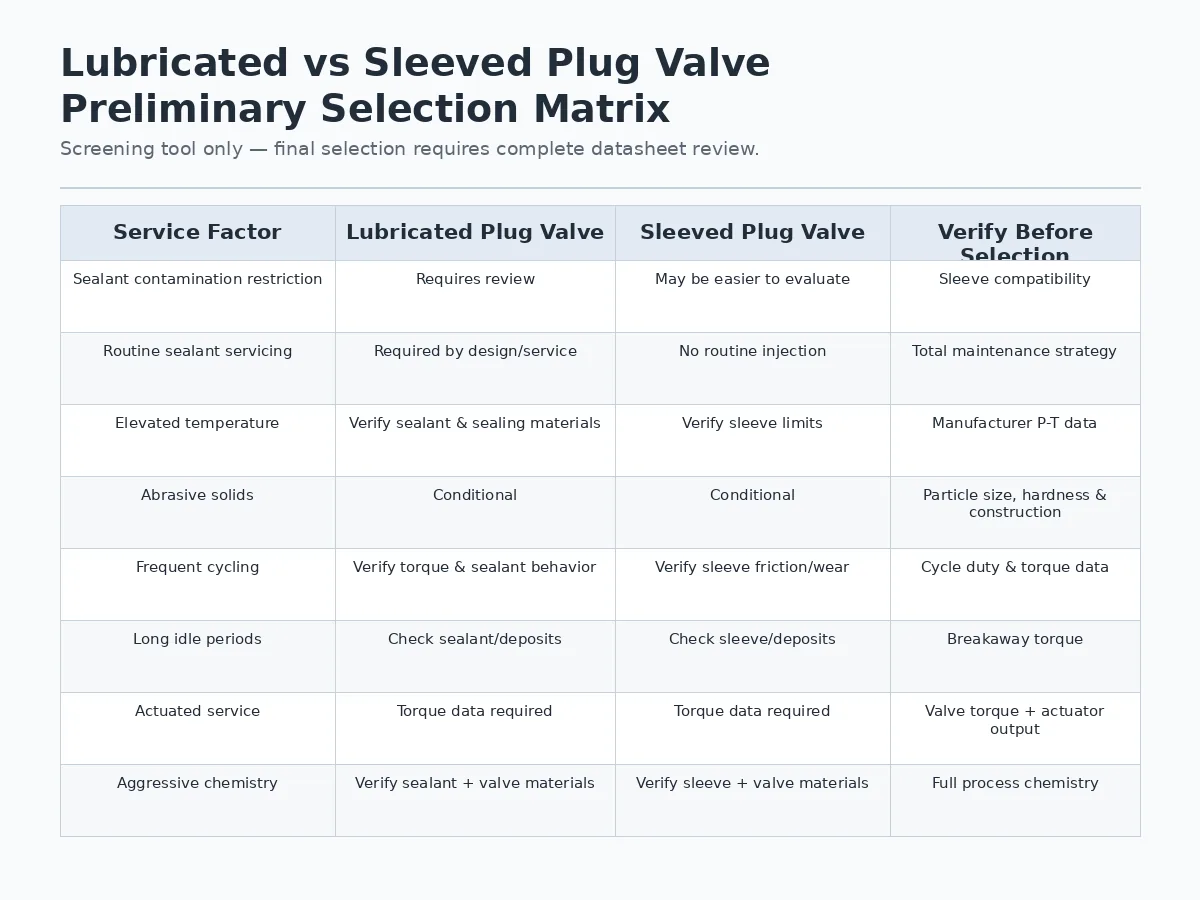
| Service Question | Lubricated Direction | Sleeved Direction | Engineering Verification |
|---|---|---|---|
| Is injected sealant unacceptable in the process? | Additional review required | May simplify the sealing philosophy | Confirm sleeve compatibility |
| Is routine sealant servicing practical? | Can be considered | Routine injection not required | Compare total maintenance requirements |
| Is service temperature elevated? | Verify sealant and sealing materials | Verify sleeve limits | Confirm manufacturer pressure-temperature data |
| Does the medium contain abrasive solids? | Conditional | Conditional | Review particle size, hardness and exact construction |
| Is cycling frequent? | Verify sealant condition and torque behavior | Verify friction and sleeve wear | Obtain cycle-duty and torque data |
| Will the valve remain idle for long periods? | Review sealant, corrosion and deposits | Review sleeve condition and deposits | Obtain breakaway torque basis |
| Will the valve be actuated? | Exact torque data required | Exact torque data required | Match valve torque to actuator output |
| Is the medium chemically aggressive? | Verify sealant and all wetted materials | Verify sleeve and all wetted materials | Review full process chemistry |
Common Failure Symptoms and What to Check
| Symptom | Possible Lubricated-Valve Causes | Possible Sleeved-Valve Causes | Evidence / Verification Direction |
|---|---|---|---|
| Increasing operating torque | Sealant condition, deposits, corrosion or internal damage | Sleeve friction, wear, deformation or deposits | Compare torque trend and inspect according to the approved maintenance procedure |
| Internal leakage | Sealant or sealing-interface condition, surface damage or deposits | Sleeve damage, wear, deformation or deposits | Perform the required leakage evaluation and inspect the sealing interface |
| Difficult breakaway after a long idle period | Deposits, sealant condition or corrosion | Sleeve/deposit interaction or friction change | Compare current and historical breakaway torque and review internal condition |
| External stem leakage | Packing or stem-seal condition | Packing or stem-seal condition | Inspect the external sealing system under the approved site procedure |
| Frequent maintenance intervention | Sealant system may not match the service or maintenance regime | Sleeve or material system may not match the service | Recheck the original service data and valve specification |
A recurring maintenance-review mistake is to interpret rising operating torque as proof that the actuator is undersized. Increased torque can also reflect deposits, corrosion, sealant condition, sleeve friction or internal damage. The safer diagnostic direction is to compare current load with the original valve torque basis and operating history before changing the actuator or modifying the valve package.
Practical Plug Valve Sealing-System Selection Path
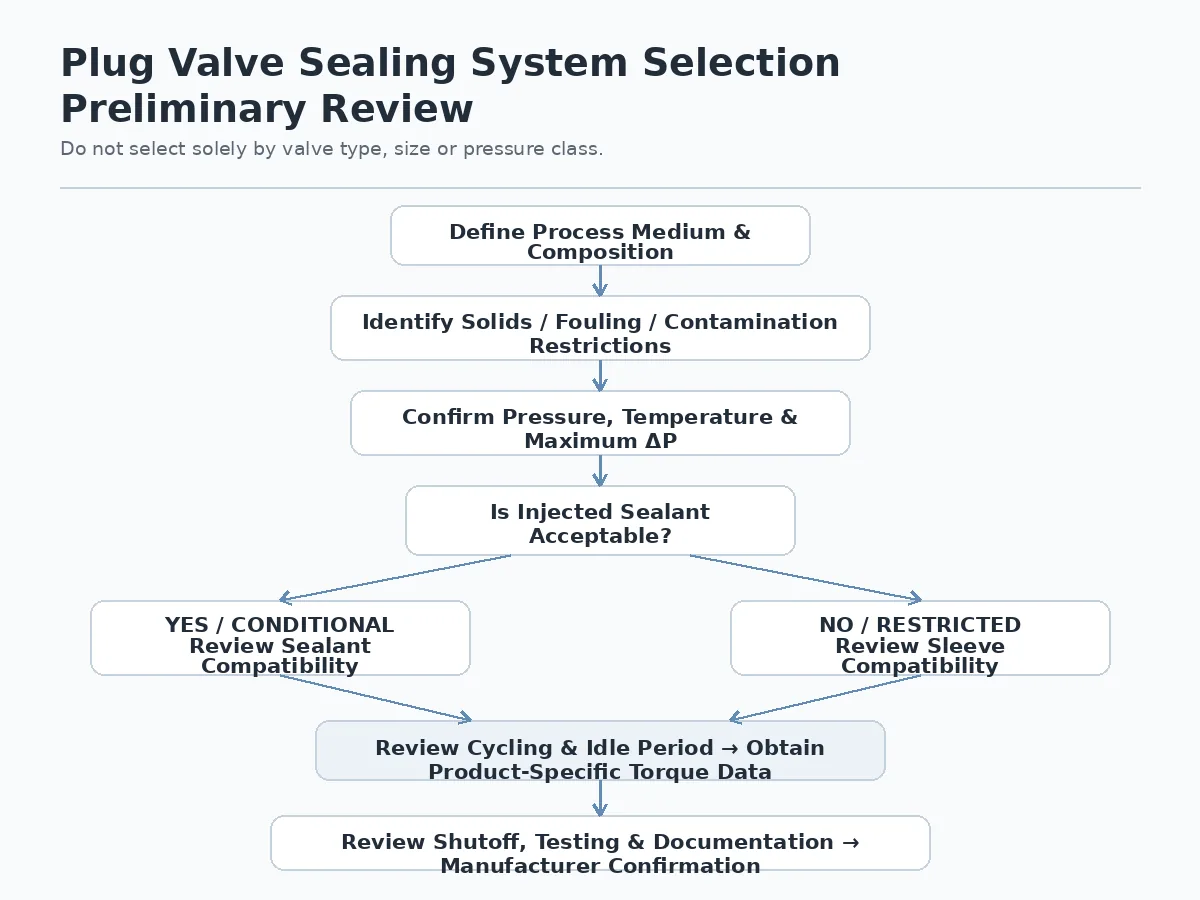
- Define the process medium, phase and complete composition.
- Identify solids, fouling and contamination restrictions.
- Confirm normal and design pressure and temperature.
- Establish the maximum differential pressure.
- Define cycle frequency and expected idle periods.
- Determine whether an injected sealant system is acceptable.
- Review sealant or sleeve compatibility.
- Obtain product-specific torque data.
- Review the maintenance strategy and installation accessibility.
- Normalize shutoff, testing, inspection and documentation requirements.
- Obtain manufacturer confirmation against the complete datasheet.
What Should Be Included in a Plug Valve RFQ?
A technical quotation is easier to compare when all bidders receive the same service data and are asked to identify the same engineering assumptions.
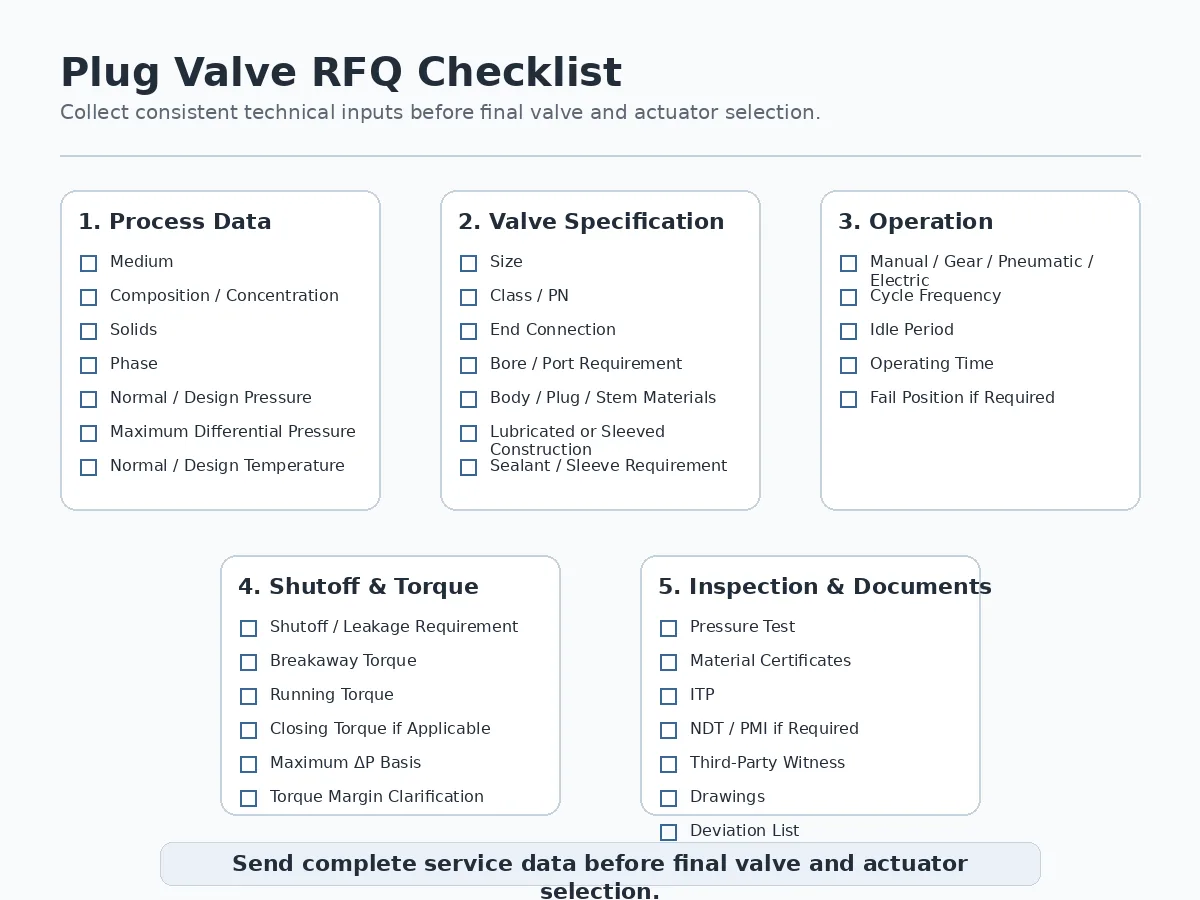
Process Data
- medium, phase and composition;
- concentration where relevant;
- solids and particle characteristics;
- normal and design pressure;
- maximum differential pressure;
- normal and design temperature;
- cleaning or flushing media where relevant.
Valve Data
- nominal size;
- pressure class or PN;
- end connection and governing connection standard;
- port or bore requirement;
- body, plug, stem, packing and other required materials;
- lubricated or sleeved preference if already specified;
- sealant or sleeve requirements.
Operating Requirements
- manual, gear, pneumatic, electric or hydraulic operation;
- cycle frequency;
- expected idle period;
- required opening or closing time;
- fail position where applicable;
- available pneumatic or electrical supply data;
- required shutoff or leakage acceptance.
Inspection and Documents
- applicable valve and project specifications;
- pressure-test requirements and acceptance criteria;
- material certificates;
- ITP where required;
- NDT or PMI where project-required;
- third-party inspection or witness points;
- drawings, torque data and technical deviation list.
For broader context on shell, seat and project acceptance testing, see the industrial valve pressure testing guide.
How to Normalize Supplier Technical Bids
Two plug-valve quotations can appear commercially similar while containing materially different sealing systems, torque assumptions, test scopes and documentation. Normalize the engineering basis before comparing price.
| Bid Item | Supplier A | Supplier B | Supplier C |
|---|---|---|---|
| Plug valve construction | To be completed | To be completed | To be completed |
| Lubricated / sleeved | To be completed | To be completed | To be completed |
| Sealant or sleeve material | To be completed | To be completed | To be completed |
| Body / plug / stem / packing materials | To be completed | To be completed | To be completed |
| Pressure-temperature rating basis | To be completed | To be completed | To be completed |
| Maximum differential-pressure basis | To be completed | To be completed | To be completed |
| Breakaway torque | To be completed | To be completed | To be completed |
| Running torque | To be completed | To be completed | To be completed |
| Actuator sizing basis | To be completed | To be completed | To be completed |
| Pressure-test scope and acceptance | To be completed | To be completed | To be completed |
| Material documentation | To be completed | To be completed | To be completed |
| Technical deviations | To be completed | To be completed | To be completed |
Any field that can materially change valve suitability should be clarified before technical acceptance.
What Evidence Should the Supplier Provide?
A technical bid should contain enough evidence to verify the construction, material scope, operating assumptions and acceptance requirements used in the quotation. The exact document list depends on the project specification.
| Evidence / Document | What It Helps Verify | Important Limitation |
|---|---|---|
| Valve datasheet | Size, rating, materials, construction, operation and design basis | Check that purchaser service data and supplier assumptions match |
| General arrangement or approved drawing | End connection, face-to-face, operator arrangement and major construction details | A drawing does not prove material compatibility or operating torque |
| Sealant or sleeve specification | Exact sealing-system material or consumable proposed | Compatibility still depends on the actual service condition |
| Pressure-temperature rating basis | Applicable rating basis for the offered valve construction | Pressure class alone does not establish service suitability |
| Valve torque data | Breakaway, running or other relevant operating torque | Torque should identify differential pressure, temperature and assumptions |
| Actuator sizing basis | Relationship between required valve torque and available actuator output | Confirm supply condition, fail requirement and applied margin |
| Pressure-test documentation | Specified shell and seat test scope and recorded results | Does not prove chemical compatibility, fire-safe performance or fugitive-emission qualification |
| Material certificates | Traceability of specified pressure-containing or wetted materials | Certificate scope should match the purchase specification and does not by itself rule out material mix-up |
| ITP / NDT / PMI records where required | Project-specific inspection and verification scope | Only applicable when specified by the project or purchase order |
| Technical deviation list | Differences between the supplier offer and purchaser specification | Unresolved or hidden deviations can distort technical bid comparison |
| Installation and maintenance instructions | Sealant servicing, adjustment, overhaul and operational requirements | Instructions should correspond to the exact valve model supplied |
Supplier Quote Red Flags to Clarify Before Technical Acceptance
A quotation may appear complete while important engineering assumptions remain undefined. Clarify these points before price comparison or technical approval:
- Torque without a differential-pressure basis: request the operating condition used to establish the value.
- Sleeve identified only as “PTFE”: request the proposed material specification and verify it against the actual service.
- Lubricated valve without a sealant specification: clarify the sealant, compatibility basis and servicing requirement.
- Actuator model without valve-load assumptions: request the valve torque basis, actuator supply condition and applied margin.
- Testing standard without acceptance scope: identify which shell, closure/seat or other tests apply and what acceptance criteria govern them.
- No technical deviation schedule: require differences from the purchaser’s datasheet or specification to be identified explicitly.
Standards and Testing: What They Do and Do Not Prove
Plug-valve specifications may reference product standards, pressure-containing valve standards, testing standards and separate project requirements. These documents serve different purposes and should not be treated as interchangeable.
API Standard 599 is a current product standard for metal plug valves. API’s current Standards Plan lists the 9th Edition, published in 2025, as Metal Plug Valves—Flanged, Threaded, and Welding Ends. Its inclusion in a project specification establishes a product-standard framework; it does not by itself prove suitability for a specific chemical medium, solids condition, sealing system or actuator duty.
ASME B16.34-2025 covers pressure-temperature ratings, dimensions and tolerances, materials, nondestructive-examination requirements, testing and marking for applicable valve constructions. It provides important pressure-containing and construction requirements, but it does not replace project-specific review of the sleeve or sealant system, process chemistry, operating torque or actuator selection.
Where pressure testing is specified, the purchase documents should identify the applicable test standard, edition and acceptance criteria. For additional context on shell and seat testing, see the industrial valve pressure testing guide.
- shell testing is not the same as closure or seat-leakage testing;
- a routine production pressure test is not the same as a fire-safe type test;
- a fugitive-emission qualification is not the same as a routine external leakage check;
- a material certificate does not establish universal chemical compatibility;
- PMI can help verify alloy identity but does not replace the complete material certificate and required heat-treatment records;
- a product-standard reference does not establish actuator sizing or product-specific operating torque.
Conclusion
The most important difference between lubricated and sleeved plug valves is not simply whether lubricant is present. The real difference is the complete sealing and friction-management system.
A lubricated plug valve requires a compatible and maintainable sealant system. A sleeved plug valve replaces that interface with an engineered sleeve whose material, preload, wear and chemical behavior become central to valve performance.
Neither design has a universal advantage in torque, sealing, maintenance burden or service life. Compare process chemistry, solids, pressure, temperature, differential pressure, contamination limits, cycling, idle periods, maintenance access and actual valve torque before finalizing the construction.
Frequently Asked Questions
What is the main difference between a lubricated and sleeved plug valve?
A lubricated plug valve uses an injected sealant system associated with the plug/body sealing interface. A sleeved plug valve uses an engineered polymer sleeve between the plug and body as the primary sealing and bearing interface. The difference affects friction, maintenance, contamination considerations and the service data needed for selection.
Does a sleeved plug valve have lower operating torque?
Not necessarily. Torque depends on valve geometry, sleeve preload and material, differential pressure, temperature, deposits, wear and the specific valve design. Product-specific torque data should be used for actuator review.
Does a lubricated plug valve require regular sealant injection?
It may require periodic sealant inspection or replenishment, but there is no universal injection interval. The correct maintenance frequency depends on valve construction, process conditions, cycling, sealant condition and manufacturer instructions.
Can a sleeved plug valve handle corrosive chemicals?
It may be considered when the sleeve, body, plug, packing and other wetted materials are compatible with the actual medium and operating conditions. Composition, concentration, temperature, pressure, solids and cleaning media should be reviewed rather than relying on the polymer name alone.
Which plug valve is better for dirty or solids-containing media?
There is no universal answer. Solids can affect friction, sealing, sleeve wear, sealant passages, torque and shutoff performance. Particle size, hardness, concentration, deposition tendency and exact valve construction should be reviewed before selecting either design.
What torque data should I request for an actuated plug valve?
Request breakaway torque, running torque and any applicable closing or seating torque at the specified differential pressure and temperature. Also clarify the assumed valve condition, actuator supply basis and whether an engineering margin has already been included.
Request a Plug Valve Selection Review
Send the service data and current valve specification so the proposed lubricated or sleeved construction can be reviewed against the actual operating conditions.
Include, where available:
- medium, phase, composition and concentration;
- solids content and particle characteristics;
- normal and design pressure and temperature;
- maximum differential pressure;
- valve size, class / PN and end connection;
- required shutoff or leakage acceptance;
- cycle frequency and expected idle period;
- whether injected sealant is acceptable;
- manual, pneumatic, electric or other actuation requirement;
- required pressure testing, inspection and documentation.
The review can then focus on sealing-system suitability, material compatibility, torque requirements, maintenance implications and RFQ clarification points rather than selecting a valve from size or pressure class alone.
Submit Your Valve Datasheet / RFQ English
  German
  Arabic
  French
  Spanish
  Italian
  Portuguese
  Russian