
Butterfly valve vs ball valve selection starts with the required duty. Shortlist a butterfly valve when compact installation and lower weight are priorities, particularly on larger lines. Shortlist a suitable full-bore ball valve when a clear passage and low open-valve pressure loss matter. Confirm the actual seat system, pressure-temperature limits, medium, differential pressure and operating method before deciding. This comparison helps engineers and buyers screen both constructions, identify disqualifying conditions and compare quotations against the same shutoff, hydraulic and installation requirements.
On this page
Butterfly Valve vs Ball Valve: Quick Selection Comparison
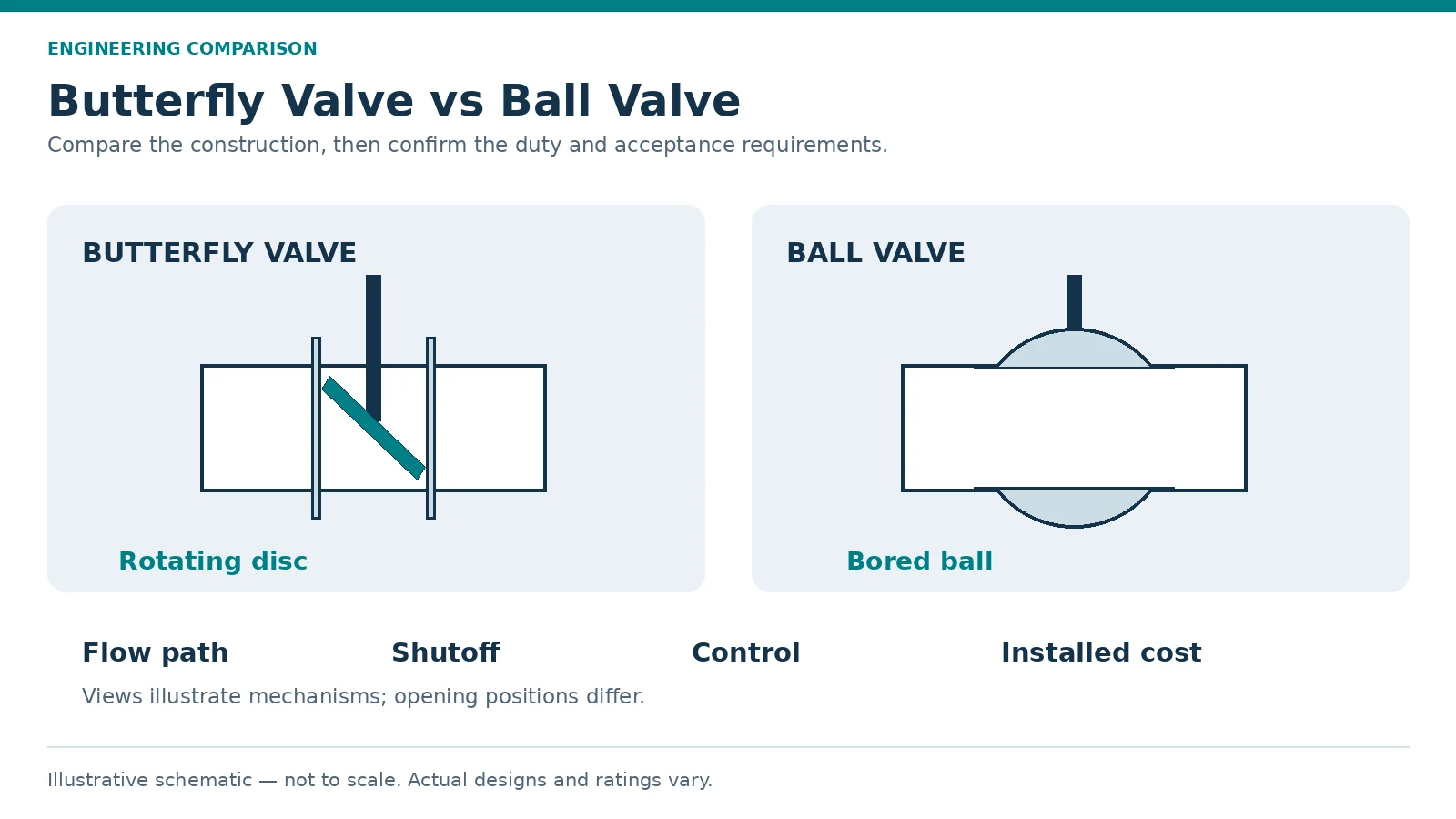
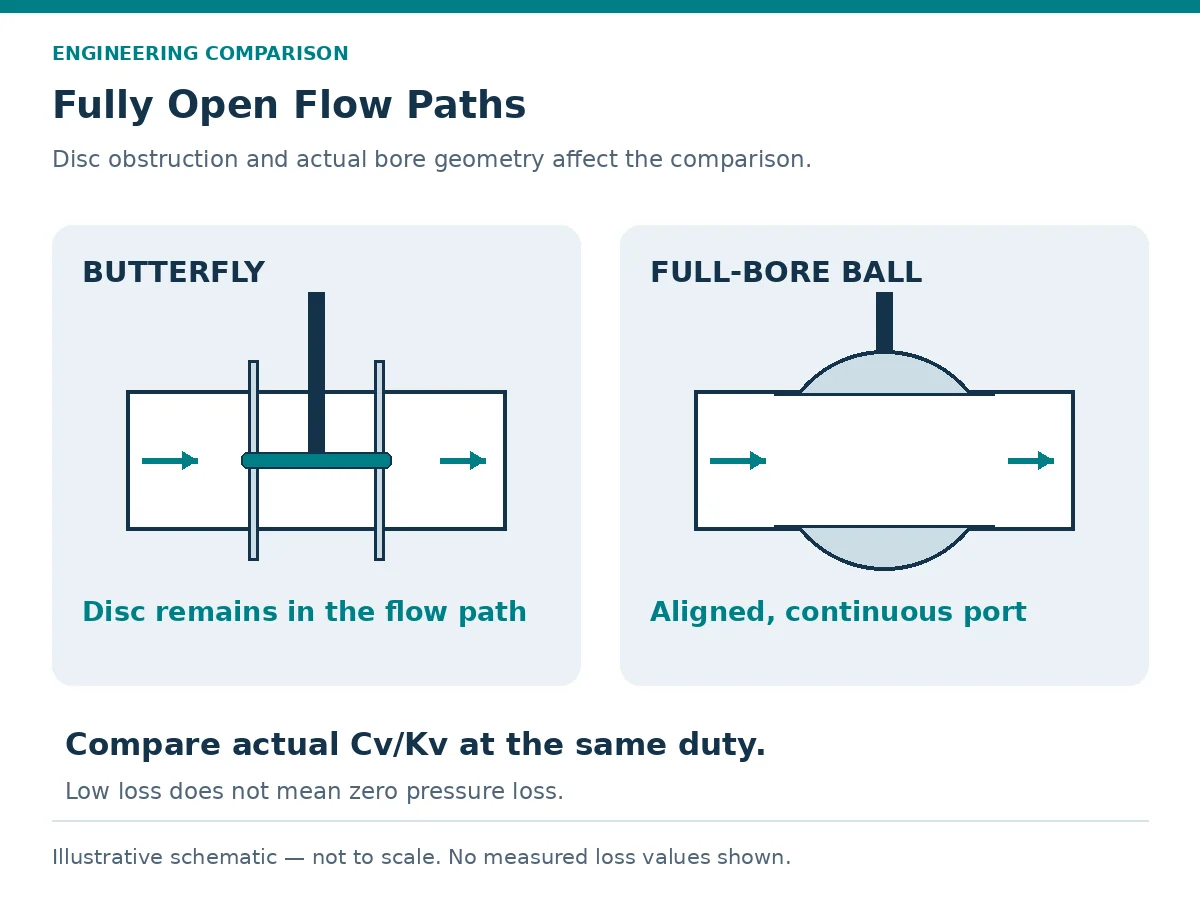
A butterfly valve turns a disc within the pipe bore. The disc remains in the flow path when open. A ball valve turns a bored ball; with the port aligned, fluid passes through the ball. Full-bore and reduced-bore ball valves present different flow restrictions.
Both are quarter-turn valve families. Their operating motion is similar, but the flow path, sealing arrangement and pressure loads differ. Use the following table to establish a shortlist, then compare the proposed models.
On smaller screens, scroll each comparison table horizontally to view all columns.
| Decision factor | Butterfly valve | Ball valve | Evidence to request |
|---|---|---|---|
| Open flow path | Disc and shaft occupy part of the passage | Port through the ball; bore depends on construction | Section drawing and actual bore |
| Pressure loss | Depends on disc geometry and opening | Full-bore versions often offer low open-valve loss; reduced-bore versions need separate review | Cv/Kv at the relevant position |
| Shutoff | Depends on seat, geometry, pressure direction and applied torque | Depends on seats, pressure loading, direction and operating condition | Defined closure-test acceptance |
| Pressure and temperature | Resilient-seated and offset designs have different limits | Body, seats, seals and support arrangement set limits | Complete assembly rating |
| Flow control | Dedicated control designs are available | V-port and segmented control designs are available | Sizing and installed operating range |
| Installation | Often short and light; disc clearance matters | Body length, weight and removal space can be significant | General arrangement and interface drawing |
| Actuation | Seating and flow-induced loads require review | Seat friction and pressure-related loads require review | Valve torque envelope and actuator calculation |
| Maintenance | Seat access and replacement depend on design | Split-body, top-entry and welded designs have different access | Model-specific maintenance scope |
| Cost | Often attractive for larger lines | Depends strongly on bore, class, materials and construction | Equivalent installed-scope quotation |
Practical starting points: for larger utility isolation lines, compare suitable butterfly constructions where compactness matters and hydraulic loss is acceptable. For process isolation requiring a clear passage, compare suitable full-bore ball constructions. Pressure-temperature limits, seat acceptance, fluid compatibility and installation requirements may rule out either starting point.
Screen mandatory requirements before comparing cost
- Clear passage or pigging required: a conventional butterfly disc remains an obstruction. Review a suitable clear-bore construction and confirm the complete pig envelope.
- Continuous modulation required: shortlist dedicated control constructions. A quarter-turn operator alone does not establish control suitability.
- Reverse pressure or end-of-line duty required: obtain the permitted direction, configuration and differential-pressure limit before accepting either offer.
Record an unmet mandatory requirement as a deviation. Where evidence is missing, keep the decision open rather than treating the candidate as approved.
Which Valve Has Lower Pressure Drop?
Full-bore, reduced-bore and disc-obstructed flow paths
A full-bore ball valve is a useful starting point when the process needs a relatively clear passage and low loss during fully open isolation service. It still has finite pressure loss. A reduced-bore ball valve introduces a smaller passage, so the type name alone cannot establish a hydraulic advantage over a particular butterfly valve.
For butterfly valves, the open disc and shaft affect the flow. Their effect varies with geometry, size and position. A visual comparison of the openings cannot replace capacity data.
If pipeline pigging is required, specify the pig envelope and verify the complete passage, including seat openings and transitions. A full-bore description does not by itself confirm that a particular pig can pass.
Compare Cv or Kv at the same flow and fluid conditions
DN and NPS identify nominal size, not the actual bore or flow capacity. Cv and Kv express flow capacity under defined reference conditions using different unit conventions; they are not interchangeable numerical values. Request the coefficient for each offered size, construction, trim and opening position, with the supplier’s data basis. Compare at the same process cases using consistent units and sizing methods.
For isolation, examine the fully open condition. For modulation, examine the required flow range and the corresponding travel. A large fully open coefficient can coexist with poor controllability over the actual operating range.
For gases, viscous liquids or conditions involving cavitation, flashing or choking, a simple liquid pressure-loss comparison is insufficient. Obtain a sizing calculation with the relevant corrections and limits before accepting a numerical result.
Illustrative hydraulic review: two offers can match the line size yet produce different pressure losses because the actual bores and flow passages differ. Compare their opening-specific flow data at the required flow cases before accepting either offer. A steady-state Cv/Kv calculation does not prove acceptable system transient behavior.
Which Valve Meets the Required Shutoff Duty?
Seat design and pressure direction matter more than the type name
Both families include constructions intended for demanding shutoff duties. The relevant question is whether the offered seat system meets the specified leakage requirement at the required differential pressure, direction and temperature.
An elastomer-seated butterfly valve, an offset metal-seated butterfly valve and a soft-seated ball valve should not be assigned a common leakage capability from their names. Similarly, a metal seat does not automatically establish suitability for hot, abrasive or corrosive service.
Identify whether reverse pressure occurs during normal operation, shutdown or testing. Ask the supplier to state directional restrictions and any differences in allowable differential pressure. Bidirectional capability, double block and bleed, and double isolation require specific design evidence.
Define the leakage test before comparing quotations
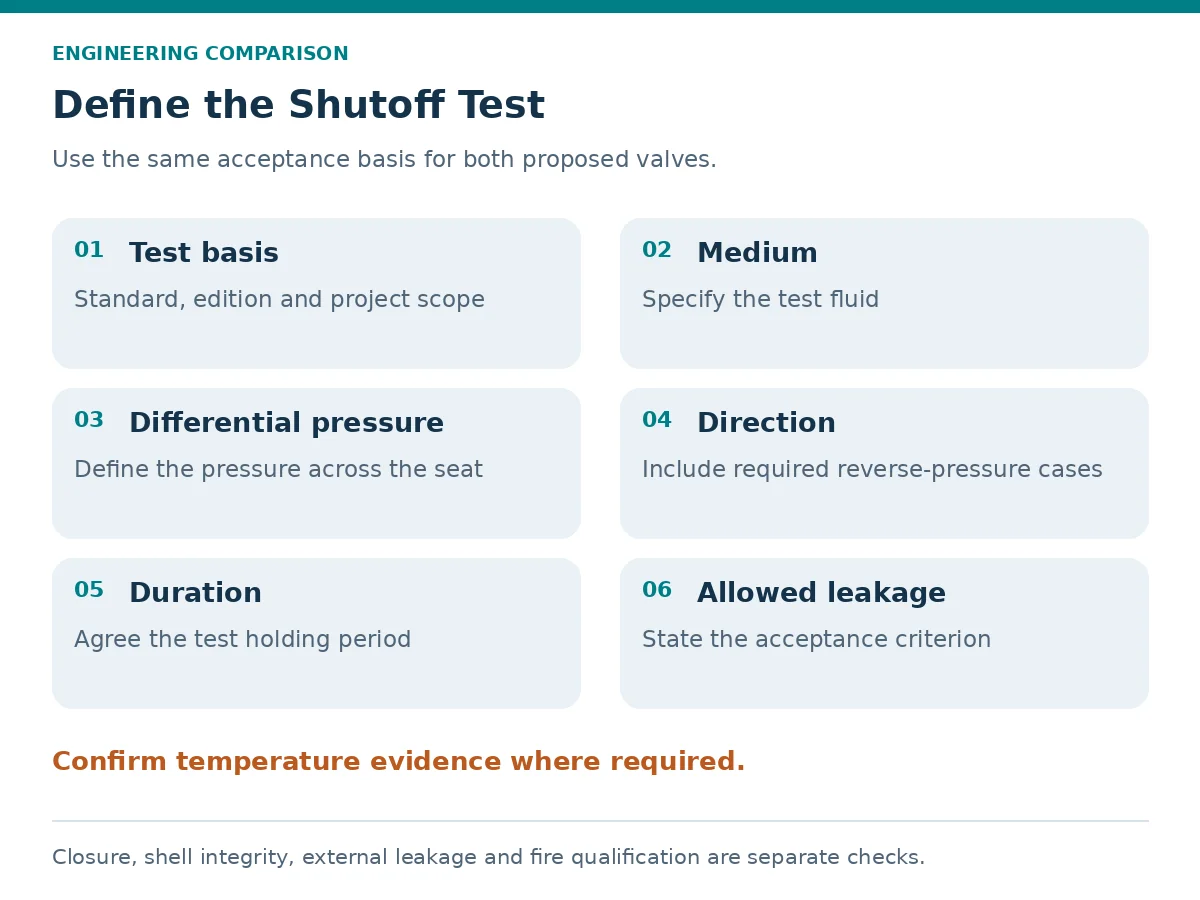
Put the following in the enquiry: test standard and edition, test medium, pressure, duration, test direction and allowable leakage. Also state any required operating-temperature evidence; an ambient production test alone does not establish sealing behavior throughout the service envelope.
A shell test assesses pressure-boundary integrity. A seat test assesses leakage through the closed valve. External stem leakage, functional operation and fire qualification answer different questions. One result cannot stand in for the others.
Use the valve pressure testing guide to organize the required records. Avoid comparing two quotations that use different test bases under the same phrase, such as “tight shutoff.”
How Do Pressure, Temperature and Medium Change the Choice?
Compare the complete assembly rating and seat limits
Pressure class is a rating designation, not a fixed allowable pressure. For the applicable metallic construction, allowable pressure depends on the material group and temperature as well as the governing design basis. Review the design pressure-temperature envelope, minimum temperature and thermal cycles; normal operating pressure alone does not define that envelope. Body, cover where fitted, bolting, seat, packing, gasket and trim must each suit the proposed duty.
Within the butterfly family, resilient-seated, high-performance and triple-offset constructions provide different sealing and load paths. Within the ball family, floating, trunnion-supported and specialized designs also differ. Review industrial butterfly valve options and industrial ball valve options to identify constructions worth evaluating against the datasheet.
Where applicable, ASME B16.34 addresses ratings and construction requirements for defined metallic valve scope. Its official listing identifies the 2025 edition. The project must establish the governing edition and applicability; citing the standard does not prove chemical compatibility, control suitability or qualification of an offered product.
Screen steam, corrosive media, solids and trapped fluid
For steam or hot process service, review sealing materials, thermal cycling and operating loads. Do not treat either valve family as universally suitable because a catalog includes a high-temperature model.
Illustrative sealing review: an offered body may cover the specified pressure and temperature while the selected soft seat does not cover a startup or cleaning excursion. Check the complete assembly limits and seal materials against those cases, then request an approved alternative or record the deviation before purchase.
For corrosive fluids, assess composition, concentration, pressure, temperature, velocity and cleaning or shutdown conditions. Where relevant, include chloride content, pH and H₂S. Review the credible corrosion or degradation mechanism for each wetted component rather than treating a stainless-steel body or polymer liner as complete compatibility evidence.
The seat controls closure contact and allowable leakage, but also contributes friction and wear. Packing controls the external stem/shaft sealing path and affects friction; gaskets seal body or flange joints. Their chemical and temperature limits may differ from those of the body or trim. Specify these materials separately and request evidence appropriate to any fire or fugitive-emission requirement.
For solids-bearing service, investigate particle size, hardness, concentration, settling and operating frequency. Disc-edge erosion, seat damage, deposits and restricted motion may control the outcome. A ball valve is not automatically a slurry valve, and a butterfly valve is not automatically excluded from every solids-bearing application.
Where liquid can be trapped in a ball-valve cavity and heated, require review of cavity pressure and the proposed relief arrangement. Relief direction and behavior must remain compatible with the isolation duty.
Can Butterfly Valves and Ball Valves Both Control Flow?
Separate isolation valves from engineered control constructions
Both families include valves designed for flow control. An ordinary isolation ball valve should not be treated as equivalent to a V-port or segmented ball control valve. A butterfly valve also needs a suitable disc, operating range, actuator and positioner for the intended regulation duty.
Bray’s segmented ball valve datasheet (PDF) provides a manufacturer example of a shaped V-profile control construction, distinct from a general isolation design. It is background on valve technology; its product ratings and capabilities do not establish Raymon valve performance.
Review operating range, cavitation, noise and actuator response
Collect minimum, normal and maximum flow cases with their corresponding pressures and fluid properties. Check whether the selected valve can regulate throughout those cases without relying on unsuitable near-closed operation or running out of travel.
For liquids, consider cavitation and flashing where conditions warrant. For compressible fluids, review noise, choking and downstream velocity. Installed response also depends on actuator resolution, friction, linkage and positioner performance.
Do not assign either family a universal rangeability or usable opening-angle band. For the modulation shortlist, review the control valve options for modulating duty and submit all operating cases for sizing. Line size alone is insufficient to select the valve size or flow coefficient.
How Do Installation and Actuation Affect the Comparison?
Check disc clearance, flanges, face-to-face length and maintenance access
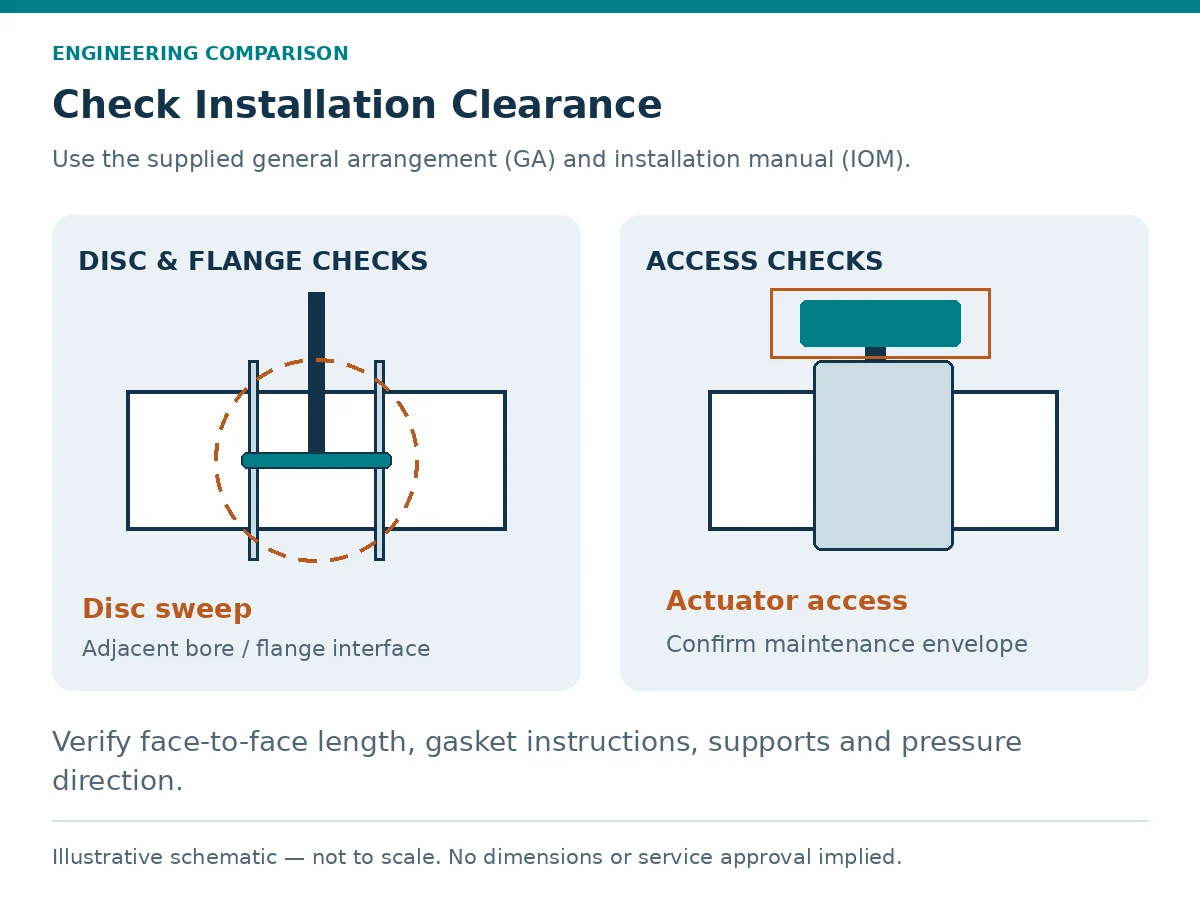
A short butterfly body can suit a restricted installation, but the disc may project beyond it when opening. Check adjacent pipe and flange bores, liners, reducers, gaskets and neighboring equipment against the disc sweep. Flange compatibility includes facing and gasket instructions as well as bolt pattern.
Manufacturer instructions are construction-specific. For example, the Bray 2-Cx installation manual addresses flange-interface and disc-clearance concerns for that lined design. Use the supplied valve’s own instructions for the actual installation.
For end-of-line duty, obtain the manufacturer’s permitted configuration, pressure direction and differential-pressure limit. Lug construction alone does not establish full-rated dead-end service.
For a ball valve, review weight, supports, face-to-face length and the space needed to remove the actuator, body section or internals. A replacement between families may require piping changes even when nominal size and flange class match.
Illustrative replacement review: the flange bolt pattern may match while an adjacent pipe liner restricts butterfly-disc travel. Overlay the proposed disc envelope and actual mating-bore drawings before procurement. Treat an unresolved interference as an interface deviation, not as a reason to force the valve through its travel.
Size the actuator from the torque envelope and minimum utility
Compare required torque throughout travel with available operator output. Include breakaway, running and seating loads, plus hydrodynamic effects where relevant. Temperature, differential pressure, seat construction and service condition can change those loads.
For pneumatic packages, use the specified minimum available supply pressure. For spring-return packages, check both powered and spring strokes. Confirm closure time, fail position, cycling duty, ambient conditions, accessory loads and the sizing-margin basis. Check maximum operator output against shaft and drive limits as well as minimum available output against required torque.
A common mounting interface establishes a mechanical connection, not adequate torque or suitable fail action. Require a sizing basis tied to the offered valve and actuator.
Illustrative actuator review: a package selected at nominal air pressure may lack seating margin at the specified minimum supply or during its spring stroke. Compare the valve torque envelope and operator output throughout both required actions, including maximum differential pressure, before approving the package.
Where rapid closure can cause significant pressure transients, check the specified closing time against the system surge assessment. Faster operation is not automatically preferable. The valve comparison alone cannot establish an acceptable closure time.
When Should You Shortlist Each Valve Type?
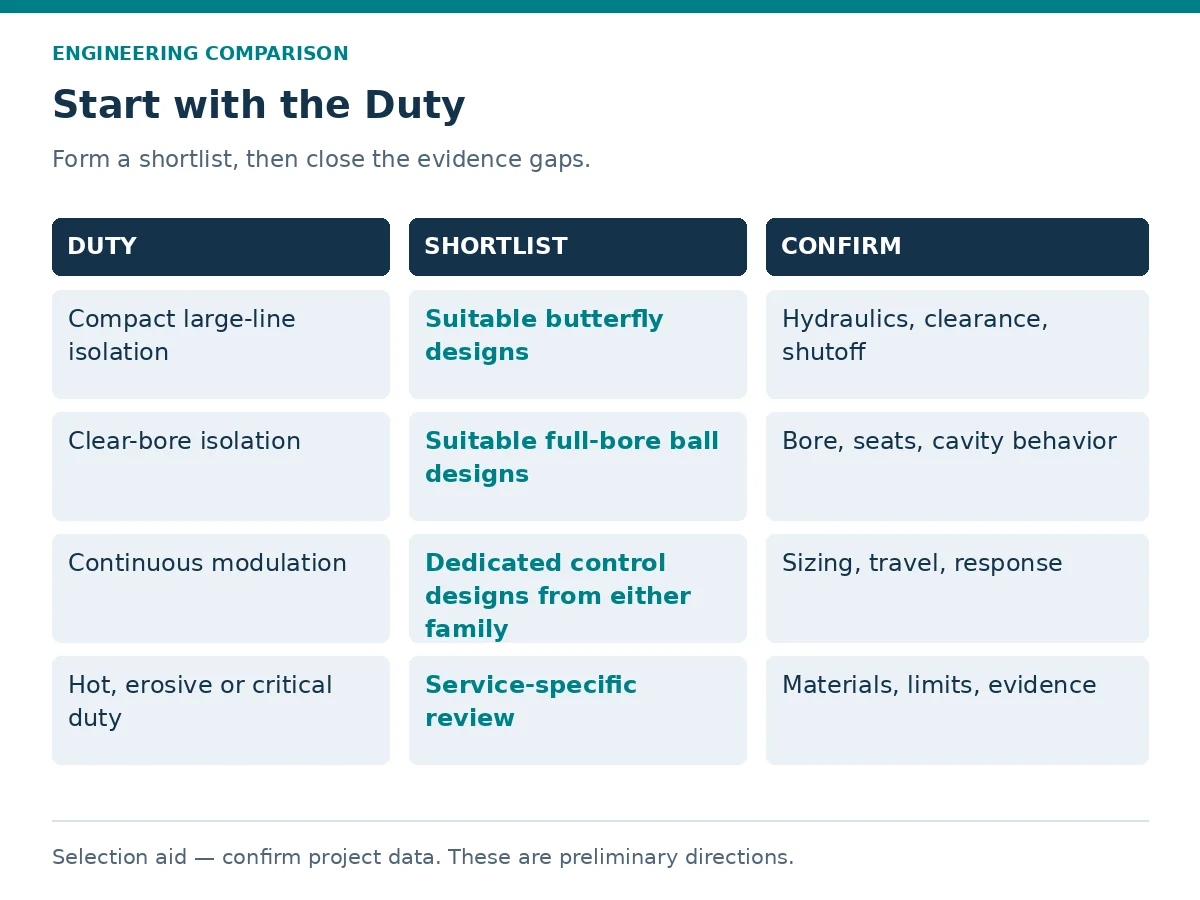
The following examples establish preliminary directions. They are illustrative duties, not approved selections or project case studies.
| Stated duty | Preliminary shortlist | Hold point | Evidence needed |
|---|---|---|---|
| Large clean-water isolation line with limited space | Qualified butterfly constructions | Acceptable flow loss, closing response and installation clearance | Flow data, transient review where needed, GA and torque basis |
| Process isolation requiring a clear passage and low open-valve loss | Suitable full-bore ball constructions | Actual bore, materials, seats and cavity behavior | Section drawing, flow coefficient and service limits |
| Continuous flow modulation | Dedicated butterfly or shaped-ball control constructions | Stable operation across all process cases | Sizing results, travel range and actuator/positioner data |
| Hot, erosive, solids-bearing or critical shutoff duty | Service-specific constructions; expand the shortlist if necessary | Materials, wear, sealing and qualification gaps | Detailed datasheet, application review and applicable evidence |
Start with mandatory requirements. If a candidate cannot meet the required rating, leakage basis or mechanical interface, resolve the deviation before comparing price. If both candidates meet the requirements, compare operating performance, maintainability and installed cost.
Compare Installed Cost Using the Same RFQ Basis
Include actuator, installation, energy and maintenance scope
Butterfly valves can offer a weight and installation advantage on larger lines, but this does not establish a universal price crossover. A specialized offset butterfly valve and a general-purpose ball valve may have very different qualification and material scopes.
Normalize the valve, operator, accessories, supports, coatings, testing and documentation first. Then assess pressure-loss consequences using the operating profile and system efficiency. Include spare parts, access and maintenance effort where reliable data exist.
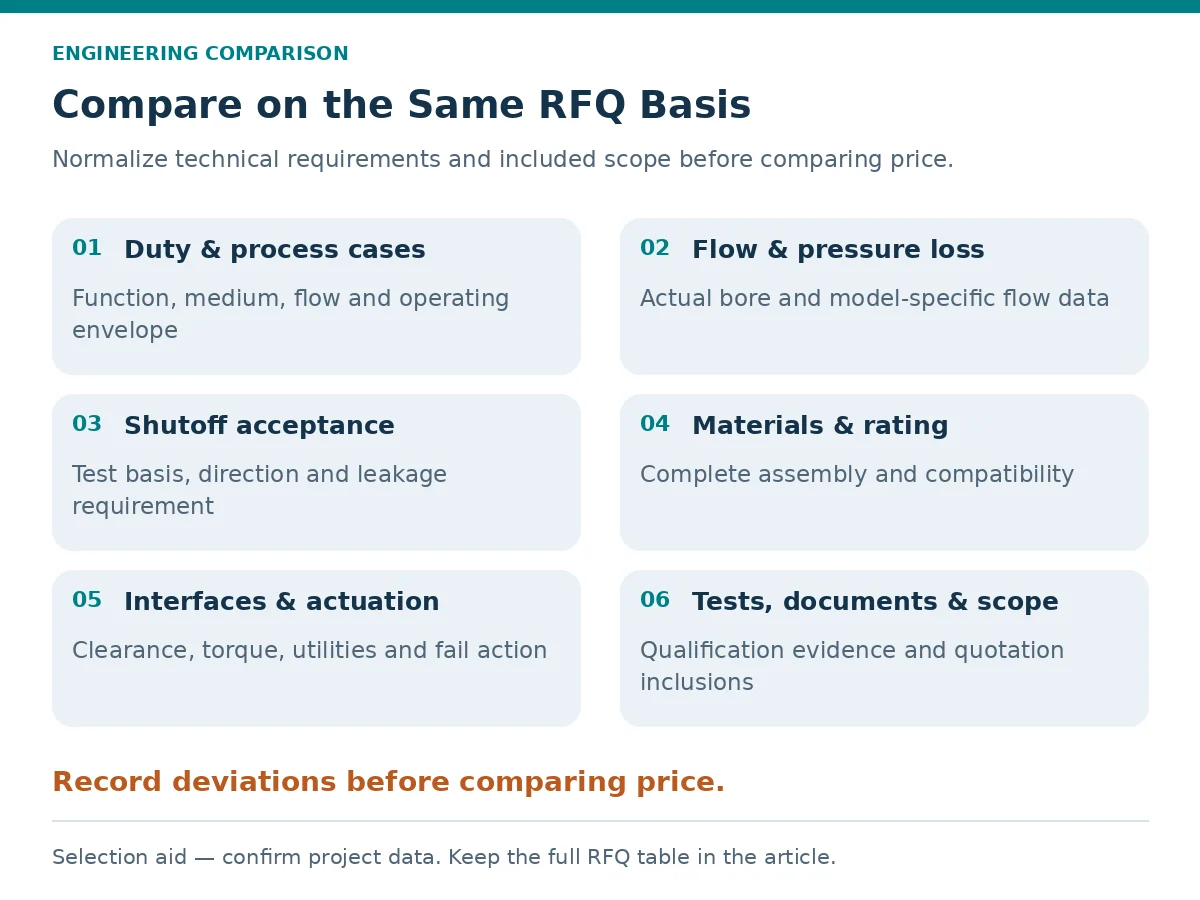
A lower purchase price is only useful if both offers satisfy the required duty. Record differences as technical deviations rather than assuming an omitted requirement is included.
Resolve non-equivalent bids before ranking price
Suppose one offer includes a soft-seated butterfly valve and actuator, while the other includes a metal-seated ball valve with different leakage acceptance and inspection scope. Their totals do not yet compare equivalent duties. First ask both suppliers to respond to the same seat-performance requirement, pressure direction, process cases and package scope. Require every exception to be listed.
If both candidates satisfy that common basis, compare pressure loss, installation and maintenance using stated assumptions. If only one meets a mandatory requirement, the cheaper nonconforming offer is not an equivalent alternative. If neither has sufficient evidence, retain a technical hold and request clarification.
What evidence should close the technical review?
Ask each supplier to identify the offered model and construction on its response. Use the matrix below to connect an operating concern with the document needed to assess it.
| Concern | Evidence to request | Review question |
|---|---|---|
| Flow loss or unstable regulation | Model-specific Cv/Kv data, operating cases and sizing assumptions | Check every required case; fully open capacity alone does not establish control performance. |
| Seat leakage or wrong pressure direction | Closure-test procedure, acceptance criterion and directional limits | Match the proposed seat and construction to the required duty; do not substitute a shell-test result. |
| Disc interference or restricted maintenance | GA, mating-pipe/flange details and model IOM | Confirm the installation envelope against actual interfaces, including end-of-line restrictions. |
| Failure to move or shaft overload | Valve torque envelope, actuator output curve and shaft limits | Check the complete stroke, minimum utility and both fail/powered actions where applicable. |
| Unsubstantiated material or special-service claim | Component material schedule, traceability records and applicable qualification coverage | Match records to the offered design and order scope; record gaps and exclusions. |
Butterfly Valve vs Ball Valve RFQ Checklist
| Comparison field | Common enquiry basis | Required response |
|---|---|---|
| Function and medium | Isolation/control; composition, phase and solids | Proposed construction and exclusions |
| Process envelope | Normal/design pressure and temperature; flow cases | Applicable limits and calculation assumptions |
| Differential pressure | Operating, closing and reverse-pressure cases | Permitted limits and directional restrictions |
| Flow performance | Same flow conditions and comparison method | Bore, Cv/Kv and relevant opening position |
| Shutoff | Same test basis and service leakage requirement | Medium, pressure, duration, direction and acceptance |
| Installation | Ends, facing, available length, clearance and orientation | GA, weight and interface deviations |
| Actuation | Utility minimum, duty, fail action and operating time | Torque/output comparison and package scope |
| Materials and qualification | Body, trim, seat, packing and gasket materials; required special-service evidence | Material schedule, traceability records and qualification coverage limits |
| Inspection and documents | Pressure/closure and functional tests; specified material/NDE records; hold or witness points | Acceptance criteria, included documents, traceability, exclusions and deviations |
| Lifecycle and commercial scope | Installation, spares and maintenance assumptions | Itemized quotation and supporting data |
Request a Valve Selection Review
Send the datasheet or specify the function, medium, flow cases, normal/design pressure and temperature, size, class, end connections, maximum differential pressure and shutoff requirement. Include actuation, fail action, installation constraints and required tests/documents. Mark missing data as unknown.
Request a proposed construction with supporting rating, flow and torque data, included scope, deviations and unresolved items. Review Raymon Valve’s scope and quality approach when assessing the response.Request Valve Selection Review
Frequently Asked Questions
What is the main difference between a butterfly valve and a ball valve?
A butterfly valve rotates a disc within the flow path. A ball valve rotates a bored ball. This changes open-valve obstruction, sealing geometry and installation requirements, but the actual construction determines performance. Does a ball valve always have lower pressure drop?
No. A full-bore ball valve often offers low loss when fully open, but reduced-bore designs and actual geometry change the comparison. Use Cv/Kv data for the offered models at the same flow conditions and opening position. Can a butterfly valve provide tight shutoff?
Yes, suitable constructions can meet defined tight-shutoff requirements. Confirm the seat design, differential pressure, direction, temperature and specified leakage test. The valve-family name alone does not establish the acceptance result. Can both valve types be used for throttling?
Yes, when the specific construction is designed and sized for that duty. Dedicated butterfly control valves and V-port or segmented ball valves should be assessed using process cases, installed response and cavitation/noise limits. Ordinary isolation designs are not automatic substitutes. Is a butterfly valve always cheaper than a ball valve?
No. Size, pressure class, materials, seats, operator and qualification requirements affect price. Compare equivalent scope and installed cost rather than assuming a fixed percentage saving or diameter threshold. Can a butterfly valve replace a ball valve without piping changes?
Only after an interface and duty review. Confirm face-to-face length, flange details, disc clearance, weight, supports, pressure loss, shutoff and actuation. Matching nominal size and class does not establish interchangeability.
Engineering Note
Technical content: Raymon Valve Technical Content Team. Project-specific selection and acceptance remain subject to the responsible project reviewers and approved order documents.
This article supports preliminary industrial valve comparison and RFQ preparation. The example duties are illustrative; no model-specific flow coefficient, actuator size, service-life result or qualification is established here. Selection requires the complete datasheet, applicable project requirements and evidence for the offered construction. Production testing, special qualification and installed performance should be reviewed separately.
Technical References
Official sources checked on November 9, 2026. Their scope supports the general discussion; they do not establish performance or qualification of a supplied Raymon valve.
- ASME B16.34 — Valves—Flanged, Threaded, and Welding End: the official listing identifies the 2025 edition and its defined metallic-valve construction and rating scope. The project determines the applicable edition and requirements.
- Bray — Series 19/19L Segmented Ball Valve Datasheet (PDF): a manufacturer example of a shaped V-profile control construction. Its model-specific ratings, certifications and service claims are not transferred to Raymon products.
- Bray — 2-Cx PTFE-Lined Butterfly Valve IOM: an example of construction-specific disc-clearance and flange-interface requirements. Follow the supplied valve’s own drawings and instructions.
- KSB — Risk of Pressure Surges: background on liquid-flow transients and the role of valve closing time; system-specific assessment is still required.
 English
 German
 Arabic
 French
 Spanish
 Italian
 Portuguese
 Russian