
Liquids
Home / Resources / Valve Material and Media Compatibility Guide
Fluid data before material or valve selection
Valve and Media Compatibility: What Engineers Must Check
Start a valve and media compatibility review by classifying the stream as a liquid, gas, steam or solids-bearing fluid, then recording its composition, phase, pressure and temperature across operating, startup, cleaning and upset conditions. These data determine which materials, seals and flow passages need further review. Check the body, trim, seats, packing and gaskets against their actual exposure. Use the media examples and RFQ checklist below to document the conditions and acceptance criteria the supplier must address.
Request Technical ReviewOpen Technical Scope
Full fluid compositionAll wetted materialsTemperature and phaseEvidence and limits
What Types of Media Do Industrial Valves Handle?
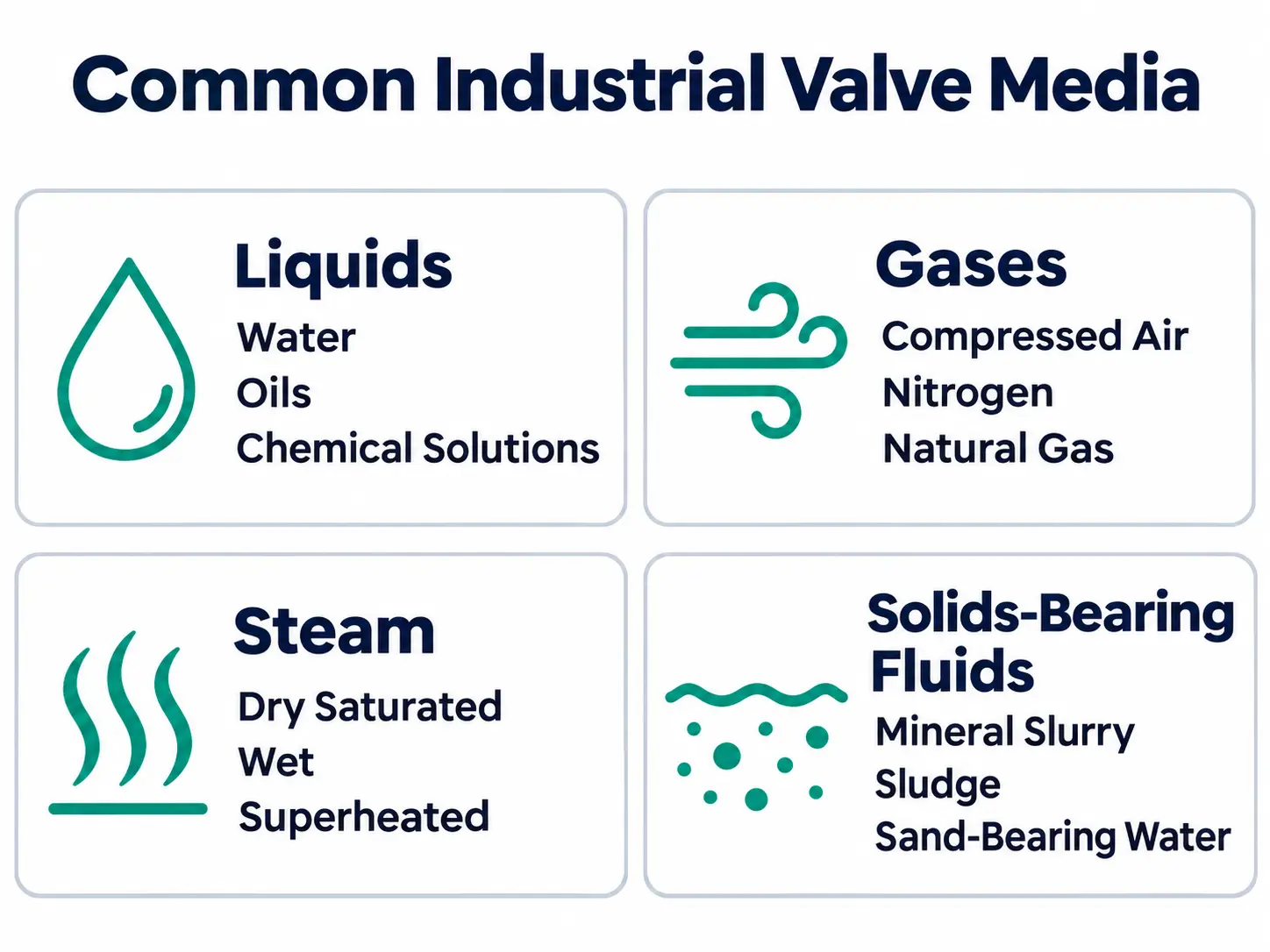
For a preliminary valve and media compatibility review, group the fluid as a liquid, gas, steam or solids-bearing fluid. These groups can overlap. Wet steam contains liquid droplets, and seawater carrying sand needs both a liquid corrosion review and a solids wear review.
Liquids
Examples include water, oils and chemical solutions. Record concentration, temperature, pH or chloride content where relevant, and any cleaning fluid. A chemical solution may be compatible with the body alloy while causing the seat compound to swell. Verify the exact compound against both the process liquid and the cleaning cycle.
Gases
Examples include compressed air, nitrogen and natural gas. Specify composition, moisture, pressure and the external leakage requirement separately from seat shut-off. For a throttling valve, include the inlet and outlet pressures at each flow case so the supplier can review gas capacity and noise.
Steam
Distinguish dry saturated, wet and superheated steam. Record pressure and temperature for each case, including heat-up and shutdown. If condensate can collect during startup, confirm how the system handles it and have project engineering assess the transient loads. Check the seat and packing temperature limits against the selected valve design.
Slurries and Solids-Bearing Fluids
Examples include mineral slurry, sludge and sand-bearing water. Record the particle size distribution, solids concentration and basis, and whether solids settle at low flow or during shutdown. Review flow passages, seat exposure and shut-off after cycling with the manufacturer.
RFQ Example: Seawater with Suspended Sand
An illustrative RFQ lists seawater with suspended sand at 45 °C and 8 barg in normal operation. Those values leave two open reviews: chloride-driven attack on susceptible wetted parts and abrasion of the seat and trim.
- Corrosion review: Provide chloride concentration, cleaning chemicals and expected periods of stagnant service. Ask the supplier to identify the exact wetted alloys and seal compounds.
- Wear and shut-off review: Provide sand concentration and particle size distribution, flow range and the required leakage acceptance. Ask the supplier to identify where particles can collect or cross the seating surfaces.
- Rating review: Add design pressure and temperature combinations, the maximum differential pressure across the valve, and startup and cleaning conditions. Request documented limits for the proposed construction.
4 Risky RFQ Mistakes in Valve and Media Compatibility
- Giving only the fluid name. Add phase, composition, concentration and any suspended solids.
- Giving only normal operating conditions. Include design pressure and temperature combinations and the startup, shutdown and cleaning cases that affect valve and media compatibility.
- Specifying only the body alloy. Ask for the wetted-material list, including the exact seat and seal compounds where applicable.
- Leaving shut-off open to interpretation. Specify the required leakage limit, test basis and direction where applicable.
Information and records to define
Technical scope
Service Data for a Valve and Media Compatibility Review
Composition and range
List primary chemicals, concentrations, water, dissolved gases, inhibitors and credible contaminants—not just a trade or stream name.
Phase and behavior
Identify liquid, gas, vapor, mixed phase, flashing, cavitation, crystallization, polymerization or settling risks.
Temperature cases
Include normal operation, startup, cleaning, steaming, regeneration, upset and minimum ambient or cryogenic exposure.
Flow and solids
Velocity, particle size, hardness, concentration and flow direction influence erosion, clogging and seat damage.
Containment objective
Define internal shutoff, external leakage/emissions, toxicity, flammability, vacuum and fire requirements.
Maintenance context
Flushing, draining, decontamination, lubrication, inspection access and expected cycle frequency affect construction choice.
Evidence matrix
Valve and Media Compatibility by Component
| Valve element | Exposure question | Typical damage mechanism | Required decision |
|---|---|---|---|
| Body and bonnet | Does the fluid contact base metal, lining, overlay or trapped cavities at every operating condition? | General/localized corrosion, erosion, brittle behavior or lining permeation. | Pressure-boundary material route, corrosion allowance/lining and inspection evidence. |
| Closure and seats | What differential, velocity, particles and temperature act during movement and shutoff? | Seat swelling, softening, abrasion, galling, wire drawing or deposit damage. | Seat/trim material pair, shutoff class, direction and operating limits. |
| Stem/shaft and bearings | Can process fluid migrate into stem guides, bearings or bonnet spaces? | Corrosion, galling, deposit binding and torque growth. | Materials, surface treatment, isolation and torque margin. |
| Packing and body seals | What chemistry, temperature, cycling, vacuum and emissions duty reach each seal? | Swelling, shrinkage, creep, permeation, oxidation or relaxation. | Seal compound/grade, loading system, emissions qualification and replacement plan. |
| Bolting and external parts | Are parts exposed to process leakage, marine atmosphere, washdown or insulation moisture? | Environmental corrosion, stress corrosion or loss of preload. | Bolting/coating/protection specification and inspection access. |
| Actuator and accessories | Are ambient corrosion, hazardous-area, water ingress or process-temperature effects present? | Enclosure degradation, signal failure, lubricant change or loss of output. | Environmental rating, materials, utilities, controls and thermal isolation. |
For the seat, packing and gasket review, see the valve seat and sealing materials guide.
Engineering evidence
Evidence for Valve and Media Compatibility
Service questionnaire
Process owner confirms composition and all normal/upset cases.
Materials review
A competent reviewer evaluates every wetted and exposed component.
Field history
Comparable concentration, temperature and flow history supports—but does not automatically prove—selection.
Published data
Material suppliers and controlled references provide condition-specific guidance.
Testing route
Immersion, coupon, seal or functional testing can address defined uncertainties.
Approval record
Assumptions, limits, alternatives and monitoring requirements are documented.
Technical boundaries
Claims and shortcuts this page does not support
Media names are not chemical specifications
Sour gas, produced water, acid, solvent or slurry labels omit variables that control damage.
Body compatibility does not prove seal compatibility
Polymers, graphite, coatings, trim and bolting require separate review.
Compatibility is not unlimited service life
Manufacturing condition, stress, velocity, deposits and operating excursions still affect performance.
Controlled workflow
Documenting Valve and Media Compatibility
1. Collect fluid dataUse a structured datasheet covering composition, range, phase and contaminants.
2. Define operating envelopeRecord pressure, temperatures, flows, cycles and abnormal cases.
3. Map exposed componentsIdentify all wetted, trapped, permeated and externally exposed materials.
4. Assess mechanismsReview corrosion, erosion, swelling, permeation, galling, deposition and fire/toxicity risks.
5. Select and qualifyChoose construction and any test, inspection or qualification evidence needed.
6. State limitationsDocument approved conditions, monitoring, maintenance and deviation controls.
Project checklist
Information and records to define
Include these details in the RFQ so suppliers assess valve and media compatibility against the same operating cases and acceptance criteria.
Fluid name plus complete composition/concentration range
Water, oxygen, H2S/chlorides and other contaminants
Liquid/gas/mixed phase, solids and particle data
Valve duty and the normal, design, startup, cleaning and upset pressure–temperature cases
Flow range, maximum differential pressure, flow direction and operating frequency
Body, trim, seat, packing, gasket, bolting and coating materials
Allowable seat leakage and test basis, plus emissions, fire, toxicity and other applicable service requirements
Evidence basis, approved limits and monitoring/maintenance plan
Technical authority and scope
How this resource should be used
Preliminary compatibility review
Before approving valve and media compatibility, record the reviewed process conditions, exposed components and any gaps in the supplier’s evidence.
Technical content owner
Raymon Valve technical content team. Final project decisions require the controlled documents and responsible engineer or quality reviewer.
Standards boundary
ASME B16.34 covers pressure–temperature ratings for valve designs within its scope. Confirm the project-specified edition, material group and coincident design conditions, then obtain the proposed valve’s pressure–temperature and seal limits from the supplier.
Review status
Technical scope reviewed 27 July 2026. Editions, procedures, acceptance criteria and product evidence must be reconfirmed before order.
Resource CenterValve StandardsInspection & TestingRequest Technical Review
Frequently asked questions
Valve Material and Media Compatibility Guide FAQ
Can I select a valve from the fluid name alone?
Use the fluid name to start the review. Confirm composition, concentration, phase, solids, operating and design conditions, and cleaning exposure before asking the supplier to assess the materials and construction.Why can a stainless-steel valve still fail in a corrosive service?
Corrosion resistance depends on the exact grade and environment. Chlorides and stagnant deposits can promote local attack on susceptible alloys. Verify the wetted materials and assess crevices, temperature and cleaning conditions.Are PTFE seats compatible with every chemical?
Check the exact PTFE compound against the process and cleaning fluids. Confirm the supplier’s combined pressure and temperature limits, cycling conditions and allowable seat leakage for the proposed valve.What evidence should accompany a compatibility recommendation?
Ask for the reviewed process conditions, the wetted-material list, the basis for compatibility, documented operating limits, and any tests or inspections needed for project approval.
Technical evidence review
Send the requirement and the evidence you need to verify
For a valve and media compatibility review, send your valve duty, fluid composition, pressure and temperature cases, required shut-off and applicable test or document requirements.
 English
 German
 Arabic
 French
 Spanish
 Italian
 Portuguese
 Russian