
Manufacturing & selection guide
By Raymon Valve
Cast vs forged valves differ in how the body or bonnet is formed: casting solidifies molten metal in a mold, while forging shapes solid stock under compression. Casting can suit complex passages and larger geometries; forging can suit compact components with a controlled working route. Neither method alone proves pressure capability, tightness or service life. To compare supplier offers, check the actual valve design, material condition, pressure–temperature rating, examination scope and traceability before accepting either construction.
Use this guide to compare supplier proposals, define acceptance evidence and resolve technical deviations before award.
On this page
- Quick comparison
- Strength and pressure capability
- When to consider casting
- When to consider forging
- Quality evidence
- RFQ checklist
Cast vs Forged Valves: A Quick Comparison
Start by confirming whether the project specification permits both constructions. If one route is mandatory, an alternative needs formal technical review before price comparison. If both are permitted, compare the approved geometry, material condition, rating and acceptance evidence before deciding whether either offer is suitable.
Scroll horizontally if needed to view all columns.
| Review factor | Cast valve components | Forged valve components | Buyer action |
|---|---|---|---|
| Forming process | Molten metal solidifies in a mold | Solid stock is shaped by compressive working | Identify the route for each pressure-boundary component |
| Geometry | Mold and core design can accommodate complex passages | Forging shape and machining access influence the finished geometry | Review the sectional drawing and manufacturing route |
| Material condition | Solidification and heat treatment influence properties | Starting stock, deformation and heat treatment influence properties | Specify the exact material grade and condition |
| Quality concerns | Porosity, shrinkage, inclusions and cracking may require evaluation | Laps, seams, internal discontinuities and cracking may require evaluation | Define examination and acceptance requirements |
| Pressure capability | Determined by the complete rated design | Determined by the complete rated design | Confirm the rating at design temperature |
| Cost and delivery | Depend on tooling, alloy, quantity, processing and inspection | Depend on stock, tooling, machining, processing and inspection | Compare offers with equivalent technical scope |
The forming-process and geometry distinctions are discussed in the Steel Founders’ Society of America comparison of castings and forgings. They provide a manufacturing framework, rather than approval for a particular valve.
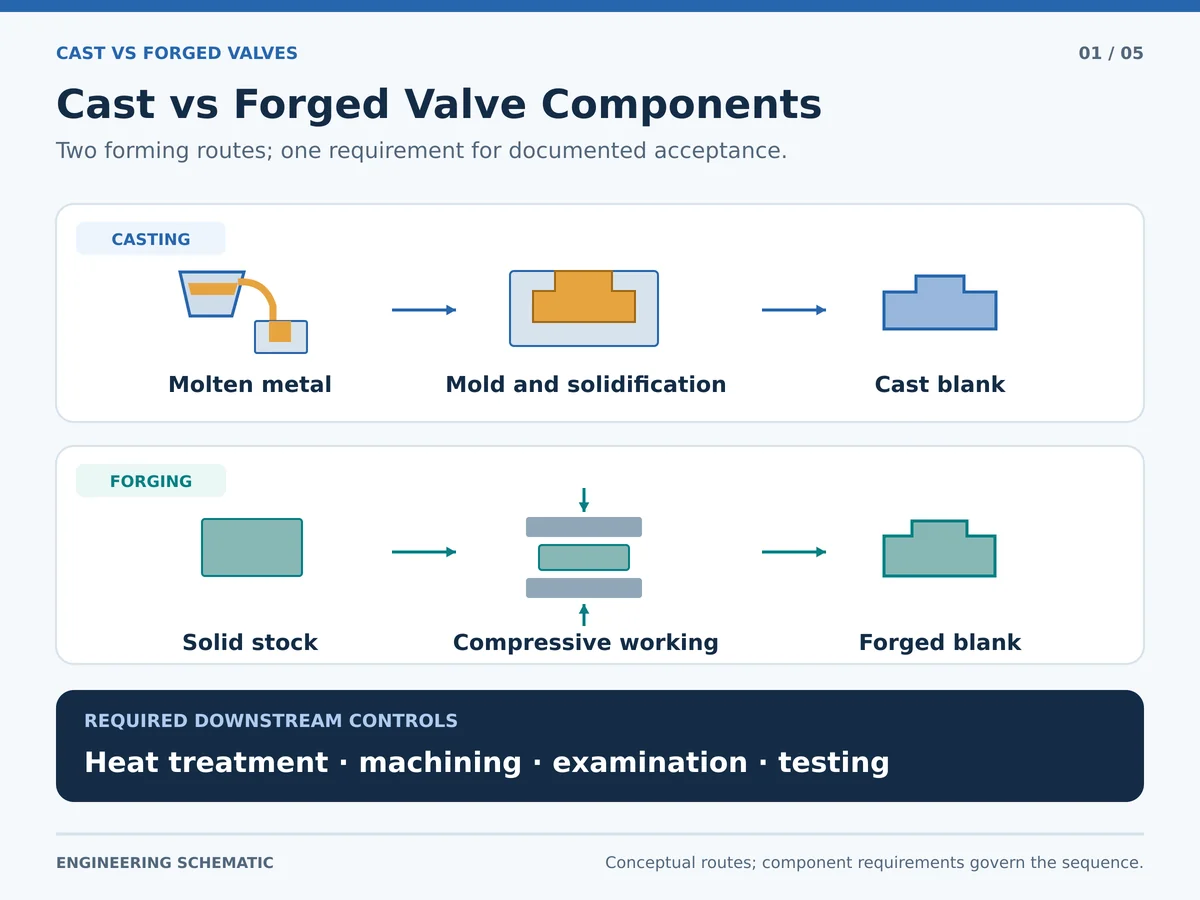
How Casting and Forging Produce Valve Components
For general functions and construction terminology, see the industrial valve body guide.
Casting: Solidifying Metal in a Mold
Casting forms the component around a mold cavity, with cores used where appropriate to create internal spaces. The resulting shape is cleaned, heat treated as specified, machined and examined before acceptance. This route can integrate passages, flanges, bosses and other features into the body geometry.
Quality depends on control of the process and acceptance of the actual component. A smooth exterior does not demonstrate internal soundness. See the valve casting process and quality-control overview for the detailed manufacturing sequence.
Forging: Shaping Solid Metal Under Compression
Forging mechanically works solid starting stock, commonly at elevated temperature. Deformation can develop directional material flow, while subsequent processing establishes the required finished condition. The Forging Industry Association explains these potential grain-flow benefits.
The benefit must be evaluated for the component. Stock quality, working sequence, heat treatment and final machining remain relevant. A heavily machined passage may also affect how the original material flow relates to the finished shape.
The valve forging process overview covers route controls and traceability. Buyers should identify whether an offer involves a shaped forging, forged stock subsequently machined into a body, or another permitted product form. These descriptions need enough detail to demonstrate compliance with the purchase requirement.
What Determines Valve Strength and Pressure Capability?
Material Grade, Heat Treatment and Component Geometry
“Cast steel” and “forged steel” describe broad manufacturing categories. Neither identifies an exact composition, heat-treatment condition, toughness requirement or certified result.
For each critical component, request its exact material specification, grade, heat-treatment condition and relationship to the supplied heat or test lot. Similar alloy names or chemistry do not establish interchangeable product specifications. Review the confirmed medium, concentration, contaminants, solids, temperature, cleaning media and shutdown conditions; a manufacturing route does not establish chemical compatibility.
Receiving-review example: A certificate lists the specified grade, but machining has removed the component marking and no identity-transfer record is supplied. The unresolved issue is traceability, not whether the document looks complete. Request the controlled link between the component, heat, required process records and final valve identity before closing material acceptance.
Pressure–Temperature Ratings and Service Loads
Pressure class is a rating designation, not a fixed pressure at every temperature. Obtain the applicable material group, temperature-dependent rating basis and complete valve construction. Design conditions must also suit the bonnet, bolting, trim, seats, packing and gaskets; normal operating pressure cannot replace design pressure, and body suitability does not establish every sealing-material limit.
For an applicable design, ASME B16.34-2025, Valves—Flanged, Threaded, and Welding End, addresses ratings, materials, examination and testing for constructions within its scope, including cast, forged and fabricated valves. Confirm the edition invoked by the order and any additional product or service requirements. A reference to this standard does not establish that a particular valve complies.
The review should also identify loads or conditions needing separate consideration: piping forces, thermal cycling, pressure cycling, vibration, low-temperature exposure or elevated-temperature duty. These are inputs for the responsible engineering review, not reasons to approve either route automatically.
Temperature-review example: Two offers quote the same size and class, but one identifies only normal operating temperature. The minimum and maximum design conditions, required material-property evidence and sealing limits remain unresolved. Request those inputs and the applicable rating data before treating the two constructions as technically comparable.
Finally, distinguish pressure-boundary capability from shut-off performance. Seats, closure members, joints, packing and assembly all contribute to valve behavior. Choosing a forged body does not establish an allowable seat-leakage result.
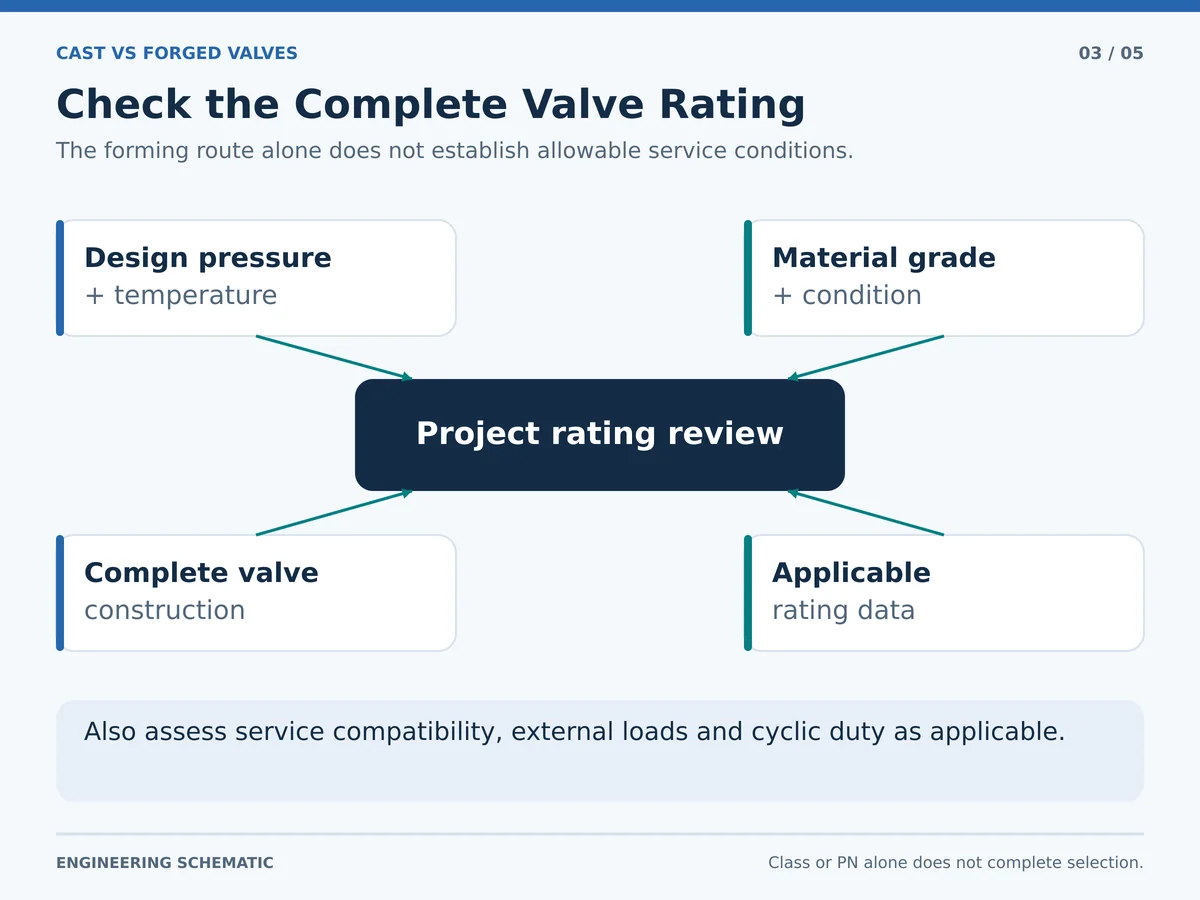
When Should You Consider a Cast Valve Body?
A cast body is worth evaluating when its geometry suits the passage and envelope, and the supplier can demonstrate the required material and inspection condition. Ask whether the casting design reduces unnecessary machining or assembly without compromising inspection access.
For a large or complex body, review the offered drawing and evidence rather than assuming that casting is acceptable because of size. Identify critical regions, examination coverage, minimum-wall requirements and repair restrictions before ordering.
Useful supplier questions include: Which areas receive volumetric examination? At what manufacturing stage? What acceptance criteria apply? What happens if repair is required? These questions turn a general manufacturing preference into an auditable purchase requirement.
When Should You Consider a Forged Valve Body?
Evaluate forging where the approved design suits the available stock, deformation route and machining capacity. Compact bodies are a useful starting point for discussion, but size alone cannot establish the appropriate route.
Ask the supplier to identify the material specification, forging source, heat-treatment lot and required examination. Where the project requires route qualification or reduction information, include that requirement explicitly in the RFQ.
When comparing a forged steel gate valve with a cast steel gate valve, review the bore, bonnet joint, end connections and maintenance access alongside the body route. Compare the actual drawings and supplier evidence; matching nominal size and class alone does not establish interchangeability.
When Does Either Offer Need Further Review?
Use these checkpoints to identify missing information. They do not rank casting against forging or approve either construction for a particular duty.
Scroll horizontally if needed to view all columns.
| Project condition | What the supplier must identify | When the decision stays open |
|---|---|---|
| Low-temperature or elevated-temperature duty | Applicable material condition, rating basis and required property evidence at the specified service limits. | Temperature limits or required toughness/property evidence are not confirmed. |
| Pressure or thermal cycling; external loads | The actual duty and the design review required by the project, with supporting information for the offered construction. | The offer addresses steady pressure only, while other specified loads remain unresolved. |
| Corrosive, erosive or contaminated medium | Exact wetted materials and the compatibility or wear review required for the confirmed fluid and operating conditions. | A generic alloy name or manufacturing route is the only suitability evidence. |
| Restricted repair or enhanced examination | Permitted repair route, examination coverage, acceptance criteria and purchaser intervention points. | Supplier practice differs from the purchase specification without an approved deviation. |
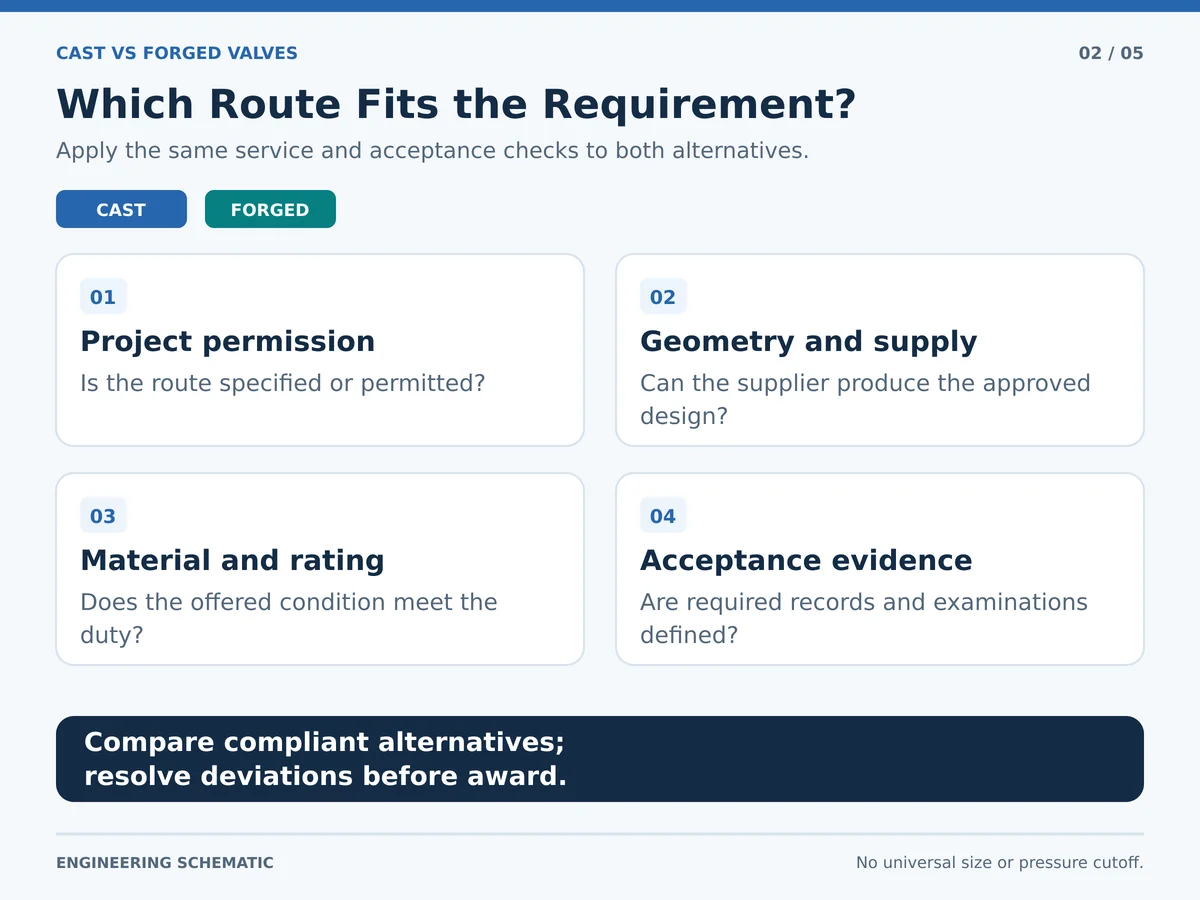
What Quality Evidence Should Buyers Compare?
Discontinuities and Appropriate Examination
An indication found during examination needs evaluation against the specified acceptance criteria. The method must be suitable for the material, geometry, location and type of condition being investigated.
The ASNT overview of nondestructive testing methods distinguishes their purposes. RT and UT can investigate internal discontinuities where the material, geometry and access permit an effective examination. MT applies to ferromagnetic materials for suitable surface and near-surface indications; PT reveals surface-breaking indications on suitable nonporous surfaces. These methods are not interchangeable certificates of a defect-free component.
Do not assign one universal inspection package to every casting or forging. Instead, agree the following evidence matrix with the supplier and project reviewer.
Make examination requirements complete: identify the component and drawing region, method, coverage, examination stage, procedure and personnel qualification requirements, acceptance criteria, and required report. “NDT included” does not define that scope. Ask the supplier to state inaccessible regions or other coverage limitations explicitly.
Scroll horizontally if needed to view all columns.
| Evidence item | Question to resolve before ordering | Required relationship |
|---|---|---|
| Material certificate | Is the specification, grade and condition correct? | Certificate to heat and component identity |
| Heat-treatment record | Does the cycle correspond to the supplied lot? | Furnace load to component and test lot |
| Surface examination | Which surfaces, methods and acceptance criteria apply? | Report to identified component and examination stage |
| Volumetric examination | Which regions are covered, and what limitations remain? | Coverage record to drawing and component |
| Repair records, where applicable | Is repair permitted, and who approves it? | Approved procedure and disposition to repaired location |
| Dimensional report | Does the finished part satisfy the approved drawing? | Drawing revision to measured component |
| Valve test report | Were the required tests performed and accepted? | Assembled valve identity to procedure and results |
Heat Treatment, Traceability and Repair Controls
Confirm that the component marking, material certificate, applicable heat-treatment or test lot, and final valve identity can be reconciled. Where an original marking is removed during machining, request the controlled identity-transfer record required by the order. A certificate without a demonstrated relationship to the supplied component leaves traceability unresolved.
State repair restrictions before award. Where repair welding is allowed, define the approval route, qualification requirements, any applicable heat treatment and re-examination. A supplier’s permission to repair under a material specification may still be subject to additional purchaser restrictions.
Pressure Testing and Material Examination
Pressure testing and material examination answer different questions. A pressure-test pass does not prove the absence of every internal discontinuity, establish all material properties or replace the ordered examination. Likewise, acceptable material records do not establish assembled-valve shut-off performance. If positive material identification (PMI) is specified, reconcile its composition-check results with the component identity and material certificate; it does not replace mechanical-property or heat-treatment evidence.
Examination-review example: A cast body has passed the specified shell test, but the purchase order also requires examination of defined internal regions. The test report leaves that separate requirement open. Check the examination method, coverage, accessibility limitations, component identity and acceptance criteria; obtain the required report or an approved deviation before release.
Specify shell, seat and functional testing separately as applicable. Shell testing addresses the pressure boundary under the specified test conditions; seat testing assesses closure leakage against the stated acceptance criterion; functional checks address the required operation. None establishes an unrestricted service-life guarantee. See the valve pressure-testing guide for scope distinctions. Define additional service qualifications separately when the project requires them.
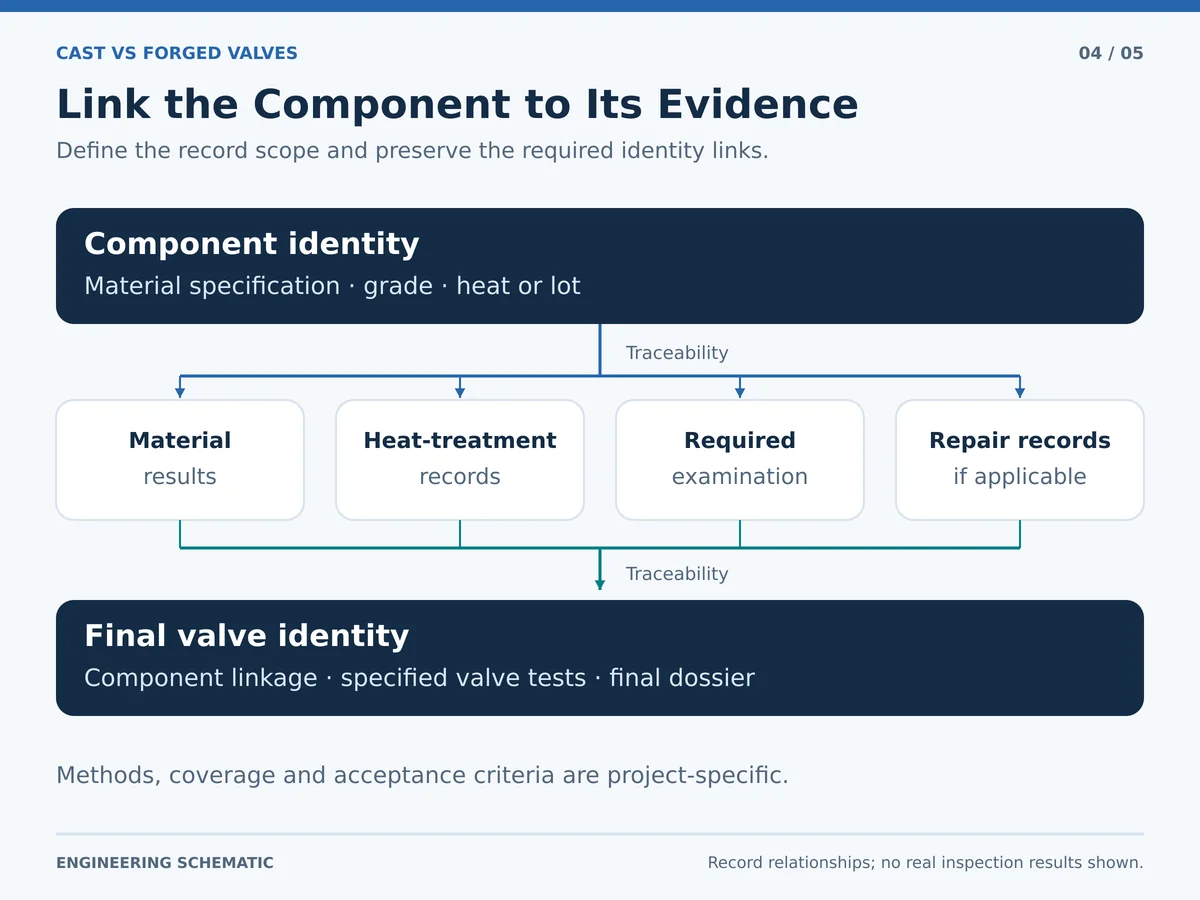
How Do Cost and Lead Time Compare?
There is no reliable universal price percentage between cast and forged valves. A comparison is useful only after the technical scope is aligned.
Ask whether the price includes tooling, required material condition, machining, specified examinations, purchaser witness points, repair documentation, final testing and the complete dossier. Also confirm whether the quoted delivery starts from order receipt or approval of drawings and documents.
The example below is hypothetical. Neither offer represents a supplier, a price advantage or an accepted valve. It shows how different wording can conceal different technical scope.
Scroll horizontally if needed to view all columns.
| Review item | Offer A states | Offer B states | Buyer action |
|---|---|---|---|
| Material evidence | Specified grade and linked process/test records. | Grade name and material certificate only. | Check the required records and component/lot relationship; request any omissions. |
| Examination | Method, coverage and acceptance criteria. | NDT included. | Obtain the actual method, regions, stage, coverage and acceptance criteria. |
| Repair control | Proposed repair restrictions and approval route. | Standard manufacturer practice. | Reconcile both offers with the project repair requirements. |
| Delivery basis | Schedule starts after defined document approvals. | Schedule starts after order receipt. | Compare milestones, approval assumptions and the same shipment-release scope. |
Classify each requirement as confirmed compliant, clarification required, or a deviation requiring approval. Offer A may be more explicit, but it still needs review against the purchase specification. Compare revised prices only after the scope and open deviations are resolved.
Apply the same discipline to delivery. Stock availability may shorten one route, while approval, special material or examination requirements may govern another. Request the supplier’s actual schedule rather than assigning a delivery advantage to casting or forging in general.
RFQ Checklist for Comparing Cast and Forged Valves
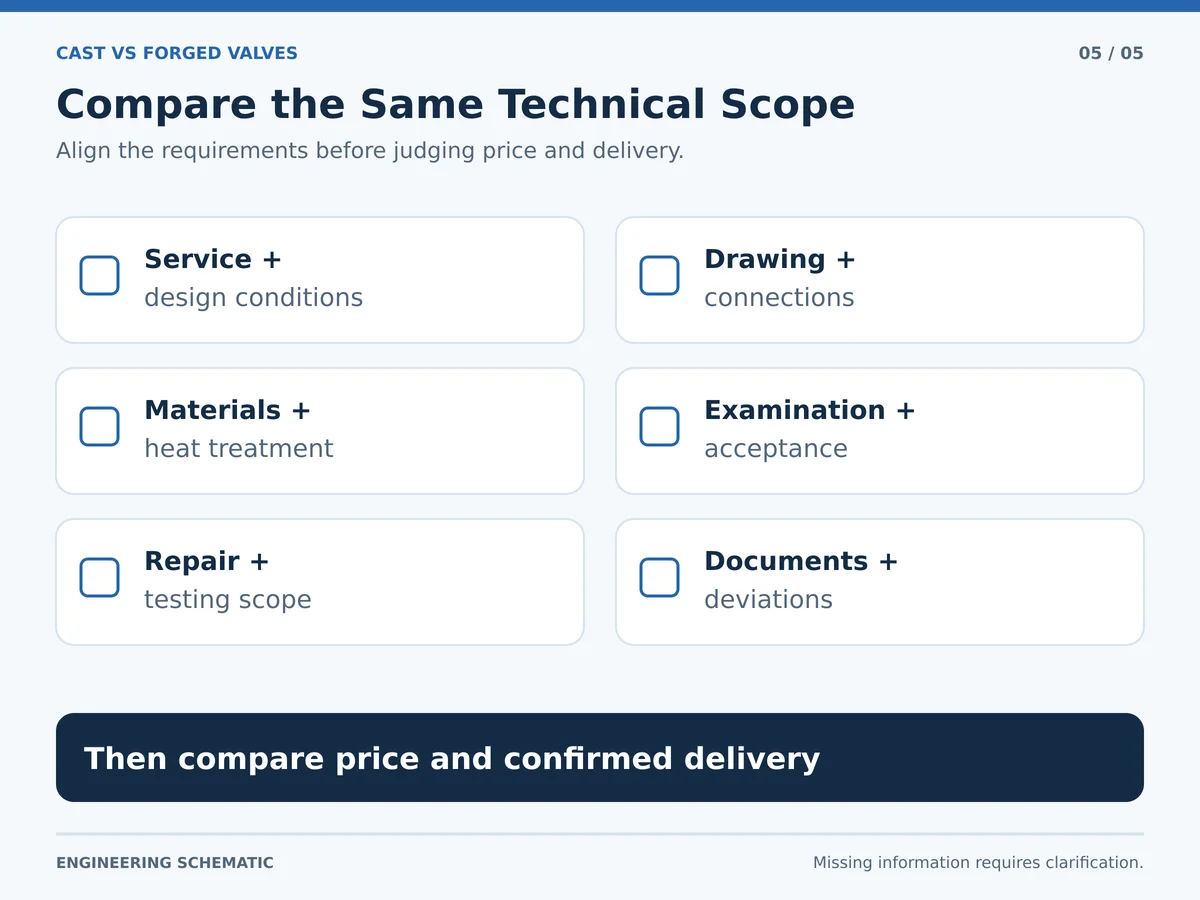
Use this checklist to prepare a common technical basis:
- Service: valve function, medium, composition, phase, contaminants and solids.
- Conditions: normal and design pressure and temperature, minimum exposure temperature, cycling and relevant external loads.
- Geometry and rating: nominal size, required bore or flow capacity, class/PN, end-connection standard, dimensional requirements and installation space. The nominal size alone does not establish flow capability or interchangeability.
- Materials: exact body, bonnet, trim, seat, packing, gasket and bolting requirements.
- Manufacturing route: mandatory or permitted component forms, source restrictions and alternative-approval process.
- Material condition: heat treatment and required mechanical, toughness, hardness or other verification.
- Inspection: methods, extent, locations, stage, acceptance criteria and witness or hold points.
- Repair: permitted methods, restrictions, approval points and records.
- Testing and sealing: shell, seat and functional test scope; required shut-off or allowable leakage; and any separately specified service qualification. Identify the applicable procedure and acceptance basis rather than requesting an undefined test certificate.
- Documents and supply scope: drawings, certificates, reports, traceability, deviation list, order quantity and final dossier requirements. Compare offers on the same quantity and tooling-cost basis.
Maintain one requirement register across the datasheet, quotation, drawing and inspection plan. For every open item, identify the supplier response, supporting document and required project disposition. Do not treat silence in a quotation as agreement with a requirement.
Frequently Asked Questions
What is the main difference between cast and forged valves?
Casting shapes molten metal through solidification in a mold. Forging shapes solid metal through compressive working. The description normally identifies particular valve components, especially the body or bonnet.Are forged valves always stronger than cast valves?
No. Compare the exact material grade, heat treatment, component geometry and design basis. Potential grain-flow benefits do not establish a universal performance ranking for complete valves; the offered rating and required inspection evidence still need confirmation.Can cast valves be used in high-pressure service?
Yes, where the applicable design, material, rating, manufacturing quality and project requirements support that duty. “Cast” alone neither approves nor excludes a pressure application.Are forged valves limited to small sizes?
No universal small-size limit follows from the word forged. Confirm availability and suitability for the specific component, grade, geometry and supplier manufacturing route.Does forging guarantee a leak-free valve?
No. Body construction does not establish seat, packing or joint performance. Define the required leakage acceptance and verify it through the specified tests and supporting evidence.What documents should buyers request for either construction?
Start with the approved datasheet and drawing, heat-linked material certificates, required process and examination records, valve-test reports and deviation schedule. Include repair records where applicable. The purchase order and inspection plan must define the actual scope and traceability required.
Engineering scope: This comparison concerns primarily metallic valve bodies and bonnets. It supports preliminary selection and quotation review; it does not qualify a material substitution, certify a supplier, or establish a valve rating. Confirm the complete valve design, sealing materials, service conditions, applicable requirements and order-specific evidence before acceptance.
Request a Cast or Forged Valve Selection Review
Send Raymon Valve the valve function, medium, design pressure and temperature, size, end connections, material requirements and inspection scope. Include the datasheet, project specification and supplier offer. Identify any mandatory manufacturing route, repair restriction or unresolved deviation so the review can focus on the actual decision.Request Valve Selection Review
The review helps identify the proposed construction, missing inputs and records requiring confirmation. Final selection and acceptance depend on the approved datasheet, applicable requirements and project engineering review.
 English
 German
 Arabic
 French
 Spanish
 Italian
 Portuguese
 Russian