
Equal Percentage vs Linear Control Valve: Inherent Characteristic, Installed Gain, Rangeability and Selection
Equal-percentage and linear control valves differ in how Cv changes with travel, but neither characteristic is universally better. A linear inherent characteristic gives approximately proportional Cv change with travel, while an equal-percentage characteristic gives approximately equal percentage changes in existing Cv. The practical selection depends on what happens after installation: valve differential pressure, system resistance, required flow range, predicted travel and installed gain can reshape the response.
Equal Percentage vs Linear Control Valve: Quick Comparison
| Engineering Factor | Linear Characteristic | Equal-Percentage Characteristic |
|---|---|---|
| Inherent Cv versus travel | Approximately proportional under defined conditions | Cv increases by approximately the same percentage for equal travel increments |
| Inherent gain | Approximately constant under constant valve ΔP | Increases as valve opening increases |
| Changing valve ΔP | Installed response can deviate substantially from linear | Can compensate for falling valve ΔP in suitable systems |
| Wide operating range | Conditional | Often worth evaluating |
| Oversized valve | Does not correct sizing | Does not correct sizing |
| Final selection from characteristic alone? | No | No |
Five Questions to Answer Before Choosing the Characteristic
1. What Are the Operating Cases?
Minimum, normal and maximum flow conditions should be known. If only maximum flow is available, characteristic selection is premature.
2. How Does Valve ΔP Change?
A characteristic that appears suitable at one differential-pressure condition may behave differently when piping and equipment losses change.
3. Where Will the Valve Operate?
Rated Cv alone does not show whether normal operation falls within a useful portion of valve travel.
4. How Does Installed Gain Change?
Installed gain should be reviewed across the operating envelope rather than at one design point alone.
5. Do Hydraulic Limits Dominate?
Cavitation, flashing, choked flow, noise or velocity may require a different hydraulic or trim solution before characteristic selection is finalized.
What Is an Inherent Control Valve Characteristic?
A control valve’s inherent flow characteristic describes the relationship between valve travel and flow capacity when differential pressure across the valve is maintained under defined conditions. ISA distinguishes this inherent characteristic from the installed characteristic, which reflects the actual pressure drop available to the valve in the complete system. ISA guidance on control-valve flow characteristics provides additional background on this distinction.
Installed behavior: Valve Travel → Cv → Valve ΔP + System Resistance → Actual Flow
Linear Inherent Characteristic
With a linear inherent characteristic, equal increments of valve travel produce approximately equal increments in Cv. Under constant valve differential pressure, the relationship between travel and capacity is approximately proportional. This does not mean actual installed plant flow will remain proportional to travel after piping and process losses are included.
Equal-Percentage Inherent Characteristic
With an equal-percentage characteristic, equal increments of valve travel produce approximately equal percentage changes in the existing Cv. The absolute capacity change is smaller at lower capacity and becomes progressively larger as the valve opens.
Why Installed Characteristic Matters More Than the Datasheet Label
Once installed, a control valve operates as one resistance element within a complete piping and process system. For a broader engineering framework covering characteristic selection, boundary conditions and project evidence, see Raymon Valve’s Flow Characteristic Selection Guide.
Why Valve Pressure-Drop Share Matters
A control valve has greater hydraulic influence when a larger share of available system pressure drop occurs across the valve. As piping and process equipment consume more available pressure at higher flow, less differential pressure may remain across the valve. Valve ΔP should therefore be reviewed at minimum, normal and maximum operating conditions rather than only at the maximum-flow case.
Why a Linear Valve May Not Produce Linear Installed Flow
Changing system resistance can alter the relationship between Cv and actual flow. A linear inherent characteristic can therefore produce a nonlinear installed characteristic if valve differential pressure changes through the operating envelope.
Why Equal Percentage Can Compensate for Falling Valve ΔP
Equal-percentage trim provides progressively larger absolute capacity changes as the valve opens. In suitable systems this can partially compensate for declining valve differential pressure, but it does not guarantee a linear installed flow response.
Installed Gain: The Link Between Travel and Control Response
Installed gain describes how strongly actual process flow changes in response to a change in valve position at a particular operating condition. ISA’s installed-gain discussion illustrates why gain should be reviewed across the required operating range rather than at only one design point.
Why High Installed Gain Can Be Difficult
Relatively high gain means that a small valve-position change can produce a comparatively large process-flow change, increasing sensitivity to friction, stiction, position error and loop tuning.
Why Very Low Installed Gain Also Matters
Very low installed gain can require substantial valve movement to create a useful flow change, consuming available travel and reducing control authority.
Rangeability Is Not the Same as Process Turndown
Rangeability is a valve characteristic under specified conditions, while usable process turndown is a system-level result. ISA75.11 addresses inherent control-valve flow characteristics and inherent rangeability; see the current ISA75.11 scope and publication information.
Usable process turndown can also be limited by valve sizing, pressure drop, actuator and positioner resolution, friction, deadband, hydraulic limits, instrumentation and process dynamics.
A Different Characteristic Cannot Correct These Problems
- incorrect Cv/Kv sizing;
- excessive valve size;
- unsuitable trim geometry;
- inadequate actuator or positioner resolution;
- excessive friction or deadband;
- cavitation or flashing;
- insufficient available valve ΔP;
- incorrect controller tuning;
- rapidly changing process gain.
When Does a Linear Characteristic Make Sense?
- valve differential pressure remains relatively stable over the required operating range;
- system resistance does not strongly distort installed response;
- approximately proportional Cv changes support the required control objective;
- minimum, normal and maximum operating points remain in a useful travel range;
- installed gain remains suitable across the operating envelope.
When Does an Equal-Percentage Characteristic Make Sense?
- valve differential pressure decreases substantially as flow increases;
- the required operating envelope is comparatively broad;
- smaller relative capacity changes are useful toward lower capacity;
- the inherent characteristic helps compensate for changing system pressure distribution;
- installed-flow and gain analysis supports the proposed characteristic.
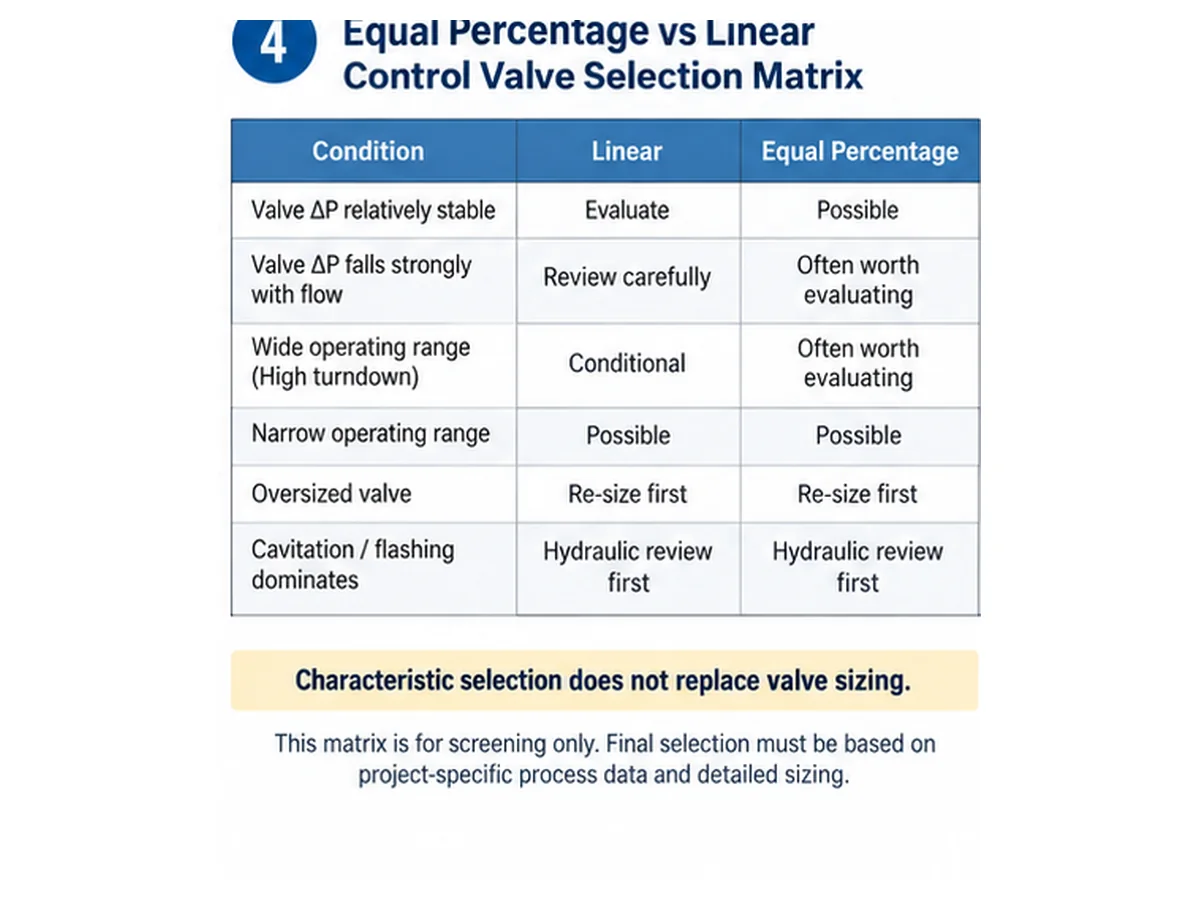
Equal Percentage vs Linear Selection Matrix
| Process / System Condition | Linear | Equal Percentage | What Must Be Verified |
|---|---|---|---|
| Valve ΔP remains relatively stable | Often worth evaluating | Possible | Installed characteristic |
| Valve ΔP decreases strongly as flow rises | Review carefully | Often worth evaluating | ΔP at minimum, normal and maximum flow |
| Broad operating range | Conditional | Often worth evaluating | Required Cv and predicted travel |
| Narrow operating range | Possible | Possible | Normal operating point and gain |
| Candidate valve is oversized | Re-size first | Re-size first | Rated Cv versus required Cv |
| Low-flow controllability is important | Verify carefully | Often worth evaluating | Travel, resolution, friction and gain |
| Cavitation or flashing exists | Secondary decision | Secondary decision | Hydraulic sizing first |
| Gas or steam noise dominates | Secondary decision | Secondary decision | Noise and choked-flow review |
| Pump or system curve changes strongly | Review installed curve | Often worth evaluating | System curve and valve ΔP |
| Process gain varies significantly | Review installed gain | Review installed gain | Complete loop response |
Valve Sizing Should Come Before Final Characteristic Selection
A characteristic comparison requires confirmed minimum, normal and maximum operating cases, including flow, P1, P2, temperature, relevant fluid properties and calculated Cv/Kv. For a broader discussion of required sizing inputs and calculation review, see the Control Valve Sizing Guide.
Where liquid-service conditions create cavitation or flashing risk, also review Control Valve Cavitation vs Flashing. Characteristic preference is secondary if the proposed hydraulic condition already creates unacceptable cavitation, flashing, noise or choked-flow constraints.
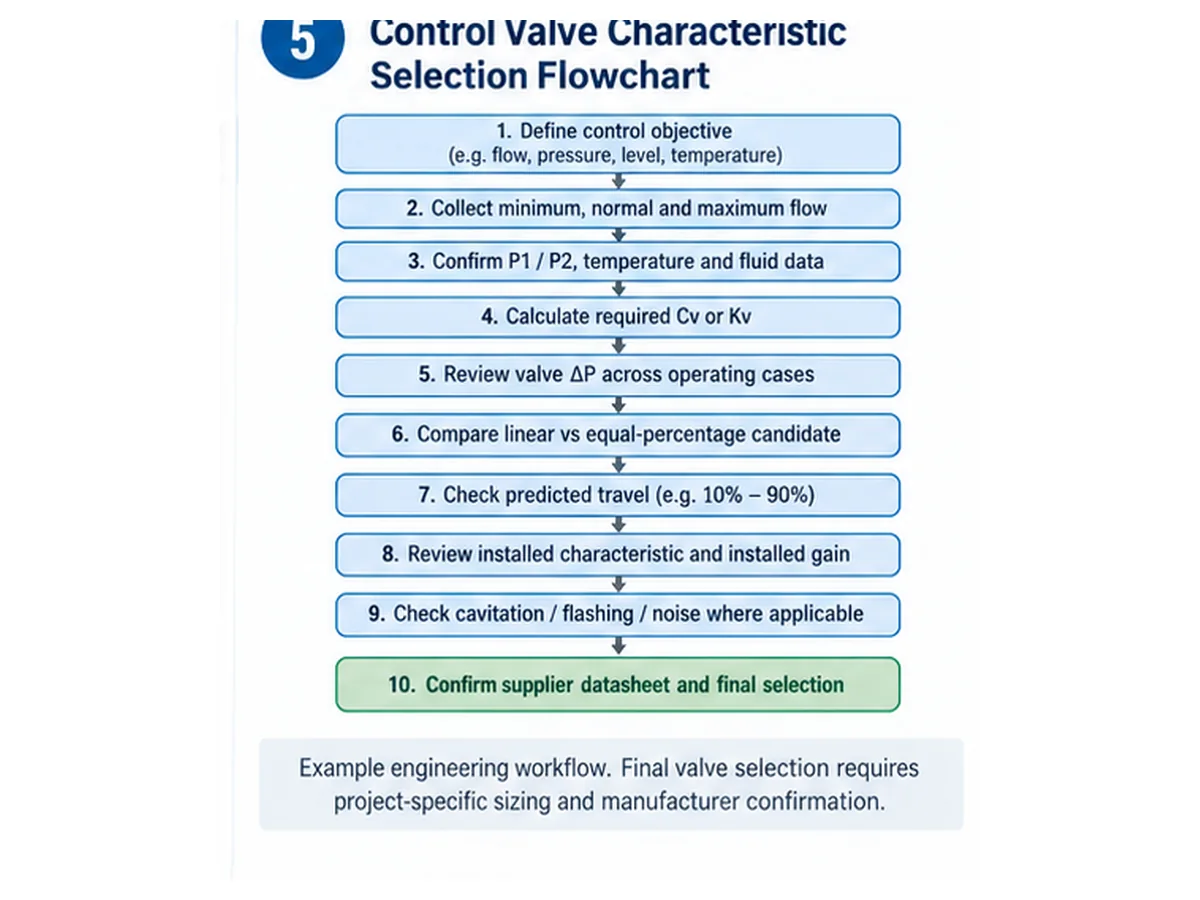
Control Valve Characteristic Selection Workflow
- Define the control objective. Identify the required process response.
- Define minimum, normal and maximum operating cases.
- Confirm P1, P2, temperature and fluid data.
- Calculate required Cv or Kv.
- Review valve differential pressure.
- Compare candidate characteristics.
- Check predicted valve travel.
- Evaluate installed characteristic and installed gain.
- Review cavitation, flashing, choked flow, noise or velocity where applicable.
- Confirm the exact supplier datasheet and trim data.
What Should the Supplier Provide?
- sizing basis and calculation method;
- selected valve size and trim size;
- exact proposed trim designation;
- required Cv/Kv at minimum, normal and maximum flow;
- selected rated Cv/Kv;
- predicted travel at key operating cases;
- proposed inherent characteristic;
- Cv-versus-travel curve or data for the exact proposed trim where available;
- inlet and outlet pressure assumptions;
- calculated valve differential pressure;
- cavitation, flashing or noise review where required;
- actuator and positioner selection basis;
- technical deviations;
- calculation revision, date and assumptions used where relevant.
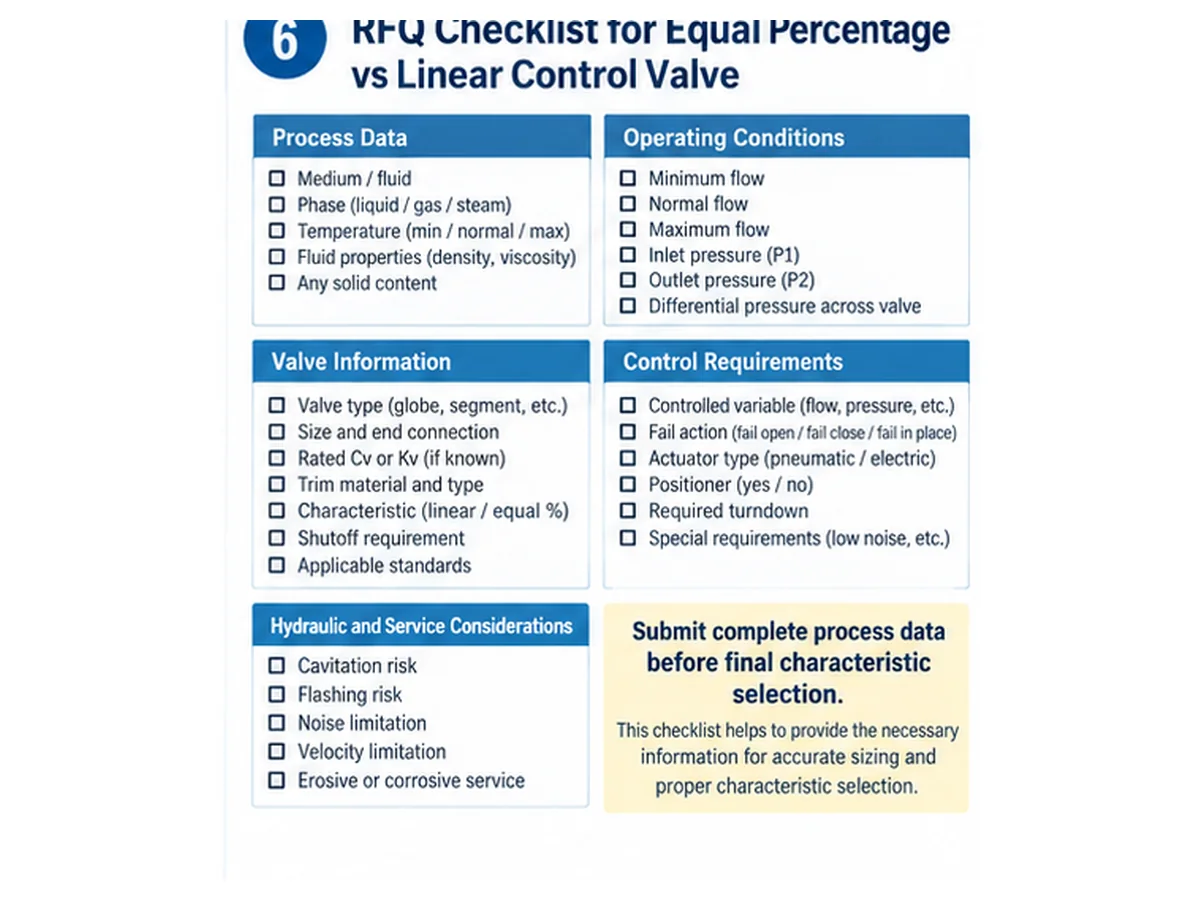
RFQ Data Needed Before Selecting Linear or Equal Percentage
- medium and phase;
- minimum, normal and maximum flow;
- P1 and P2 for each operating case;
- operating temperature;
- relevant fluid properties;
- line size and connection;
- control objective;
- required operating range;
- shutoff requirement;
- fail action;
- noise or severe-service limits where applicable;
- available valve datasheet or existing supplier sizing sheet.
Normalize the Sizing Basis Before Comparing Price
| Comparison Field | Supplier A | Supplier B | Buyer Review |
|---|---|---|---|
| Flow cases | Confirm | Confirm | Same minimum, normal and maximum cases? |
| P1 / P2 | Confirm | Confirm | Same pressure basis? |
| Fluid properties | Confirm | Confirm | Same sizing inputs? |
| Valve size | Confirm | Confirm | Same sizing philosophy? |
| Rated Cv/Kv | Confirm | Confirm | Compare against required values |
| Trim size | Confirm | Confirm | Full or reduced trim? |
| Characteristic | Confirm | Confirm | Linear / equal percentage / other |
| Predicted travel | Confirm | Confirm | Check minimum / normal / maximum flow |
| Valve ΔP | Confirm | Confirm | Same system assumptions? |
| Installed gain | Request if needed | Request if needed | Review variation across operating range |
| Hydraulic limits | Confirm if applicable | Confirm if applicable | Same acceptance basis? |
| Actuator / positioner | Confirm | Confirm | Same fail-action and control requirements? |
| Technical deviations | List | List | Normalize before PO |
Common Selection Mistakes
Assuming Equal Percentage Is Always Better
No characteristic is universally superior. Installed system behavior determines whether the proposed characteristic provides useful control response.
Assuming Linear Trim Means Linear Plant Flow
Linear describes the inherent valve characteristic under defined conditions. Changing system pressure losses can reshape installed flow response.
Choosing Characteristic Before Sizing
Characteristic selection cannot correct a valve that is fundamentally oversized or incorrectly sized.
Treating Catalog Rangeability as Plant Turndown
Usable process range is a system-level result affected by sizing, valve ΔP, actuation, instrumentation and process dynamics.
Checking Only Maximum Flow
Maximum flow confirms capacity, but minimum and normal operating cases often determine whether the valve provides useful controllability.
Ignoring Installed Gain
Two valves that both satisfy maximum Cv requirements can still behave very differently across the required operating envelope.
Final Selection Guidance
It is: Which inherent characteristic produces the required installed response across the actual operating envelope?
A linear characteristic may perform well where valve differential pressure remains comparatively stable and the installed system supports a suitable response. An equal-percentage characteristic may be worth evaluating where valve ΔP falls as flow increases or where a broader operating range must be controlled.
Neither characteristic can compensate for incorrect sizing, unsuitable trim, hydraulic limitations or incomplete process data. Final selection should be confirmed against the actual datasheet, sizing calculation, exact trim curve and project requirements.
Frequently Asked Questions
What is the main difference between linear and equal percentage control valves?
A linear inherent characteristic produces approximately equal changes in Cv for equal changes in valve travel. An equal-percentage characteristic produces approximately equal percentage changes in existing Cv for equal travel increments. Actual installed flow can differ because valve differential pressure changes with the system.
Is equal percentage better than linear for most control valves?
Not universally. Equal percentage is often worth evaluating where valve ΔP decreases as flow increases or the operating range is broad. Linear may be suitable where valve ΔP remains more stable. Final selection should be based on installed behavior.
Why can a linear valve become nonlinear after installation?
Changing piping and equipment losses alter the differential pressure available to the valve, so the relationship between valve travel, Cv and actual process flow can become nonlinear after installation.
What is installed gain in a control valve?
Installed gain describes how strongly actual process flow changes in response to a change in valve position at a specific operating condition. It should be reviewed across the required operating range.
Is control valve rangeability the same as process turndown?
No. Rangeability is a valve characteristic under specified conditions. Usable process turndown also depends on sizing, valve ΔP, actuation, instrumentation, hydraulic limits and process dynamics.
Can changing from linear to equal percentage fix an oversized control valve?
Not necessarily. If rated Cv is much larger than required capacity, normal operation may remain concentrated in a narrow part of valve travel regardless of characteristic. Sizing should be reviewed first.
Request Control Valve Selection Review
Send the medium, minimum / normal / maximum flow, corresponding P1 and P2, operating temperature, line size, control objective, shutoff requirement, required operating range and available control-valve datasheet.
If available, also send the supplier sizing sheet, proposed trim designation and Cv-versus-travel curve. For significant pressure reduction, include the information needed to review cavitation, flashing, choked flow or noise.
Request Control Valve Selection ReviewFor broader product information, see Raymon Valve Control Valves. For company background, see About Raymon Valve.
This article provides a framework for preliminary comparison of linear and equal-percentage control-valve characteristics. It does not determine a final valve size, Cv/Kv, trim, actuator or operating range.
Final selection requires confirmed operating data, the applicable sizing method, actual valve differential pressure, exact manufacturer trim data and any relevant hydraulic, noise, material, shutoff and project requirements.
Where project specifications or owner requirements differ from the general principles described here, the project documents govern.
 English
  German
  Arabic
  French
  Spanish
  Italian
  Portuguese
  Russian