
Hydrogen valve leakage control requires separate limits for gas escaping to atmosphere and gas passing a closed seat. Review the stem packing, seat and body seals against the actual pressure, temperature, gas composition and cycle duty, then check whether the supplier’s test evidence covers that configuration. For an RFQ or technical bid, specify the leakage boundary, measurement method, acceptance criterion and required records. A low-emissions label or a packing certificate alone does not settle those decisions.
This guide addresses gaseous hydrogen service. Liquid hydrogen requires a separate cryogenic design and qualification review. For broader application inputs, use the hydrogen valve application guide. On this page
- Which Hydrogen Valve Leakage Path Must Be Controlled?
- What Service Data Defines the Sealing Requirement?
- How Should Stem Packing Be Reviewed for Hydrogen Service?
- Which Seat Design Details Govern Shut-Off Performance?
- What Do Fugitive-Emissions and Hydrogen Tests Actually Prove?
- Can Helium or Methane Test Results Support the Hydrogen Duty?
- Does the Qualification Report Cover the Supplied Valve?
- What Should the RFQ and Inspection Plan Require?
- Frequently Asked Questions
Which Hydrogen Valve Leakage Path Must Be Controlled?
Define the leakage path before choosing a test or comparing results. A closed valve can pass gas downstream while remaining externally tight; a valve with acceptable seat tightness can still leak at its stem.
Use this review order: identify the leakage boundary, define the acceptance conditions, compare the proposed sealing assembly with relevant test evidence, and resolve coverage gaps before technical release. If the required leakage method or operating case is missing, record an open item rather than assuming the supplier report covers it.
Scroll the table horizontally on smaller screens.
| Leakage path | What the requirement controls | Evidence to request |
|---|---|---|
| Stem or shaft seal | Escape from the moving stem boundary to atmosphere | Applicable external-leakage qualification and production records |
| Body or bonnet joint | Escape at a static pressure-boundary joint | Defined joint coverage, test conditions and measured results |
| Closed seat | Gas passing into the downstream volume or another defined cavity | Seat test procedure, pressure direction, differential pressure and acceptance result |
| End connection | Leakage at the installed piping connection | Connection design, assembly requirements and installation test scope |
| Permeation through a nonmetallic seal | Gas transport through the seal material | Compound-specific data and an agreed measurement interpretation |

External Leakage at the Stem and Body Joints
State which joints are included in the external-leakage acceptance boundary. Do not assume a report covering the stem also covers every body joint or the installed flange connections. The scope exclusions of a selected standard matter as much as its title.
Internal Leakage Across the Closed Seat
Specify the destination of measured leakage, valve orientation or flow direction where relevant, test gas, pressure, duration and permissible result. An isolation requirement must reflect the consequence of downstream gas passing. A valve seat leakage class alone does not establish a safe maintenance isolation arrangement.
Seal Permeation and Interface Leakage
Hydrogen can migrate through some nonmetallic materials as well as through imperfect sealing interfaces. The mechanisms require different interpretation; a detector reading alone does not establish the cause. Ask how the procedure handles stabilization, background and the measurement boundary. Sandia’s hydrogen materials reference provides a starting point for compatibility review, rather than approval of a particular seal compound or valve.
What Service Data Defines the Sealing Requirement?
A valve size and pressure class do not complete the sealing specification. State the tag, valve function, size, end connection and proposed sealing construction, then provide the following controlling inputs:
- Hydrogen concentration, other gas constituents, moisture, particles and cleanliness requirements.
- Minimum, normal and maximum operating temperatures and pressures, together with design conditions.
- Maximum shut-off differential pressure, pressure direction and any reverse-pressure case.
- Operating frequency, stem motion, stroke or rotation and required service cycles.
- Pressure cycling, temperature cycling and depressurization cases, including their rates where relevant.
- Separate external and seat leakage requirements, with test conditions and acceptance methods.
- Function, fail position, actuation, access and maintenance constraints.
Identify which conditions occur together. A temperature extreme, maximum differential pressure and maximum cycling rate may represent different operating cases. Pressure class is a rating designation, not a fixed allowable pressure: the applicable material group, temperature and valve design govern the pressure-temperature review. The ASME B16.34 valve-rating scope is one relevant basis where specified; its official page lists the 2025 edition. Check the adopted edition and exact construction, then confirm the seat, packing and gasket limits separately.
Illustrative service-envelope check: an RFQ includes a cold startup case, but the offered leakage report documents only ambient testing. The gap is the unrepresented temperature case, not necessarily a defective valve. Ask for a service-to-qualification comparison and relevant additional evidence, or an explicitly restricted proposal, before approval.
Assign the valve function first. An on-off isolation valve needs a defined shut-off duty; a modulating valve also needs movement, control and friction requirements. Leakage evidence for one operating pattern is not sufficient justification for another without a coverage assessment.
Keep hydrogen compatibility and mechanical integrity as separate review items. Map hydrogen-exposed body, stem, trim, springs, welds, seats and seals to the applicable material evidence and manufacturing condition. A low measured leak rate does not prove resistance to hydrogen-related degradation. Retain material identity and relevant heat-treatment or processing records; suitability of the body material does not establish suitability of the stem, springs or seals.
How Should Stem Packing Be Reviewed for Hydrogen Service?
Packing Grade, Ring Arrangement and Extrusion Control
Treat packing as a controlled assembly. Review the exact grade or compound, ring dimensions, quantity, order, adaptor rings and extrusion-control features. A description such as “PTFE packing” leaves important design variables unresolved.
Nonmetallic seal review should address gas exposure, temperature, pressure, permeation and decompression behaviour as applicable to the exact material and geometry. Material-family data can support screening, but the supplier must explain how it applies to the proposed assembly.
Stem Condition, Gland Loading and Operating Friction
The review should connect packing selection to stem diameter, surface condition, coating, stuffing-box dimensions, gland alignment and loading procedure. Request the design limits and assembly records relevant to the qualified configuration.
Increasing gland load can increase operating friction. A leakage remedy therefore needs an operability check, including the torque or thrust basis for an actuated valve. Do not specify an actuator from valve size alone. The valve stem packing resource explains the broader system variables.
Illustrative operability check: a proposed packing adjustment reduces a measured leak but raises the operating load. Increased seal friction is one possible explanation; the leakage result alone does not show that the valve can still meet its travel or fail-action requirement. Compare the approved loading limits and torque/thrust evidence before accepting the change. This is a design-review example, not an instruction to adjust a valve in service.
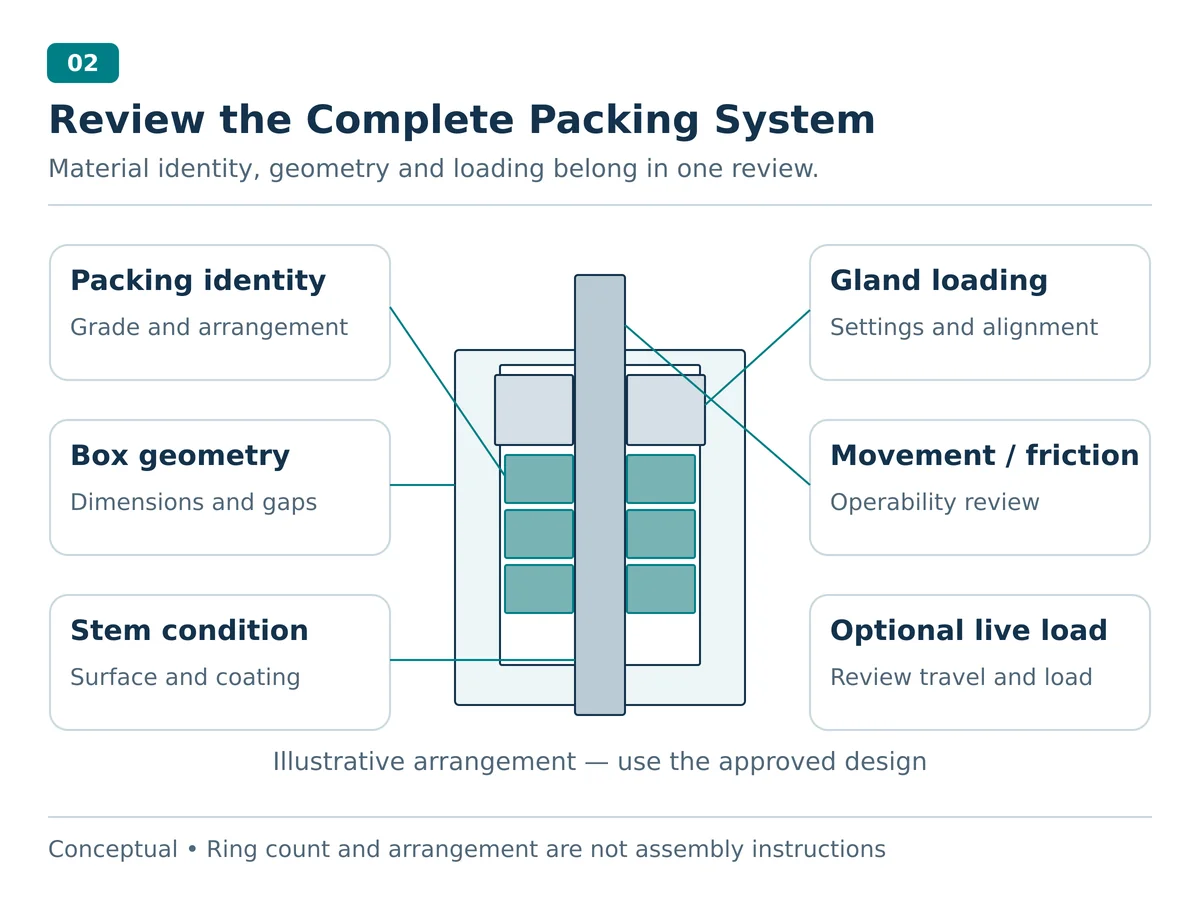
Live Loading and Alternative Stem-Sealing Designs
Live loading uses springs to maintain a controlled packing load within the designed travel and load range. Review the settings, available travel, operating temperature and maintenance instructions. The presence of springs does not itself prove emissions performance.
Bellows or other alternative stem-sealing designs also need configuration-specific evidence. Review the relevant pressure-temperature limits, movement and cycling duty, secondary containment where provided, and inspection or replacement requirements. Select the route from its demonstrated envelope.
When Does a Sealing Route Need Further Evidence?
- PTFE-based or other polymer seals: request the exact compound and assembly limits for the specified temperature, pressure, movement and gas exposure. Stop approval where only a material-family name is offered.
- Graphite-based packing: assess the actual packing system and its applicable test coverage. A high-temperature capability statement does not establish the required hydrogen leakage performance.
- Live-loaded or alternative stem seals: request the defined load/travel or movement envelope and configuration-specific evidence. A design feature is a review direction, not a qualification result.
Where elastomeric seals experience pressure cycling, include decompression conditions in the compound review. Sandia research on hydrogen decompression in elastomers supports examining this mechanism; it does not qualify every elastomer or predict the life of a supplied seal.
Which Seat Design Details Govern Shut-Off Performance?
Soft Seats and Metal Seats: Compare the Actual Design
Soft-seated and metal-seated valves should be compared against the required shut-off duty, rather than ranked by material category. Ask how the selected seat handles the service temperature, pressure, gas exposure, particles, wear and repeated operation.
For nonmetallic seats, obtain the exact material designation and supporting limits. For metal seats, review the sealing surfaces, coating or overlay where used, contact geometry and required closing load. Neither construction establishes an acceptable leakage rate without a defined test and result.
Pressure Direction, Cavity Behaviour and Cycling
Confirm which pressure direction establishes the required seal and whether reverse pressure is part of the duty. For valves with a body cavity, document the seat arrangement, cavity-pressure management and any relief route. Do not infer double isolation or a particular cavity-relief function from the product name.
Record whether seat leakage is checked initially, after cycling, or at other agreed stages. An initial result supports the tested condition; evidence for performance after cycling requires the relevant sequence and measurements.
Illustrative seat-test check: a bid describes shut-off performance in both directions, while its report identifies only one test direction. The unresolved point is coverage of the reverse-pressure duty. Check the seat and cavity arrangement, request the relevant directional evidence and record any deviation before technical acceptance. Do not extrapolate from a passing result in the opposite direction.
For general acceptance distinctions, see isolation versus control valve leakage standards.
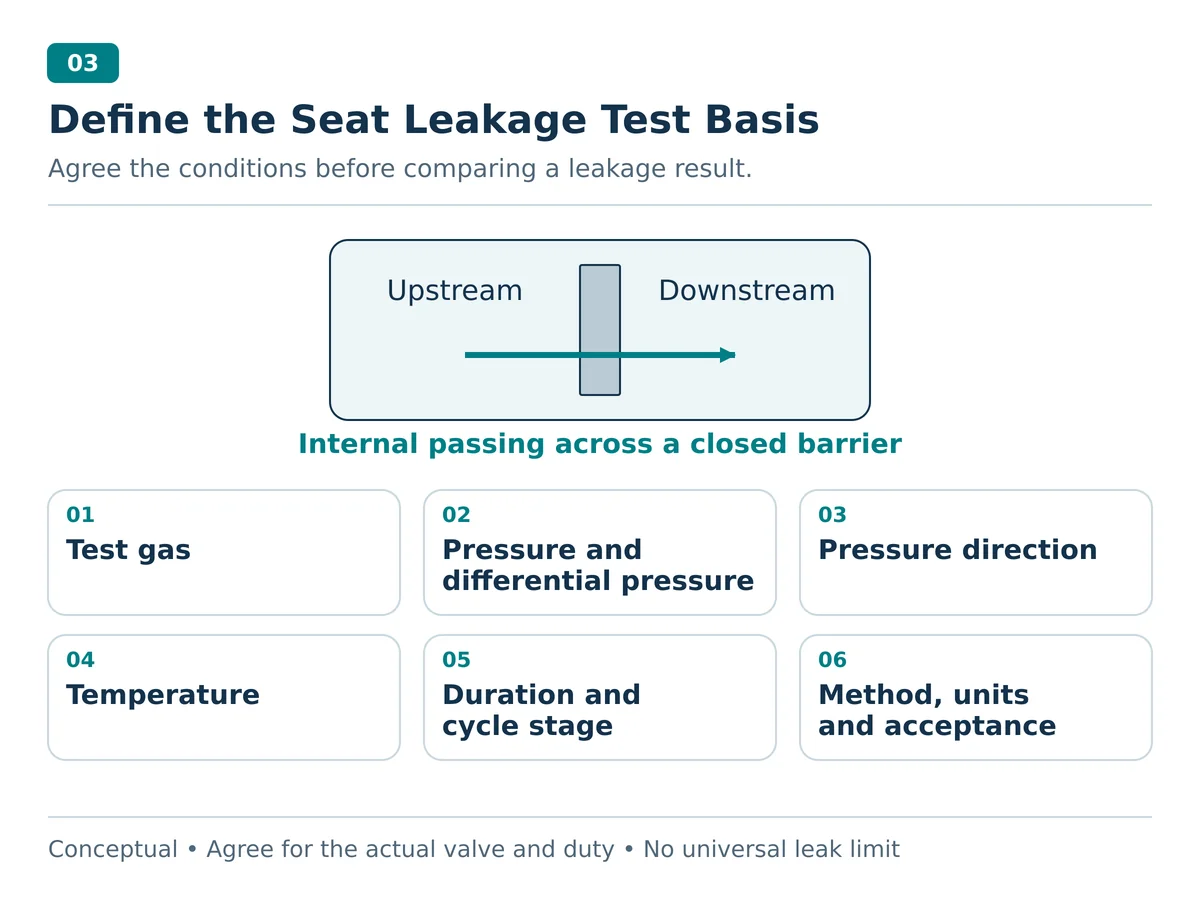
When reviewing an isolation proposal, compare the actual construction in the ball valve range against the specified duty. A category listing does not establish hydrogen qualification for an individual valve.
What Do Fugitive-Emissions and Hydrogen Tests Actually Prove?
Testing requirements should identify the document edition, applicable scope, purchaser options and acceptance criteria. A collection of standard numbers is insufficient.
For procedure, witness and record requirements, use the fugitive-emissions test planning resource alongside the project specification.
Scroll the table horizontally on smaller screens.
| Evidence route | Principal review purpose | Limit to retain |
|---|---|---|
| ISO 15848-1 | External-leakage type testing and qualification | Does not establish seat leakage acceptance or cover end connection joints |
| ISO 15848-2 | External-leakage production acceptance testing | Does not replace the type-test qualification review |
| API 622 | Process valve packing type testing | A packing report alone does not qualify the supplied complete valve |
| API 624 | Fugitive-emissions type testing of rising and rising-rotating stem valves with graphite packing within the standard’s scope | Verify valve construction, packing and qualification coverage |
| API 641 | Quarter-turn valve fugitive-emissions type testing within its scope | Verify the applicable design and tested conditions |
| API 6D hydrogen provisions | Applicable product requirements for hydrogen gas service | Confirm contract edition, applicability and required supplementary scope |
| ISO 19880-3 | Safety performance requirements and test methods for valves within its hydrogen-station scope | Do not extend the scope to every industrial hydrogen valve |
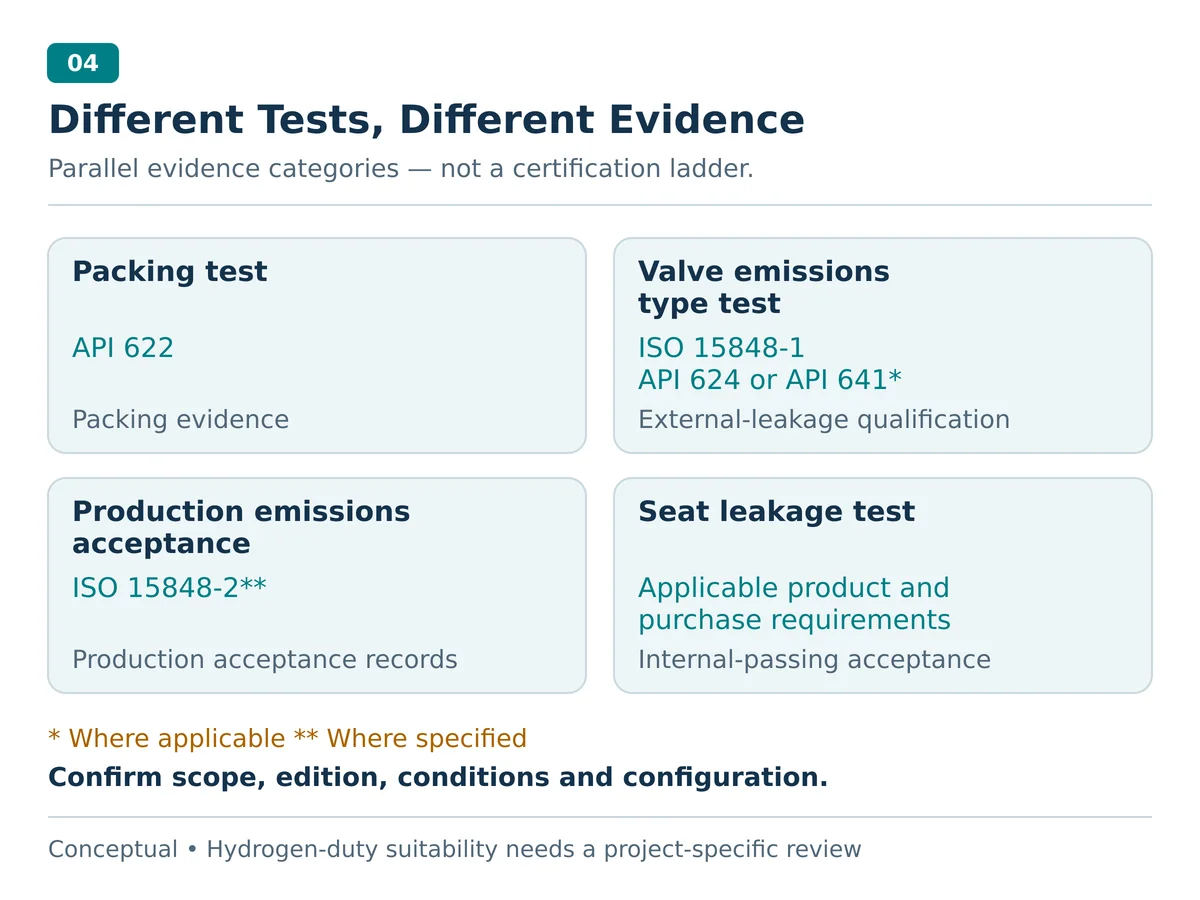
ISO 15848-1:2015 covers external leakage at stem or shaft seals and body joints. Its published Amendment 1 is ISO 15848-1:2015/Amd 1:2017. At the source check on 3 November 2026, ISO 15848-1:2015/AWI Amd 2 was under development; it is not a published amendment. ISO 15848-2:2015 addresses production acceptance and remained published with a revision project listed. A developing amendment or replacement must not be presented as a published requirement.
API announced hydrogen Annex M in Addendum 2 to API 6D, 25th Edition, in September 2024. Its official announcement establishes that publication history. As checked on 3 November 2026, the API update register also lists Addendum 3 (March 2025) and Errata 4 (October 2026) for that edition. Specify the project-adopted edition and applicable revision set; the listing alone does not explain each revision’s technical effect or determine its contractual applicability.
ISO 19880-3:2018 addresses specified high-pressure gas valves in gaseous hydrogen stations up to the H70 designation. Application outside that scope needs its own assessment.
A shell test checks the pressure boundary under its specified conditions; a closure or seat test checks shut-off across the closed seat. A backseat test, where applicable, addresses a separate sealing feature. Functional, fire, cryogenic and fugitive-emissions tests have their own purposes. Material identification and NDT supply different evidence again: a pressure test does not establish the absence of every internal defect, and a witness signature does not expand a test’s scope.
The API 624 scope summary above follows the API publications catalog. Confirm the adopted edition, addenda and detailed coverage rules before writing the purchase requirement.
Sources and Version Notes
Source status checked on 3 November 2026. Publisher records distinguish published documents, developing work and listed revisions; use that distinction when defining the approved document set. The two ISO references above have different purposes: general external-leakage qualification and the specific hydrogen-station scope.
The 2025 API catalog supports the scope summaries for API 622, API 624 and API 641; it is not a complete current amendment register. Confirm their latest applicable edition and revision set with the publisher and project specification. The scope summaries here do not reproduce or replace the full standards.
Can Helium or Methane Test Results Support the Hydrogen Duty?
A helium or methane report can be relevant evidence when its use is accepted by the governing standard and project specification. It should retain its actual test-gas designation. Do not relabel it as a hydrogen test.
Require the supplier to state the gas composition, pressure, temperature, measurement method, calibration, units, detection capability and stabilization conditions. A concentration reading and a total leak rate are different measurements; they cannot be compared as bare numbers.
A result reported as “not detected” must retain the method’s detection or reporting limit, measurement boundary and test conditions. It establishes non-detection at the stated capability, not absence of leakage below that capability or outside those conditions. Assess the reporting capability against the specified acceptance criterion before accepting the result.
This guide provides no universal conversion factor between helium and hydrogen leakage. If a correlation is proposed, require its technical basis and project approval for the particular configuration and mechanism. Where evidence does not cover a required hydrogen condition, record the gap and agree a justified qualification route. Additional hydrogen testing, if required, belongs in an approved procedure at a suitably equipped facility.
Which Evidence Helps Explain a Leakage Change?
The following patterns are investigation prompts, not diagnoses. If hydrogen leakage is suspected in service, follow the site response and isolation procedures. Inspection, disassembly or adjustment requires the approved manufacturer and site procedure; this table is not a live-service repair instruction.
Scroll the table horizontally on smaller screens.
| Observed pattern | Possible causes to assess | Evidence that helps distinguish them |
|---|---|---|
| Stem leakage appears after cycling | Packing wear or relaxation, stem damage, misalignment, or service beyond the qualified envelope | Leakage-versus-cycle record, temperature history, loading records and condition inspection after safe isolation |
| Leakage changes after depressurization | Seal damage, loss of contact, or gas permeation/stabilization effects | Pressure-time history, exact seal compound, approved test stabilization record and post-test examination |
| Seat passing is direction-dependent | Directional sealing behaviour, different pressure loading, or damage/contamination | Approved seat/cavity drawing and separately identified directional test results |
| Leakage falls but operating load rises after adjustment | Increased packing friction or another source of mechanical resistance | Approved adjustment record and torque/thrust trend against manufacturer limits |
| Results differ between test setups | Different gas, units, collection boundary, background, stabilization or calibration | Complete procedures, instrument records and a comparison on an agreed measurement basis |
Does the Qualification Report Cover the Supplied Valve?
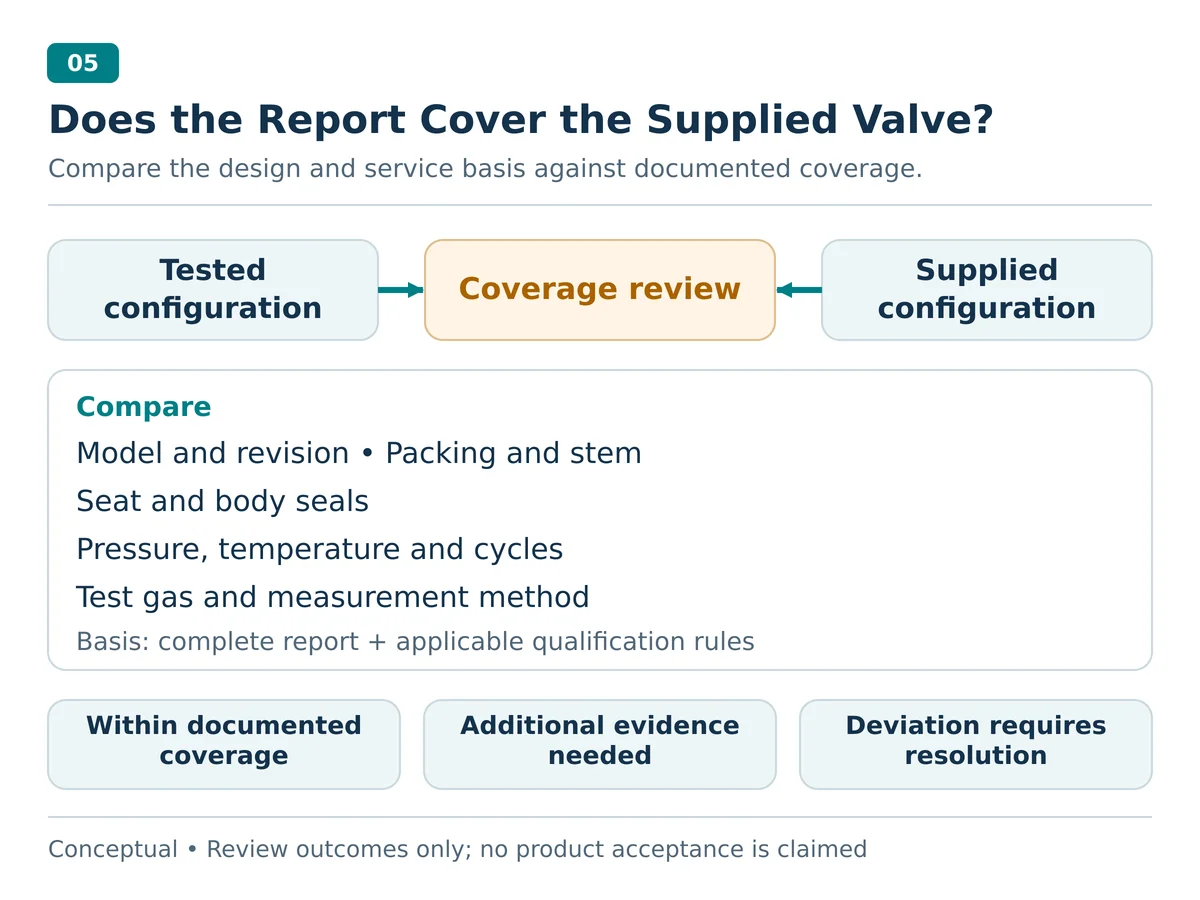
Use the complete report and controlled design records to compare the tested valve with the proposed supply. An exact match is one route; an extension is acceptable only where the applicable qualification rules and supporting evidence justify it.
A certificate, letter of attestation or summary can identify an approval or test outcome, but its title alone does not establish all the evidence needed for your duty. Request the underlying complete report and relevant supporting records: specimen identity, configuration, conditions, recorded results, adjustments, deviations and the basis for coverage of the supplied valve. Assess the documents together against the claim being made.
Scroll the table horizontally on smaller screens.
| Review item | Evidence to compare | Action when unresolved |
|---|---|---|
| Product identity | Manufacturer, model, drawing revision and specimen identification | Establish a traceable design link |
| Sealing assembly | Packing, stem, seat and body-joint details | Obtain a configuration comparison |
| Qualification designation | Full achieved classification/designation, test fluid, tightness, temperature, endurance and adjustment basis as applicable to the adopted standard | Compare with the purchase requirement; do not infer a universal hydrogen target class |
| Qualification envelope | Tested conditions and permitted coverage rules | Request a documented applicability assessment |
| Cycles and adjustments | Sequence, measurements, retightening, repairs and replacements | Obtain the complete test history |
| Measurement quality | Method, gas, units, calibration and detection capability | Resolve comparability before accepting results |
| Production controls | Assembly procedure, material identity and specified acceptance records | Add the missing requirements to the ITP |
| Design changes | Substitutions or revisions since qualification | Assess their effect on coverage before release |
Illustrative bid-review case: a quotation proposes a different packing grade from the type-test report. Ask the supplier to identify the change, cite the applicable coverage rule and provide a configuration comparison. If the justification is insufficient, agree additional evidence or an alternative qualified construction before approval. This example contains no Raymon product test result.
Maintain an evidence-gap register with the affected tag and requirement, missing record, responsible party, proposed resolution and required closure stage. The supplier explains applicability; the designated purchaser reviewer accepts or rejects the proposed basis.
Scroll the table horizontally on smaller screens.
| Evidence position | Purchaser action | Record to retain |
|---|---|---|
| Within documented coverage | Proceed with the remaining material, functional and production requirements | Approved applicability assessment and controlled configuration |
| Coverage gap or measurement mismatch | Hold technical acceptance of the affected requirement until resolved | Agreed evidence plan, owner and closure point |
| Proposed departure from the specification | Use the project deviation process before manufacture or release as applicable | Accepted deviation or corrected proposal |
What Should the RFQ and Inspection Plan Require?
Ask bidders to respond against the same requirements. The RFQ should contain the service inputs above, the controlled valve datasheet and separate leakage acceptance schedules.
For each required test, record:
- The leakage boundary and purpose.
- Standard, edition, approved procedure and purchaser options.
- Test gas, pressure, temperature, direction, duration and cycle sequence as applicable.
- Measurement method, units, acceptance limit and required reporting.
- Whether testing is a type qualification, a sample check or a specified production test.
- Witness or review points, deviation handling and final record identification.
Require bidders to mark items as included, excluded, proposed deviation or awaiting project input. Do not leave an omitted test indistinguishable from an included test. Identify pressure/closure testing and external-emissions testing as separate procedures and records in the inspection and test plan (ITP).
Normalize the Bid and Documentation Scope
- Qualification: list the complete report, applicable coverage statement and any additional work separately.
- Production testing: identify every-valve versus sample scope, measurement conditions, reporting and witness requirements.
- Configuration control: tie the approved packing, seat, stem and body seals to drawings, parts and change review.
- Deliverables: state which records accompany each tag or serial number, including deviations and replacement-seal instructions.
Before technical release, confirm that both leakage boundaries have agreed acceptance criteria, controlling service cases have supporting evidence, configuration differences have an accepted disposition, and the ITP includes the required production records. Qualification testing and production acceptance should remain separately identifiable in the bid.
Define intervention points in the agreed ITP. A hold point requires the specified release before work proceeds; a witness point provides the agreed notification and opportunity to attend, with attendance or waiver handled under the contract. State who reviews results and closes nonconformances. Before freezing the revision set, compare the adopted API requirements with the official API standards update register.
Ask for Testing and Documentation Scope
Send your valve datasheet to Raymon Valve with the valve function, hydrogen composition, pressure-temperature cases, maximum shut-off differential pressure and cycle duty. Include separate seat and external-leakage criteria, purchaser standards and required witness points.
If you are comparing quotations, also provide the offered seal configuration and the test-report scope you need clarified. Request a response that separates available evidence, proposed testing, documentation inclusions and technical deviations.Request Testing and Documentation Scope
Frequently Asked Questions
Does ISO 15848 qualification prove hydrogen suitability?
It provides evidence for the external-leakage qualification it covers. Review test conditions, configuration, materials and hydrogen-duty requirements separately before accepting the valve for service.
Is an API 622 packing report sufficient for the complete valve?
No. It concerns packing testing. Complete-valve evidence and any permitted qualification coverage must address the actual valve construction and project requirements.
Can helium leak-test results be directly converted to hydrogen leakage?
Do not use an unsupported conversion. Interpretation depends on the mechanism, configuration, gas conditions and measurement method. Require an accepted technical basis for any proposed correlation.
Does a seat leakage test cover fugitive emissions?
No. Seat leakage measures passing across the closed seat under specified conditions. External leakage at the stem and body joints needs its own applicable assessment.
Are soft seats always better for hydrogen shut-off?
No universal ranking is appropriate. Compare the actual construction, material, service envelope, cycling and demonstrated leakage performance.
What evidence should a supplier submit for a hydrogen valve?
Request the approved datasheet, controlled configuration, relevant qualification reports and coverage assessment, applicable material records, ITP, specified production test results and documented deviations. Match the dossier to the supplied item and revision.
Engineering Note
Prepared by the Raymon Valve Technical Content Team for screening and RFQ preparation in gaseous hydrogen service. The decision tools support project review; they are not standard-mandated acceptance rules. Final suitability depends on approved service data, applicable codes, material review, supplied configuration and accepted qualification evidence.
The diagrams are conceptual and no model-specific Raymon hydrogen qualification report is presented here. Confirm the manufacturer’s proposed testing and documentation scope against current procedures and the exact offered model. Use the approved site procedures for isolation and maintenance; the article does not replace responsible project review.
 English
 German
 Arabic
 French
 Spanish
 Italian
 Portuguese
 Russian