
A valve functional test report supports factory acceptance test (FAT) sign-off when each required result can be traced to the tested valve assembly, approved procedure, test conditions, and recorded evidence. Match the valve tag first. Then compare the measured travel, position feedback, stroke time, and specified fail action with the project acceptance criteria. If a result only says “PASS” and the required evidence is missing, keep that item open and request the source record. Check shipment authorization separately.
In this guide
- Report review checklist
- Valve assembly and approved documents
- Travel, feedback, and stroke time
- Fail-action evidence
- Acceptance requirements and test records
- Closing-time example
- Deviations and release readiness
- Frequently asked questions
Valve Functional Test Report Review Checklist
Use this checklist to review a valve functional test report for an actuated on-off or modulating valve assembly. Review each row against the approved datasheet, purchase specification, FAT procedure, and inspection and test plan (ITP). Record the test outcome and the documentation review status. A measured result can meet its limit while a required witness signature or supporting record remains outstanding. Match each review item to its ITP row and identify who can close it.
Scroll the table horizontally to see all columns.
| Review item | Acceptance basis | Evidence to check | If evidence is incomplete |
|---|---|---|---|
| Valve identity and tested configuration | Approved datasheet and assembly documents | Valve tag, required traceability identifier, actuator model, and accessories included in the test | Request the record that links the valve functional test report to the assembly offered for release. |
| Travel and position feedback | Specified travel and feedback requirements | Direction of movement, verified valve position, and corresponding feedback at the required points | Ask how actual position was verified and request results for any missing points. |
| Opening and closing time | Approved timing method and direction-specific limits, where specified | Start and end events, measured time and unit, supply conditions, and differential pressure when required. If specified, check the timing instrument or recorder ID, calibration or verification status, timing resolution, required cycle count, and result for each cycle. | Request the original timing record or another traceable record accepted by the project procedure. |
| Fail action | Approved cause-and-effect document or project fail-action requirements | Defined trigger, actual final position, and response time or holding period where specified | Identify the missing event or condition and agree on the required evidence or repeat test. |
| Witnessing and deviations | Approved ITP and project disposition process | Applicable witness or hold-point record, approval authority, approved deviations, and any retest and closure references | Keep the affected item open until the required evidence or authorized disposition is recorded. |
| Delivered reporting scope | Purchase order, approved ITP, and document list | Final report revision, tag-linked result sheets, required source records, and applicable release documentation | List missing documents by tag and revision and assign a closure owner. |
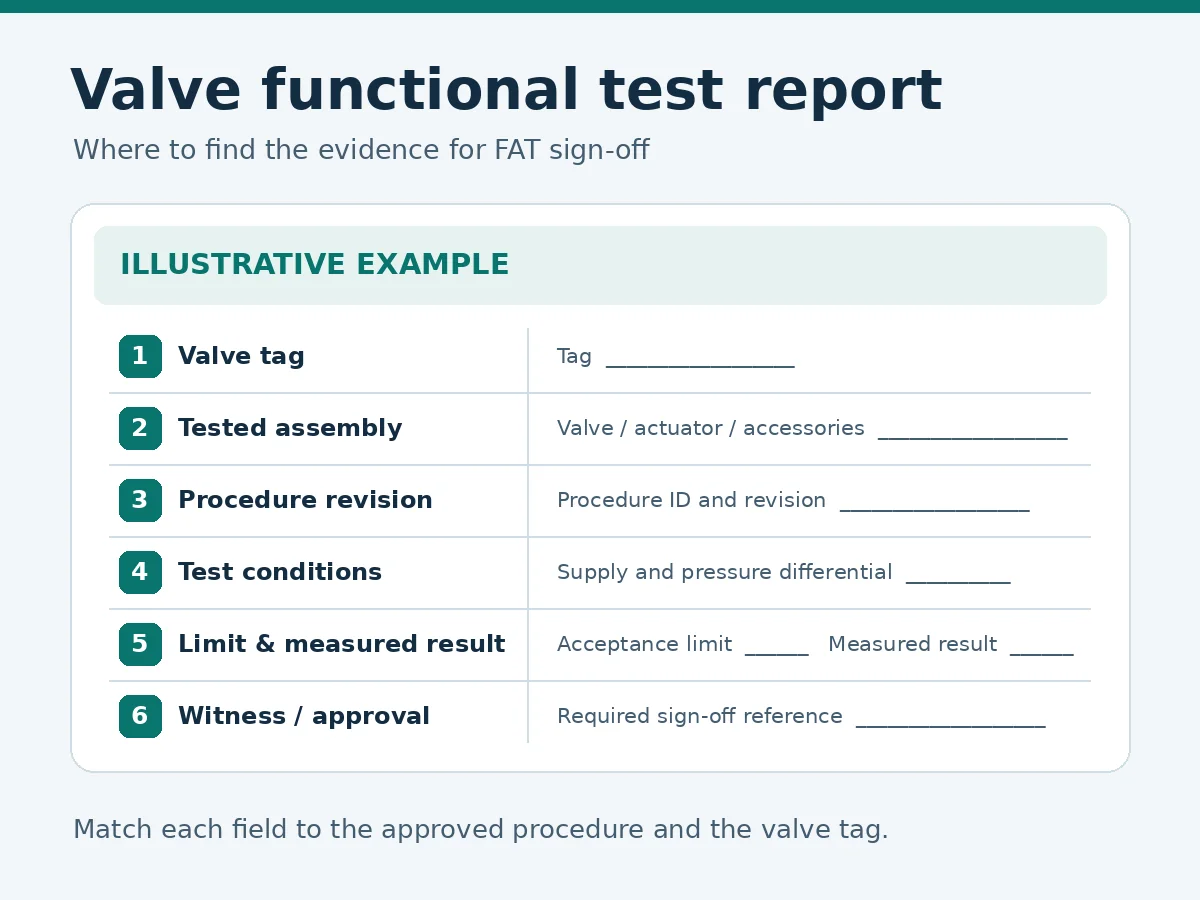
Match the Valve Functional Test Report to the Tested Assembly
Identify what was tested
Match the report to the valve tag and its required traceability identifiers. For a batch report, check which results apply to each valve and whether the ITP permits the reporting or sampling arrangement used. For an assembled package, check that the report identifies the valve, actuator, and accessories relevant to the tests performed. These may include a solenoid valve, limit-switch box, or positioner.
If a supplier changed a component or setting after FAT, record the change and assess which results it could affect. For example, a replacement limit-switch box can change the feedback switching point. Compare the as-tested and as-built records, verify the approved switch settings, and request the checks required by the project change procedure. See Actuated Valve Packages for typical package components and interfaces.
Check the acceptance basis
Confirm that the valve functional test report cites the applicable revisions of the datasheet, FAT procedure, and ITP. Where the supplier tested to an approved deviation, request the disposition reference and confirm which tags and requirements it covers. If the report uses a different limit from the approved procedure, resolve the discrepancy before accepting that row.
Verify Travel, Position Feedback, and Stroke Time
Compare the command, valve movement, and feedback
For an on-off valve, confirm the required open and closed positions and check that each indication corresponds to the verified valve position. If the valve functional test report lists only the switch state, ask how the tester confirmed its relationship to actual position. For a modulating valve, review the command points, observed travel, and reported feedback at the points specified in the approved procedure. Apply the project tolerance where one is specified. For industrial-process control valves within its scope, IEC 60534-4:2021 covers inspection and routine tests. Its actuator requirements apply to pneumatic actuators. Confirm the governing requirements for other actuator types in the project documents.
Check where the timer started and stopped
Record the direction tested, the start event, the end event, and the measured time. First movement to end of travel measures the movement interval. Command to confirmed end-position feedback measures the interval from the command to the feedback event. If the project specifies separate opening and closing limits, check both results.
Keep the measured value and unit with the original timing record. If the approved procedure specifies a timing resolution or requires a calibrated or verified instrument, check the recorder ID, applicable status at the test date, and recorded resolution. If repeated cycles are required, verify the cycle count and retain each result so the acceptance rule can be applied to the recorded data.
Compare the recorded test conditions with the required basis. For a pneumatic package, check where supply pressure was measured and whether the procedure requires a reading during movement. For an electric package, check the specified power supply condition. Where the approved test case specifies differential pressure across the valve, verify the recorded pressure difference and direction. For example, a bench test with no imposed valve differential demonstrates movement under that bench condition. If the purchase specification calls for a loaded stroke, check for the specified test record or a project-approved alternative.

Review Fail-Action Evidence for Each Specified Event
An entry such as Fail action: PASS in a valve functional test report needs enough detail to identify the event exercised and the response observed. Where the project specifies separate responses to loss of air, loss of power, or loss of command signal, review each event against its own criteria. For example, a trace showing a response to loss of command leaves any required air-loss response open. Check the trigger recorded in the test sheet against the approved cause-and-effect document.
For each applicable event, look for the initial position, the trigger applied, the actual final position, and any required response time or holding period. If the requirement is to hold the last position, check the stated observation period and allowed movement where specified. For an emergency shutdown package, confirm which interfaces the FAT exercised and check the project records for any required site or end-to-end validation. See ESD valve package testing for the scope of factory tests and safety-function verification.
Match Each Acceptance Requirement to Its Test Record
A supplier may submit several test sheets in one FAT dossier. Link each requirement to its own evidence. Shell testing checks pressure-boundary integrity, seat testing checks closure leakage under specified conditions, and functional testing records the specified movement and response of the tested assembly. Use the same valve tag or approved traceability identifier to connect the valve functional test report with the other records in the dossier. See the Valve Pressure Testing guide for shell and closure test documentation. For the scope and evidence of the underlying functional checks, see the valve function testing guide.
ISO 5208:2015 covers pressure-boundary and closure tests for metallic valves within its scope, as referenced by the applicable product standard. Use the approved purchase specification, governing editions, and ITP to determine the evidence required for each test.
Worked Example: A Closing-Time Result Marked “PASS”
Assume the approved procedure measures closing time from issue of the close command to confirmation of closed-position feedback. In this example, the supplier’s valve functional test report records the result as Closing time: PASS.
First, request the measured time and the corresponding timing record. Ask the supplier to identify the valve tag, procedure revision, start event, end event, and test conditions required by the procedure. If the original record captures the specified interval and the approved conditions, the supplier can reference it in the revised report through the project’s document-control process.
If the record starts when the actuator first moves and ends when the movement stops, it demonstrates the measured movement interval. The required command-to-feedback interval remains unverified. If an original event log captures both required events on a common or verified synchronized time base, check whether the approved procedure allows that log to establish the interval. If those events cannot be reconstructed from accepted evidence, refer the item for disposition and repeat the check if required.
Illustrative review record
Valve tag and requirement Example tag XV-DEMO-01. Approved FAT procedure, closing-time check. Required timing basis Close command issued to closed-position feedback confirmed, under the conditions specified by the procedure. Supplier entry and review status Closing time: PASS. Measured interval, timing events, and source record are missing from the entry. Open. Request to supplier QA Provide the tag-linked source record with the measured interval, timing events, units, and applicable test conditions. Include the procedure and report revisions. Closure basis The authorized reviewer verifies the accepted evidence against the approved requirement and records its reference in the issue log. If the record cannot substantiate the required interval, refer the issue for project disposition or an approved repeat test. Closure reference remains pending.
Close Deviations and Confirm Release Readiness
Decide whether to accept, request records, or refer the result
Scroll the table horizontally to see all columns.
| What the file shows | Review decision | What to record |
|---|---|---|
| The tested configuration, method, and conditions match the approved basis. The result meets the limit. | Accept the individual result if the required records and approvals are complete. | Valve tag, requirement reference, measured result, record revision, and applicable sign-off. |
| The summary says “PASS,” and the original measurement may exist. | Request the traceable original record and keep the item open pending review. | Missing field, requested record, responsible party, and closure reference. |
| The test used a different timing method, condition, or assembly configuration. | Refer the difference through the project disposition process. Determine whether equivalent evidence, an approved deviation, or a repeat test is required. | Actual and required methods or conditions, affected tags, disposition authority, and any repeat-test reference. |
| A traceable measurement exceeds the approved limit. | Record the nonconformance and follow the approved corrective action and disposition process. | Original result, limit, affected tags, disposition, and any required verification after correction. |
Before signing, work through the outstanding items by valve tag. Confirm that the final valve functional test report references each required result, that the relevant ITP witness or approval signatures are recorded, and that each deviation has an approved disposition. Where a repeat test was required, link the new result to the original finding.
Check what your signature authorizes. A signature may acknowledge witnessing, accept a defined test result, or approve release, depending on the project documents. At a witness point, check the notification, attendance, waiver, or other record required by the ITP. At a hold point, verify clearance by the authority named in the ITP before proceeding past the specified stage. Before dispatch, obtain the release authorization required by the order and document any open items the project has explicitly approved for later closure. For how hold points, witness roles, and release records are documented, see the valve inspection and ITP guide.
Engineering note. The example uses an illustrative timing definition. Apply the method, limits, and approval authority stated in the project documents. Where the project requires performance evidence at a specified service load or for an installed safety function, review the records required for that condition.
Frequently Asked Questions
What should a valve functional test report include?
Include the valve tag, tested assembly configuration, approved procedure revision, test conditions, measured results, acceptance criteria, and required sign-offs. Add instrument IDs, source records, and approved deviations when the procedure or inspection and test plan (ITP) requires them.
Is “PASS” enough for a valve stroke-time test?
A summary status can support sign-off when the approved procedure permits it and the required evidence is traceable. If measured time, units, or timing events are required, confirm that they appear in the report or its referenced source record.
Does a valve pressure test report cover functional testing?
Check the scope of the submitted dossier. Shell and seat records cover pressure-boundary integrity and closure leakage under specified conditions. Find the functional test sheets for required travel, position feedback, timing, and fail action.
When should a functional test be repeated?
Refer the result for project disposition if the tested assembly changed, the conditions or method differed from the approved procedure, or a required result cannot be traced. The authorized reviewer determines whether accepted evidence, an approved deviation, or a repeat test can close the item.
Request a Valve FAT Documentation Review
Send the affected valve tags, approved datasheet, relevant FAT procedure section or ITP row, and the current revision of the supplier’s valve functional test report. Include the timing trace, feedback record, or deviation reference if available. Identify which requirement is open and whether you need to review the acceptance basis, reconcile the evidence, or define the records required before release.Request a Valve FAT Documentation Review
For a package that has yet to be tested, include the specified fail action, timing definition, supply conditions, and any required differential-pressure test case.
 English
 German
 Arabic
 French
 Spanish
 Italian
 Portuguese
 Russian