
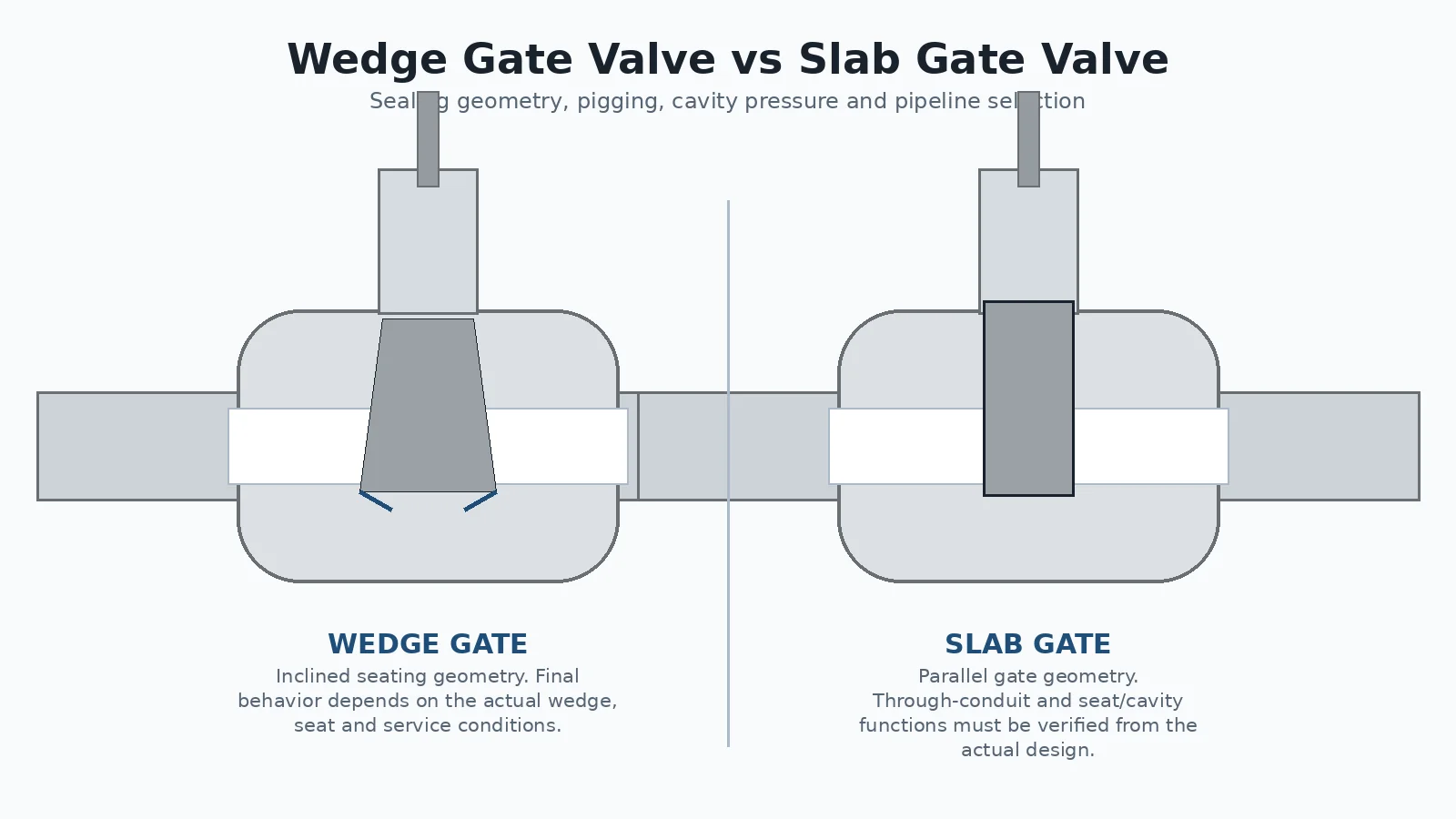
A wedge gate valve and a slab gate valve can both isolate a line, but they solve different pipeline and piping requirements. Conventional wedge designs use inclined seating geometry and are generally not chosen where a continuous pigging bore is contractual. Slab designs use a parallel gate and are commonly evaluated for through-conduit service. The final choice still depends on the actual bore, seat arrangement, cavity-pressure behavior, service conditions, operating loads and project acceptance requirements.
For broader gate-valve construction and product-family context, see Raymon Valve’s industrial gate valves page. For general gate-valve selection beyond this focused comparison, use the Gate Valve Guide.
Wedge Gate Valve vs Slab Gate Valve: Quick Comparison
| Decision Point | Wedge Gate Valve | Slab Gate Valve | Approval Evidence |
|---|---|---|---|
| Gate geometry | Wedge-shaped closure | Parallel slab gate | Sectional drawing |
| Seat geometry | Inclined seating surfaces | Parallel seat assemblies | Seat schematic and sealing direction |
| Closing / operating load | Influenced by stem thrust, wedge action, differential pressure and friction | Influenced by seat design, pressure condition, friction and exact construction | Exact-model operating-load data |
| Bore continuity | Conventional wedge construction does not provide the same through-gate bore architecture | Through-conduit versions can provide a continuous opening | Minimum-bore drawing |
| Pigging | Generally not selected for through-conduit pigged lines | Common reason to evaluate through-conduit slab construction | Pig envelope + bore geometry |
| Body cavity | Construction-specific | Important where fluid can be isolated between seats | Seat and cavity-relief schematic |
| DBB / DIB | Cannot be inferred from valve family | Cannot be inferred from “slab” | Seat arrangement + defined pressure/test condition |
| Actuation | Requires actual thrust/torque basis | Requires actual thrust/torque basis | Manufacturer operating-load data |
| Final approval | Project-data dependent | Project-data dependent | Datasheet, drawings, testing and deviation schedule |
What Actually Changes Between a Wedge and a Slab Gate Valve?
Wedge Gate Geometry and Inclined Seats
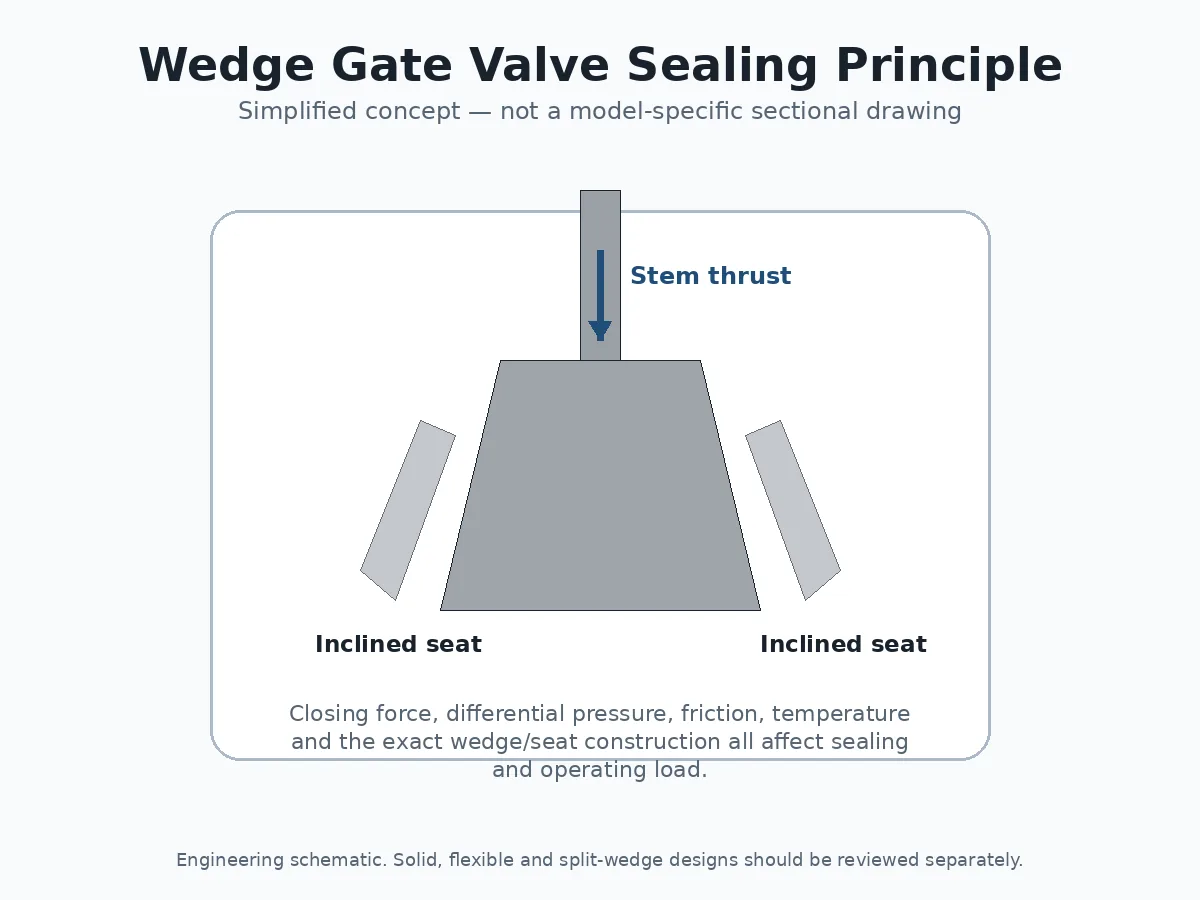
A wedge gate valve uses a gate moving between inclined seating surfaces. As the valve closes, stem thrust moves the wedge into the seat region. Wedge geometry, differential pressure, friction, seat condition and temperature can therefore influence both sealing behavior and operating load.
“Wedge gate valve” is still a broad construction description. Solid, flexible and split-wedge designs should not be assumed to respond identically to temperature change, alignment, pressure differential or repeated operation.
Slab Gate and Parallel Seat Architecture
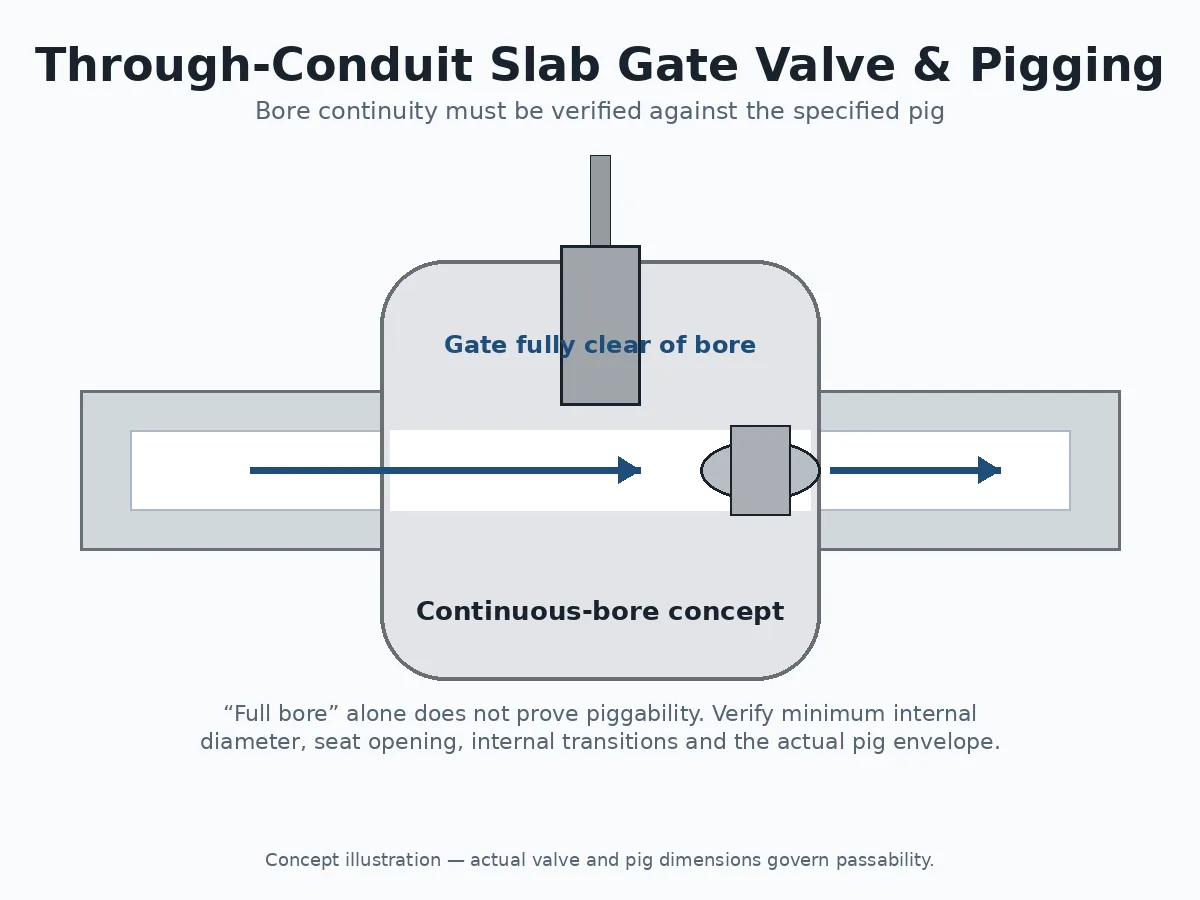
A slab gate valve uses a single parallel gate moving between parallel seat assemblies. Pipeline-oriented versions may use through-conduit construction so that the fully open gate moves clear of the main flow passage.
A slab gate valve should also be distinguished from an expanding gate valve. A slab design uses a single gate unit, whereas an expanding gate uses a gate-and-segment mechanism. Both can appear in pipeline applications, but their sealing mechanisms are different.
Through-conduit architecture matters where bore continuity or pigging is contractual. It does not, by itself, define DBB, DIB, bidirectional isolation, seat relief direction or emergency sealing features.
How Does the Sealing Mechanism Affect Selection?
Wedge Seating Load
In a wedge gate valve, seating and operating effort can be affected by wedge geometry, stem thrust, differential pressure, friction, temperature, deposits and the condition of the seating surfaces.
A typical RFQ mistake is to specify only valve size, pressure class and “wedge gate valve.” That leaves unanswered the operating differential pressure, shut-off requirement, temperature range and operating frequency—the same inputs that may materially affect the required construction and operating load.
Slab Seat Response
In a slab valve, the seat assemblies and their response to line and body-cavity pressure are central to the isolation philosophy. Floating or pressure-responsive seat arrangements may be used, but their behavior is design-specific.
The technical bid should therefore identify what each seat does under the defined upstream, downstream and cavity pressure conditions.
Which Gate Valve Is Better for Pigging?
Why “Full Bore” Is Not Enough
For pipeline pigging, the key question is whether the installed valve provides the required continuous passage for the specified cleaning, gauging or inspection tool. Conventional wedge gate valves are generally not selected for through-conduit pigged pipelines because their open geometry does not provide the same through-gate bore arrangement associated with slab or expanding gate designs.
However, “full bore,” “full port” or “full opening” is still not sufficient procurement evidence. Actual pig passage should be checked against the offered valve geometry.
Review at least:
- minimum internal bore;
- seat opening;
- fully open gate position;
- internal transitions;
- body geometry;
- end-connection transitions;
- adjoining pipe inside diameter;
- pig outside diameter and flexible elements;
- inspection-tool envelope where applicable.
Through-Conduit Slab Valves in Pigged Lines
Through-conduit slab construction commonly deserves priority review where cleaning pigs, gauging pigs or inspection tools must pass through the valve. In the fully open condition, the gate is moved clear of the primary flow passage.
If pigging is contractual, require a minimum-bore or sectional drawing and compare it with the actual pig envelope before technical approval.
Can a Wedge Gate Valve Be Used in a Pigged Pipeline?
A conventional wedge gate valve is generally not the preferred construction for a through-conduit pigged line. If a supplier proposes a special wedge construction for service requiring pig passage, do not accept the proposal from “full bore” terminology alone.
Require dimensional evidence showing the minimum opening, body transitions and fully open geometry against the specified pig or inspection-tool envelope.
Body Cavity Pressure: What Must Be Approved?
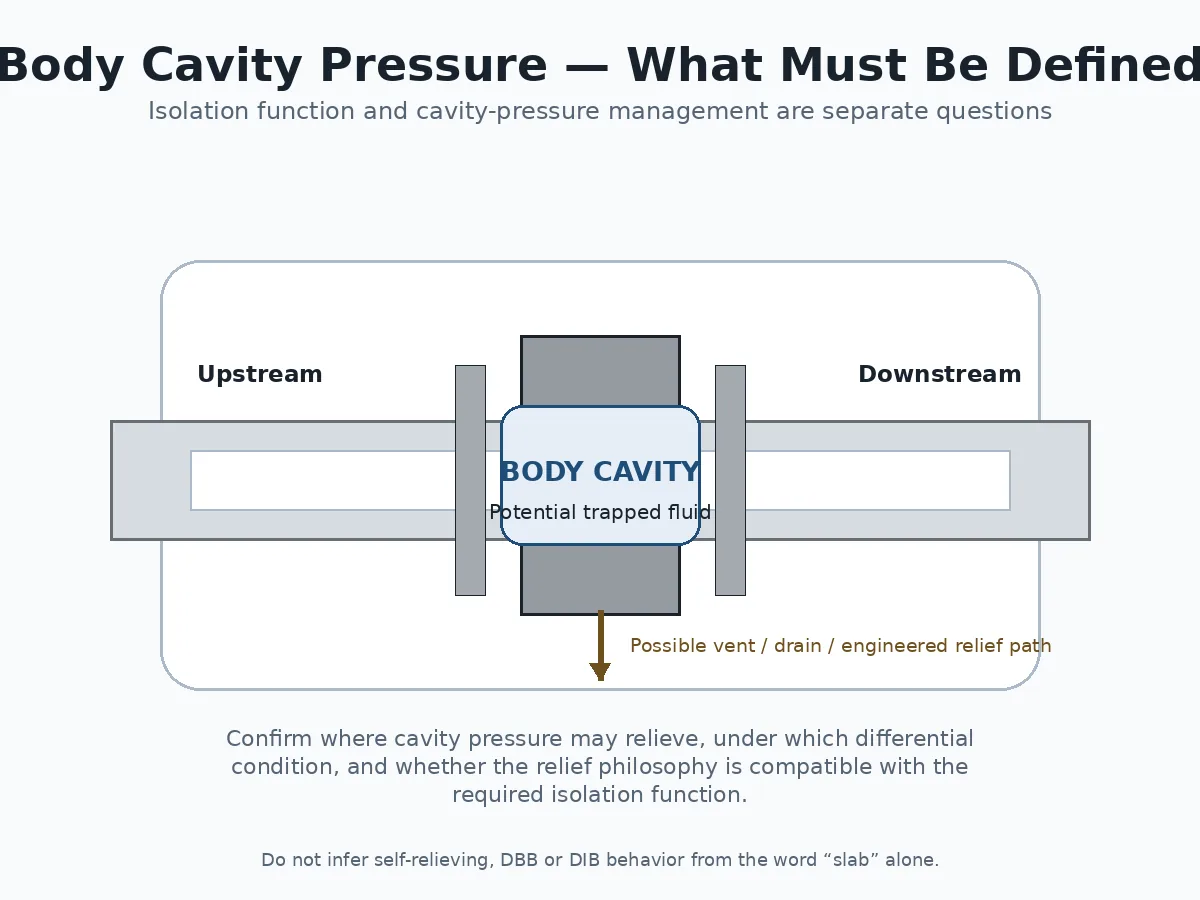
Body-cavity pressure matters where fluid can become isolated between sealing interfaces. If trapped liquid is heated, thermal expansion may raise cavity pressure. The engineering question is not simply whether the valve is a slab design, but how the actual seat and cavity arrangement manages that pressure.
Questions the Purchaser Should Ask
- Can fluid become trapped between the seats?
- Which seat, if any, can relieve cavity pressure?
- In which direction can relief occur?
- Under what pressure condition does relief occur?
- Is a body vent, drain or separate engineered relief path required?
- Is the cavity-relief philosophy compatible with the required isolation function?
- How will the required behavior be documented or tested?
DBB and Cavity Relief Are Separate Approval Questions
Double block and bleed describes an isolation function under defined pressure conditions. Body-cavity pressure management addresses a different question: what happens to pressure trapped between the sealing interfaces.
A specification should therefore define the isolation requirement and cavity-pressure management independently.
DBB, DIB and Seat Direction: Normalize the Technical Bid
Terms such as DBB, DIB and bidirectional sealing are useful only when the relevant seat behavior, pressure direction and verification condition are defined.
| Bid Item | Do Not Accept Alone | Required Clarification |
|---|---|---|
| DBB | Catalog statement only | Seat arrangement, pressure direction, bleed point and test condition |
| DIB | Generic “double isolation” statement | Which seat isolates each pressure source and how the cavity is managed |
| Bidirectional | Generic product description | Required sealing direction and allowable leakage condition |
| Self-relieving seat | Valve-family assumption | Relief direction and differential-pressure condition |
| Emergency sealant | Presence of injection fittings alone | Exact seat/stem injection arrangement and purchaser requirement |
Where API Specification 6D is part of the project requirements, confirm the contractual edition and purchaser supplements before approval. At the time of this review, API lists Specification 6D, 25th Edition, with Addendum 3 issued in March 2025.
API 6D covers pipeline and piping valve requirements within its stated scope, but a reference to the standard does not prove that a specific offered valve satisfies every project requirement. Product-specific compliance must be supported by the applicable design, manufacturing, testing and documentation records.
Technical References
- American Petroleum Institute — API 6D updates — current edition/addendum verification.
- SLB — Gate Valve Construction Overview — supporting reference for slab, expanding and conventional wedge construction terminology.
Solids, Deposits and Contamination
Neither wedge nor slab construction should automatically be described as superior for dirty service. The useful engineering question is how the actual contaminant interacts with the offered seat, gate, body cavity and moving surfaces.
| Service Input | Engineering Effect | What to Verify |
|---|---|---|
| Solids concentration | Changes contamination exposure | Seat and cavity susceptibility |
| Particle size / hardness | Can increase abrasion or obstruction risk | Seat materials and operating clearances |
| Wax / scale / deposits | Can accumulate in pockets or interfere with travel | Drainability, flushing and maintenance provisions |
| Operating frequency | Changes wear and deposit disturbance | Operating-load data and maintenance strategy |
Operating Thrust, Torque and Actuation
Valve size, pressure class and family name are not sufficient to select an actuator. Actual operating thrust or torque can depend on differential pressure, seat design, stem arrangement, friction, packing, temperature, contamination and exact valve construction.
For an actuated package, the RFQ should identify the governing operating differential pressure, required operating time, operation frequency, fail or emergency function where applicable, available air or electrical supply and the manufacturer’s torque or thrust basis.
Wedge vs Slab Gate Valve for Pipeline Service
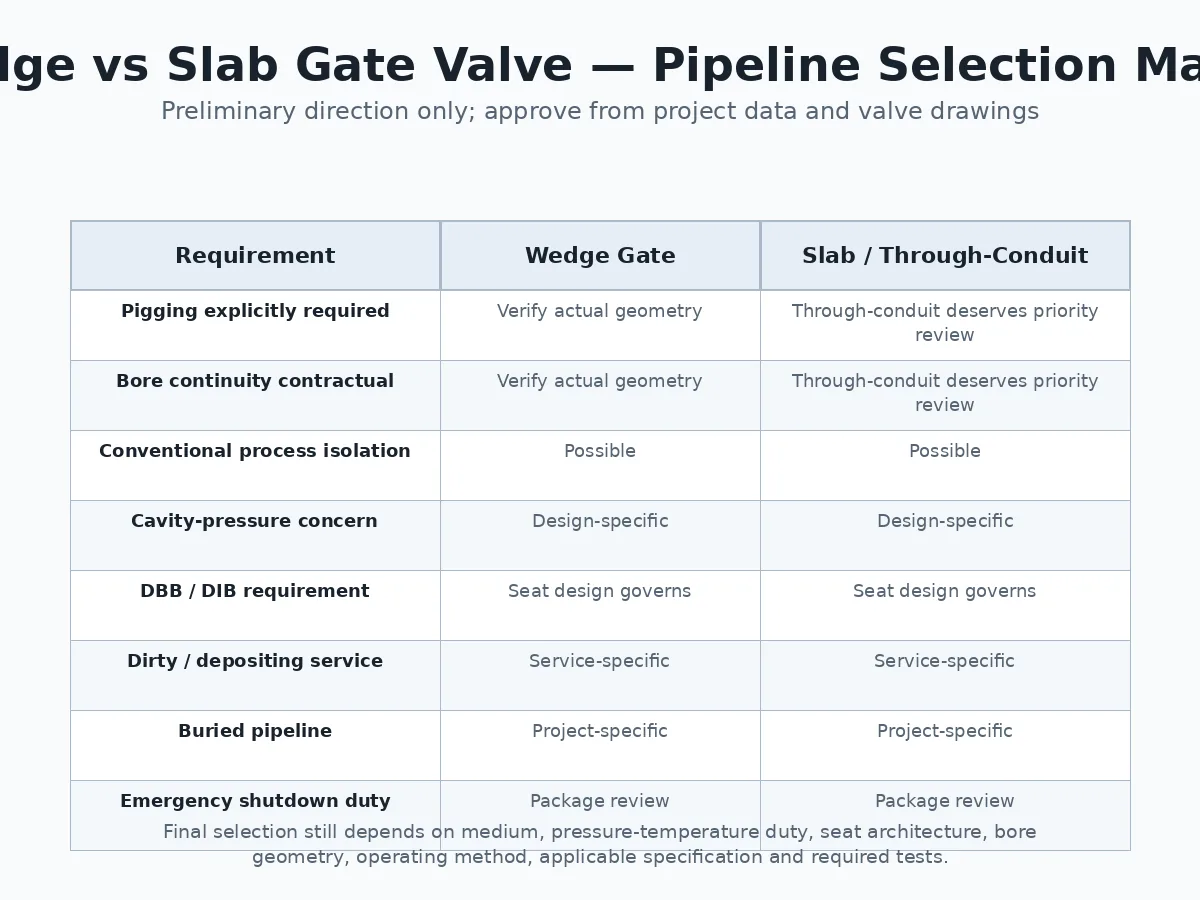
| Service Requirement | Preliminary Direction | Why | Approval Evidence |
|---|---|---|---|
| Pigging explicitly required | Verified through-conduit construction deserves priority review | Continuous internal geometry can be critical | Minimum-bore drawing + pig specification |
| Intelligent inspection tool passage | Through-conduit construction deserves priority review | Tool envelope and internal transitions matter | Valve geometry + tool envelope |
| Conventional process isolation | Wedge may be suitable | Through-conduit geometry may not be required | Datasheet + piping specification |
| Cavity-pressure concern | Design-specific review | Seat and cavity architecture govern | Seat/cavity schematic |
| DBB / DIB requirement | No automatic winner | Seat behavior governs function | Seat schematic + acceptance requirement |
| Dirty / depositing medium | Engineering review required | Contamination behavior is design-specific | Medium data + seat/cavity details |
| Frequent operation | Design-specific | Wear and operating loads matter | Exact-model thrust/torque data |
| Buried pipeline | Project-specific | Operator access, stem extension and maintenance change | Installation / GA drawing |
| Emergency shutdown duty | Complete package review | Valve, actuator and controls interact | Valve/actuator data + functional requirement |
When a Wedge Gate Valve May Be the Better Choice
A wedge design may be a reasonable preliminary direction when:
- the principal duty is conventional isolation;
- contractual through-conduit pigging is not required;
- the selected wedge construction suits the confirmed pressure-temperature conditions;
- seat, trim and pressure-boundary materials are compatible with the service;
- the governing project specification permits the construction;
- operating frequency and maintenance access are acceptable.
This is not automatic approval. Temperature changes, difficult differential pressure, contamination, leakage requirements or actuation demands can change the final selection.
When a Slab Gate Valve May Be the Better Choice
A slab or other verified through-conduit gate design deserves priority evaluation when:
- pig passage is contractual;
- minimum bore continuity is specified;
- pipeline isolation is the principal duty;
- the specification requires through-conduit construction;
- seat and cavity-pressure behavior must be explicitly documented;
- a defined pipeline isolation philosophy is required.
Even then, the actual seat arrangement, materials, operating loads, cavity behavior, testing and documentation must be confirmed from the offered design.
When Neither Valve Should Be Approved Yet
Technical approval should stop when information capable of changing the construction decision remains undefined.
- valve function;
- medium, composition and phase;
- solids or contamination;
- normal and design pressure;
- normal and design temperature;
- maximum differential pressure during operation where relevant;
- NPS / DN and pressure class / PN;
- end connection;
- required minimum bore;
- pig type and envelope;
- seat and isolation requirement;
- DBB / DIB requirement;
- cavity-pressure requirement;
- vent / drain requirement;
- operation method;
- buried or remote installation;
- governing specification;
- testing, inspection and documentation scope.
RFQ Checklist for Wedge or Slab Gate Valve Selection
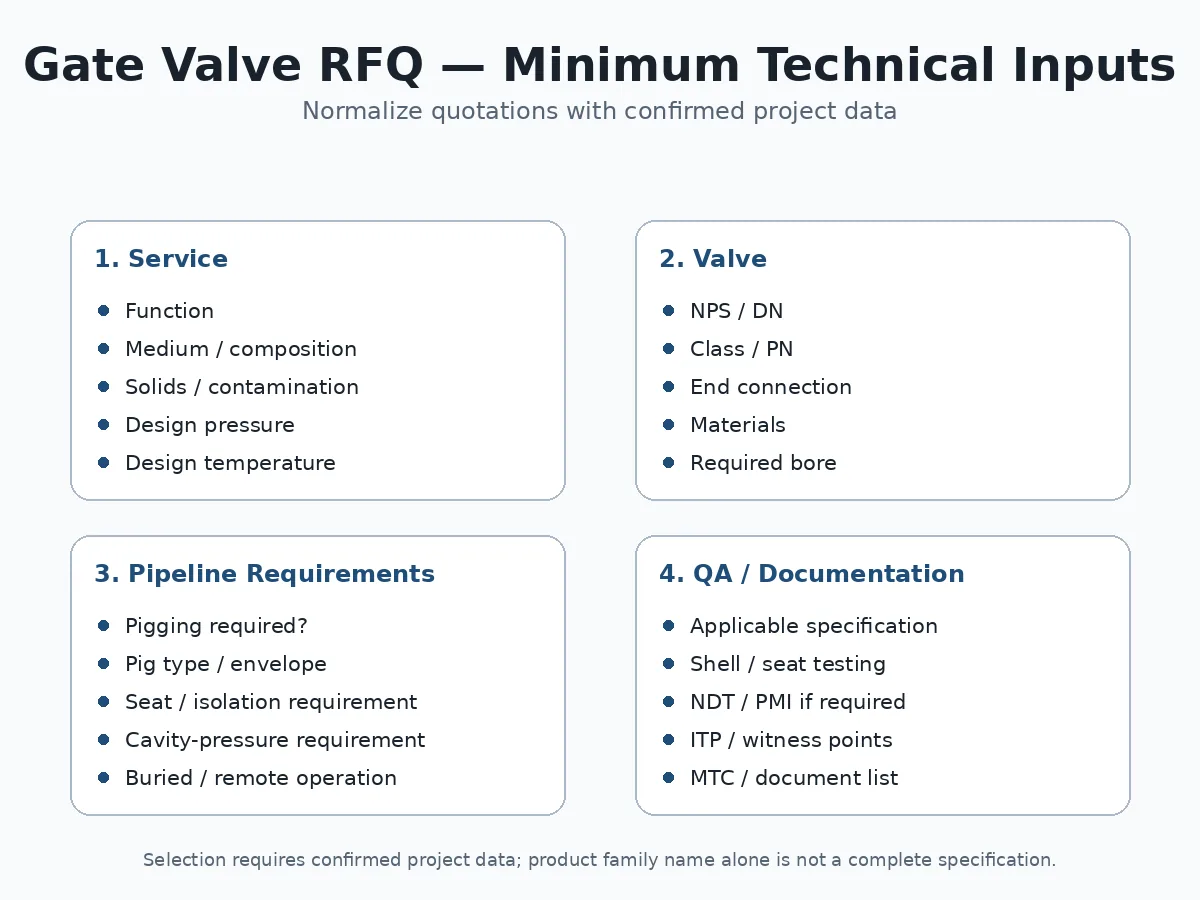
| RFQ Field | Why It Matters | Supplier Should Confirm |
|---|---|---|
| Valve function | Defines isolation duty | Offered construction matches the required function |
| Medium / composition | Supports material and seat review | Material selection basis and limitations |
| Solids / contamination | Can affect seat and cavity behavior | Construction limitations and maintenance provisions |
| Design pressure | Affects pressure boundary and operating load | Applicable rating basis |
| Design temperature | Affects material and sealing selection | Pressure-temperature and sealing basis |
| NPS / DN | Defines nominal size | Exact offered valve size |
| Class / PN | Defines rating designation, not a universal fixed pressure | Applicable pressure-temperature rating basis |
| End connection | Defines piping interface | Applicable end dimensions / facing / weld-end details |
| Minimum bore | Critical for pigging and flow-passage review | Drawing dimension |
| Pigging requirement | Can drive valve construction | Geometry compatibility |
| Pig type / envelope | Determines actual passability | Dimensional compatibility review |
| Seat arrangement | Defines isolation behavior | Seat schematic and pressure response |
| DBB / DIB | Defines required isolation function | Pressure and verification condition |
| Cavity-pressure requirement | Addresses trapped-pressure management | Relief philosophy |
| Operation method | Affects operator / actuator selection | Operating-load basis |
| Testing | Defines acceptance scope | Shell, closure/seat and required functional tests |
| NDT / PMI | Defines additional inspection scope where required | Methods, extent and acceptance basis |
| ITP / MTC / documents | Supports traceability and bid normalization | Included document deliverables |
For broader pressure and leakage acceptance planning, see Raymon Valve’s Valve Pressure Testing guide.
Supplier Technical Evidence Matrix
Two suppliers can quote the same valve family and still offer materially different technical scopes. Normalize the evidence and document package before comparing commercial price.
| Evidence Item | What It Helps Verify | Typical Approval Question |
|---|---|---|
| Completed datasheet | Service conditions and offered construction | Has every purchaser field been answered? |
| Sectional drawing | Gate, seat, stem and body arrangement | Does the drawing represent the quoted valve? |
| Minimum-bore drawing | Pigging / bore continuity | Does the offered geometry satisfy the pig envelope? |
| Seat schematic | DBB / DIB / sealing direction | How does each seat respond to line and cavity pressure? |
| Cavity-pressure information | Trapped-pressure management | Where can cavity pressure relieve? |
| Material list / BOM | Body, trim, seats, packing and gasket scope | Are the required materials identified and traceable? |
| Torque / thrust data | Operator or actuator evaluation | Is the data based on the exact offered construction and governing condition? |
| Test scope | Acceptance requirements | Which shell, closure/seat and functional tests are included? |
| ITP / inspection scope | Witness and hold points | What inspection activities are included in the quotation? |
| Deviation schedule | Technical bid comparability | Has every departure from the purchase specification been declared? |
For projects involving multiple valve tags, drawing approvals, technical deviations, inspection points and document turnover, see Raymon Valve’s project valve technical evaluation and supply coordination framework.
Pre-PO Technical Approval Gate
Before approving either construction, confirm that the technical bid answers the following questions:
- Is the valve duty clearly defined?
- Are normal, design and relevant differential-pressure conditions available?
- Are medium, phase, solids and temperature conditions confirmed?
- Is the exact offered construction shown on a sectional drawing?
- If pigging is required, is minimum bore verified against the pig envelope?
- Is seat behavior shown instead of described only by DBB/DIB terminology?
- Is cavity-pressure management explicitly defined?
- Are pressure-boundary, trim, seat, packing and gasket materials identified as required?
- If actuated, is the torque/thrust basis tied to the offered valve and governing operating condition?
- Are test, inspection and documentation requirements included?
- Are technical deviations declared before PO approval?
Final Selection: Wedge or Slab?
If contractual pigging and continuous-bore geometry are central requirements, a verified through-conduit construction normally deserves priority evaluation. In a direct wedge-versus-slab comparison, that generally points toward the slab option rather than a conventional wedge design.
If the service is conventional isolation without a through-conduit pigging requirement, an appropriate wedge construction may be sufficient and may align better with the governing piping or project specification.
This is not a universal rule for all gate-valve architectures. Expanding gate valves and other pipeline isolation designs may also be relevant outside the specific wedge-versus-slab comparison.
Final approval still depends on the actual seat arrangement, cavity-pressure philosophy, pressure-temperature rating, medium and contamination, materials, operating loads, leakage requirements, testing and project specification.
Request Gate Valve Selection Review
For a project-specific wedge-versus-slab review, provide the operating and procurement data required to evaluate the actual service.
- valve function;
- medium, composition, phase and solids;
- normal and design pressure;
- normal and design temperature;
- maximum operating differential pressure where relevant;
- NPS / DN and Class / PN;
- end connection;
- required minimum bore;
- pigging requirement and pig type / envelope;
- seat / isolation requirement;
- cavity-pressure requirement;
- operation or actuation method;
- applicable project specification;
- required testing, inspection and documentation.
Frequently Asked Questions
What is the main difference between a wedge gate valve and a slab gate valve?
A wedge gate valve uses a wedge-shaped closure against inclined seating surfaces, while a slab gate valve uses a parallel gate and parallel seat assemblies. For selection, the important differences are bore geometry, seat behavior, pigging requirements, cavity-pressure management and operating conditions.
Is a slab gate valve always piggable?
No. Through-conduit slab construction is commonly evaluated for pigged pipelines, but actual piggability must be verified from the minimum internal bore, transitions and the specified pig or inspection-tool envelope.
Can a wedge gate valve be used in a pigged pipeline?
A conventional wedge gate valve is generally not selected for a through-conduit pigged line. If a supplier proposes one, require dimensional evidence showing that the exact valve geometry is compatible with the specified pig.
Why can pressure build up in a gate-valve body cavity?
Fluid can become trapped between sealing interfaces under some conditions. If trapped liquid is heated, cavity pressure can rise. The actual seat, vent, drain or relief arrangement must define how that pressure is managed.
Does a slab gate valve automatically provide double block and bleed?
No. DBB depends on the actual seat arrangement, pressure direction, bleed configuration and verification condition. The word “slab” does not prove the required isolation function.
Which gate valve is better for oil and gas pipelines?
There is no universal choice. Through-conduit slab construction often deserves priority review where pigging and bore continuity are contractual. Wedge designs may suit conventional isolation duties. Final selection requires the project datasheet and offered valve design.
What should be included in an RFQ for a wedge or slab gate valve?
Include valve duty, medium, pressure, temperature, size, pressure class, end connection, minimum bore, pigging requirements, seat and cavity philosophy, materials, operating method, testing, inspection and document deliverables.
 English
  German
  Arabic
  French
  Spanish
  Italian
  Portuguese
  Russian