
Butterfly valve vs gate valve: choose a butterfly valve when compact installation, lower handling weight and quarter-turn operation are priorities; consider a full-bore gate valve when a relatively unobstructed fully open flow path is critical. Neither choice is automatic. Differential pressure, temperature, seat leakage, flow coefficient, actuator loads and installation constraints can change the decision. This comparison gives piping engineers and buyers a practical way to screen both designs, review a possible replacement and request comparable supplier quotations.
For piping engineers, EPC teams and industrial buyers, the butterfly valve vs gate valve comparison should support a documented specification decision—not an assumption that one valve type is always superior.On this page
- Quick comparison
- Operating principles
- Pressure drop
- Pressure, temperature and sealing
- Installation and actuation
- When to choose butterfly
- When to choose gate
- Replacement review
- Cost and maintenance
- Selection matrix
- RFQ checklist
- FAQs
- Service data
- Failure modes
- Bid normalization
- Standards and evidence
- Illustrative selection worksheet
- Technical references
Butterfly Valve vs. Gate Valve: Quick Comparison
| Factor | Butterfly valve | Gate valve |
|---|---|---|
| Operating mechanism | Quarter-turn rotating disc | Multi-turn linear gate movement |
| Primary function | Isolation; selected designs support throttling | Primarily fully open / fully closed isolation |
| Fully open flow path | Disc and shaft remain in passage | Full-bore designs retract gate from passage |
| Pressure drop | Depends on disc and model-specific flow coefficient | Often lower for fully open full-bore designs |
| Installation | Often shorter and lighter at large diameters | Often taller; rising stem needs travel clearance |
| Operating speed | Generally faster quarter-turn motion | Typically slower manual multi-turn motion |
| Pressure and temperature | Depends on seat, materials and design rating | Depends on body, trim, seat and design rating |
| Shut-off | Must verify direction, differential pressure and leakage criteria | Must verify direction, differential pressure and leakage criteria |
| Cost | Often competitive for large-diameter utility duty | Depends on size, materials, class and construction |
Neither type is universally superior. Compare the exact model, not just the valve category.
How Do Butterfly Valves and Gate Valves Work?
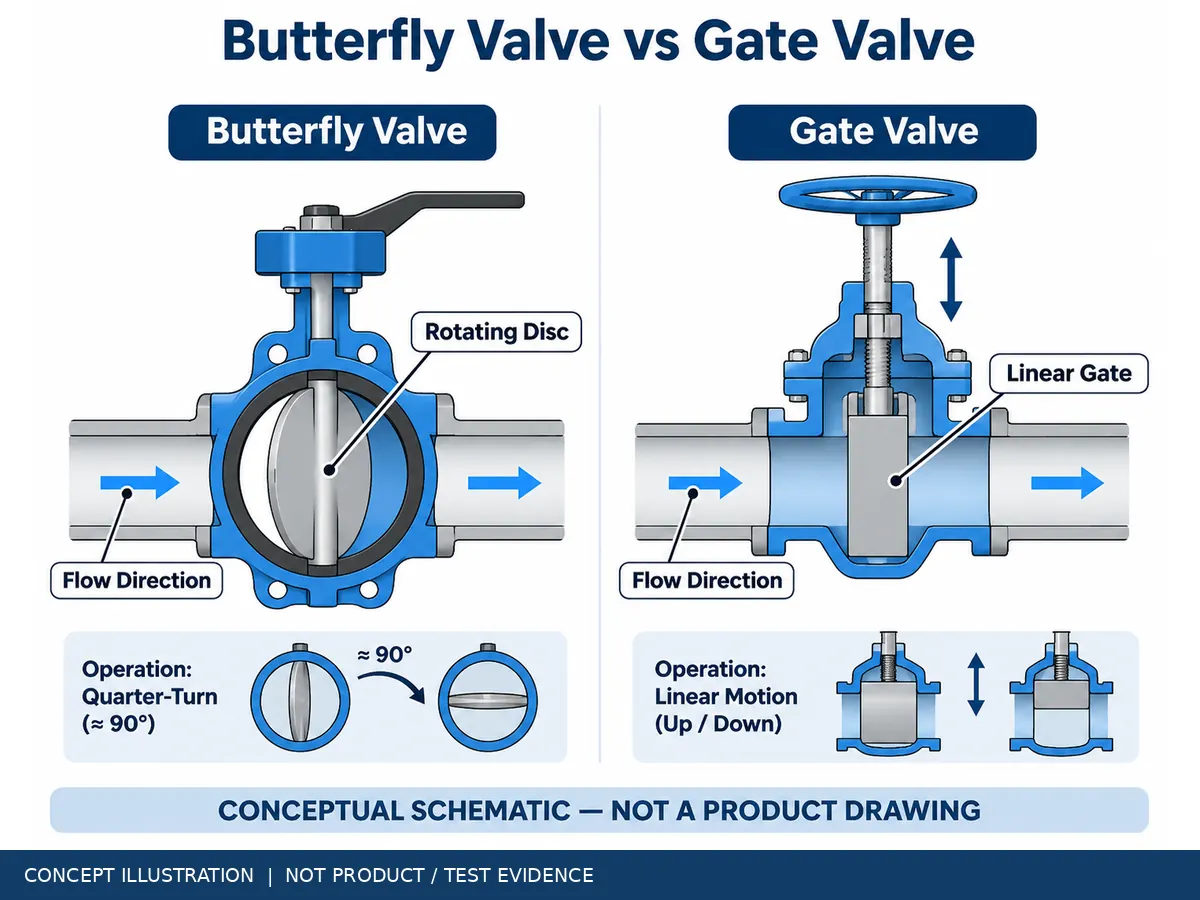
Butterfly Valve: Quarter-Turn Disc Operation
A butterfly valve rotates a circular disc approximately 90 degrees between closed and fully open positions. Even when fully open, the disc and shaft remain in the pipeline. Concentric resilient-seated, double-offset and triple-offset designs differ in seat contact, operating torque and service suitability.
A resilient-seated butterfly valve may suit selected water or utility duties. Specialized metal-seated or offset constructions may be evaluated for more demanding services, but construction alone does not establish pressure-temperature or leakage suitability. See the industrial butterfly valves category for the relevant product range.
Gate Valve: Linear Gate Movement
A gate valve raises or lowers a gate or wedge perpendicular to the flow. In a fully open, full-bore configuration, the closure element retracts from the main flow passage. Solid wedge, flexible wedge and parallel-slide constructions address different service requirements. Rising-stem and non-rising-stem designs have different clearance and indication characteristics.
Gate valves are generally selected for isolation rather than sustained throttling. Partial opening can expose seating surfaces to localized velocity, vibration and erosion. Review the industrial gate valves category when comparing constructions.
Operating Mechanism and Actuator Implications
The mechanism affects operator clearance, automation, cycle frequency and required operating loads. Butterfly actuator torque changes with opening angle, differential pressure and seat geometry. Gate valve actuator thrust and torque depend on pressure loading, wedge friction and stem design. Request manufacturer operating-load data rather than sizing an actuator from nominal diameter alone.
Flow Resistance and Pressure Drop: Which Valve Performs Better?
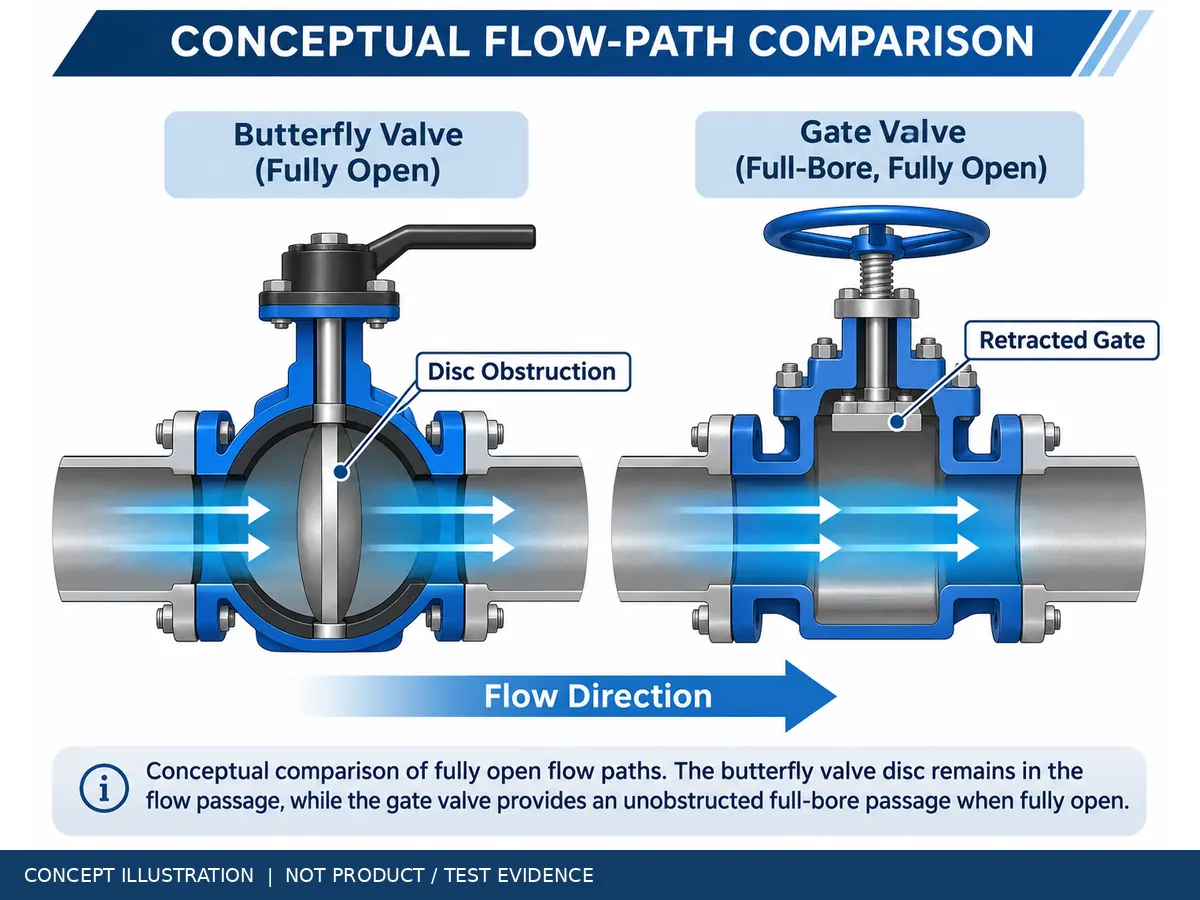
Butterfly Valve Disc Obstruction
The fully open butterfly disc produces local obstruction and changes the velocity distribution. Actual loss depends on disc profile, valve opening, flow rate, fluid properties and the specific valve flow coefficient. Use manufacturer Cv, Kv or pressure-loss data for the selected size and model.
RFQ screening example: Two valves with the same nominal diameter can have different full-open Cv/Kv values. A bid that lists only DN and pressure class cannot establish the pumping-energy effect. Ask both suppliers for model- and size-specific flow data at the expected operating position, then review the system calculation.
Full-Bore Gate Valve Flow Passage
A fully open, full-bore gate valve commonly provides a relatively low-resistance passage because the gate is outside the main stream. This is not a universal property of reduced-port gate valves or all installation arrangements.
Review Pressure Drop at Actual Flow Conditions
For steady, single-phase, non-cavitating liquid flow with constant fluid properties and consistent Cv units, the simplified relationship ΔP ∝ (Q/Cv)² illustrates how a lower flow coefficient can increase pressure loss at the same volumetric flow rate. This is a screening relationship only: it does not cover gas sizing, cavitation, flashing, choking, fittings or transient conditions. Use the applicable sizing method and model-specific data for a calculation.
Request full-open flow coefficients or verified pressure-loss curves for both candidates, and assess the effect on pump duty and available system pressure.
Throttling, Cavitation and Erosion
Appropriately designed butterfly valves can provide some throttling service, subject to the manufacturer’s allowable operating range. Partial opening may increase local velocity, turbulence, vibration and cavitation risk. Conventional gate valves are generally not recommended for sustained throttling. Severe control duty may call for a dedicated control valve or another engineered solution.
Pressure, Temperature and Sealing Performance
Pressure-Temperature Rating
A pressure class is not a fixed permissible pressure at every temperature. Confirm the applicable pressure-temperature rating for the specified material group and design temperature, including minimum temperature and thermal cycling where relevant. Review the pressure boundary, bolting, seat, packing, gaskets and trim independently; the body rating does not establish the seat or actuator limits. Neither butterfly nor gate valves have a universal pressure or temperature ceiling.
Shut-off review example: A quoted valve may meet the specified body pressure rating yet lack an agreed seat-leakage acceptance for the maximum reverse differential pressure. Record test direction, test medium, test pressure and allowable leakage in the datasheet and obtain a model-specific supplier response.
Seat and Closure Construction
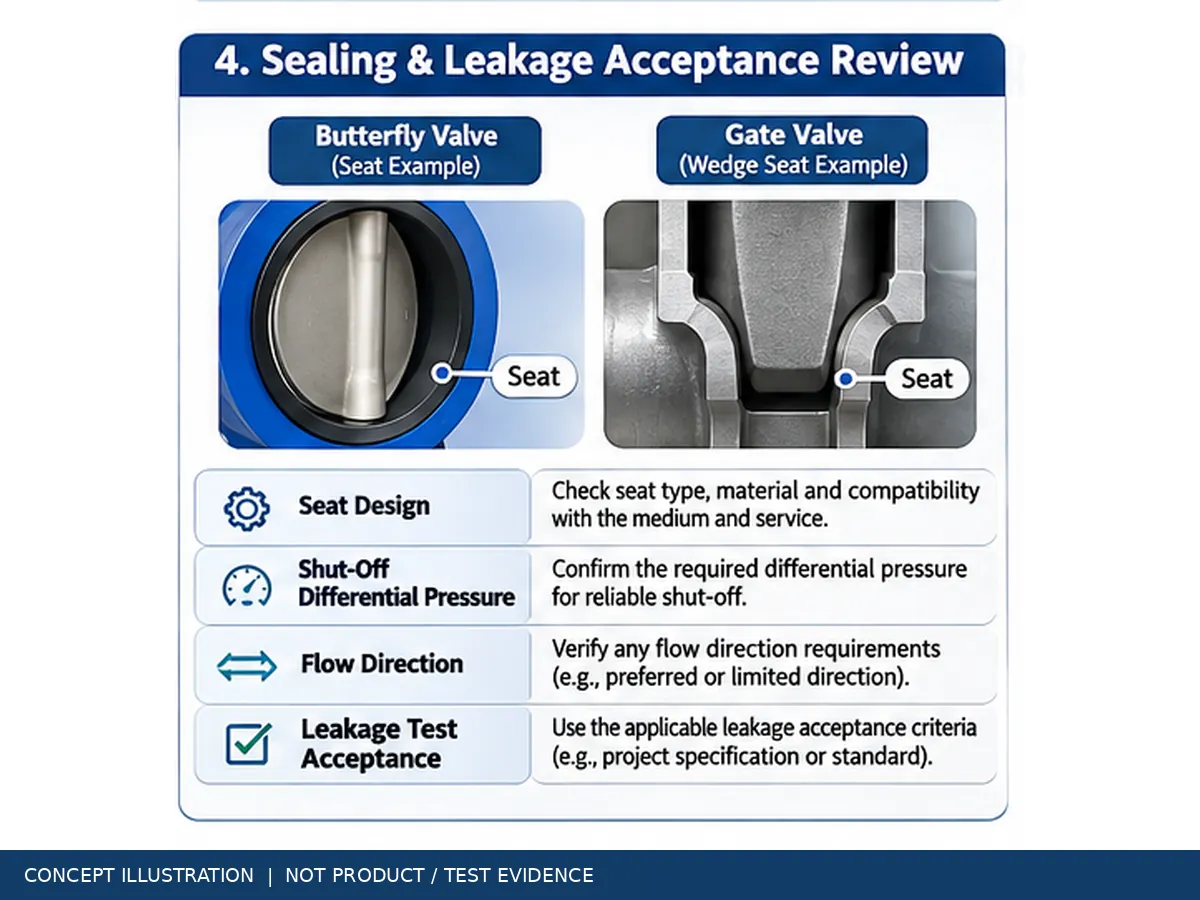
Resilient-seated butterfly valves rely on compatible elastomeric or other compliant materials. Metal-seated and offset butterfly designs use different sealing mechanics and may suit selected demanding conditions. Gate valves use wedge, parallel-slide or other closure arrangements, with seat wear, thermal binding, debris and alignment among the relevant risks.
Bidirectional Shut-Off and Leakage Acceptance
Both valve families can be configured for bidirectional isolation, but capability must be confirmed for the actual design. Specify maximum shut-off differential pressure, direction, test medium, test pressure, acceptance criteria and applicable test standard. “Bubble-tight” is not a replacement for an agreed leakage criterion. Review the site’s valve pressure testing resource for related inspection topics.
Size, Weight, Installation Space and Actuation
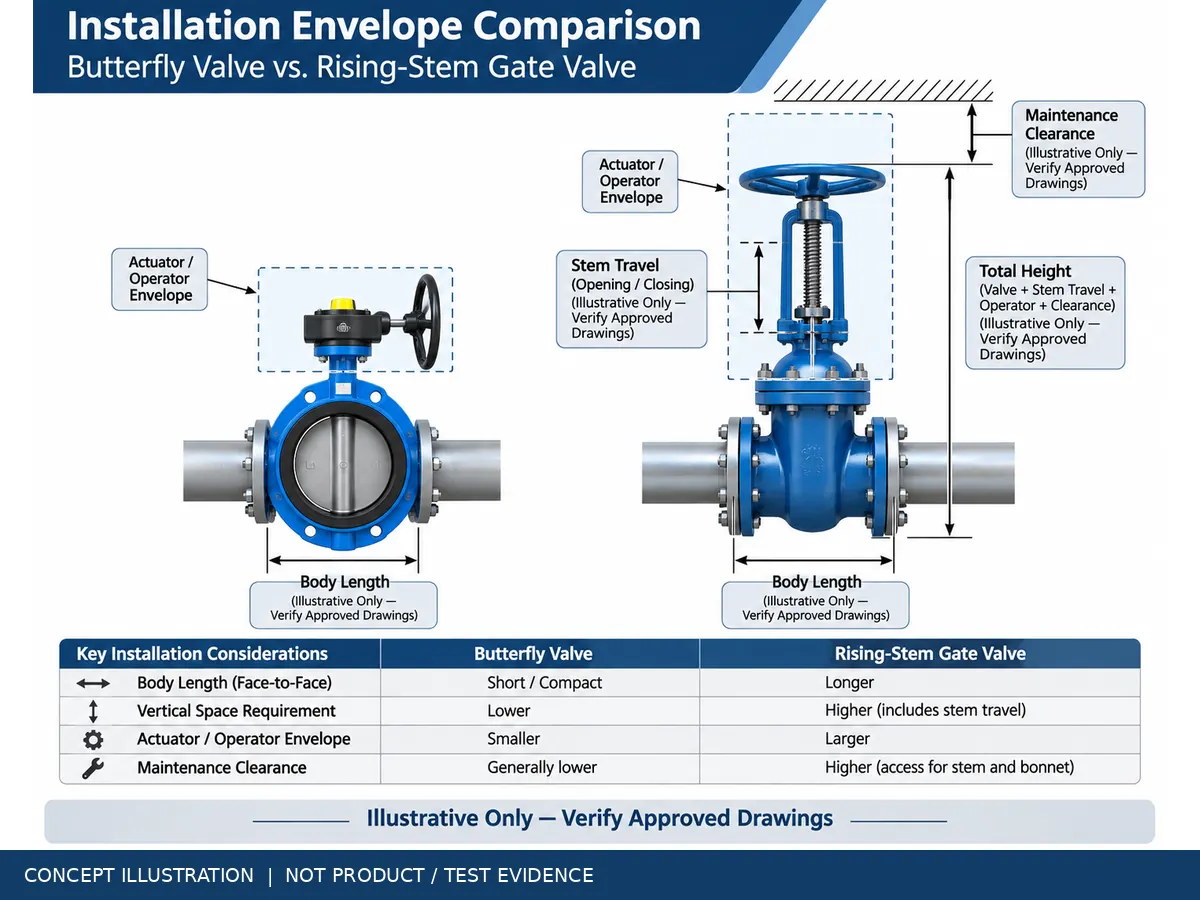
Face-to-Face Dimensions and Clearance
Wafer and lug butterfly configurations can reduce installation length, while rising-stem gate valves generally need additional vertical space. The exact installed envelope also depends on the operator, actuator, flanges and maintenance access. Confirm dimensions using approved general-arrangement drawings.
Installation review example: A butterfly valve may fit between the specified flanges while its open disc interferes with an adjacent pipe lining or reducer. Check the disc swing envelope against the actual spool geometry before approving a gate-to-butterfly substitution.
Large-Diameter Handling and Installed Cost
Butterfly valves can offer handling and weight advantages in large-diameter water and utility service, but total cost includes lifting, supports, spool changes, gearboxes, actuators and commissioning. A specialized butterfly valve is not automatically cheaper than a gate valve.
Operating Frequency and Automation
Specify cycling duty, required opening and closing time, available power, environmental constraints and any fail-position requirement. Confirm butterfly torque or gate thrust with the supplier and review the actuator package as an integrated assembly.
When Should You Choose a Butterfly Valve?
A butterfly valve is often worth evaluating for large-diameter water distribution, cooling-water and selected utility pipelines, particularly when compact construction, reduced installed weight or quarter-turn operation is valuable.
- Large nominal diameter with limited installation space.
- Applications where quick quarter-turn operation is useful.
- Utility isolation where the specified seat, velocity and differential pressure can be verified.
- Automation projects with suitable cycling-duty and actuator evidence.
Additional review is essential for high differential pressure, elevated temperature, severe cavitation, abrasive solids, critical isolation and demanding shut-off criteria.
When Should You Choose a Gate Valve?
A gate valve is often worth evaluating when a low-resistance full-open flow passage is important and the valve normally remains fully open or fully closed. Selected gate valve constructions are used in demanding steam, power and process services, subject to their ratings and material requirements.
- Full-open isolation with a verified full-bore passage.
- Services where flow-path resistance is a primary selection factor.
- Selected high-pressure or high-temperature applications with suitable construction.
- Low-frequency isolation where operating time and stem clearance are acceptable.
Gate valves may be less attractive for frequent throttling, restricted vertical clearance or applications prone to cavity deposits. Infrequent operation does not eliminate inspection or maintenance needs.
Service Data That Can Change the Valve Decision
Before comparing butterfly and gate valve quotations, confirm which service parameters could reverse the preliminary selection. A valve that looks favorable on footprint or initial cost may be unsuitable once differential pressure, seat temperature, cycling duty, or solids loading is considered.
| Service input | Why it matters | Supplier evidence to request |
|---|---|---|
| Medium, phase and chemistry | Corrosion, elastomer compatibility, fouling and abrasive wear | Wetted-parts material list and compatibility review |
| Design pressure and temperature | Pressure-containing integrity and seat/packing limits | Model-specific pressure-temperature rating |
| Maximum shut-off differential pressure | Closure loading, seat tightness and actuator sizing | Shut-off rating, torque/thrust and leakage basis |
| Normal and maximum flow | System loss, disc velocity and potential instability | Cv/Kv or pressure-loss data at relevant openings |
| Solids, deposits or abrasives | Seat damage, obstruction, trapped debris and erosion | Construction review and any relevant service evidence |
| Cycles and operating time | Wear, torque, actuator duty and control-system fit | Cycle-duty limits and actuator sizing calculations |
| Space and connections | Stem travel, disc swing, spool length and flange compatibility | Approved GA drawing and connection dimensions |
Decision gate: If these inputs are incomplete, issue a clarification request rather than treating a nominal size and pressure class as a complete valve specification.
Can a Butterfly Valve Replace a Gate Valve?
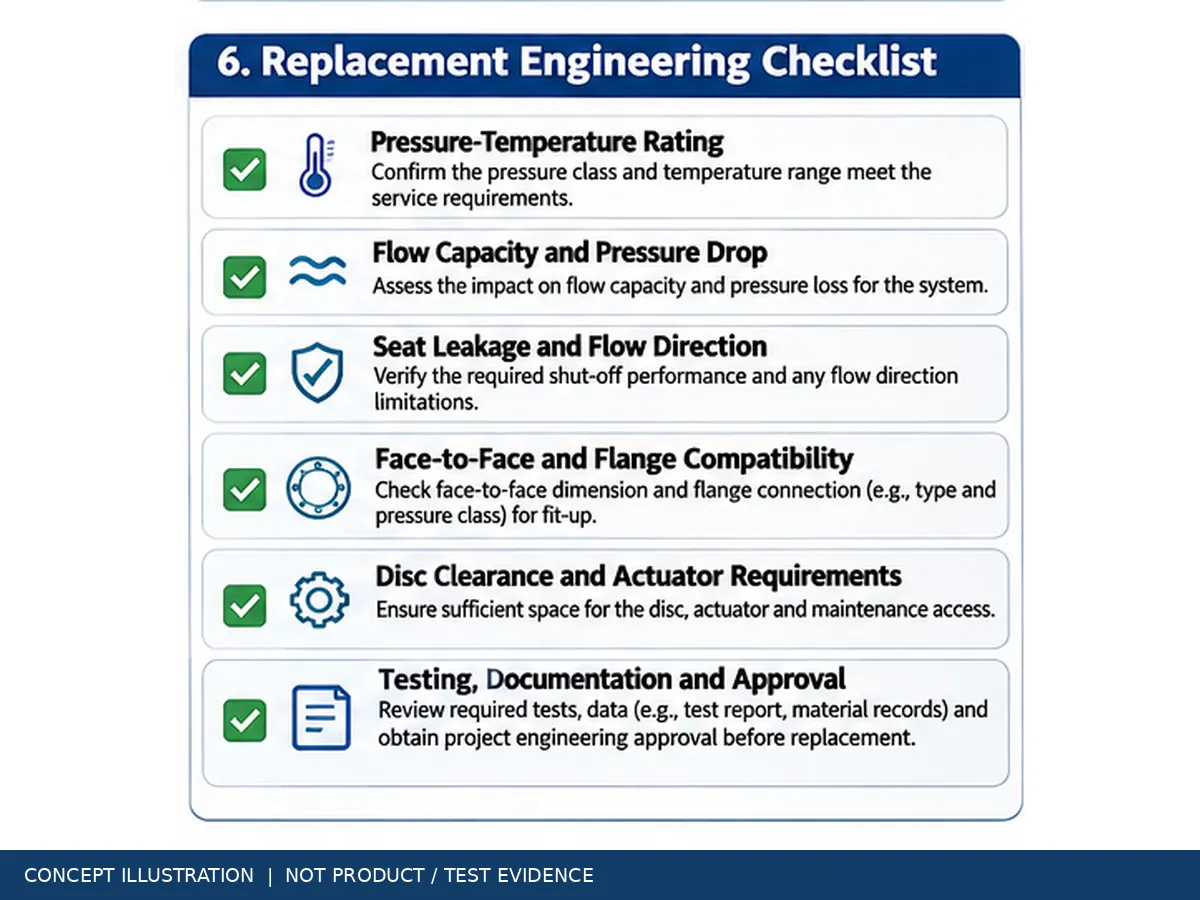
Do not treat a butterfly valve as a drop-in replacement for a gate valve based on nominal size and pressure class alone. A replacement changes the closure geometry and may change hydraulic performance, clearance, actuation and shut-off behavior.
Replacement Approval Checklist
- Confirm the original isolation function and any bidirectional requirement.
- Verify design pressure, design temperature, materials and fluid compatibility.
- Compare actual pressure drop, Cv/Kv and system hydraulic implications.
- Check face-to-face length, flange pattern, gasket arrangement and pipe modifications.
- Confirm disc clearance from adjacent pipework, reducers and linings.
- Verify seat leakage criteria, maximum shut-off differential pressure and test requirements.
- Review actuator torque, controls, opening time and maintenance envelope.
- Record deviations and obtain responsible engineering approval before substitution.
- Confirm whether pipeline pigging, mechanical cleaning or internal inspection tools must pass through the valve; butterfly discs may obstruct the passage.
- Evaluate hydraulic transients and water hammer where closing time, actuator speed or emergency shut-off behavior may change.
- Check the valve’s installed flow orientation, accessibility and any downstream equipment sensitive to altered velocity distribution.
A dimensional fit does not establish functional equivalence.
Failure Modes and Installation Risks to Review
| Potential problem | Typical mechanism or condition | Review / mitigation |
|---|---|---|
| Butterfly valve cannot fully open | Disc interference with lining, adjacent pipe or reducer | Check disc swing envelope on approved installation drawing |
| Excessive hydraulic loss | Selected valve flow coefficient is inadequate | Compare actual Cv/Kv or tested pressure-loss data |
| Seat leakage above acceptance | Incorrect seat construction, differential pressure or flow direction | Specify test basis, acceptance limit and shut-off direction |
| Gate valve seat erosion | Extended partially open operation in unsuitable service | Confirm isolation-only duty or choose a suitable control design |
| Valve cannot operate at design differential pressure | Undersized operator or unverified seating/unseating loads | Review torque/thrust curves and actuator sizing margin |
| Maintenance access unavailable | Stem travel, actuator removal or bonnet clearance overlooked | Review full operating and maintenance envelope |
These are screening risks, not predictions of failure for a particular model. Their likelihood and severity depend on the actual design and service conditions.
Butterfly Valve vs. Gate Valve: Cost and Maintenance
Procurement and Installation
Butterfly valves are often cost-competitive for large diameters, but the comparison depends on construction, materials, rating, seat design, testing and actuation. Installed cost includes lifting, pipe changes, supports, commissioning and operator access.
Wear and Maintenance
Butterfly valve maintenance may involve disc, seat, shaft seals and bearings. Gate valve maintenance may involve packing, stem threads, wedge or gate surfaces, guides and seats. Actual maintenance intervals depend on fluid, cycling frequency, contamination and service severity.
Lifecycle Cost
Compare purchase, installation, inspection, maintenance, replacement parts and downtime over the expected operating life. Neither valve family has a universal lifecycle-cost advantage.
Engineering Selection Matrix: Which Valve Should You Specify?
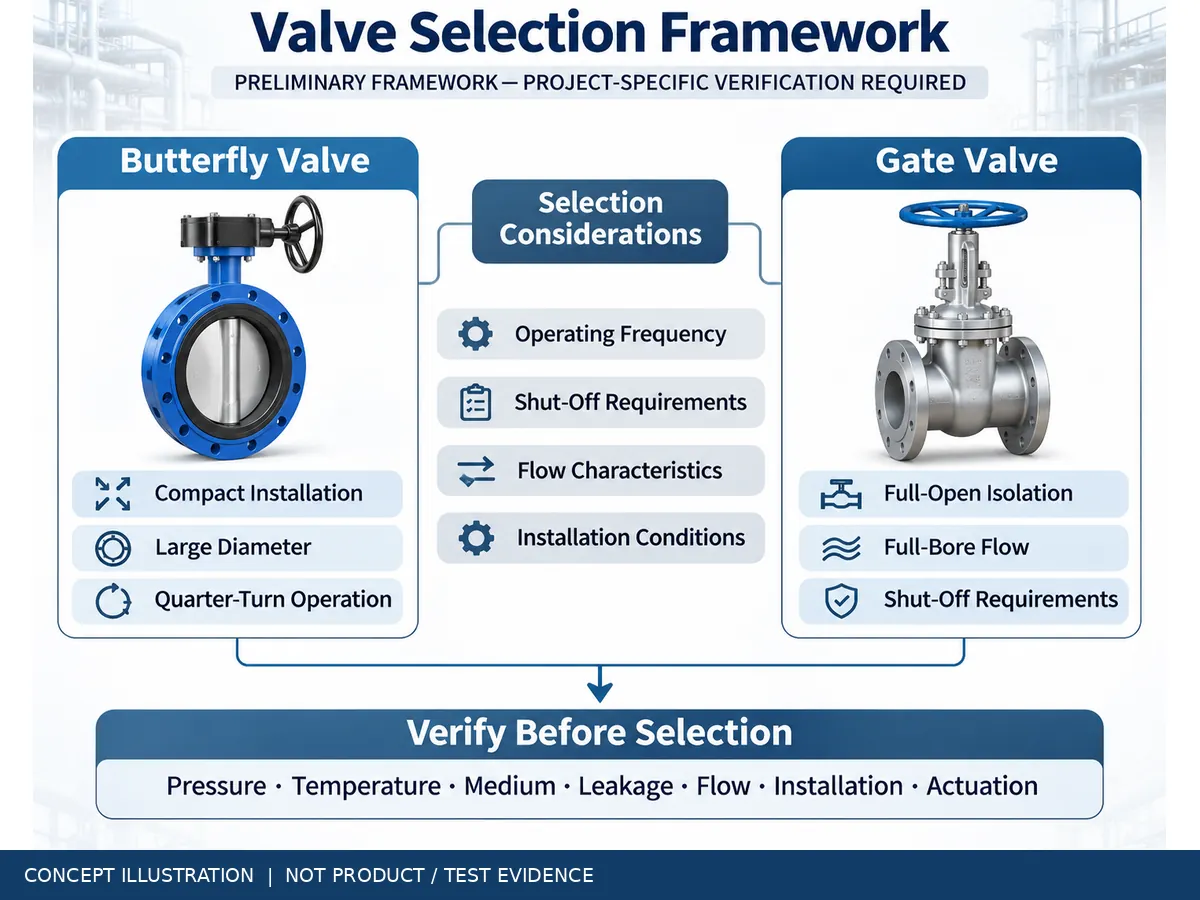
| Service condition | Preliminary direction | Verify before specification |
|---|---|---|
| Large-diameter water pipeline | Butterfly valve often worth considering | Pressure, velocity, seat, torque |
| Full-open low-resistance isolation | Full-bore gate valve often worth considering | Actual flow coefficient and loss |
| Limited installation space | Compact butterfly valve | Disc and operator clearance |
| Elevated-temperature steam isolation | Suitable gate or specialized butterfly design | Ratings, materials, leakage and evidence |
| Frequent automated operation | Suitable butterfly valve may be advantageous | Cycle duty and actuator loads |
| Bidirectional tight shut-off | Either, depending on design | Pressure direction and leakage acceptance |
| Abrasive slurry | Specialized engineering review | Solids, erosion, deposits and geometry |
| Gate-to-butterfly replacement | Conditional | Complete functional and dimensional review |
This matrix supports preliminary screening only. Critical isolation, severe cavitation, high solids loading or demanding control duty may require additional engineering analysis or a different valve type.
Illustrative Selection Worksheet: Large-Diameter Water Isolation
Hypothetical screening scenario, not a Raymon Valve project or performance test: An EPC team must compare a butterfly valve and a full-bore gate valve for a large-diameter water isolation point. The team has not yet confirmed the maximum shut-off differential pressure, actual valve Cv/Kv, actuator load, or whether future pigging is required.
- Functional gate: Confirm isolation duty, direction and allowable seat leakage. If the service requires pigging, verify the clear passage before considering a butterfly design.
- Hydraulic gate: Request model-specific full-open Cv/Kv or pressure-loss curves at the specified flow; do not infer a numerical pressure-drop difference from valve type alone.
- Mechanical gate: Check the face-to-face interface, disc swing envelope, stem travel and maintenance clearance using approved drawings.
- Operating gate: Compare maximum shut-off torque/thrust, cycle duty and closing time; evaluate surge risk if operating speed changes.
- Evidence gate: Record pressure-temperature rating, leakage test acceptance and deviations in a bid comparison sheet.
Conditional outcome: If compactness is important and all hydraulic, shut-off, clearance and operating checks pass, the butterfly valve remains a candidate. If unobstructed passage or verified lower full-open resistance governs, a full-bore gate valve may be preferred. No selection is approved without the missing project data.
RFQ Checklist for Butterfly and Gate Valve Comparison
Process and Design Conditions
- Fluid composition, phase and solids content.
- Normal and design pressure and temperature.
- Nominal size, required flow rate and maximum shut-off differential pressure.
- Required isolation function and flow direction.
Valve Construction and Materials
- Construction, bore or flow-capacity requirements and pressure rating.
- Body, bonnet/cover where applicable, trim, stem/shaft, seat, packing, gasket and bolting materials, including corrosion and temperature compatibility.
- End connections, face-to-face dimensions and required standards.
- Packing and other sealing requirements.
Operation, Testing and Documentation
- Manual or automated operation, cycling frequency and opening time.
- Available electrical, pneumatic or hydraulic utilities and fail position, if relevant.
- Shell and seat testing, leakage acceptance and functional checks.
- Material certificates, inspection plan, dimensional records and any specified NDE or PMI.
- Applicable project-required fire-safe or fugitive-emissions evidence, if relevant.
Compare supplier bids on a consistent technical basis and record deviations. General background on applicable requirements is available from valve standards; always verify the governing standard and edition for the project.
Supplier Technical Bid Normalization
Two quotations should not be compared on price until the engineering scope is aligned. Use the following review as a hold-point checklist for the procurement team.
| Bid comparison item | Required review | Typical disposition |
|---|---|---|
| Construction and bore | Confirm offered valve type, disc/wedge design and passage size | Accept / clarify / deviation |
| Pressure-temperature rating | Compare actual rated limits with design conditions | Accept / clarify / deviation |
| Materials and seals | Check body, trim, seat, packing and fluid compatibility | Accept / clarify / deviation |
| Leakage and test basis | Confirm acceptance criterion, test direction, medium and pressure | Accept / clarify / deviation |
| Flow and operating loads | Review pressure loss, maximum shut-off load and actuator selection | Accept / clarify / deviation |
| Installation envelope | Verify face-to-face, flange interface, clearance and operator access | Accept / clarify / deviation |
| Inspection and documents | Confirm agreed ITP, certificates, test reports and witness points | Accept / clarify / deviation |
For every unresolved item, record the supplier response and project engineer’s disposition before technical acceptance. For an overview of production stages and inspection context, see the valve manufacturing process resource; project-specific evidence must still be requested.
Frequently Asked Questions
Which is better, a butterfly valve or a gate valve?
Neither is universally better. Butterfly valves often offer compactness and quarter-turn operation, while full-bore gate valves can offer a lower-resistance fully open passage. Select against actual service requirements.
Which valve has a lower pressure drop?
A fully open full-bore gate valve often has lower resistance, but actual pressure drop must be verified with model-specific flow data.
Can butterfly valves be used for high-pressure applications?
Appropriately designed butterfly valves may suit selected high-pressure duties. Confirm the construction, pressure-temperature rating, shut-off differential pressure and qualification evidence.
Can a butterfly valve replace a gate valve?
Possibly, but only after verifying isolation duty, pressure-temperature rating, flow performance, leakage, connections, clearance, actuation and engineering approval.
Which valve is better for large-diameter pipelines?
Butterfly valves are often attractive for large-diameter water and utility service due to compact construction. Hydraulic, sealing and service requirements may change the choice.
Can gate valves be used for throttling?
Conventional gate valves are generally not recommended for sustained throttling because localized flow can damage seating surfaces. Evaluate a suitable throttling or control valve instead.
Standards, Testing and Document Evidence
Applicable standards depend on the valve construction, end connection, project jurisdiction and contractual specification. The names below indicate review categories only; no particular edition or certification is asserted here.
| Evidence category | What to verify | Typical requested record |
|---|---|---|
| Product design standard | Which standard governs the offered valve construction and design | Datasheet and manufacturer compliance statement |
| Pressure-temperature and connections | Applicable rating and flange or end-connection requirements | Rated limits, GA drawing and connection details |
| Pressure and seat tests | Test procedure, direction, pressure, medium and leakage acceptance | Inspection and pressure-test reports |
| Material traceability | Specified material grades and required traceability scope | Material test certificates where contractually required |
| Special service qualification | Fire-safe, emissions, sour service or other requirements if specified | Applicable test or qualification evidence for the exact scope |
API, ASME, ISO, MSS or EN documents may be relevant, but the applicable standard and edition must be verified against the project specification and the exact valve model. A general standards claim is not evidence of product-specific qualification.
Technical References and Evidence Boundaries
These third-party resources support general selection principles; they do not verify the ratings, leakage, Cv/Kv, dimensions or certifications of any Raymon Valve product. Confirm the applicable document edition and manufacturer model before specifying a valve.
- Dixon — Valves and Accessories, Valve Selection Guide: general guidance on butterfly quarter-turn use, gate valve full-open isolation and throttling limitations (catalogue selection guide, p. 2).
- Danish Technological Institute / AVK — Guidelines for Selecting Valves in Water Supply Systems (first edition, 2019): water-service valve principles, flow characteristics, pressure loss and installation; its water-supply scope must not be generalized to all process fluids.
Verification boundary: Manufacturer data sheets, approved drawings, pressure-test records, applicable project standards and the selected edition remain required for model-specific engineering decisions.
Final Selection Recommendations
Begin the butterfly valve vs gate valve decision with required function and real operating conditions. Butterfly valves are often strong candidates for compact large-diameter isolation; full-bore gate valves may be preferred where a low-resistance fully open passage is central. Final selection requires verified manufacturer data, applicable project standards and engineering approval. To learn more about the company, read about Raymon Valve.
Request Valve Selection Review
For a comparable technical review, send the medium and phase, design pressure and temperature, normal flow, maximum shut-off differential pressure, nominal size, pressure class, end connections, material and leakage requirements, operating frequency, actuator preference and available drawings. Ask suppliers to identify technical deviations and provide model-specific rating, flow, operating-load and test evidence.Contact Raymon Valve for an RFQ
Engineering note: This is a preliminary industrial selection guide, not a valve sizing calculation, verified product drawing, or performance guarantee. The six generated images are conceptual illustrations. The article has not been attributed to an individually qualified reviewer; technical acceptance and standards editions require project-specific confirmation.
 English
 German
 Arabic
 French
 Spanish
 Italian
 Portuguese
 Russian